
In the1600s my ancestors left France and embarked on an adventure to New France. In 1651 Julien Fortin de Bellefontaine settled in Chateau Richer, near Quebec City, and built a home, while Claude Jodouin landed in Ville Marie (Montreal) in 1666 and remained in the area.
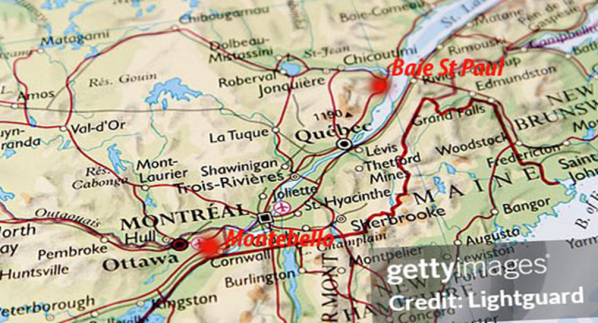
The Jodouin descendants moved east of Ville Marie (Montreal) to Varennes and Verchères on the south side of the St Lawrence River. Fortin descendants settled east of Quebec City in the Charlevoix, Baie St. Paul, Cap St. Ignace region on the north shore of the St. Lawrence River.
My third great-grandfather Francois Xavier Fortin (1755-1853) was born and baptized in Saint Pierre and Saint Paul church in Baie St. Paul and married Marie Rose Lemieux (1773-1853) at Saint Ignatius of Loyola Church in Cap St Ignace in 1793.
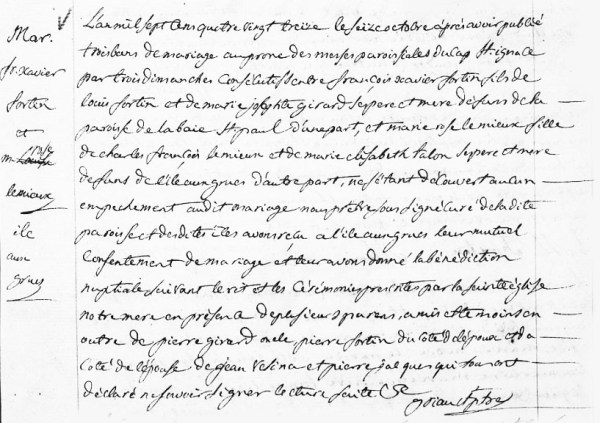
Marriage of Francois Xavier Fortin and Marie Rose Lemieux
Francois was a blacksmith and a farmer. While living in Cap St Ignace, they had two children. The births of their other nine children reveal that they moved four times over the years. I don’t know why they moved so often. Perhaps, the community required a blacksmith.
Their third child, Francois Xavier died in 1800 in St. Hyacinthe. Three more children were born in that community. Research does not enlighten us about the events that led to their next move. In 1808 they were living in Rigaud where their son Moyse Hypolite was born. The family settled in 1810 in the Seigniory de la Petite Nation in Montebello.
Joseph Papineau (1752-1841) became the first Seigneur de la Petite Nation in Montebello. He was a notary, surveyor, and landowner, who had bought land from the seminary in Quebec between 1801 and 1803.
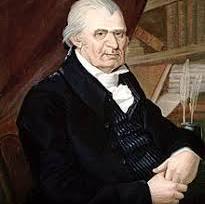
Joseph Papineau -first Seigneur de la Petite Nation
In 1810 Papineau sold land to Francois Xavier Fortin who built a home where the family finally settled in Montebello, Seigneury de la Petite Nation on the shores of the Ottawa River. For over fifty years the Fortin family farmed the land. Today this home is known as The Fortin House. It played a significant role in the history of the area.
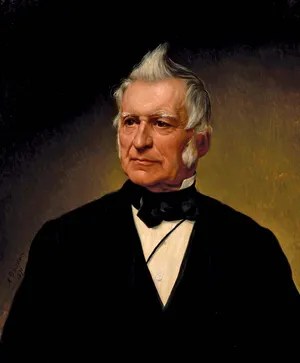
Louis Joseph Papineau
Joseph Papineau’s son Louis Joseph (1786-1871) purchased land from his father and began to build on the property. During the construction (1848-1850) of the Manoir Papineau, Louis Joseph and his family “borrowed” Francois Xavier Fortin’s home and they lived in his house while the manoir was being built. Changes were made to the Fortin house to accommodate the large Papineau family.
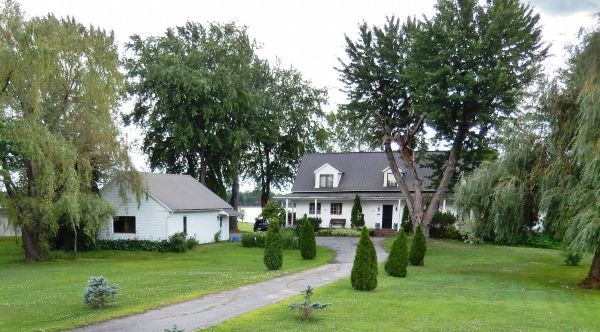
The Fortin House “borrowed by Louis Joseph Papineau
Louis Joseph had an interesting career as a politician, a leader of the Patriot movement, a speaker of the House at the National Assembly, and for a time, was exiled due to his involvement in the Rebellion of 1837.
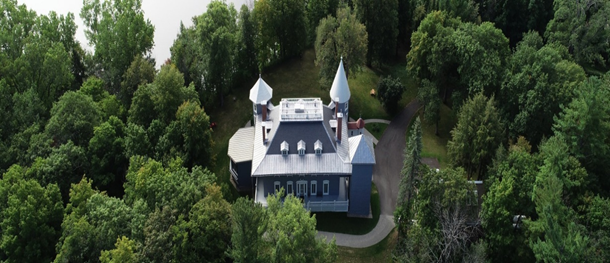
An aerial view of Manoir Papineau
The Manoir is situated on Cap de Bonsecours
Parks Canada manages Manoir Papineau.
It is a National Historic site.
Research does not tell us where Francois Xavier and Rose were living while the manoir was being built and the Papineau family were in the Fortin home, however, one might surmise that the Fortin children were married and living in the area. Perhaps, as was the custom at the time they cared for their elderly parents.
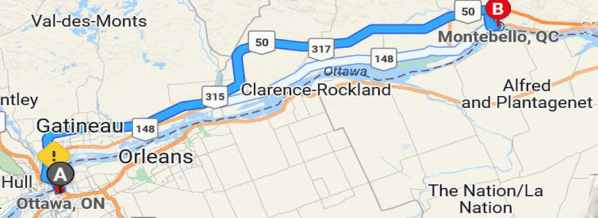
Route from Montebello to Ottawa
In November 1853 Rose passed away, and within two short weeks, Francois Xavier followed in December. Both are buried in the Notre Dame de Bonsecours cemetery in Montebello.
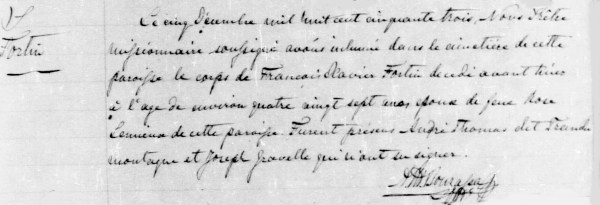
The Burial of Francois Xavier Fortin
In 1900 The Fortin House and surrounding farm were purchased by the Huneault family who continue to farm the land.
Sources
Généalogie Québec, Francois Xavier Fortin/Marie Rose Lemieux mariage. https://www.genealogiequebec.com/Membership/LAFRANCE/acte/359845
Généalogie Québec, Francois Xavier Fortin death/burial. https://www.genealogiequebec.com/Membership/LAFRANCE/acte/5961939,
“Canada, Québec, registres paroissiaux catholiques, 1621-1979,” database with images, FamilySearch (https://familysearch.org/ark:/61903/3:1:3QSQ-G99W-X984?cc=1321742&wc=HCZJ-T38%3A13629401%2C13629402%2C14536101 : 16 July 2014), Cap-Saint-Ignace > Saint-Ignace-de-Loyola > Baptêmes, mariages, sépultures 1768-1822 > image 250 of 745; Archives Nationales du Quebec (National Archives of Quebec), Montreal.
“Canada Census, 1851”, database, FamilySearch (https://www.familysearch.org/ark:/61903/1:1:MWRX-R5H : 1 October 2021), François Xavier Fortin, 1851.
“Canada, Québec, registres paroissiaux catholiques, 1621-1979,” database with images, FamilySearch (https://familysearch.org/ark:/61903/3:1:3QS7-8993-W5FP?cc=1321742&wc=HZM6-7M9%3A24354201%2C24354202%2C25955601 : 16 July 2014), Sainte-Madeleine-de-Rigaud > Sainte-Madeleine-de-Rigaud > Index 1802-1876 Baptêmes, mariages, sépultures 1802-1817 > image 403 of 540; Archives Nationales du Quebec (National Archives of Quebec), Montreal.
https://parks.canada.ca/lhn-nhs/qc/manoirpapineau
https://www.thecanadianencyclopedia.ca/en/article/louis-joseph-papineau
 Genealogy Ensemble