
Tag Archives: politics

private radio inspector

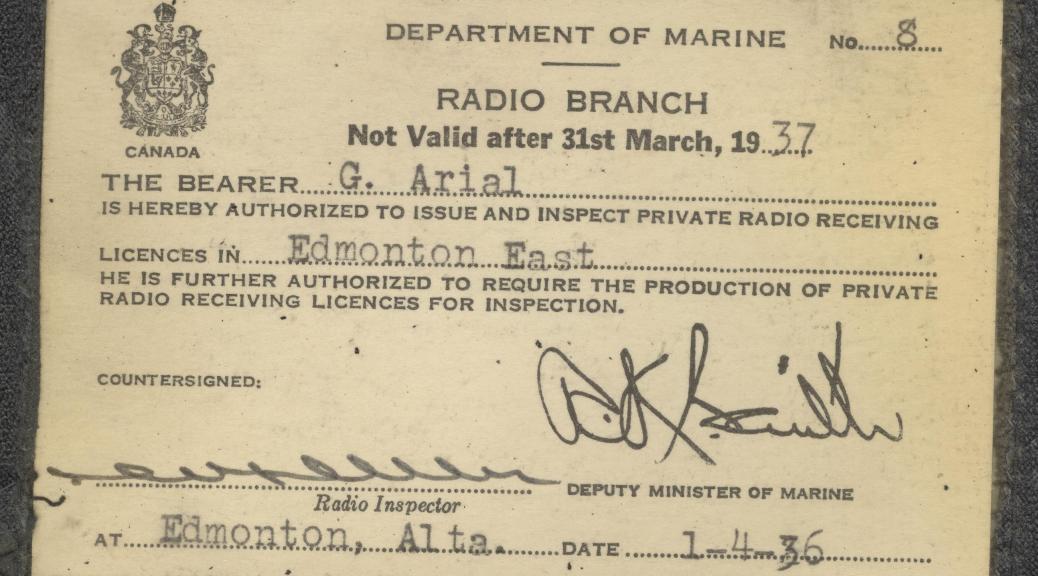
The black-leather-lined plasticized bilingual identity card wacked my arm as it fell from the shelf. Until then, I had never really noticed the card among the many items my grandmother left me.

Luckily, its heavy construction protected the words on the card, which remain as legible as they were when my grandfather received it on January 4, 1936.
The Canadian federal “Department of Marine” issued the card to give my grandfather credibility as a radio inspector. It says:

“The bearer G. Arial is hereby authorized to issue and inspect private radio receiving licences in Edmonton East. He is further authorized to require the production of private radio receiving licences for inspection.”

Turns out that this little artifact hints at a short-lived controversy in Canadian history. The card expired on March 31, 1937, but it would be defunct before then.

The Department of Marine seems like an odd overseer of radio licences until you realize that early broadcasting began in the 1890s when Morse Code was used to enable ship-to-ship and ship-to-shore communication. The idea of a public broadcaster begin in May, 1907, when the Marconi station in Camperdown, Nova Scotia began broadcasting regular time signals to the public.

The “wireless telegraphy” industry continued to develop with private individuals investing in ham radios with no regulation. By June 1913, the federal government decided to regulate the industry to protect military communication.

When World War I began in August 1914, private licenses were banned altogether. Only the Marconi Wireless Telegraph Company of Canada, Ltd. kept operating during the war years, in part because it became a research arm of the military.i

After the war, the private industry blossomed, particularly in Western Canada. Many of the new broadcasters came from multiple religious communities, a situation the federal government tried to prevent by setting up a public broadcasting system through the Radio Broadcasting Act of 1932.

That act led to the establishment of a licensing commission called the Canadian Radio Broadcasting Commission under the leadership of Hector Charlesworth. Charlesworth’s group censored many religious groups and political groups, but none more than the Jehovah’s Witnesses.

Norman James Fennema described the controversy in his 2003 dissertation, Remote Control.

…in Canada we find a situation in which the original impetus for regulating radio broadcasting began with the specific aim of putting a rein on religious broadcasting. Originally directed at the radio activities of the Watchtower Bible and Tract Society, this expanded in the early 1930’s into a policy against the licensing of religious broadcasters, a policy initially justified on the basis of the scarcity of the broadcasting spectrum, but that survived the expansion of the system.ii

By 1935, Clarence Decateur Howe became both the Minister of Railways and Canals and the Minister of Marine,iii the ministry under which my grandfather’s job was created.

Howe favoured private broadcasting, and encouraged new private entities to flourish.

Prime Minister Mackenzie King preferred a public broadcast system however. In February, 1936, the Canadian Broadcasting Corporation (CBC) came into being, and my grandfather’s job ended.

Sources

i https://en.wikipedia.org/wiki/History_of_broadcasting_in_Canada, accessed May 26, 2020.

ii Fennema, Norman James. REMOTE CONTROL: A History of the Regulation of Religion in the Canadian Public Square, PhD thesis, 2003, https://dspace.library.uvic.ca/bitstream/handle/1828/10314/Fennema_Norman James_PhD_2003.pdf?sequence=1&isAllowed=y.

iii https://en.wikipedia.org/wiki/Minister_of_Transport_(Canada), accessed May 26, 2020.

R. Stanley Bagg, Tory Politician

Robert Stanley Bagg (1848-1912), was a Montreal businessman, sportsman and life-long Tory. A newspaper report of his death noted, “He was a staunch Conservative both in and out of power, and some years ago was president of the Liberal-Conservative Club giving a great deal of his time to the work of organizing as well as well as to public discussion. He was well known amongst the French-Canadian people and spoke French almost as fluently as his mother tongue.”1

My great-grandfather’s interest in politics was not limited to reading about the issues of the day in the newspaper (The Gazette was a die-hard Conservative-leaning publication) or debating issues privately with his friends. Stanley became actively involved in the Liberal-Conservative Club after it was founded in 1895 as a rallying point for English and French-speaking Conservatives in Montreal. The club took a leading role in the Dominion (federal) election of 1896, and the Quebec campaign of 1897. No doubt to Stanley’s dismay, the Conservatives lost in both elections.

The Conservatives had been the party of Canada’s first prime minister, Sir John A. MacDonald, who is said to have been a personal friend of Stanley’s father, Stanley Clark Bagg (1820-1873). They were in power until 1896, when Sir Wilfrid Laurier’s Liberals defeated them, and Laurier remained prime minister for the next 15 years. One of the main differences between the two parties was that the Conservatives promoted loyalty to the British Empire, independence from the United States and protectionism in trade, while the Liberals were in favour of free trade.

Robert Stanley Bagg, portrait by Adam Sheriff Scott. Bagg family collection.

Stanley played a role in many party activities, especially after his retirement from the family real-estate business at the turn of the century. Trained as a lawyer, he frequently chaired public meetings, he served for several years in the early 1900s as president of the Liberal-Conservative Club, and he twice attempted to run for a seat in the House of Commons in Ottawa. The first time was during the Dominion election of 1896 in the St. Lawrence riding, east of Mount Royal. This was the area where Stanley’s ancestors had lived and owned property for almost a century. Stanley was the third candidate in the riding, and the nomination papers he submitted showed he had considerable support among both English and French-speaking party members. However, four days later, when it became apparent that the other Conservative candidate had broader support, Stanley withdrew his name.

In 1905, The Gazette anticipated that Mr. R. Stanley Bagg might run as an independent candidate for the provincial legislature vacancy in the St. Lawrence division caused by the death of the incumbent.2 The newspaper’s prediction was wrong, however, and he did not run. A few years later, in the federal election of 1908, Stanley did put his name in for the Conservative nomination for the St. Lawrence division. This time, Henry Archer Ekers, the outgoing mayor of Montreal, won the nomination by a narrow margin, and Stanley called on the meeting to make the choice unanimous.

Although he never did run for office, Stanley appears to have been a popular speaker at Conservative party functions, and the newspapers reported on his speeches on several occasions.

When he addressed a meeting during the 1897 provincial campaign, The Montreal Star summed up his remarks:

“Mr. R. Stanley Bagg was the last speaker. In a really eloquent and polished speech this gentleman drew a picture of the possibilities of the Province of Quebec under good government. Especially strong were his commendations of the Flynn educational programme, which would bestow that priceless boon of education upon the poor as well as upon the rich. This education would enable the growing generation to intelligently study the questions appertaining to the government of the province, and when the young people became enfranchised, such study would enable them to vote for honest government, for the party and platform that best represented the best interests of Quebec.“3

In January 1900, Stanley was president-elect of the Liberal Conservative Club and a general election was coming soon. In remarks to a meeting, he pledged to put forward the interests of the club, the Conservative party and the county, adding that the Conservative party was the “true patriotic party of Canada.”4

Later that year, during the Dominion election campaign, The Montreal Star quoted his remarks to a Tory campaign rally: “Never in the history of Canada has there been an election so important, so fraught with vital interest in the whole Dominion, as that in which the people of this country are now engaged. The relations between Canada and the Mother Country are, at the present time, peculiar. The South African (Boer) war afforded Canada an opportunity to demonstrate Canadian loyalty and Canadian valour, and today we have as a result an exceptional chance to secure favours from the Mother Country, which never before presented itself. The Imperial sentiment is strong throughout the Empire and the British people are disposed to accord to the colonies trade concessions the value of which to ourselves cannot be overestimated.

“There is but one way in which Canada can benefit from this opportunity, and that way lies through the return of the Conservative party to power. The Conservative party is pledged to use its best efforts to secure a mutual imperial preferential tariff …. The Conservative party stands for protection, for stability in the tariff, for patriotism and for progress.…”5

Eleven years later, Stanley again focused on the topic of reciprocity (free trade) with the U.S. In an hour-long address, he noted that, as someone who had taken part in a large number of election campaigns and given close and continuous study to public affairs, he had been invited to give his views on the great question now before the voters. He “emphatically urged that reciprocity be thrown out. He not only showed that the pact would be commercially injurious to Canada, but appealed to the patriotism of the electors, their spirt as Canadians and Britons. He reminded them, amidst ringing applause, how Sir John A. Macdonald had denounced the attempts of Liberal leaders to bring about unrestricted reciprocity in 1891 as ‘veiled treason’.”6

These accounts of Stanley’s speeches may seem old fashioned today, but I was pleased to discover them as they provided a window into my ancestor’s thoughts. He clearly identified as Canadian and British, although his ancestors also included Americans and Scots.

This story is also posted on http://www.writinguptheancestors.ca

See also:

Janice Hamilton, “Horses, Snowshoes and Family Life”, Writing Up the Ancestors, Sept 21, 2024, https://www.writinguptheancestors.ca/2024/09/horses-snowshoes-and-family-life.html

Janice Hamilton, “The Silver Spoon”, Writing Up the Ancestors, ”, June 12, 2024, https://www.writinguptheancestors.ca/2024/06/the-silver-spoon.html

Sources:

  1. “R. Stanley Bagg Died Yesterday,” The Gazette, (Montreal, Quebec), July 23, 1912, digital image, https://www.newspapers.com/image/419604976 accessed Aug. 4, 2024.
  • “St. Louis Division; Mr. Parizeau’s Supporters Enthusiastic.” The Montreal Daily Star (Montreal, Quebec), 10 May, 1897, p. 4, digital image, https://www.newspapers.com/image/740883625 accessed Oct. 1, 2024.