Tag Archives: Quebec City

A Death-Forged Bond

On August 18, 1943 Royal Canadian Air Force (RCAF) Flight Sergeant Colin Angus was posted as missing and presumed dead following a devastating air raid made on the missile research laboratories at Peenemunde, Germany. Forty one bombers and one fighter plane were lost that night. Colin’s plane did not return.

Peenemunde was Colin’s second mission. He was initially rejected by the Air Force on medical grounds – a damaged mastoid bone, the legacy of a childhood illness. As the war took its toll, the physical requirements were downgraded. Colin was accepted and trained as a navigator.

The target of Colin’s first mission was Cologne, Germany’s military command center. Other comrades and other aircraft did not return that night.  “We can only hope for them”, Colin wrote in a letter to his brother Ian.

Two days before Colin flew his second and final mission, he wrote in another in another letter that should he “take a cropper”‘ would Ian, also a RCAF pilot stationed in England, send from his personal effects “such stuff as should go home”.

The family of the missing exist in a liminal zone. How long did my grandparents hold out hope that their son would be found? They may have reasoned that he lay wounded and yet unidentified or that he would soon be listed as a prisoner of war.

How powerless they must have felt during the days and weeks and months that followed. When Colin had hovered between life and death as a child, they could hold him, soothe and tend to him. Now they could do nothing but wait. Did they rant at the unfairness? Did they make pacts with God? How did they get through the long nights when daytime activities could no longer offer a sense of normalcy and hold the pain at bay? Were they able to share their fears and support each other, or did they suffer alone, neither willing to expose their despair to the other?

It took seven months for the RCAF to confirm their son’s death. On April 30th, 1944, a memorial service was held providing the family a semblance of closure. There was no coffin. His body, along with those of his crew members, had been buried in German soil far from loved ones.

“Such stuff that should go home” eventually reached my grandparents. It was a very small package that included Colin’s watch and glasses.

When I was sixteen, my grandmother was chosen to be Mother of Honor at the annual Armistice ceremony in Quebec City. The night before the event she carefully unwrapped the package. As I watched, she stroked each item, tears streaming down her cheeks. I was yet too young to fully understand her grief. I could only fixate on the glasses, so very fragile, and marvel that they could survive the crash that killed the uncle I would never know.

Yet that uncle left me a treasured gift. The bond I had with my grandmother was forged because of his death. I have since come to understand that her joy in the birth of a grand-daughter the year following her son’s death enabled her to move beyond her sorrow. I believe that I was her salvation and the reason she held me close all her days.

Sources

Service Record of Sergeant David Colin Brodie Angus, Library and Archives Canada

Personal letters between Colin and his brother Ian – on file with author, Ian’s daughter

Service Held for Colin Angus, Quebec Chronicle Telegraph, May 1, 1944 – clipping on file with author

Germanic Presence in Quebec City

The 2015 German Christmas Market in Quebec City, http://www.noelallemandquebec.com/
The 2015 German Christmas Market in Quebec City

Jacques begins his latest compilation, The German Presence in Quebec City, with a translated quote by German Quebec expert University of Montreal Professor Manuel Meune. In this quote, Meune describes the context of German immigration to Quebec over the years.

The circumstances Meune describes challenge family researchers with ancestors from Germany who might wonder where original records might be stored. To help sort out the information, Jacques has highlighted books and document collections in churches, libraries, schools and societies in and around the Quebec City area.

He’s also included Facebook or other contact information for each repository so researchers can visit these locations to explore what might be available.

Call Me Ismael

IMG_7917
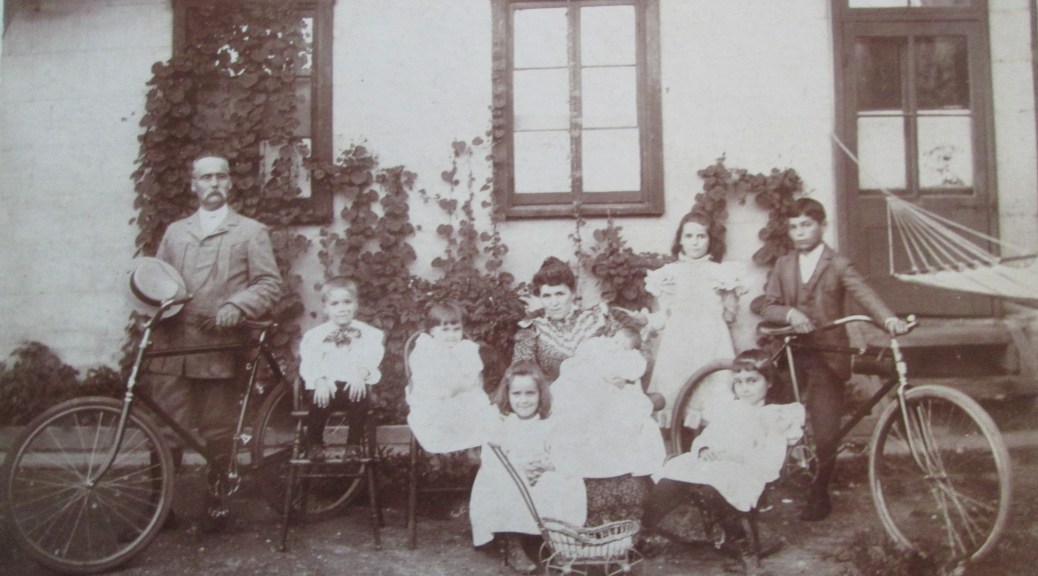
The Bruneau family in Montreal about 1899

 He arrived when the service was almost over. He walked to the pulpit and announced the last hymn “Seigneur Tu donne Ta Grace.” As the organ played he collapsed to the floor. So ended the life of Ismael Bruneau, my great grandfather.

His life began in 1852 as Ismaer Bruneau in St-Constant Quebec, just south of Montreal. Ismaer was the eleventh of thirteen children and the youngest son of Barnabé Bruneau and Sophie Prudhomme. He attended the French Protestant school in Pointe aux Trembles and one summer went to West Randolph, Vermont to work in the mills. He spent a lot of time thinking about his future. He had written for advice to the principal of the school, Dr. Tanner who encouraged him to return to his studies and take the classes for those considering the ministry.

He was not sure of that path. One day he was out walking in the woods and climbed to the top of a hill. He sat facing Canada and prayed to God about the decisions he must make. As he reported, there was a dark cloud on the horizon and a voice spoke to him as if from the sky, telling him to return home and study, then travel and spread the gospel.

Ismaer continued his studies at Pointe aux Trembles and was then admitted to the Presbyterian College in Montreal, which had begun teaching subjects in French. At this time he changed his name from Ismaer to Ismael which he thought was more biblical and added Prudhomme as a middle name in honour of his mother.

After graduating, he was sent to Saint-Anne’s Kankakee County, Illinois to work with Father Chiniquy. Father Chiniquy was a Catholic priest who had left Quebec in the wake of several scandals. His zeal for God remained intense but not his feelings for the Catholic Church, which he renounced. He made his beliefs known to his congregation and they all chose to follow him and convert to Protestantism.

One family living in Kankakee was the Girods, who had recently immigrated from Switzerland. When their daughter Ida, a teacher in Baltimore came to visit, she was introduced to their minister. Ismael had been very homesick and often wrote letters home. He began writing about the lovely woman he had met. Then in one letter, he wrote to his sister Anais, “ Wouldn’t you like to come out after the harvest and see my wife. It would be worth it for without a doubt she is one of the beauties of the world in my eyes.” Ismael and Ida were married June 12, 1886.

The Bruneaus had three children in Green Bay, Wisconsin, one in Holyoke, Massachusetts, three in Quebec City and the last three in Montreal. Ismael had wanted a biblical family, a child for each of the 12 tribes of Israel but in the end had only 10. Nine of the children survived. He continued moving and preaching, taking a charge in Cornwall, Ontario and finally in 1917 back to Quebec City.

In Quebec, he had a church in the Old City as well as a congregation in Portneuf. He would conduct the morning service, catch the train to Portneuf for an afternoon service and be back in Quebec City in time for the evening service. On January 27, 1918 the train was delayed because of a troop train. Arriving late in Quebec City he ran up the hill from the station. He entered the church before the service ended but while his spirit was still willing his heart was weak. His family suffered financial hardships after his death as there were no pensions and the Presbyterian Church sent his widow one cheque for the days he had worked that month and nothing more.

Bibliography:

Bruneau, Ida. A Short History of the Bruneau – Girod Families. 1993.

Duclos, Rieul P. Histoire Du Protestantisme Français Au Canada Et Aux États-Unis. Montreal, Canada: 1912. Print

Villard, Paul. Up to the Light: The Story of French Protestantism in Canada. Toronto: Issued for the Board of Home Missions of the United Church of Canada by the Committee on Literature, General Publicity and Missionary Education of the United Church of Canada, 1928. Print.

Here is a link to a story about Ismael’s wife Ida Girod.

https://wordpress.com/post/genealogyensemble.com/3674