Tag Archives: William Workman

William Workman: Public Successes, Personal Problems

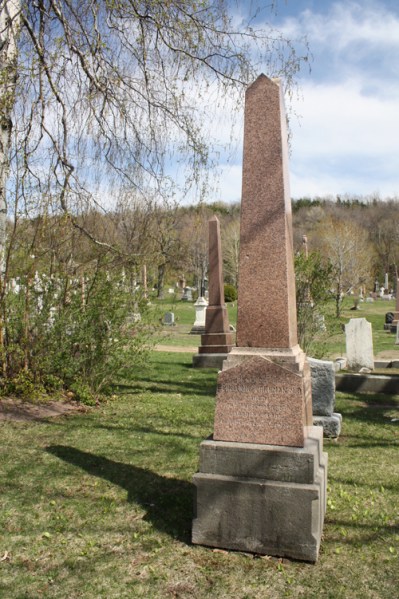
The Workman family plot in Montreal’s Mount Royal Cemetery is a large one, including six large tombstones engraved with the names of almost 30 people. But William Workman (1807-1878), a successful businessman who served as mayor of Montreal for three years, is not buried there. He was laid to rest alone, in a large mausoleum some distance from the family plot.

Before I started researching the Workmans, a cemetery staff member told me that William had wanted family members to be buried in the mausoleum with him, but they refused. Neither of us knew why, but now I have an idea.  

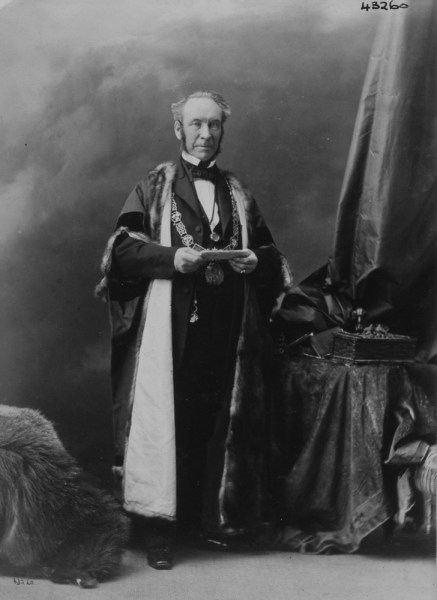
William Workman, 1866, Montreal, QC, William Notman Studio, McCord Stewart Museum online collection, I-22186.1, accessed Jan. 6, 2026.

Born in 1807, William was the fifth of nine children. The family lived near Belfast, in what is now Northern Ireland, where his father was a teacher and estate manager. In 1819, William’s oldest brother, Benjamin, immigrated to Montreal. Three brothers followed soon after and, in 1829, the rest of the family moved to what was then Lower Canada.1

Before emigrating, William worked as a surveyor for the Royal Engineers, mapping Ireland for the Ordnance Survey project. In Montreal, his first job was as assistant editor of the Canadian Courant and Montreal Advertiser, a weekly newspaper owned by brother Benjamin. Soon, however, William found his true calling: as a businessman.

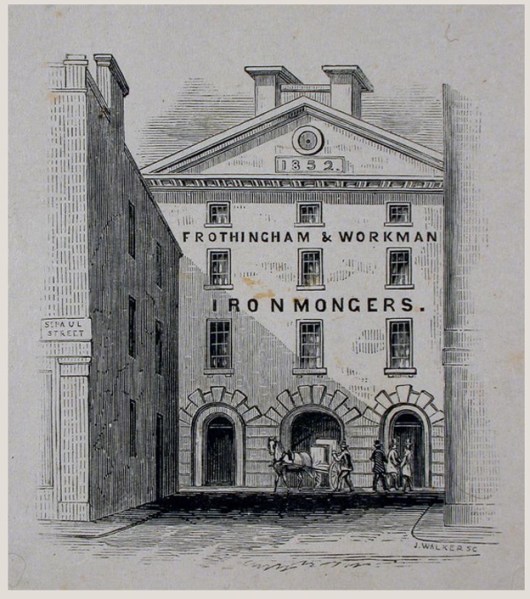
He found employment with a hardware firm, Frothingham & Co., and within a few years he became a partner. As of 1836, the company was known as Frothingham and Workman, and it became the largest wholesale hardware company in Canada, selling scythes, shovels, augers and nails. When William retired from the hardware business in 1859, his brother Thomas took over running the company.2

Frothingham and Workman, Iron Mongers, Montreal, John Henry Walker, McCord Stewart Museum online collection, M930.50.7309, accessed Jan. 6, 2026.

Montreal was growing rapidly, and William found opportunities to invest in fields such as banking, transportation and real estate. William was elected president of the City Bank in 1849 and served in that capacity until 1874.3 In 1846 he was one of a group of prominent Montrealers who founded the City and District Savings Bank, established to help ordinary people save their money, and he was president of that institution for several years.

William invested in Canada’s first railway, the Champlain and St Lawrence, completed in 1836 to connect Montreal to Saint-Jean on the Richelieu River.4 He was also a shareholder in the St. Lawrence and Atlantic Railroad, and he collaborated with several other individuals to found the Canadian Ocean Steam Navigation Company in 1854.

Around 1850, he and a business partner became real estate developers. They bought a piece of land south-west of Montreal’s city limits, near the Lachine Canal. The canal attracted industries such as brass foundries and rolling mills, and nearby manufacturing facilities belonging to Frothingham and Workman employed hundreds of people. The partners laid out streets, built sewers and divided the property into housing lots. The area, known as Sainte-Cunégonde, became a village in 1876 and a tiny independent city in 1890, but eventually it became part of the City of Montreal.5 Workman Street, named after William, still exists in the area.

William was also a generous philanthropist. He was president of the St. Patrick’s Society at a time when that organization was involved with both the Roman Catholic and Protestant communities. Later, he supported the Irish Protestant Benevolent Society. In 1864, he helped create the Montreal Protestant House of Industry and Refuge, serving as president from 1874 to 1877. He was also president of the Montreal Dispensary and Hospital for Sick Children.

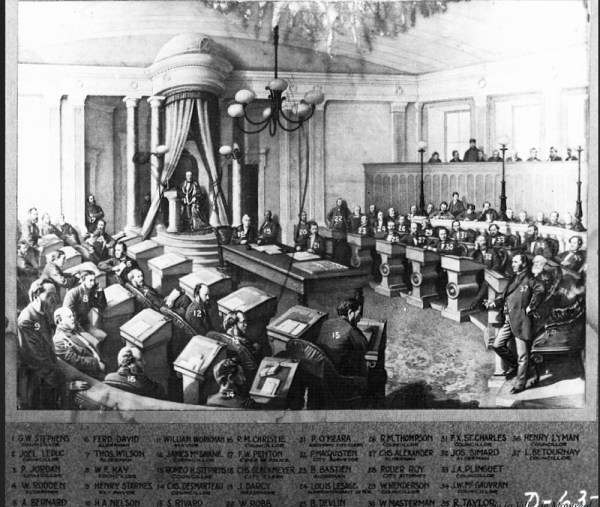
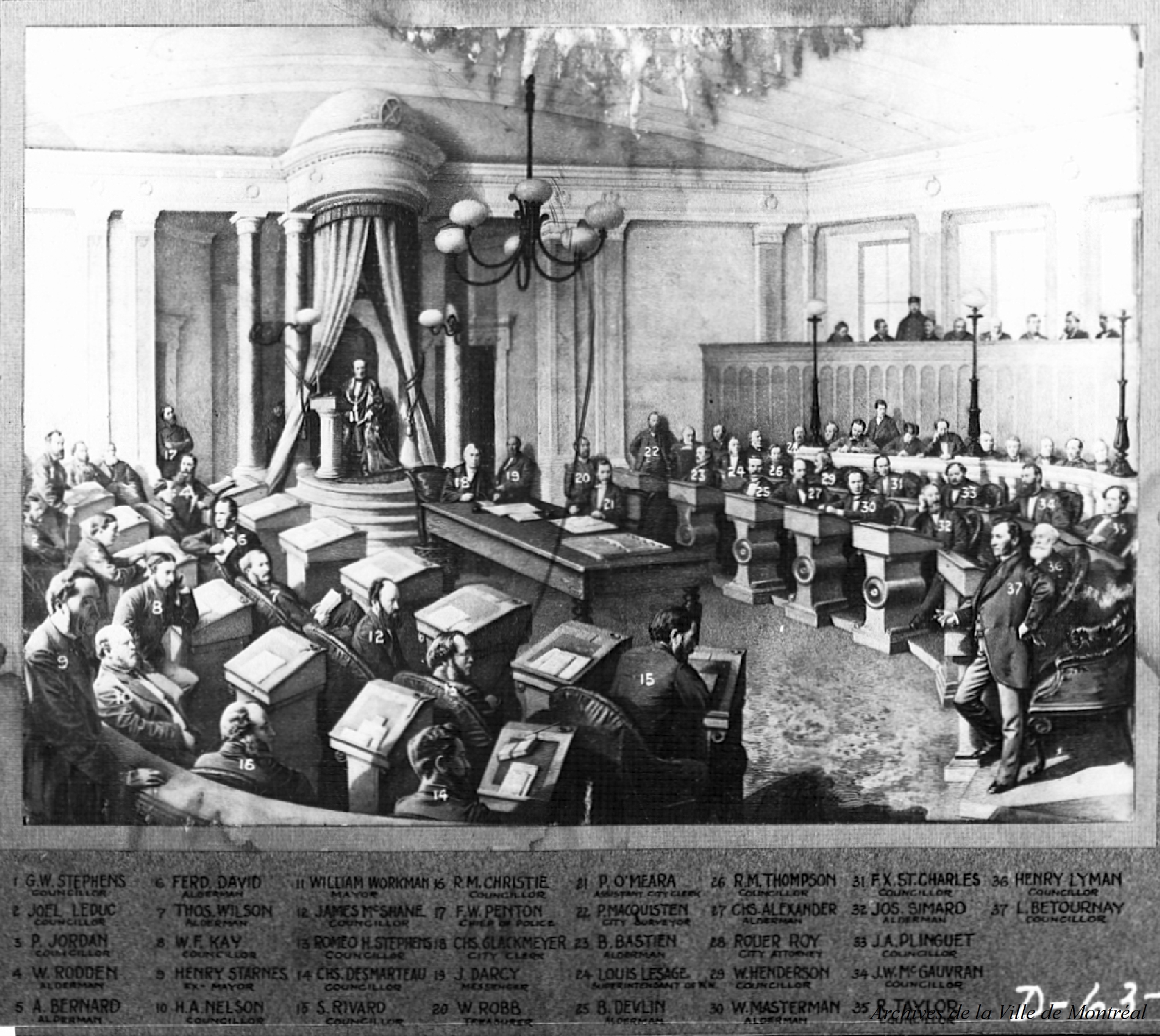
He was not deeply involved in politics, but he was elected mayor of Montreal from 1868 to 1872 and proved to be very popular. This aspect of his life will be the topic of another story.

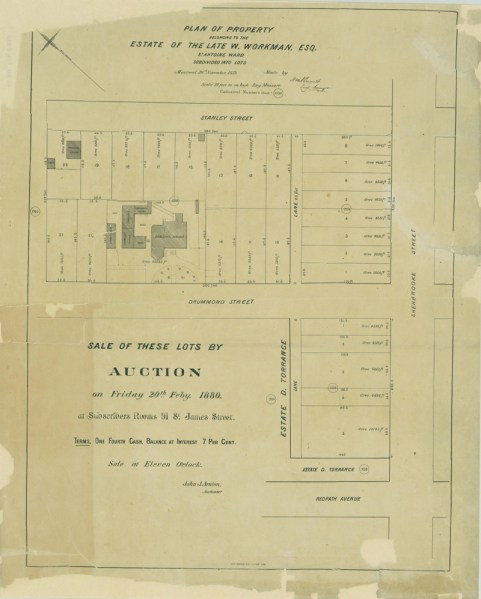
Around this time, wealthy merchants began building large homes on the slopes of Mount Royal, an area that became known as the Golden Square Mile. William bought a full block on the north side of Sherbrooke Street, between Drummond and Stanley, and built a mansion he called Mount Prospect.

“Plan of property belonging to the Estate of the Late W. Workman Esq. subdivided into lots.” H.M. Perrault, 20 Novembre, 1879; Bibliothèque et Archives nationales du Québec, entry for William Workman, https://numerique.banq.qc.ca/patrimoine/details/52327/3394052?docsearchtext=William%20Workmanaccessed 6 January 2026.

William Workman and Elizabeth (Eliza) Bethell were married at St. Paul’s Presbyterian Church on February 10, 1831. Eliza came from the same part of Ireland where William had grown up, so perhaps they had known each other there. They had seven children, so the house should have been full of activity, but it didn’t turn out that way.

It was all too common for children to die young in 19th century Montreal, and William and Eliza lost three little ones. Their firstborn, Elizabeth, was born in December 1831 and died the following summer. Their third child, Emma, was born in August 1837 and died in April 1839. Another girl, Malvina, was born in July 1845 and died in April 1847. Two daughters, Louise (or Louisa) and Elizabeth (Eliza), grew to adulthood, but Eliza, who married Robert Moat, died in 1871. Louisa married Joel C. Baker, a lawyer who went into the hardware business with Louise’s uncle Henry Mulholland.

But William found the death of his only son, also named William (1840-1865), the most devastating blow of all. By then, he and his wife may have already been living apart.

An image of the 1861 census suggests that Eliza was not living at Mount Prospect house, but with her married daughter Louisa Baker and her husband,6 so perhaps William and Eliza had unofficially separated by then. In the 1871 census, seven people were listed as living at Mount Prospect, including a cook, a coachman and a horseman. William was the only family member listed.

In a book about William’s brother, The Father of Canadian Psychiatry, Joseph Workman, author Christine Johnston remarked that Joseph did not have a high opinion of William, commenting in his diary that he thought Wiliam had damage in his head, as well as bumps outside it.7 Perhaps William was also concerned about his own mental health: Johnson wrote that William visited a phrenologist in the United States to examine those external bumps. Johnston also noted that family records suggested William was an alcoholic. If true, that might explain the difficulties in the Workman household.

Nevertheless, many people admired him. When he died, Montreal’s English-language newspapers published extensive obituaries, describing William’s many accomplishments as well as the long and painful illness that led to his death.8 According to one newspaper account, some 400 people attended his funeral at St. James the Apostle Anglican Church, and many followed the hearse to Mount Royal Cemetery.

Wiliam Workman seemed to have everything, but without his family surrounding and supporting him, his life appears to have been a sad one, and those problems followed him to the grave.

The article is also posted on my personal family history blog Writing Up the Ancestors.

Notes

William’s sister Ann (1809-1882), who married hardware merchant Henry Mulholland, was my great-great-grandmother.

Some photos of brother Thomas Workman’s house on Sherbrooke Street are erroneously identified as William’s house. I have not found a photo of Mount Prospect.

There are several photographs of a young man identified as William Workman in the McCord Stewart Museum’s online photo collection. This must the son who died in 1865.  

Phrenology was a popular pseudoscience in the 19th century. Its proponents believed that the measurements of the skull were indicative of mental faculties and character traits.

Sources:

1.   Christine Johnston. “The Irish Connection: Benjamin and Joseph and Their Brothers and their Coats of Many Colours,” CUUHS Meeting, May 1982, Paper #4, p. 2. 

 2.  John Frothingham, Obituary. The Portland Daily Press, May 24, 1870, p. 3. Newspapers.com, accessed Jan. 5, 2026.

3. Nicholas Flood Davin, The Irishman in Canada, London: S. Low, Marston, 1877, p. 334, Internet Archive, https://archive.org/details/irishmanincanada00daviuoft/page/334/mode/2up accessed Jan. 5, 2026.

4. G. Tulchinsky, “Workman, William,” in Dictionary of Canadian Biography, vol. 10, University of Toronto/Université Laval, 2003–,  https://www.biographi.ca/en/bio/workman_william_10E.html

5. Olivier Paré, “Les bâtisseurs de la Petite-Bourgoyge” Encyclopédie du MEM, https://ville.montreal.qc.ca/memoiresdesmontrealais/les-batisseurs-de-la-petite-bourgogne5 accessed Jan. 5, 2026.

6. Ancestry.ca, 1861 Census of Canada. entry for Joel C. Baker, Canada East, Montreal. Library and Archives Canada, Canada East Census, 1861, p. 4210. accessed Jan. 6, 2026.

7. Christine I. M. Johnston, The Father of Canadian Psychiatry: Joseph Workman, Victoria: The Ogden Press, 2000, p. 122. 

8. “Late William Workman”, The Gazette, Feb. 25, 1878, p. 2. Newspapers.com, accessed Dec. 30, 2015. 

Benjamin Workman, MD: Leading the Way

One spring day in 1819, a young man named Benjamin Workman stood on the dock at Belfast, Ireland, trying to decide where he should immigrate to in North America. He had relatives in the United States, but before he booked his passage, he wanted to check on the safety of the vessels that were scheduled to leave soon.

He noted that the captain of the New Orleans-bound ship appeared to be drunk, the mate of the ship going to New York swore profusely, and the crew of vessel going to Philadelphia ignored his questions, but the captain of the Sally, bound for Quebec, impressed him favourably, so that’s the ship he chose. He later noted that this had been a lucky choice since yellow fever was widespread in American port cities that year.1

Benjamin left Ireland on April 27 and arrived in Montreal a few weeks later. He was 25 years old and had 25 guineas (a coin worth one pound, one shilling) in his pocket.

This photo of Dr. Ben Workman appears in Christine Johnston’s book The Father of Canadian Psychiatry, Joseph Workman

His choice of Canada turned out to be a good decision: within 10 years, all of his eight younger siblings and both of their parents had followed him. The Workmans were all hard-working, ambitious and smart, and they took advantage of the opportunities available to them in their new homeland. Four of Ben’s brothers (Alexander, Joseph, William and Thomas) became prominent in business, medicine and politics. His only sister, Ann (1809-1882), married Irish-born Montreal hardware merchant Henry Mulholland and was my great-great-grandmother.

Benjamin’s parents were Joseph Workman (1759-1848) and Catherine Gowdey (1769-1872). Ben was born on Nov. 4, 17942 in the village of Ballymacash, County Antrim, near Lisburn, where the family lived in a small house near the top of a hill.  

Joesph was a teacher in Ballymacash, but he left teaching for a job as a manager for a local landowner, and as a deputy clerk of the peace for the area. Without its only teacher, the local school had to close, so young Ben started studying on his own, reading the Bible and geography books while his father helped him with arithmetic. When Ben was 11, Joseph apprenticed him to a linen weaver, but it soon became clear that Ben had no talent in that field. What he really wanted to do was study. Eventually, Ben went back to school, where he excelled in grammar and the classics. After he graduated, he found a teaching job in Belfast, then another position near Lisburn.   

Ben’s decision to leave Ireland was influenced by an event that took place in 1817. As he was eating his evening meal at his parents’ home, a dozen beggars came in the gate and asked for food and money. Perhaps realizing how widespread poverty was in Ireland, he began to think about going to North America.3

Montreal suited Ben well: other Irish and Scottish immigrants arrived there around the same time, and there were work opportunities for all. He immediately found a teaching job, but after that school’s owner disappeared with its funds, several parents who had noticed what a good teacher Ben was started a new school, with Ben as headmaster.

The Union School, as it was called, was unique. For one thing, girls were admitted, although they were taught separately by a female teacher. It was also successful. By the spring of 1820, it had 120 pupils, and it remained the largest English school in Canada for 20 years.4 Several of its graduates went on to have distinguished careers in business and politics. In 1824, Ben became the sole owner of the school, but he eventually turned over the responsibility of running it to his brother Alexander, who had come to Montreal in 1820.

In 1829, Benjamin switched careers and became a newspaper editor, partnering with a friend to purchase a weekly Montreal newspaper, the Canadian Courant. It had been founded in 1807 as the Canadian Courant and Montreal Advertiser. Ben published the newspaper until 1834, using it to promote his liberal religious views, social welfare issues, and the temperance movement. When the paper ceased publication, Ben blamed distillers, saying that their advertising had dried up because of his support for temperance.

Meanwhile, Ben experienced several tragedies in his personal life, as he was married twice and became a widower twice. He married Margaret Manson, a teacher at the Union School, in 1823. The couple had no children and Margaret died seven years later. He married Mary Ann Mills on October 14, 1838, in Franklin, Michigan, and the couple had three children: Mary Matilda, born in July 1840; a son, Joseph, who was born in November 1841 and died at age 10 months; and Annie, born in July 1843. Mary Ann died two months after Annie’s birth, and Ben’s mother, Catherine, looked after his two daughters.

Soon after that, Ben took up his third career — as a druggist. For several years in the 1840s, Lovell’s city directory of Montreal listed “B. Workman & Co., chemists and druggists”, located at 172 St. Paul Street, corner Customs House Square.5 Meanwhile, he studied medicine at McGill University, graduating in 1853, at age 59. He was henceforth known as Benjamin Workman M.D., which helps differentiate him from several other Benjamins in the family.

During these years as a pharmacist and doctor, Ben demonstrated compassion and generosity, often providing care to people who were too poor to pay. Then, in 1856, he reinvented himself again and moved to Toronto, where he assisted his brother Joseph run the Provincial Lunatic Asylum, the largest and most progressive psychiatric hospital in Canada at the time.

Benjamin is buried in Montreal’s Mount Royal Cemetery, near the Workman family plot. JH photo.

Benjamin Workman is probably best remembered as the founder of the Unitarian Congregation in Montreal.  In Ireland, the Workman family had attended the Non-Subscribing Presbyterian Church of Ireland in Dunmurry. Its members strongly believed in freedom of thought in religion.6

When Ben first arrived in Montreal, there were not enough Unitarians to organize a congregation, so he attended the St. Gabriel Street Presbyterian Church. When the city’s Unitarian congregation was permanently established in 1842, he played a key role.7

In 1855, Ben got into a disagreement with the congregation’s minister, Rev. John Cordner, a man he himself had recruited for the job. Benjamin argued that Cordner had excessive authority, and when the rest of the congregation sided with their minister, Ben withdrew from the church. Soon after, he moved to Toronto, joining the Unitarian congregation his brother Joseph had helped to found there. He got along well with the Toronto congregation’s members and their minister, and he ran the Sunday School there for many years.

Ben lived with his daughter Anne in Uxbridge Ontario at the end of his life, dying there on Sept. 26, 1878, several weeks short of his 84th birthday. He was buried a few days later next to the large Workman family plot at Montreal’s Mount Royal Cemetery.

This article is also posted on http://www.writinguptheancestors.ca.

See also:

Janice Hamilton, “Dr. Joseph Workman, Pioneer in the Treatment of Mental Illness” Writing Up the Ancestors, Oct 26, 2017, https://www.writinguptheancestors.ca/2017/10/dr-joseph-workman-mental-health-pioneer.html

Janice Hamilton, “Henry Mulholland, Hardware Merchant” Writing Up the Ancestors, March 17, 2016,  https://www.writinguptheancestors.ca/2016/03/henry-mulholland-montreal-hardware.html

Notes:

The children of Joseph and Catherine Workman were: Benjamin (1794-1878), Alexander (1798-1891), John (1803-1829), Joseph (1805-1894), William (1807-1878). Ann (1809-1882), Samuel (1811-1869), Thomas (1813-1889), Matthew Francis (1815-1839).

Benjamin kept a journal in which he recorded his memories of growing up in Ballymacash, and an account of the Workman family’s 200-year history in Ireland.  A large online database called A Family Orchard: Leaves from the Workman Tree, https://freepages.rootsweb.com/~database/misc/WORKMAN.htm, includes a family history going back to the 1600s, that was part of Ben’s journal. The late Calgary researcher Frederick Hunter prepared this site and database. 

Catherine Gowdey’s name has been spelled in various ways, including Gowdie and Gowdy.

Thank you to Christine Johnston, former archivist and historian of the First Unitarian Congregation of Toronto, and author of a biography of Ben’s brother Joseph.

Sources: 

1. Christine I. M. Johnston, The Father of Canadian Psychiatry: Joseph Workman, Victoria: The Ogden Press, 2000, p. 16.

2. A Family Orchard: Leaves from the Workman Tree, https://freepages.rootsweb.com/~database/misc/WORKMAN.htm, accessed Jan. 31, 2025.

3. The Digger, One Family’s Journey from Ballymacash to Canada, Lisburn.com, http://lisburn.com/history/digger/Digger-2011/digger-19-08-2011.html, accessed Jan. 31, 2024.

4. Nicholas Flood Davin, The Irishman in Canada, London: S. Low, Marston, 1877, p. 334, Internet Archive, https://archive.org/details/irishmanincanada00daviuoft/page/334/mode/2up, accessed Jan. 31, 2025.

5. Lovells Montreal Directory, 1849, p. 246, Bibliothèque et Archives nationales du Québec (BAnQ), https://numerique.banq.qc.ca/patrimoine/details/52327/3652392, accessed Jan. 31, 2024.

6. Christine Johnston, The Father of Canadian Psychiatry: Joseph Workman, p. 15.

7. Christine Johnston. “The Irish Connection: Benjamin and Joseph and Their Brothers and Their Coats of Many Colours,” CUUHS Meeting, May 1982, Paper #4, p. 2.