Tag Archives: Winnipeg

Mulholland Bros. Hardware Merchants

In 1878, two brothers from Montreal opened a hardware store in Winnipeg, Manitoba. The Prairie city, known as the “gateway to the west,” was growing rapidly, and for several years the store appears to have been profitable, however, it went bankrupt in 1889. After that, the brothers’ lives took very different paths.

Mulholland Bros. Hardware Merchants was owned by Joseph Mulholland (1840-1897) and his younger brother Henry (1850-1934). Hardware must have been an easy choice for them since their father and several of their uncles had been very successful in the hardware business.  

Their father, Henry Mulholland (1809-1887), was born in Lisburn,1 near Belfast in the north of Ireland, and immigrated to Montreal as a young man. He soon found employment with a wholesale and retail hardware firm owned by Benjamin Brewster. By 1851 he was a partner in the Brewster and Mulholland hardware company. He later went into partnership with a member of the extended Workman family, Joel C. Baker. The hardware firm of Mulholland and Baker was in business from 1859 to 1879.

Henry Mulholland senior married Ann Workman (1809-1882) in Montreal in 1834. The Workman family had also come from the Lisburn area. Four of Ann’s brothers were in the hardware business, including William Workman (1807-1878) and Thomas Workman (1813-1889),who were partners in the firm of Frothingham and Workman, reputed to be the largest wholesale hardware company in Canada. The country’s population was growing, and hardware and building materials were in great demand.  

Henry and Ann Mulholland had several children who died very young, but two daughters (Ann and Jane) and three sons (Joseph, Henry and Benjamin) lived to adulthood. Both daughters remained in Montreal. Ann married Dr. George Henry Wilkins, while Jane and her husband, banker John Murray Smith, were my great-grandparents. Son Benjamin died of tuberculosis in Toronto in 1882.

The 1870 Canadian census found Joseph, 29, and Henry, 19, living in Montreal with their parents. Joseph was identified as a merchant, probably employed by his father’s firm. According to one newspaper account, he lived in Guelph, Ontario for a time prior to going to Winnipeg.2 Henry also worked for the family-owned hardware companies at the beginning of his career. Then, in 1878, Joseph and Henry headed to Manitoba. Many families were doing the same thing, attracted by the vast expanses of prairie farmland

The city of Winnipeg, incorporated in 1873, was a service center for the surrounding grain farms and, about a decade later, it became an important stop on the newly built Canadian Pacific Railway. The first CPR train steamed into the city in 1886. Optimists envisioned Winnipeg as a future “Chicago of the North”. In 1873, the city had a population of about 1900 people; that had risen to 8000 by 1881 and 42,000 in 1901.

When Joseph and Henry opened their Winnipeg store in 1878, it faced stiff competition, and the large newspaper advertisement announcing the opening of Mulholland Bros. ran alongside ads from several other hardware stores. Over the next few years, the newcomers focused on basic items like fencing wire and wood stoves.
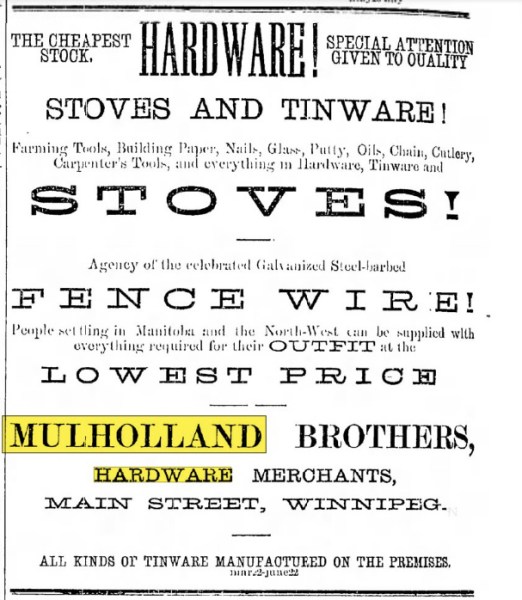
The store advertised regularly in the local newspapers. source: Manitoba Free Press, p. 4, May 26, 1880, Newspapers.com

Running a business with a sibling had its challenges. In a letter to his father in 1884, Henry must have mentioned that he and Joseph did not see eye to eye on a bookkeeping entry. Henry senior replied, “Joseph is a good-hearted, generous fellow, and I trust that you and he will get on cordially together, as it will be for your natural interest to continue the business without any wrangling and refer any differences of opinion between you and him to your Uncle Thomas [Workman] and me who have had long experience in co-partnership businesses and in keeping accounts between the copartners.”3

Henry senior continued to offer sensible advice and encouragement: “I am glad to hear that you are making no bad debts and that you have no large accounts due to you in the books and that your stock is well selected and next to this never be tempted to offer any customer to increase his indebtedness by selling him more goods on credit in hope of obtaining payment of a past due debt.”

It appears that Joseph was the more outgoing sibling. His name appeared frequently in Winnipeg newspapers as he was involved with the Board of Trade. He was for a time president of the Winnipeg Liberal-Conservative Association, and he was briefly a candidate for mayor of Winnipeg, but withdrew his name. Several newspaper clippings following his death described him as a very likeable fellow. 

Meanwhile, Henry’s name never appeared in the newspapers, so perhaps he was the quiet one, busy running the store. It is also possible he was distracted by family obligations. Henry was married to Ontario-born Christina Maria Shore and the couple had six children.
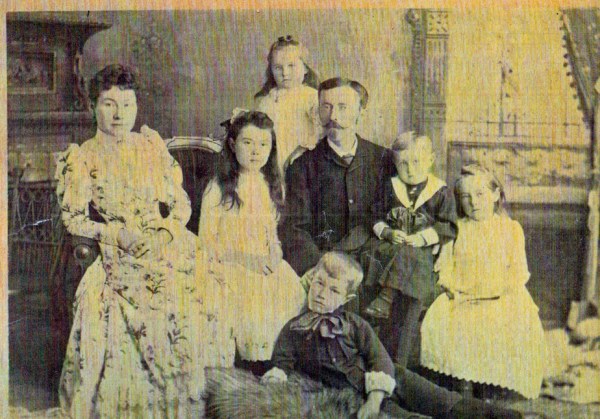
Henry and Christina Mulholland and five of their six children. source: Mulholland family collection.

On June 25, 1885, Mulholland Bros. ran an ad in the Manitoba Daily Free Press listing the many new items they had in stock, including blacksmith and livery stable supplies as well as articles for barbers, butchers, hunters and gardeners. They also carried bird cages and ivory-handled table knives.

Few of Winnipeg’s citizens were wealthy, the local economy was dependent on a good grain harvest, and shipping costs to Winnipeg were high. The business may have over-extended its inventory. In February 1889, a bankruptcy sale notice for Mulholland Bros. appeared in the paper, listing egg boilers and dog collars among the many items to be disposed of.4

Joseph returned to Montreal and, in 1890, he married Amelia Bagg (1852-1943). Amelia had inherited Montreal real estate from her father, Stanley Clark Bagg, and she was an independently wealthy woman. She was generous to family members in need, and in return, she was loved and respected by members of both the Bagg and Mulholland families. For Joseph, marriage to Amelia not only brought companionship, it also brought him a job in the Bagg family business as a real estate agent.
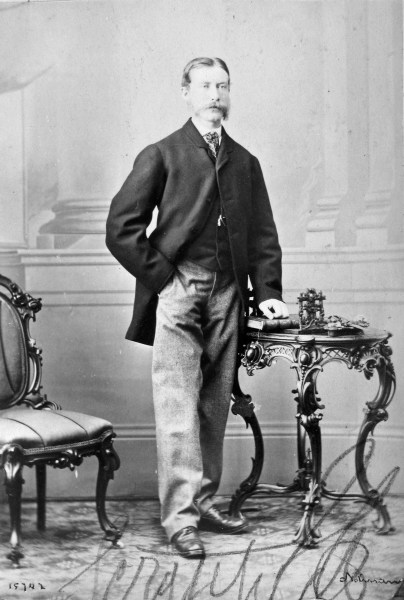
Joseph Mulholland, Montreal, QC, 1865, source: William Notman, I-1757421, McCord Stewart Museum

His good fortune did not last long, however. Joseph died of heart failure brought on by extreme heat in Montreal on July 15, 1897.5

As for Henry, after the Winnipeg store failed, he remained in Manitoba for a time — the family was still there in 1891 when the census was taken — but they eventually moved to Toronto, where Henry continued to work as a hardware merchant. After his death, his youngest son, Toronto lawyer Joseph Nelson Mulholland, commented that Henry had never regained his stride following the bankruptcy.6 When Henry died in Toronto in 1934, at age 84, his obituary did not mention the Winnipeg venture.7

A special thank you to a distant cousin who reached out to me recently with a question about his ancestor Henry Mulholland. Until then, I had never heard about Henry and had no idea Joseph had run a hardware store in Winnipeg.

This article is also posted on my personal family history blog, http://www.writinguptheancestors.ca

See also:

Janice Hamilton, “Henry Mulholland, Montreal Hardware Merchant”, Writing Up the Ancestors, March 17, 2016, https://www.writinguptheancestors.ca/2016/03/henry-mulholland-montreal-hardware.html

Janice Hamilton,  “The Life and Times of Great-Aunt Amelia”,  Writing Up the Ancestors, June 21, 2023, https://www.writinguptheancestors.ca/2023/06/the-life-and-times-of-great-aunt-amelia.html

Janice Hamilton, “The World of Mrs. Murray Smith”,  Writing Up the Ancestors, Feb.24, 2016, https://www.writinguptheancestors.ca/2016/02/the-small-world-of-mrs-murray-smith.html

Sources

  1. “The Late Mr. Mulholland”, The Montreal Star, Feb. 19, 1887, p. 8, Newspapers.com, https://www.newspapers.com/image/740882983/?match=1&terms=Henry%20Mulholland
  • 3. Letter from Henry Mulholland sr. to Henry Mulholland jr., Dec. 8, 1884, Mulholland family collection.
  • 5. “Late J. Mulholland. a man who was cordially liked by many friends in this city”, The Winnipeg Tribune, July 10, 1897, p. 5, Newspapers.com,
  • 6. Letter from Nelson Mulholland to Fred Murray Smith, June 22, 1943, Mulholland family collection.

7. “Henry Mulholland Dies in Toronto”, Montreal Daily Star, Nov. 12, 1934, p. 17, Newspapers.com, https://www.newspapers.com/image/741983911/?match=1&terms=Henry%20Mulholland

Railway Man, Family Man

James Cecil Hunt (1879-1937) worked a 30-year career as a Locomotive Engineer in Manitoba, Canada. He left his birthplace in Owen Sound, Ontario, at the age of 22, and headed west to Port Arthur (now Thunder Bay), Ontario. There he met and married Cassie (Catherine Elizabeth Grummett 1884-1966), a glamorous Winnipeg girl, at the age of 28. They raised their five children in Brandon, Manitoba, and eventually moved back to Winnipeg where they bought a house and stayed the rest of his life.

His first job as a “labourer” according to the 1901 Census might have been with the Canadian Northern Railway (CNoR). “The Canadian Northern Railway was incorporated (1899) as a result of the amalgamation of two small Manitoba branch lines. It was built up over the next 20 years by its principal promoters, William Mackenzie and Donald Mann, to become a 16,093 km transcontinental railway system.”

However, the competition with their transcontinental rivals proved to be insurmountable and Mackenzie and Mann were forced out of the company, which then became one of the first major components of the soon publicly owned Canadian National Railways (CNR).1

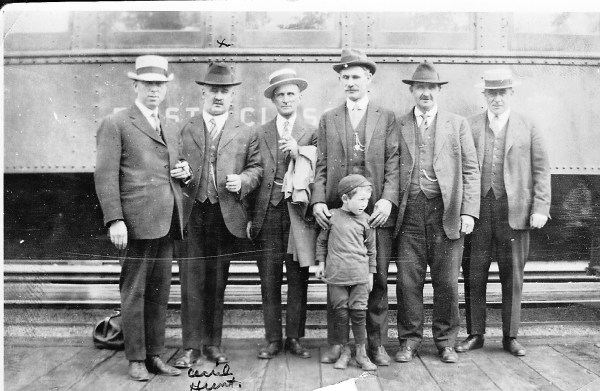
Cecil Hunt (second from the left) and other locomotive engineers posing in front of a First Class car.

After 18 years working up the CNoR ladder, Cecil’s career as a Locomotive Engineer began shortly after the June 1919 incorporation of the CNR, which then consisted of several other bankrupt railways belonging to the Canadian government.2 The CNR is the longest railway system in North America, controlling more than 31,000 km of track in Canada and the United States. It is the only transcontinental rail network in North America, connecting to three coasts: Atlantic, Pacific and the Gulf of Mexico.3

As a Locomotive Engineer, Cecil would have operated and controlled a locomotive engine (No. 73083.5 to be exact) that powered the train on railways. His responsibilities would have included controlling the speed, acceleration, and braking to ensure smooth and timely journeys as well as a thorough knowledge of the entire railway system, signals, and track conditions, all while adhering to strict safety regulations and protocols.4

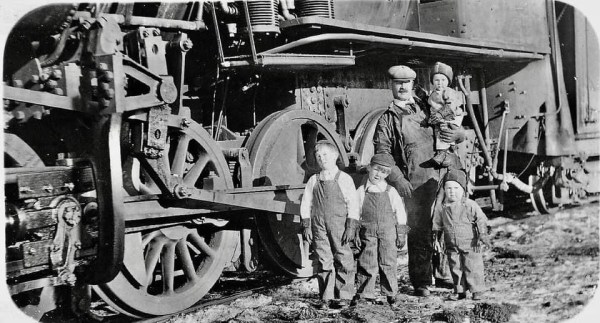
  • Cecil and children Allan, Lyndon, Holman and Beatrice circa 1916
  • Cecil’s CNR Steam Engine no. 7308 (scrapped in November 1951)

According to the 1931 Census, Cecil at age 52 owned a three-story eight room stucco house at 588 Warsaw Avenue, in Winnipeg not far from the Red River, and made an annual salary of $3,200 ($65,000 in today’s dollars). Locomotive engineers easily make double that today.5

Cecil had obviously done well for himself since ten years before becoming a proud homeowner, he already owned a Model T Ford which, according to this photo, the whole family enjoyed!

Cecil, Sydney, Cassie, Beatrice, Holman, Lyndon and Allan (my husband’s father) circa 1920

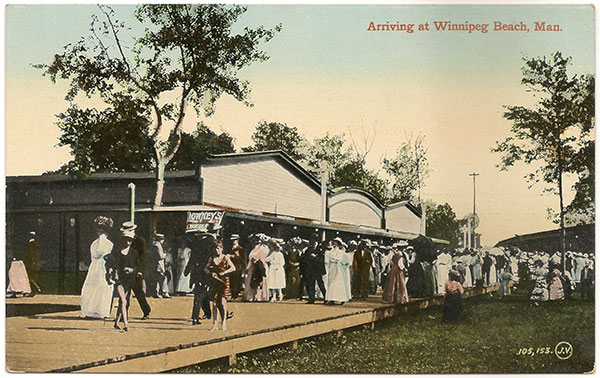
Although, travel by car did not become common until the mid-1920’s, most people could take the “beach train” for their excursions to the famous nearby Winnipeg Beach. By 1912, ten trains took 40,000 vacationers to the beach each weekend.5.5

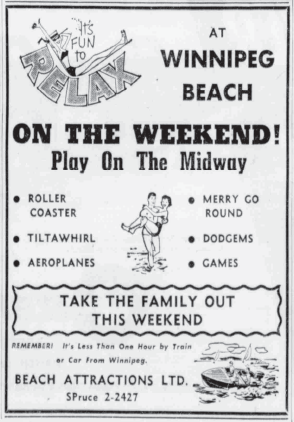
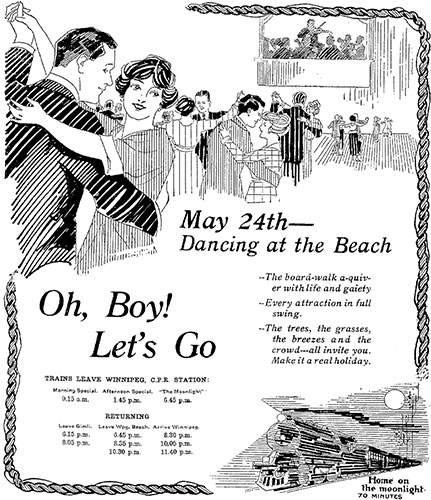
Winnipeg Beach had developed into an impressive amusement park – complete with a roller coaster, merry-go-round, and “moving picture house”. Over the years, more attractions were added, including bumper cars and an airplane ride. All this as well as the very popular dance pavilion and multiple arcades along the boardwalk. The “Moonlight Special” provided a round trip by train for 50 cents and a night of dancing could be purchased for another nickel. It is rumoured that “many generations of people owe their existence to the fact that their parents, grandparents or great-grandparents met on the ‘Moonlight’.”6

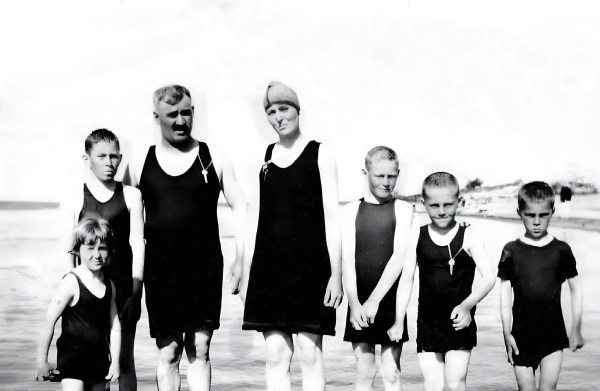
Winnipeg Beach: L to R – Beatrice, Sydney, Cecil, Cassie, Allan, Lyndon and Holman (notice the locker keys pinned to their bathing suits!)

In May 1937, Cecil and Cassie attended their son Allan’s wedding to Agnes Kirk (my husband’s parents). Allan worked his whole life in aviation with several airlines culminating in a 37-year career with Trans-Canada Airlines (which later became Air Canada) and my husband also had a 30-year career with Air Canada. Three generations of Hunts working in national transportation!

Shortly after that May wedding, Cecil suffered heart failure and Cassie nursed him at home until November when he died at age 58. The “weak heart” gene plagued all the Hunt men and continues to do so even to this day.

Tall stylish Cassie, however, lived almost another 30 years, and as a CNR widow, travelled with her train pass visiting her family from coast-to-coast every few years. After Cecil’s death, she lived for a while with her son Holman in the Slate River district near Thunder Bay, and then with her daughter Beatrice in Richmond, British Columbia until she died at the age of 82. Her obituary pays tribute to her lifelong commitment to the Order of the Eastern Star (part of the Masonic Family) both in Winnipeg and in Richmond.

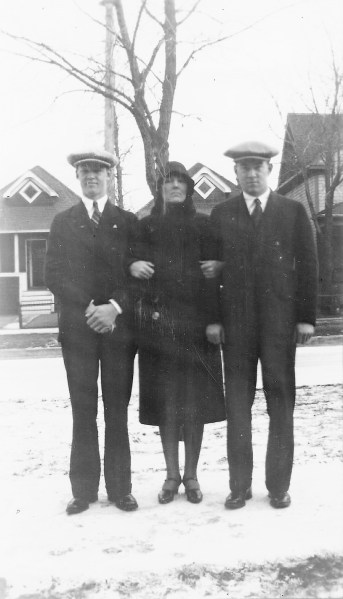
Cassie and her two sons Allan and Sydney

The glimpse into the life of any ancestor makes writing about genealogy so gratifying … and the best part about this story is my husband getting to know a little about the grandfather he never met.

Please read my story about my husband and his father Allan Hunt:

Like Father, Like Son

1https://www.thecanadianencyclopedia.ca/en/article/canadian-northern-railway

2https://wiki2.org/en/Canadian_National_Railway

3https://www.thecanadianencyclopedia.ca/en/article/canadian-national-railways

3.5http://www.trainweb.org/j.dimech/roster/060ros.html#O-15-b

4https://www.careerexplorer.com/careers/locomotive-engineer/

5https://www.payscale.com/research/CA/Job=Locomotive_Engineer/Salary

5.5https://winnipegbeach.ca/p/our-history

6 Memories of the Moonlight Special and the Grand Beach Train Era – Barbara Lange

Did Louis Riel hide in my ancestor’s basement?

riel rebellion battoche

Family lore says that my ancestor Joseph Arial had many meetings with Louis Riel in the basement of a hotel he owned. The story might be about a hotel in St. Boniface that may have served as a hide-away for the Métis hero and later burned to the ground or it may be referring to a hotel owned by his son Joseph Gabriel, who ran his own hotel in Gleichan* (near Cluny), Alberta.

How does a genealogist go about proving such a story? The family legend might refer only to my great great great grandfather or his son, or it may combine the exploits of both.

My first challenge was figuring out the timing. Louis Riel was born in the Red River Valley in 1844 and was hanged for treason on November 16, 1885.[1]

Then I began searching through the names and dates of my ancestors’ lives.[2]

Joseph Arial was the first of my ancestors who left Quebec. He was born in 1812 in St. Roch and died on November 4, 1880 in St. Boniface, Manitoba, where he is buried. His wife was Julie Belleau dit LaRose who was born the year before he was. The two were married in St. Roch on September 4, 1832. St. Boniface is on the south side of the Red River, so the location is correct, although he would have been much older than Riel.

His son, Joseph Gabriel was married to Marie Sophie Bernard in St. Boniface, Manitoba on August 8, 1887. Their hotel would be too late to have anything to do with Riel. Joseph’s wife is important to my story, however, because her mother was born in 1838 in St. Anne-des-Chênes (Oak Point), just down the river from where Riel would be born six years later. Her mother, Sophie Henault Canada was also born in the Red River Valley, so there were roots that went back years. The possibility that Sophie’s parents, Charles-Henault-Canada and Marie Gris, knew Louis Riel’s parents, Julie Lagimodières and Jean-Louis Riel, who were married in the chapel of St. Boniface Cathedral on January 21, 1844 were high.

That isn’t proof though.

My next step will be to verify the guests at the marriages of Joseph Gabriel and Marie Sophie and the marriage of Julie Lagimodières and Jean-Louis Riel, but in the meantime, perhaps what happened after Riel’s death will tell us more.

So far, the only information I have comes from Fred Jones in his story called “Blackfoot Reserve. ” He speaks about Gabriel Arial running a hotel. He writes:

My first impression of Gleichen was when we arrived by way of Calgary from the Blood Reserve. We stayed in the Palace Hotel, owned by a French Canadian named Mr. Gabriel Arial, and I think he built it. Some of the Old Timers seem to think it was originally build of logs, but I had seen parts of it torn down and repaired here and there with no logs under the sheeting, but the rough boards were hand-sawn with the old, long ripsaw, and iron nails were used. The style was what you might call early Western, and no luxuries were provided. The rooms contained a bed, chair, washstand and plain dresser, a big jug full of cold water and a smaller jug, for drinking. If you needed more water you took your jug downstairs and outside, to the well. A kerosene lamp provided light.

The Arials welcomed us, and were very hospitable. So were the cockroaches and bed bugs, but that was the usual thing in any dwelling in those days. There were no insect repellents, except kerosene and pyrethrum powder and these failed to attain victory. A a standoff was the best to be hoped for, as the walls were hollow and the plaster cracked so the enemy could retreat and fight another night.

I went to school later with the Arial boys and girls. The hotel was later sold to Brosseau Brothers, and the Arials moved to Edmonton.

I think we arrived in Gleichen about 1896 or 1897, as the C.P.R. roundhouse was still there and I think it was moved to Calgary in 1898. (As I recount these many events, please consider that they happened over seventy years ago. They may be kind of sketchy and not follow in proper sequence and some that made an impression then, may not have been as important as others that might have been forgotten.)[3]

Is this Gabriel my grandfather? I don’t know for sure yet, but I think so. My grandfather was called Gabe after his father and he grew up in Edmonton. My grandmother also moved to Cluny as a child and that’s where they met. This Gabriel Arial may also have been a cousin though, so I still have much more verification to do.

[1] All the facts about Louis Riel and his life in this story come from Maggie Siggins’ book “Riel A Life of Revolution” Harper Collins, Toronto, 1994.

[2] For this part, I relied on the handwritten notes of Mary Alice Kite and my grandmother, Ann Marguerite Arial. My grandmother learned how to do genealogy from Mary Alice and she knew my great grandparents personally. She would have confirmed their parents’ and grandparents’ names with them. She also collected photos of the family, which I now have. Few of the people can be easily identified now.

[3] The Prairie Hub, by John Julius Martin, Rosebud, Alberta, The Strathmore Standard, 1967, p. 160.


*An earlier version of this story spelled Gleichen incorrectly.