Tag Archives: Yorkshire

Not…Quite…Forgotten

Driving into Helmsley.

The North Yorkshire town

Where my ancestors toiled

In the nearby fields

And laboured

In the limestone quarry

Or – in one case – bent over smartly

As footman to the local Earl

Is now a pristine tourist destination

For posh Londoners

(Who like to hunt partridge, grouse and pheasant)

With high-end clothing shops

And luxury gift boutiques

Lining the old market square

Two wellness spas

And at least one pricey Micheline-recommended restaurant

Serving up the likes of Whitby crab

(with elderflower)

Or herb-fed squab

On a bed of

Black Pudding.

The oh-so pretty North Yorkshire town

Where my two-times great-grandmother

A tailor’s wife

Bore her ten children

And worked ‘til her death at 71

As a grocer

(So says the online documentation)

Now has food specialty shops as eye-pleasing as any in Paris or Montreal

With berrisome cupcakes and buttery French pastries

(Some gluten-free, some vegan)

Mild Wendsleydale cheese

(From the udders of contented cows)

Locally-sourced artisanal game meats

Hormone-free, naturally

And free-range hen’s eggs with big bright orange yolks

That light up my morning mixing bowl like little suns gone super-nova.

And, for the culturally curious

Packages of the traditional North Country oatcakes

(Dry like cardboard if you ask me.)

It cannot be denied

Nary a wild rose nor red poppy is out of place

In this picturesque

Sheepy place

3000 years old!

(Apparently)

Where my great-grandfather

During WW1

Managed the Duncombe saw mill

Supplying timber for telephone poles

And trench walls.

Where because of the highly variable weather

(I’m assuming)

Rainbows regularly arched over the hills and dales

From Herriotville to Heathcliffetown,

Back then

As they

Do now.

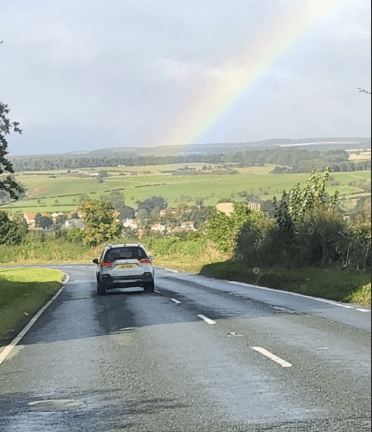
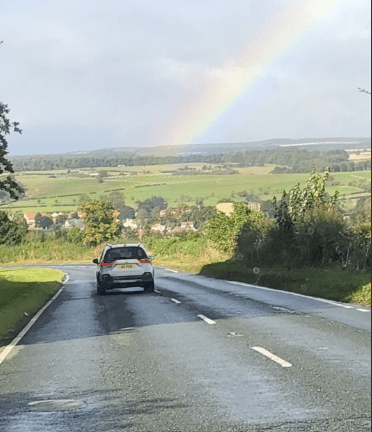
(At least I met with one as I drove into my ancestral town– and thought it a good sign.)

Off-season,

This is a town for locals

Not for overseas imposters like us.

I was told…

The natives drive only short distances as a rule

From dirtier, busier places

like Northallerton

(but an hour away)

Through the awesome

(no hyperbole here)

Primeval forests and heathery plateaus

Of the much storied Moors

On narrow snaking highways.

Wearing rainproof quilted jackets in boring colours

They walk their well-behaved dogs

Spaniels mostly

In and out of ice cream shops

And cafes

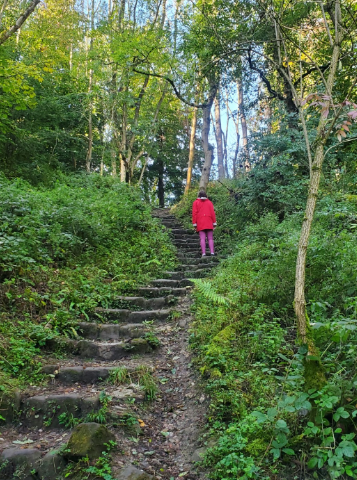
Or up and down

the daunting (to me)

muddy

….medieval

…………..Fairy

…………………….Staircase

…………………………………..along

…………………………………………..the Cleveland

…………………………………………………………………….Way.

To visit quaint Rievaulx

And admire the Grade II Heritage cottages

With their bewitching thatched roofs

And wisteria-laced windows

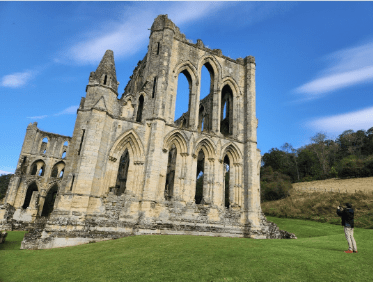
Where the skeleton of the old Cisterian monastery

Rules the blue horizon

Like a giant antique crustacean trapped in grim History.

(Unlike myself, they do not pay the ten plus pounds to visit the Monastery ruins.

“And would you like to donate an extra 75p to the National Trust?”

Sure. Why not?)

They just like to walk their dogs.

Yes, all is picture-perfect these days

(It’s early October in 2024)

In my ancestral town

In the North of England

Where at least two in my family tree

Travelled the Evangelical Circuit

From Carlisle to Whitby

Preaching thrift and abstinence

And other old-fashioned values

To men and women with calloused hands

And a poor grasp of the alphabet.

Except, maybe, for the Old Methodist Cemetery

*no entrance fee required

Just around the corner from our charming air bnb

Where the crows, flocking for winter (I guess)

Caw maniacally in the moulting trees

And a black cat might cross your path

(It did for me)

And the old tombstones jut out helter-skelter like crooked mouldy teeth

From the soft-sinking Earth under which some of my ancestors lie,

Mostly

,,,,,,,But

Not ,,,,,,,,

,,,,,,,,,Entirely

Forgotten.,,,,,,,,,,
The Black Out

On September 15, 1943 Police Inspector James Scales stopped my father, Edward McHugh, on the road between Easingwold and Tholthorpe. It was the middle of WWII and my father was probably in a hurry to get back to the RCAF base in Tholthorpe, Yorkshire, England. As he was part of the maintenance ground crew of RCAF Iroquois Sqaudron 431, he may have had to get up early to prepare the aircraft for an early morning sortie.

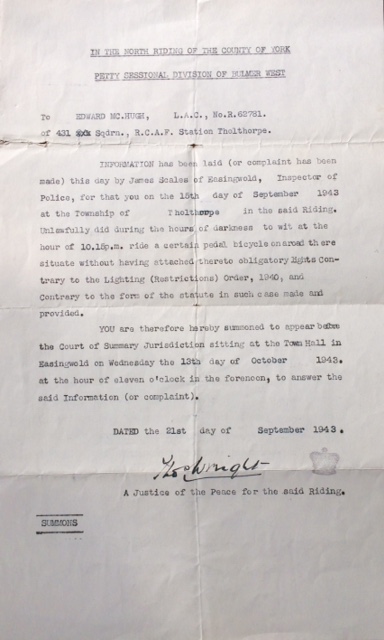
Officer Scales stopped my dad while he was riding a bicycle in the dark. He had left Easingwold, a small village about a half hour bicycle ride from the base. More specifically, it was 10:15 p.m.  I have the Summons that he received to report to the Court of Summary Jurisdiction in Easingwold.1

McHugh, Edward Summons.jpg

Dad was riding a “certain pedal bicycle” during the hours of darkness. He had unlawfully failed to attach the “obligatory lights” in conformance with the Lighting (Restrictions) Order, 1940.2

Great Britain, together with France, declared war on Nazi Germany on September 3, 1939.3 By January 1940, the Lighting (Restrictions) Order established a country-wide blackout during the hours of darkness.4 This restricted and forbade public lighting in towns. It required that street lamps be dimmed and that business and private residences black out their windows with blackout curtains so that light could not seep out. It also provided specifications for dimming the lights of motor vehicles and bicycles.5

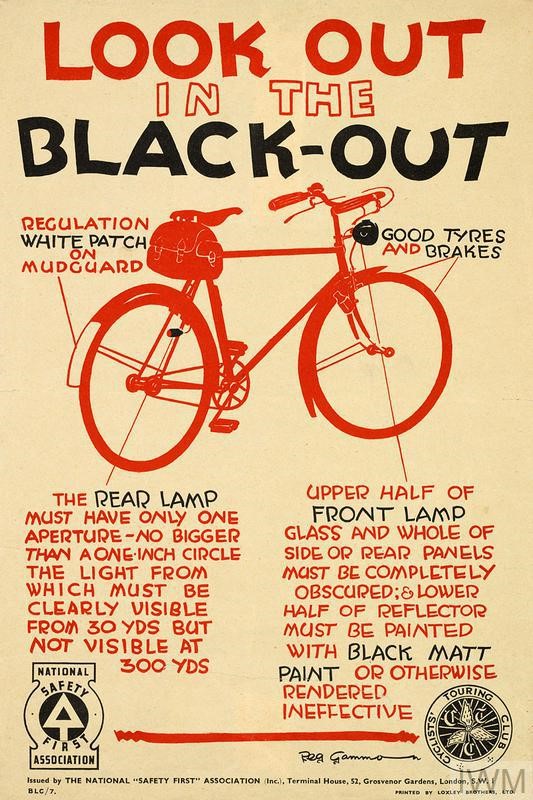
Here is a poster that gives instructions on how to outfit a bicycle so that the lights are dimmed and facing the ground.6

Look out Black Out.jpg

My father would have known that the blackout was important and all his life he scrupulously followed the law. So he was not stopped because he didn’t care about the blackout. He was stopped because he didn’t have any lights at all.7

Once Britain imposed a country wide blackout through the Lighting (Restrictions) Order, car accidents increased and pedestrian fatalities doubled.8 Citizens were discouraged from nights out at the pub and were told to carry a newspaper or a white handkerchief so that they could be seen.9 Police Inspector Scales had decided to impose the letter of the law.10

I like to imagine that my dad had cycled into Easingwold for an evening out at the pub for a pint and a game of darts. He learned to play darts during the war and he continued to enjoy the game his whole life.  Bicycles were used on the base, so I assume that he borrowed one of them.11

In any event, while he must have been frustrated at being summoned to court for failing to have a light on the bicycle, it does seem a little dangerous to be travelling on a country road with no lights during a total blackout. But surely a smaller risk than fighting in a war that lasted five years.


  1. Summons to Edward McHugh, LAC, No. R. 6278 of 431 Squadron, RCAF Station Tholthorpe dated September 21, 1943, in author’s possession.
  2. Ibid.
  3. Wikipedia web site, “Declarations of war during World War II,” https://en.wikipedia.org/wiki/Declarations_of_war_during_World_War_II, accessed April 22, 2018.
  4. Wiggam, Marc Patrick, The Blackout in Britain and Germany in World War II, Doctoral thesis, University of Exeter, March 2011, page 107.
  5. The Guardian, online edition, “Life during the blackout,” November 1, 2009, https://www.theguardian.com/lifeandstyle/2009/nov/01/blackout-britain-wartime, accessed April 22, 2018.
  6. Used with the kind permission of the Royal Society for the Prevention of Accidents. rospa.com.
  7. Summons to Edward McHugh, LAC, No. R. 6278 of 431 Squadron, RCAF Station Tholthorpe dated September 21, 1943, in author’s possession.
  8. Spartacus Educational web site, Blackout World War 2, http://spartacus-educational.com/2WWblackout.htm, accessed April 22, 2018.
  9. The Guardian, online edition, “Life during the blackout,” November 1, 2009, https://www.theguardian.com/lifeandstyle/2009/nov/01/blackout-britain-wartime, accessed April 22, 2018.
  10. Summons to Edward McHugh, LAC, No. R. 6278 of 431 Squadron, RCAF Station Tholthorpe dated September 21, 1943, in author’s possession.
  11. Joost, Mathias (Major), The unsung heroes of the Battle of Britain: The ground crew of No. 1 (RCAF) Squadron, September 11, 2017, Royal Canadian Air Force web site, http://www.rcaf-arc.forces.gc.ca/en/article-template-standard.page?doc=the-unsung-heroes-of-the-battle-of-britain-the-groundcrew-of-no-1-rcaf-squadron/idw3fd9t, accessed April 22, 2018.


RCAF Iroquois Squadron 431

By Sandra McHugh

In World War II, RCAF Iroquois Squadron 431 executed 2,584 sorties, dropped 14,004 tons of bombs, lost 72 aircraft, and suffered 490 aircrew causalities, including 313 deaths, and 14 operational personnel deaths.1 My father, Edward McHugh, was part of the ground crew of this squadron.  He was an electrician by trade and when he enlisted during the summer of 1940, it was determined that the RCAF needed aircraft electricians. He began his training in Canada as part of the British Commonwealth Air Training Program (BCATP). Prime Minister William Lyon Mackenzie King had agreed that Canada would manage the BCATP at 231 facilities across Canada, mainly at air bases.2

Great Britain’s Royal Air Force’s Bomber Command was formed on July 14, 1936 and became part of the air defence of the country.  It was made up of groups and the Canadians were included in these groups. Group 6 was established on January 1, 1943 and was entirely made up of Canadian squadrons. At its peak, there were 14 squadrons belonging to group 6, including Iroquois Squadron 431.3

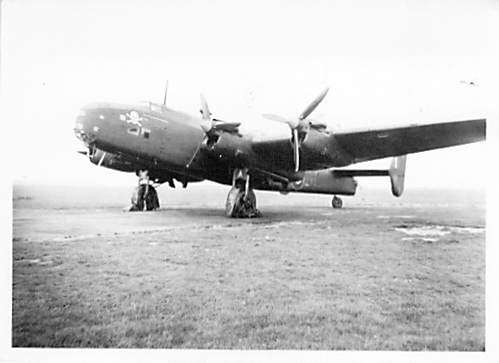
Squadron 431 operated Wellington X, Halifax V, and Lancaster X aircraft.  The Halifax and Lancaster aircraft had higher speed and greater bomb loads than earlier aircraft.4 The Canadian squadrons were stationed in Burn, Tholthorpe, and Croft, Yorkshire, allowing them to make sorties out across the English Channel, out into the North Sea, and into mainland Europe. Their targets included military targets, U boats, industrial centres, and Nazi occupied territories. The battle honours of Squadron 431 include the English Channel and North Sea, the Baltic, Fortress Europe (areas occupied by Nazi Germany), France and Germany (1944-45), ports in the Bay of Biscay, the Ruhr valley, Berlin, German Ports, Normandy, and the Rhine.5

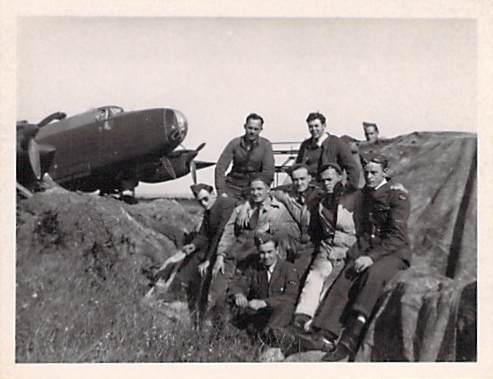
My father almost never spoke about the war.  Despite the camaraderie and deep friendships he forged during his time of service, it was a dark period of his life and he wanted to forget about it. The few times he spoke of it, he mentioned the busy work leading up to a mission, whereby the ground crew would be working intensely to ensure that everything was the best it could be.  Each person was acutely aware that a small detail could mean the difference between life and death.  Each team of the ground crew was assigned to one bomber and they would wait for their bomber to come back after the mission.  Sometimes the bay remained empty and the bomber never came back.  My father never got over the pain of waiting for a bomber that would not return.

Sources

A special thanks to W.E. Huron for his publication about Squadron 431: The History of 431 R.C.A.F. Squadron and more, 1942-1945: Burn, Tholthorpe, Croft

1 Heron, W.E., A Yorkshire Squadron, the History of 431 R.C.A.F. Squadron and more, 1942–1945: Burn, Tholthorpe, Croft, General Store Publishing House, 2009, p. 8

2http://en.wikipedia.org/wiki/List_of_British_Commonwealth_Air_Training_Plan_facilities_in_Canada

3 Heron, W.E., A Yorkshire Squadron, the History of 431 R.C.A.F. Squadron and more, 1942–1945: Burn, Tholthorpe, Croft, General Store Publishing House, 2009, pages 3 and 4

4 http://en.wikipedia.org/wiki/RAF_Bomber_Command

5 Heron, W.E., A Yorkshire Squadron, the History of 431 R.C.A.F. Squadron and more, 1942–1945: Burn, Tholthorpe, Croft, General Store Publishing House, 2009, p. 8

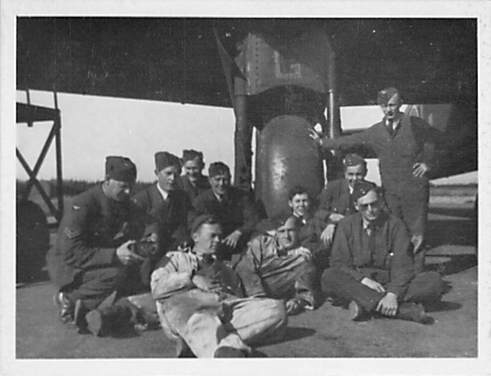
Ground crew. Edward McHugh, wearing overalls, is in the front.

Ground crew.
Ground crew.

Bomber
Bomber