Lancaster Days in Gransden Lodge

Recently, as I read the history of the WWII era on the webpage of the Cambridge Gliding Centre, which operates out of the Gransden Lodge Airfield, I was reminded of my great uncle’s fun-loving spirit. The page read:

“Despite the grim business of the war being waged, there was also a lighter side to life at Gransden Lodge, with many sporting events, parties, concerts and film shows being organised, along with the inevitable pranks carried out by the boisterous Canadians.”1

I don’t know what pranks they were talking about, but its likely my uncle Charlie fell among the pranksters. He served at Gransden Lodge for six months in 1944.

Uncle Charlie, officially known as Sgt. John Charles Mathieu, worked three different jobs from the time he enlisted in the Royal Canadian Air Force on January 8, 1940 until he went missing just before Christmas 1944.

Each job got closer to the action, with the first assisting officers, the second serving as a Spitfire flight mechanic and the third as a tail gunner in a Lancaster.

In many ways, his personal development matched the development of Canada’s Air Force.

Canadian Air Force Development

Canada founded its own Air Force in 1920, just after World War I ended. King George V gave it the Royal Canadian Air Force title four years after that. For a while, it controlled civil aviation in the country, but that ended in 1927. It then re-established recruitment and training in 1939, as part of the build-up to the British effort in World War II.

The Royal Canadian Air Force created Squadron 405 in Driffield, Yorkshire, on April 23, 1941. It became operational as part of Britain’s Royal Air Force’s Bomber Command a month and a half later.2

Canadian and British crews tried to hit German and French targets individually as best they could, but the bombs dispersed too widely.

Captain D. C. Bennett came up with a plan to send a small group of bombers ahead of the others. These Pathfinder bombers would drop green and red short-burning flares called “sky indicators” on targets so that a bigger group of bombers would know where to aim.

Just as this new strategy was developed, the Royal Canadian Air Force created its own Bomber Command. It assigned the 405 Squadron to the pathfinder role and moved it to Gransden Lodge. The squadrons originally based there researched the use of radar. As the use of that technology expanded, they had to be moved to larger, more secretive locations.

Uncle Charlie’s Path

Meanwhile, Charlie began training as a tail gunner just before Christmas 1943. His two-and-a-half month journey ended with a mark of 76.1%. I think this is a pretty good grade, but his course instructor P.W.H. Walker clearly expected better. Walker wrote in Mathieu’s log book that he was “a pupil who would have done better had he devoted more time to his work.”3

He worked harder after that, training from March until May in a Wellington in Wellesbourne Mountford and then from the 9th until the 24th of June in a Halifax. For that last training session, his instructor gave him a mark of 91% and assessed him as “average.”

Then it was off to the Navigational Training Unit, which used the new safer, faster bombers known as Lancasters. The Lancasters also marked a vast improvement in technology. After successfully prototyping by the A.V. Roe Company in Chadderton, the manufacture of some Lancasters moved to Canada. Charlie told me that plane saved him and his crew multiple times.

Charlie’s study habits by then had vastly improved; he and his rear gunner came in second and third in the class. Together, they got assigned to the elite squadron 405, something that shocked Charlie.

The rest of the crews were all experienced, some with two tours of ops to their credit; we didn’t even have one flight.4

Arrival at Gransden Lodge

Charlie arrived in Great Gransden, a tiny hamlet in Sandy, which was part of Bedfordshire in Huntingdonshire County, 11 miles west of Cambridge in early July 1944. He got a welcoming pamphlet from his predecessors that said in part:

“We old die-hards, some of whom you will have the pleasure of meeting later in this booklet, began our P.F.F. life just as you are, with few clues but a willingness to learn. We settled down and soon became enshrouded with the spirit, that we not only had a job to do well, but one which was to be done far better than was expected, no matter how small it proved to be. That spirit and responsibility is handed down to you by the older crews as they end their tours.”5

Charlie’s log shows eleven-and-a-half hours of day flying and two-and-a-quarter hours of night flying over a three-day period that ended on July 10, 1944.6

That same day, Charlie got a new “class A” driver’s license that gave him the right to drive “heavy locomotive, light locomotive, motor tractor, heavy motor car, motor car, or motor tricycle equipped with means for reversing”7 for a year.

He wouldn’t need the last six months.

For More about WWII

Read my other stories about WWII service at:

Last flight (this is more about Uncle Charlie)

Difficult holiday for two families (this story features the death of a crew member on Charlie’s last flight)

Sad death (this story features one of the women who served)

Kitty Freeman: WWII Heroine and Food Research Pioneer (another story about a woman who served)

Visit Picton for insight into military ancestors from WWII (Charlie trained in Dunville, but the site was similar to this one)

Sources

1https://www.camgliding.uk/about/airfield-history/, accessed January 29, 2020.

2 Skaarup, H. (n.d.). Canadian Wings: The History & Heritage of the Royal Canadian Air Force. Retrieved November 24, 2014, from http://www.canadianwings.com/Squadrons/squadronDetail.php?No.-405-Squadron-64.

3Flying Log book for Navigators, Air Gunners, Flight Engineers, Royal Air Force, Form 1767, Revised October 1943, December 12, 1943 to February 26, 1944.

4Mathieu, John Charlie. All this Heaven Almost, private manuscript.

5 No. 405 Squadron Operational Books, Library and Archives Canada, microfilm reproduction copy number C-12272.

6Log book, Personal documents, John, Charles Mathieu, Flying Log book for Navigators, Air Gunners, Flight Engineers, Royal Air Force, Form 1767, Revised October 1943.

7Huntingdonshire County Council Road Traffic Provisional Driving Licence No. A6430.

The Story of Three Thomas Wells’s

or

In Praise of Small, Local Museums


THOMASWELLS

My husband’s grandfather, Thomas Gavine “Fuddy” Wells, born 1868, Ingersoll, Ontario.

My husband’s grandfather, Thomas Gavine Wells, or “Fuddy” was born in Ingersoll, Ontario in 1868,“ the year after Canadian Confederation” as my father-in-law, Thomas Gavine Wells Jr., liked to say.

According to my father-in-law, Fuddy’s father, also Thomas Wells, was a lawyer from  England. His mother was a White – and, by the way – the Whites invented the hockey net.

This is everything my father-in-law, who loved to regale us with family stories, knew about his father’s British branch.

It has taken me quite a few years to confirm through the historical record that this information is correct –  well, except for the hockey net part.

…..

A few years ago, I started researching the background of my husband’s grandfather, Thomas “Fuddy” Wells, the one born in 1868 in Ingersoll.

As a young man,  Fuddy came to Montreal to work as an accountant for his uncle, Thomas White, who had founded an accidental company, Laurentian Spring Water, when he stumbled upon a golden aquifer under Craig Street while digging a well to service a shoe factory. Fuddy eventually became a salesman and then the President of the company.

Laurentian Spring Water was the first bottled water company in North America – and that deserves a story of its own – but not here.

DAPPERGENTS

The dapper gentlemen of the St. George’s Lawn Bowling Club, Westmount, Quebec. Fuddy is seated above the man on grass with splayed legs.


This piece is about my more recent search for more information about Fuddy’s father, Thomas, the lawyer in Ingersoll, Ontario, who was from England, but what part?

But, finding that out was difficult. Putting up my husband’s DNA  on Ancestry did nothing to clear up the mystery. Wells is a common name, as is White.

Making things more difficult, Fuddy’s 1868 birth certificate isn’t online, nor is Thomas, the lawyer’s, marriage certificate.

CENSUS

However, Fuddy’s four marriages (yes) are online, giving his birth date as 1868 and his mother as Mary White.

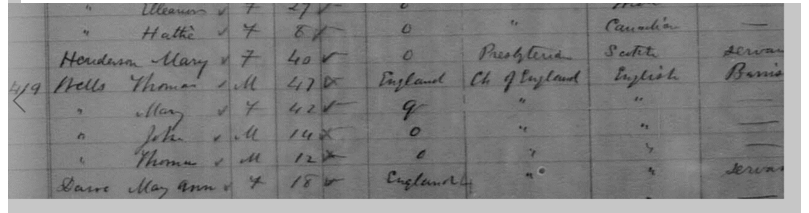
The  1901 and 1911 censes claim Fuddy was born in England, in 1868, (that would explain the lack of a Canadian birth certificate) but the 1881 census (above) confirms he was Canadian-born.

The paper-trail isn’t always to be trusted, it seems.

According to an online notice from the Canadian Law Almanac, Fuddy’s father, Thomas, started his law career in Ingersoll in 1866 – the year before Confederation.

Now, I put all this information aside for a year or two until a few months ago when a genealogist friend  said she’d give it a try using UK records.  After a bit she got back to me: “No luck. There are just too many Thomas Wellses,” she said.

Then, trolling the Internet for more information,  I stumbled  upon a brand new net nugget: a citation in the footnotes of a book published in 1989 for “Diary of Thomas Wells, teacher, 1851-1864, Ingersoll Cheese Factory Museum.”

I immediately contacted said Cheese Factory Museum to be told that Thomas Wells’ diary was in the Ontario Archives – and, then,  I couldn’t find it on their database. Darn!

But, shortly  thereafter, I received another email.

An intrepid researcher at the Ingersoll Museum had taken it upon herself to do a little research about Thomas Wells and she had discovered his obituary in the Woodstock Journal. Bingo!

Thomas, it seems, was born in Fulbourn, Cambridgeshire, 4 miles from the famed University.

His father, John, had a farm there, 326 acres, 10 employees.*

Thomas came to Canada in 1854, to Ingersoll in 1856, and worked as a teacher as he put himself through law school. He was a sportsman, like many of his descendants, and played baseball among other games. (He kept a diary that was used for a very detailed thesis and subsequent book on amateur sports in small-town Ontario.)*

Thomas, said the  obit, was “the Dean of Western Ontario lawyers” and was still practicing law at 93 years of age, right up until his death in 1926!

Now, that ‘s a scintillating family story my father-in-law  should have passed on to his four children and fourteen grandchildren.

It was every bit as good as the  ‘hockey net’ one – and it has the added benefit of being true.

(Adding this after the fact. Although Wikipedia does not give Frank Stocking credit for the hockey net (He was the husband of Thomas’s wife’s cousin a daughter of the founder of Laurentian Spring Water, Robert White) there is evidence he invented the sturdy net with frame.

INGERSOLL

The Professionals of Ingersoll. Thanks to the railway, Ingersoll (between Toronto and London) was a town of note in the 1870’s, with a healthy sporting rivalry with nearby Woodstock. But the hockey net was NOT invented there. According to online info, the hockey net  was invented in Beamsville, Ontario.


WestmountHIGH
Westmount High School Football Team, circa 1936. Thomas Gavine Wells Jr., my father-in-law, second row, fourth from left.  He played semi pro hockey for a Montreal team, but that career was ended at 19 when Emile “Butch” Bouchard, the future defenceman for the storied Montreal Canadiens, checked him into the boards at the Montreal Forum. He broke a leg. (Wikipedia describes Bouchard as ‘the best body checker of his era.’ OUCH!)


*Fulbourn Valley Farm, as described in a Victorian Era list of Cambridgeshire farms on the Internet. This was a farm slightly above average size for the era in England.

There are other snippets about John and his Cambridgeshire farm on the Net: hail was a problem for his barley crops; his maid lied a lot;  his wife took over the farm when he died; and there were two ransacked Roman burial tombs on the farm.

JohnWells

*For the Love of the Sport: Amateur Sports in Small-Town Ontario. Bouchier, Nancy B. (Her thesis is available at Canada’s Thesis Portal.)

(Funny story: researching Fuddy’s life in Montreal for a book, Milk and Water: Scandals, Lies and Covers-Up in Jazz Age Montreal, I came across a 1903 snippet in a newspaper about the St George’s Club and how they evaded Westmount prohibition by claiming to be a private club and not encumbered by city by-laws.)

The lack of a birth certificate would just mean that his Anglican Record from St. James Anglican in Ingersoll is not online. His father, Thomas, was warden of the Church.

The Protestants of Paris in the 16th and 17th Centuries

Protestantism in Paris

The first national Protestant synod was held in Paris in 1559.  See the following French language text by Christiane Guttinger; scroll down the page for the English translation.

http://www.huguenots.fr/2010/09/le-premier-synode-national-protestant-reuni-a-paris-en-1559/

The City of Paris is home to splendid archives, libraries and societies in the repositories of which you may find partial answers to your questions about an ancestor who might have been a member of the Église réformée de France or l’Église luthérienne en France from as early as 1555 in the Paris region.

Some of the leading societies or repositories addressing Huguenots in the Paris region are: Société de l’Histoire du Protestantisme Français, Comité protestant des amitiés françaises à l’étranger (Paris), BnF – Bibliothèque nationale de France (Paris), Archives nationales de France (Paris), Archives de Paris, Archives départementales de Paris, Archives départementales – Essonne, Archives départementales – Eure-et-Loir, Archives départementales – Hauts-de-Seine, Archives départementales – Loiret, Archives départementales – Seine-et-Marne, Archives départementales – Seine-Saint-Denis, Archives départementales – Val-de-Marne, Archives départementales – Val-d’Oise – Archives départementales – Yvelines, Archives départementales – Yonne – Archives municipales of the region of Paris

If you are researching French Protestant ancestors who came to North America, you may find the following site of special interest: The Huguenot Refuge in America is an online museum and website in French, English and German.  See https://www.museeprotestant.org/en/notice/le-refuge-huguenot-en-amerique/

The following 45-page compilation in PDF format is designed to help you research Protestants in the Paris area in the 16th and 17th centuries. Click here:  The Protestants of Paris 16th, 17th centuries

This compilation includes various listings; a list of books and articles on the subject (many of these are in French; you can use an online tool such as Google Translate to help understand these texts); a list of historical societies concerned with Protestantism in France; a list of online archival resources including databases, libraries and museums; links to the national library of France, national archives of France, the archives of Paris and other departmental and municipal archives; links to historic Protestant newspapers; French genealogical links; a list of publishers.

See also the following related posts on Genealogy Ensemble:

Jacques Gagné, May 20, 2018, «How to Search for Huguenot Ancestors in Francehttps://genealogyensemble.com/2018/05/20/how-to-search-for-huguenot-ancestors-in-france/

Jacques Gagné, June 3, 2018, «Huguenot Family Lineage Searches,»  https://genealogyensemble.com/2018/06/03/huguenot-family-lineage-searches/

Jacques Gagné, May 13, 2018, «Researching Your French Ancestors Online,» (the attached updated PDF describes how to research in the Archives départementales de France, the country’s 95 regional archives)  https://genealogyensemble.com/2018/05/13/researching-your-french-ancestors-online/

Jacques Gagné, Jan. 27, 2019, «The National Archives of France, » https://genealogyensemble.com/2019/01/27/the-national-archives-of-france/

Jacques Gagné, Dec. 16, 2018, «BNF Gallica» (Bibliothèque nationale de France) https://genealogyensemble.com/2018/12/16/bnf-gallica/

Jacques Gagné,  Sept. 23, 2018, «Finding Ancestors in French Municipal Archives» https://genealogyensemble.com/2018/09/23/finding-ancestors-in-french-municipal-archives/

The Future of Asbestos

Asbestos Part 3

In August 2019 my genealogy friend, Marian and I drove to Asbestos, a mining town among the gentle rolling hills of the Eastern Townships. We took the scenic route, admiring the lush farms as we drove along secondary roads, away from the hustle and bustle of the major highway between Montreal and Quebec City. The town is approximately a two-hour drive from the city.

location of the town of asbestos

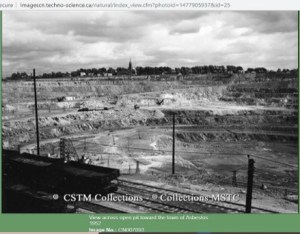
Our family had moved to Asbestos in 1945. Our house was very close to the Jeffrey Mine, perhaps about 300-400 yards from the largest open pit in North America.

Jeffrey Mine, 1952
Jeffrey Mine 1952 with St. Aime Church #3 visible.

When we arrived in Asbestos on that warm summer day, we began our visit in what was once our very modern St. Aime Parish Church, that still maintains the beautiful Casavant organ where there are occasional organ recitals. The church is now transformed into the town hall, a local library, and a mining museum. The young lady librarian was knowledgeable and helpful with information and some suggestions, one of them being to make certain we visit the lookout.

It was in the museum section that I took a careful look at the huge diorama and noted the many identified expansions of the pit. It was difficult to comprehend all the changes that had taken place over a span of nearly 75 years, from my earliest memories when we first arrived in Asbestos. The large diorama indicated where our home once was. All the childhood visions came to the forefront. This  created a deep feeling of loss, one that permeated most of that day.

We left the library and drove around looking for places and landmarks that might be remotely familiar. There were no traces of childhood haunts. They were long gone! Our house, our neighbour’s homes, the Main Office, the hospital, the school at the end of our street, the movie theatre, the bowling alley, the outdoor skating rink, the hardware store and so many other buildings along the main street have become a part of the history of the town now only to be seen in photographs! They are forever etched in our data banks, along with multitudes of childhood memories.

New areas were built away from the open pit as it grew and expanded.

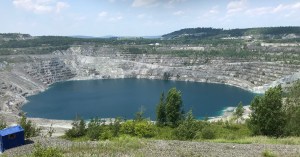
We ventured over to the lookout and we both gasped at the enormity of what lay before us. Once this giant hole was active with several 200-ton trucks moving in and out along paved roads carrying tons of crushed asbestos rocks containing fibres up to the mill for processing.  There were no more trucks or roadways. Today, the pit is simply referred to as “the hole” by the townspeople, silently, slowly filling with water.

Jeffrey Mine
Jeffrey Mine 2019
Photograph by Claire Lindell

At one point the mine was the largest single source of asbestos fibres in the world. Today the size of the pit is now close to 2 kilometres across and 350 meters in depth. Oh! so much bigger than in 1945.

The company ceased all operations in 2012 and the consequences were devastating for the industry and community. The production of Asbestos was banned throughout North America and Europe, noting that asbestos is a carcinogen causing cancer of the lungs and chest wall.

Over the last few years the town has been working toward attracting and developing new enterprises, creating new business opportunities.  One of the main companies to invest in the town is Alliance Magnesium. They are extracting magnesium from the residues. of 400 million tons of tailings from the mine, accumulated over a period of more than one hundred years.

Magnesium Ingot

Magnesium is a light weight mineral that is used in everything from medical implants to electric cars.  It is 34% lighter than aluminum. It will lighten the weight of automobiles. making them more efficient and better for the environment. At the museum we were able to handle one of the first ingots produced by Alliance Magnesium.

Hemp Insulation

Hemp farming has been introduced to the area with the intention of replacing various insulations made of fibreglass, plastic and foam. Hemp is eco-friendly and non-toxic, among its many other attributes.

Brome Lake Duck has invested $30 million to setup a processing plant raising Peking ducks, to meet the high export demand while creating 150 new jobs.  

A microbrewery, Moulin 7, named after the last working mill, has gained recognition through their award-winning beers. We had a delicious lunch in the pub. The décor has a mining theme and the beers have names such as La 1949. References to the strike and “White Gold”

…and the winner is

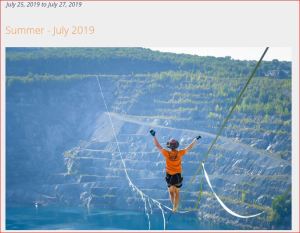
Another interesting tourist attraction is the Slackline that spans the width of the pit. There is an annual Slackline Festival attracting people from around the world. Last summer a young lady from British Columbia crossed without incident from one end to the other, the entire 1.66 kilometres in :58 minutes creating a new world record.

This record was broken on July 27, 2019, by Mia Noblet of British Columbia and Lukas Irmler of Germany. Both managed to cross a 2-kilometre (1.2 mi) slackline suspended more than 200 metres (660 ft) above the open-pit Jeffrey Mine in Asbestos, Quebec, during Slackfest, a slackline and highline festival. Noblet completed her crossing in 58 minutes.

Marian and I took one more quick drive around town and were pleasantly surprised at how businesses appear to be thriving. Success seems to be on the horizon.

We drove back to Montreal late in the afternoon, with a sense of satisfaction knowing that  my hometown has survived several setbacks over the years and now appears to be heading for success in new business ventures and perhaps a name change, or a new identity.

It will be interesting to follow the possibilities that lie ahead for Asbestos.

Sources:

Ducks

https://www.cbc.ca/news/business/duck-production-1.3731001

Hemp

https://www.ecohome.net/guides/3342/hemp-insulation/

https://hemplogic.blogspot.com/2018/03/hemp-insulation-comes-to-north-america.html

Identity

https://www.cbc.ca/news/canada/montreal/asbestos-quebec-change-name-1.5375703

https://www.asbestos.com/news/2016/11/07/asbestos-mining-town-canada-new-identity/

https://www.theglobeandmail.com/news/national/five-years-after-asbestos-mine-closure-quebec-town-seeks-new-identity/article31569391/

Magnesium

https://www.therecord.com/news-story/8352298-quebec-town-built-on-asbestos-may-find-new-life-in-byproduct-of-deadly-mineral/

Beatrice Bruneau Quiet Perseverance

IMG_0047
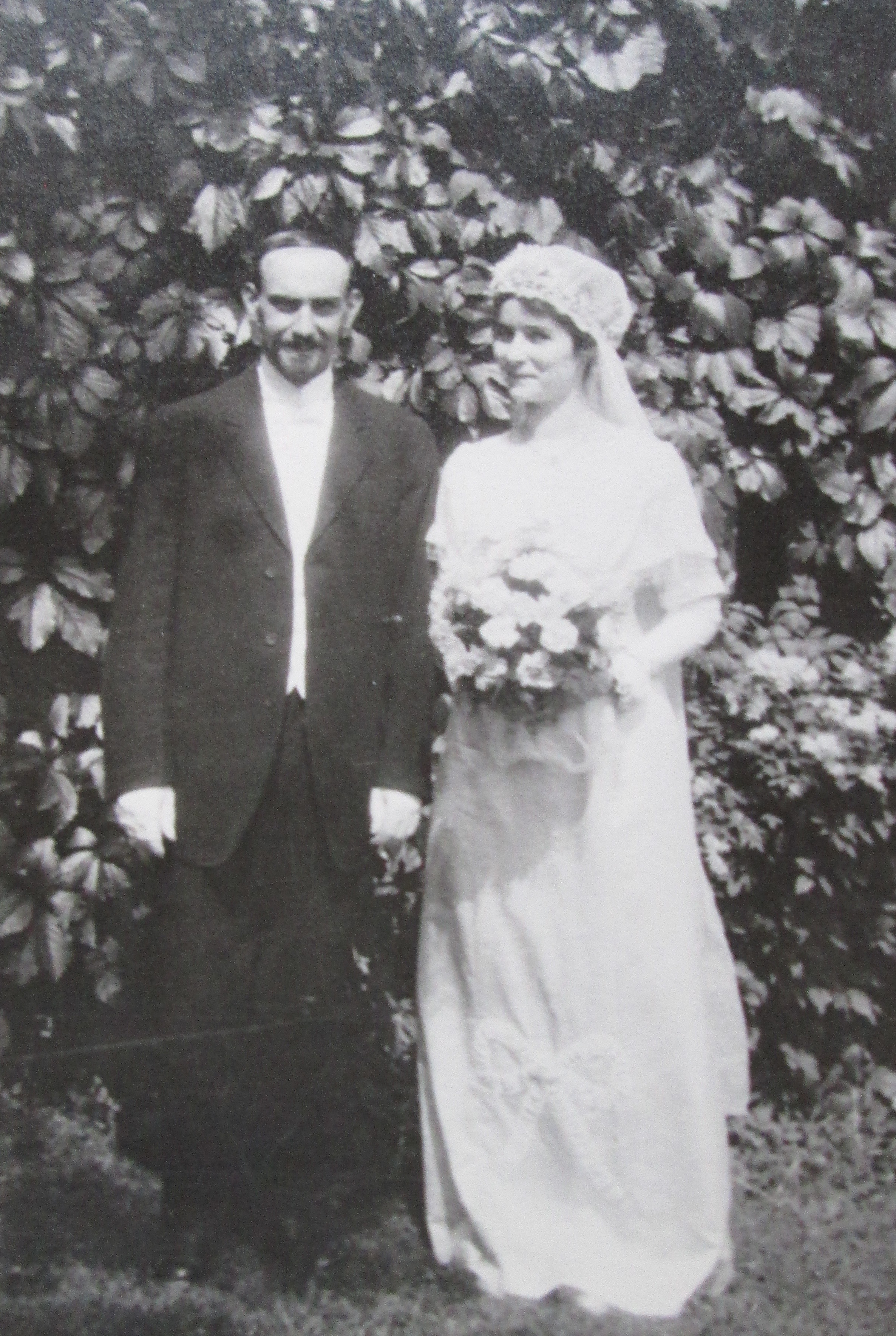
Rene Raguin & Beatrice Bruneau Wedding Day 1912

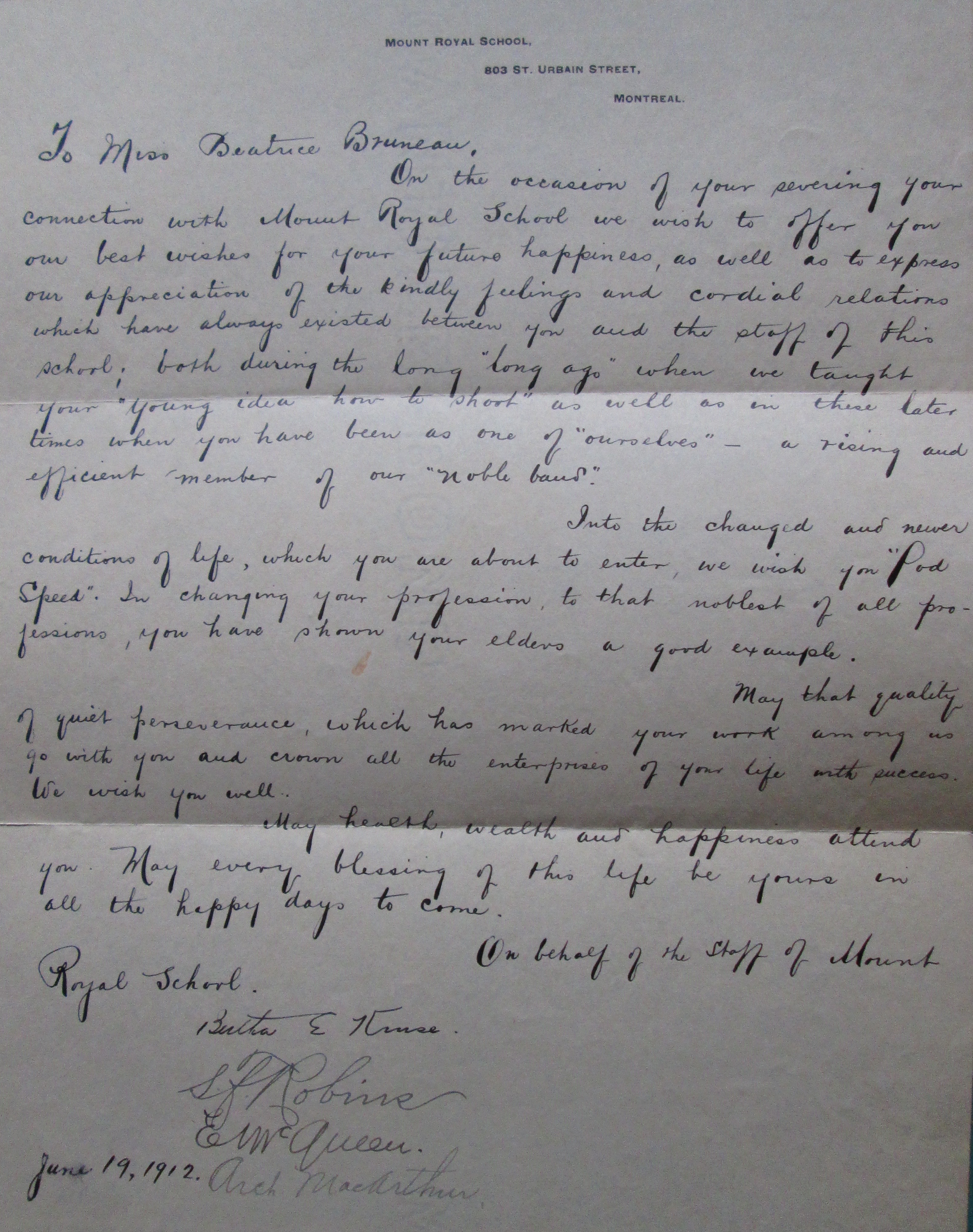
I am always looking through my files, searching for something I knew I had. Recently, I came upon a letter addressed to Miss C. Beatrice Bruneau, my grandmother.

“ In changing your profession to that noblest of all professions you have shown your elders a good example.” She left teaching to get married. “May that quality of quiet perseverance, which has marked your work among us go with you and crown all the enterprises of your life with success.” This one sheet of paper indicated a lot about her.

She was definitely my quiet grandmother, sweet and gentle. Grannie never raised her voice although sometimes she used firm words. My sister thought she had eyes in the back of her head, behind the two buns she always wore, so we couldn’t get away with anything. She always kept her hands busy, knitting socks or crocheting fancy potholders.

Although of French Canadian descent, Cecile Beatrice Bruneau (1889- 1967 ) was born in Green Bay Wisconsin. There, her father Ismael Bruneau, a French Presbyterian Minister, served a congregation of Swiss Protestants. Her mother Ida Girod, from the French part of Switzerland, had taught school in Baltimore, Maryland before getting married.

French Protestants were few and far between so the family moved a lot, from Wisconsin to Holyoke, Massachusetts, to Quebec City, and then Montreal.

IMG_0048
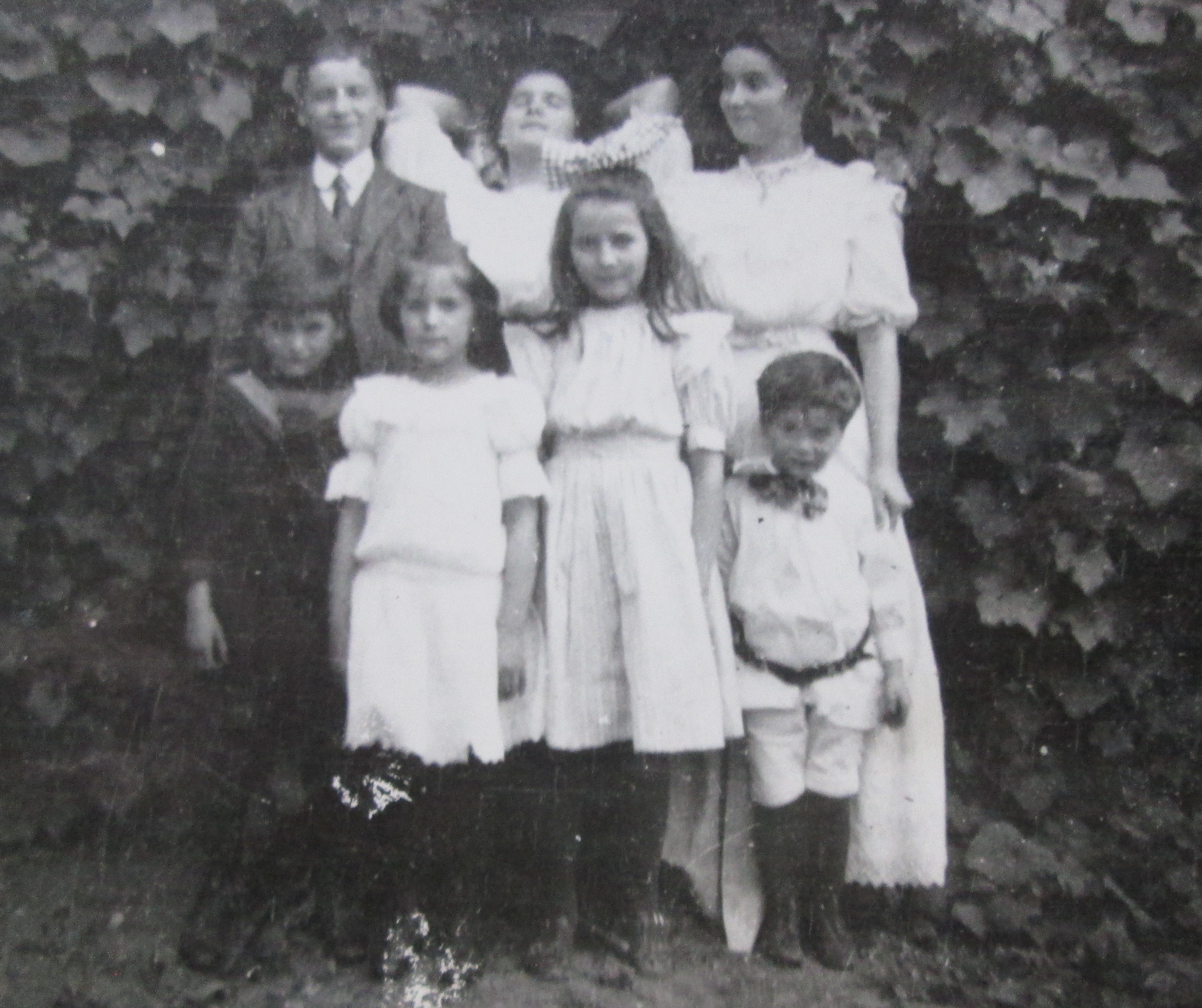
Some of the Bruneau Children; Sydney, Helvetia, Beatrice, Herbert, Renee, Edmee, and Gerald – Montreal 1907.

My grandmother did most of her schooling in Montreal. The family lived over the French Presbyterian Mission on Dufferin St (now De La Roche). The Mission was just north of La Fontaine Park, between Marie Anne and Mount Royal in an area now known as Le Plateau-Mont-Royal.

Beatrice, the oldest girl didn’t have an easy life, being a minister’s daughter, one of nine children and protestant in a catholic province. A minister didn’t make much money and the family relied on handouts from the church community. Two other protestant families lived on the block and according to her brother Sydney that marked them as an “unloved minority.” The sisters played happily with the neighbours but Sydney had a hard time. Small in stature the bullies followed him around.

There were no French Protestant schools available to them. The Catholics refused to have any Protestants in their schools and so English was the language of their schooling. After attending Mount Royal elementary school Beatrice went to The High School of Montreal. The five eldest children all earned scholarships from the lower schools so their parents didn’t have to pay fees.

The Bruneau children all received a good education. Beatrice went on to McGill’s Normal School, the Teacher’s College, where she received her teaching diploma. This program later moved from the downtown campus to MacDonald College in Saint Anne de Bellevue. She came 23rd out of 61 students and won the Superintendent’s prize in French. She received elementary and first-grade staff certificates and passed in cardboard work. Beatrice later earned her French Specialist certificate from the Protestant School Board. At that time, as they could only hire Protestants to teach in their schools, native French speakers had no problem finding a position. In 1907 Beatrice was hired by the Protestant Commissioners as a teacher without experience.

When Ismael and Ida made another move, this time to Cornwall, Ontario, Beatrice and two sisters, Herminie and Helvetia stayed in Montreal teaching in public schools. They all gladly left the crowded quarters over the mission hall to lodge with a fellow minister, a friend of their father’s.

The 1912 letter indicated that Beatrice had been teaching at Mount Royal School on St Urbain Street in Montreal, the same school she had attended. Her teaching career lasted only five years. She married Rene Raguin that July and never taught again. She quietly persevered in her family life looking after her husband and raising their five children.

IMG_0049

Notes:

Grannie told us one joke. I now realize it was connected to the area where she grew up. A woman was riding the bus up St Lawrence Blvd. The driver called out Rachel, the bus stopped and a woman got off. He then called out Marie Anne and another woman got off. The woman then went up to the driver and said my name is Suzanne, when do I get off?

Walking with God in Duquen, A. Sydney Bruneau 1960s, transcribed by his granddaughter Virginia Greene in 2017. A copy with the author.

The Gazette, Montreal Quebec, Canada. May 29, 1907, page 8. Downloaded Nov 16, 2019.

The Gazette, Montreal, Quebec, Canada. June 14, 1907, Page 12. Downloaded Nov 16, 2019.

Cardboard Work was part of the manual dexterity training in elementary schools. The children used cardboard to make boxes and made other things of raffia and plastic material while the high school students did woodwork and metalwork.

There is a church structure on De La Roche between Mount Royal and Marie Anne. According to the Montreal Tax role it was built about 1912, so after the Bruneaus left. It is now two residences.

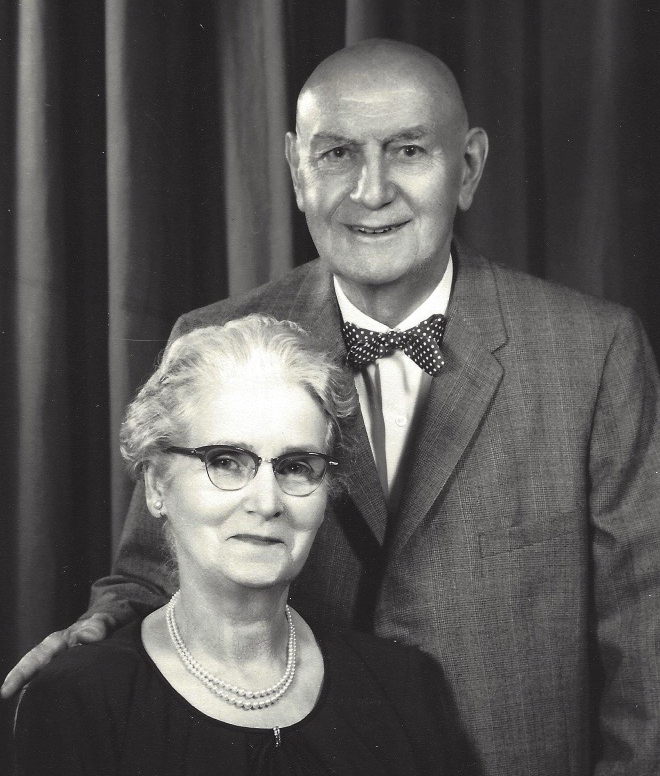
Rene & Beatrice 1961
Beatrice & Rene Raguin 50th Anniversary 1962

For a story about Beatrice’s father Ismael Bruneau see: https://wordpress.com/post/genealogyensemble.com/1237

For a story about Ida Girod, Beatrice’s mother see: https://wordpress.com/post/genealogyensemble.com/3674

Searching for Loyalist Orphans in Quebec

The Loyalist Orphans of Quebec under British Military Rule and Lower Canada

United Empire Loyalists were people who remained loyal to the British during the American Revolution (1765-1783), and settled elsewhere in British North America after the United States became independent. In Quebec, the Loyalists settled in various places from the Mauricie to the Gaspé, but primarily in the Eastern Townships, southeast of Montreal and near the American border.

Most of these families were poor and had gone through very hard times fleeing their homes. The difficulties involved with rebuilding their lives, clearing lands and erecting barns and houses in Quebec often resulted in the early deaths of parents. Their orphaned children were usually assigned to other families in the three regional Judicial Districts of Montreal, Quebec City and Trois-Rivières.

If you suspect you had Loyalist ancestors who came to Quebec, but it appears they simply vanished, notarial acts dealing with these orphans might help you break through your brick walls. The notarial documents known as tutelles and curatelles (guardianships of minors) are most likely to be helpful.

The attached compilation is a list of notaries who served during this time period and these places, and whose tutelle and curatelle acts might shed light on the lives of the Loyalist orphans. Click here: Searching for Loyalist Orphans in Quebec

Thank you to the Heritage Branch of the United Empire Loyalists’ Association of Canada for this info, passed on in a 2014 conversation with a member of the executive.

Key Terms:

The following are notarial acts or notarial expressions used in official documents which you might want to consider in your notarial searches of your ancestors in Québec and Lower Canada (Bas-Canada).

Curatelle – Judicial acts – Authority given to an adult individual by the Justice system (Regional Court House) or by an assembly of family members in order for the selected person to be the administrator of all assets, funds, capital for those who are not capable of managing their assets.

Testament – Wills and testaments

Tutelle – Authority given to a person by law or by the wishes of a testator or by an assembly of family members in order for said person selected to be the guardian of said emancipated minor and for said chosen person to be the overseer and administrator of all assets, funds, capital obtained through a will from his or her parents.

See also: Jacques Gagne, Genealogy Ensemble, Feb. 10, 2019, “Quebec guardianship records can help resolve brick walls,” https://genealogyensemble.com/2019/02/10/quebec-guardianship-records-can-help-resolve-brick-walls/

Some Geographic Background:

The first Loyalist families under British Military Rule arrived in Québec in 1777.  Loyalists from the Mohawk Valley appear to have been the first to arrive, settling along the shores of the Richelieu River near the town of St. Johns (St-Jean-sur-Richelieu) and in Montreal.

In 1779, Governor Frederick Haldimand assigned Captain Daniel McAlpin with the King’s Royal Regiment to oversee the establishment of the Loyalist refugees in British Quebec.

In the Montreal region, Loyalist families settled in Pointe-Claire, Lachine, and Montreal.

Along the shores of the Richelieu River, in addition to St. Johns, Loyalist refugee camps were organized in Chambly, Sorel, St-Ours, Sorel being the largest refuge in the region. A few miles away in Yamaska, a small group of Loyalist families were present.

Across the St. Lawrence River from Sorel, in the townships of Berthier and Yamachiche, a much larger group of Loyalists families were given temporary lands. The hamlet of Yamachiche became known to Loyalist families as Machiche. It became the largest temporary Loyalist settlement in Quebec. The settlement of Machiche was organized from two seigneuries which were the property of Conrad Gugy, secretary to Frederick Haldimand, Governor of Trois-Rivières and later Governor of Quebec.

The seigneuries owned by Conrad Gugy were the Seigneurie de Grosbois-Ouest, also known as Petite-Rivière-Yamachiche. In 1771, Gugy purchased a second seigneury, Seigneurie de Dumontier, which adjoined the Seigneurie de Grosbois-Ouest where the Loyalist camp of Machiche was organized.

South of Quebec City, in present day Beauce County, there was a small and short-lived Loyalist refuge referred to as Nouvelle-Beauce. It was along the banks of the Chaudière River near present-day St-Georges-de-Beauce.

Just north of Montréal, in the townships of Terrebonne and St-Eustache, a few Loyalist families settled on farms alongside former German mercenaries who had fought with British Regiments during the American Revolutionary War.

A few Loyalist families also settled in the Lower Laurentians in hamlets such as Lachute, St. Andrews (St-André-d’Argenteuil) and more to the east in St-Gabriel-de-Brandon, within the present-day district of D’Autray in the County of Berthier.

In 1784, a large group of Loyalist families settled in the Gaspé Peninsula and organized communities such as New Carlisle, Bonaventure, New Richmond, Carleton, Port Daniel and the Matapedia region.

Finally, the largest group of Loyalist settlers in Quebec were the families who were highly instrumental in establishing the Eastern Townships and of the communities on the Upper Richelieu River at Bay Missisquoi.

Loyalists were present within the Eastern Townships in St. Armand, Stanbridge, Dunham, Sutton, Farnham, Granby, Shefford, Stukely, Bolton, Brome, Potton, Stanstead, Magog, Hatley, Oxford, Ascot, Eaton and Clifton townships and also Foucault, Bay Missisquoi and Noyan on the shores of the Richelieu River at the U.S. – Canadian border.

http://www.biographi.ca/en/bio/gugy_conrad_4E.html

http://gaspesie.quebecheritageweb.com/article/loyalists-gaspesia-1784-1984

uelac.org/SirJohnJohnson/eastern-townships.php

Dear Miss Bulford …

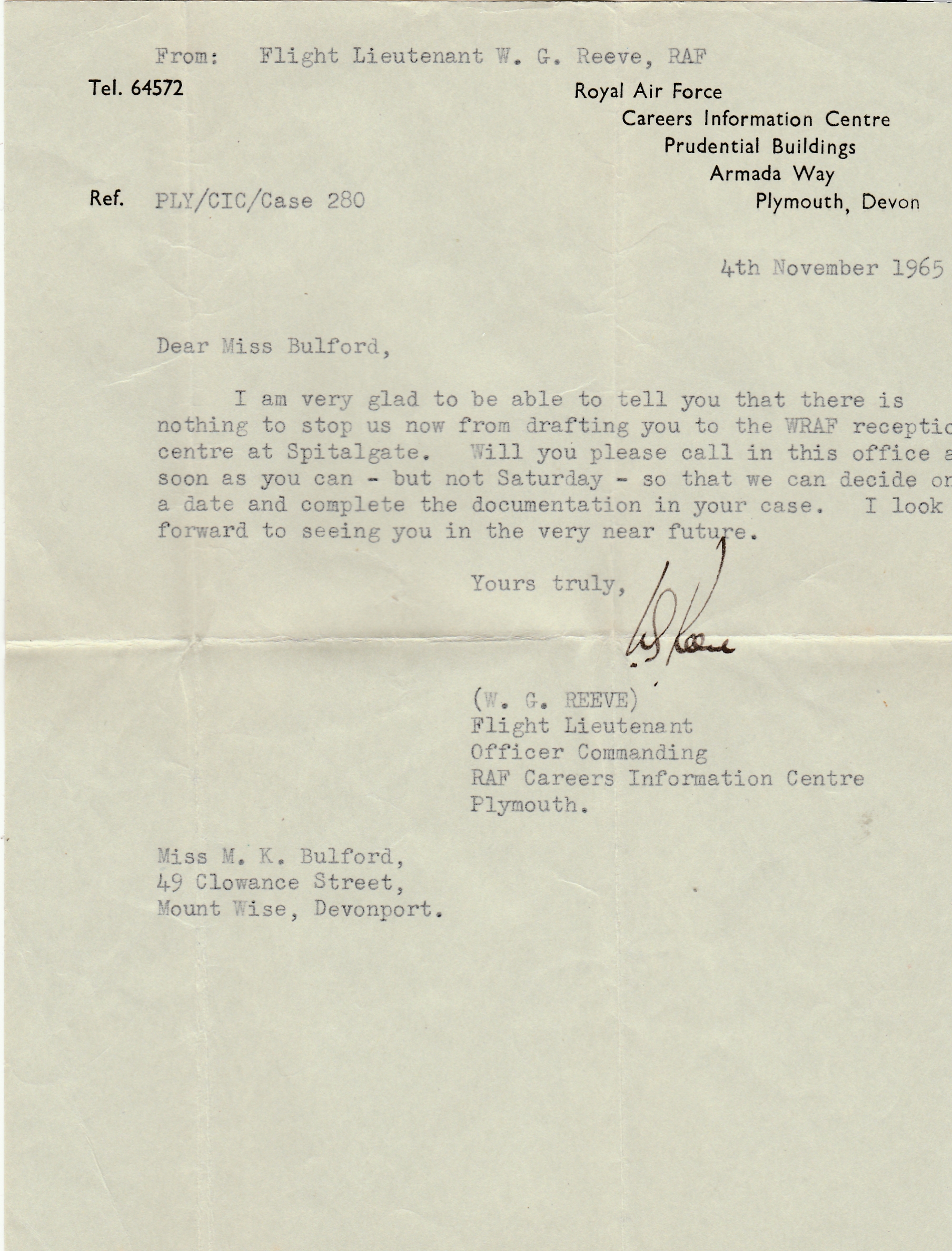
With the following letter, so begins the most exciting period of my life.

It came to a 19 year-year old me still living in Plymouth, Devon England the town of my birth. That version of me wanted something new. Having left school at 15 years and one month hardly qualified me for anything other than low-paid dead-end jobs, until, like most girls around me, marriage beckons.  Such was NOT the life I wanted, so I applied to join the Women’s Royal Air Force (WRAF). To my amazement, I got in.

Initially, it seemed a lark and a good way to show off to my friends. Still, joining up offered a chance to leave home with accommodation, a job and an ability to feed myself all at the same time. I had to take the chance!

Soon after the initial interview in Plymouth with Flight Lieutenant W. G. Reeve – above – As the letter states, my acceptance was based on passing a medical examination and a selection interview at RAF Spitalgate, In Lincolnshire. To travel there I was issued with travel documents and a kit list including an apron! Stockings! Suspender belt!.

Travel Warrant and Kit List for the journey. 

I left my home in Plymouth to Kings Cross railway station in London then a 4 and 3/4 hour journey. From there, another train from Kings Cross to Grantham, Lincolnshire railway station to join several other nervous-looking girls. We discovered a phone on the wall with the first order of our careers. It read:

“RAF SPITALGATE

NEW RECRUITS

PHONE FOR CAR”

Once on ‘camp’, our Corporal introduced herself and we were ushered into a room in a large building known as the barracks. This is where we would sleep and live together, for the next six weeks. It was a vast room with 10 beds either side spaced out with a locker and a wardrobe. Once we had deposited our luggage in our space, the Corporal took us to a cafeteria-like place called a mess for our tea and the food was really good!

The next day the medical assessments began. We had medical exams, Xrays, general fitness tests dental examinations and vaccinations. We started out with about 22 girls which whittled down to 17 after that first day. The next day, those of us who were formally accepted began our training. First, we were taught how to make a bed the RAF way, keep our ‘space’ clean and tidy enough to pass inspections every day.

Our bathrooms and toilets were at the end of the room. For many of us, this was the first experience of hot running water, baths every day plus central heating. After a few days, several of us developed sinus problems. Our bodies were used to cold houses, fires and baths only once a week.

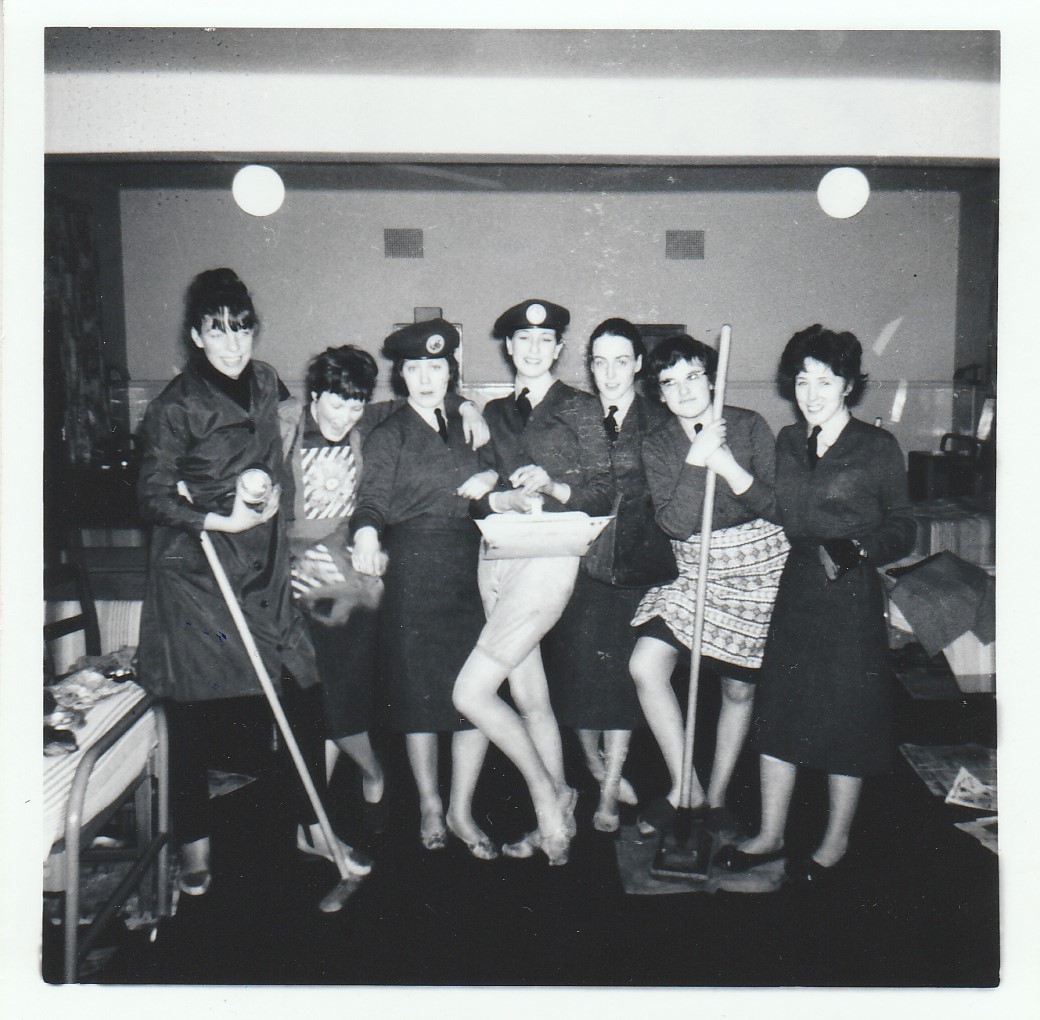
We soon developed a routine. Every Wednesday, we deep cleaned in a tradition called ‘bull night’. We pushed a large heavy flat ‘buffer’ side to side to polish the floors, A cumbersome task but good for the stomach muscles! We finished by putting newspapers on the floors because nobody was allowed to walk on those perfectly polished floors! We wanted everything shiny and bright the next morning at 6 a.m. inspection. Despite the hard work and need to adapt to new realities, we managed to have a lot of fun. 

We had parts of our uniforms issued over the next few days, including the laughable ‘passion killer’ knickers. We were each issued three pairs, pale blue, down to the knee and  I don’t think anyone wore them at all, except here, for one night only as a giggle. The photo below shows the ‘buffer’ we used to polish the floors to a high gloss. I’m the one holding the dustpan and a cigarette wearing the pale blue ‘passion killers’

For the next 6 weeks, we learned to wear our uniforms properly, tie our ties, make sure hair was off the neck and how to wear our berets and best blue hats. Most importantly, we learned how to salute an officer. That lead to discovering various badges and who to salute and who not to salute.

We were shown the NAAFI (Navy Army Air Force) shop where we were ordered to buy shoe polish, then taught how to clean our shoes to a very high gloss with spit and polish and repeated for hours on end

We learned how to march together, in order. That’s not as easy as it sounds. A few girls began as ‘camel marchers’  They were girls who just could not march at first. They tended to march with the left arm and left leg together, instead of the opposite.

We marched every day, and everywhere from day one, chanting left-right-left-right, halt out loud as we went! Each day we practised marching on the parade ground for one hour, then off to classes.

In class from 9am to 5pm we learned all about the history of the RAF, and the trades available, which uniforms to wear on which occasion (such as ‘fatigues’ and ‘best blue’) and how to keep our ‘kit’ clean. We had hygiene classes informing us how and when to brush our teeth, take a bath and keep ourselves clean. We had Pt classes to keep fit. It was exhausting and exhilarating. The morning after our first bull night, an officer inspected us the next morning with white gloves and ran her fingers along every surface. We had to stand at attention together, whilst she inspected our quarters. The first few weeks everything had to be ‘done over again’ as she ripped out sheets and blankets and shouted at us saying the beds were not made properly. She complained about the dirty surfaces and how dirty the bathrooms were. We could no nothing right those first three weeks. We had no uniforms yet, so every day we marched in ‘civilian’ clothing with just a beret on. We felt silly. 

It was a great day when we were eventually issued with our uniforms and full kit.

Our best blue uniforms at last! Me on the left.

After six weeks of basic training came our ‘Passing Out Parade’ and the next day, after our goodbyes, we were all posted to our various trade training camps, but that is another story!