The not-at-all wicked stepmother – Part 1 (The Unsung Hero)

Elizabeth Fulcher emigrated to Montreal, Quebec, from England in 1961 at age 23, to fulfill a teaching contract at a private girls’ school. Little did she know that within two years time she would marry my father, a widower 20 years her senior, and become step-mother to his four children aged six to 14.

Does the movie “The Sound of Music” come to mind? Perhaps…but we couldn’t sing and, thankfully, our father didn’t blow a whistle to discipline us!

July 1938 was a busy time at Friston Hall1, the village between Saxmundham and Aldeburgh, north of the river Alde in Suffolk on the East Coast of England. Elizabeth and her twin sister, Diana, were born and their sister Margaret (Maggie) was only 11 months old. They were often mistaken for triplets much to Maggie’s dismay.
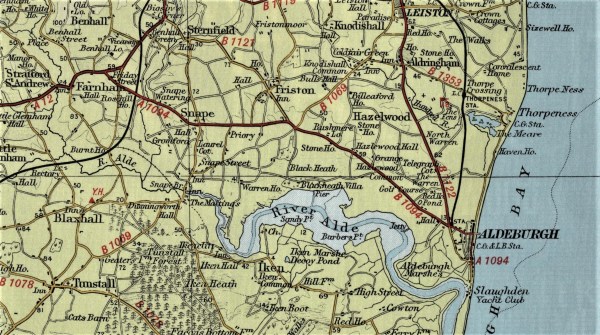
Map of Suffolk area near Aldeburgh with Friston (north of the River Alde ) and Iken (south of the River Alde)

Some six years later, during Hitler’s last offensive air attack during WWII, the empty family home was doodlebugged1 in August 1944. Luckily, all three girls were at their cousin’s birthday party.

Their father, Henry Fulcher (1906-1985), moved the family to one of the farm cottages while their mother, Tweedie Mann (1908-1952), retrieved whatever could be salvaged from the bombed main house. During their nine month stay in the farm cottage, they endured outside plumbing and indulged in weekly baths in a tub by the fireplace.

When Elizabeth and her family eventually moved back to the main house, they all slept together in the dining room, as the upstairs remained in shambles and the chickens occupied the lounge.

As the war raged on, families all over Britain managed their food frugally with coupons. The farm labourers “enjoyed” extra rations twice a year but they only lasted a week.

There was always enough food because we lived on the farm. At one point for breakfast, we each had a third of an egg on toast with a third of a rasher of bacon which was rationed. We would have cereal before this, so we weren’t hungry”.

Elizabeth’s father ran a small dairy farm in Friston as well as his father’s dairy and prize winning barley farm in Aldeburgh. He sold his father’s farm in 1948 to buy another in Iken five miles away across the river Alde. “Poplar Farm” consisted of 13 separate properties – three farmhouses and ten cottages – and 800 acres of land. The local milk truck collected the milk produced by the 60 Friesians1 (dairy cows) daily which supplemented the farm’s income from wheat, barley and sugar beet.

Around this time, the three young girls were sent away to St. Felix Boarding School2, some 30 miles away from the farm. Elizabeth, only ten at the time, remembers: “I didn’t like it there, as I was afraid of the teachers. I would cry every time someone spoke to me. I couldn’t remember the poems we needed to recite, and I couldn’t spell well either”.

Elizabeth, Margaret (Maggie) and twin Diana – 1949 – Poplar Farm, Iken, Suffolk, UK

Two years later, in 1950 when the twins were 12 years old, the birth of their brother Roger surprised the family. And just two years after his birth, while the girls were still away at boarding school, their mother died suddenly from polio.

Auntie Marion4 looked after Roger and Henry when Tweedie first died in July and stayed with us for the summer. We went back to school in September. We were worried about Roger, he was only three years old. Auntie Ophie came to look after Roger, but she had a bad temper, and our Father wasn’t very involved. No one said Roger had down syndrome, they just said he was slow.”

The whole class came to Poplar Farm for a picnic and a swim at Iken Cliff to celebrate the twins’ graduation from boarding school. One of their school friends, Judith, came as well and it was her mother Eileen who eventually married the twins’ father Henry in 1957.

Eileen stepped into multiple roles as Henry’s wife, farm accounts manager, step-mother (especially to Roger) and encouraged a more social lifestyle. As an example, she hosted a catered party for 120 guests for Elizabeth and Diana’s 21st Birthday.

Elizabeth, being more athletic than academic, excelled at sports. “The only people we knew growing up were farmers or teachers and we didn’t want to stay on the farm so we became teachers”. She pursued a degree in Physical Education at a teacher’s college in Aberdeen, Scotland while her twin attended teacher’s college in London.

After teaching for a couple of years in Aberdeen, Elizabeth wanted something more and accepted a job with the Trafalgar School for Girls in Montreal, emigrating to Canada in 1961.

And “more” was what she found!

1https://wiki2.org/en/V-1_flying_bomb as accessed 2020-07-17

2https://wiki2.org/en/Holstein_Friesian_cattle as accessed 2020-08-24

3https://wiki2.org/en/St._Felix_School as accessed 2020-07-17

4Auntie Ophie and Auntie Marion were Tweedie’s sisters
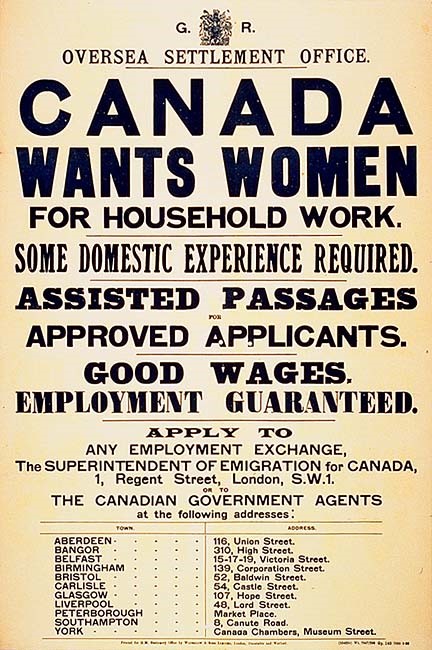
Good wages, employment guaranteed

Good wages. Employment guaranteed. These words echoed over and over again in Mary McHugh’s head. And only some domestic experience required. Mary thought that she had quite enough domestic experience, thank you, as she was the only daughter still at home.

It was 1910 and Mary had turned 20 in February.1 Old enough to be married. No prospects in sight. She had been working at the jute factory since she finished school at 14.2 Like her older brother, Thomas McHugh, she immediately got a job in the jute factory as soon as she could. Mary’s mother, Sarah McLaughlin, was happy that Mary was working as Sarah was a widow and still had three children at home. Her husband, Michael McHugh, had died of tuberculosis when Mary’s brother, Francis, was just three months old.3  It had been a struggle for Sarah to make ends meet. Even though Sarah had managed to get a job as a charwoman,4 it was not easy. Sarah was exhausted when she got home, too, and it was up to Mary to help with the housework and cooking for her younger brothers. Mary’s older brother, Thomas, was already married with six children. He helped when he could but he had his own worries.

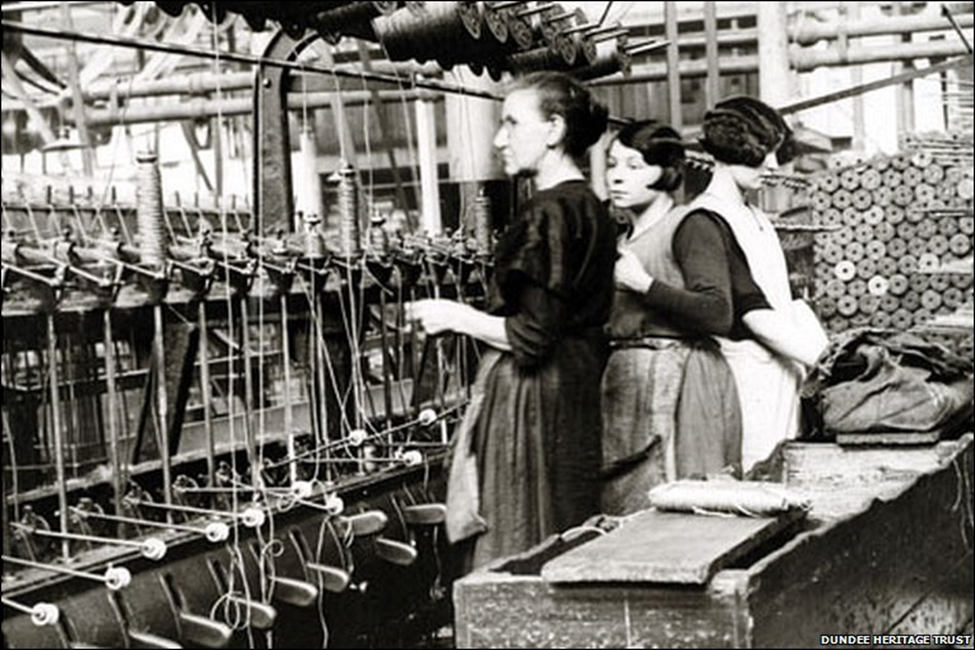
Mary thought ruefully about her job. She was a jute spinner at the flax mill.5 The mill was noisy and crowded. Mary worked twelve hours a day and it was back-breaking work. The women worked hard in the mills but made less wages than the men. The machines were dangerous. Accidents happened often.6 And then there was mill fever or brown lung. Most people who worked in the mill had a dry cough and sometimes even a fever.7

Mill Workers

Photograph from the BBC8

Mary liked the idea of being a domestic. The hours would be long and she would be on her feet all day but the air would be clean and it would be quiet. But Canada? So far away? All by herself? Could she do it?

These thoughts were the beginning of Mary’s plan to emigrate to Canada. Mary McHugh was my great aunt and she arrived on the S.S. Grampion that sailed from Glasgow and arrived in Quebec City in July 1911.9

In the early 1900s the demand for domestic servants in Canada exceeded the number of young Canadian women willing to do this type of work. Governments, employers, and women’s organizations made a special effort to encourage the immigration of household workers.8 More specifically, British immigrants were considered as desirable immigrants to Canada. As of 1888, steamship agents received a bonus for selling the passage of a female immigrant whose intent was to work as a domestic servant in Canada. This was called the British Bonus and it came into effect by an Order-in-Council on September 27, 1890. Its purpose was to offer an incentive to desirable British immigrants. Often the Canadian employer would pay the fare of the immigrant to the steamship company.10 The emigrating domestic would then have to pay it back out to her employer out of her wages. This meant that the young immigrant woman was already indebted to her employer even before she started working. If she was unhappy with her employment, it made it difficult for her to find a better employment as long as she owed money.11

It is probable that Mary’s fare to Canada was paid by her employer. Beside Mary McHugh’s name on the passenger manifest of the Grampion there is a stamp British Bonus Allowed.

Hopefully Mary enjoyed her employment. She was the first member of the McHugh family to arrive in Montreal in 1911. She was probably delighted when her mother, Sarah, and three brothers, Thomas, Edward and Francis, followed her to Montreal in May 1912. And Thomas’ wife, Elsie Orrock, and their seven children, Ann, Elsie, Sarah, Francis, Mary, Adam, and Thomas arrived in October 1912. Mary married John Mervin Porter in June 1913 and her family would have been there to celebrate with her.


Notes and sources:

This poster from the Canadian Museum of History is from a 1926 pamphlet entitled Housework in Canada: duties, wages, conditions and opportunities for household workers but there would have been similar pamphlets advertising for immigrants that may have given Mary the idea.  This pamphlet says that “Canada welcomes men and women of the right type who come to seek their fortune in this broad new land … (people) of good moral character, and in good health, mentally and physically.” You can see this on the Canadian Museum of History web site in the section Advertising in Britain in the 1920s, https://www.historymuseum.ca/cmc/exhibitions/hist/advertis/ads7-06e.html

Household work

  1. Scotland’s People, Register of Births, Mary Ann McHugh, born February 4, 1890, accessed November 18, 2017.
  2. Wikipedia web site, History of Education in Scotland, https://en.wikipedia.org/wiki/History_of_education_in_Scotland, accessed August 17, 2020.
  3. Scotland’s People, Registers of Death, Michael McHugh, died May 16, 1895, accessed November 27, 2017 and Scotland’s People, Registers of Births, Francis McHugh, born February 21, 1895, accessed November 27, 2017.
  4. Scotland’s People, 1911 Census, Sarah McHugh, 1 Tait Lane, Dundee, Scotland, accessed February 15, 2018.
  5. Scotland’s People, 1911 Census, Mary McHugh, 1 Tait Lane, Dundee, Scotland, accessed February 15, 2018.
  6. DD Tours web site, Workers of the mills, September 16, 2014, https://www.ddtours.co.uk/archive/workers-of-the-mills/, accessed August 17, 2020.
  7. com web site, Byssinosis, https://www.healthline.com/health/byssinosis, accessed August 19, 2020.
  8. BBC web site, Tayside and Central Scotland, The history of mills in Dundee, December 2, 2009, http://news.bbc.co.uk/local/taysideandcentralscotland/hi/people_and_places/history/newsid_8390000/8390747.stm, accessed August 17, 2020.
  9. Passenger list, S.S. Grampion, July 1911, Glasgow – Quebec City.
  10. British Bonus Paid, British Home Children web site, https://www.britishhomechildren.com/single-post/2014/11/09/British-Bonus-Paid, accessed August 18, 2020
  11. Barber, M.J., Immigrant Domestic Servants in Canada, Canadian Historical Association, Ottawa, 1991, p. 9

Phineas Rixon and His Three Wives

Do you have a photo of Phineas? I am writing a family history book, and would love to include his picture, but I’ve never come across one. If you can help, please contact me at janhamilton66@gmail.com.

Farmer Phineas Rixon and his wife Barbara had been out doing errands in town. After they returned home, he was getting ready to do chores when he was stricken by a heart attack. The doctor came, but Phineas never regained consciousness. He died two days later, age 78, on Friday, September 9, 1938, on the farm he had operated for almost 40 years.

The local newspaper, The Colborne Express, reported, “the large number floral tributes and friends present [at the funeral] showed the high esteem in which he was held.”1

These few facts about his last days are the most detail I found about my great-great uncle’s long life. Phineas seldom moved far from his birthplace in rural Northumberland County, Ontario, a few miles from the shores of Lake Ontario. However, considering that his first two wives and his daughter predeceased him, and that he married a third time at age 76, his home life must have had its ups and downs.

Phineas (also spelled Phinehas, Phenas, and other variations) was born on May 8, 1859,2 the son of Martha Rixon and probably of her cousin Thomas Rixon.3 His unmarried mother moved to the United States when he was about nine, leaving him and his sister Samantha (my great-grandmother) to be brought up by their grandparents, Thomas and Betsey Rixon, on their farm in Cramahe Township.

It is not clear where Samantha and Phineas lived after their grandparent’s deaths; by then they were teenagers, and they likely stayed with relatives.

In 1878, Phineas joined the militia and was listed as a private in the 40th Regiment Northumberland. He next appeared in the 1880 U.S. Census (as “Fenis Rickson,”) working as a labourer in Michigan. He must have stayed in the United States for at least a year as he was not counted in the 1881 Census of Canada.

At age 24, he married 18-year-old Almeda Warner, daughter of John Warner and Harriet Morden. Phineas’s and Almeda’s daughter, Samantha Almeda Rixon (usually known as Mattie or Medie,) was born in June, 1884. Almeda died of typhoid fever in December, 1897, aged 32, leaving Phineas with a 13-year-old to raise and a farm to run on his own.

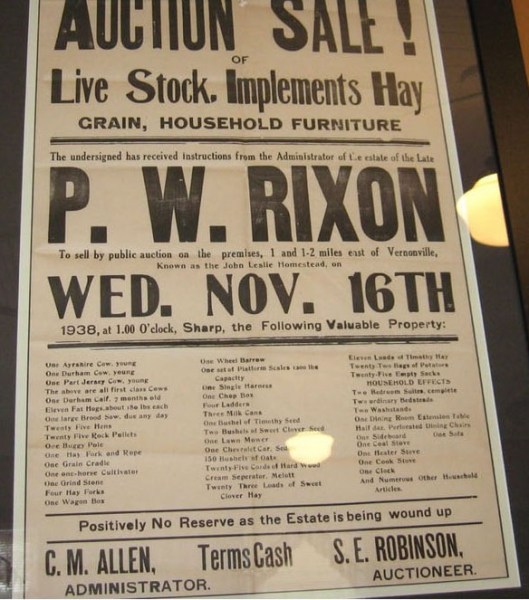
Within four years, Phineas had remarried. The 1901 census showed Phineas, 41, married to Mary Leslie, 34. With them were his daughter, Mattie, 16, and Mary’s mother and her two sisters, both in their twenties. He had also moved from Cramahe Township to lot 6, Concession 4, Haldimand Township.4 An advertisement for an estate auction held soon after Phineas’s death said the auction would be held on the John Leslie Homestead, about a mile east of the village of Vernonville, so Phineas and Mary must have lived on what had been her parents’ farm. 

Phineas and Mary were married for about 30 years. After she died in January, 1931, he remained single for the next five years. In May, 1936, he remarried. His third wife was a widow, Barbara Jemima (Haynes) Cowey.5

Phineas was buried in Castleton Cemetery, Cramahe, Northumberland County, with his first wife and his daughter. Medie, who was married in 1906 to farmer Claude Tweed and had six children, died in 1915.  Barbara, died in 1939, age 73.

Photos: courtesy Gabrielle Blaschuk

Sources:

1. The Colborne Express, Thursday Sept. 15, 1938, p. 1.

2. Year: 1901; Census Place: Haldimand, Northumberland (West/Ouest), Ontario; Page: 3; Family No: 26. Ancestry.ca, 1901 Census of Canada (database on-line, entry for Phineas Rixon, accessed Aug. 9, 2020,) citing Library and Archives Canada. Census of Canada, 1901. Ottawa, Ontario, 2004, Series RG31-C-1, Statistics Canada Fonds, Microfilm reels: T-6428 to T-6556.

3. This complex story is recounted in the following two posts:

“The Ancestor Who Did Not Exist,” Writing Up the Ancestors, April 11, 2017, http://writinguptheancestors.blogspot.com/2017/04/the-ancestor-who-did-not-exist.html

“Martha J. Rixon’s Short and Difficult Life,” Writing Up the Ancestors, May 14, 2017, http://writinguptheancestors.blogspot.com/2017/05/martha-j-rixons-short-and-difficult-life.html

4. Reference Number: RG 31; Folder Number: 74; Census Place: 74, Northumberland, Ontario; Page Number: 7, Ancestry.com. 1921 Census of Canada (database on-line, entry for Phineas Rixon, accessed Aug. 9, 2020,) citing Library and Archives Canada. Sixth Census of Canada, 1921. Library and Archives Canada, 2013, Ottawa, Ontario. Series RG31. Statistics Canada Fonds.

5. Archives of Ontario; Registration of Marriages 1936; Ontario, Canada, Marriages, 1826-1938, online database, Ancestry.ca and Genealogical Research Library (http://ancestry.ca, accessed Aug. 4, 2020,) entry for Barbara Cowey, citing Ontario, Canada, Select Marriages, Archives of Ontario, Toronto.

Petunias and Brown Betty

A singular memory of my childhood is the summer I spent with my Angus grandparents in Quebec City. I was nine years old.

My family had moved to La Tuque several months before my sister’s birth. The move, a difficult pregnancy, and a three-day labour left my mother exhausted. Caring for a new- born and two school age children set free for the summer was overwhelming. In an effort to help out, my grandmother invited me to come to Quebec.

My grandparents lived in a third-floor walk-up apartment on St. Cyrille Blvd. (now Rene Levesque) at the corner of Maple Ave. During the Depression, they moved from an elegant home on Fraser Avenue while my grandfather fought to save his book store. The store eventually failed but my grandparents remained in the apartment until my grandfather’s death.

A large porch extended the full length of the apartment overlooking the street below. The sun shone down on it all morning so Grandpa planted petunias in boxes that grew into a beautiful profusion of pinks, lavenders and burgundies. My job that summer was to water and deadhead, a responsibility I took very seriously. “A new blossom will not grow until the dead one is removed”, Grandpa explained. “We want lots and lots of blooms.”

The various rooms of the apartment were strung out along a narrow hallway stretching from the front door to the back bedroom: an elegant parlour with life size china dogs standing sentinel on either side of an artificial fireplace; a very large dining room with several china cabinets and a table for twelve; and a sitting room with three walls lined with books salvaged from the store that were the core of my grandmother’s lending library. There was a bathroom and two bedrooms, the largest of which looked out on the city stables. How I loved to watch the caliche horses going and coming each morning and evening. I imagined them to be my very own and gave each one a name.

Then there was the kitchen tucked into the middle of the flat. It was a very tiny room, only big enough for a stove, a fridge, an ironing board that dropped from the wall, and the food prep table where my grandmother sat to work her daily cross word puzzle. The sink was folded into a back corner beneath a set of cupboards. The dark, cramped room had but one window in the door leading to the back porch and another in the walk-in pantry. How different from my Willett grandparents’ large, sunny farm kitchen in the Gaspe that housed not one but two stoves and a pair of day beds.

Yet it was in this tiny kitchen that my grandmother cooked daily meals for two (three that summer) as well as large family meals for various holiday occasions: Christmas, Easter and Thanksgiving. She carried dishes of food through the swinging door into the dining room in what I now recognise as priceless Spode and Limoges bowls and platters. Nothing was served onto plates in the kitchen and brought to the table. Glasses and desert dishes were cut crystal. I even ate my morning boiled egg from a silver cup. Such a little princess.

Lazy summer afternoons were spent in the park. A friend and I would meet there, walking by ourselves from our homes, carrying our dolls and their accessories along with several umbrellas. The umbrellas served to demarcate the various rooms of our “doll house”. Who today would allow two young girls to spend an afternoon alone in a park? The caliche drivers came to know us and would wave, pointing us out to their tourist passengers as a quaint part of the old city.

I walked a lot that summer – my grandparents didn’t own a car. I walked with my grandmother to buy groceries on Cartier Avenue or dolls’ clothes at Woolworths on St. John’s Street. I walked with grandpa to Earl Grey Terrace to watch ships sailing the St. Lawrence to and from exotic ports. On Sundays I walked to church with both of them. The Sundays that babies were baptised were the best. As a church elder, Grampa would walk the family to the font and stand, straight and proud, while the minister performed the ceremony.

Evenings were spent reading, doing puzzles, or completing paint-by-number kits. My grandparents didn’t have a television – televisions were still too new and expensive. Sometimes on our walks Grampa and I would stop and watch the news on a TV in a store window. I don’t think Grampa would ever stoop to that if he were alone. I was the excuse for him to take a peek.

I learned to cook that summer in the tiny kitchen. My grandmother must have had the patience of Job. How much faster and easier it would have been to do it herself. Apple Brown Betty became my speciality. Eventually I could peel and slice the apples myself, measure and mix the flour, oats and brown sugar, and work in the butter with my fingers. The final touch was the nutmeg grated by hand over the top before the desert went into the oven. So delicious served with a slice of ice cream!  Remember, Ice cream was purchased in a brick-shape wrapped in cardboard.

The days passed slowly with a pleasant and predictable sameness. I was loved and indulged. Before I knew it, it was time for me to return home.

I would be sixteen when next I lived with my grandparents for my final year of high school. Although I loved being back with them, life was never again as simple as the summer when I was nine.


Slavery in New France in the 17th & 18th Centuries

August 1, 2020, Emancipation Day in Canada

In 1734, a huge fire destroyed part of Montreal. Marie-Joseph Angélique, a black slave, was accused on setting the fire deliberately as she tried to escape from her owner. She was arrested and found guilty, then she was tortured and hanged and her body was burned.

Angélique was one of many slaves, some black, others Indigenous, in New France.  Slavery was legal in Canada for more than 200 years. The Slavery Abolition Act brought an end to chattel slavery throughout the British Empire, coming into effect on August 1, 1834 in Britain, Canada, and several other colonies.

The attached PDF  Slavery in New France   is a 23-page research guide to the topic of slavery in New France in the 17th and 18th centuries. It contains the following contents:

Page 2     A link to a complete online copy of the book L’Esclavage au Canada français – 17e et 18e siècles” (in French) Author: Marcel Trudel – 474 pages Publisher- Les Presses Universitaires Laval, Quebec, Canada 1960

Pages 3-17    A List of authors who have written about slavery in Canada

Page 17- 20       Repositories in Quebec

Pages 21-22     Various online sites

Pages 22-23     Publishers