My Parents’ Courtship

As a child, I never imagined what life was like before my parents had my brother and me. But once in a while they would talk about their courtship and what it was like to meet right after World War 2.

When war broke out in 1939, my dad, Edward McHugh, signed up right away. He was stationed in Yorkshire, England and only returned home when the war ended in September 1945. He was already 31 and normally would have been considered a confirmed bachelor.

My mom, Patricia Deakin, would often speak about the day the war ended. She worked for the Sunlife Insurance Company of Montreal. The Sunlife Building was located on Dominion Square in downtown Montreal. When word got out that Germany had surrendered, all of the office workers in downtown Montreal just left their offices and walked out into the streets to express their joy. My mom described it as an amazing outburst of pure joy and celebration of the end of a long and painful war.1

Celebrations in the streets of Montreal at the end of WW2

When Edward went to war, he intended to return to work for his employer, the Canadian Celanese located in Drummondville and his employer had guaranteed his employment. However, my dad decided to stay in Montreal.

At that time, my mom’s brother, Jack Deakin, was dating Norine Scott. Norine and Patricia became great friends. The picture below shows them in the Laurentians for a day of skiing.

Norine Scott (left) and Patricia Deakin at the ski hill

Both the Canadian National and the Canadian Pacific operated trains from Montreal to the Laurentians, known as the “snow trains,” otherwise known as the P’tit train du Nord.2 Below is one of the Canadian Pacific posters.3
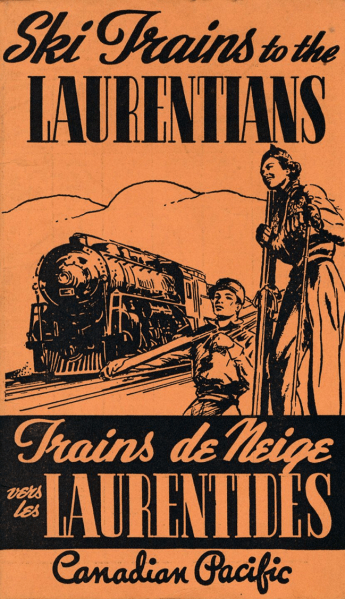
Promotional poster for snow trains

It wasn’t long before Norine introduced her young and eligible Uncle Eddie to my mom and that was the beginning of their courtship.

Both Ed and Patricia loved going to the movies and their Saturday night dates were often a meal at Bens Delicatessen, followed by a show. Bens was a well known delicatessen in Montreal that was famous for its Montreal-style smoked meat. In 1908, Benjamin Kravitz and his wife Fanny Schwartz opened a sweet shop on Saint-Laurent Boulevard and then added sandwiches, using Benjamin’s mother’s recipe. In 1929, they moved to 1001 Burnside (now de Maisonneuve), in the theatre and night club district of the city, and then to their final location in 1949.4

Bens Store Front5

My parents were married on May 21, 1949 at St. Columba Anglican Church in Notre-Dame-de-Grace. This church was built in 1920 but has now been sold to a developer.6 My grandparents would have been parishioners of the church as they lived just 10 minutes away.7 The post WW2 period was marked by a housing shortage. Pressure on the housing shortage was due to demobilized soldiers returning home, and the increase in newly created families. My parents, like many post WW2 newlyweds, lived with my grandparents after the wedding.
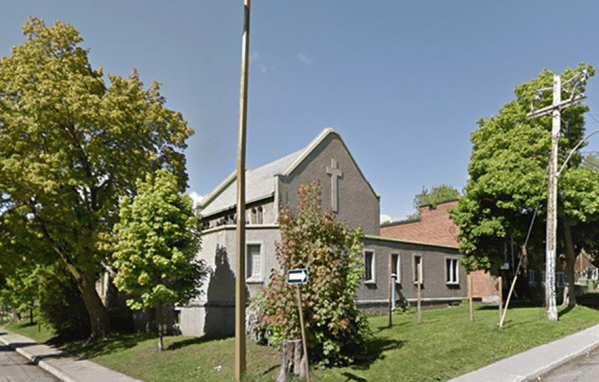
St. Columba Anglican Church, Notre-Dame-de-Grace, Montreal

The wedding announcement in the Montreal Star on May 30 1949, describes the bride as wearing:

“A gown of white slipper satin made with nylon yoke on Grecian lines and with train. Her veil was of tulle illusion, was finger tip length, held with a bandeau of lilies of the valley and orange blossoms. She carried a cascade bouquet of white carnations and bavardia.”8

The wedding announcement goes on to say that the reception was held at the Montreal West City Hall, in the music room. This photograph of the wedding party is probably taken outside the Montreal West Town Hall.

From left to right: Alistair Lamb, Mary McHugh, Ronald Lamb, John Deakin, James Meikle, Edward McHugh, Patricia Deakin, Melba Jones, Norine Scott, Dorothy Newcombe, Grace Hunter, George Deakin

The wedding announcement continues:

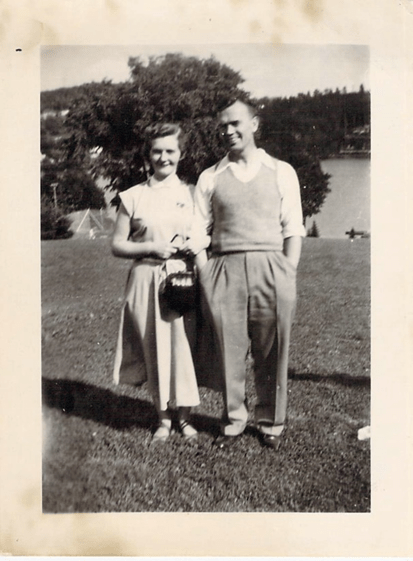
“Mr. and Mrs. McHugh went to Pleasant View Hotel, North Hatley, for their honeymoon, the bride wearing for travelling a three-piece suit of beige Scotch mist, with white straw hat and green accessories and a corsage of white carnations.”9

Founded in 1897 and located on Lake Massawippi, North Hatley is one of the prettiest villages in Quebec.10 Below is a post card of the Pleasant View Hotel:11
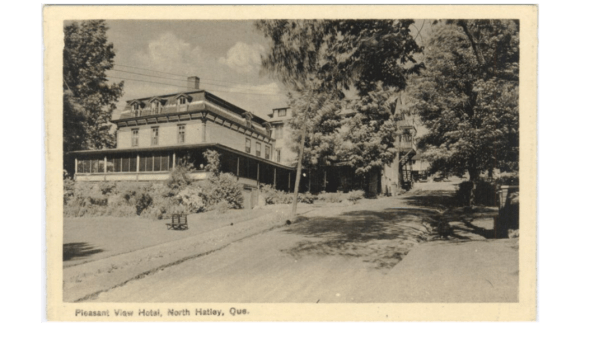
Pleasant View Hotel, North Hatley, Quebec
Patricia Deakin and Ed McHugh, North Hatley
  1. Courtesy Cadeau, C, All About Canadian History, The End of World War II in Canada, Montrealers celebrate VE Day, https://cdnhistorybits.wordpress.com/2015/11/11/ve-day-vj-day-canada/, accessed 29 November 2022.
  2. Baladodiscovery.com, Saint-Sauveur History, https://baladodiscovery.com/circuits/900/poi/10159/saint-sauveur-history, accessed 27 December 2022.
  3. Pinterest, Kirill Blinov, accessed 26 December 2022.
  4. Wikipedia, Bens De Luxe Delicatessen, https://en.wikipedia.org/wiki/Bens_De_Luxe_Delicatessen_%26_Restaurant, accessed 7 December 2022
  5. Stanton, Michael, 2005
  6. Memento Heritage Montreal, St. Columba Church, https://memento.heritagemontreal.org/en/site/st-columba-church/#:~:text=Built%20in%201920%2C%20the%20church,the%20Polish%20and%20Korean%20communities, accessed 27 December 2022.
  7. Lovells Directory, 1949, Deakin, page 1120, accessed December 20, 2022.
  8. Newspapers.com, McHugh-Deakin wedding announcement, 30 May 2022, accessed 22 November 2022.
  9. Ibid.
  10. Eastern Townships, North Hatley, Things to Do in North Hatley, https://www.easterntownships.org/towns-and-villages/45050/north-hatley#:~:text=Founded%20in%201897%2C%20the%20village,village%20centre%20are%20all%20unique., accessed 28 December 2022.
  11. Pleasant View Hotel, North Hatley, Quebec, Photogelatine Engraving Co. Limited, 19?, Bibliothèque et Archives nationales du Québec, 0002643996, accessed 28 December 2022.

Dusty Old Boxes

*Note: This seemed like the perfect time to publish this story again. If you’re lucky, you may inherit a box of family papers someday…and if you’re smart, you will take the opportunity to ask for them when you see everyone over the holidays!

************************************************************************

The latest de-cluttering expert tells us to keep only things that give us “joy”1. All other items should be thanked for their purpose or memories and then given away. At the end of this challenge all that should remain are the things that spark joy in us!

We are told to start with clothes, then books, kitchen cupboards and desktops. Only then, after all that practise detecting feelings of joy over an item, will we be ready to tackle family photos and personal memorabilia.

On the highest shelf of my largest cupboard were three dusty old boxes that I inherited many years ago. They were to be the last step of my de-cluttering project!

I slowly opened the lid of the first box finding lots of old photographs, mostly black and white, some labelled and others not. The first handful of photos was mostly of loving couples and family reunions at the dinner table. Others showed groups of people standing proudly on the front step of a house (a new home perhaps?). The next scoopful were of children at play – sometimes holding family pets in their arms. Another handful produced proud young adults smartly dressed in various uniforms – perhaps starting a new job or ready to go to war. The last bunch showed lazy days on sandy beach holidays, numerous birthday party celebrations and Christmas gatherings.

Frozen moments captured in time from so long ago for me to enjoy now. It all felt so precious. I very gently placed the photographs back, undisturbed, into that first box.

Nothing to be given away.

The second box was filled to the brim with letters and cards. Some still neatly tucked into their envelopes, others held together with yellowing scotch tape and looking well fingered. Most of them had handwritten messages in big loopy writing that was difficult to read. The stamps alone told another story postmarked from places and dates from years ago. Among the letters were also children’s drawings, thank you notes, lists of party guests, festive menus and various well loved recipes.

But my very favourite find in this box were the love letters, written with such passion and lovingly folded into perfect little rectangles and decorated with doodled hearts.

Nothing to be given away.

The last box contained newspaper clippings announcing family births, deaths, weddings and other special events from all my ancestors over the years. And then, underneath all that newspaper, I discovered more treasures!

First, my grandmother’s monogrammed lace handkerchief with a tiny baby’s christening dress complete with a lock of hair tied in a ribbon and stored in a small envelope. Then I picked up the old school primer (book) and several dried flowers fell to the floor. Neatly stored in the bottom were numerous diaries filled with daily messages with the writing continuing up the sides of each page. Finally, carefully folded in tissue paper was an old sampler stitched by my ancestor, as a young girl two hundred years ago. Several of my family’s treasures (and perhaps a little piece of them?) had been lovingly preserved in this last box.

Nothing to be given away.

As I closed the lid on the last box, it dawned on me that someone had already sorted the family memorabilia into those three separate boxes, leaving me to find…three dusty old boxes of pure joy.

1 Spark Joy by Marie Kondo

Fur Trading in Northern Canada – Part 1

Royal Charter 1.

“Have you in the past ever shopped at Morgan’s Department store in downtown Montreal or at a major department store in downtown Toronto? Maybe you ventured to New York City and made a purchase at Saks Fifth Avenue or Lord and Taylor? “

“Did you know that all these stores have a distinct connection? One company that has been in existence for many years owns these stores. Have you any idea what company that might be?”

“If you ventured a guess and came up with The Hudson Bay Company, you would be right-on.”

The famous fur traders, Medard Chouart Des Groseilliers and Pierre Esprit Radisson, my eighth great uncle, were both born in France and arrived in New France in the mid- 1600’s. Fate brought them together and their explorations were instrumental in developing the fur trade in the young colony. Through their efforts they were the driving force leading to the creation of the Hudson Bay Company more than 350 years ago.

The Early Beginnings of the Company

In 1660, Prince Rupert introduced Pierre-Esprit Radisson and Médard Chouart Des Groseilliers to his cousin, King Charles II of England who eventually received them in his court. They informed him of the “great store of beaver” in an area far north of the St. Lawrence River 2.

The explorers proposed a trading company where they would be able to access the northern interior of the continent by sailing into the waters of Hudson Bay and James Bay. Prince Rupert financed a trip for Des Groseilliers and Radisson to sail to Hudson Bay. Radisson’s ship was forced to turn back off the coast of Ireland. He managed to return to London,3 while Des Groseilliers continued to Hudson Bay and into James Bay where he traded furs with Cree hunters. He returned with a boatload filled with beaver pelts and  noted that “Beaver is plenty”.3.

A map of Hudson Bay

The Charter:

Desgroseilliers’ successful voyage led Prince Rupert to urge the King to grant a royal charter to the Hudson’s Bay Company. (HBC) 4.

The Royal Charter of the Hudson’s Bay Company

 granted by King Charles II of England – May 2, 1670

To this day HBC is the oldest merchandising company in the English-speaking world.

“Under the charter establishing The Hudson’s Bay Company, the company was required to give two elk skins and two black beaver pelts to the English king, then Charles II, or his heirs, whenever the monarch visited Rupert’s Land.

The exact text from the 1670 Charter reads:5. 6.

“Yielding and paying yearly to us and our heirs and successors for the same two Elks and two Black beavers whensoever and as often as We, our heirs and successors shall happen to enter into the said Countries, Territories and Regions hereby granted.”

With the royal charter a legal commercial monopoly was established, prohibiting others from availing themselves of the eight million square kilometres including the 1.5 million square kilometres, lands of the Inuit and First Nations.

Today, the original Royal Charter is preserved in HBC’s Corporate Head Office in Toronto and is both the premier artifact and primary record of the Company.7

The land granted in the charter became known as Rupert’s Land, the name given to an exclusive HBC trapping area, a large expanse of northern wilderness roughly a third of today’s Canada. From 1670 to 1870, it became the exclusive commercial domain of HBC.

 For 250 years from the 17th century to the 19th century the demand for beaver pelts was most profitable for HBC. The pelts were used to make felt hats. European elite sought these hats. 8.

The Hudson Bay company established trading posts staffed predominately by British and Scottish personnel, while traders bartered with Indigenous trappers for manufactured goods, such as knives, tools, guns, blankets and foodstuffs. 9.

“The English-made wool point blanket — cream, with thick coloured stripes — harkens back to the 18th century, when it was the company’s most popular traded good”. 10.

Hudson’s Bay Company hired labourers, voyageurs, tradespeople, and professionals such as accountants, clerks and surgeons who were under contract to HBC. These people were called “servants” of the company. They were mostly men from England, Scotland and also French-Canadian voyageurs from New France who were skilled in the fur trade, along with contracts for a few women who served as cooks.11.

The contracts were usually between I and 5 years beginning June 1 and ending May 31. Free return passage was often in the contract. Those who chose to remain in the north were given 25 acres of land from the Hudson’s Bay Company.

The company rules banned men from marrying indigenous women, until it became apparent that local officers and governors of the company had taken indigenous women as their wives. The company revoked the ban while noting that these marriage ties with indigenous communities were beneficial. The indigenous people played a distinct role teaching the employees how to adapt to life in the north. 11.

The marriage of an employee with an indigenous woman was known as the “custom of the country” rather than the traditional European marriage custom.12.

“Until the early 19th century and the founding of Manitoba’s Red River Colony, HBC had strict policies for employees. They prevented employees from remaining in Rupert’s Land once they were no longer working for HBC.

When the employee’s contract was over many of the men returned to their homelands. The indigenous family members remained behind in their communities.

Notes:

In a recent blog for Genealogy Ensemble, (https://genealogyensemble.com/2020/03/11/allegiancesI wrote a biographical sketch  “Allegiances”. It describes the exploits of my eighth great uncle Pierre Esprit Radisson. He was an explorer involved in the fur trade in New France. His accounts are a main source of the explorations he undertook in partnership with his brother-in-law, Medard Chouart des Groseilliers who was married to Pierre’s half sister Marguerite.

In the process of researching his story my curiosity was piqued by the partnership of these explorers and their contributions which influenced King Charles II of England’s decision to grant a royal charter creating The Hudson’s Bay Company.

“Fur Trading in Northern Canada”, is the result of the research that has answered the questions arising from “Allegiances”.

Footnotes:

  1. https://www.thecanadianencyclopedia.ca/en/article/hudsons-bay-company#:~:text=The%44 7%27s%20Bay%20Company%20(HBC,and%20the%20development%20of%20Canada
  2. Ibid
  3. https://en.wikipedia.org/wiki/Hudson%27s_Bay_Company#17th_century
  4. . https://www.hbcheritage.ca/things/artifacts/the-royal-charter
  5. . https://www.thecanadianencyclopedia.ca/en/article/hudsons-bay-company#:~:text=The%44 7%27s%20Bay%20Company%20(HBC,and%20the%20development%20of%20Canada
  6. . https://www.google.com/search?q=beaver+hats+fur+trade&rlz=1C1YT UH_enCA1032CA1032&oq=beaver+hats&aqs=chrome.1.69i57j0i512l2j0i20i263i512j0i512l6.8034j0j15&sourceid=chrome&ie=UTF-8#imgrc=AMzUgiB_WH6tTM
  7. . https://en.wikipedia.org/wiki/Hudson%27s_Bay_Company
  8. Ibid
  9. .https://www.google.com/search?q=HBC+and+indigenous+marriages&rlz=1C1YTUH_enCA1032CA1032&oq=HBC+and+indigenous+marriages&aqs=chrome.69i57j0i546l3.13967j0j15&sourceid=chrome&ie=UTF-8
  10. .https://en.wikipedia.org/wiki/Hudson%27s_Bay_Company
  11. .https://www.gov.mb.ca/chc/archives/hbca/name_indexes/understanding_servants_contracts_index.html#:~:text=Hudson%27s%20Bay%20Company%20servants%27%20contracts,women%20who%20served%20as%20cooks
  12. .https://www.google.com/search?q=HBC+and+indigenous+marriages&rlz=1C1YTUH_enCA1032CA1032&oq=HBC+and+indigenous+marriages&aqs=chrome.69i57j0i546l3.13967j0j15&sourceid=chrome&ie=UTF-8

A Montreal Landmark

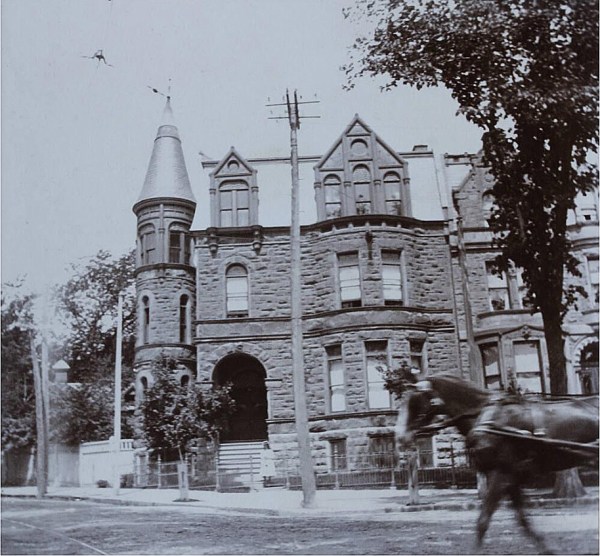
The Robert Stanley Bagg home at the corner of Sherbrooke Street West and Cote-des-Neiges. My grandmother, Gwen Bagg, took this photo in 1903 and it is now in the possession of the McCord Museum.

The old house at the corner of Sherbrooke Street West and Cote des Neiges in downtown Montreal pops up regularly on the internet sites devoted to historical photos of the city, but often the information that accompanies those photos is incorrect. Frequently, people erroneously identify the owner as Montreal landowner Stanley Clark Bagg (1820-1873). In fact, the house belonged to his son, Robert Stanley Clark Bagg (1848-1912).

The building is prominently located on the corner of Sherbrooke Street West and Côte-des-Neiges, which leads up the hill toward Mount Royal. Thousands of people pass by daily, and it is hard not to notice the four-story red sandstone building with its pink tiled top floor.

It has gone through several reincarnations over the years. When it was built in 1891, it formed the south-west anchor of the Golden Square Mile, the neighbourhood where Canada’s wealthiest businessmen, manufacturers and bankers lived. Today it is a commercial building, surrounded by other small businesses and medical offices.

The original owner, R. Stanley Bagg (I will refer to him as RSB), grew up in a house called Fairmount Villa that was at the corner of Sherbrooke Street and Saint-Urbain. His father, Stanley Clark Bagg (SCB), was one of the largest landowners on the Island of Montreal, having inherited several adjoining farm properties along St. Laurent Boulevard from his grandfather, John Clark.

RSB studied law at McGill University and went abroad to continue his studies after graduation, but when his father died of typhoid in 1873, RSB came home. He practised law in Montreal for a short time, but quit to manage the properties belonging to his father’s estate, a position he held until 1901.

He married Clara Smithers (1861-1946) in 1882, and for several years the couple lived just around the corner from Fairmount Villa, where RSB’s mother still resided. Eventually they decided to build a new house in a more fashionable part of the city. When they moved, they had two daughters, Evelyn (1883-1970) and Gwendolyn (1886-1963)—my future grandmother. Their only son, Harold Stanley Fortescue Bagg (1895-1945), was born a few years after the move.

Many houses in Montreal were built of locally quarried grey limestone because it was abundant and cheap, but RSB chose red sandstone, probably imported from Scotland. Originally designed by architect William McLea Walbank, the house was renovated twice in the eleven years RSB lived there, with a major addition constructed in 1902 and other changes in 1906.

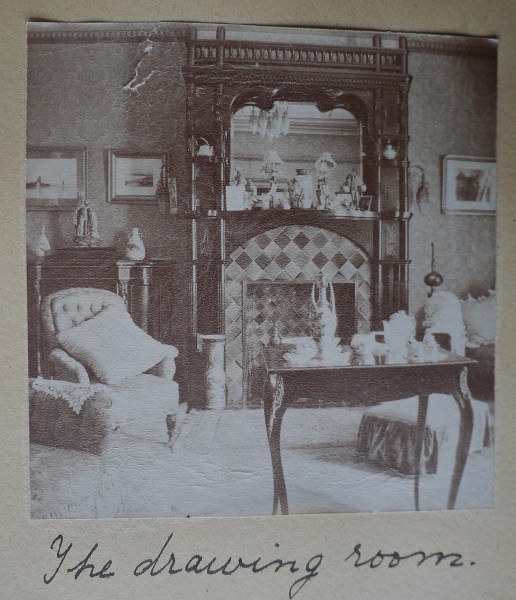
It was a large, even for a family of five, but the Baggs employed at least two live-in domestic servants—a cook and a maid—and perhaps a man to do the heavier chores. The interior was ornately furnished, as shown in photos my grandmother took of the drawing room, with a carved mantlepiece over the fireplace, heavy floor-to-ceiling drapes, and pillows and knickknacks everywhere. She also took photos of the interior of the tower on the Côte-des-Neiges side of the building. It must have been a sunny spot for reading and a good place to watch people struggle up the hill during a snowstorm.

The drawing room (living room) of the house was ornate. This is another photo from my grandmother’s 1903 album, now at the McCord Museum.

RSB died of cancer while on vacation in Kennebunkport, Maine in 1912. Clara (who was usually identified as Mrs. Stanley Bagg) divided the house into two apartments and continued to live there until her death, at age 85, in 1946.

After she died the house was sold and renovated, with a new entrance facing Côte-des- Neiges, and Barclay’s Bank (Canada) moved in. Many of Montreal’s elite families became customers of this British-based institution. In 1956 the Imperial Bank of Canada took over Barclay’s (Canada) and five years later, it became the Canadian Imperial Bank of Canada (CIBC). In 1979 CIBC decided it could no longer upgrade the old Bagg building to the modern requirements of banking and it moved its customers to a branch down the street at the Ritz Carlton Hotel.

For the next few years, the building was home to a jazz bar on the main floor and a bookstore upstairs, until a fire destroyed the interior in 1982. It may have been that fire that destroyed the cone-shaped roof of the tower. Many years earlier, my mother noticed that a stained-glass window displaying the Bagg family crest had disappeared.

The building was restored in 1985-86 and two art galleries moved in, but the interior featured bare brick walls, a style that was popular at the time in some older parts of the city, but was not appropriate for this Victorian-era building. An oriental carpet store rented the main floor in the mid-1990s.

Today, Adrenaline Montreal Body Piercing and Tattoos has been located there for many years. I suspect my great-grandparents would not be impressed.

Note: Lovell’s Directory of Montreal shows the address of this building changed several times over the years. It was at 1129 Sherbrooke in 1894-97, and 739 Sherbrooke W. in 1908-1910. The attached house, on the right, had a separate address – 737 Sherbrooke West—and belonged to another family. The Bagg house had been divided into apartments 1 and 2 at 739 Sherbrooke W. by 1927-28, and the address had changed to 1541 Sherbrooke W. apartments 1 and 2 by 1935-36.

Sources:

Edgar Andrew Collard, “A sandstone house on Sherbrooke St.”, The Gazette, October 20, 1984.

Répertoire d’architecture traditionnelle sur le territoire de la communauté urbaine de Montréal. Les residences. Communauté urbaine de Montréal, Service de la planification du territoire, 1987.

Charles Lazarus, “Farewell to Landmark”, The Montreal Star, April 30, 1979.

This article is simultaneously posted on my family history blog, https://writinguptheancestors.ca.