A simple act followed by a direct command can be life changing.
Such was the case for my Dad. At the outset of his working life, my father’s new challenges of a career in the gold mines of Colorado were dashed through no fault of his. In some ways it turned out to be one of the best things that ever happened. It launched his career in the mining industry and he travelled to mines around the world. Would he have been so fortunate in Colorado?
Kaarlo Victor Lindell was born in the early winter of 1905 in Ashtabula, Ohio, a port on Lake Erie, not far from Cleveland. He was the second child of Ida Susanna Karhu and Johan Hjalmar Lindell, a blacksmith. They had immigrated to the United States from Finland in the mid-1890s.
As a young man, my father worked as a cook on the iron-ore boats on the Great Lakes and, although he loved sailing the lakes, he wanted something more fulfilling. He enrolled at the Michigan College of Mines in Houghton, graduating with a degree in Mining Engineering in 1928. Many years later, in 1972, he gave the Commencement Address to the graduating students at the Michigan Technological University, as the College is now a university. At that event he received a Doctor of Engineering and the Distinguished Alumnus Award.
After graduation In 1928 he received a job opportunity at Royal Tiger Gold Mines in Breckenridge, Colorado. He packed his Model T Ford and set out for the west with hopes and dreams, doing something he truly enjoyed. He was a young man ” going west”.
Not long after arriving at the mines, he discovered that the owner-manager was tampering with the assays (a scale used to measure gold). When the owner realized that his new employee was aware of his actions, he ordered him “out of town by sundown.” Kaarlo didn’t back down and said that he would leave, “as soon as I can get my Model T on a railroad car to carry it over the mountains”.
Aspirations of working in the gold mines were crushed. Being a young go-getter, he immediately contacted the College to see if they knew of any openings for newly graduated mining engineers. They responded that there were openings in Canada in the nickel mines in Copper Cliff – Sudbury area in Ontario. It was time to head north.
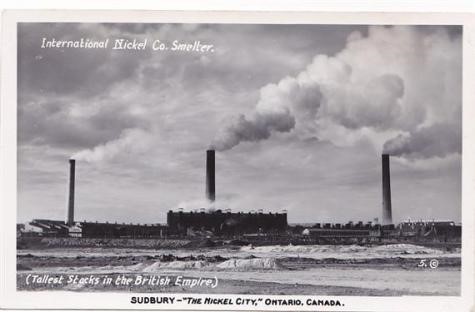
Kaarlo crossed into Canada on the 31st of January 1929 at Bridgeburg, Ontario with hopes and dreams of a rewarding career and a new challenge. He found a room in a boarding house and began working for the International Nickel Company (INCO) in Copper Cliff and Frood Mine. He spoke Finnish and soon made friends with his coworkers, among them many Finns.
Before long he met a pretty, vivacious young lady named Estelle (Esty) Jodouin and wasted no time seeking her hand. They were married on September 6tth, 1930, in Sudbury. While Grandpa Jodouin was happy to have Dad as a son-in-law, he was concerned that he practised the Lutheran faith. In the meantime, Kaarlo legally changed his name to Karl and had started studying the Catholic faith.
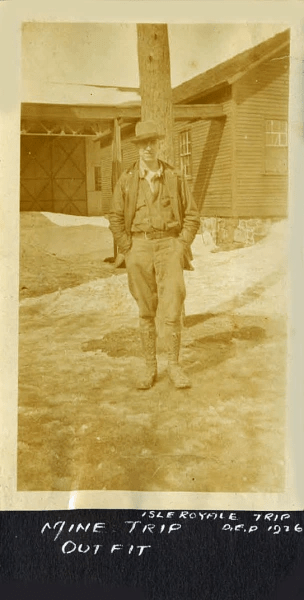
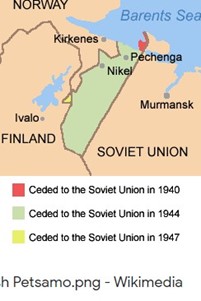
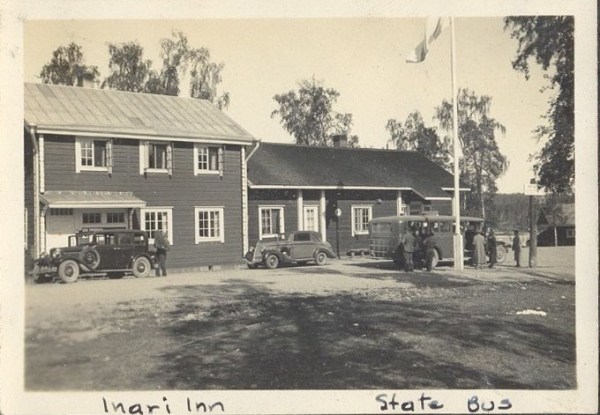
His employer took advantage of his knowledge of Finnish and in 1934 Karl was seconded to Mond Nickel of England and sent to Petsamo, Lapland, in northern Finland, near the Russian border, close to the Barents Sea. Dad’s task was to open a new nickel mine in the area.
In 1939 Petsamo, now Pechanga, was seized by Russia and consequently closed off Finland’smain access to northern waters.
Finnish Inn 1934
With WW11 on the horizon, Karl wanted to serve his new country. He became a naturalized citizen on the 8th of August 1939, however, with four children and a fifth on the way, his services were needed in the nickel industry. He remained at work for INCO. Nickel production was crucial for ammunition during the war years.
After working for seventeen years with INCO, it was time for a change. The Canadian Johns-Manville Company (CJM) had sought his expertise and hired him to design and oversee the construction of a headframe and shaft for underground mining in Asbestos, Quebec.
In November 1945, the family moved to the rolling hills of the Eastern Townships of Quebec where a new chapter would enfold.
Finland is a country of lakes and saunas.
It is presently rated (2023) as the happiest country in the world.
The database below focuses on the early Judicial System in Quebec and consists of an extensive list of authors who have written on the subject. Complete books and articles are available online, publishers are also noted.
I never expected to find much information about my great-grandfather’s sister, Mathilde Bruneau. I knew her name, dates, the fact she had a twin brother and that she never married. That was all. Then when searching Newspapers.com, Mathilde, born on a farm in southern Quebec appeared on the social page of the Fall River, Massachusetts Daily Herald. It was reported that she had been visiting her brother Aimé Bruneau and then returned to her teaching duties at the Rhode Island Institute for the Deaf in Providence, Rhode Island, only twenty miles from her brother’s home.
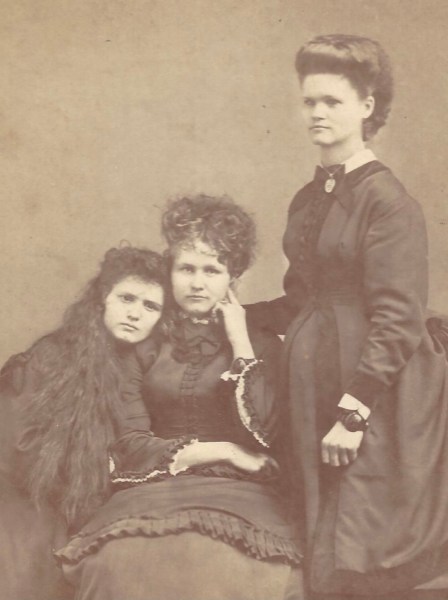
Sophie, Helene & Mathilde Bruneau in New York
Mrs. Mary Ann Lippitt founded the school in 1876. Her daughter Jeanie became deaf after a bout of scarlet fever so her mother taught her daughter to speak and read lips, as no schools for the deaf existed at that time. Mary Ann’s husband Henry Lippitt was the Governor of Rhode Island and had political influence, so he persuaded the state to take over the operation of the school. In 1893 the school moved to a large new building which could hold 60 students. This might have been the time Mathilde began teaching there. The school is still operating today.
I don’t know how Mathilde ended up teaching deaf students. Did she answer a newspaper ad while visiting her brother? Before teaching the deaf, Mathilde had been a French teacher in New York City along with her sister Virginie. Virginie didn’t stay there but returned to Quebec to marry.
Mathilde had not yet moved to Rhode Island 1887 when the social page reported on an earlier visit to her brother Aimé, in Fall River. I don’t know where Mathilde obtained her teaching credentials as I haven’t found records of her training. Her sister Virginie attended McGill Normal School. Did Mathilde begin her teaching career in Montreal before moving to New York?
Mathilde was one of thirteen children of Barnabé Bruneau and Sophie Marie Prudhomme, born in St-Constant, Quebec, south of Montreal, in 1844. She had a twin brother Napoleon, one of very few twins in my family tree. In the 1871 Canadian census, she was listed as living with her parents in St-Constant (and two years older than her twin brother), so she was at least 27 when she moved to New York City. Napoleon stayed on the farm but he also had a career as a veterinarian and a Justice of the Peace.
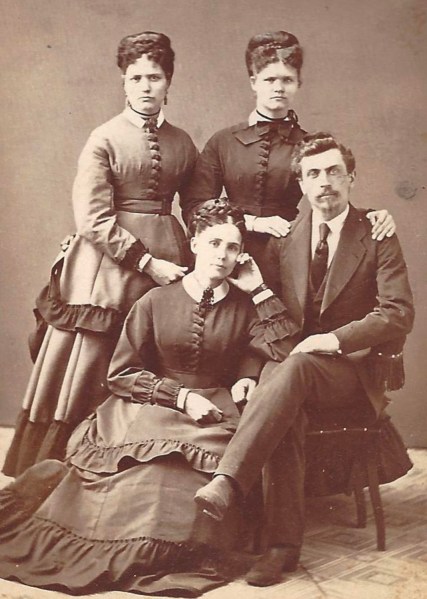
Sisters Sophie, Mathilde& Elmire with Washington Huntley
Although some of her siblings became American citizens, it seems she never did. After Mathilde retired from teaching, she moved back to Quebec. She maintained her independence and didn’t live with her twin brother in St-Constant or even with one of her sisters, instead she was a lodger in John Dooley’s house on Bordeaux Street in Montreal.
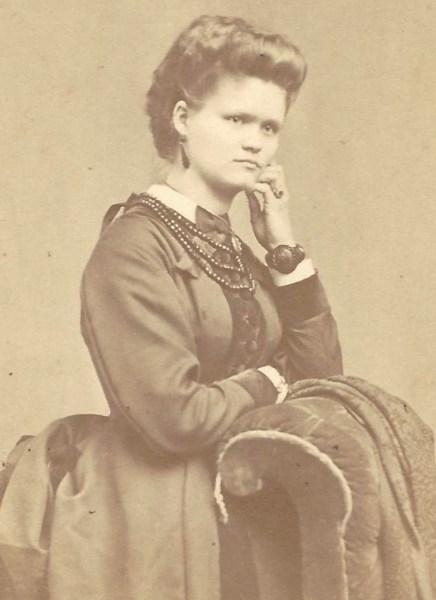
Mathilde Bruneau
She appeared again in a newspaper in April 1912, “Miss Matilda Bruneau 68, 1149 Bordeaux St. fell on the sidewalk corner of Mary Ann and Erables last night and broke her left leg. She was taken to the Royal Victoria Hospital” reported the Montreal Gazette. The weather the day before, Easter Sunday, had been very rainy and well above freezing so an icy sidewalk probably wasn’t the cause of her fall.
She died only four months later. PerhapsHer her leg never healed. I didn’t find a death certificate or cause of death, just a certificate of burial signed by two of her sisters. Marie Mathilde Prud’homme Bruneau was buried with her parents in the Baptist cemetery in Grande-Ligne, Quebec.
Mabel Hubbard, who later became the wife of Dr. Alexander Graham Bell was deaf and also taught by Mrs. Lippitt. Jeanie Lippitt later went to Dr. Bell for voice training lessons. Dr. Bell had to discontinue these lessons to devote himself full-time to the development of the talking machine.
Fall River Daily Herald June 30 1898, Page 7. Newspapers.com accessed Jan 12, 2023. Miss M P (Prudhomme) Bruneau was an instructor at RI School of the Deaf.
The Providence News February 21, 1893 Newspapers.com accessed Feb 17, 2023. A new school building was dedicated. 35 pupils enrolled with a capacity for 60.
In the 1911 Canadian census, Matilde was living on Bordeaux Street in the Maisonneuve district of Montreal as a lodger with a Mr John Dooley and his family.
Fell and Broke Leg: Montreal Gazette April 8, 1912, page 3. Newspapers.com accessed Jan 23, 2023.
Her sisters Virginie and Sophie signed her burial record. There is no cause of death April 15, 1912.
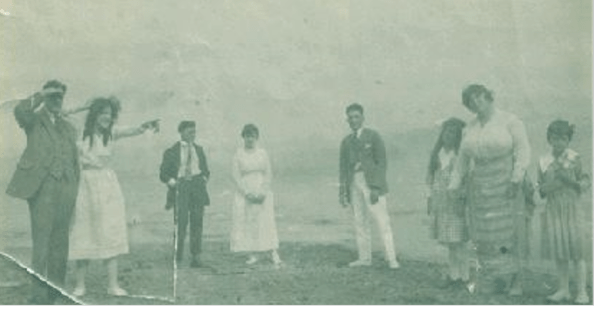
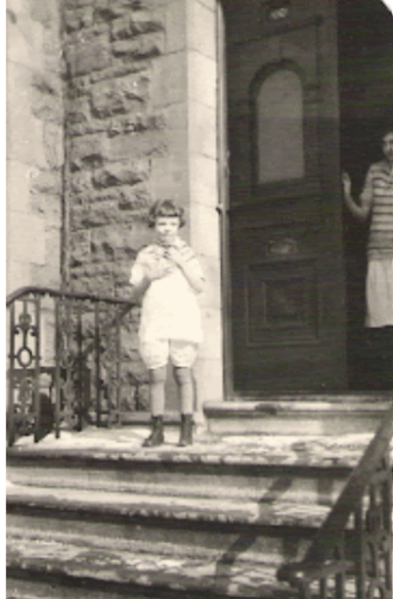
Perhaps the only picture of my mother’s cousin, Laura Lacombe, fourth from left in a Crepeau family picture circa 1914.
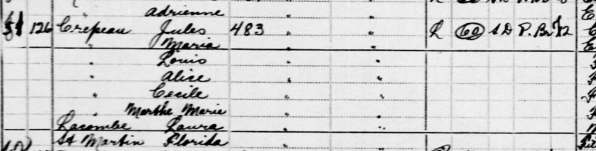
Genealogy is a gift that keeps on giving. A few years ago, when the 1921 Canadian census came online, I anxiously consulted it to see a Crepeau listing for my mother (4 months old), my uncle Louis, my aunts Alice and Cecile (20 and 17) and my 15 year old Aunt Flo, listed as adopted under the name Florida St-Martin.
Bingo! That’s what I had been waiting to see for 10 years!
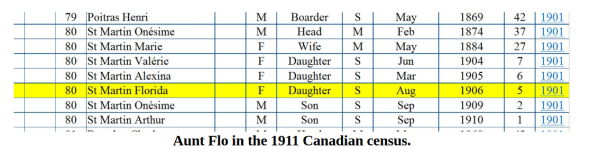
In the 1911 census, my Aunt Flo is listed with her birth family, the St-Martins but I wasn’t 100 percent sure the listing was hers. (I had only a vague recollection of her birth family’s name. The family name St-Martin had come to me in a light-bulb moment in the middle of the night!) So this 1921 listing confirmed my subconscious’ powers. I suddenly felt very smart.
Aunt Flo peeking out at my mother in around 1925.
But, I also noticed another name in the Crepeau household on the 1921 census, Laura Lacombe, niece, born 1892. I had never heard this name before, so I took another peek at the 1911 census. Laura Lacombe is listed there, too. I had missed it.
Now I was really confused. (I suddenly didn’t feel so smart.) I rationalized that I might have missed Laura ten years earlier when the 1911 census came online because the Crepeau family listing is at the bottom of one page and Laura’s name comes up on the top of the next. Or maybe I did notice Laura’s presence on the census and just assumed she was one of the many young girls brought in over the years to help my grandmother, Maria, keep house.
Whatever the reason, it did not take long before I figured out who this Laura Lacombe was. She was the daughter of my grandmother’s sister Melina Roy Lacombe who had died in the mid 1890’s leaving behind two young children, Raoul and Laura.
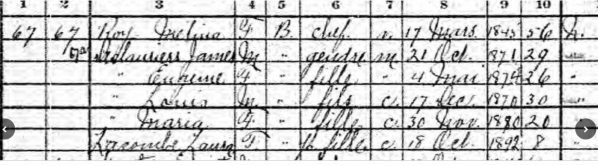
On the 1901 census Laura is living with her grandmother (my great-grandmother) Melina Gagnon Roy and my grandmother, Maria; also Maria’s brother Louis and sister Eugenie who is married to a James Deslaurier. Maria and Louis are mistakenly listed under Deslauriers. (For this reason, I had a lot of trouble finding Maria on the 1901 census at first. ) Melina Gagnon Roy is listed as chef or head of the household.
So, when Maria, my grandmother, got married later in 1901 to the ambitious Jules Crepeau, she took in the twelve-years-younger Laura. Or maybe Laura moved in with them in 1906, after the death of the grandmother.
Now, the real question begs: how come I never heard about Laura before? Was she for some reason a family secret?
Over the decades, I never heard my Aunt Flo or my own mother speak of this cousin – and they both liked to talk about the Crepeau family in the early days.
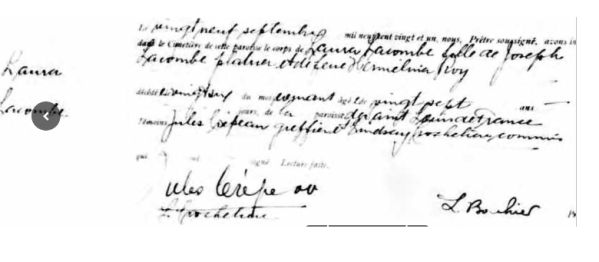
The answer might lie in another document I found: Laura’s death certificate. You see, she died only a few months after the 1921 Census man came around – and a few months more after my mother’s birth. My grandfather, Jules Crepeau, signed her death certificate. No reason for the death is given, which makes it all very sketchy. (I’m not embarrassed to say, I looked for the name “Lacombe” among my many French Canadian DNA cousins on Ancestry. The name hardly appears at all. Phew!)
Still, I have to ask. Why the silence surrounding Laura’s life. A real mystery, it is.
My grandfather was 26 years old when Canadian Prime Minister William Lyon Mackenzie King recommended the country declare war on Germany in a radio speech on Sunday, September 3, 1939. Seven days later, Canada officially declared war on Germany and created the Royal Canadian Air Force (RCAF) Special Reserve, which was placed on active service.
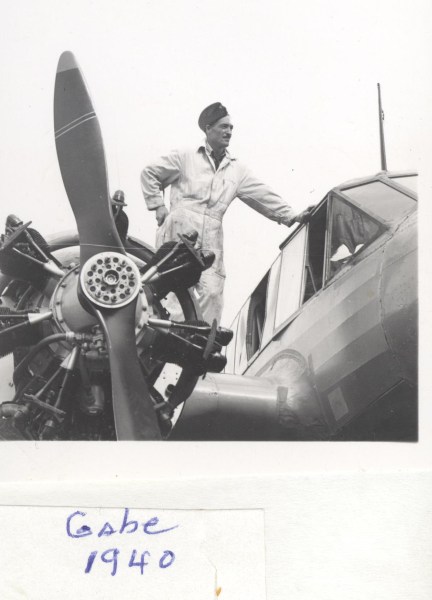
I’m not sure what Grandpa Joseph Isidore Alfred Gabriel Arial was doing that year, but he probably lived in Edmonton after his last known job as a radio inspector ended in February 1936. He may have built and renovated houses with his cousins.
Eventually, he would contribute to what would become the world’s largest flight training program, although like many military volunteers, he never considered his contribution worthwhile. I remember standing in his garage as a 12-year old hearing him tell me how he regretted not doing his part during World War II. It never occurred to me that he had actively served in the RCAF until decades later when I found his release papers. It turns out that he honourably served for from February 20, 1941 to September 5, 1945.
It turns out that he’s among a great many men who volunteered to go to Europe to fight and ended up staying in Canada to keep the British Commonwealth Air Training Plan (BCATP) operational.
Britain, Canada, Australia and New Zealand officially created the British Commonwealth Air Training Plan on December 17, 1939, King’s 65th birthday but efforts to get it going began even earlier than that.
According to Dunmore, the British Commonwealth Air Training Plan began just after Adolf Hitler became chancellor of Germany in January 1933. “The Air Ministry suggested a scheme whereby Canadian, South African, and New Zealand air force cadets could be granted short-service commissions, serve five years in the RAF, then return home for reserve services.”1
Shortly thereafter, in 1936, Vincent Massey, the Canadian High Commissioner to Britain presented British Air Minister Lord Swinton’s suggestion that some airmen be trained in Canada prior to joining the RAF.
Later in 1936, Scottish pilot RAF Group Captain Robert Leckie described a plan to create “a Flying Training School formed in Canada” in a memo to Air Commodore Arthur W. Tedder. In this memo, he pointed out that more than a third of the RAF officers in WWI had been Canadian. The idea was proposed, but the Canadian Cabinet rejected the plan in favour of a Canadian-run training school instead.2
In 1937, 15 Canadians were trained under the plan.
When Germany annexed Austria to the Third Reich in 1938, the Canadian government increased the number of Canadians able to join the RAF to 120 per year and later it went up to 138. That plan attracted a total of 400 Canadian pilots to the RAF.
It took from May 1938 until April 1939 to convince the Canadian Government to train up to 50 British pilots and 75 Canadian pilots. Eight flying clubs, in Calgary, Hamilton, Montreal, Regina, Toronto, Vancouver and Winnipeg were recruited to do the training. In August 1939, five RAF officers (Ken McDonald, Dick Waterhouse, Jackie Mellor, Desmond McGlinn and Leslie Smallman) crossed the Atlantic by ship from Southhampton, England to Montreal and then to Trenton to help set up navigation training in Canada.
By April 29, 1940 the first 168 RCAF recruits entered No. 1 Initial Training School in Toronto getting the BCATP air training plan fully underway. Just in time too. By June that year, France fell to the Nazis.
Over the next four years, Canada built more than 100 pilot training facilities in every province and territory.
“Looking back it is difficult to grasp the BCATP in all its dimensions,” wrote J.F. Hatch, in his 1983 book describing the project. “In themselves, the statistics are impressive: 131,553 [plus 5,296 RAF and Fleet Air Arm personnel trained prior to July 1, 1942] aircrew trained for battle, through a ground structure embracing 105 flying training schools of various kinds, 184 support units and a staff numbering 104,000. When war was declared the RCAF had less than two hundred aircraft suitable for training, many of them obsolete. In December 1943 there were 11,000 aircraft on strength of the BCATP.”3
I suspect that my grandfather kept many of those planes flying as an air mechanic in Fort William. Clearly this work contributed greatly to the allied war effort, but most of the stats about its importance talked about front-line combatants, not the 6,000 behind-the-scenes people who made the project operational.
The Canadian Government post about the project, for example says: “Of the Canadians trained in the BCATP, 25,747 would become pilots: 12,855 navigators; 6,659 air bombers; 12,744 wireless operators; 12,917 air gunners, and 1,913 flight engineers.”4
Also, several of the daily diaries for this period include the arrival of billiard tables, the building of skating rinks, sports tournaments and multiple leisure activities,5 so perhaps it’s no wonder that volunteer soldiers who served on these bases felt like they sat out the war.
1 Dunmore, Spencer. Wings for Victory: The Remarkable Story of the British Commonwealth Air Training Plan in Canada. Toronto, Ont.: McClelland & Stewart, 1994, p10.
2 Dunmore, Spencer. Wings for Victory: The Remarkable Story of the British Commonwealth Air Training Plan in Canada. Toronto, Ont.: McClelland & Stewart, 1994, pp24,25,26.
3 Hatch, F. J. The Aerodrome of Democracy: Canada and the British Commonwealth Air Training Plan, 1939-1945. Ottawa: Directorate of History, Dept. of National Defence, 1983, 222 pages.
Click the above link to download the database in a new window..
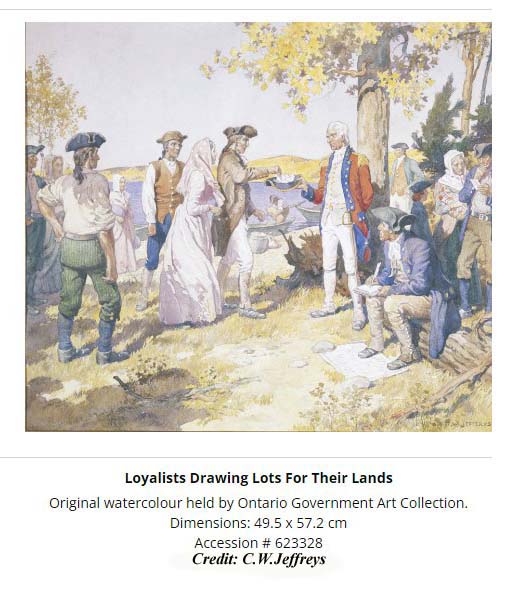
The above file contains information on the arrival of Loyalist Families in the Province of Quebec ( 1873) after the American War of Independence as noted by varaious authors. These books and articles are available, many upon request at numerous BanQ websites for consultation, while a number of articles may be downloaded.
When my English-born three-times great-grandfather Robert Mitcheson arrived in Philadelphia from the West Indies in 1817, he was a 38-year-old unattached merchant. Within two years he was married and had started a family, established a new career and was on the way to becoming an American citizen.
Robert (1779-1859) grew up in County Durham, England, where his father was a farmer and small-scale landowner. Robert became an iron manufacturer as a young man, then spent some time in the West Indies. Family stories say he was largely occupied in the West Indies trade. In 1817 he sailed from Antigua to Philadelphia with the intention of settling in the United States. He applied for naturalization – a first step towards citizenship — in July, 18201 and took an oath of citizenship on Sept. 12, 1825.
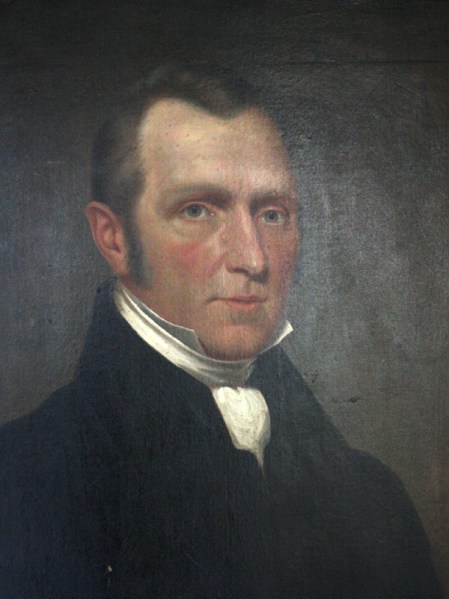
Robert Mitcheson, portrait probably painted in Philadelphia in the 1830s. Artist unknown. Bagg family collection.
Perhaps he had met his future wife, Scottish-born Mary Frances (Fanny) MacGregor, on a previous trip to the city. I have not found a record of their marriage, but it probably took place in Philadelphia. The couple’s first child, Robert McGregor Mitcheson, was born on August 15, 1818 and baptized at St. John’s Episcopal Church in north-end Philadelphia.2
In 1819 Robert was listed in a city directory as a distiller, and the following year’s directory clarified that he made brandy and cordials. The business was located at 275 North Third Street, in the Northern Liberties area of the city. The distillery continued to appear in each annual directory until 1835, when Robert was simply listed as “gentleman”, with his home address on Coates Street.
The family appeared in the U.S. census for the first time in 1830,3 living in Spring Garden, then a largely rural part of Philadelphia. Robert owned a large lot bounded by Coates (later renamed Fairmount Street) and Olive Streets, between Eleventh and Twelfth Streets. There, he and Fanny raised their five children: Robert McGregor (1818-1877), Catharine (my two-times great-grandmother, 1822-1914), Duncan (1827-1904), Joseph McGregor (1828-1886) and Mary Frances (1833-1919). Two other children, Sarah and Virginia, died as babies. Two of their sons graduated from the University of Pennsylvania. Robert M. became an Episcopal minister, and Joseph, who went by the name MacGregor J. Mitcheson, was a lawyer.
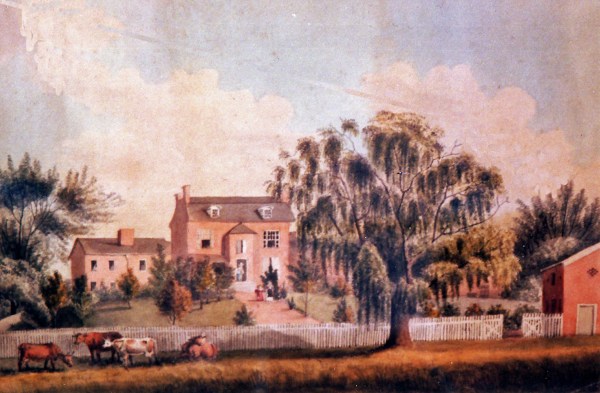
This painting of Monteith House, the family home in Spring Garden, was painted by daughter Catharine Mitcheson. Bagg family collection.
Robert never became part of city’s elite, despite his financial success. For one thing, he was a newcomer living in an old city. Founded in 1682, Philadelphia was the birthplace of the United States and many of its citizens were known as the descendants of colonial and revolutionary families. Also, Robert appears to have been a low-key person. A search for his name in local newspapers brought up only one article that named a long list of people involved in establishing a refuge for boys.
The only obituary I was able to find appeared in a Montreal newspaper, where daughter Catharine Mitcheson Bagg and her husband, Stanley Clark Bagg, lived.4 It said: “As a citizen of Philadelphia for more than 40 years, he has done much, in a quiet and unostentatious manner, for the advancement of her interests and the relief of the distressed. He enjoyed a well-earned reputation for unwavering integrity in all the transactions of his long life – prolonged almost to his 80th birthday — and his remarkable urbanity of manner which the firm, yet elastic step of his manly person, were but slightly impaired up to the period of his dissolution. He was universally respected and died serenely, with a Christian’s hope and faith.”5
Robert appears to have travelled back to England at least once, probably to visit family members and take care of some business, as he had inherited property in Durham when his father died in 1821. A land transfer document dated September 16, 1835 described him as “Robert Mitcheson, iron manufacturer, late of Swalwell, now of Philadelphia”.6 Several weeks later Robert Mitcheson, gentleman, appeared as a passenger on the Pocahontas, sailing from Liverpool to Philadelphia.7
Perhaps he also visited his brother William, an anchor maker and ship owner in London. A short biography of his son published by the St. Andrews Society in Philadelphia described Robert as a “retired merchant and shipowner,”8 however, I cannot confirm whether Robert owned any ships or perhaps invested in his brother’s business.
After Robert left the distillery business he reinvented himself again, this time as a landlord. The city was rapidly expanding and there was a need for housing. Many people lived in boarding houses and Robert saw rents from boarders as a way to generate income for his grown children after he died. In his will, he left 14 “dwelling houses” located near his house, as well as several nearby other buildings, in trust to sons Robert M. and MacGregor J..9 They were to collect the income and pay certain sums every year to their other three siblings, and to look after repairs to the buildings.
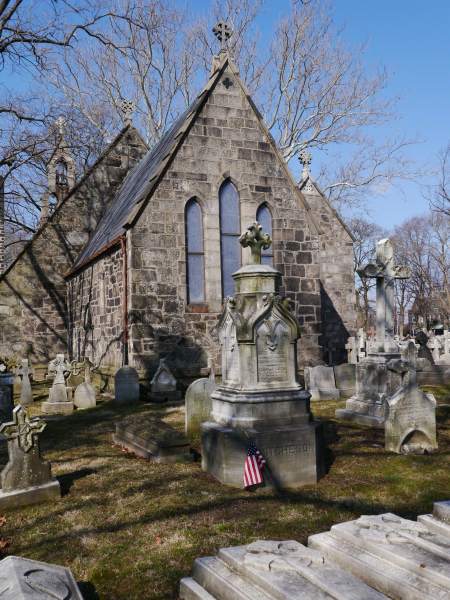
This large monument in the cemetery of St. James the Less Episcopal Church is in memory of Robert Mitcheson, his wife and several other family members. JH photo, 2013.
Robert died at age 79 and was buried in the cemetery at St. James the Less, a small, Gothic-style Episcopal church built around 1846 as a chapel of ease for wealthy families in the area. Robert is said to have helped found that church.
His story doesn’t end there, however. Sadly, his estate was the focus of a court battle that took almost 30 years to resolve, by which time both executors had also died. In addition to a dispute between the brothers, the case focused on a legal error in the way the trust was set up10 and who was to inherit the final balance of income.11
1. Ancestry.com. Pennsylvania, U.S., Federal Naturalization Records, 1795-1931 [database on-line]. Original data: Naturalization Records. National Archives at Philadelphia, Philadelphia, Pennsylvania. Accessed Feb. 15, 2023.
2. I found records from St. John’s Church at the Historical Society of Pennsylvania, Philadelphia in 2013.
3. “United States Census, 1830,” database with images, FamilySearch (https://familysearch.org/ark:/61903/1:1:XH5W-MC3, accessed Feb. 16, 2023), Robt Mitchinson, Spring Garden, Philadelphia, Pennsylvania, United States; citing 323, NARA microfilm publication M19, (Washington D.C.: National Archives and Records Administration, n.d.), roll 158; FHL microfilm 20,632.
4. Stanley Clark Bagg (SCB) was Robert’s son-in-law and also his nephew: Robert’s older sister, Mary Mitcheson Clark, was SCB’s maternal grandmother.
7. “Pennsylvania, Philadelphia Passenger Lists Index, 1800-1906,” database with images, FamilySearch (https://familysearch.org/ark:/61903/1:1:QV9Y-VXJ9, accessed Feb. 17, 2023), Robert Mitcheson, 1835; citing ship Pocahontas, NARA microfilm publication M360 (Washington, D.C.: National Archives and Records Administration, n.d.); FHL microfilm 419,525.
8. Biography of MacGregor Joseph Mitcheson in An Historical Catalogue of the St. Andrews Society of Philadelphia with Biographical Sketches of Deceased Members, 1749-1907, printed for the Society 1907; p. 287, Google Books, accessed July 19, 2013.
10. Mitcheson’s Estate, Orphan’s Court. Weekly Notes of Cases Argued and Determined in the Supreme Court of Pennsylvania, the County Courts of Philadelphia, and the United States District and Circuit Courts for the Eastern District of Pennsylvania by Members of the Bar. Volume XI, December 1881 to August 1882; p. 240. Philadelphia: Kay and Brother, 1882. Google Books, accessed Feb. 17, 2023.
11. Mitcheson’s Estate, Pennsylvania Court Reports, containing cases decided in the courts of the several counties of the Commonwealth of Pennsylvania, Vol. V, p. 99. Philadelphia, T. & J.W. Johnson & Co., 1888. Google Books, accessed Feb. 17, 2023.







 Genealogy Ensemble