William Hanington comes to Canada in 1785

… and now his church celebrates its 200th Anniversary in 2023

(upcoming celebration details below)
The deed described the property as “a commodious estate upon the outskirts of the thriving town of Halifax, in the Colony of Nova Scotia, Canada”. Imagine William’s surprise to arrive in Halifax in February to discover that “outskirts” meant a 200-mile hike through thick forest and deep snow!

My great-great-great grandfather, William Hanington, was born in London, England, in 1759. As the son of a fish dealer, he trained as an apprentice to the Fishmonger’s Company but became a freeman in 1782. Two years later, at the age of 25, this adventurous young man paid £500 sterling for 5,000 acres of land “near” Halifax, Nova Scotia, from Captain Joseph Williams.

After the initial shock upon their arrival, William and his companion found an Indian guide, loaded all their worldly belongings onto a hand sled, trudged through the snow, slept in the open and finally arrived in bitterly cold Shediac in March 1785. His discouraged companion quickly returned to Halifax and sailed back to England on the first available ship!
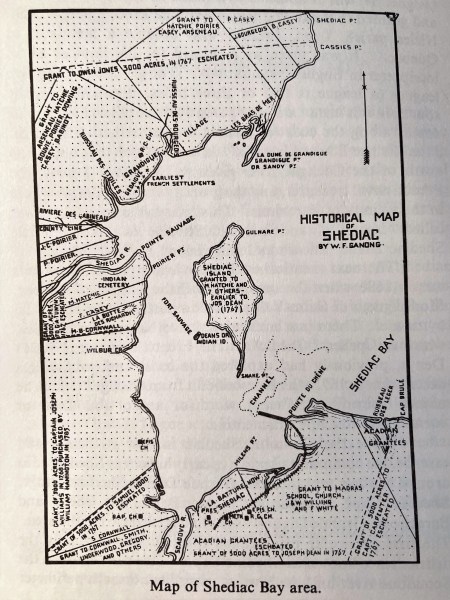
Large Lower left piece of land belonged to William Hanington 1785

William, however, was obviously made of sturdier stuff and delighted by what he found! A good size stream flowed into the bay and he had never seen such giant trees! He must have pictured the lucrative possibilities for trade in lumber, fish, furs and more.

Seven years after his arrival in Shediac, at the age of 33, he hired a couple of Indian guides to paddle a canoe over to Ile St. Jean (now known as Prince Edward Island) where there were other English settlers. The Darbys were Loyalist sympathizers who escaped from the rebels in New York. While riding along in an oxcart through St. Eleanor’s (now known as Summerside), he spotted a young lady (age 18) named Mary Darby, drawing water in her father’s yard. After a brief stay with her family, William and Mary married and paddled back to Shediac where they eventually raised a large family of 13 children.

After the first three years together, they persuaded Mary’s sister Elizabeth and her husband John Welling to come over from Ile St. Jean and settle on their land – becoming the second English family in Shediac.

And in the next five years, William boasted eight families on his property of about one hundred acres of cleared land. He opened a general store and dealt in fish, fur and lumber. The furs and timber were shipped to England and the fish to Halifax and the West Indies! He imported English goods from Halifax and West Indies products – mainly sugar, molasses and rum from St. Pierre. He also bartered with the friendly Indians for furs and helped them clear land.

Before long, a considerable village clustered about the Hanington Store – including a post office and a tavern. William remained the leading figure of the community and acted as the Collector of Customs of the Port, Supervisor of Roads and Magistrate enabling him to officiate over the marriages of many couples. To top it all off, in 1800, just 15 years after his arrival from England, this remarkable young man built a shipyard 10 miles north of Shediac in Cocagne.

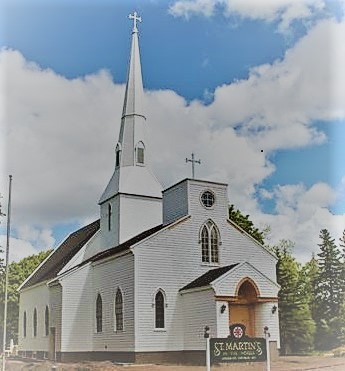
The only thing lacking in this delightful little community was a church. Until then, William being a religious man, conducted service in his home every Sunday and welcomed all to attend. Then in 1823, William donated the necessary land and lumber and oversaw the completion of St. Martin-in-the-Woods, the first Protestant church. He named it after his church in England; the famous St. Martin-in-the-Fields overlooking Trafalgar Square in London.
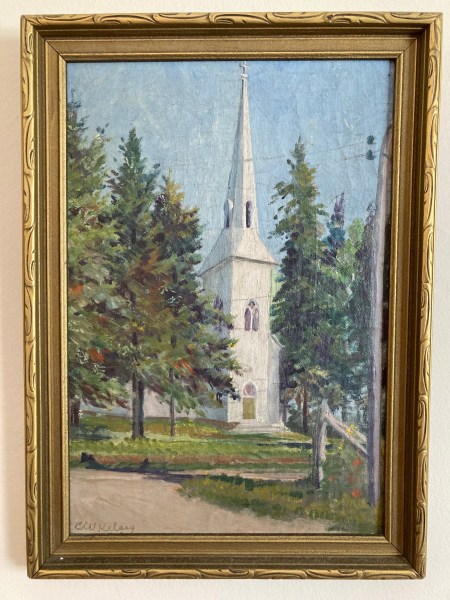
Painting of

St Martin-in-the-Woods Church

by Charles Kelsey

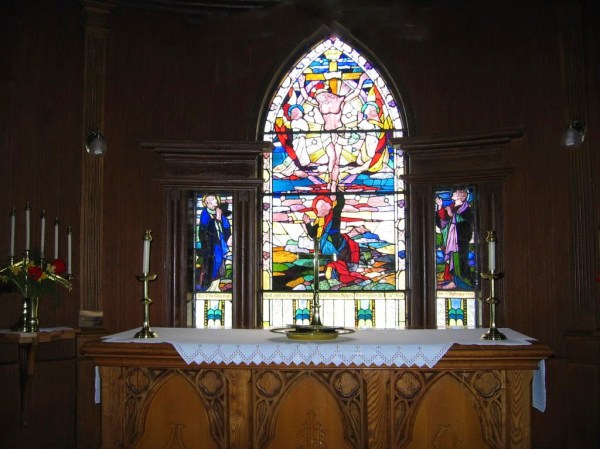
In 1934, my grandfather Canon Sydenham Lindsay (Shediac summer resident at Iona Cottage – She Owned A Cottage – with his wife Millicent Hanington and sometimes stand-in priest at the church) dedicated a large memorial stain glass window in the sanctuary to his father-in-law, Dr. James Peters Hanington (1846-1927) who was my great-grandfather and William’s grandson. The window was designed and installed by Charles W. Kelsey of Montreal and described as follows:

The centre light of the window represents the Crucifixion, with Mary Magdalene at the foot of the cross, while the two side windows represent the Blessed Virgin Mary and Saint John the Evangelist.(1934 – The Montreal Gazette)

Stain Glass Window in St Martin-in-the-Woods (photo credit Paul Almond)

Also mounted inside on the church’s side walls are two honourary brass plaques. One in memory of William and his wife and one in memory of his son Hon. Daniel Hanington (1804-1889) and his wife Margaret Ann Peters – my great great grandparents.
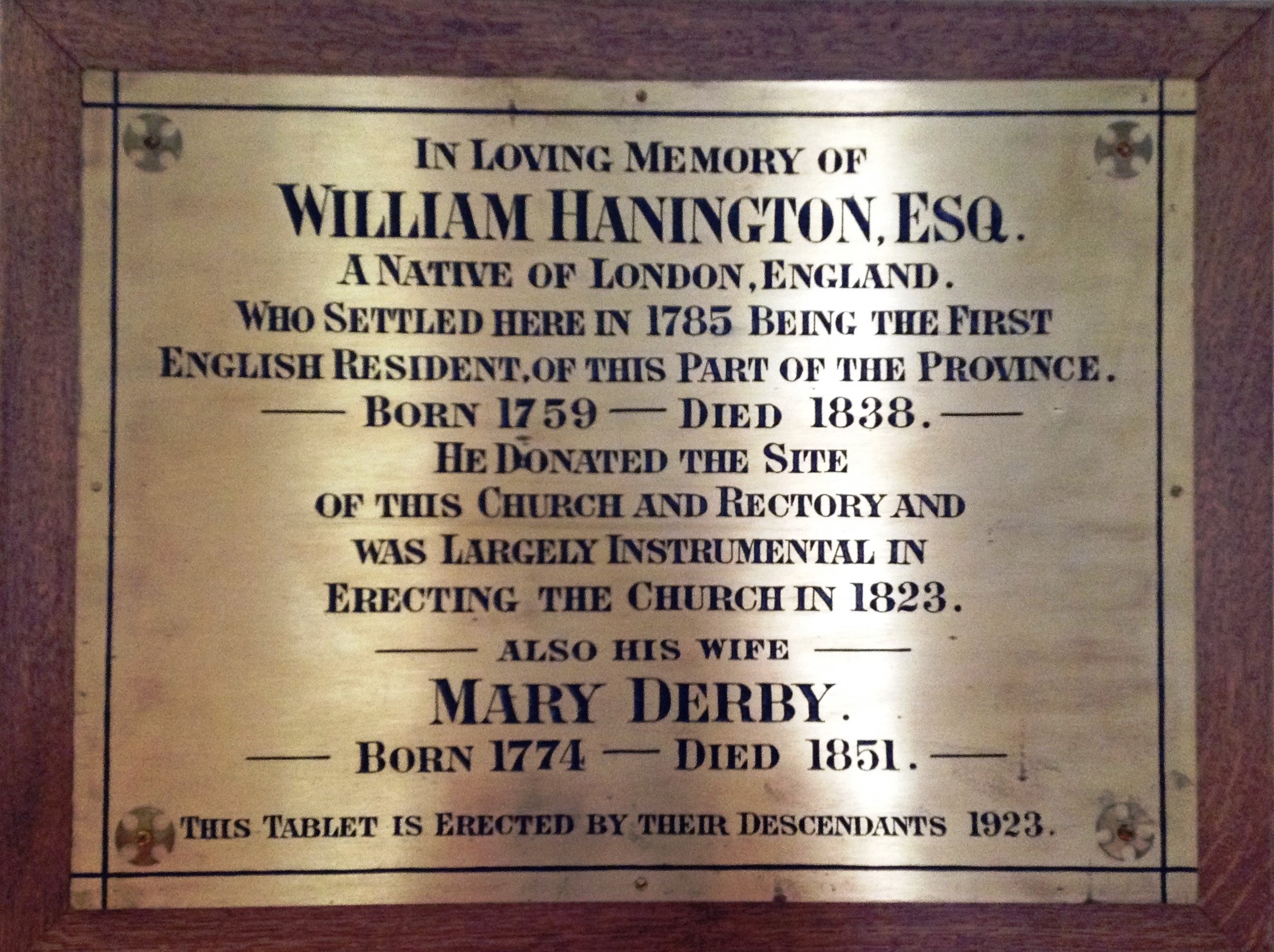
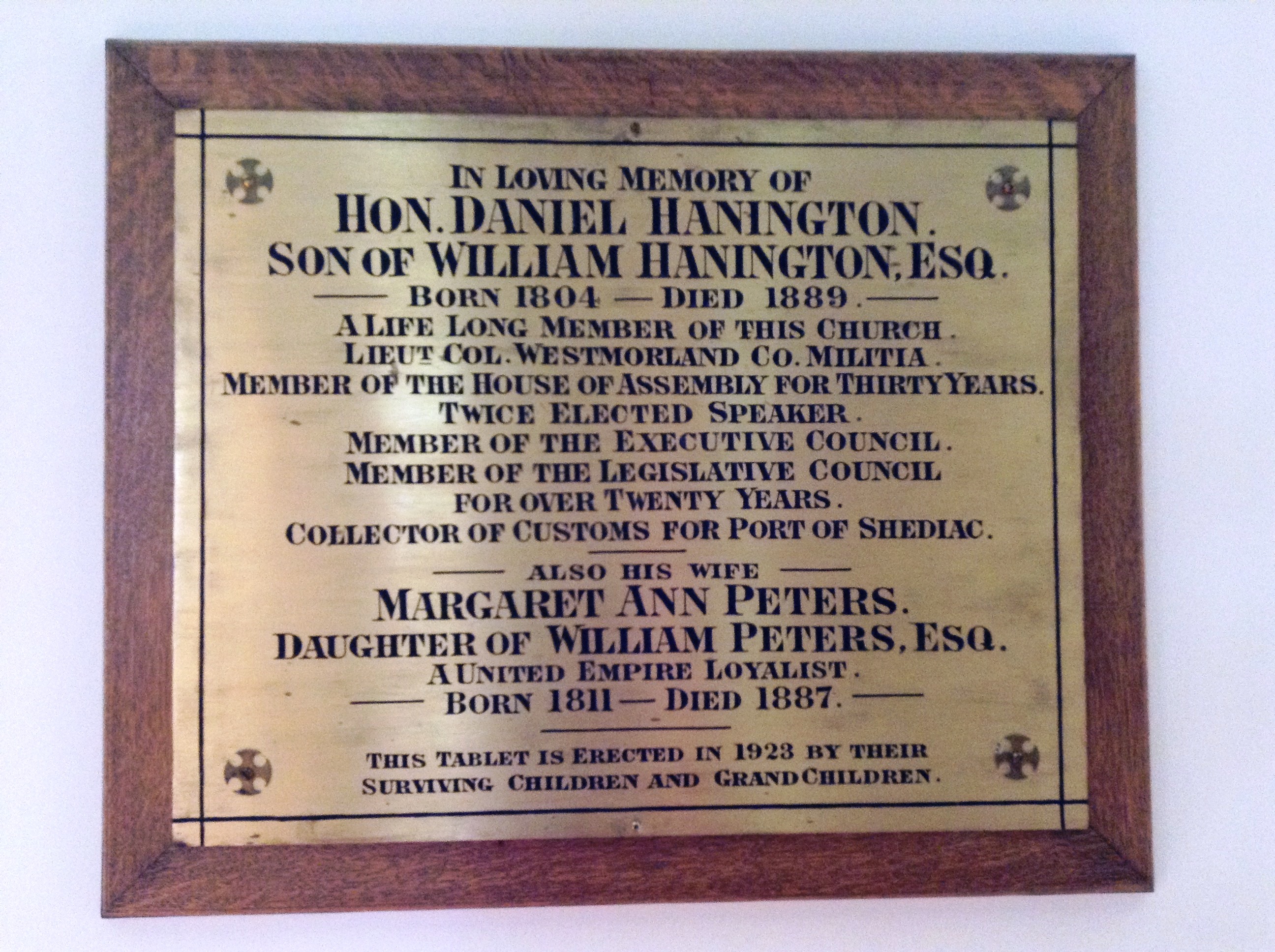
William died in 1838 at age 79. A huge memorial of native freestone marked his grave, in the cemetery beside his beloved church nestled in the community of Shediac, where he spent a lifetime building a “commodious estate” from a forest of giant trees.

Two hundred years later on this anniversary of the St. Martin-in-the-Woods church, William and Mary are lovingly encircled by the graves of several generations of their descendants.

*********************************************************************

A memorial plaque to William and his wife Mary, was erected in 2001 by the Hanington Reunion Association. This year the Association will be adding a bench in the cemetery in celebration of the 200 years.
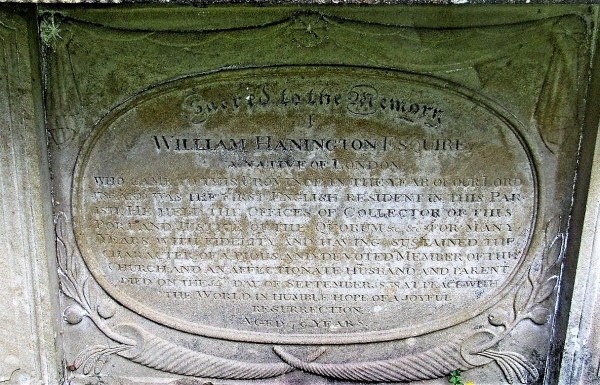
Close-up of the Headstone of William Hanington (1759-1838)
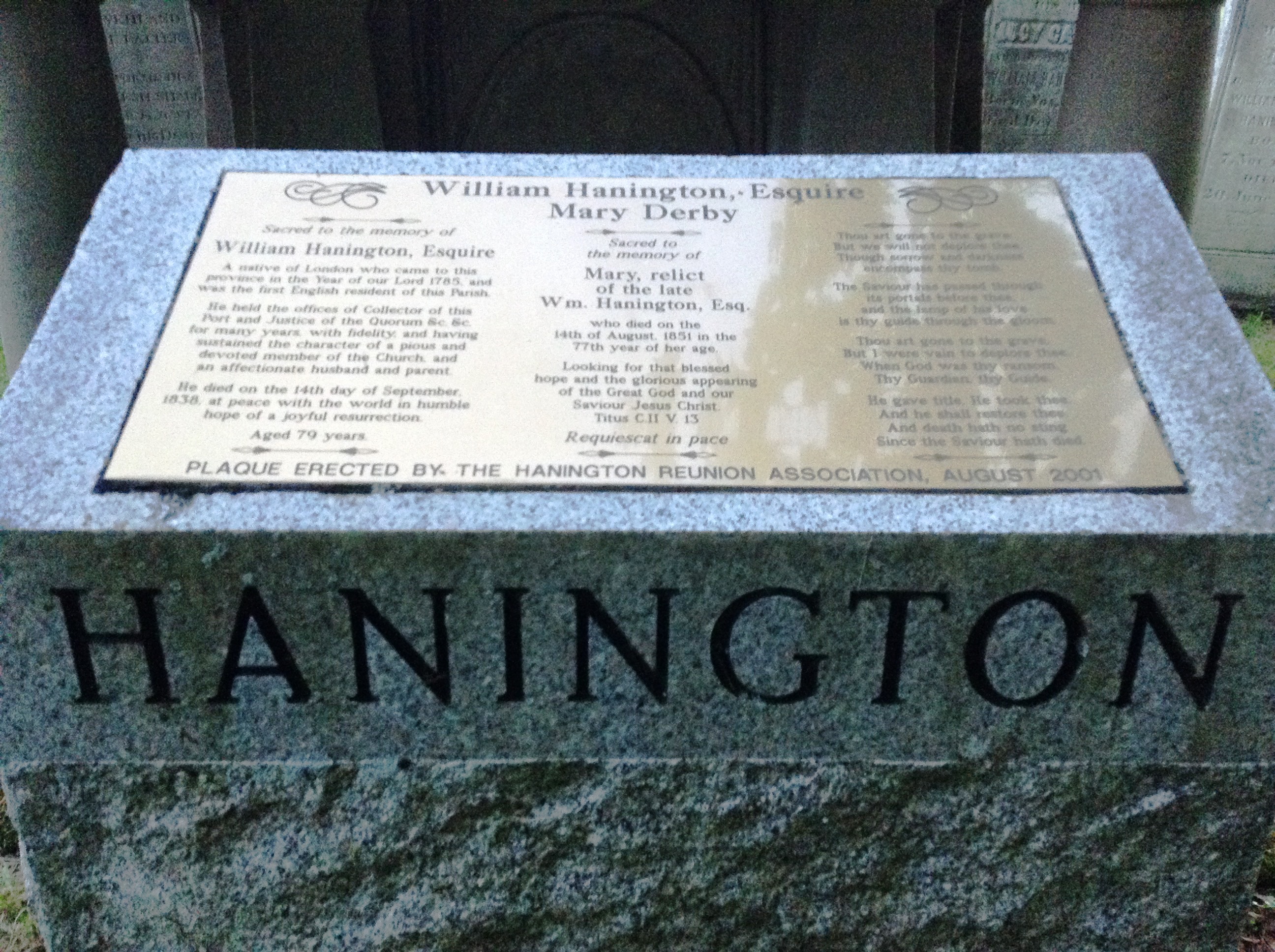
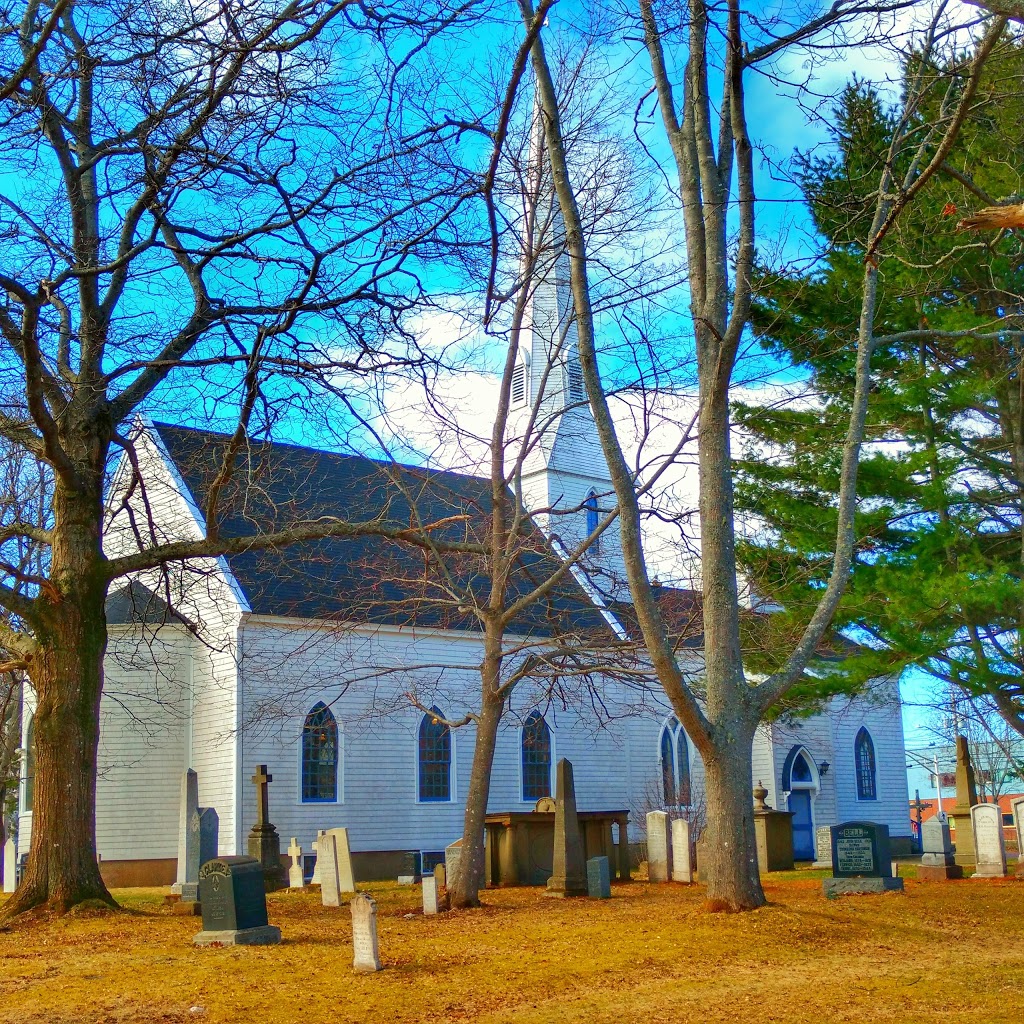
(L)Hanington Reunion Association Plaque (2001) honouring William Hanington and his wife Mary Darby and (R) photo by Scotty Horsman showing William’s large headstone at the side of the church.
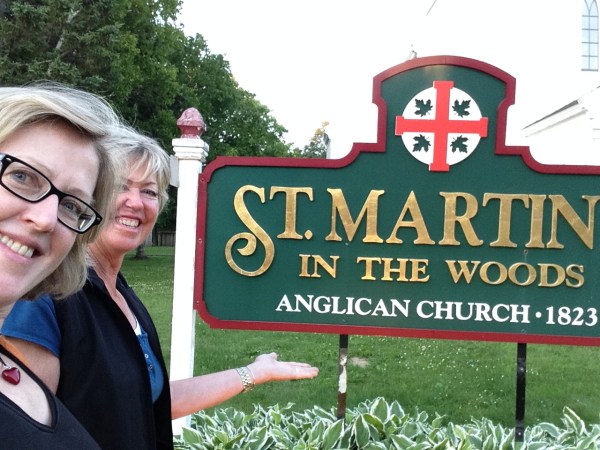
In 2015, my sister and I visited the church and our ancestors in the graveyard and also enjoyed meeting some Hanington cousins as well!

Read our story here: Sister Pilgrimage

***********************************************************************

ANNIVERSARY CELEBRATION DETAILS FOR SEPT 16-17, 2023:

The main events for the 200th Anniversary will be Sept. 16th and 17th with a corn boil, hotdog/hamburger barbecue and cake on Saturday, Sept. 16th. There will also be games, a bonfire, fireworks and music at the church shore.

The Anglican Bishop, David Edwards, of Fredericton will be attending this celebration. He will also be at the 10:30 AM church service on Sunday, Sept. 17th. After the church service there will be a pot luck lunch and a skit in the hall. There will also be items on display in thechurch basement and in the hall. There will be items for sale – glasses, mugs and lapel pins, with the Hanington crest as well as lapel pins. ornaments and trivets with the church on them.

**************************************************************************

If anyone would like a PDF copy of Lilian Hamilton’s famous Hanington genealogy family tree book from 1988, please email me at anglinlucy@gmail.com

My cousin was kind enough to take the time to copy the book into PDF so that everyone can have a digital copy.

My Hanington number is 6-9-7-3-4 if anyone wants to know who I am!
Quebec and Acadia Prior to New France

Grand Pré

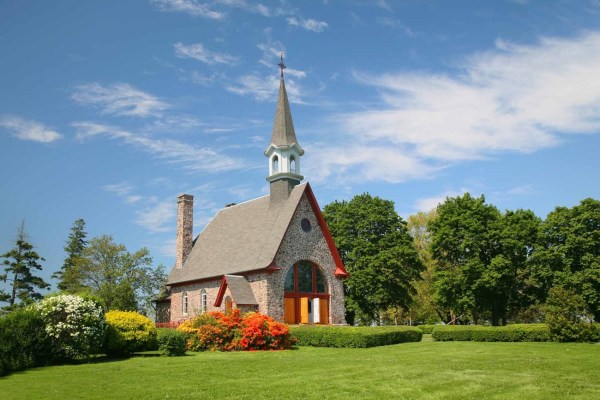
The Memorial Church of Grand Pré located in the Annapolis Valley of Nova Scotia in the Grand Pré National Historic Site, a park commemorating the deportation of the Acadians between 1755 and 1763 . (Photo taken on: June 21, 2008.)© Verena Matthew/Dreamstime

Introduction:

“Renowned historian Marcel Trudel in one of his many books described the above time period as; The Failed Attempts of the French Colonies of Canada prior to New France.

 Among the many authors, historians, archivists selected, few agree that the period of time prior to Samuel de Champlain in both Acadia and Quebec, the administrators, governors appointed by the kings of France in comparison to those appointed by various kings of England who administered the New England British Colonies were no match to those residing in Boston, Massachusetts.

Many historians are also in agreement that New France needed more individuals of the high calibre of Jean Talon who served as intendant (administrator) of the French colony from 1665 to 1668 and 1670 to 1672.

 Still the colony survived until September of 1759 at the Plains of Abraham.”

 By Jacques Gagné

https://genealogyensemble.com/wp-content/uploads/2023/07/quebec-prior-to-new-france-4.pdf

Click on the above link to open the pdf file.

Unto Death Do Us Part

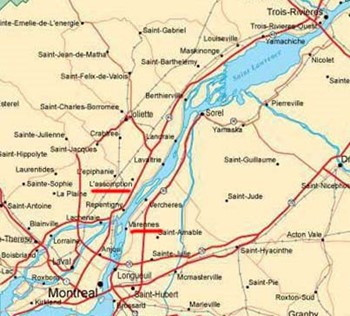
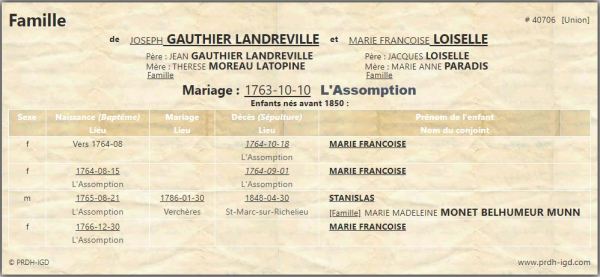
No one knows how their lives will take shape over the years. Little did my fourth great-grandfather, Joseph Antoine Gauthier dit Landreville know the path that lay before him. Joseph Antoine was one of 9 children, born in the midst of winter, February 20, 1731 to Jean Gauthier dit Landreville and Therese Moreau dite Latopine in Varennes, a village west of Ville Marie ( Montreal) on the banks of the St. Lawrence River

Baptism of Joseph Antoine Gauthier

Map of the area including Varennes and L’Assomption

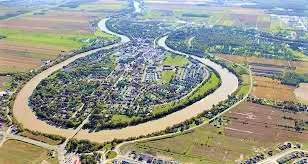
“In 1647, the L’Assomption Seignory was granted to Pierre Legardeur de Repentigny, named after the river, already named such since the seventeenth century. Between 1640 and 1700, a settlement formed inside a large horseshoe-shaped meander of the L’Assomption River. Amerindians had already been visiting this site since ancient times and called it Outaragasipi meaning widening river, in reference to the river’s course. They would drag their canoes across the peninsula as a short-cut for the meander, and therefore the settlement was first called Le Portage.

In 1717, the parish was formed, known thereafter as Saint-Pierre-du-Portage-de-l’Assomption and also as Saint-Pierre-et-Saint-Paul-du-Portage. In 1766, the village saw an influx of Acadian settlers. Between 1774 and 1888, L’Assomption was the most prosperous and important town between Montreal and Trois-Rivieres. 3.”

When Joseph Antoine was almost 25 years old on the 12th of January 1756, in L’Assomption he married a young 23-year-old widow, Agathe Laperche dit Saint Jean, along with her young daughter, Marie. The young couple had 2 sons, Joseph, and Pierre.

Almost 4 years into their marriage tragedy struck with no mention as to the cause, Agathe died leaving Joseph Antoine with three young children. Guardianship was arranged for the children.

Below is a translation of the first several lines of the above burial record for Agathe Laperche dite St Jean 4.

In the year seventeen hundred and fifty-nine, the 25th of November by the undersigned priest Vicar of this parish inhumed in this cemetery the body of Agathe Laperche dit St Jean spouse of Joseph Gautier Landreville at the age of  twenty three who died yesterday…..

Three long years passed.

In February of 1762 Joseph Antoine married his second wife, 19-year-old, Louise Gregoire. Within three months tragedy struck and she, along with 9 other young women perished while crossing the Assomption River.

Marriage record of Louise Gregoire and Joseph Antoine Gauthier dit Landreville 5.

Below are the first two and half lines translated from the above Marriage record of Joseph Antoine to Louise Gregoire. 

Joseph Gauthier dit Landreville widower of Agathe  Laperche from this parish on one part and Louise Gregoire daughter of defunct Basil Gregoire and Marie Clemence Proulx, mother from this same parish declare no impeachment to this marriage.

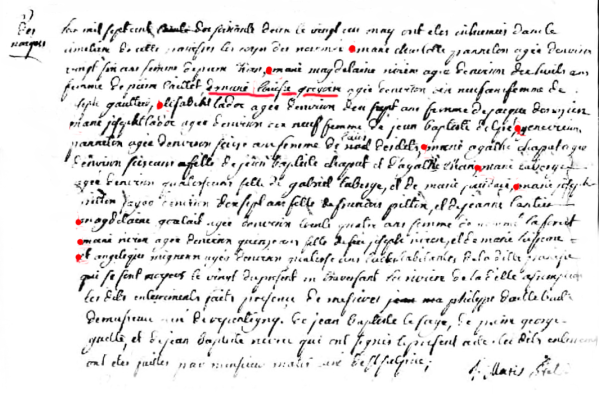
Three months after their wedding tragedy struck and Louise, along with 9 other young women perished while crossing the Assomption River on the 20th of May 1762. They ranged in age from single girls 16 -17 years old and young wives who were around 19 or 20. Were they returning home to their farms across the river from the village?

The Assomption River meanders forming a peninsula around the village.6.

The above is the burial record of Louise and the other young ladies who drowned in the Assomption River. 7.

A year and half after Louise’s drowning Joseph Antoine married for the third time in October 1763. Both he and his new bride, Francoise Loiselle, were born in the same year, 1731, and were now 32 years old.

Marriage of Francoise Loiselle and Joseph Antoine 8.

On August 15, 1764, Francoise gave birth to a daughter Marie Francoise, however, the baby’s stay on earth was very brief and she died two weeks later. Another year went by and on August 31, 1765, Louis Stanislas was born. He had a long life and died at the age of eighty-three. Francoise on the other hand was not as fortunate. Her life was cut short. After less than three years of marriage to Joseph Antoine, she died in January 1767.

At this point in his life, Joseph Antoine at age thirty-six had been married three times, lost a daughter, buried three wives, and now had five children between 2 and 14 years of age in his care, no doubt a daunting task. How would he cope? Where would he find the courage and strength to continue? His life thus far adhered to the saying “Things come in 3s” or “Jamais deux sans trois”.

When were the tragedies going to end? He had experienced more upheavals in his short life than the average person. Would there be a brighter future in store for him?

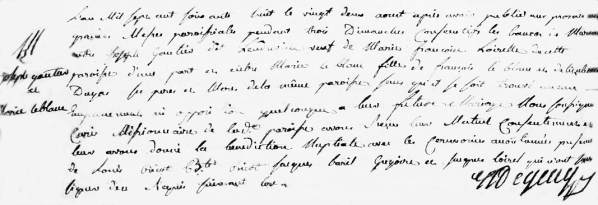
Not letting the grass grow under his feet and with firm determination, within a year and a half on August 22, 1768, he married an Acadian, Marie Leblanc. He was thirty-seven and she was in her mid-twenties. She too had endured hardships in her life. Her family had been deported along with many other Acadians who made their way to Massachusetts, then eventually settled in L’Assomption, Quebec and surrounding area.

                     The marriage record for Joseph Antoine and Marie Leblanc 9.

                                        Translation of the first few lines:

In the year seventeen hundred and sixty-eight on the 22 of August, after publishing the bans at Mass for three consecutive Sundays……. Joseph Gauthier dit Landreville widower of Marie Francoise Loiselle from this parish on the one hand between Marie Leblanc, daughter of Francois Leblanc and Elizabeth Dugas the father and mother from the same parish….

In Québec, the Acadians settled in every corner of the province starting in the late 1760s. Mostly concentrated along the St. Lawrence River, they progressively settled in other areas where agriculture was predominant. The province of Québec is where the largest Acadian population was living by the end of the 18th century. Because of the similarities in religion, language, and social status with the Canadiens (French Canadians, today’s Québecois), the Acadians easily integrated into mainstream society. The Acadians who lived in the province embraced the struggle for the rights of French speakers that drove politics and social discourse in Québec throughout the 19th and 20th centuries. Despite their integration, these communities maintained an awareness of their ancestry and contact with the Acadian communities of eastern Canada. In the late 19th century. 10.

In May of 1769 Marie gave birth to Marie Josephe. Alas, their joys were dashed. The little girl did not survive her first winter and died the following February. One more heartache.

Their lives took a positive turn and in March of 1771 Alexis was born. Between 1771 and 1778 three more sons and a daughter rounded out the family. At long last stability had become a part of their lives. There was joy in the Gauthier household.

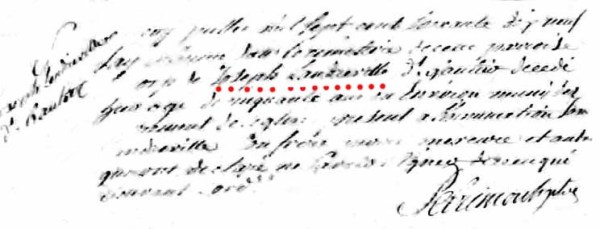
Alas! At the age of forty-eight and in the prime of life Joseph Antoine’s life abruptly came to an end. He had experienced more than his fair share of trials and tribulations during his short life. He had endured many heartaches and misery beyond belief. Despite all all the turbulence in his life, in the end he finally found companionship, joy, and happiness. Joseph Antoine died of unknown causes on the 8th of July 1779. He was buried in L’ Assomption the following day.

Burial Record of Joseph Antoine Gauthier dit Landreville

 Translation of the burial record for Joseph Antoine Gauthier dit Landreville

                   In the year seventeen hundred and seventy-nine…….in the cemetery of this parish the body of Joseph Landreville…..

Marie Leblanc married a second time in the fall of 1780 and had several more children. She lived to the age of 82 and died in 1824 in the neighbouring community of St. Joseph de l’Achigan.

Note:

In the scope of this research there was no mention of Joseph Antoine’s occupation, however, given the fertile land around the Assomption River one could surmise that he was a farmer…. un “cultivateur’

In this research I have maintained the French spelling that is used in the province of Quebec for the name of the town and river. The spelling in English is ‘Assumption’.

Sources:

1.https://www.myheritage.com/names/joseph_gauthier%20dit%20landrevilleJoseph Antoine Gauthier dit Landreville, 1731 – 1779

2.Ibid

3.https://www.google.com/search?q=map+of+southern+quebec+province&rlz=1C1YTUH_enCA1032CA1032&oq=map+of+southern+Quebec&gs_lcrp=EgZjaHJvbWUqBwgBEAAYgAQyBwgAEAAYgAQyBwgBEAAYgAQyBwgCEAAYgAQyCAgDEAAYFhgeMggIBBAAGBYYHjIICAUQABgWGB4yCggGEAAYChgWGB4yCggHEAAYChgWGB4yCAgIEAAYFhge0gEONDEwMTIzNTAyajBqMTWoAgCwAgA&sourceid=chrome&ie=UTF-8#vhid=Ewr6KV_ljOM7JM&vssid=l

4.https://famille-arbour.com/2012/04/14/gauthier-joseph-1731-laperche-agathe-1736/

5.https://www.myheritage.com/names/joseph_gauthier%20dit%20landreville

6.https://www.google.com/maps/place/L’Assomption,+QC,+Canada/@45.7152305,-73.4005752,11z/data=!4m6!3m5!1s0x4cc8ebc2c89a8083:0x74c64a2b19247dd5!8m2!3d45.8519896!4d-73.4123978!16zL20vMDM3a2xi?hl=en-US&entry=ttu

7.Ancestry.com. Quebec, Canada, Vital and Church Records (Drouin Collection), 1621-1968 [database on-line]. Lehi, UT, USA: Ancestry.com Operations, Inc., 2008.
Original data:Gabriel Drouin, comp. Drouin Collection. Montreal, Quebec, Canada: Institut Généalogique Drouin.

8. https://www.myheritage.com/names/joseph_gauthier%20dit%20landreville

    9. https://www.genealogiequebec.com/en/

https://www.myheritage.com/names/joseph_gauthier%20dit%20landreville

 10. http://www.landscapeofgrandpre.ca/deportation-and-new-settlement-1755ndash1810.html

 11. familysearch.org


..

Letters

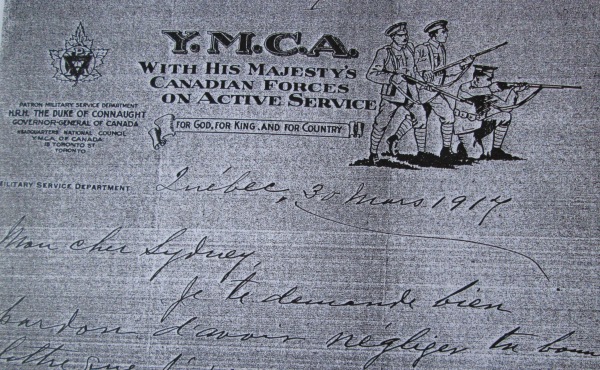
Nothing gets a genealogist’s heart beating faster than finding an old letter written by an ancestor. These are as close as we come to knowing what they really thought, gleaning a little bit of an ancestor’s character. “Thank you very much for your good wishes for my 65th birthday and it seems to me only yesterday that I was your age. Oh! Life goes fast; we should use it well so as not to have one regret on reaching the end.”¹ I am lucky as I have a number of family letters but one always wishes for more.

Many of the letters are somewhat disappointing. People seem to be just filling the page. How are you? We are all fine and the neighbours too, unless of course they aren’t and then the neighbours ailments are itemized. They often finish with please write soon as we have waited such a long time to hear back from you. Other than knowing the letter writer is still alive not much other information is given. Still the recipient was happy to receive the note.

Letter written by Ismael Bruneau

Before the telephone became ubiquitous people would just drop a note in the mail. It might just be a postcard with thanks for a visit, even to a neighbour around the corner. They used the post as a means of keeping in touch.

Some letters are heartfelt, such as a father wishing his sons wouldn’t go to war. “ I am sorry to tell you that I do not approve of your plans to go to war. Alas I certainly had greater and nobler ambitions for my boys than to make simple soldiers of them.”² If they did go he prayed that God would keep them safe. All his congregation was praying for them. My great-grandfather Ismael Bruneau wrote many letters to his son Sydney during the First World War. He signed most, “ton père affectionné I.P. Bruneau”. Sydney kept the letters and his daughter translated some. I only have photocopies which are hard to read.

These letters have only snippets about the family as he writes, “Your mother told you about the family so I won’t.” Only one letter written by Ida Bruneau survives and that was written just after Ismael’s death.

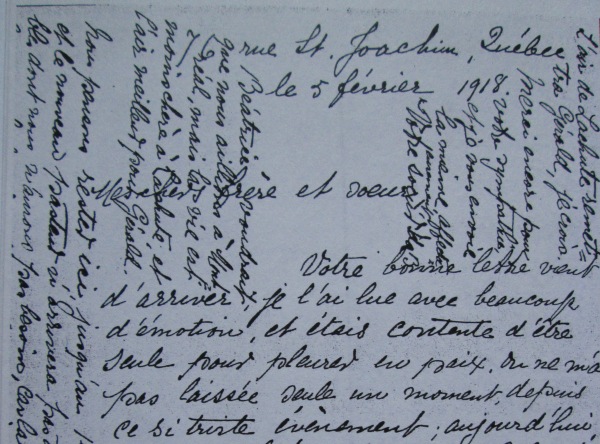
Letter written by Ida Girod Bruneau

Handwriting can be difficult to decipher and letters written in other languages make them even harder to read. Some people had beautiful even cursive script and their letters are still a pleasure to read. They learned “real writing” in school with much practice. Other letters are covered in tiny script as they didn’t want to waste the paper. Most difficult to read are those with writing perpendicular to the first lines, again to save paper or a just remembered thought.

Unfortunately, there are also some letters you wished you had never found as they say things you didn’t want to hear. Letters from people recounting their hard times and mental struggles you never heard about and negative opinions about people you thought you knew.

Did those who saved the letters ever think someone would read them many, many years later? Most often there is just one side of the correspondence. I have a series of letters my grandfather wrote to my grandmother before they were married. He mentions often rereading her letters so he didn’t immediately discard them but they didn’t survive. Were they too personal or showed too much anger or just stupid thoughts? I imagine my grandmother found them and was embarrassed by her openness and she threw them out.

What will future generations find? Nothing? Emails and texts they can’t access, Facebook pages that have disappeared or meaningless tweets but almost no letters. There will be no papers touched by a loved one’s hand to find, tied with a ribbon or tucked into a fancy box. So after reading this, go and write someone a letter. They just might keep it!

Notes:


  1. Letter from Ismael P. Bruneau to his son Sydney Bruneau: Y.M.C.A., Quebec, 30 March 1917. Ismael died before his 66th birthday.
  2. Letter from Ismael P. Bruneau to his son Sydney Bruneau: Cornwell, ONT, 15 March 1915. Both Sydney and his brother Edgar survived the war.
  3. Letter from Ismael P. Bruneau to his son Sydney Bruneau: Cornwall, Ont, 18 July 1915.

These letters were translated by Sydney Bruneau’s daughter Ida Bruneau.

The Whalers of the Gaspe Coast

https://www.britannica.com/topic/

An excerpt from https://www.patrimoine-culturel.gouv.qc.ca/rpcq/detail.do?methode=consulter&id=74&type=imma

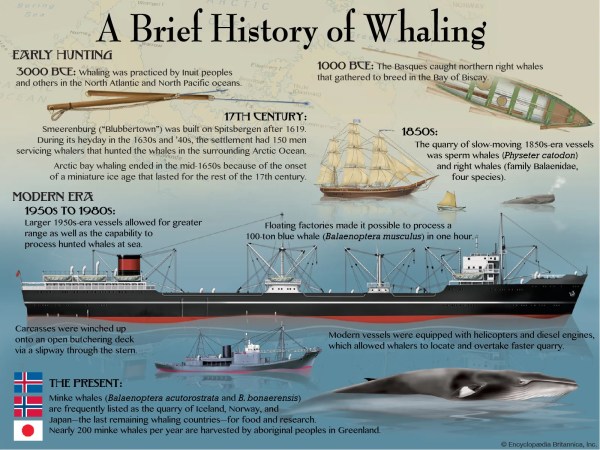
“Introduced around 1804 by the Loyalists established in Gaspé Bay after the American Revolution (1775-1783), whaling played a leading role in the regional economy and even on the Canadian scale for nearly a century. Gaspé and Saint-Jean, New Brunswick, were the only two ports in the country to have a total fleet of a dozen whaling schooners in 1846. But nothing to do with the American fleet, which then had 635 whaling ships. tracking cetaceans on the seas of the world. On the other hand, Gaspé stands out as the leading Canadian port with a fleet of seven schooners which supply 80% of the country’s demand for whale oil.

In Gaspé, whaling is a family affair. Originally from Nantucket and New Bedford, the main whaling centers on the American east coast, the Coffins and the Boyles were the first families to perpetuate the practice of whaling in Gaspé. Oral tradition attributes to the Coffin family, settled in Anse-aux-Cousins, the role of precursor of the profession of whaler. However, the Boyle family turns out to have a head start in oil production. In 1809, the whaling captain Boyle produced 90% of the local oils.”

************

The following database prepared by Jacques Gagné consists of various documents and books written about whaling in the Gaspe.

Below is a link to a map of the Gaspe Coast

https://www.tourisme-gaspesie.com/images/Upload/cartes/carte_routiere_gaspesie_2023.pdf

The Ugly Vases

Here men and women were working side by side, the women subordinate to the men. All were preoccupied, wrapped up in their respective operations, and there was the sound of irregular whirring movements from every part of the big room. The air was laden with whitish dust, and clay was omnipresent—on the floor, the walls, the benches, the windows, on clothes, hands and faces. It was in this shop, where both hollow-ware pressers and flat pressers were busy as only craftsmen on piecework can be busy, that more than anywhere else clay was to be seen in the hand of the potter.” Anna of the Five Towns by Arnold Bennett.

Family heirlooms are loaded both with history and with sentiment. While an heirloom’s historical significance often grows over time, the sentimental side of it inevitably diminishes down the generations.

A once-cherished heirloom very often becomes something a baffled descendant holds up in the air while wondering “Is this teacup pretty enough to keep?” “Does this glass lamp match my decor?” Or more likely. “I wonder if this hideous silver ladle is worth something.”


In my house, I have many heirlooms from my husband’s side –and have disposed of even more – and only a few from my mother’s side. My mother’s much older sisters got all the delightful bourgeois bric-a-brac from the family, my mother ended up with only a few turn-of-the-last-century vases.

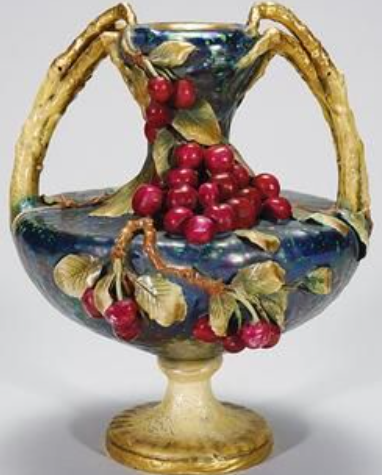
I gave my sister-in law this Austrian Amphora with a cascade of cherries. She has more baroque decorating tastes than I do.

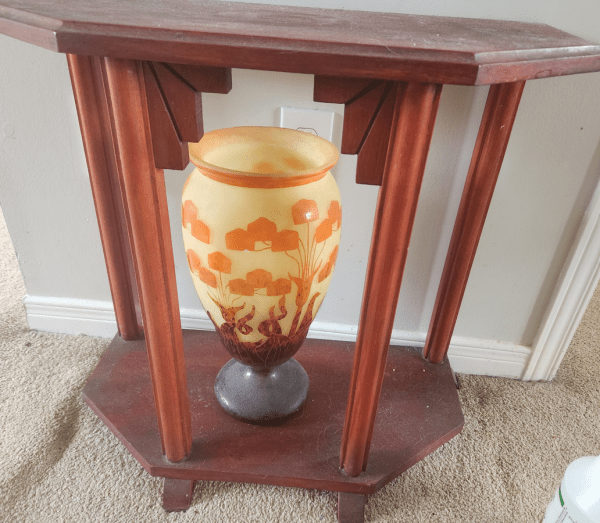
This classic Schneider Verre Francaise I keep in an Art Deco place of honour – on the floor – so my kamikaze cat won’t knock it over.

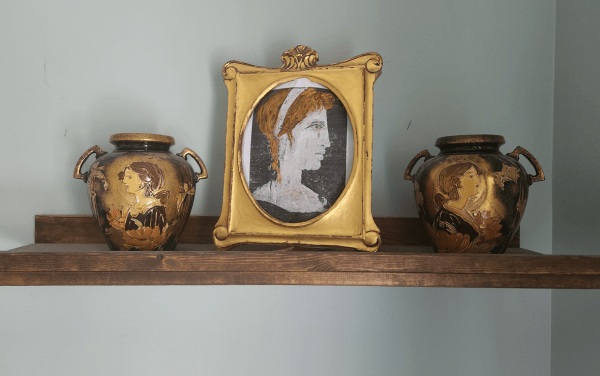
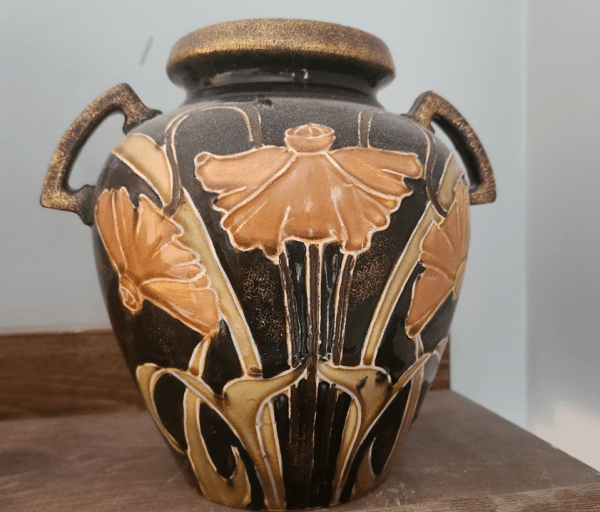
And the two rather ugly portrait vases once belonging to my chere Grandmaman Crepeau, I keep up on a shelf in the spare bedroom

for one reason and one reason only: I was practically born under them.

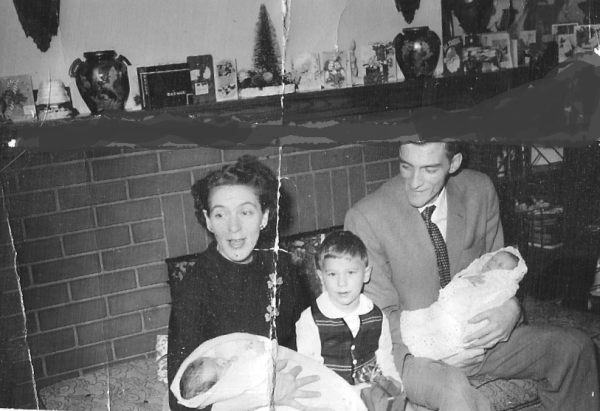
December 1954. That’s me in father’s arms. We are at my Aunt’s home in NDG

Twenty years ago, I investigated the provenance of the ugly vases for my Mom. She had just inherited them from my Aunt. They had a certain Pre-Raphaelite feel, I told her. Maybe they were worth something.

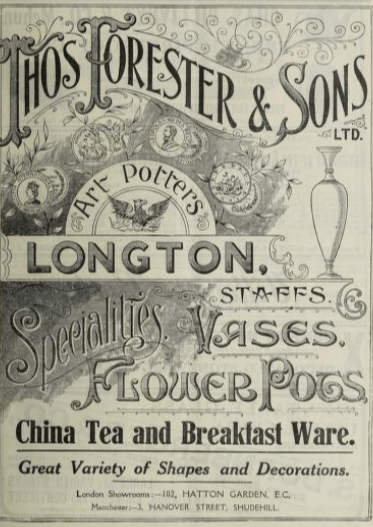
It didn’t take too long to figure out. These vases were English “art nouveau’1 Rembrandt vases out of the Thomas Forester factory in Longton, Stoke-on-Trent, a business supplying “useful and decorative” pottery to the masses.

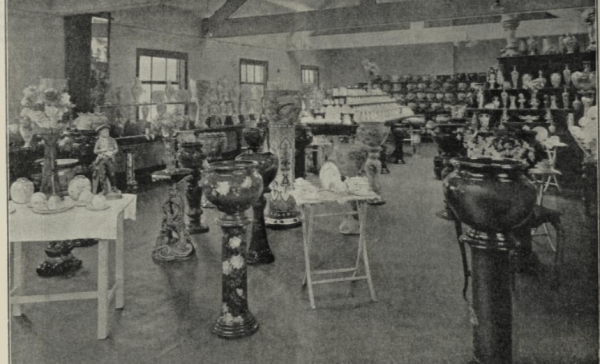
1912 Thomas Forester Showroom, Glasgow. The company specialized in Phoenix ware, a bright blue kind of pottery.

Later, I brought the ugly vases to a woman who was holding a “road show” event locally and she seemed impressed that I knew of their provenance. She said my Rembrandt vases were worth 400 dollars. Well, OK. Today, I can see a nearly identical pair on auction in Yorkshire for a mere 30 British pounds.

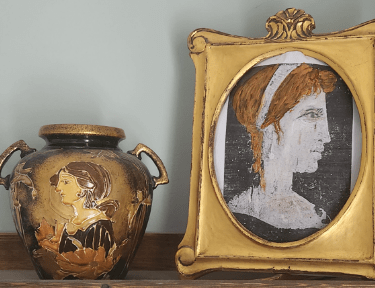
These days, I display the vases beside a print-out of a painting of the Pompeii Cleopatra. (I am a classical history enthusiast which, let’s face it, is largely about pottery – or pottery shards.) There’s a similarity in style, I think, especially with the girl on the left. I’ve always called her the Egyptian girl.

The back of the vases. Poppies? The Road Show lady said all the ugly bleeding is a mark of multiple firings and a good thing.

The designer of the vases is likely one Thomas Deans 2. I wonder if Mr. Deans ever visited Pompeii. Still, I don’t find these vases very appealing. Too chiaroscuro3 for my tastes. Too rough around the edges. The auction sites agree 🙂

Now, wouldn’t you know, Mary, the Queen of England, expressed a fondness for Rembrandt vases in 1913, the very year my vases were thrown. I know because Their Majesties made a tour of the Potteries (five towns in Staffordshire) in April . The tour was recounted in detail in the May 1913 issue of The Pottery Gazette.

The pottery industry was so important in England in 1913 that it warranted a Royal tour.

The King and Queen were also there, I suspect, to help calm down the natives who were upset over muscly new workplace laws threatening their businesses.5

This Royal visit was a PR masterclass, skilfully curated in support of the English pottery industry: The Royal Couple was on a tight schedule but they always seemed to linger longer than permitted, “so interested they were in the orchid paintings of Mr. Dewsbury; such pleasure they took in the engravings of Mr. Wyze; how attentively they watched the Wedgewood throwers at their work.”

And at every turn, Her Majesty revealed a vast knowledge of all things moulded, pressed and thrown.

Their Majesties did not stop at the two Thomas Forester factories in Longton but they did visit another factory-of-the-masses in that town signifying that they were not pottery snobs and very much interested in the ‘utilitarian’ aspect of the products.

They also went upscale. It was at the Doulton Factory toward the end of their tour where Queen Mary expressed a keen interest in my vases, ah, well, similar ones. “The Rembrandtware was singled out by the Queen for special inspection.” I guess, she really liked those gloomy vases gilded with gold.

So, my ugly art nouveau vases do contain a bit of history, even if it can’t be proved that Thomas Dean the designer ever visited Pompeii; even if Queen Mary of Teck, King Charles’ great-grandmother, never set eyes on them. 4

The vases certainly contain loads of sentiment: that photo is the only one I have of me as a baby and I’m in my Dad’s arms. For all I know, I first learned to focus my eyes on one of those gilded West Midlands maidens as my father moved toward the couch for this first-ever family photo-op.

Reminder to self: Put a copy of this story in one of the vases for when my my kids are deciding whether to give it to the VON. Also. Reread Anna of the Five Towns.

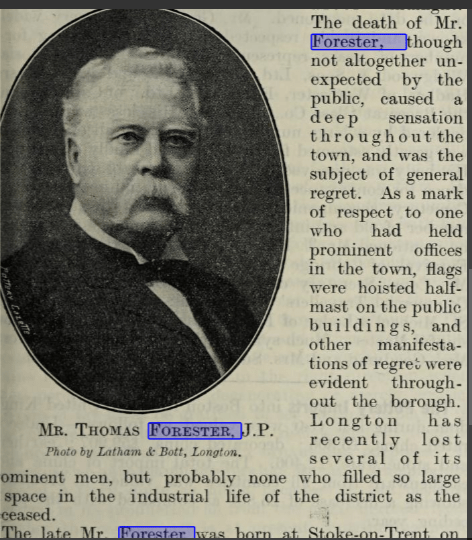
Thomas Forester: A local self-made man with good business sense. He would have two factories on Longton, his home town.

1. Art Nouveau. I love Art Nouveau. But where are the Mucha-like flowers in the hair? Forester produced prettier vases with women adorned like that. Just not here. My vases are a mishmash (miss match) of Dutch Golden Age, Art Nouveau and Classical Antiquity, I think anyway.

2. My vases have no Forester stamp, just a squiggly line, but online at auction an identical vase was designated Deans.

3. Rembrandt style as in clear/dark. I remember the term from an art history lecture in college. Funny what sticks in your head. Doulton Rembrandt vases are worth a fair bit on the auction sites. They have traditional portraits of hoary old men.

4. Maybe she did, after all. To put a stamp on the Royal visit, the Potteries mounted a huge exhibit for the benefit of all citizens.

5. Children under fourteen were banned from the workplace. The glass industry said this would ruin them. Boys needed to start work at 10 or so in order to become apprentices at 14. Not to worry, the children would only work 44 hours a week! There were new laws regarding the unbearable heat in the buildings, too, and lead-poisoning (of women and children) was also a topical issue.