
“Pop” Sherron and “Texas Betty” (his air-conditioned travelling mobile theatre bus) must have been a welcome sight whenever they pulled into small towns in and around Phoenix, Arizona, in the 1940’s.
Sherron, my great-uncle, charged admissions of 40 cents per adult and 20 cents per child to enjoy “two feature picture comedies nightly” and “a different show nightly” on his travelling mobile theatre bus.
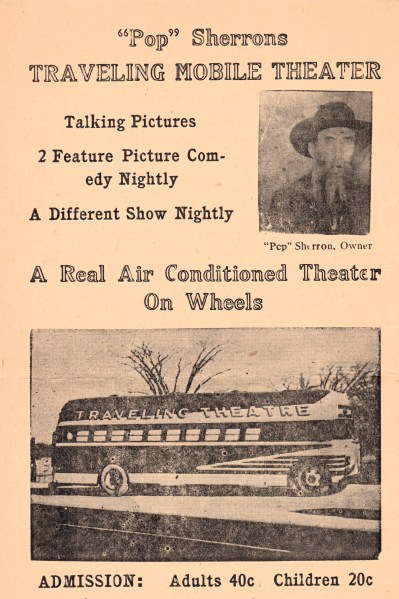
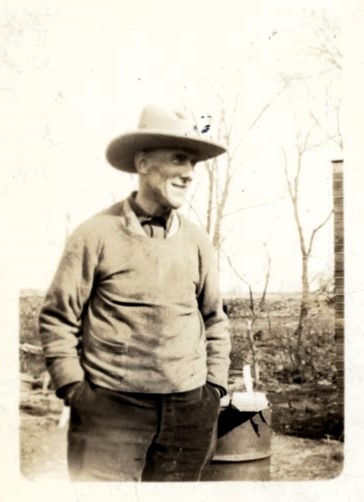
Roger Sherron (1895-1963) was a somewhat “reclusive” man or what one might consider a “hermit” and, according to a phone conversation with his nephew, his own family labelled him as “odd.” These opinions were supported on his WW1 registration (and rejection) in 1917 (age 22) with “arrested development mentally” entered by hand in the exemption section by officials.
Fortunately, we have come to better identify and understand mental conditions nowadays.
The Sherron family belonged to Philadelphia’s high society. Roger’s father owned and operated a wholesale grocery business while his mother and two sisters were frequently featured in the society pages of the local newspapers with their luncheons, tea parties, bridge games, fundraisers and such. This was not Roger’s “cup of tea” so to speak.
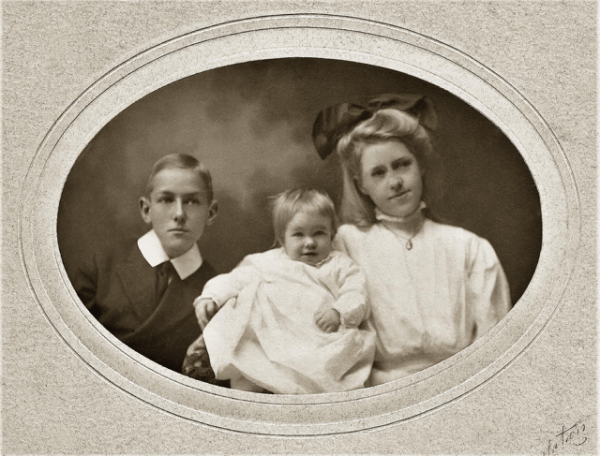
Roger, Alberta and Josephine Sherron (my grandmother) – 1906
Young Roger briefly attended the Wenonah Military Academy in New Jersey, a private secondary school “where a diploma entitled the graduate admission to West Point, Annapolis, or one of the best colleges or universities in the country, usually without qualifying tests.” He left school before he finished his studies but luckily could read and write by then even if his handwriting remained somewhat childish.
According to the censuses, Roger sometimes worked at odd jobs (in 1920 – grocery sales at age 25 and in 1930 – game warden for the State Government at age 35) but otherwise he was listed as “unemployed.”
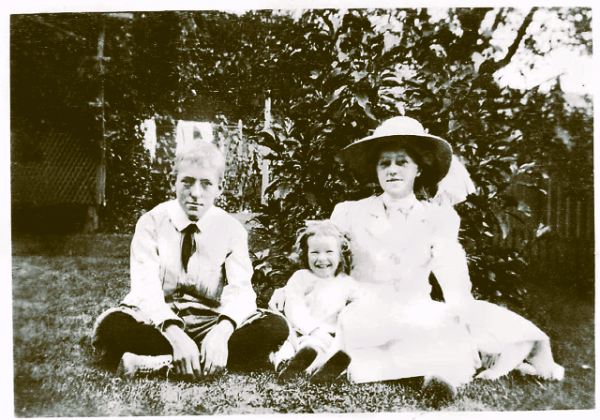
He never married, living with his parents in Philadelphia until 1940 when his mother died. His father passed away in 1932. His younger sister Alberta also remained nearby with her family but his older sister Josephine (my grandmother) moved to Montreal, Quebec, with her stockbroker husband, Wendling Anglin, and her two sons (my father, Tom, and his brother Bill).
Roger was 44 years old when his mother died, alone in the world for the first time and without a place to live.
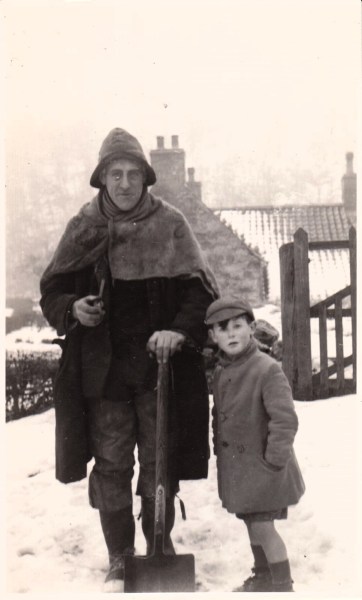
Roger and his nephew Donnie – 1932 – visiting his sister Alberta after his father died
Sometime, after the death of his mother, he moved west to a very different world and a warmer climate.
Once in Arizona in 1942, at 47 years old, and possibly homeless and jobless, he tried yet again to enlist with the WWII Draft. According to the registration form, he stood at 5’7” tall and 125 lbs with tattoos on his left arm. Unsurprisingly, Uncle Sam didn’t accept him this time either.
He must have inherited some money from his parents’ estate because this is where he acquired a retrofitted theatre bus he named “Texas Betty” which enabled him to start a rather unique business and support himself. At some point, it appears he might have attempted to expand his business as I have a piece of printed letterhead stating:
POP SHERRON’S FAMILY
Travelling Amusement Center and Big Free Circus
In Route – Pop Roger Sherron
Texas Betty Sherron
Owners
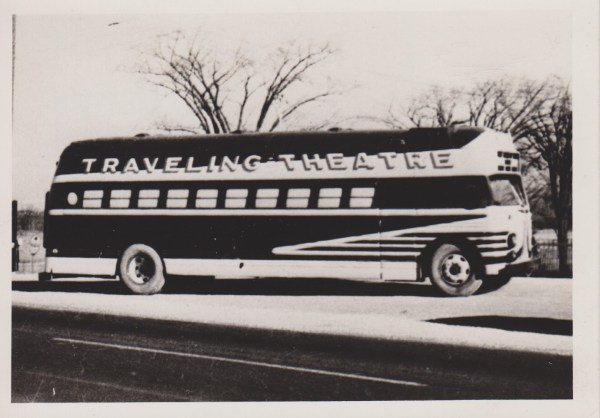
Again, according to my phone conversation with his nephew, Roger’s home in Phoenix was just “a shack.” He lived in the Hispanic part of town and it is likely the entire neighbourhood consisted of similar housing.
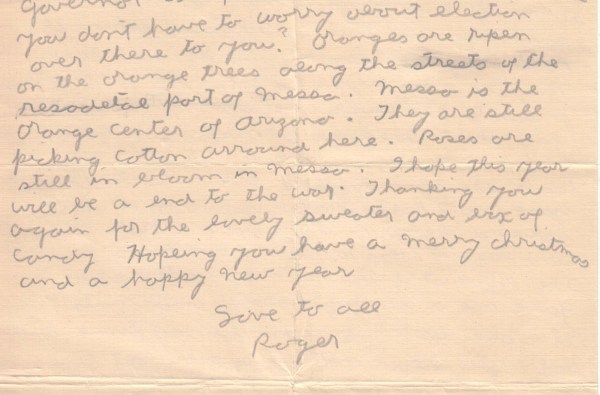
At the age of 50, some six years after he left Philadelphia, he wrote a Christmas letter to his older sister Josephine from Tempe, Arizona, which is half way between Phoenix and Mesa. He settled in this new community (and dare I say new family) who it seems wholeheartedly accepted him.
“I spent Christmas eve with some Spanish friends five houses down the road. They had tamales and Spanish food. They are nice people.”
“I got a lot of Christmas presents. The people next door gave me a fine shirt. The people three houses down gave me some handkerchiefs, a Coke, a comb, pen and ink and envelopes…the Spanish fellow who owns the store gave me a big bag of candy and nuts.”
“The television has come here now. The people next door have a fine set. It don’t hurt your eyes or nothing. Down at the bus station at Mesa, they have a set but it hurts your eyes.”
His neighbours might have struggled but they were rich in love and support for one another.
The letter continued with what might seem like “odd ball” concerns about the ongoing war, the atomic bomb and politics:
“I think the country will go Republican next election. I hope so. People are getting tired of this New Deal bussiness (sp). The Republicans will jump right in and fight Rushea (sp) and China. Lots of Chinese arround (sp) here in Phoenix and Mesa. They are aloude (sp) to run loose. They ought to put them in camps till after the war.”
Paranoia? No, just a typical American way of thinking at the time.
Roger, revealing his good prep school manners and poetic side, continued with a lovely description of his immediate surroundings: “Oranges ripen on the orange trees along the streets of the resodental (sp) part of Mesa. Mesa is the orange center of Arizona. They are still picking cotton arround (sp) here. Roses are still in bloom in Mesa.”
His letter ended with hope the war would end soon, another thank you for the gifts of a sweater and box of candy, and finally Roger wished his sister well and sent his “love to all.”
Roger died of a heart condition in 1963 at the age of 68. So he spent
the last 20 years of his life in the Arizona desert with his one-of-a-kind air-conditioned cinema bus Texas Betty and his kind-hearted friends, no longer considered a hermit, reclusive or even odd.
 Genealogy Ensemble
There is a common thread of “individualism” that runs in the Anglin side of our Family. It makes me wonder what Granny Jo’s, Aunt Alberta’s and Great Uncle Roger’s mother and father were like?
LikeLiked by 1 person