
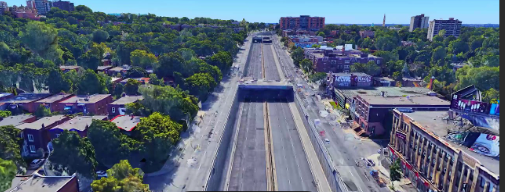
I spent my elementary school years living on Coolbrook, a one-way street in the Snowdon district of Montreal, adjacent busy Decarie.
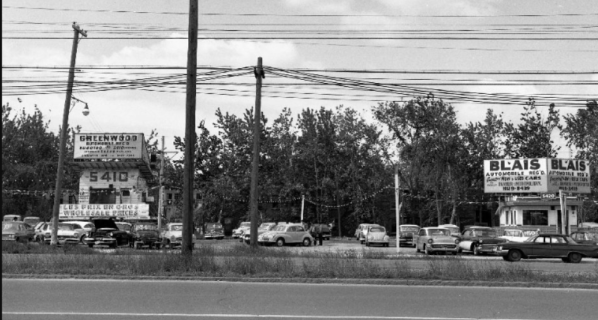
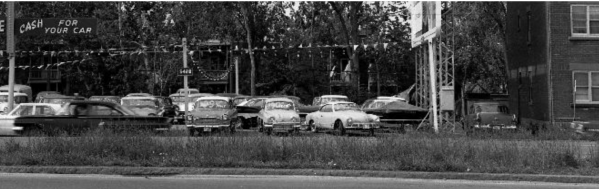
Before Decarie became “the trench” in time for Expo 67 it was a wide boulevard with a stretch of storefronts on the east side of my area including Young’s Vegetable Market and Green’s Pharmacy; and on the west side right behind my upper duplex apartment were a few used car lots as well as one empty lot where we children sometimes played. This lot, I remember, was strewn with dirty old toilet bowls and big baffling, almost supernatural chunks of quartz, but also sprinkled in between with enchanting pink hollyhocks and charming pussy willows. 1.
In those early days, I would cross Decarie at Isabella and skip down a few steps to the basement Decarie Handy Store to spend my 25 cent allowance on, usually, a MacIntosh Taffy or Cherry Blossom, ten cents each in those days. Any extra pennies would go to Lik-M-Aid, a sour powder in a paper tube.
My allowance didn’t permit me to buy the giant, perhaps healthier, Fruit and Nut bar I so craved. It cost 39 cents and I never thought to save up week to week.
The major commercial area in the neighbourhood was one and a half blocks south, up an incline on Queen Mary Road. There was a Woolworth’s on the corner of Coolbrook and Queen Mary with a lunch counter that featured enticing ads for banana splits for, yes, 39 cents. Again, too expensive for me although I imagine I could have always asked my Mom to buy the ingredients and make me one. She wasn’t cheap like my accountant Dad, who made us sign for our meagre allowance in a little booklet he kept for the purpose.
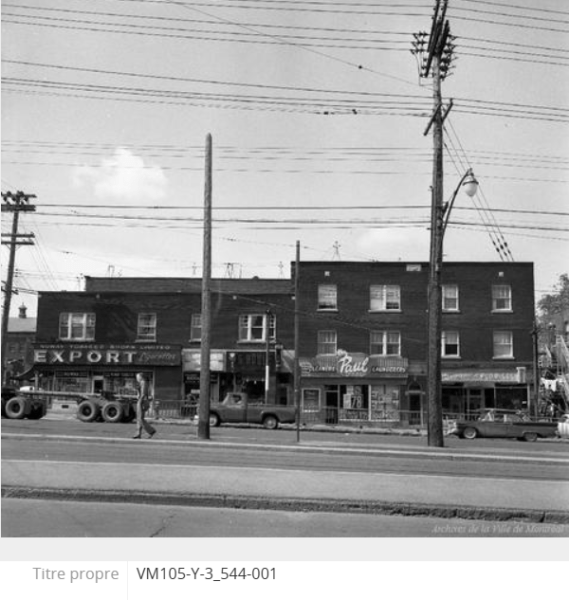
Every fall, we bought our school supplies at the Woolworth’s, sometimes a new pencil case. You could still get the old fashioned wooden ones with the sliding top or a newfangled plastic pouch with a zipper. I still get excited at the sight of an unsullied Hilroy scribbler.
The other stores of importance on Queen Mary was Black and Orange stationery shop, a dingy post-war style store but, still, all that potential in the pens and paper!
And the Zellers further up towards Cote des Neiges, also a bit of a dust bowl. Morgan’s Department store had a small shiny two story branch on Queen Mary, but that store was of no significance to me although my brother, fooling around with friends, once kicked in their showcase window.
And a little further up the street was the NDG library for boys and girls where I borrowed the horsey tome King of the Wind by Marguerite Henry over and over.
Yes, I remember the stores in my area with varying degrees of yearning, for sugar and for learning, but when it comes to the block of Coolbrook on which I lived, I only have half a memory of it.
That’s because I don’t recall one person, not one, who lived on the other side of the street. I suspect no children lived across the street in the 1960’s. Maybe whoever owned those duplexes refused to rent to families with children. And it was the baby boom era!
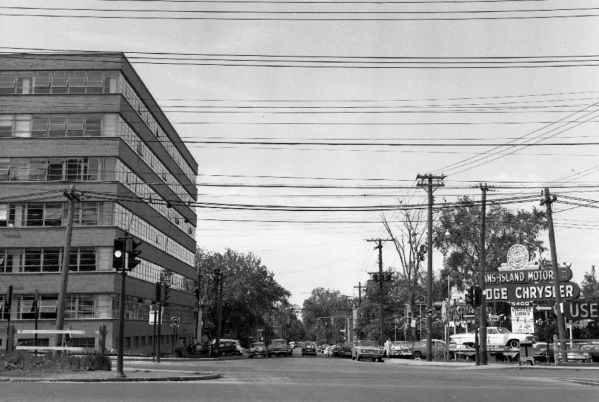
Our duplex block of four homes, two lower, two upper, was one of a stretch of five or more owned by the same man, an unpretentious French Canadian, a Monsieur D. who dressed like a hobo. My mom also said he thought I was the loveliest little girl, so kudos to him. Monsieur D. was very cheap, it seems. He painted all the doors of his brown/red brick buildings dark brown and all the porches grey, casting a gloom over the entire block. He must have got a deal on paint, my mom said.1
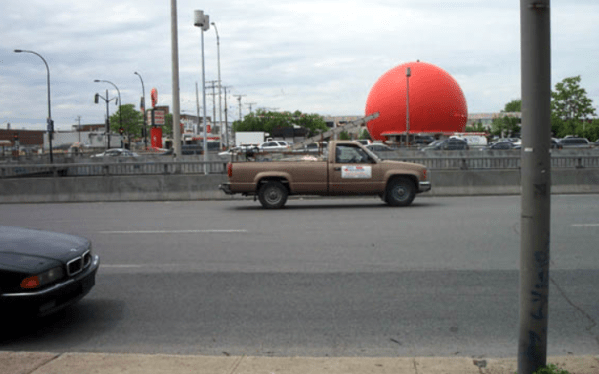
I lived smack in between two of Montreal’s most iconic structures, the Orange Julep
and the Snowden Theatre, below, in an otherwise dreary-looking neighbourhood.
I visited Orange Julep but once. The drink tasted sulphury to me.
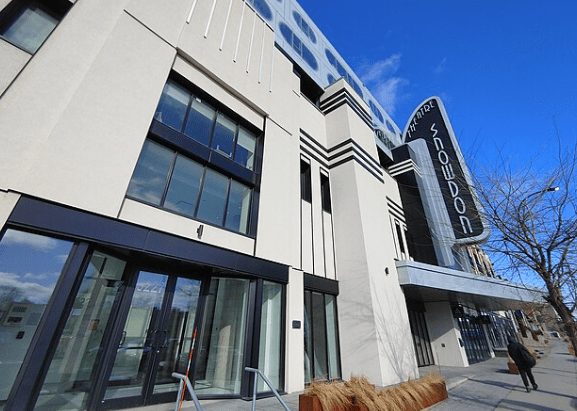
Also maybe Sound of Music. I didn’t see many movies as a child.
Children were banned from theatres until 1962 in Quebec due to the Laurier Palace Fire of 1927
It didn’t help that in those days no one bothered to decorate their upper or lower balconies with pots of flowers except for the Italian man a half dozen doors down living in a gaudy new duplex (Lovell’s reveals he was a landscaper) and an unknown family in one of the few stand-alone houses on my street, up near Queen Mary Road, who had a very splashy flower garden in summer. One year it snowed in the middle of May and I recollect the sight of a lovely row of red tulips with a cushion of white on top as I passed this tiny cottage on my way to the Nuway Tobacco Store at the corner of Decarie and Queen Mary to buy my mom a carton of Du Maurier cigarettes.
Luckily, the trees along my stretch of street were tall and leafy and during the hot, humid Montreal summers the setting sun dappled the baking macadam with light. I could reach out over my balcony and touch a branch of my very own mystic maple. I do suspect the tree’s leaves protected me – a bit – from the ubiquitous 1960’s air pollution and the lead-laden fumes of the pink, turquoise and fire-engine red Corvairs, Thunderbirds and Mustang convertibles idling on the street below. These automobiles belonged to visitors as few families on our side of the street actually owned a car. Kids cost money, after all.
A glance at Lovell’s Directory on BANQ reveals to me the familiar surnames of families living around us. I recognize, too, the phone numbers, as I dialed many of them over and over during my childhood. The family names from across the street are new to me, of course. Mostly French, some English and one Finn. The breadwinner of the family is the only one listed on Lovell’s, but had any children lived there, French or English or Finnish, I would have seen them playing on the short sloping driveways or on the sidewalk or at least walking to school.
Yes, we kids played out on the street in those days, chanting to skipping games like“double dutch” on those short sloping driveways, bickering over the rules of hopscotch or “yoki” on the sidewalk. The boys sometimes played ball hockey right on the road.2
However, when it comes to the other side of the street, I have no recollection at all. Ain’t memory funny.
I recall not one incident, not one visual. Nothing has imprinted itself on my brain for life, such as when my neighbour’s German Shepherd got hit by a truck late at night and my friend’s mom sobbed loudly on the street and there was leftover blood and sawdust on the curb the next morning.
I don’t recall one bit of gossip about anyone on the other side of the street. On our side plenty: “Did you know the L family’s kids are ONLY fostered? Did you know that in the S family, the Mom makes more than the husband?” Did you hear that the W sons went with two girls they hardly knew on a car trip out West? Real shameful stuff it was!
I don’t even remember seeing anyone out shovelling the walk across the street in winter. And I stared at that side of the street for seven years from my tiny bedroom window. No one picking up garbage strewn around by a stray dog. No one leaving the house in the early morning, rubbers on feet, leather briefcase in hand, felt fedora on brylcreemed head to take the brown and yellow No. 65 bus to some downtown skyscaper like Place Ville Marie.
I have to smile: the 1966 Lovell’s reveals that there were quite a few vacant homes across the street from us. Is it possible that it was harder to rent that block on that side of Coolbrook because of us? Because there were so many boisterous, loud, unruly children (I count about fifteen) playing out on our small section of Coolbrook Street.
As in happens, in 1967, Expo year, while my British grandmother was visiting us from Malaya for the first and only time, my brother was playing ball hockey with a friend when he knocked over one of the Italian man’s pretty flower pots, red geraniums, I think, with a errant slap shot. Supposedly the man was enraged and ran out onto the street and hit my brother with a leather strap, the one and only genuinely violent act I ever heard of on our street- and, yes, it was on our side!
My grandmother, who herself had complained many times about the “shrill” Canadian children playing on the street, convinced my father to move out of the district and within months we were living in a smog-free ex-burb north of the city in a house with a huge yard with at least two weeping willows and more fir trees than I could count.
One broken porch ornament – and a rather Felliniesque incident – and the trajectory of my life took a dramatic turn, for better or for worse, who knows. For sure, my current Facebook friends would be totally different had my brother’s ball just skipped off the railing and missed that freakin’ flower pot! Life, just like hockey, can be a game of inches.
But, as someone who has lived in sleepy suburbs most of her life, I carry that time in the west end of the city deep inside of me, even if it’s only half a memory.
END
1. Our backyard area was especially ugly. It was expansive with a floor of gravel and dirt. Each family had a little yard, yes, with a grey fence about 15 feet by 25 feet, with grass. Our plot contained a giant tree, so no light, and nothing grew there despite my efforts at a garden. We neighbourhood girls would sling blankets over the fence and tie skipping ropes to the wires and play ‘horse.’
A newlywed couple moved in for a while and I recall one time watching from my second story back balcony as the young wife was chased off the porch by her husband who was holding a bucket of water. He caught up to her and swung the bucket and poured the it over her head. I could feel their euphoria. Oh, to be in love.
Beyond the yard was an over-grown alley way, my black cat, Kitty Kat’s, private jungle, where we once saw a pheasant that had flown down from the mountain, so said my mother, and beyond that alley the used car lot. The moms would let kids run wild while at play, as was the usual in the 1960’s, but they would dutifully call their children in for lunch from the backyard porches. One Mom had a bell.
Once I and a friend came upon a ‘hobo’ sleeping in one of the used cars behind our house. He had one leg and he said he was a war veteran. I stole a rather large chunk of left-over roast beef for him, from my house. When my mom wondered what had happened to her leftovers, I told her that I had given it to a stray dog – and she laughed. No fool I.
2. I recall once and only once a huge slimy Norway rat scuttling past us into the drainpipe a we played.. How did that huge thing fit in that tiny hole? A favourite game was yoki ( I thought Yogi) also called elastics or Chinese skipping, where we used a sewing elastic and manipulated it around our lower leg to rhymes. Classic skipping was popular, too, double dutch, etc. “My mother and your mother were hanging out the clothes. My mother gave your mother a punch in the nose. What colour was the blood.” This rhyme sticks in my head probably because my French Canadian mother wasn’t friends with any of the other mothers on the block. She had little in common with them, being French and also a working mother who played competitive bridge at the tony Boulevard Club.
There was a definite pecking order among the children playing on our section of the block in the form of arguments, fights, churlishness, and a lot of one-upmanship. I was a passive observer type, definitely at the lower end of the hierarchy. A good thing too: I recall the two alpha-girls in my group viciously fighting and literally pulling out handfuls of each other’s hair.
My brothers did play ON the road, classic road hockey which was safe on our quiet one-way street. One day a car honked at them and just as they were about to give the guy the finger they noticed it was John Ferguson, the legendary Canadiens enforcer. A rather dishevelled looking man whom we sometimes saw around was related to a playmate of mine. It was Doug Harvey, the Canadiens legend.
Pierre Lalonde, a young teen idol at the time, lived in the Italian man’s place for a few years in the 1960’s. He seemed shy – but he owned two flashy convertibles, both neon aqua and two motorcycles. (I worked in the same building as he did in the early 80’s – a TV station – and lived in the same town as him, in the 1990’s, often seeing him at the pool – but never once spoke to him. I did walk his dog as a child.)


Thanks for bringing back memories I had long forgotten. A girlfriend and I used to take the 17 streetcar to Garland from St. Laurent, switch to another one and get off at Queen Mary. We loved to visit the shops, include the Black & Orange Stationery shop and Woolworth’s. Would you believe we were 10 or 11 years old and our mothers had no way of reaching us?
I also had an aunt and uncle living on Coolbrook, and later when I was married my son’s orthodontist was on Coolbrook.
LikeLiked by 1 person
Yes, back then we were armed with our home phone number that we could use either payphone or ask a merchant.
LikeLiked by 1 person
Wonderful trip down memory lane!
LikeLiked by 1 person