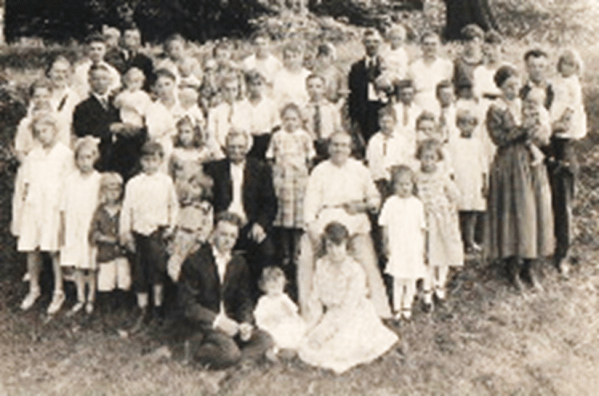
Altonen, Karhu, Kuivinen Family reunion 1919 At the dawn of the twentieth century many of my ancestors from Finland immigrated to the United States. They settled in Ashtabula Harbor, Ohio on the shores of Lake Erie. In the above photo seated are my Karhu great-grand parents surrounded by their offspring. Directly behind my great-grandfather(in the black Jacket – seated) is my Dad, Kaarlo.
Over the past decade a number of stories about my father’s adult life as a Professional Mining Engineer were presented on this blog. However, from his neatly organized photograph album we get a glimpse of his youth.
Kaarlo Victor Lindell was the oldest son of Johan Hjalmar Lindell, a blacksmith and Ida Susanna Karhu. He was born November 14th, 1905. The family lived on Bridge Street above grandfather’s shop. Dad was second of eight children, four girls and four boys
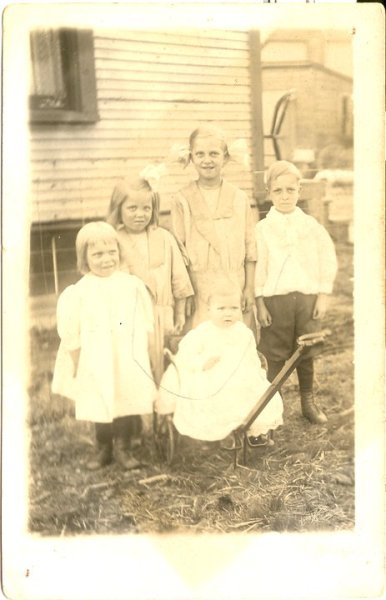
This is one of the earliest photos of Kaarlo pictured here with his four sisters. He was about 9 years old at the time. His brothers were born years later.
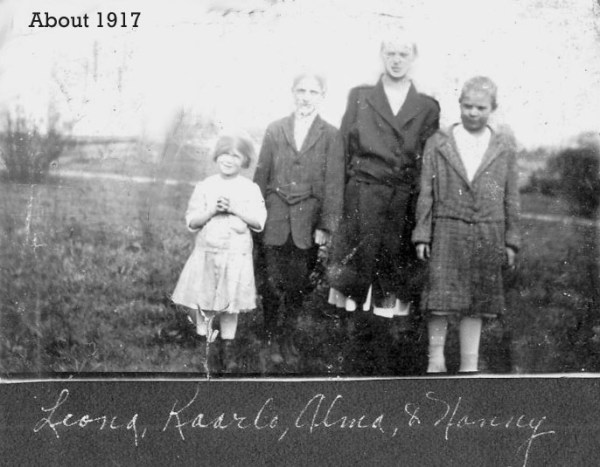
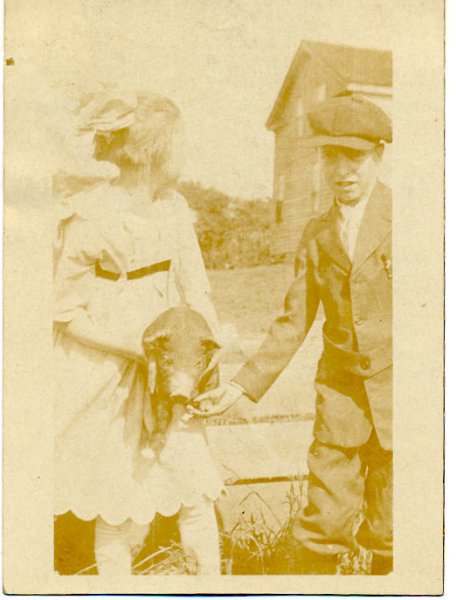
Dad would have been about 11 in this photo with his sister Leona.
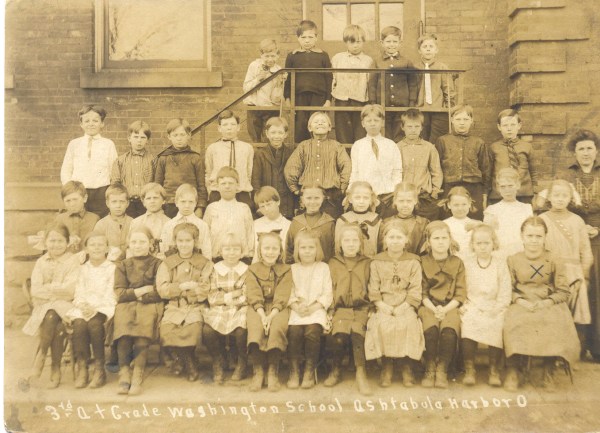
Kaarlo attended Elementary School in Ashtabula Harbor.
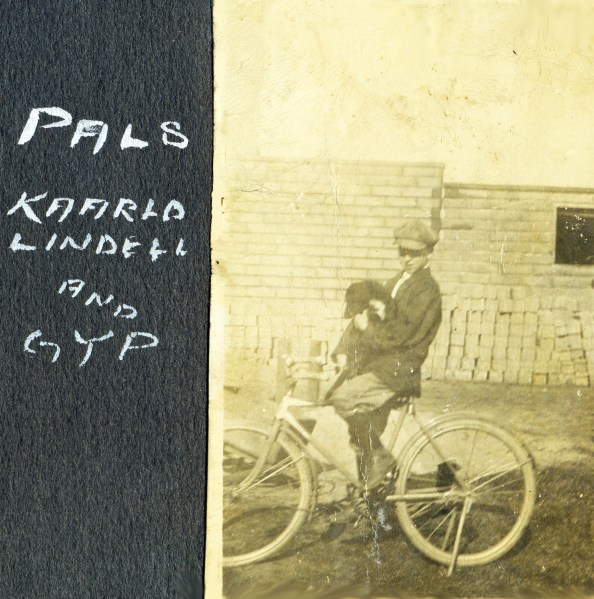
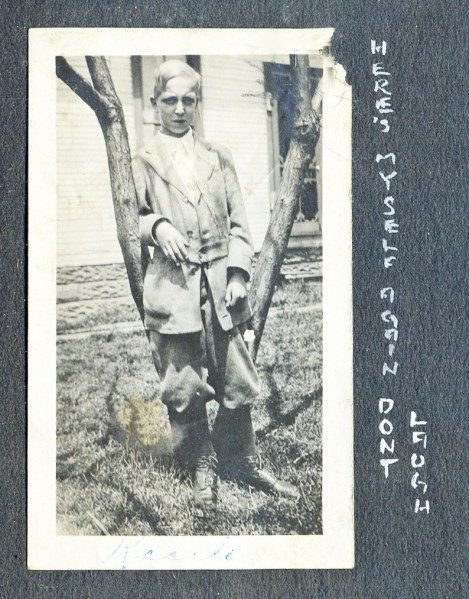
The description says it all!
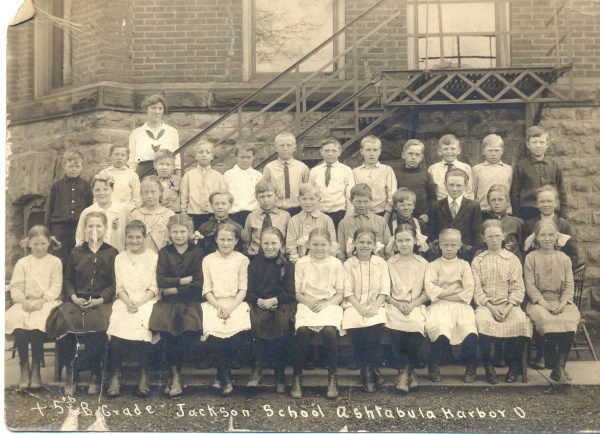
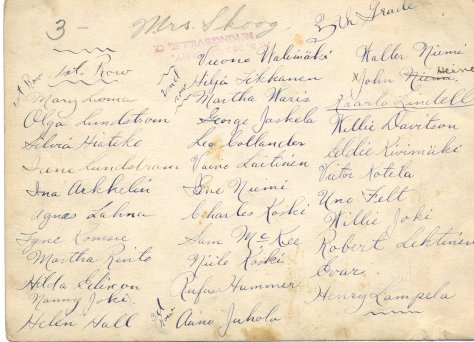
Grade 5 Class Picture and the signatures of Kaarlo’s classmates
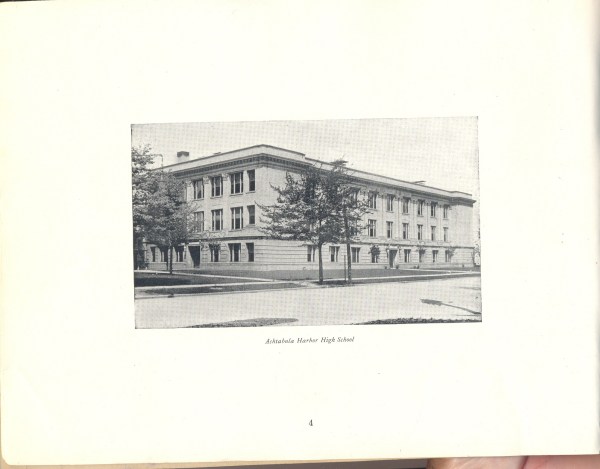
Ashtabula Harbor High School
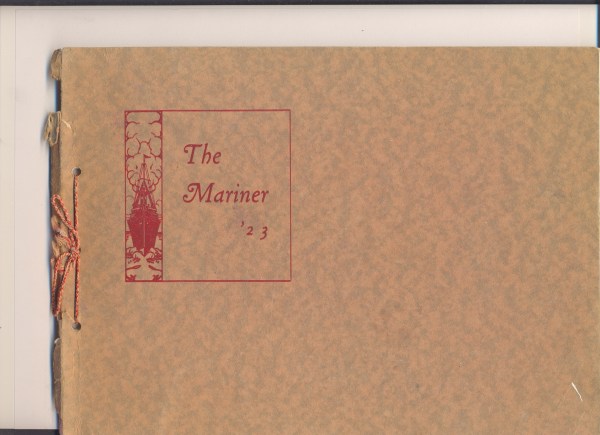
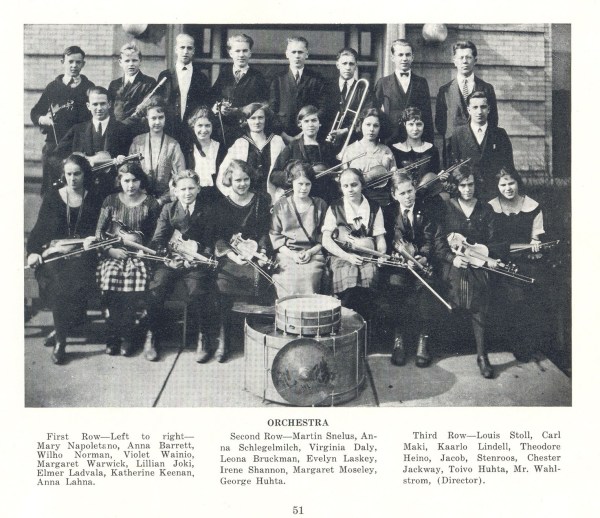
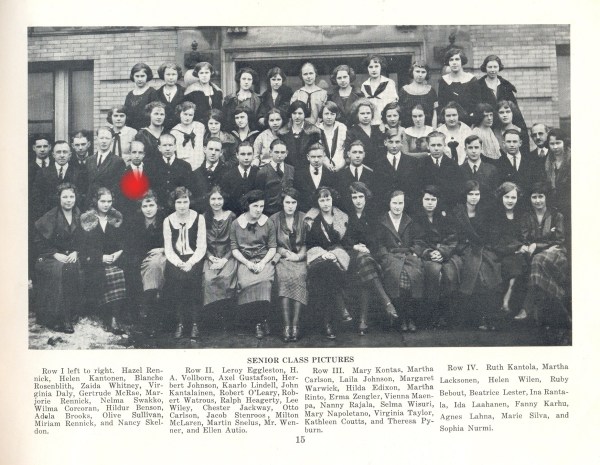
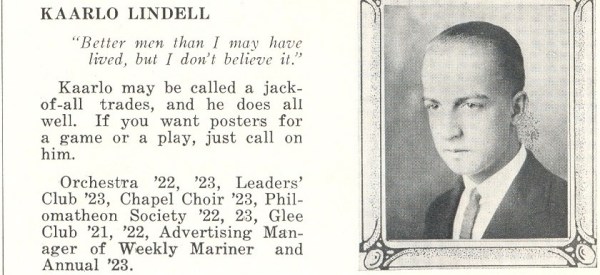
The Mariner – The yearbook for Ashtabula Harbor High School 1923.
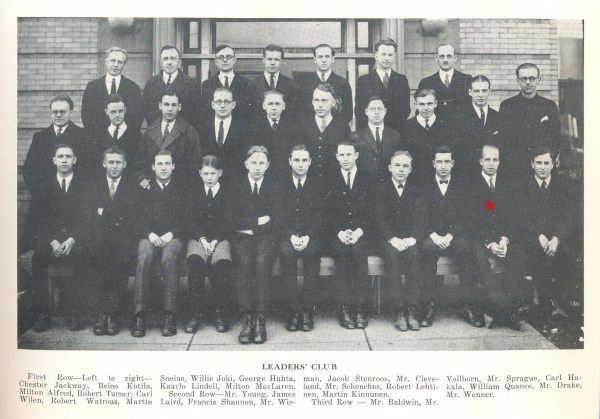
Dad was on the Advertising Committee and was also involved in many of the school activitiesas can be seen in the following photographs.
As a youngster during his teenage years Kaarlo had “many irons in the fire”. He built a crystal radio to the delight of his family. To earn money for college he read meters and ran the movie projector in the local theatre. During the summer months he sailed the Great Lakes as an assistant cook on ore boats.
From his humble beginnings as the son of a blacksmith throughout his life he became a driving force in the mining industry and travelled the world.
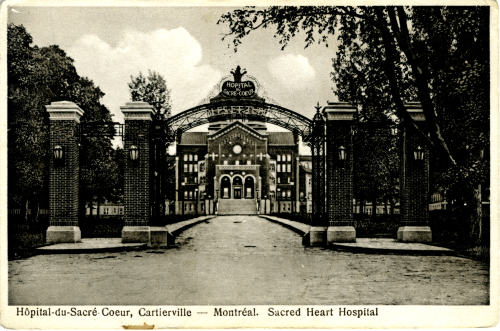
Recently, for a minor medical reason, I was referred to Hôpital Sacré Coeur de Montréal, located in the Ahuntsic/Cartierville neighbourhood, North of Montréal. Instead of using the major highway, we decided to travel via Gouin Boulevard. Motoring along a pleasant country road, filled with all manner of houses, trees, flowers and bushes, it was a very enjoyable route.
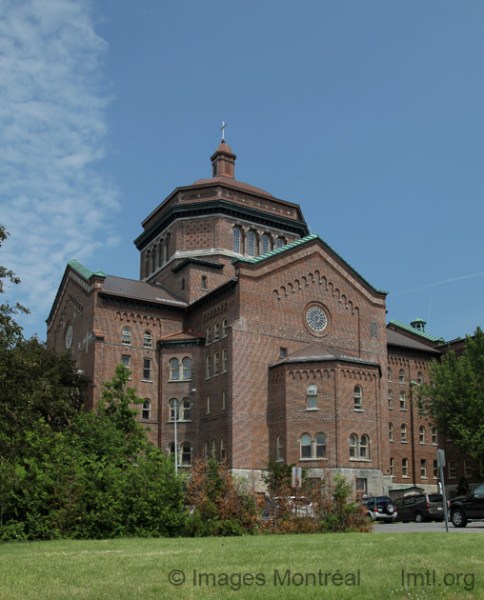
The reason I wanted to write about this hospital I had never seen before was because when we arrived and I saw the majestic gateway that led up to the main entrance, I thought at first the building may have once been a cathedral.
Although the photo below was taken C. 1940, it looks exactly the same today.
Publisher: Novelty Manufacturing and Art Co. Ltd., Montreal
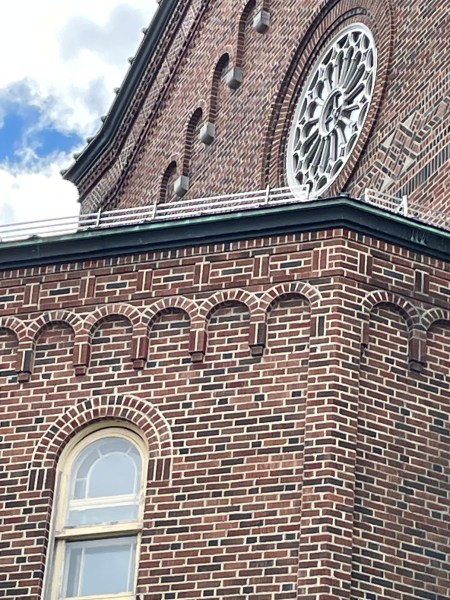
It intrigued me so much that I wanted to learn about the history of this striking building. As we approached the parking lot, I could see the huge cross on the top of the building. The original stonework, which was masterly, really stood out to me.
Picture Alexis Hamel
The original stonework would reflect the architectural styles popular in the late 19th and early 20th centuries, potentially incorporating elements of the Victorian or Beaux-Arts styles common for public buildings of that era.
Picture Marian Bulford
Excited to begin researching, I found a lot of interesting information. For instance, did you know that the institution was originally founded on June 1, 1898, the day of the Feast of the Sacred Heart, by a small group of women located in a building in downtown Montréal? (1)
They named it the Hôpital du Sacré-Cœur de Montréal, and the women cared for a dozen ill individuals, deemed the ‘incurables’. An unfortunate name, but cancer and patients with serious diseases were incurable then. By 1902, support care was provided by the Sisters of Providence.
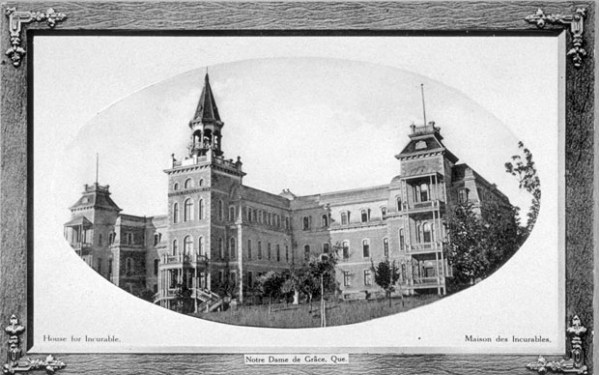
In 1900, the hospital moved to a larger building on Décarie Boulevard in Notre-Dame-de-Grâce (NDG). and was known as the Hôpital des Incurables.
Hôpital des Incurables.
This building was destroyed by fire in March 1923, and in 1926, a new building was built on Gouin Boulevard in Cartierville, where it still stands today. With the new building, the administration reverted to using the original name, Hôpital du Sacré-Cœur de Montréal.
Initially, it specialised in the treatment of tuberculosis. This was soon followed by the development of orthopaedic surgery (Dr. Édouard Samson, 1931) and thoracic surgery (Dr. Norman Bethune, 1933). In 1973, the Hospital became a tertiary care trauma centre for Western Quebec, together with the Institut Albert-Prévost, to provide psychiatric care and was affiliated with the University of Montreal as a research and teaching centre.(2)
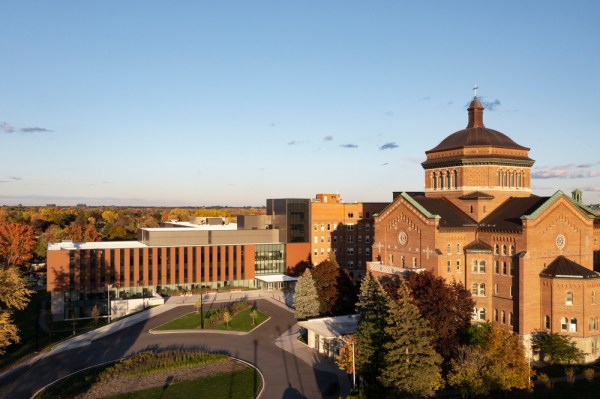
In 2022, an expansion by Provencher_Roy and Yelle Maillé was completed, adding 16,252 square meters, which complements this heritage structure. (4)
Although a visit to a hospital is sometimes an anxious experience, the building and staff at Hôpital du Sacré-Cœur de Montréal were most helpful and attentive. Young volunteers are situated on each floor, ready to give directions to various parts of this now vast hospital.
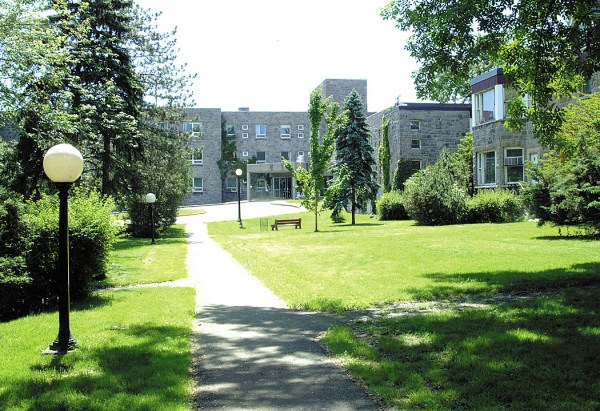
Along Gouin Boulevard, we passed the affiliated Institut Albert-Prévost, set in a pleasant park-like area, before reaching the Hôpital du Sacré-Cœur de Montréal.
Entrance to the Institut Albert-Prévost
Before becoming a hospital, Albert-Prévost may have changed names from sanatorium to pavilion, but never its vocation: it has been treating mental health problems for over 100 years. This influence is due as much to the teaching it provides as to the care it gives.
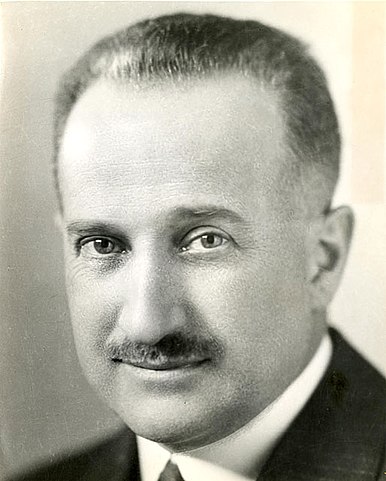
Who was Albert Prévost?
Albert Prévost
He was a Quebec neurologist and forensic physician, born in 1881 and died in 1926. He was the first holder of the chair of neurology at the Université Laval in Montreal and the founder of the institute that bears his name. (5)
Ten years ago in July 2015, my sister and I shared a “Sister Pilgrimage” to Shediac, New Brunswick, the home of our maternal ancestors. Here is a part of the story I wrote upon our return:
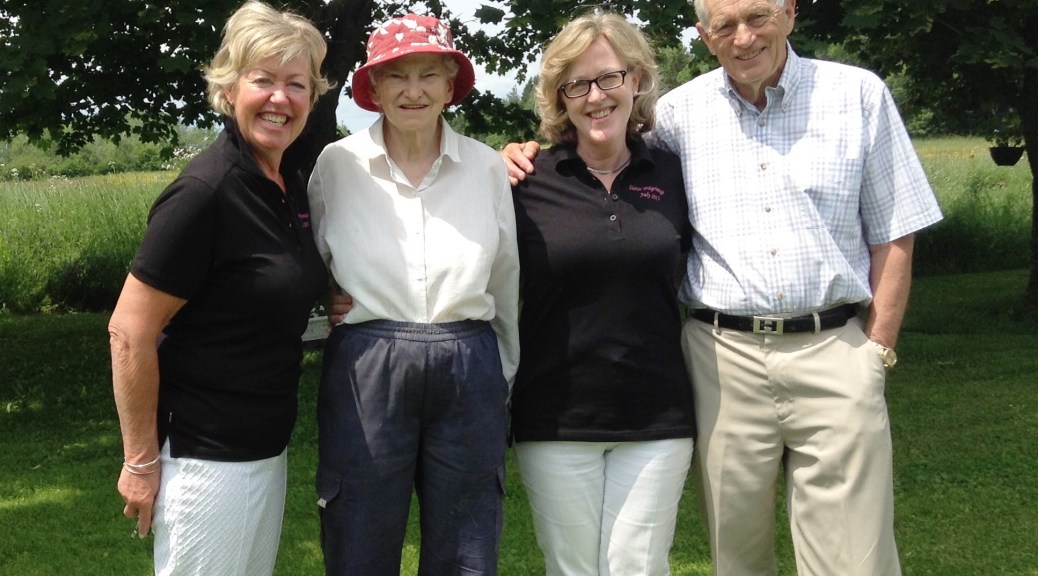
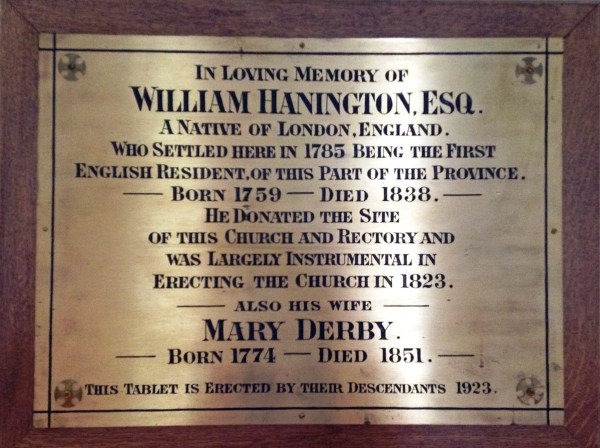
“Early Sunday morning, dressed in our special t-shirts, we left in plenty of time for the morning church service at St Martin’s-in-the-Woods. The greeter welcomed us warmly, and we asked if there might be any Haningtons at church that day. She beckoned down the aisle to her husband who then introduced himself as Allen Hanington. Overjoyed, we threw our arms around our surprised distant cousin and snapped a commemorative photo. And so our journey began.
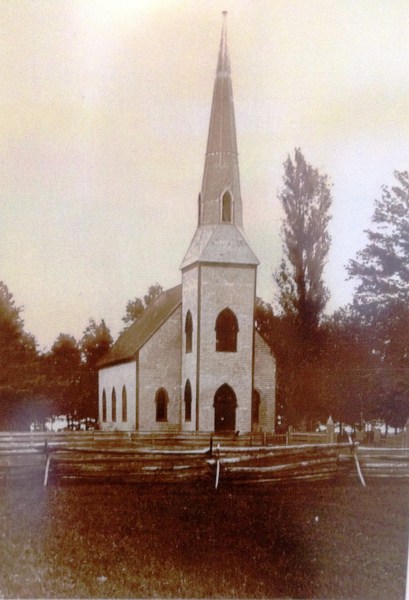
My 3x great grandfather, William Hanington William Hanington comes to Canada, was the first English settler in Shediac, New Brunswick, in 1785. He was an amazing fellow who emigrated from England at the age of twenty-six, built a whole community, set up lumber exports, built ships, married a PEI girl Shediac’s First English Woman Settlerand had a family of thirteen. Later in life, in 1823, he donated a piece of land and built St Martin’s-in-the-Woods Anglican Church, where he was buried in 1838.Later on that Sunday after the morning service at St Martin’s-in-the-Woods, we visited with Allen’s charming sister Lilian, the family historian who knew our exact location in the Hanington family tree!
… PS The August 2015 family newsletter, the Hanington Herald, just arrived by mail! Included in the comments from the President’s Desk (that would be our cousin Allen!), it says: “We just experienced a lovely visit from the Anglin sisters; Lucy (Montreal) and Margaret (Ottawa) who were visiting in the area and attended morning service at St Martin’s-in-the-Woods Anglican Church on Sunday, July 5th 2015. We had a very nice visit on Sunday afternoon. They are descendants of Daniel Hanington.” Roaring Dan
After the recent passing of Allen Hanington, I spoke with his sister Lilian—and it quickly became clear that her story deserved to be shared.
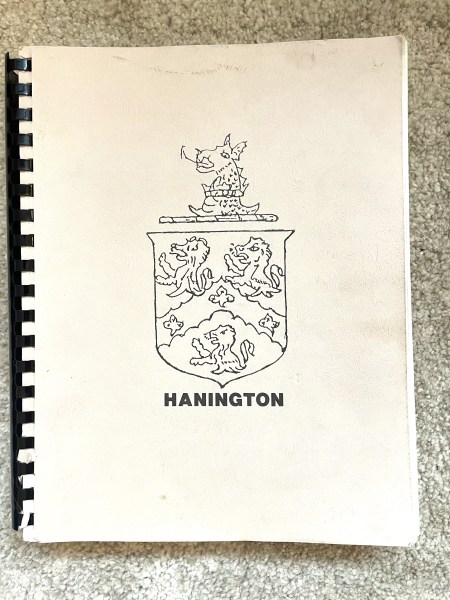
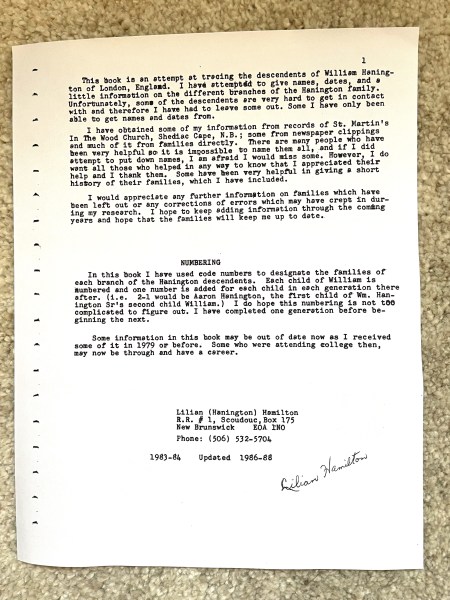
Lilian is my third cousin once removed on the Hanington side, and she’s made a lasting impact as our family historian. Her most significant legacy is the Hanington Book—a detailed 394-page family tree that she compiled and first published in 1983, then updated in 1988. Every Hanington was assigned a unique number to trace their lineage. Lilian herself is #2-4-6-10, meaning she is the 10th child of the 6th child of the 4th child of the 2nd child of our original Shediac settler, William Hanington. I now have a PDF copy of the Hanington book and happily share it with cousins near and far.
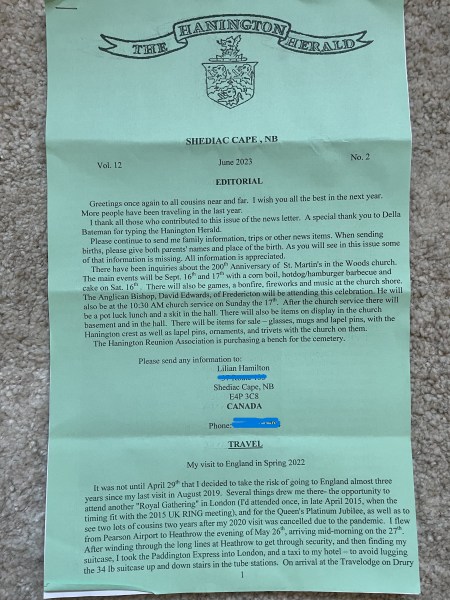
To keep the family connected, Lilian also created The Hanington Herald, an annual newsletter filled with updates on births, deaths, travels, and all things Hanington. She maintained it faithfully, offering four years of family news for the modest subscription price of just $12.
Lilian’s father, John Moore Hanington (1886–1967) ventured west from his birthplace in Shediac, N.B., in the early 1900s on a “grain excursion,” later joining the 145th Battalion in WWI, though he never served overseas. A skilled carpenter, he worked on the Scoudouc airport and maintained a thriving farm when he returned to Shediac. At one point, he had over 100 plum trees and picked more than 100 pints of raspberries in a single day. He also kept cattle, pigs, and hens for the family’s use.
His wife, Ada, came to Canada from Cheshunt, England at age 12. Together, they raised a large family—Lilian, their tenth child, was born in 1940.
Lilian attended Moncton High School, graduated from Teacher’s College in Fredericton, and taught school briefly before working at T. Eaton Co. Mail Order for 12 years. Like her father, she grew fruits and vegetables, ran a farm stand, and still maintains a huge garden. Her beautifully handwritten multi-page Christmas letters always include updates on her abundant harvest of that year.
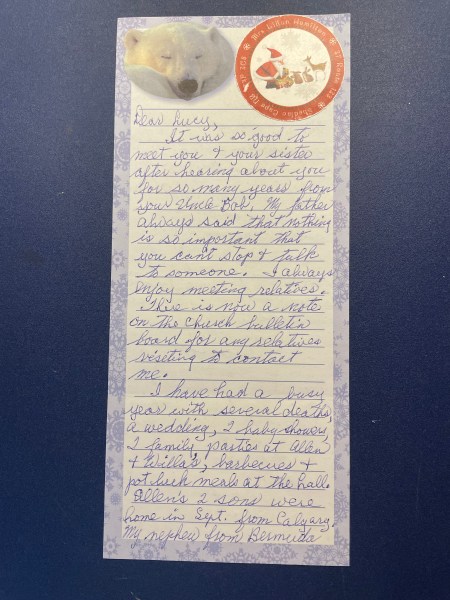
I received my first Christmas letter after we met in 2015… and now I look forward to it every year:
Christmas 2015
Dear Lucy,
It was so good to meet you & your sister after hearing about you for so long from your Uncle Bob. My father always said that nothing is so important that you can’t stop & talk to someone. I always enjoy meeting relatives. There is now a note on the church bulletin board for any relatives visiting to contact me…
My garden did well in spite of the late planting. I had peas to freeze, beans to sell, bushels of potatoes, some large carrots, cucumbers & small tomatoes to give away. I also had lots of gooseberries, pears & grapes. Allen had black currants and crab apples so I made lots of jam, jelly, preserves & marmalade. Some of which I will give as Christmas gifts. I also make dozens of cookies, many of which I give as gifts also. Easier shopping that way…
I wish you a very Merry Christmas with peace, joy, love & happiness. All the best in 2016. It was so nice to meet you. Please keep in touch.
Love,
Lilian
It feels fitting that I met Lilian at St. Martin’s in the Wood Anglican Church—a place deeply rooted in our family history. Built by her 2x great-grandfather (my 3x great-grandfather), the church has been a cornerstone of her life. She married Robert Hamilton there in 1967 and served faithfully for over 20 years as a Sunday school teacher, sewer, knitter, and superintendent.
In 1985, Lilian helped organize the 200th Hanington Reunion, a celebration that brought together 400 relatives for a parade and lobster dinner—honouring a legacy built on faith, hard work, and community. I only wish I had been there to witness it!
Before we ended our phone call, she fondly recalled my grandparents’ summer cottage Iona Cottage down the lane from the church and how my grandfather, an Anglican priest The Priest, would occasionally step in to lead summer Sunday services.
A natural historian and gifted storyteller, Lilian clearly inherited not only her father’s green thumb but also an extraordinary memory.
The Mile End neighbourhood of Montreal is famous as the home of Montreal bagels and of novelist Mordecai Richler. Its iconic architecture features outside staircases attached to two- and three-storey rowhouses, next door to churches, synagogues, shops, cafés and renovated manufacturing buildings. But Mile End’s history goes back to one small tavern at a crossroads in the countryside more than 200 years ago.
The Mile End Tavern was located at today’s northwest corner of Saint Laurent Boulevard and Mount Royal Avenue,1 now the starting point of the Mile End neighbourhood. In turn, Mile End is on the Plateau, an elevated plain lying north of Sherbrooke Street and east of Mount Royal.
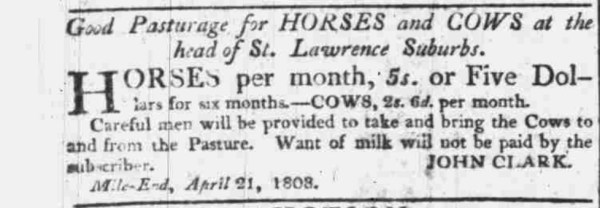
The first known reference to Mile End was dated April 21, 1808, when landowner John Clark placed a notice in the Gazette advertising Mile End Farm as providing “good pasture for horses and cows at the head of the Faubourg [suburb] Saint-Laurent.”
Screenshot
Clark (1767-1827), an English-born butcher, acquired the land he would call Mile End Farm in several transactions, including purchase agreements and leases, between 1804 and 1810.2 Like most farms in Quebec, it was long and narrow. At its greatest extent in 1810, it measured 2.5 kilometers from south to north, and between 400 and 550 meters wide. Clark was almost certainly the one who chose the name Mile End. The centre of his property was about a mile north of the small city of Montreal, and the area might have reminded him of another Mile End, a mile east of London, England. The name caught on and has been in use ever since.
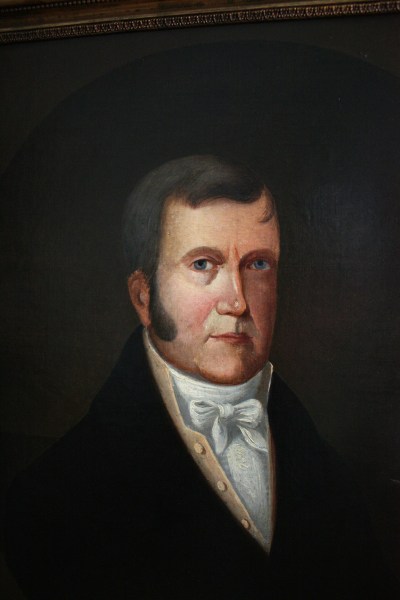
John Clark, a butcher from Durham, England, settled in Montreal around 1797. Portrait in a private collection.
When Montreal was founded in 1642, Mile End was probably uninhabited. The ground was too rocky for settlements or agriculture, and few Indigenous artefacts have been found there. The northeastern region of the Island of Montreal was covered by a vast cedar forest. The heart of Mile End was also forested, but there, both cedar and ash trees were the dominant species. This forest was still intact when the Sulpician priests mapped the area in 1702, but as the city’s population grew — it stood at around 1,200 residents in 1700 – more and more trees were cut to provide firewood.
By 1780, most trees had disappeared from the foot of the mountain, replaced by houses, farm buildings, hay fields and pastures. In the Mile End area, livestock pastures, vegetable crops, tanneries and quarries dominated the countryside, and orchards were planted in the mid-1800s.
In 1663, the Sulpician priests became the seigneurs, or feudal lords, of the entire island. In 1701, the Hôpital Général acquired an extensive piece of land from the Sulpicians in the future Mile End area, and the Grey Nuns took over the hospital and all its lands in 1747. In 1803, the nuns sold the piece of land that would become Mile End Farm to two masons, Jean-Baptiste Boutonne and Joseph Chevalier. They wanted to quarry its stone and sand for building materials.
The masons had to pay the Grey Nuns a rente constituée (annual interest), as well as yearly seigneurial dues to the Sulpicians. So when John Clark bought the property – the first part of his Mile End Farm — in 18044 and gave Boutonne and Chevalier the right to continue collecting building materials for seven years after the sale, they must have been relieved. Meanwhile, Clark found another use for the land, first advertising pasture for other peoples’ cows in 1808.
When the same ad for livestock pasturing at Mile End Farm appeared the following year, it was placed by Phineas Bagg (c.1751-1823) and his son Stanley Bagg (1788-1853), my four-times and three-times great-grandfathers. A farmer from western Massachusetts, Phineas had brought his family to Canada around 1795. Initially he worked as an innkeeper in LaPrairie, near Montreal, and then the family moved onto the island. In 1810, Phineas and Stanley signed a lease with John Clark.5 Paying an annual rent of 112 pounds, 10 shillings, they ran the Mile End Tavern and managed the farm for the next seven years before subletting to another innkeeper.
description below.
The lease described the property as having a two-storey house (which at some point must have been converted into the tavern), a barn, stable and outbuildings. The Baggs were required to sufficiently manure the pastures and arable land, to cultivate and to perform road maintenance and other required duties. They were permitted to cut wood for fencing and firewood, but they had to preserve the maple grove. They were also permitted to cut and remove stone.
No doubt the tavern brought them a good income since it was located at an important, if somewhat remote, intersection. Stanley must have attracted many additional customers after he built a racetrack nearby. In May 1811, he signed an agreement with the Jockey Club of Montreal, subletting a piece of land to the club and promising to build the track within five weeks. The club supervised the races. The track, partially on land leased from the Sisters of the Hôtel-Dieu, was about a mile in circumference and what is now Jeanne Mance Park, extending east to Saint-Laurent. It was most likely the first racetrack in Montreal.6
Another reference to Mile End appeared in the Gazette on August 4, 1815 when Stanley Bagg, Mile End Tavern, placed a notice offering a reward for information about a lost bay horse, about 10 years old, with a white face and some white about the feet.7
In 1819, Stanley married John Clark’s daughter, Mary Ann (John Clark was also my four-times great-grandfather). Their son, Stanley Clark Bagg (1820-1873), eventually inherited the Mile End Farm, as well as other properties Clark had owned nearby.
In the second half of the 19th century, Stanley Clark Bagg began subdividing and selling the properties he had inherited from his father and grandfather. He died in 1873 and the next generation of the family continued to sell building lots from the Stanley Clark Bagg Estate.
In 1891, they sold most of the Mile End Farm property to McCuaig and Mainwaring, a pair of promoters from Toronto who envisioned a high-end residential suburb they called Montreal Annex.8 The project got off to a slow start because basic services such as water, sewers and streetlights were nonexistent and a promised electric tramway did not materialize in time. A recession that started in 1893 put an end to their dreams. A few years later another group of investors, the Montreal Investment & Freehold Company, took over the property and the area developed as a mixture of duplexes, triplexes and commercial buildings.
Meanwhile, the Mile End Hotel continued to appear in city directories at the corner of Saint- Laurent and Mount Royal until 1900. The property was expropriated for road widening in 1902 and the building was demolished. A department store had replaced it by 1906.
Description ofMap: The areas with a greyish tinge are the areas that John Clark held by lease rather than owning them; none of them ever came back to Clark-Bagg possession after the leases ended. The yellow areas are cutouts belonging to and reserved by other people, excluded from the rectangles describing the property leased to P & S Bagg in 1810. Mile End Farm was bounded by the modern Saint-Laurent Blvd. in the east, while the future Park Avenue was just to the west and Pine Ave. would have been the southern boundary. RHSJ refers to the Religieuses Hospitalières de Saint-Joseph de Montréal, a religious order dedicated to caring for the sick.
1. Mount Royal Avenue is the continuation of Côte Sainte-Catherine Road, which traverses the northeast slope of Mount Royal and continues east of Saint-Laurent Boulevard. Saint- Laurent, now a busy commercial street, was at one time the only road leading north from city to the Rivière des Prairies, on the north shore of Montreal Island. Built by the Sulpician priests in 1717, Saint Laurent was initially known as Le grand chemin du Roy – the Great King’s Highway. Over the years it has been known by many names, English and French, including Chemin Saint-Laurent, St. Lawrence Street and “the Main”. Since 1905, its official name has been Boulevard Saint-Laurent.
2. Yves Desjardins, Histoire du Mile End, Québec: Les Ēditions du Septentrion, 2017, p. 22.
3. Island of Montreal property owners were required to pay dues to the Sulpicians every year until the seigneurial system was gradually abolished there, starting in 1840. The system was abolished in the rest of Quebec in a gradual process starting in 1854.
4. Louis Chaboillez, n.p. no 6090, 30 May 1804. A reference to the purchase also appears inJ.A. Labadie, n.p. no 16733, 7 June 1875. This was the inventory of Stanley Clark Bagg’s Estate. It includes the name of the seller, the date of the sale and the notary who prepared the deed. This part of Mile End Farm is item #264.
5. Jonathan A. Gray, n.p. no 2874, 17 Oct. 1810.
6. Justin Bur, Yves Desjardins, Jean-Claude Robert, Bernard Vallée, Joshua Wolfe, Dictionnaire historique du Plateau Mont-Royal (Montreal, Éditions Écosociété, 2017), p 107.
7. Justin Bur, “À la recherche du cheval perdu de Stanley Bagg, et des origines du Mile End.” A la recherche du savoir: nouveaux échanges sur les collections du Musée McCord; Collecting Knowledge: New Dialogues on McCord Museum Collections. Joanne Burgess, Cynthia Cooper, Celine Widmer, Natasha Zwarich. Montreal: Éditions MultiMondes, 2015, p. 143.
8. Justin Bur, Yves Desjardins, Jean-Claude Robert, Bernard Vallée, Joshua Wolfe, Dictionnaire historique du Plateau Mont-Royal (Montreal, Éditions Écosociété, 2017), p 271.
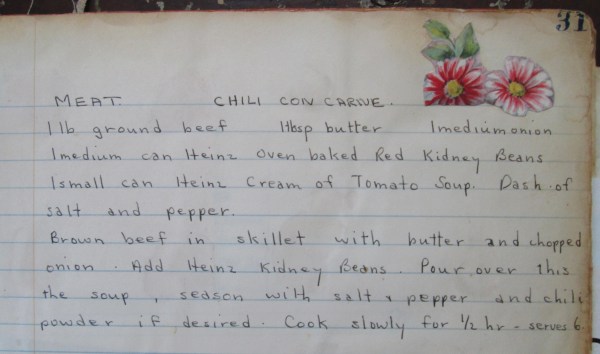
One of my favourite recipes in Mom’s recipe book is for chilli con carne. It has only a few ingredients: hamburger, kidney beans, onions, Heinz tomato soup, salt, pepper and chilli powder but only if desired. With fresh rolls and tomato slices, it was a meal we often had at the cottage, without the chilli powder. I was surprised to see that there was no Campbell’s tomato soup in the recipe.
Mom’s famous Chilli Con Carne!
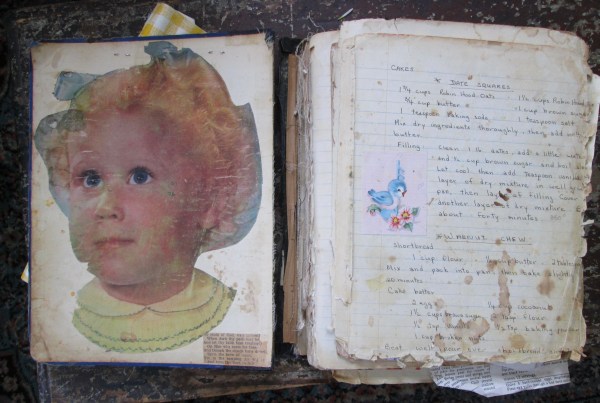
Mom started this book when she got married in 1948. It contains recipes cut out of magazines and newspapers, her handwritten recipes and ones collected from friends and family. In her later years, she mostly cooked from memory but sometimes would open the book just to check.
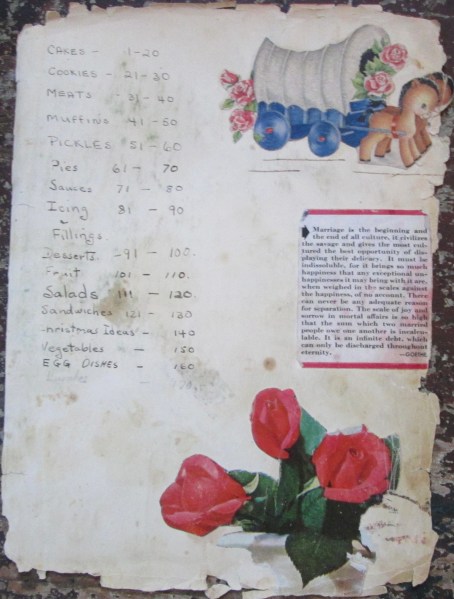
The indes page
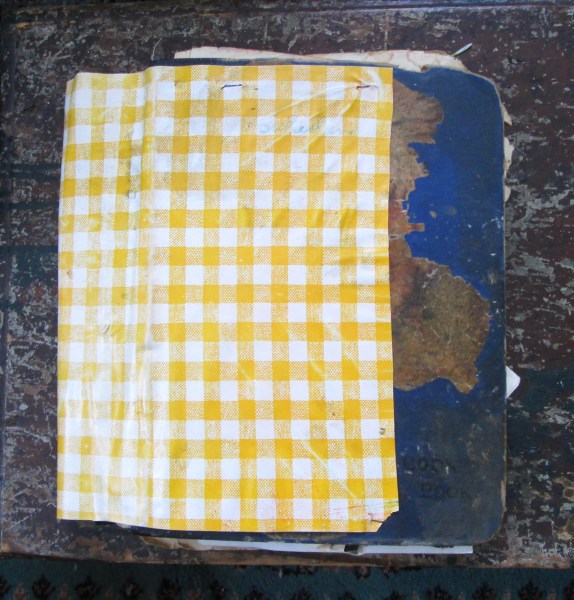
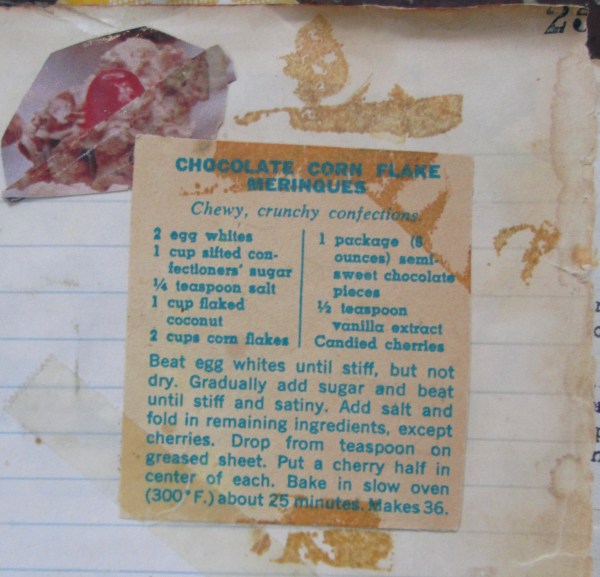
The book is now falling apart. It has been taped and covered with mactac but those adhesives don’t hold forever. The favourite recipes are worn, smudged with sticky fingerprints and ingredients. The newspaper clippings are starting to disintegrate.
A favourite Christmas treat
My mother’s recipe book used to travel back and forth from Montreal to our cottage in the Laurentians. When Mom moved into a senior residence, it remained in Dunany. I then took charge of it, not wanting to leave it to the mice over the winter.
I thought I would make a book or calendar of some of the recipes as they all have stories to tell. Funny how most of them are for sweets. Main dishes at home were mostly roasted meat and boiled potatoes, which didn’t require recipes.
As kids, we would ask Mom what was for supper but all we really wanted to know was what was for dessert. Would it be a cake, a pie, a pudding, a cobbler, squares, cookies and ice cream or my least favourite, canned fruit? We had to eat our dinner before we got dessert but we always had dessert.
Inside front cover and sweets
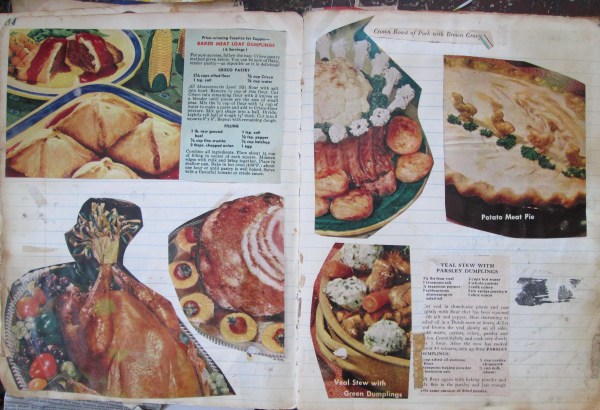
Mom’s planned menus were similar each week. She would make a list and only buy what was on the list. On Sundays, we had a roast at noon with potatoes, vegetables, gravy and then omelet, pancakes or bread broiled with cheese and bacon for supper. Monday was usually chicken, with one cut up for six people. Tuesdays meant leftover roast and on Wednesdays the menu varied with veal patties, liver, sausages or pork chops. We ate leftover roast again on Thursdays, sometimes being shepherd’s pie. On Fridays, we always ate fish even though we were not Catholic. This was our least favourite meal as it mostly consisted of frozen white fish, sometimes with a soup sauce. On Saturdays, we had hamburgers, usually without buns.
Our meals didn’t look like these pictures
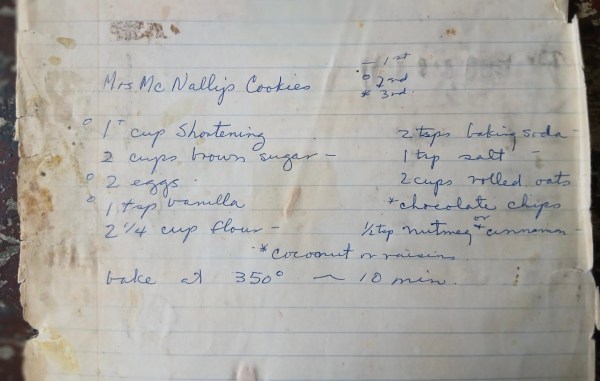
Mrs McNally’s cookie recipe came from the mother of a university friend of mine. Eileen’s mother used to send cookies back with her daughter, much to the enjoyment of her roommates. It is a basic oatmeal cookie with raisins, nuts, chocolate chips, cinnamon and nutmeg. It became my mother’s go-to recipe and she added whatever was in her pantry. The cookies were often stored in a ceramic cookie jar in the kitchen. Dexterity was needed to quietly raise the top and sneak a cookie.
Mrs McNally’s Cookies
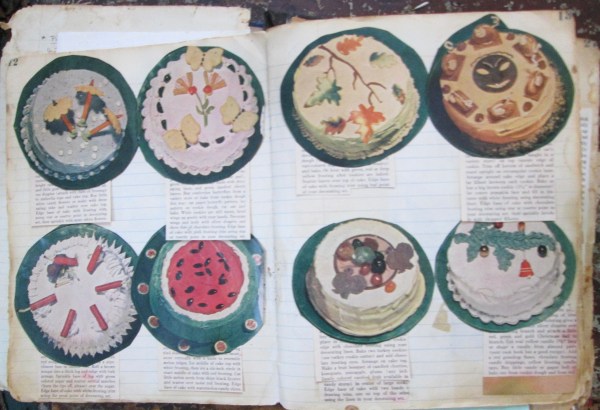
There are many pictures of decorated cakes. Mom took a class but only made a few very fancy cakes. Most were just plain iced layer cakes. She made some doll cakes with a Tammy or Debbie doll (we never had a Barbie doll) in the center of an angel food cake with fancy icing for her skirt. She also put money between the layers of cake, wrapped in wax paper. Pennies, nickels and dimes with one quarter. She would mark on the cake plate where to find the quarter and show the Birthday person.
Very fancy decorated cakes
Rhubarb upside-down cake replaced pineapple upside-down cake when my mother got the recipe from her sister. We always had this dessert in the spring and summer with rhubarb from the garden. Rhubarb and chives were the only edible things my mother grew.
Mom was an excellent pie maker. Her book does contain a booklet on how to make pie crust. She mastered this skill in no time. She would make all her fruit pies without looking at a recipe. I preferred blueberry and raspberry pies made from berries she picked around our cottage. Apple was my father’s favourite. One day, she anxiously watched as he cut into a pie and asked if it was ok. “When is your pie not alright? ” answered my father.
There would often be a little sugar pie made with the leftover pie crust sprinkled with sugar, cinnamon and little pats of butter. Pieces were eaten right out of the oven if you were lucky enough to be around.
There were definitely things we didn’t like, such as porridge every morning before school but we were well fed!




 Genealogy Ensemble