My Chicken Farm Summer

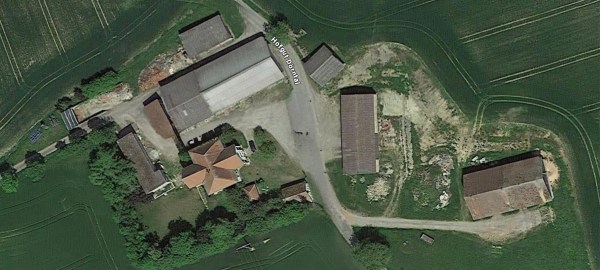
Hofgut Dorntal as seen on Google Maps 2026. The big grey building housed the chickens

A strange clomp, clomp, clomping woke me up. I looked around a strange room, from a strange bed, in a strange country. It was 1973 and I had arrived in West Germany the day before on a Canadian German Academic Exchange Society trip. I was going to a farm to work for two months, but the only location I had was Hofgut Dorntal. I knew it was in West Germany, but I had no idea where. 

The clomping was the farmer, Herr Leo Knorzer going downstairs on his artificial leg. I assumed he lost it during the war and never asked him about it. It turned out it was in a car accident. His leg was broken and the cast was put on too tight. By the time his brother, a doctor visited, gangrene had set in and the leg couldn’t be saved.

I had just finished my third year at Queens University in Kingston Ontario. I had taken German as an elective, although majoring in biology. One day, the professor announced that we should all apply for a summer exchange in Germany, so I thought, why not! We could apply to study or to work. I didn’t expect to be chosen but when another student dropped out, I was offered a place.

We flew to Frankfort and picked up train tickets to our final destinations. My ticket said Eubigheim. I boarded a train to Munich, but had to change in Lauda. I sat alone on a bench outside the Lauda station in the cold and wet, thinking I would rather be home! I When the Eubigheim train arrived, it was only a two-car commuter train. All the seats were full, so I sat on my suitcase. I hadn’t slept, so I dozed as the train rumbled on. I kept jolting awake, hearing strange words around me. I knew they were German but some sounded like out-of-context English. I had to keep alert so I wouldn’t miss my station.
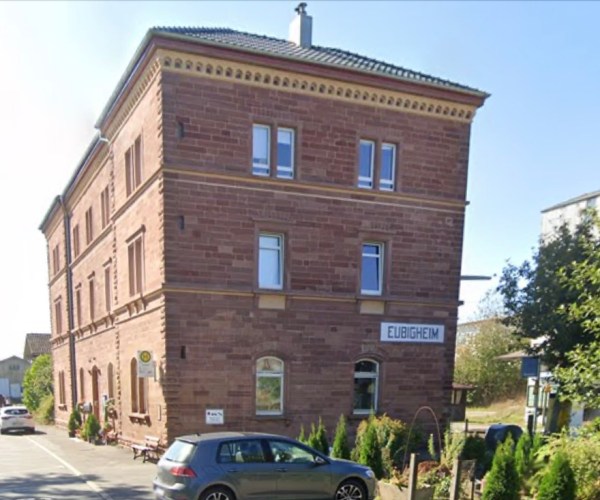
Eubigheim Station Google Maps 2026

When we arrived at Eubigheim, I gathered my luggage and followed the commuters off the train. They hurried through an empty station and out the other side. With no one to ask, I wandered around outside the station and found a man in a little office. With some difficulty, I made him understand that I wanted to contact Herr Leo Knorzer at Hofgut Dorntal. He called and soon their son arrived in his little Porsche sports car. I was expected, but not that day. His parents were out at a farmer’s meeting. Ekkehard spoke good English but said this was the only time he would speak English, as I needed to learn German to communicate with his parents.

Ekkehard and his wife Gutrune had their own apartment in his parents’ house. Gutrune was expecting a baby, so they needed help with the chickens. They gave me supper of rye bread, cheese and salami while we watched Bugs Bunny cartoons on TV in German. What was I doing there! They showed me to my room on the other side of the house and I slept, to be awoken by the clomping. I had forgotten the alarm clock I had purchased for the trip, so Frau Knorzer had to wake me with a knock on my door. 

My main job was collecting eggs. They had a large barn with two sections of hens. One section, the horse stalls, was up steep cement steps where I collected the eggs by hand into buckets and carried them down. I always worried about falling down the stairs with all the eggs! The other section was on the ground floor and automated. They had conveyor belts which carried the eggs into the grading room where they would be sorted by size and weight. Any dirty eggs had to be washed and misshapen eggs broken into a bucket. Those eggs were frozen sent to make egg noodles. The conveyor belt worked well until an egg broke. Then, with the call gelbe, gelbe (yellow, yellow) the conveyor was stopped and Herr Knorzer had to go into the hen house and clean it up so not all the eggs would need to be washed. 

Conveyor belts under the cages carried away the poop and others supplied food. Pipes carried their water and the dispensers often leaked.

“ Today I washed all the egg racks and pails. Then I swept and removed cobwebs in the cellar. Then I washed the whole wash kitchen. When I collected the eggs there was water dripping. One of taps was gone and the feeding tray was full of water. I held my fingure over the hole while Gurtrune tried to block it. Then I carried out the wet feed.”

Most hens lay an egg a day. When their production falls, they are crated and sent away. That was tough work as the hens didn’t cooperate, resulting in scratched and pecked hands. The Knorzers didn’t raise hens from chicks but would buy a new set of laying hens.

“ The new hens came today, all 2000 of them. The men came at 7 am. What a stinking mess. Shit all over the place from the frightened birds. I took out the birds while Frau K. put them in cages. I got more bruises on my poor arm.”

These new hens laid lots of eggs. One morning I collected 3261 eggs or 27 pails full that all had to be carried down the stairs. 

Most evenings, Frau Knozer would deliver the eggs to customers. So Herr Knorzer and I often ate, just the two of us. He was very interested in how everything worked in Canada: farms, hospitals, schools and transportation. With my rudimentary German and his only English words, grandfather and grandmother one would think we would have trouble communicating but he could always find another way to say something so I would understand. Because of his patience, I learned quite a bit of German. 

Frau Knorzer, on the other hand, had no patience. She would get very frustrated when I didn’t understand what she wanted me to do. “Die Mary this and die Mary that!” she would say with a sigh. She did everything quickly but one vacuumed slowly. She always told me, “Immer langsam.” I still hear her, “always slowly,” every time I vacuum. I did learn to clean the house to her satisfaction and weed the garden while only pulling out some of the lettuce.
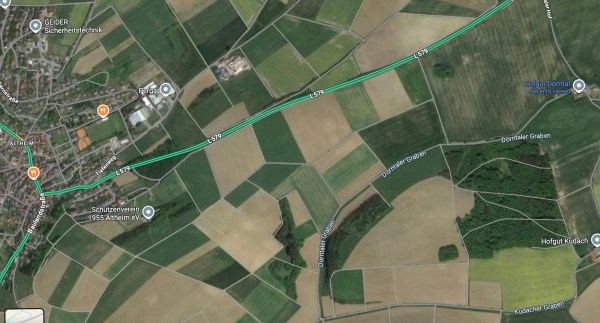
Town of Althheim on the left and Hofgut Dorntal on the top left Google Maps 2026.

The farm was a few miles from anywhere, so at night we would just watch TV. They took me most places they went, including to their next farmers’ meeting. We walked into a room with about twenty people sitting around a large table. They introduced me, and I had to walk around and shake everyone’s hands. They treated me as one of the family so much so that after their two daughters and their families left after a visit, Frau Knorzer said she was tired of entertaining them and glad it was just us!

My last day wasn’t a good day. Overnight visitors came and I am sleeping on a lawn chair in the sewing room. After the eggs, I had to clean out my room, help change the beds, vacuuum, make a cake with 20 minutes beating sugar and eggs, clean Soren’s room, clean up the kitchen, sweep, then lunch, clean the car, wash the floors and then I was finished!”

I left at the end of July after two months of work. I then had a month to travel before meeting up with my exchange group in Frankfurt for a trip to Berlin, before we flew home. I left the farm without any real plans. The Knorzers said that if I had any problems or for any reason, I was welcome to come back. They drove me to Osterburken, where I boarded a train to Heidleburg on my way to Frankfurt to begin another adventure.

My parents didn’t know where I was going or even if I had arrived. I sent a postcard soon after I arrived. 

“ I got 2 letters today. One from Mom and one from Dad. They just got my postcard on the 27th. That took over a month to get there. I think they were kind of worried.”
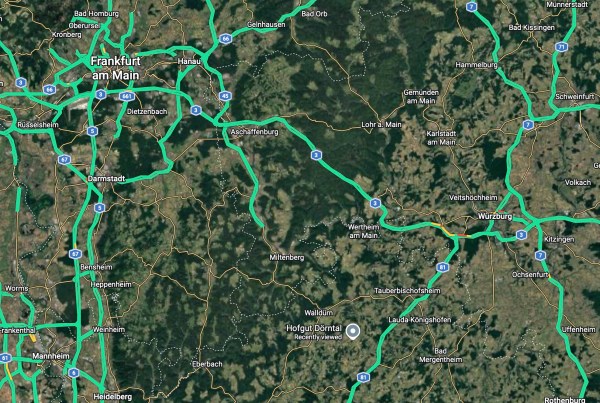
Hofgut Dorntal in relation to Frankfurt

Notes:

Fast forward to 2026. I Googled Hofgut Dorntal and Google Maps took me right to the farm. I could see the house and the outer buildings.

I also couldn’t find Eubigheim, but when I Googled Altheim, the town nearby, Eubigheim appeared on the map, right on a railway line. It was the closest station to the farm, but not the most convenient. There is a three-story building where the Banhof should be, but on the side of the building is a big sign “Eubigheim,” so it appears that it is the station. 

All the quotes are from a journal I kept during the summer of 1973.

I looked up Leo and Erna Knorzer on the internet and found their final resting places.

Gravsten: Friedhof Osterburken (Neckar-Odenwald-Kreis) Germany.

Knorzer Erna Hofmann 1922-2007.  Knorzer Leo 1911-2006.
I am Born

Chapter 2 of Diary of a Confirmed Spinster a story based on family letters from the 1900 era from Montreal and Richmond, Quebec. The story in pdf form is archived online at National Library of Canada. (See below)

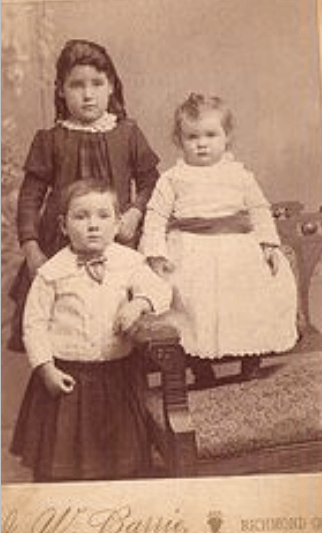
Edith, Herb and Marion Nicholson circa 1890

But, first, let’s go back to the beginning. (But which beginning? The beginning beginning. The I AM BORN beginning, to once again invoke David Copperfield, that despite appearances is not my favourite novel. Middlemarch is.)

Easy enough. I am born in January 1884 in a green clapboard rental house in Melbourne, Quebec, 10 months after my parents’ marriage.

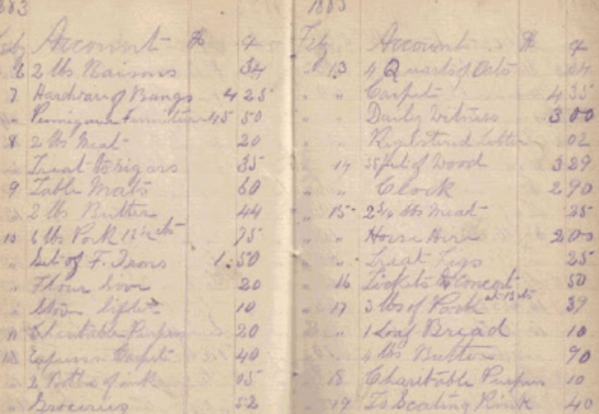
I know this because I have been told and also because the proof resides in shaky ink strokes in my father’s Store Book for 1884.

His household accounts that he kept from 1882, before his marriage to 1921, the year he passed away.

Fifty years of family accounts, kept in little black books.

It could be claimed that the entire story of our family is told in these pocket-size volumes, the practical side at least. The down-to-earth work-a-day side.

I was born in early January 1884 because the store book has an entry on the 7th, inserting baby’s birth 25 cents. I have survived my first challenge.

Under that breast pump 75 cents. Breast shield 25 cents. Along with one quart of milk 5 cents, a loaf of bread 10 cents, a gallon of coal oil, 25 cents. Two cords of wood 8 dollars and 35 cents. 11 pounds of oatmeal 38 cents. One dozen herring 20 cents. 1 ½ pounds of steak 15 cents. And rent 25 dollars a month. The staples of bodily existence then and today: shelter, heat, light and daily bread.

On February 19th a baby cradle is purchased 3 dollars. And some flannel and some cotton for baby. And on April 28, baby’s picture 25 cents. I have officially arrived. I have survived the precarious early days. I am safe to be sketched in silver bromide.

On June 27, 1 baby carriage 6.37. October 1884, one crib. 2.75. Some wool for baby 2.60.

A year later, baby’s first shoes, 1.20. I am now officially a financial burden on my parents. They would spend a great deal on shoes and boots – and the mending of same – for me and my three siblings in the following decades.

In June 1886, a child’s broom is purchased. 15 cents and I begin to pay for my keep. In those days they began teaching girls the womanly arts very early.

Also purchased that month: baby’s first book. We are Scots after all, who value education above all else. “An education is something they cannot take away from you,” my mother always says.

Still, it’s something of a mixed message I am being sent, as a 2 and ½ year old. But I might as well get used to it. Being a female, I will be showered with mixed messages for most of my life.

Then, the narrative in numbers continues: 1890 to 1895 school fees 25 cents a month. The occasional slate 5 cents. Bottles and bottles of cough medicine 25 cents each. (Cough medicine had kick in those days.) Later scribblers 5 -7 cents. Skating rink 10 cents. Soda at Sutherland’s drugstore 5 cents. (Soda had kick in those days, too.)

Also pocket money for Edith 5 cents. I guess I was doing a lot more than sweeping by then. Oddly, my younger brother Herb received ‘wages’ for his household chores.

And then I grow up. St. Francis Academy 50 cents a month. Latin text 1.25. Euclid’s geometry 1.00, the Jamaica Catechism, 80 cents, etc.(Students must purchase their textbooks, many published by the Renouf Company of Montreal, who, in turn, cash city teachers’ paycheques for them, as women don’t have bank accounts.) And I get stockings and gloves at Christmas, just like Mother.

We are living in our own house by 1896, built at a cost of 2,718 dollars, not including landscaping. My father is by now a well-to-do hemlock bark dealer. Hemlock is plentiful in the E.T. and used in the leather tanning process. Father sells his bark to tanneries in Montreal, New Hampshire and Maine.

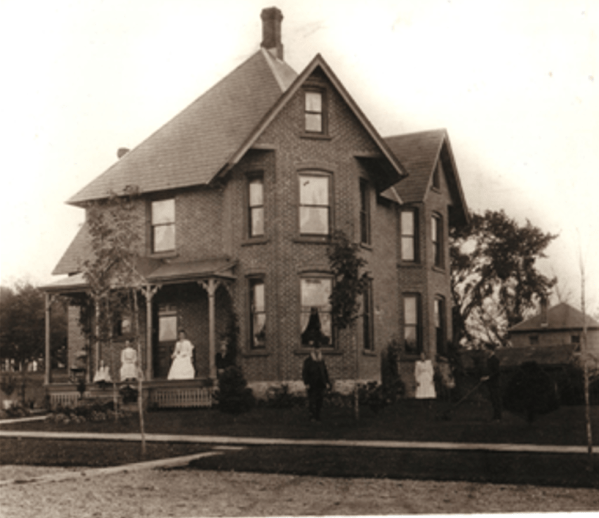
The mortgage on our house is 30 dollars a month, similar to what we paid on the rental house, but “Tighsolas” or House of Light in Gaelic is ours. And it is a fine house, a brick-encased Queen-Anne Revival in the good part of Richmond, not far from St. Francis Academy on College Street. (The kind of house seen often in Ontario but fairly rare in Quebec.) Building this house my father inspected every plank, brick and tile himself, tossing aside more than he used.

By now, as I said, I have three siblings, a younger brother, Herb and two younger sisters, Marion and Flora, born 1885, 1887, and 1892.

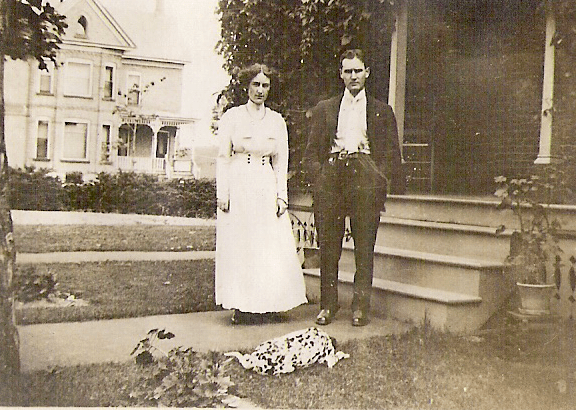
Edith and Herb circa 1910 in front of home in elegant part of Richmond.

By 1901 I am ‘fully out’ : corset for Edith 2.35. I start wearing my hair tied up around then, but only at dances. Combs for Edith: 20 cents.

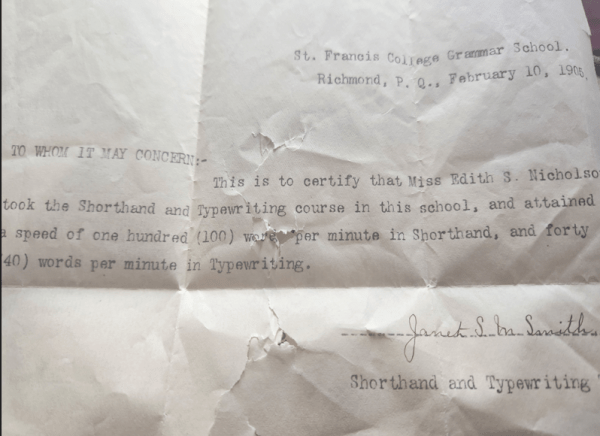
I graduate from St. Francis Academy II in 1903 and a little later take a stenography course there. Stenography is an up-and-coming profession for women. 13.50 for the course. 1.28 for a shorthand book. 5 cents for a reporter’s notebook.

I pass the course with 100 words a minute in shorthand and 45 words a minute in typing, good enough to get a job, but my parents don’t want me going to the city to work. Life in the city for young working women is a dreary business, at least according to a cousin, Jessie Beacon, in a letter to Mother.

Jessie laments that she works until six at her insurance office, goes home to her boarding house for a “lousy hash complete with garnish of housefly” and then dresses for a predictably boring evening.

My parents are intent on saving me from such a degrading existence and seek a job for me in Richmond, but jobs for young people in country towns are few and far between.

Money is plentiful at home despite the fact my father has had to change lines of work. He now sells pulpwood instead of the bark. At Christmas, over and above the usual stockings and gloves, there are gifts of watches, rings and perfume.

In 1905 my younger sister, Marion, leaves for McGill Normal School and adventures in the Big City. My determined little sister has managed to convince my wary parents that the City is safe, as long as she rooms at the YWCA on Dorchester.

And, as Herb works in Montreal, at the E.T. Bank, she is not alone, so my parents permit her to go despite the great cost: 16.50 a month.

Everything in life is timing!

And I am left alone at home with my little sister, born nine years after me. My parents shower me with ‘pity gifts’ at Easter: 5.00 for a plaid “Montreal” dress. (Plaid voile is all the rage this year, I read it in the Delineator.) 2.35 for a ticket to see the Madame Albani concert in Sherbrooke. Opera singer Emma Lajeunesse, now in her middle age, is a ‘local’ girl from Chambly made good. She is world-famous, a long-time favourite at London’s Covent Garden. So, this is a huge event. All of the. E. T. seems to want to attend.

At 22, I feel like a debutante about to make her grand appearance under the patronage of a local legend. But nothing comes of it. No eligible young men come out to the home-coming concert.

But late 1906 the pulp contracts dry up. To add fuel to this fire, we are disinherited by a wealthy Maiden Aunt on her deathbed.

My brother takes this especially hard.

“Well, now that my house is being given to someone else, I will have to give up all hope of being rich and look at it as a fortune lost,” he writes in a letter home.

“My house? MY house?” exclaims Marion at Christmas. She is now working at Sherbrooke High School and boarding at a Mrs. Wyatt’s who has a daughter, Ruth, Marion’s age. “What has Father been telling him?”

I don’t tell my sister that Herb believes we were disinherited because Old Aunt Maggie did not approve of ‘working women.’

In June 1907 my father is desperate for work with a meagre 33 dollars left in his bank account. He applies to our local Member of Parliament, E.W. Tobin, to work as inspector on the crew building the Canadian Transcontinental Railway.

He receives a polite letter from the TCR offices in Ottawa. They say they have their full complement of inspectors. They acknowledge that Tobin has been in to see them on his behalf.

Then in August a great bridge, half built, collapses, the Quebec Bridge. It was to be the world’s longest suspension bridge. 78 men die, mostly Mohawks from Cawgnawaga near Montreal.

The bridge was a component of the TCR. Magically, there is a need for inspectors at end of steel and father gets the call to La Tuque, to be Timber Inspector at 100 dollars a month.

My parents take out a 1,000 dollar insurance policy on my father’s life. It is well known that jobs on the railway are dangerous.

My mother exchanges one worry for another.

“What is a timber inspector? Is it safe? It doesn’t sound safe.”

And I am still at home, no income, no prospects.

Then arrives a letter from Reverend J. R. McLeod, my mother’s cousin living in a town half way between Montreal and Quebec City.

Three Rivers, Sept. 1907

My dear Friend,

I have but a few minutes to write as prayer meeting is starting. I was asked yesterday by the Manager of Works in a village 15 miles from here if I could find a suitable girl to teach a small school, about 10 children. My thoughts went to you. They will take you without a diploma. They offer $20.00 a month. I know you are fit for the position.

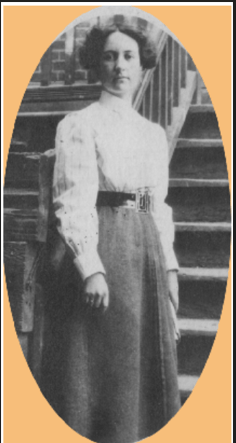
Edith as a school marm, likely 1911-1914 ish in a classic working girl shirtwaist blouse. Neckties were often worn with them.

Regards, Reverend J. R. Macleod

“Should I accept now, I mean that Father is away?” I ask my mother.

“It is your decision to make,” my mother replies. She does not seem surprised at all by the letter from her cousin.

Mother hands me another letter, just arrived in the mail, from a young friend of the family’s, Mary Carlyle. The correspondent omits the obligatory opening pleasantries and gets straight to the irksome point:

“Dear Maggie,

I am writing you with such good news. I am to be married! He is a George White and he is from Kingsey. He is a sweet, kind man, with a good position and very good looking, in my opinion. It is such a relief. I was worried I was destined to be a burden on Father.”

“Kingsey. So, that’s where all the perfect men are,” I say to Mother in a tired voice but my mind is suddenly made up. I climb the stairs to my room to scratch off a note to J.R. McLeod saying I will take the job as offered.

END

(This is Chapter 2 of a novellette I wrote, Diary of a Confirmed Spinster, part of School Marms and Suffragettes that can be found at the National Archives of Canada. The story is based on the letters and other memorabilia of the Nicholson family of Richmond, Quebec).

At National Library of Canada. Online collection.

1883 store book: setting up house a year before Edith arrives. Table mats, a clock, flat irons and 45 dollars for furniture!!!

Auntie Ann’s Second Sight

Second sight has a long tradition in Scotland, more particularly in the Highlands and among Irish-Scots.  Scots are a superstitious people and many believe even today in the gift or curse of the second sight. 1 My family was Irish-Scots and maybe this is why they believed that they had family members with this gift. It is called the second sight is because the first sight is our normal vision that everyone has. Only some people have inherited the second sight. There are many Gaelic words for the second sight, the most common being An Da Sheallad, meaning two sights.2

Auntie Ann always said that she had inherited the gift of premonition. She knew things before they were going to happen. She also claimed that she could ‘feel’ things about people.

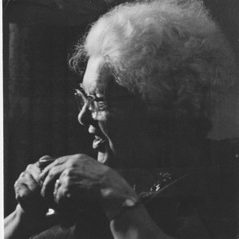
Ann Lynn McHugh Smith (1897-1975)

“Such nonsense!” my mother would snort when we got back in the car after visiting Auntie Ann. Her sister-in-law always had a story or two about the times she could foresee the future or just knew something. I used to listen in open-mouthed wonder while my father squirmed uncomfortably. My mother held her tongue during the visits but I could feel her bristling with indignation.

One time Auntie Ann told a story that scared me for years. She was in her kitchen and she felt a cold shadow pass over her. She knew something terrible had happened and she learned later that a toddler had fallen to his death in the neighbourhood.

Another story that struck me was about Auntie Ann’s son, Tommy Smith, when he was overseas during World War II. He was injured in battle and she claims to have sat right up in bed because she knew he was going to be injured in the leg.  When I was little, I could easily imagine Auntie Ann sitting up in bed, terrified and unable to reach her son.

There are detailed written accounts of incidents involving the second sight since the 17th century in Scotland. They have been collected by modern day folklorists and ethnographers. These include many detailed descriptions about how the prophecy appeared to the person with the second sight. Sometimes people saw exactly what was going to happen. At other times, they saw symbols and interpreted them. Sometimes these visions were accompanied by smells and sounds.3

When I would ask my dad about Auntie Ann’s second sight, he would answer that Scots believe that this ability runs in families and that Auntie Ann was convinced that she had this gift. But I wanted to know whether my father believed it. I realize today that my father didn’t want to hurt his sister so he never really said one way or the other.

Ethnographers are sure that the second sight is an inherited ability.4 However, no one in our family has this ability now. And what would my mother say? “Hogwash!”

  1. McCain’s Corner, Barry McCain, blogger, The Second Sight Amongst the Scots Irish, July 17, 2015, https://barryrmccain.blogspot.com/2015/07/the-second-sight-among-scots-irish.html, accessed November 26, 2018
  2. Scotclans website, Prophecy, Scottish Second Sight, David McNicoll, February 2, 2012, https://www.scotclans.com/prophecy-scottish-second-sight/, accessed November 26, 2018
  3. Cohen, Shari Ann, Doctoral thesis abstract, Scottish tradition of second sight and other psychic experiences in families, University of Edinburg Research Archive, 1996,  https://www.era.lib.ed.ac.uk/handle/1842/9674, accessed November 26, 2018
  4. Ibid.

Colonizing the Saint Lawrence Valley

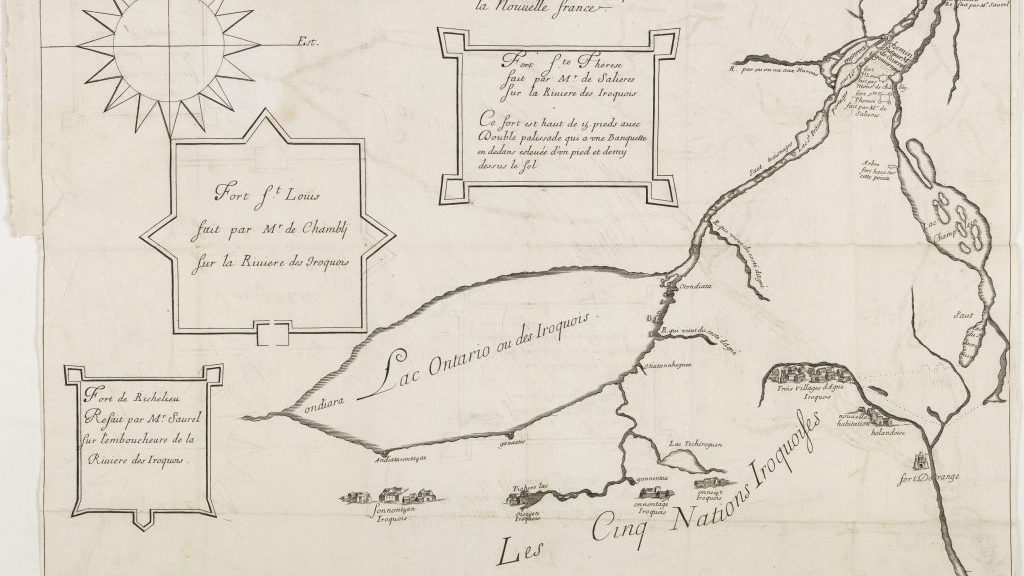
In 1665, 1,200 French soldiers arrived in New France to set up a series of fortresses along the Richelieu River to protect New France colonies in the Saint Lawrence Valley from the Five Nations of the Iroquois.

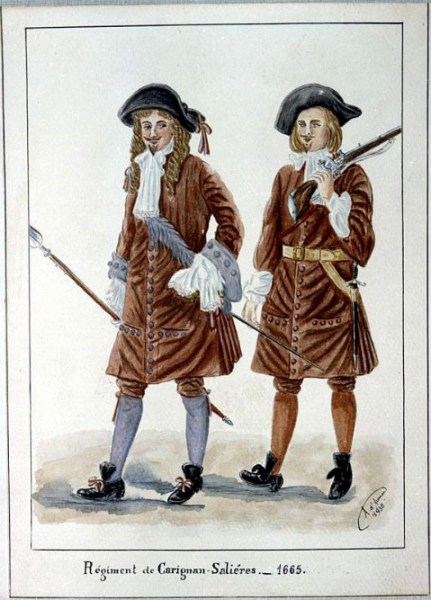
They were known as the Carignan-Salières Regiment and my ancestor Blaise Belleau dit LaRose was among them. He served in the La Tour Company, one of the 20 companies officially commanded by Marquis Henri de Chastelard de Salières. (Note: the regiment’s name came from a merger of the Salières Regiment with the regiment of Emmanuel Philibert of Savoy, Prince of Carignan, in 1660.)1

regiment-de-carignan-salieres-1665-a.-d-auriac-1932
Régiment de Carignan-Salières – 1665 / A. d’ Auriac – 1932
© Bibliothèque et Archives nationales du Québec
Collection initiale
Cote : P600,S5,PAQ33

After Christmas 1664, Belleau left his parents (François Belleau and Marguerite Crevier) to join 1,099 soldiers in Marsal, Lorraine. They began marching across France in January 1665 to get to La Rochelle, where seven ships waited to carry them to New France. They were stationed on the Île d’Oléron and the Île de Ré prior to leaving.

On April 19, 1665, Belleau crossed the Atlantic Ocean on the Viex Siméon, a 200-ton ship piloted by Sieur Pierre Gaigneur. In addition to soldiers from the La Tour Company (probably eight officers and sub-officers: Captain, Lieutenant, Ensign, Sergeant, Corporal, Cadet, Drummer, and a Surgeon plus 50 soldiers), the ship carried passengers from the Chambly, Froment and Petit companies. They arrived in Quebec City on June 19.2

Another 200 men from four additional companies (Berthier, La Brisandière, La Durantaye and Monteil) arrived in Canada under the command of Alexandre de Prouville de Tracy, Lieutenant-General of the Antilles and New France on June 30. The rest of the soldiers continued arriving until the fall. (Note that some documents place my ancestor Belleau in the Berthier Company, which means he would have gone to the Antilles prior to getting to Quebec.)

The Regiment’s first task was to build forts Saint-Louis, Richelieu, and Sainte-Thérèse along the Richelieu River to block Iroquois intending to invade New France colonies. By late September, the forts were built and all the soldiers had arrived to fully station them. The Marquis de Tracy stationed others in Quebec City, Ville Marie (Montreal), and Trois-Rivières.

Although they initially served as defence forces, the following year, the regiment went on the offensive. By the winter of 1666, 500 to 600 soldiers, volunteers, and Indigenous allies headed towards Iroquois villages in what is now New York State. The cold and lack of food prevented them from continuing, however, and 60 men died en route. Despite that failure, some Iroquois Nations began negotiating peace treaties with New France. In September 1666, a second expedition of 1000 soldiers, 600 militiamen and 100 Hurons and Algonquins reached four abandoned Mohawk villages, which were burned to the ground. These attacks combined with smallpox and scarlet fever epidemics led the Mohawk Nation to sign a treaty with France in Quebec City on July 10, 1667. Eventually, all Five Iroquois Nations signed onto the treaty concluding the Beaver Wars and bringing a 17- to 18-year respite to New France.

The Carignan-Salières Regiment was recalled to France in 1668, but King Louis XIV offered land to soldiers and officers who wished to establish themselves in the new colonies. Belleau was among nearly 400 men who chose to demobilize and settle. He was also among another 283 men who married a Fille du Roi (King’s Daughter).

Blaise Belleau dit LaRose (also known as Bellot and Bezou) settled in the Sillery seigneury and built a home. He married Hélene Calais on September 25, 1673. By 1712, they had enough to donate a portion of land with a home to their son, Jean-Baptiste Bellot (Belleau), and his wife, Catherine Berthiaume.3

If you want to learn more about this period, the Fort Chambly National Historic Site demonstrates the military life during this era,
and will reopen for general admission in spring 2026. (Note that Fort Chambly was built in 1711. It is located at 2 Richelieu Street, Chambly, QC J3L 2B9. The website is https://parks.canada.ca/lhn-nhs/qc/fortchambly.)

Sources

1Arrivée du régiment de Carignan-Salières en Nouvelle-France, Répertoire du patrimoine culturel du Québec, which was an event designated by the Minister of Culture and Communications on June 19, 2015, https://www.patrimoine-culturel.gouv.qc.ca/detail.do?methode=consulter&id=26633&type=pge#

2Verney, Jack. The Good Regiment: the Carignan-Salières Regiment in Canada 1665-1668, McGill-Queen’s University Press, 1992.

38 mai 1712 [Document insinué le 30 août 1712], Cote : CR301,P755, Fonds Cour supérieure. District judiciaire de Québec. Insinuations – Archives nationales à Québec Id 81885, pièce provenant des registres des insinuations de la Prévôté de Québec, vol. 3 (Anciennement registres 7, 8, 9, 10, 11 et 12) (15 octobre 1709 – 24 mars 1715), pages 433-434, https://advitam.banq.qc.ca/notice/81885.