All posts by Lucy H. Anglin

I am an artist and a writer.

“Roaring Dan”

Roaring Dan

aka Daniel Hanington (1804-1889)

by Lucy Hanington Anglin

“Just open the window, Dan, and they’ll hear you clear to Fredericton!”[1]  Daniel Hanington was nicknamed “Roaring Dan” by his fellow politicians in Moncton, because he had such a deep, booming voice. Although he thought of himself as a farmer, Daniel’s greatest interest was really politics.

Daniel was elected to the Legislative Assembly as Member for Westmoreland County (south eastern part of New Brunswick) in 1834. He served in either the Lower or Upper House until he died 55 years later, spanning the terms of 12 Lieutenant Governors. [2] According to the Saint John DAILY SUN, he “was a courteous, genial gentleman of the old school, respected by all who knew him… His election to the presidency of the Legislative Council in February, 1883, was a fitting crown to a long and successful political career, and he brought to the performance of the duties of this office an amount of political experience and a familiarity with public affairs in which he was absolutely without a rival among provincial public men.” [3]

Daniel was born to William Hanington and Mary Darby (the first English settlers in Shediac, New Brunswick) in 1804, and was educated at the Sackville Grammar School.  He actually was a farmer as well as comptroller of customs at the port of Shediac, New Brunswick, for more than forty years.  He retired from that post in 1880, at the age of 76.

His wife, Margaret Ann Peters (1811-1887), was the daughter of William Peters and Charlotte Haines, both having arrived in Saint John, New Brunswick, as youngsters with their families along with several other Empire Loyalists in 1783.  Charlotte came with an aunt and uncle and never saw her parents again.  She lost her little handmade slipper in the mud when she disembarked and the remaining slipper is in the Museum in Saint John.

When their children were growing up, Daniel refused two departmental offers, because the duties of the office would compel him to be away from home much of the time.  He preferred the country life, and to oversee the education and training of his children. Indeed, they raised a truly remarkable family.  All nine sons were first-class businessmen, including another successful politician like himself,  a lumber merchant, a broker, a rector, a barrister, a chemist and druggist (my great great grandfather – James Peters Hanington), a civil engineer, a chief surgeon and a comptroller of customs.   It was also noted that the three daughters had also “done well”, which I am guessing in those days meant they married men with family money and lucrative careers!

In 1881, Daniel and Margaret Ann celebrated their fiftieth wedding anniversary, with nine of their twelve children (one son died as an infant).  At that time, the grand total of their children and their immediate families came to 73 people and over half of them were at the party!

Daniel Hanington and Margaret Ann PetersDaniel Hanington and his wife, Margaret Ann Peters

[1] as told by Mary Thorpe Lindsay Kerr (his great grand-daughter).

[2] The Canadian Biographical Dictionary 1881. Lieut-Col. Hon. Daniel Hanington, M.L.C., Shediac, NB

[3] DAILY SUN, Saint John, New Brunswick – newspaper

Shediac’s First English Woman Settler

Shediac’s First English Woman Settler

By Lucy Hanington Anglin

Mary Darby was feeding the chickens in her father’s yard, when along came an oxcart carrying a handsome gentleman.  To her amazement, he stopped the cart, dismounted, raised his hat in greeting and approached her for a chat.  The story told is that young William Hanington (age 33 years) proposed to her on the spot and she (age 18 years) accepted just as quickly.  After their marriage, she was taken across the Northumberland Strait from her father’s home in St. Eleanor’s, Isle St. Jean (now Summerside, PEI), in a canoe paddled by a couple of Indians, to her new home in Shediac, New Brunswick, where her English husband had settled seven years earlier in 1785.

Mary Darby was the daughter of Benjamin Darby, a Loyalist of Newbury,  New York.  Born in England in 1744, he emigrated to America in and settled in Newburg, 50 miles from New York City.  He was imprisoned at one time for his Loyalist sympathies and suffered great hardships at the hands of the rebels.  In 1783, hearing that Washington’s troups were marching on the town, he snatched his ailing wife from her sickbed and fled to New York with their five children.  They embarked for Isle St. Jean at Long Island.  Poor Mrs. Darby died on the voyage and was buried at sea. Mary Darby was only nine years old.  Her father re-married and had another family.

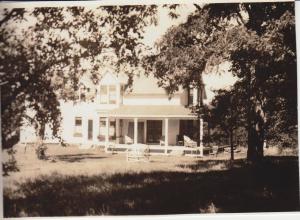
Mary’s first home was the log house her husband William had built in 1787, just two years after his arrival from England.   Although her first child died at birth, the next five of her twelve children were born in that log house.  In 1804, he built a three-storey frame house for his wife and family.  The house was all hand-wrought, the boards and beams were hewn by hand, the shingles were hand split, the trimming hand carved, split boards served as laths and the nails were all hand- made.  Water was obtained from a deep well by means of a bucket attached to a long well-sweep or pole.  Their son Daniel (my great great grandfather), born in 1804, was the first of the next seven children born in that frame house.

It’s hard to imagine but Mary was without female companionship for the first three years of her life in Shediac.  It must have been such a relief when her sister Elizabeth and husband, John Welling, also came over from PEI in 1795 to settle in Shediac.  John bought 200 acres of land from William for 20 pounds sterling (about $20 then). Once settled, Elizabeth and John also raised a large family of 12 children.

William died at the age of 79, in 1838, and Mary lived another 13 years without him.  Her life must have been one of hardship and suffering and yet she lived to the age of 77 years.  Amazing!

William Hanington comes to Canada

William Hanington comes to Canada

By Lucy Hanington Anglin

The property was described as “a commodious estate upon the outskirts of the thriving town of Halifax, in the Colony of Nova Scotia”.  Imagine William’s surprise to arrive in Halifax to discover that “outskirts” meant a 200-mile hike through thick forest and deep snow!

My great-great-great grandfather, William Hanington, was born in London, England, in 1759.  He was the son of a fish dealer, trained as an apprentice to the Fishmonger’s Company and became a freeman in 1782.  In 1784, this adventurous young man purchased land in Nova Scotia from an army officer, Joseph Williams, who had been given a 5,000 acre grant as a reward for services.

After the initial shock upon arrival, he and his friend, Mr. Roberts, found an Indian guide, loaded all their worldly belongings onto a hand sled, trudged through the snow, slept in the open and finally arrived in bitterly cold Shediac in March 1785.  Mr. Roberts was so discouraged that he immediately returned to Halifax and sailed back to England on the first available ship!

William, however, was made of sturdier stuff and was delighted with it all.  There was a good size stream flowing into the bay and he had never seen such giant trees!  He was astute enough to see the lucrative possibilities for trade in lumber, fish, and furs.

Seven years after his arrival, at the age of 33, he hired a couple of Indian guides to paddle a canoe over to Ile St. Jean (now known as Prince Edward Island) where he heard there were other English settlers.  While riding along in an oxcart through St. Eleanor’s (now known as Summerside), he spotted a young lady (age 18) named Mary Darby, feeding chickens in her father’s yard.  It was love at first sight, he proposed to her on the spot and she accepted.  They married and paddled back to Shediac where they raised a large family of 13 children.  Three years later, missing the companionship of another woman, she persuaded her sister Elizabeth and husband John Welling to come over from Ile St. Jean and settle on their land – becoming the second English family in Shediac.

Within the next five years, William had eight families on his property of about one hundred acres of cleared land.  He opened a general store and dealt in fish, fur and lumber.  The furs and timber he shipped to England and the fish to Halifax and the West Indies.  He imported English goods from Halifax and West Indies products, mainly sugar, molasses and rum from St. Pierre. He also bartered with the friendly Indians for furs and helped them clear land.  Before long, a considerable village clustered about the Hanington Store – including a post office and a tavern.  William remained the leading light of the community and acted as the Collector of Customs of the port, supervisor of roads and as Justice of the Quorum (magistrate) in which capacity he married many couples.  To top it all off, in 1800, just fifteen years after his arrival from England, this remarkable young man opened a shipyard at Cocagne and built several vessels there.

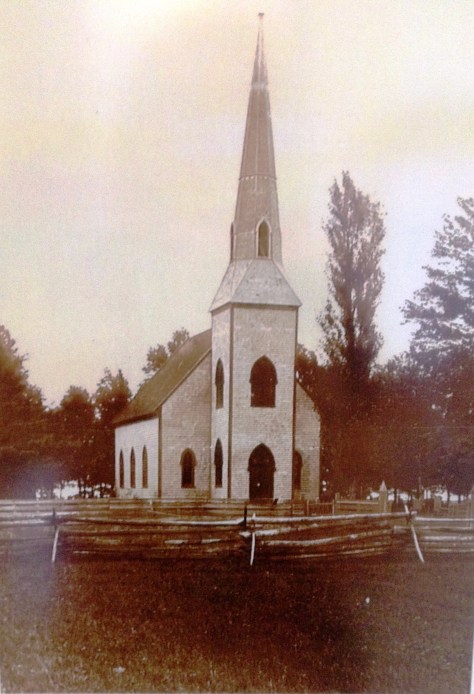
Until 1823, there was no church, and William being a religious man, conducted service in his home every Sunday.  So William donated land and lumber, and oversaw the completion of St Martin-in-the-Wood, the first Protestant church.  In 1838, age 79, it only seemed fitting that William was buried in the cemetery there in the shadow of the church he founded.  A huge memorial of native freestone, complete with a secret compartment, still stands.


4-1stmartin-haningtons-81.jpg