All posts by Sandra McHugh

James’ Tragedy

Suicide is a tragedy that leaves a deep and lasting scar. On an April day in 1864, James Hunter, 45 years old, my second great-granduncle, decided to throw himself in front of a train. All the sadness of this event is illustrated in James’ father’s registration of the death described as “accidentally killed on Monkland Railway by the engine.”1 The newspaper article is more direct, “Hunter threw himself in front of the engine.”2 Understandably, James’ father probably rewrote history to get through his pain of registering such a sad event. He also possibly wanted to avoid further pain for the family as a result of a suicide in the family.

In 1864, sudden deaths would have usually be referred to the Procurator Fiscal, known in other jurisdictions as the public prosecutor. There is no entry on the registration of death to indicate that the Procurator Fiscal held an inquiry into James’ death. They may have deemed it not necessary, as it was obviously a suicide. While committing suicide was considered a crime in 19th century England and Wales, this was not the case in Scotland. Citizens were free to take their own life, but it was assumed they would be answerable to God. In England and Wales, suicide was decriminalised only in 1961 with the passing of the Suicide Act. Prior to this, anyone who attempted suicide could be imprisoned and if they were successful and died, their families could be prosecuted. 3

James was born around 1819 and possibly in a colliery. James, like his father, was a coalminer. When he committed suicide he left behind his wife, Elizabeth Pettigrew, 4 and seven children.5

At the time of his death, James lived in Coatbridge, a village in North Lanarkshire in Scotland. Coatbridge is about 8 km north of Glasgow. James lived in Brewsterford, an area of Coatbridge that was close to the Calder Iron Works. It is therefore no surprise that James chose to end his life within walking distance of his home.6 The train of the Monkland Railways was at a level crossing at the Calder Iron Works when the locomotive engineer spotted James. Sadly, it was too late for the engineer was unable to stop the train in time to prevent the tragedy.7

Map of Calder Iron Works, 1859, Scotland’s Brick and Tile Manufacturing Industry

Of course, no one can know why James committed suicide or at least there is no official record of why. The newspaper article indicates that he had been “dull and melancholy for some time past.” 8 We can guess that he was clinically depressed. His family and loved ones would have noticed but, unlike today, would have had no way to help him overcome his depression.

All suicides are a tragedy. It would have been catastrophic for Elizabeth and her seven children. Added to the shame and stigma of suicide, Elizabeth would have lost the breadwinner of the family. The older children were on their own by then but the four youngest ones were still in school.

  1. Scotland’s People, Statutory Registers of Death, 1864, Deaths in the District of Old Monkland in the County of Lanark, 21 April 1864, James Hunter, accessed 23 October 2025.
  2. The Herald Glasgow Edition, Strathclyde, Scotland, 26 April 1864, page 3, accessed 23 October 2025.
  3. Wikipedia, Suicide Act 1961, https://en.wikipedia.org/wiki/Suicide_Act_1961, accessed 28 May 2024.
  4. Scotland’s People, Old Parish Registers of Marriages, 1839, Airdrie or New Monkland, James Hunter and Elizabeth Pettigrew, accessed 7 November 2025.
  5. Ancestry, family trees, children not double checked.
  6. Map of Calder Iron Brickworks, Scotland’s Brick and Tile Manufacturing Industry, https://www.scottishbrickhistory.co.uk/calder-iron-brickworks-whifflet-coatbridge-north-lanarkshire/, accessed 1 December 2025.
  7. The Herald Glasgow Edition, Strathclyde, Scotland, 26 April 1864, page 3, accessed 23 October 2025.
  8. The Herald Glasgow Edition, Strathclyde, Scotland, 26 April 1864, page 3, accessed 23 October 2025.

Getting the Names Right

In the last mad dash to send Beads in the Necklace to print, we had to make sure that the names in the stories were right. Genealogists struggle with the difficulties of names every day.

There was the question of those pesky hyphens. In French Canada, hyphenated names are common. But not every double name takes a hyphen. Then what about apostrophes that were simply dropped?

And accents. Some French names had accents and others not. There seemed to be no rhyme or reason.

Some of the people in our stories had unusual names. Hermonie? Maybe it was Harmonie? Or even Hermionie? It was Herminie. And is it Catherine or Catharine? Or Isabelle or Isabella?

And how many ways can you spell Jodouin? Each source document seemed to have a different spelling.

And then what about place names. Do we use the French place name or the anglicized place name? With or without accents?

All these variations in the names made me think of my husband’s surname. I asked him, “Why do some people in your family spell their name Delatolas as Dellatolas, with two letter ls?

He shrugged, “I dropped an “l” when I emigrated to Canada.”

“Besides, my father and my brother had already dropped an “l”. Anyway, who cares?”

“Well,” I muttered, “Genealogists care.”

The Cipher

When I say that my grandfather, Thomas McHugh, worked as a cipher, Bletchley Park, MI5, Russian spies immediately come to mind. He was neither a Russian spy nor did he work as a cipher during the war. His employer was the Bank of Montreal, and it was his first job when he came to Canada in 1912.

The decision to immigrate to Canada was not easy for Thomas. He was in his mid-30s and already had seven children, between the ages of one and fifteen. For over 40 years, the jute manufacturers of Dundee, Scotland, had been providing employment for his parents, aunts, uncles, siblings, wife, and for him. However, by the early 1900s, he was facing a precarious future for his children.

By that time, Dundee had suffered a serious decline in the textile industry and more significantly, the jute industry. Jute was imported from India; however, the mill owners realized that it would lower production costs to open mills in India to prepare the jute and import the finished product to Scotland. Once mills were established in India, the jute production in the mills in Dundee decreased substantially.1

So when Thomas arrived in Canada, a little ahead of his wife and his children, he was eager and prepared to do any job that he could. The Bank of Montreal had its headquarters in Montreal, Quebec. At the beginning of the 20th century, the bank had significant dealings with Great Britain and there were correspondence and banking instructions back and forth between Canada and Great Britain daily. These instructions were mainly sent by telegraph overnight.  Some of these instructions were confidential, and it was preferred that they remain so. Overnight instructions reduced the number of people who would have access to them. And the time difference between Montreal and the United Kingdom meant that the banks in London and Edinburgh were open for business while Montreal was still asleep.

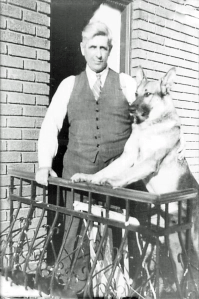
Thomas with Pal in Verdun

Even in those days, the banks were concerned about security, privacy and confidentiality. The banking instructions and transactions that were transmitted by telegraph were encrypted. It was the job of the cipher clerk to decipher them so that the bank staff could then ensure that the instructions were carried out as required.

To be a cipher clerk, one had to be reliable, meticulous and honest, and maintain the confidentiality of the bank’s business above all else. To decipher the information, the clerk used a cipher handbook and worked overnight, making it a difficult job for a man with a family.

So while my grandfather, the cipher, did not work in espionage, I still think that his first job in Canada was rather interesting.2

  1. Wikipedia web site, The History of Dundee, online<https://en.wikipedia.org/wiki/History_of_Dundee>, accessed February 19, 2017.
  2. McHugh, Edward. Personal knowledge. [Father of writer].

Gunner John Hunter, World War 1

When I discovered that my Great-Uncle, John Hunter died at the age of 20 in either France or Belgium in 1917 during World War I, I assumed that he had died in battle. He was a gunner, which mean that he either served the guns, handled ammunition, or drove the horses. My first thought was that this seemed like a particularly dangerous assignment.1 With further research, I discovered that it was almost inevitable that he would die.

John was assigned to the 87th Brigade of the Royal Field Artillery (RFA). He lived in Fife, Scotland and the RFA was actively recruiting there. In World War I, the minimum age was 19 to sign up, so John would only have seen a year of active fighting before his death. 2 He either enlisted voluntarily or was forced to as the Military Service Act was passed in 1916, requiring the conscription of unmarried and widowed men without any dependents.3

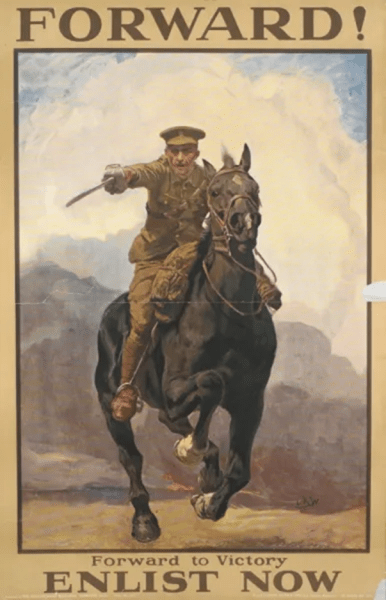
Courtesy War Museum, Recrutment Posters

The 87th Brigade was an infantry brigade formation of the British Army. By the time John would have joined the Brigade, it was serving on the Western Front.4 John would have likely participated in the Battle of the Somme and Passchendaele.

John was taken ill when he was in the theatre of war. He was sent to the Lord Derby War Hospital in Winwick, Borough of Warrington, Chesire, England. He was in a diabetic coma when he died on September 7, 1917, with my grandmother, just 16 years old at the time, at his side. Their mother had died in April 1917 and their father was also serving in World War I and was positioned in France at the time of his son’s death. My grandmother would have been summoned to his bedside and she would have had to make the journey from Lumphinnans, Scotland to Chesire, England by herself.5

Imagine the terror of being diagnosed with diabetes prior to 1921, the year insulin was discovered by a team of doctors, Charles Banting, Charles Best, and J.B. Collip and their supervisor, J.J.R. Macleod,  working at the University of Toronto.6 The symptoms would have included a terrible thirst, excessive urination, lethargy, and perhaps confusion. A urine analysis would have been done and a high glucose level would have confirmed diabetes but there was nothing to be done before the discovery of insulin except a strict dietary regime. We now know that diabetes can be triggered by trauma in someone with a genetic predisposition. There Is no doubt that the trauma of trench warfare would have had its toll on John.

When my grandson was diagnosed with diabetes when he was 16 months old, the doctors questioned whether type 1 diabetes was in the family. We could not think of any relative who had type 1 diabetes. We now know that we were wrong. My grandson will live a normal life with the help of a pump that provides insulin as he needs it. But John did not have a chance. He was living through traumatic circumstances, had a genetic predisposition, and life-saving insulin was not yet discovered. 

  1. Wikipedia, Gunner (rank), https://en.wikipedia.org/wiki/Gunner_(rank), accessed 17 June 2025
  2. War Museum, https://www.iwm.org.uk/history/voices-of-the-first-world-war-joining-up, accessed 17 June 2025
  3. War Museum, https://www.iwm.org.uk/learning/resources/first-world-war-recruitment-posters, accessed 18 June 2025.
  4. Wikipedia, 87th Brigade, https://en.wikipedia.org/wiki/87th_Brigade_(United_Kingdom)#:~:text=The%20brigade%20was%20assigned%20to,the%20rest%20of%20the%20war., accessed 17 June 2025.
  5. Death certificate, John Hynd Hunter, issued 22 April 2025, Grace Hunter, sister, was the informant.
  6. The Canadian Encyclopedia, The Discovery of Insulin, https://www.thecanadianencyclopedia.ca/en/article/the-discovery-of-insulin, accessed 18 june 2025

Easter Celebrations

I am spending this week madly rushing around to get ready for Easter Sunday. My husband is Greek and we celebrate Easter with Greek traditions on this day. Forty guests are expected at our house for the celebrations.

The star of the show will be a lamb on a spit. The “lamb team” starts early in the morning to prepare the lamb, filling the inside cavity with herbs, onions, and lemon, and then sewing it up. It will turn on the spit for many hours. We used to take turns turning the lamb but now we have an electric motor to do the job.

Courtesy Greek Boston

My husband and his uncle will also prepare the kokoretisi early Sunday morning. Kokoretsi is also roasted on the spit. Kokoretsi is a traditional dish of lamb intestines wrapped around seasoned offal, including sweetbreads, hearts, lungs, and kidneys.1 Everyone loves it, although I have to confess that I do not find it appetizing. Surprisingly none of the younger people in our family are interested in learning how to make it.  In a decade or so, kokoretsi may no longer be served.

I found a picture of kokoretsi on the My Greek Food Recipes blog, one of my favourite sites for Greek recipes:

Courtesy My Greek Food Recipes©. All Rights Reserved.

Of course, the lamb will be accompanied by many Greek favourites such as tzatziki, spanakopita, lemon potatoes in the oven, and more.

Another highlight of the day will be the Tsougrisma, a game played by bashing eggs together. Easter eggs are dyed red, representing the blood of Christ shed on the cross.2 Once dyed, red eggs are woven and baked into tsoureki, a three-braided Easter bread representing the Holy Trinity.3 The rest of the eggs are used as a table decoration and are used to play Tsougrisma, which means “clashing” and “cracking” in Greek. The cracking tradition symbolizes the resurrection of Christ and birth into eternal life.4

Courtesy Greek City Times

To play the game, each players holds an egg, finds another player and taps the end of the egg lightly against the other player’s egg. They then tap together the ends that are not broken. They then move on to other players until both ends of their egg are broken. The person who has an unbroken egg at the end wins the game.5

Of course, the Easter Bunny also visits us on this important day. The children are always very excited to hunt for Easter eggs in the back yard.

I am really looking forward to this day of celebration with our family and friends.

  1. Wikipedia, Kokoretsi, https://en.wikipedia.org/wiki/Kokoretsi, accessed 16 April 2025
  2. The Greek Food Shop, How to play the red egg game, 13 April 2019, https://greek-food-shop.com/2019/04/13/the-best-greek-easter-tradition-how-to-play-the-red-egg-game/?srsltid=AfmBOop0byvUV9-0uNZ0blsMeOGivhbWh8gIqWrTxx9w3PV9Rd6qTRcE, accessed 16 April 2025
  3. The Spruce Eats, Greek Easter Egg Game, https://www.thespruceeats.com/greek-easter-egg-game-1705738, accessed 16 April 2025
  4. The Spruce Eats, Greek Easter Egg Game, https://www.thespruceeats.com/greek-easter-egg-game-1705738, accessed 16 April 2025
  5. The Spruce Eats, Greek Easter Egg Game, https://www.thespruceeats.com/greek-easter-egg-game-1705738, accessed 16 April 2025

The Gaspé Peninsula

The Province of Quebec is breathtakingly beautiful.  I have been all over the province and I am constantly amazed.

One of my favourite trips was when, in 1982, after we had moved into our first house, we decided to leave all the angst of being a first-time home owner at a young age and go on a road trip. We decided to visit the Gaspé Peninsula. We simply loved our trip. The countryside was stunning and the Gaspésians showed us a warm welcome.

Courtesy Tripadvisor

Did your ancestors settle or live on the Gaspé Peninsula? The first European to arrive in the Gaspé was Jacques Cartier when he landed in Gaspé Bay in 1534 to plant a cross and claim the land for the King of France. The Iroquois occupied the area. It is believed that the name Gaspé derives from a Micmac word meaning “land’s end.” 1

When the Gaspé belonged to New France, there were only about 400 fishermen living there. Harvests were plentiful and the coastal high winds were excellent for drying cod. However, James Wolf and his forces attacked the residents in 1758, destroying their homes and possessions and sending them back to France.2

Still, some Gaspesians managed to hide from the authorities and remained on the peninsula until 1763 when it became a British territory. They were joined by Acadians who fled from the British who had implemented a compulsory deportation order for all Acadians in Nova Scotia. In 1784, a significant number of Loyalists, fleeing the American Revolution, settled on the Gaspé Peninsula.3

If your ancestors came from the Gaspé, here are some sites that can help you with your research:

The Quebec Genealogy eSociety has extensive links and resources (requires a membership). Some of the resources include births, marriages, deaths and some census records, and newspapers: https://genquebec.com/en

GoGaspé is a site devoted to the Gaspé Peninsula with a tab that directs you to history and genealogy links and resources. Local Gaspesian genealogists and historians have contributed to this site: https://gogaspe.com/

Jacques Gagné’s compilation about the Channel Islanders on this blog: https://genealogyensemble.com/2016/08/21/the-channel-islanders-of-eastern-quebec/

Jacques Gagné’s tips on researching your Gaspé ancestors on this blog:https://genealogyensemble.com/2019/01/20/tips-on-researching-gaspe-ancestors/

Musée de la Gaspésie: https://museedelagaspesie.ca/en/index.php

Sources for information about settlement of the Gaspé Peninsula.

  1. The Canadian Encyclopedia, Lee, David, 7 February 2006, https://www.thecanadianencyclopedia.ca/en/article/gaspe-peninsula#:~:text=In%201784%20about%20400%20English,dependence%20on%20the%20fishing%20industry, accessed 11 February 2025
  2. The Canadian Encyclopedia, Lee, David, 7 February 2006, https://www.thecanadianencyclopedia.ca/en/article/gaspe-peninsula#:~:text=In%201784%20about%20400%20English,dependence%20on%20the%20fishing%20industry, accessed 12 February 2012
  3. The Canadian Encyclopedia, Lee, David, 7 February 2006, https://www.thecanadianencyclopedia.ca/en/article/gaspe-peninsula#:~:text=In%201784%20about%20400%20English,dependence%20on%20the%20fishing%20industry, accessed 12 February 2012

The Harvester Scheme and the Empire Settlement Act

Who would have thought that finding the immigration records of my grandparents would have led to me to learn about two British government initiatives designed to promote emigration to Canada in the 1920s?  I was browsing the Library and Archives Canada web site and found digitized records of Form 30 that recorded the entry of every immigrant between July 1921 and December 1924.1  I was thrilled to find the form that my grandfather, George Thomas Deakin, signed in August 1923, and the one that my grandmother, Grace Graham Hunter, signed in February 1924.

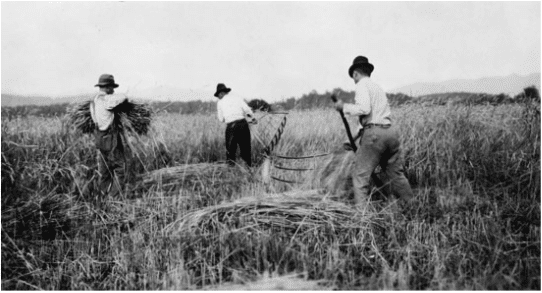
My grandfather’s form indicated that he came to Canada as part of the Harvester Scheme.  In 1923, Canada had a bumper wheat crop and North America could not provide the labour needed to harvest the crop.  Under the Harvester Scheme, the two major Canadian railway companies entered into an agreement with the British government to transport 12,000 workers out west where they would earn $4.00 per day plus board.  This was considered a successful scheme as 11,871 migrants came to Canada to work on the farms in Western Canada. The harvest was successfully completed and 80% of the harvesters stayed and were considered “successfully assimilated.”2

Source: The Farm Collector

Like the Harvester Scheme, The Empire Settlement Act was also an initiave to provide Canada with badly needed labour. It was passed by the British Parliament in 1922 and its purpose was to provide an incentive for migrants to settle in the colonies.  Canada badly needed farm labourers and domestic workers.  At that time, the Canadian government favoured immigrants from Great Britain as a means of ensuring the predominance of British values.  In the early 1920s, it was difficult for Canada to attract immigrants from Great Britain as Britain was enjoying a period of prosperity right after World War I.  Another reason was the prohibitive cost of transatlantic transportation.  Even passage in third class would have been expensive for a farm labourer or a domestic worker.3

My grandmother came to Canada to enter into domestic service as a cook and her destination in Montreal was the government hostel.  Hostels were located in major urban areas across Canada.  These hostels were partially funded by the provinces and immigrants from Great Britain were allowed free dormitory accommodation for 24 hours after their arrival.  Young ladies were looked after by the Superintendent of the hostel and referred to a church worker.  They were also referred to Employment Services of Canada who would find them employment.4

1 Library and Archives Canada:  http://www.collectionscanada.gc.ca, accessed March 2013.

2 Foster, John Elgin, 1983, The Developing West:  Essays on Canadian History in Honor of Lewis H. Thomas, University of Alberta, accessed March 2013.

http://www.pier21.ca/research/immigration-history/empire-settlement-act-1922, accessed March 2013.

4 Crawford, Ruth, 1924, “Canada’s Program for Assimilation”, The Rotarian, May 1924, p. 16, accessed March 2013

The Life of a Sailor

My 2X great-grandfather, George Murray Boggie, born in 1826 in Old Deer, Aberdeen, Scotland,1 spent his whole life in the Royal Navy. This was a life of adventure, variety, and camaraderie, but also homesickness, hard work, long hours, and sometimes sickness.

George didn’t start out wanting to be a sailor. When he was 15, and perhaps earlier, he and his brother, James worked as apprentice writers in Peterhead, Aberdeenshire. They lodged with John Bradie, a newsroom keeper. 2 John probably worked at the same newsroom as George and James.

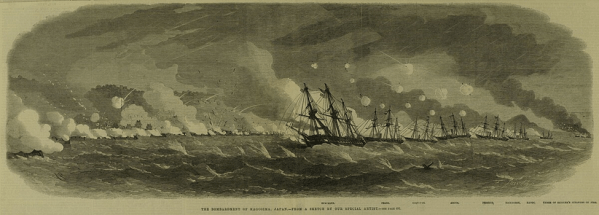
It turned out that writing was not the job for George. George started volunteering in the navy when he was 20. He served on about 14 ships between 1846 and 1854. In January 1854, he was serving on the HMS Euryalus. He then signed his indenture papers on 13 February 1854, which committed him to ten years of continuous service in the Royal Navy.3 The HMS Euryalus was commissioned in 1853 and soon after George joined the crew, it was deployed to the Baltic to take part in the Baltic Campaign as part of the Crimean War.4 The HMS Euryalus was part of an Anglo-French fleet that entered the Baltic to attak the Russian naval base of Kronstadt.5

Euryalus leading the line of battle during the Bombardment of Kagoshima, 18636

While I do not have a picture of Great-Grandfather George, Royal Navy Form 95 says that he was 5 ft., 7.5 inches tall, with a ruddy complexion, dark hair, and blue eyes. He had a tattoo on his left arm, his initials: G.M.B. 7

George was already married and a father with two children when he started his indentureship. His daughter, Mary, was 4 and my great-grandfather, Henry was just two years old. His wife, Elspeth Milne would have had her hands full with a young family and an absent husband. Elspeth would also have been worried about George as he was in active military service. As George remained a member of the Royal Navy his entire working life, it is probable that he participated in many battles.

Sailors were constantly at work when at sea. All ships were dangerous workplaces and injuries and death as a result of injuries were common. Their sleeping quarters were cramped, the sailors’ sleep was often disturbed, and their meals were neither copious nor balanced. Although some ships did issue a daily ration of lime juice and sugar, but in quantities not exceeding one ounce of each, assumably to prevent scurvy. The ships were cold, damp, and uncomfortable and their clothes could be damp for months at a time.  Most ships did not have a physician or surgeon on board so some health conditions could not be addressed quickly. Sailors’ wages were usually paid in arrears as a deterrent to desertion.8

Sailors were susceptible to tropical diseases and while dysentery can be caught anywhere, It’s a more common condition in tropical areas of the world with poor water sanitation. The Royal Navy sailed the world over, often in tropical waters. Dysentery on board was common. It is contagious and can be contracted from eating food prepared in unsanitary conditions or by drinking contaminated water. 9

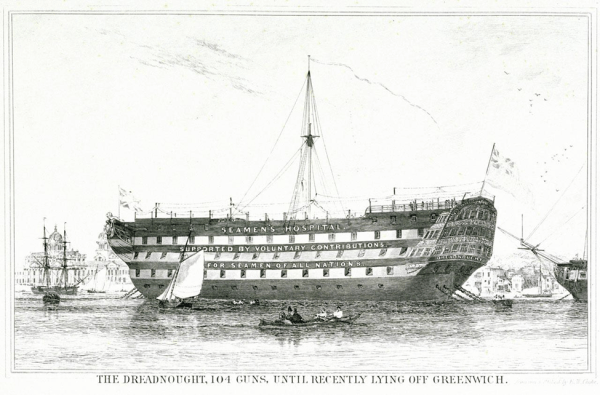
As George worked on 14 ships before he signed up for continuous service in 1854, he already had a good idea of what he was getting into. On 5 February 1847, George was admitted to the Dreadnought Seaman’s Hospital to treat dysentery.10 The registration indicates that he was victualled for 46 days which, I believe means that he was paid for the 46 days that he was in the hospital.

The Dreadnought Seamen’s Hospital provided seafarers with hospital care for 150 years. It started in 1821 as a wooden warship moored in the River Thames at Greenwich, England. After 1870, the hospital transferred to dry land at the former Greenwich Hospital Infirmary, and the hospital continued to treat sailors in Greenwich until its closure in 1986.11 In 1987, a Dreadnought Unit opened at St. Thomas Hospital in London.12

The ‘Dreadnought’, 104 Guns, At present Lying off Greenwich For The Seamen’s Hospital, ©National Maritime Museum

George was a member of the Royal Navy during the second half of the 19th century and, at that time, naval warfare underwent a complete transformation due to steam propulsion and metal ship construction. While Britain was required to replace its entire naval fleet, it managed to do so through unparalleled shipbuilding capacity and financial resources.13 When George started his career, he served on a wooden hulled steam frigate. By the time he completed his career, he would have seen great leaps of technological improvements.

  1. Scotland’s People, Old Parish Registers, Boggie, George Murray, 1826, Old Deer, Aberdeenshire, accessed 7 June 2024.
  2. Scotland’s People, 1841 Census, Boggie, George Murray, Peterhead, Aberdeenshire, accessed 12 June 2024.
  3. Form 95, Indentured royal navy papers, Boggie, George Murray, dated 13 February 1854, National Archives, accessed 3 July 2024.
  4. Wikipedia, HMS Euryalus (1853), https://en.wikipedia.org/wiki/HMS_Euryalus_(1853), accessed 20 November 2024.
  5. Wikipedia, Crimean War, https://en.wikipedia.org/wiki/Crimean_War#Baltic_theatre, accessed 20 November 2024.
  6. Wikipedia, HMS Euryalus (1853), https://en.wikipedia.org/wiki/HMS_Euryalus_(1853), accessed 20 November 2024.
  7. Form 95, Indentured Royal Navy Papers, Boggie, George Murray, dated 13 February 1854, National Archives, accessed 3 July 2024.
  8. The Old Operating Theatre, Life at Sea: The Working Conditions and Health of a Sailor, https://oldoperatingtheatre.com/life-at-sea-the-working-conditions-and-health-of-a-sailor/, accessed 13 November 2024.
  9. Cleveland Clinic, Dysentery, https://my.clevelandclinic.org/health/diseases/23567-dysentery, accessed 20 November 2024.
  10. Ancestry, Dreadnought Seamen’s Hospital Admissions, 1826-1930, Boggie, George Murray, accessed 13 November 2024.
  11. Royal Museums Greenwich, https://www.rmg.co.uk/collections/hms-nhs-nautical-health-service-transcription-project, accessed 20 November 2024.
  12. Seafarer’s Hospital Society, https://seahospital.org.uk/about-us/our-history/, accessed 20 November 2024.
  13. Wikipedia, The Royal Navy, https://en.wikipedia.org/wiki/Royal_Navy#:~:text=At%20the%20start%20of%20World,during%20the%20following%20four%20months

Sundays and the Great Depression

I used to hate Sundays. I had to go to Sunday school. I really didn’t understand why I had to attend because my parents just dropped me off. That’s right. They didn’t even go to church. And no one asked me if I wanted to go.

After they picked me up, things got worse. It was homework time until lunch. Of course, I could have done my homework on Friday night but Fridays were reserved for movies on the television and reading in bed with a flashlight until all hours.

And worst of all, some Sunday afternoons were for Visiting the Elderly Relatives. In my mind, my aunts and uncles were ancient. Plus my brother, being a boy and older than me, was apparently able to take care of himself, as he always seemed to be absent from these visits. So I would sit in the living rooms of my aunts and uncles, with no toys or any other amusements, and listen to the adults talk.

I now cherish the memories of these visits because they provided me with an appreciation of the social history of Montreal, as well as significant events such as the Depression and World War II.

The stories about the Depression are the ones that struck me the most. During the Depression, a quarter of Canada’s workforce was unemployed.1  My dad, Edward McHugh, was a young man out of work in Montreal and he joined his older brother and sister in Drummondville, to work for the Celanese. At the peak of the Depression, the Celanese employed 1,757 workers.2

None of the McHughs had cars in those days so they must have travelled back and forth to Drummondville by train. And Uncle Thomas McHugh married a local girl. I can just imagine the McHughs, from Verdun, arriving in Drummondville for the wedding. I doubt very many people spoke English in Drummondville at the time. The culture shock must have been intense.

My aunts and uncles, even into the 1960s, were thankful that they were able to have had some work during the Depression. Uncle Al Scott worked for the Northern Telecom for 40 years, although with reduced hours during the Depression. Luckily Uncle Frank McHugh worked for the Montreal Tramway Company so he was able to keep working during the Depression. He was a tram driver for tram number 24 that started in Montreal West and crossed the city on Sherbrooke Street. His job was safe.

Dad’s siblings loved to have a good time and the Depression did not stop them. My Aunt Elsie used to describe their card parties. There was only one bottle of scotch, some ginger ale, one can of salmon and one loaf of sliced white bread. My aunt was able to spread the salmon so thinly that she could make sandwiches out of the whole loaf of bread.

It was very clear to me that the Depression was a very frightening time in their lives. During this period, the future must have seemed bleak. Life was a struggle to make ends meet. But they made the most of it and persevered. Today I feel lucky to have listened and to remember their stories.

1 https://en.wikipedia.org/wiki/Great_Depression_in_Canada

2 http://www.patrimoine-culturel.gouv.qc.ca/rpcq/detail.do?methode=consulter&id=14311&type=pge#.WSNY7Gg1-Uk

Mary’s Tragedy

“Of late she was somewhat weak in the mind.”

This sad sentence concludes the obituary of Mary Boggie who died by drowning on September 6, 1884 when she was just thirty-four years old.1 Her death was a suicide and this one sentence tries to explain why. Of course, no one will ever know why she jumped off a cliff into the cold and inhospitable waters of the North Sea. What we do know is that it was a desperate and definitive act.

Mary Boggie was Henry Boggie’s sister. Henry, my great-grandfather, was taken to court by my great-grandmother, Annie Orrock, in a paternity suit. He never lived with Annie and, as far as I know, did not participate in bringing up my grandmother, Elspeth Orrock. Mary and Henry were the only children of George Boggie and Elspeth Milne. The Boggie family lived all their lives in Arbroath, Scotland. Arbroath is a coastal town located on the North Sea, about 26 km northeast of Dundee and 72 km southwest of Aberdeen.2 In the 19th century, Arbroath experienced a rapid growth in population with an influx of workers needed for the expansion of the jute and sailcloth industry.3 George was a member of the merchant navy and would have been absent from home most of the time. Both Mary and Henry lived at home, with their mother, all of their adult lives.

The registration of Mary’s death indicates that Henry was one of the “finders” of her body. The cause of death was “mental disturbance.”4 Who knows how long he and others were searching for her? She was found at the bottom of Whiting Ness, a cliff in Marketgate, Arbroath.

Part of the cliff face on Whiting Ness walk, James Herring, James Herring c10 Day Blog, Whiting Ness walk: The Needle’s E’e, The Deil’s Heid and Castle Gate, September 7, 2021

In 1884, sudden deaths in Scotland were referred to the Procurator Fiscal, known in other jurisdictions as the public prosecutor. The inquiry found that that the cause of Mary’s death was drowning and that she had committed suicide. The corrected entry notes that Mary had not been certified, meaning that she had never been certified as being mentally ill.5 The newspaper article implies that she was suffering from some mental affliction. And this is in accordance with the thinking at the time; that suicides were thought to be temporarily insane, thus being innocent of “self-murder.”6 Committing suicide was not considered a crime in Victorian and Edwardian Scotland. Citizens were free to take their own life, but it was assumed they would be answerable to God. This was not the case in England and Wales, where suicide was decriminalised only in 1961 with the passing of the Suicide Act. Prior to this, anyone who attempted suicide could be imprisoned and if they were successful and died, their families could be prosecuted. 7

No matter what the attitudes towards suicide at the time, Mary’s death was a tragedy. She could have been suffering from any number of mental or physical afflictions that would cause her to take her life. We can only imagine the anxiety and agony that Henry and Elspeth were feeling as people were desperately trying to find her. The trauma of finding her must have been almost more than Henry could bear. It would then be up to him to tell his mother. The suddenness and the violence of Mary’s death would have been a shock and difficult to understand. Henry and Elspeth were faced with an investigation and they would have had to deal with the press. Sadly, they may have had to deal with shame and the stigma of mental illness in the family.

  1. Obituary for Mary Boggie, Glasgow Daily Mail, 8 September 1884, newspapers.com, accessed 23 May 2024.
  2. Wikipedia, Arbroath, https://en.wikipedia.org/wiki/Arbroath, accessed 29 May 2024.
  3. Ibid.
  4. Scotland’s People, Registration of Deaths 1884, Mary Boggie, accessed 3 April 2024.
  5. Scotland’s People, Page 105, Register of Corrected Entries, Mary Boggie, signed by the Procurator Fiscal’s Office, 24 September 1884, accessed 3 April 2024.
  6. Shiels, Robert, The Investigation of Suicide in Victorian and Edwardian Scotland, Dundee Student Law Review, Vol. 5(1+2), No.4, https://sites.dundee.ac.uk/dundeestudentlawreview/wp-content/uploads/sites/102/2019/09/R-Shiels-No-4.pdf, accessed 27 May 2024.
  7. Wikipedia, Suicide Act 1961, https://en.wikipedia.org/wiki/Suicide_Act_1961, accessed 28 May 2024.