All posts by Dorothy Nixon

I am a Montreal based writer with a new book about the British Invasion of Suffragettes to Canada in 1912/13 Furies Cross the Mersey on Amazon Kindle.

My Grandpapa and the Greeks

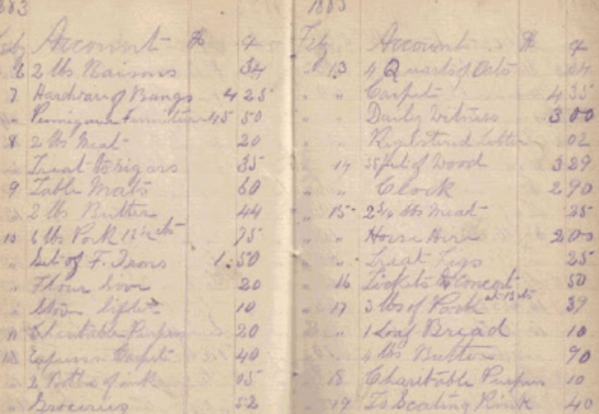
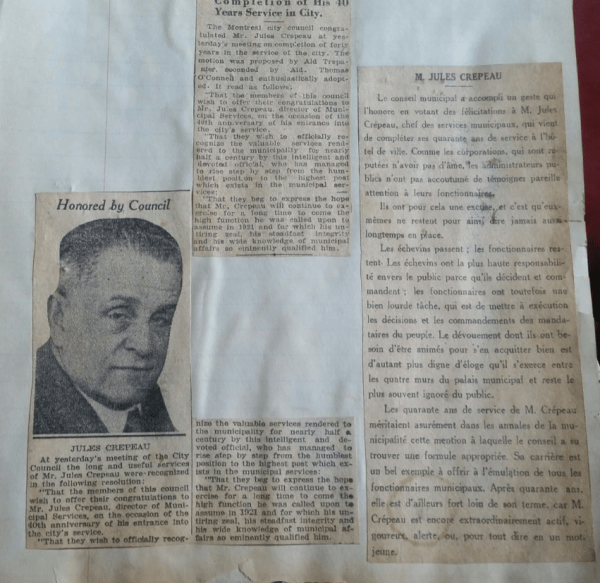
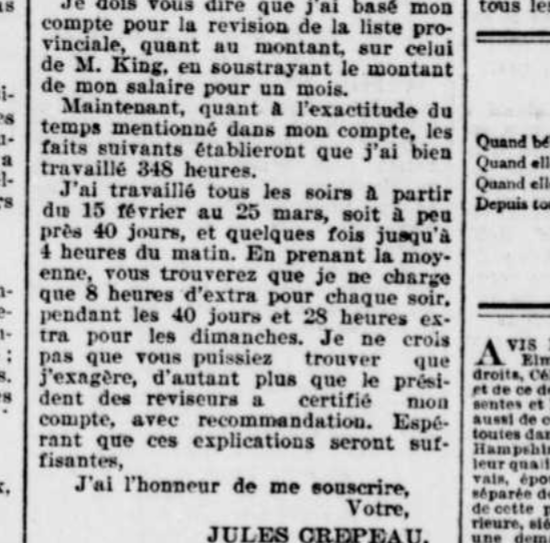
Pages from the WWI era scrapbook my Aunt Flo kept. (I threw out the cover as it was shedding).

My mom liked to tell me that her father, Jules Crepeau, started work at eight years old in the 1880’s sweeping the floors at Montreal City Hall and that by the Roarin’ Twenties he had risen to be the highest paid civil servant in the city.

This family myth spoke volumes to me: my grandfather was a self-made man and a man of the very highest calibre.

By 1921, when my mother was born, Jules was Director of City Services responsible for just about everything that came down in the city, from the Prince of Wales’ official visits to damage control during typhoid epidemics to the handing out of liquor licenses in the Prohibition Era

All seven city departments were under his control, including and most significantly, the Police Department. My mother said that my grandfather occasionally brought her to work at City Hall. This must have made quite a huge impression on her.

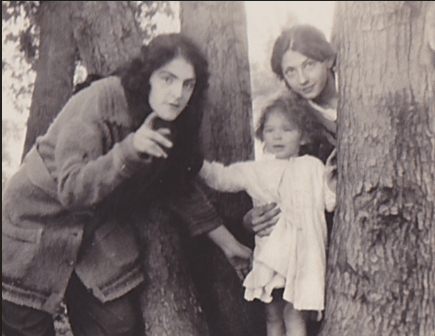
My aunts Alice and Flo and my mom, circa 1922.

My grandfather’s City Hall file reveals that he started out young as an intern in the city Health Department in 1888 and by 1901 he had worked his way up to the position of Second Assistant City Clerk, * aka the person who sees all the paperwork that passes though City Hall.

Jules had complete recall so this was a useful learning experience. In 1921, he landed that plum post of Director of City Services, a new position set up specifically to ensure an even distribution of municipal assets across the wards. Before the post was created, community groups from across the spectrum were invited to give their input on the subject.

I have since learned that Montreal’s burgeoning Greek community most probably had a hand in his promotion.1

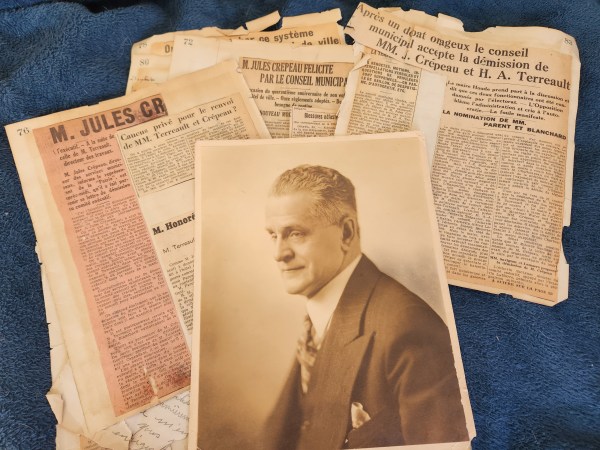
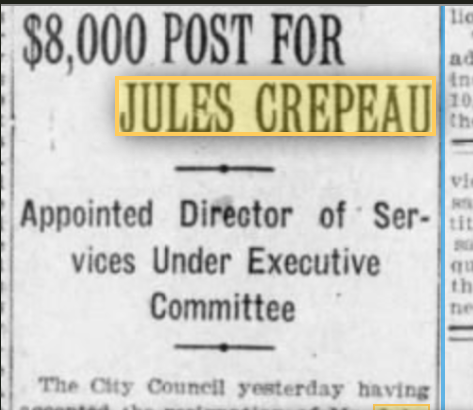
A few years after my mom died in 2009, I took a closer look at a disintegrating family scrapbook my Aunt Flo had kept. It contained yellowed news clippings from 1928 and 1930. In 1928, my father was being applauded for his 40 years of stellar service at City Hall. In 1930, he was being forced out by new Mayor Camillien Houde.

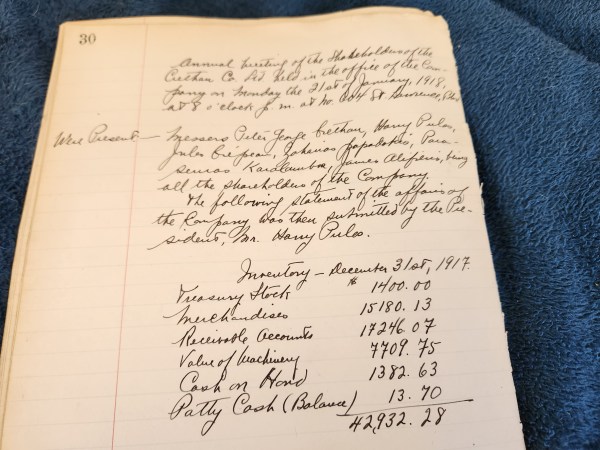
I noticed that the dilapidated black volume had originally been a minute book for The Crethan Company, a confectionery/food distribution company run out of Clarke Street by a handful of Greek men as well as my grandfather.

1917 minutes. Crethan Company. The company distributed food, olive oil, fruits, confections. Likely supplying Greek restaurants.
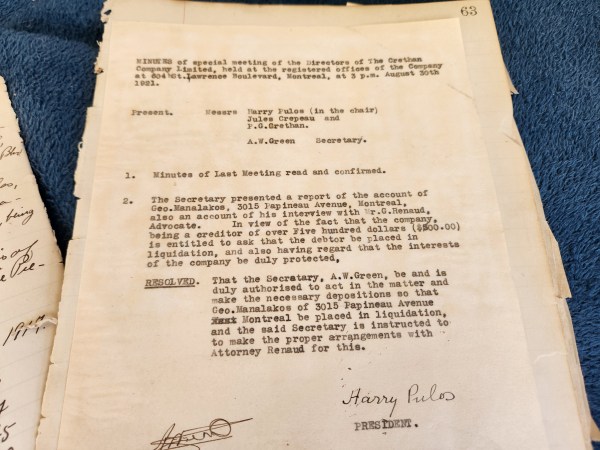
oops. Someone didn’t pay their bills

The President was Harry Pulos aka Harambolous Koutsogiannapoulos, the defacto leader of the early Greek Community in Montreal.2 How interesting.

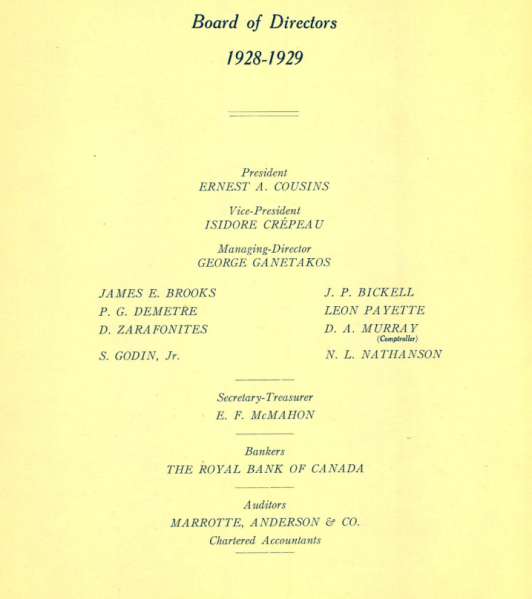
You see, by that time, I had researched my genealogy and discovered that my mom’s Uncle Isadore Crepeau had been VP of United Amusements, a movie distribution titan founded in the 1910’s by Laconian immigrant George Ganetakos. Ernest Cousins, an Anglo businessman was President..

So, I checked to see if these two men, Harry Pulos and George Ganetakos, were related: the answer is very likely.3

My mother had never mentioned her father’s Greek connections, not once, but she did talk about working in the Montreal movie biz before she was married.

In 1941, right out of Marguerite Bourgeoys secretarial school, my mom got a job at RKO Movie Distribution, a United Amusements affiliate.4 Both companies were located on Monkland Avenue in Notre Dame de Grace, near her family home at the corner of Oxford and Monkland. (LINK to story I Remember Maman)

Taking an even closer look at the Minute/Scrap Book I suddenly noticed the significance of the dates. The Crethan Company was started in 1916 and ran until (at least) 1922 when the minutes end.

Honored by council in 1928, thrown out in 1930.

Grandpapa Jules seems to have aligned himself at just the right time with these ambitious men from Laconia. They probably helped him land his prize post and, in turn, he helped them with motion picture and restaurant licenses. 5I can’t prove it, but Jules almost certainly got his brother Isadore, an insurance salesman, his gig as VP of United Amusements.

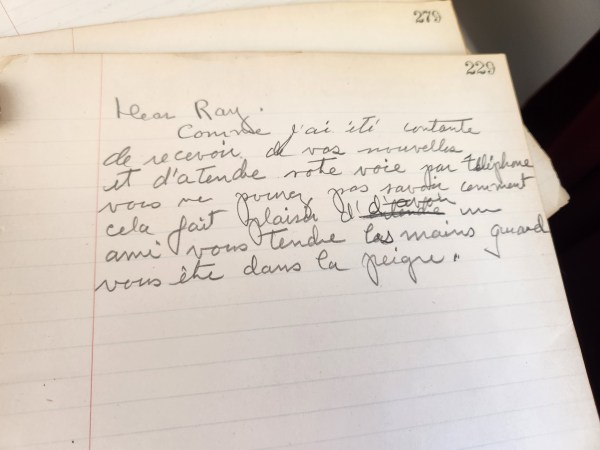
How did this get in there? A weird letter, likely my Aunt’s with spelling mistakes.
Dear Ray. How happy I was to receive your news and to hear your voice by telephone. .you can’t imagine how nice it is when a friend extends his hands when you are ‘dans la peigre.” Does she mean piege as in trap.Pegre as in underworld. If she meant Pegre, is she using a metaphor for ‘being grounded’ or does she truly mean ‘in the underworld?

In 1927 came the fatal Laurier Palace Motion Picture House Fire, where 78 children perished in a crush to the door. It was a real game changer in Quebec, and my grandfather got caught smack in the middle. He was blamed for looking the other way when citations were given to movie houses for letting in children unaccompanied by an adult.

George Ganetakos, using the name George Nicolas, immediately set up a fund for the victims. During the inquest my grandfather brought in Earnest Cousins to plead for continued Sunday showings. Isadore also spoke. Sunday showings for adults were allowed to continue.

As it happens, two years before in late 1924 during an inquest into organized crime, corrupt policemen and Montreal’s sex industry, a cop-on-the-take took the stand and accused the Greeks of “corralling” children into movie houses and warned, “one day there’s going to be a fire and no one will be able to get out.” He wasn’t even being asked about movie houses: He brought this up out of the blue. I suspect this cop was a go-between and he was sending a coded message to my grandfather.

My grandfather certainly thought so. He had that same policeman fired the very next day.

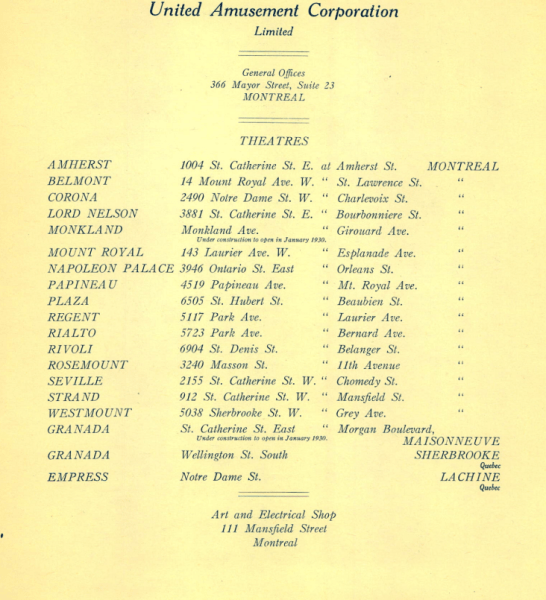
Top: 1929 annual report United Amusements. Isadore would ‘fall’ out of his 7th story office window in 1933. Bottom: movie houses owned by UA. The list of these movie palaces would grow. My Great Uncle Isadore was shown on a talkie film at the opening of the Monkland Theatre. Isadore’s glass company would make a mural to adorn the Rivoli. It’s still there today. (Mcgill digital archives.) N.L. Nathanson, an American was in Toronto, head of Famous Players. The two companies were associated.

My grandfather, in turn, was ousted in 1930 by the new Houde administration, but not before negotiating a huge life pension, likely in exchange for his silence. In 1937, during the Depression his hefty pension was rescinded by City Hall as an emergency measure – and just two weeks later my grandfather got run over by a plain clothes policeman near his home in NDG. Hmm. He spent 3 months in hospital and died the next year of complications at the age of 59.

My opinion only: Obviously my grandfather had nothing to do with the fatal fire, but his enemies may have had a hand in it.

The Laurier Palace was owned by Syrians, a group that was often conflated with Greeks back in those days.

Funny, whenever I’d ask my mom why I couldn’t go to the movies as a child she would tell me the story of ‘all the little babies who died in the Laurier Palace Fire’ and she’d pretend to rock an infant in her arms.

She didn’t know the real story.

The End

  1. L.O. David, the patrician head City Clerk, was a scholar who preferred working on his history books over the bureaucracy of City Hall. My eager-beaver grandfather got to do all the work! Montreal had universal male suffrage, but in the century earlier Montreal was an English majority city and the Mayors had to have 10,000 dollars in the bank just to run and the aldermen had to have 2,000 dollars and be fluent in speech and writing. They abolished these rules in and around 1910 as the city grew, absorbing the suburbs. The city became majority French. They also abolished the rule that an English Mayor must follow a French Mayor. Populist mayors, petit bourgeois, were now elected instead of the well-educated professionals of the Victorian Age. It must also be noted that the post of Mayor became less and less powerful, almost a figurehead in the 1920’s with the Executive Committee having all the sway. 1910 saw an immigration boom, so there were important votes to be had among these newcomers.
  1. To Build the Dream, Sophia Florakas Petsalis. 2000 explains that Koutsagiannopoulos was a pre-turn of the twentieth century arrival who had a fruit store across from where Eaton’s would be built, a highbrow location. Phillip’s Square was so ritzy, it was one of the few areas female students from Royal Victoria College up on Sherbrooke, were permitted to venture. According to the book, Pulos made sure to take care of his fellow Laconians, finding them jobs upon landing, etc. Other names on the board: Pappas, Antoniou; Economides; Crethan, Pappadakis, Karalambos and at one point a Forget.
  2. Drouin (Greek EvangelizmosChurch Montreal) reveals that in 1907 a Zarafonity from Dourali Laconia married a Koutsgiannopoulos- a marriage witnessed by Ganetakos, also from Dourali. He likely had a Zarafonitis mother. Koutsogiannopoulos also was godfather to John Zarafonity son.
  3. Lovell’s Directory reveals this fact. She lived on Monkland and Oxford with her Mom and brother and sisters. Her dad died in 1938.

Greek men (mostly from Laconia, many related),were involved in all aspects of the movie distribution industry in Montreal back in the day. Ganetakos was only the most prominent of these movie men. The Syrians who were conflated with Greeks in the newspapers might have been Pontic Greeks from Turkey.

These new Canadians often started out working in the food industry, often pushing carts through the streets, then starting up stalls and then expanding into stores, cafes and restaurants.

The story goes that Ganetakos’s uncle, Demetre Zarafonitis, started playing ‘flickers’ at his fancy uptown café, the Cosy Parlour near Phillips Square, and that George noticed these early movies were more popular than the ice cream.So he started up his own motion picture house, the Moulin Rouge in 1908.

Two decades later, George Ganetakos was working out of his palatial office on Monkland Avenue, distributing Hollywood films for Famous Players and RKO, building architectural masterpieces like the Rialto Theatre on Park Avenue, and getting lots of press in the Hollywood trade journals. (My grandfather got a fair bit of press there as well.)

It seems that George Ganetakos was as much of a self-made man than my grandfather. However, I had contact with a descendant of the Zarafonitis’ and she was told her ancestors got the bum deal.

Greeks were referred to as Syrians in the press and they faced obstacles to their success by established merchants. People complained the cart pushers yelled too much on the street. At one point, the city wanted to tax stall merchants 200 a year as they did regular stores. An alderman, one loyal to my grandfather, spoke up for them saying this would force them out of business.

  1. During the Coderre Inquiry into Police Malfeasance in 1924, a policeman on the stand said that Jules personally forced policeman to look the other way when it came to underage clients of movie houses. He also said Greeks ‘corralled’ young children into the movie houses. He brought this up out of context. No one cared about children and movie houses. In those days, across North America, Sunday showings were often an all- kid affair. (The parents got an afternoon off). And besides, the streets at that time were dangerous with horses and autos running amok with no street rules. The Inquiry was about illegal booze and, mostly, the sex trade. In Juge Coderre’s final report in 1925, published in the Gazette and other places and rehashed for a 1926 US Senate hearing into Prohibition, the testimony getting into a two page spread in the New York Times, Coderre imperiously asked, “Who is this man Jules Crepeau who tells the Chief of Police what to do?”

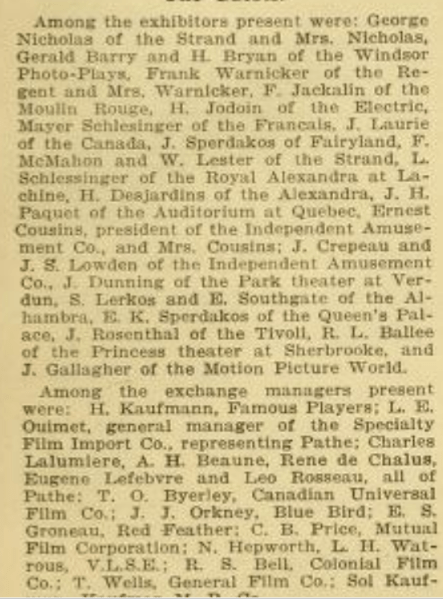
A strange bit from a May 20,, 1916 Motion Picture World with the guestlist for a bash in honor of a Pathe movie star in town written by a Gazette reporter. Seems to show my Grandfather J. Crepeau with Ernest Cousins of “Independent Amusement”. Is this a typo, supposed to be I for Isadore? Either way a mystery. Did my grandfather dip his toe into the movie business as well as the food business in 1916? Or did Isadore have the movie gig as early as 1916? George Nicholas at top is likely George Ganetakos. (I have to delve deeper. I believe Indepent Amusement became United Amusements.) And is the T Wells my husband’s grandfather? See all the Greek names? Sperdakos, Lerakos etc. and M. Ouimet of the legendary Ouimetoscope.

Dec, 1921.

Greek Tragedy

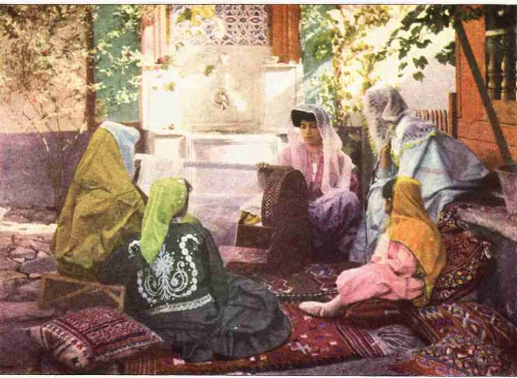
Syrian girl with her wares. (National Geographic, November, 1925. Article cited below. This magazine is in the public domain according to Library of Congress. Gervaise Courtellemont. Lumiere company.


Prologue: In my last post I explained how I recently learned, through DNA, that my biological father was likely Pontic Greek on the father’s side. Pontic Greeks are Orthodox Christian Turks who believed they are descended from ancient Greeks, who once lived on the southern coast of the Black Sea in cites like Samsun and Trabzon and who speak either a unique form of Greek or Turkish. In that post, I also wrote about the 1923 population exchange between Greece and Turkey. Here, I elaborate.

In 2010, I visited my older brother who lives in Denmark at his holiday home in Plomari, Lesbos, Greece. The large island of Lesbos is off the northwest coast of Turkey. On a good day you can see Turkey from the capital city of Mytilini. It’s only 17 miles away.

Back in 2010, before I explored my DNA, I naturally assumed I was half French Canadian and half Yorkshire British, just like my older brother, but I also knew, deep down in my heart of hearts, that I resembled the Greek locals, both in looks and in temperament.

Plomari village from the back window of my brother’s place.
The harbour is two streets down.

Today, I understand that I am very likely related to some of those local Greek citizens on Lesbos, perhaps even closely related. I know this because of a photograph I recently discovered in an article from the November, 1925 National Geographic magazine.

Greek refugees arriving in Mytilini. 1923

There is no shortage of online information on the 1923 Greek/Turk ‘population exchange’ that came on the heels of a horrific event referred to back then as ‘The Smyrna Holocaust,’ but I had high hopes that this story entitled History’s Greatest Trek. Tragedy stalks through the near east as Greece and Turkey exchange 2,000,000 of their people, written in real time by a world class journalist in a world class magazine, would shed some light on the path my Pontic bio-father (or grandfather) may have taken to reach Montreal, Canada in 1954.

I have tree matches in Samsun, a port on the Black Sea in northern Turkey. My mother, who lived and worked in the Notre Dame de Grace area of the city, likely knew Greek men whose grandparents fled Smyrna (now Izmir) in 1922, on the west coast of Anatolia on the Mediterranean Sea. Could I connect the two places?

I was not disappointed. Right at the beginning of the sixty page article there’s a picture of a young Greek man from Samsun. The caption reads: A Refugee from Samsun. He took part in the first trek of 100,000 refugees from the Anatolian interior.

According to online sources, post WWI, most elite Greeks in Samsun were killed off and all other able-bodied men sent into the interior to join the Turkish army.

Clearly, some of these Pontic Greek men and women escaped the Turkish hinterland to make it to the Mediterranean coast and Smyrna in 1922, in the hope of catching a ride to safety.

This 60 page article from 1925 is a classic piece of National Geographic reporting. It is workman-like in its execution with a prose style on the flowery side. The article offers readers a succinct historical and political perspective on the infamous 1923 population exchange between Greece and Turkey. The reporting is objective: The Muslim story is discussed with as much respect as the Christian story. And, of course, the article contains many, many photographs, about one hundred of them. Oddly, the prettiest colour ones all depict quiet Turkish life.

There’s a fascination here with exotic dress, from what I can see.


Still, the author, Melville Chater, pulls no punches as he uses his gift with words to capture the true horror of the situation in the port of Smyrna during the late summer of 1922: the hope, despair, death and disease and, eventually, the chaos, the total breakdown of civilized life.

Chater and his companion were in that coastal city when the Greek military lines collapsed in August, 1922, effectively ending the three year old Greco-Turkish war. They were in Smyrna in September to witness the Greek soldiers flee home on their military barques, leaving only ‘neutral’ observer boats in the habour.

Immediately thereafter, they saw the victorious Turkish cavalry enter the city, the riders’ left palms outstretched in a peace gesture, and a few days hence they witnessed the great fire of Smyrna that forced local citizens to flee in chaos to the quay and mix with the tens of thousands of refugees from further afield amassed there. By this time “the city had become a gigantic blast furnace… Affrighted faces mingled with wild-eyed animals, and human cries with the neigh of horses, the scream of camels, and, last, the squeaking of rats, as they scuttled by in droves from the underworld of a lost Smyrna.”

The beginning, late August, 1922.

“Refugees from anywhere within 150 miles inland herded seaward into Smyrna. At first they came in orderly trainloads or in carts, with rug-wrapped bedding, some little household equipment, and perhaps even a few animals, But as the distant military momentum speeded up, the influx became a wild rabble of ten, then twenty, then thirty thousand a day. Their increasingly scanty possessions betokened a mad and yet madder stampede from the scene of sword and fire, until September 7 saw utterly destitute multitudes staggering in, the women wailing over the first blows of family tragedy, whereby mothers with no food for their babies had been forced to abandon their older children in wayside villages….

….By now Smyrna’s broad quay swarmed with perhaps 150,000 exiles who camped and slept there, daily stretching their rugs as makeshift shelters against the sun, whose furnace-like heat was the mere forerunner to a terrible epic of fire.”

The Greek Army flees,the Turkish cavalry arrives.

On September 23rd, a fire breaks out in the Armenian quarter. The Turks give permission for women and children and old men to leave. People are dispatched to Athens to organize a flotilla of rescue boats. The Turks then give the rescuers one week to evacuate the refugees or they will be forced into the interior. Further chaos ensues.

“Uncounted hundreds were crushed to death or pushed over the quayside to drown, on that first day, when eight ships, convoyed by American destroyers left with 43,000 souls aboard. For those left behind there remained but six more chances—a chance a day—then the black despair of deportation into the interior.

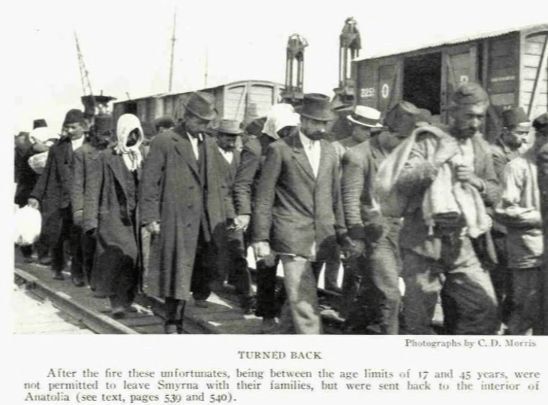
These men were not allowed to leave Smyrna after the fire with their families. “Everyone from peasants to bankers” is how these Anatolian Greek refugees are described in the article. Also as “human derelicts” and descendants of ‘those adventurous spirits who had followed Alexander the Great into Asia.” Some men apparently escaped at Smyrna, swimming to rescue boats under the cover of night. Some wealthier men bought their way onto boats. 300,000 thousand people were evacuated in two weeks, including 100, 000 ‘cellar-hiders’ in Smyrna, uncovered by the Turks in a house-to-house search.

The aftermath:

A notification is posted permitting (well, forcing) all non-Muslims to leave Asia Minor before November, 30, 1922. Hoardes of Anatolian Greeks, former prisoners of war, men, women and children, head to the Black Sea coast.

“With ship-deserted quays, as at Smyrna, and with the Black Sea ports glutted with sidewalk-sleeping, disease breeding paupers, who had been thrifty cottagers a few weeks before, the gap was finally bridged by the arrival of Greek ships flying the Stars and Stripes and convoyed by American destroyers….

….”By January, 1923, Athens had slammed its official doors protesting against further expulsions.”

With a big nudge from the US, Britain and the League of Nations, Athens agreed to accept hundreds of thousands more Christian Greek refugees in an exchange for Muslims living in Greece.

The exchange would begin in May, 1923 and be carried out in various ways. Most Greek refugees are funnelled to the Athens region as well as to Thessonaliki in the northern part of Greece and to some Aegean Islands like Lesbos.

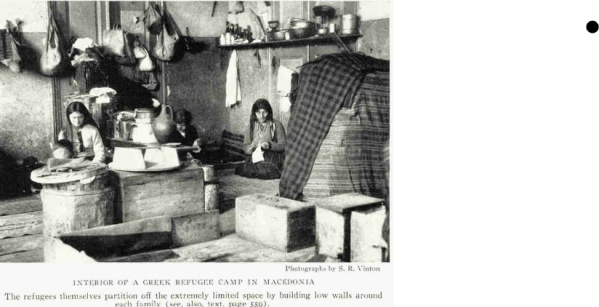
They live in refugee camps rife with disease and death. There is little usable land left in Greece due to past wars.

Greece, then a country of 6 million souls, would take in almost a million and a quarter refugees within a year of the Smyrna disaster, increasing its population by 25 percent.

“There is no adequate parallel whereby to convey even remotely a picture of Greece’s plight in 1923,” Chater summarizes.

Pretty heavy stuff – and yet the 1925 magazine article somehow manages to maintain the feel of a breezy travelogue.

Greek refugee camp Macedonia

Epilogue:

In the style of Virginia Woolf’s 1925 masterpiece Mrs. Dalloway, I imagine a comfortably middle class lady, back in the mid 1920’s, perhaps my husband’s grandmother in her favourite club chair in her cottage in Westmount, flipping through this very issue of the National Geographic, cup of tea in one hand. The inky new pages crackle as she turns them with her free hand. “How awful,” she whispers under her breath when she gets to the bit about the Greek women holding their still-born babies at their breasts because they had no place to bury them. And, then, “How pretty,” as she eyes the flowing costumes on the Turkish women, the colourful mosques and the charming minurats. And, then, as she comes to the full-page advertisement for Campbell’s Soup at the end of the article, she perhaps thinks, “Yes, tomato soup for the children, for tomorrow’s lunch.”

Here’s the archive.org link.

https://archive.org/details/nationalgeographic19251101/page/550/mode/2up?q=mosques

Genealogy Rabbit Hole

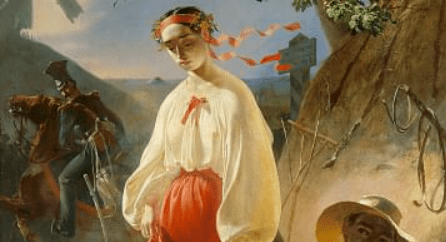
Kataryna, Serf. Taras Shevchenko. (Taras Shevchenko Museum) World History .ORG Creative Commons
Yes, the street in Lasalle is named after this celebrated Ukrainian painter/poet!

Exploring your genealogy is something of a luxury. You need the knowledge to do it, the time to do it, sometimes the money to do it. And you need the ancestors to do it, that is to say ancestors who came from relatively stable, peaceful places; countries where good records were kept.

People in North America and Western Europe sometimes have this luxury, the rest of the world, well, not so much.

My ‘official’ family tree is half French Canadian and half North of England, so easy to put together. My biological tree is half French Canadian and, let’s say, something not Western European, something very, very complicated and sometimes hopelessly obscure.

On Ancestry, the record makes clear that most of my mother’s people hail from the Lachenaie seigneury, north of Montreal. That’s a very small area. There are hundreds of cousin trees to prove this.

My unknown bio-father’s side is from all around the Black Sea and Eastern Mediterranean. That’s the crux of it, anyway.

My Ancestry Ancestral regions. Not an exact science by any stretch but getting better. The Green is “French”, my Mom. 46% She has a touch British and Norway. My bio-father, a colourful mix of Germanic Europe, Anatolia and the Caucasus and Southern Italy and Eastern Mediterranean, with touches of Balkan, Greece and Albania, Eastern Europe, Persia, Romani, Mongolia, China. Some Crimean Tatars online who have done their DNA have similar mixes without German.

We’re talking an enormous area that for centuries was home to myriad populations, myriad cultures that for economic and/or political reasons moved around a lot.

On Ancestry, my mother’s side has 28,000 matches, none of them that close, but that doesn’t matter because I know who my mother is.

My bio-father’s side has but 1,800 matches, only one match at 60 centimorgans, likely a third cousin, and the rest at 20 centimorgans and below. 1

Still, using Ancestry’s various tools to analyze my paternal side’s origins, my best guess is that my bio father was half Protestant Black Sea German (maternal side) and half Pontic Greek (paternal side.)2

YourDNAPortal’s 1000 year old ethnicity estimate is bang on for my French Canadian side and it gives me 11-20 percent Crimean Tatar from the bio-father’s side!

Incredibly, it has taken me a full seven years to figure this out. I must have the equivalent of a Master’s degree in Black Sea Studies. 🙂

I won’t make fun of you if you don’t know what a “Black Sea German” is, although some of the descendants of these people now live in the Dakotas in the United States and in Western Canada.3

They were people from Baden-Wurrtemburg and Alsace (many winemakers) who took their horse drawn wagon trains to Southern Russia (sometimes by way of Galicia, that is the Poland/Ukraine border or Swabia, the Hungary/Romania border) in the late 18th century at the invitation of Catherine the Great who offered them free land, no taxes, and no conscription in order to re-populate areas formerly held by Turks. Catherine didn’t want those nasty Turks coming back. Later, Alexander I opened up Bessarabia (today’s Moldova) to Germans, offering similar incentives.

It was a difficult life (if you survived the journey) but many of these disciplined, hard-working farmers prospered – until they didn’t. Many ‘extra’ sons or cast-outs were constantly on the move looking for a benevolent, fertile piece of land to call home. Young unmarried women sometimes moved away for work.

Some Black Sea Germans, Protestant and Catholic, moved on from Southern Russia/ Bessarabia to settle in the Crimea on land once held by Tatars.4 In later years, Bessarabian German settlers spread out southward to Dobrucha in today’s Romania at the invitation of the Turks who were still in charge there. Ironically, this is where the displaced Crimean Tatars were now living.

The North American descendants of these Black Sea Germans have done a remarkable job chronicling their ancestors’ migrations and daily lives on various websites and databases. This information includes village censuses.

The most intriguing documents, I think, are the anecdotal “village histories” written down by a leading citizen and/or self-styled local historian. Apparently, there was lots of praying as these people were pious; also lots of drunken brawling, as most every town had a tavern; and lots of hardship, too, death from disease and famine, earthquakes and plagues of all kinds. Meeting your end at the bottom of a well was quite common. Hmm.

Initially, there were a handful of ‘orderly’ villages, 25 to 100 and that number grew to around two to three thousand. Although overwhelmingly populated with Germans in extended family clusters, many Besserabian villages also harboured a few Turks, Bulgarians, Romanians and Jews.

Ancestry’s Beresen and Leibmental enclaves of Black Sea Germans, covering Ukraine mostly.(Some ventured to Caucasus because they felt Mount Ararat to be the site of the Second Coming of Christ.)

Black Sea German citizens were so mobile they often named the last village in which they lived as their ‘homeland.’

Since the borders in Austria-Hungary changed so often, even an officially listed nationality like Polish or Austrian means little.

Nationality back then was very fluid.

That’s why delving into the ‘Germanic’ side of my unknown bio-father’s genealogy, although illuminating in one sense, usually sends me down a dizzying rabbit hole.5

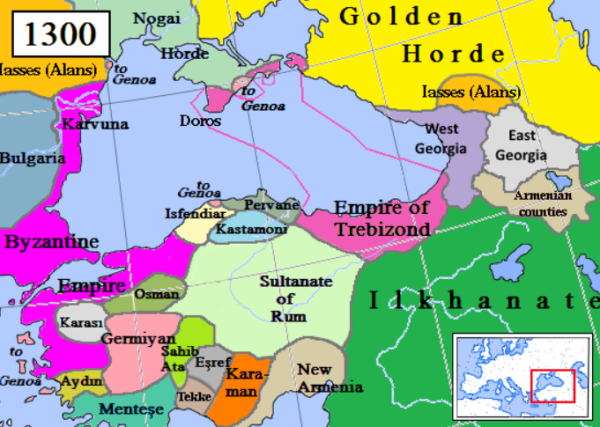
Empire of Trebizond, Wikipedia Creative Commons. “A remote and isolated splinter of the Byzantine Empire.”10
This map goes a long way towards explaining my wonky heritage.

The Pontic Greek side is even more obscure. Pontic Greeks are people who believe they are descendants of the original Greek settlers on the Black Sea in the Classical period. 6

They practised Eastern Orthodox Christianity brought in from Byzantium at a later date, lived in vibrant port cities like Samsun and Trabzon in North Eastern Anatolia, and spoke either a form of Greek or sometimes even Turkish. They mixed up their genes with Armenians. Some dressed like Tatars. Many converted to Islam.

Post WWI, these Christian Greeks were forced by the Turks to leave the Pontus, as it is called, in a series of expulsions and death marches, mostly pushed to the Anatolian interior or towards the Caucasus. (This coincided with the Armenian genocide.)

In 1923, Greeks in Turkiye (mostly Pontic) were exchanged for Muslims in Greece. These Greeks primarily went to Thessaloniki in Northern Greece.7

I know I am derived from Pontic Greeks because I have over fifty matches on Ancestry with that particular “journey.”8 Some of these matches live in Turkiye and have Turkish names and when I contact them they seem very upset to discover they are even a small part Greek. Others are merely perplexed.

Many of my Pontic cousin matches have the tell-tale suffix IDIS at the end of their surnames and identify as Greek. They live in the United States and their immediate ancestors hail from Thessaloniki or southern Russia. 6

A handful have Russian surnames.13

Southern Russia! I have a theory. My male Pontic Greek ancestor from Samsun in Northern Anatolia (where I almost certainly have antecedents) took a boat across roiling Black Sea waters to the Crimea, maybe by way of Sochi, where I have a tree match, and met up with my female Black Sea German ancestor. The mountains of southern Crimea had a climate good for growing grapes. I have many sure-fire ancestors in the village of Huffnungstal, near Odessa. Some of these Hoffs, Bollingers, Lutz’s, and Berreths went on to Crimea.

This is more than a stab in the dark. Call it an ‘educated guess.’

The essential point is this: Because of the complex history of Eastern Europe and the Black Sea area, my bio father back in 195412 Montreal may have identified as a Ukrainian (most likely) or a German or a Greek or maybe even a Turk or a Tatar. Or perhaps a Pole or a Hungarian, or even a Romanian Jew14. Or just a Canadian. His ancestors might have been Steppe nomads, serfs or slaves, farmers, vintners, blacksmiths, soldiers,sailors, shopkeepers, shipping magnates, Romani gypsies, noblemen – or all of the above.

Yes, researching genealogy is challenging for most people but next to impossible for people in my situation, with roots around the Black Sea, even if you know who your parents are.

In Soviet society, post WWII, elders kept family history and stories AWAY from their descendants rather than passing the stories on, according to an academic paper I read.9

This was for their protection.
“The less people knew about their family history the better.”

The Pontic Greek diaspora in Europe and North America now struggles to keep its cultural identity. Persons who went to Thessonaliki or other parts of Greece in the 1923 exchange were often slighted by natives and not considered ‘true’ Greeks, so they didn’t showcase their past.

The other surviving descendants of the citizens of the once dazzling Empire of Trebizond now live in Ukraine (Mariupol) and Kazakstan and Turkiye and many likely don’t know (or want to know) their ethnic heritage.

It’s no wonder I can’t figure out who my bio-father is – and probably never will. His relatives, if they exist at all, reside in places where they don’t do DNA – and sometimes for good reason. But, thanks to modern science and copious online sources, I do know an awful lot about his very mixed-up ethnic heritage.

THE END SON Кінець Das Ende Τέλος Koniec Sfârşit

Footnotes

1. I only get one or two new matches on that side a week, or maybe a month. Most are Americans or Brits with some Romani. (I’m 1 or 2 percent Romani) or distant descendants of Black Sea Germans (Eberhard from North Carolina!) and an occasional Pontic Greek.

2. I only know this because I have a twin who did his Y DNA and the one match had a Turkish name. J2A.. My 3rd cousin match, a Turkish woman, is a stand-alone match, with no mutual matches. Her ethnicity profile mirrors my bio-father’s, though, suggesting to me Crimean Tatar roots. See Note 4. Bob Dylan, apparently has a similar ancestry.

3. I am almost certainly related to the Hemmerlings of Gimli, Manitoba. Are you?

Most Black Sea Germans were repatriated to Germany or Poland during WWII. As the borders changed during the war some had to go back to Russia. A few of these Germans lobbying to return to Germany had ‘mixed marriages,’ according to records kept by the Germans. The mates were mostly Russian, but quite often Moldavian (sometimes referred to as Gagauz, a kind of Christian Turk native to Romania) and but rarely Hungarian, Polish, Bulgarian or Greek.

4. Ancestry doesn’t acknowledge Tatars or Crimean ‘journeys’ but on many other platforms the algorithms give me Crimean Mountain Tatar, at least way back. These people were a mix of Northern Italian (Genoa) Southern Italy and Greece, (Sicily), Allans (Persia) and Goths (Germany) with Nogai, as in Steppe Tatars who in turn have Central Asian and Mongolian. (I have all of these things 🙂 I have only one distant match with a tree totally from Crimea and, yes, the surnames are Tatar.

5. I have a cluster of family trees with people from a town called Hoffnungstal in Bessarabia (Odessa area). I also have a cluster in Galicia (Poland-Ukraine border)in a town called Bruckenthal. There was a trade route between these two areas and smack in the middle was a town called Botosani, Northern Romania, where I also have a tree match- a Jewish match with people who moved to Montreal. Yikes! (Any ideas? Contact me, please!)Added a week later: The immigration path of the Black Sea Germans in my trees seems to go from Baden area to Poland down to Galicia north of Lviv, around Moldova to that bit of Ukraine west of Odessa where Hoffnungstal and Kloestitz (my villages) are. The researcher says there were many long stops along the way. Works perfectly. Bruckenthal Rava Ruska is north of L’viv.

6. The Euripides play Iphigenia in Taurus speaks to this. Iphigenia, daughter of Agamemnon, is saved from death by the goddess Artemis and hidden in the land of the Taurians (Crimea). The Greeks have a long history in Russia. Rich shipping families from the Aegean ran the grain trade there in the 1800s. Many of these rich Greeks assimilated into Russian society. At the founding of Odessa, that became a bustling multicultural economic center, there were already many Greek families, who often were the wealthiest citizens there. At one point the Mayor of Odessa was a Greek.(Odessa Recollected; The Port and the People. Patricia Herlihy. 2018 Boston)

7. According to one online source, the Asia Minor and Pontus Hellenic Research Centre at Chicago, Illinois: In the city of Samsun, where I very likely have some ancestors, 72 Greek community leaders were arrested and sentenced to death in 1921. Other Greek men were killed, imprisoned or conscripted into the army and the women and children sent into exile or deeper into Turkiye where they were forced to change their Greek surnames to Turkish ones.

8. Ancestry gives me no journey on the paternal side, but there is a function that allows me to see the journeys of my paternal matches. These include: all parts of Germany; Black Sea Germans/ Leibenthal Beresen Enclaves; Pontic Greek; Eastern European Roma; North Eastern Hungary/Slovak Border. (That’s on edge of Ukraine near L’viv.) I appear to be connected to Szekelers, a sect of Hungarians who moved to Northern Romania, Bukovina.

9. A. Pahl and Thompson. 1994. Family history was dangerous even for families who left for North America.

10. https://www.grhs.org/pages/Villages A concise list of Black Sea German villages. Many descendants of Black Sea Germans and of French Canadians mixed it up in the Dakotas or Western Canada later on, so I have hundreds of distant ‘unassigned’ matches with both these heritages.

11.https://providencemag.com/2017/09/forgotten-christian-history-turkey-review-byzantiums-empire-trebizond-book-review/

12. In 1954 Crimea was returned by the Russian Soviet Socialistic Republic to the Ukraine SSR. The Russians felt that the Crimea fit more naturally with them.

13. In Family Tree’s public Pontian Greek Y database, the vast majority of subscriber surnames are Russian. This appears to show the extent these people were absorbed into Russian society.

14. MDLP algorithm, that is supposed to be best for people of my bio-father’s ancestry, is unequivocal. I am Romanian. And sometimes a Romanian Jew or Gagauz (that’s the Turkish bit). Lots of Romanian Jews immigrated to Montreal. That would mean perhaps that my closest community is not Black Sea German but Danube Swabian, Wurrtemburg Germans who lived for generations in Romania, Serbia, until expelled after WWII.

This video says genetic studies prove Pontic Greeks are descendants of Ancient Greeks. Indeed, their mountain monasteries preserved elements of Ancient Greek culture long after Byzantium died out. Also, family history information was ‘encoded’ in their dress, the fabrics and patterns of their clothings, every day and ceremonial. Now, that ‘s interesting. Because of their cohesive social system and the make up of their terrain, Pontic Greeks in North Central and Northeast Anatolia largely resisted Turkish invasions.
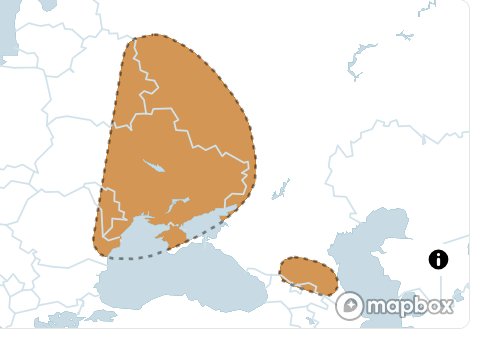
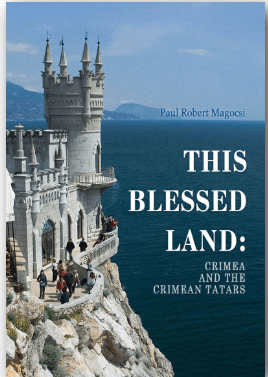
This book, from the University of Toronto Press, 2014 by Paul Robert Magocsi, is available on Archive.org. It contains pics of a Taurian Burial Ground 300 BC; Greek Amphitheatre; a cave village/Jewish Karaite; early 4th Century Christian Basilica; 14th Century Armenian Church; a Genoese Castle, and many mosques, attesting to the rich, complex history of the Crimea, a place still very much in the news for the usual reasons. This was the home of the sedentary TAT Tatars (as opposed to Steppe Tatars) as well as the Northern Pontic Greeks – as distinguished from the Pontic Greeks on the southern coast of the Black Sea in Northern Anatolia.

A Spontaneous Act of Kindness

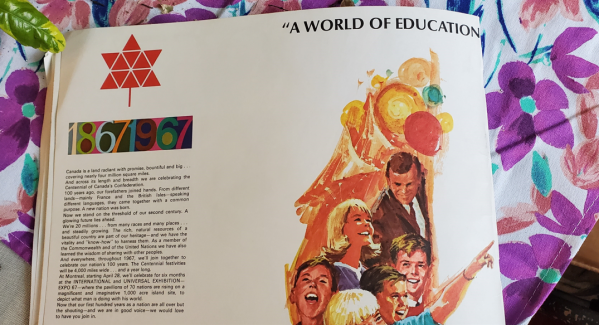
A World of Education, page from a pamphlet given out to school children in 1967 about Expo 67.

My mother, Mary-Marthe, would put herself out for people. At the check-out counter of the grocery store; on the bus; in the park my mother was not shy about helping out others. She sometimes forced spontaneous acts of kindness on complete strangers, often to my childish embarrassment.

This habit, I imagine, she picked up from her own mother, Maria, a pious French Canadian who married well in 1901 and was generous with food and home-remedies.

The story goes that in the 1920’s my mother’s Sherbrooke Street West grey stone had a mark on the gate that indicated to homeless men, or ‘tramps’ as they called them, that a hearty meal was in store for them should they knock at the back door.

I most vividly recall an incident that unfolded in the summer of 1967, the year of Expo 67, the World’s Fair, when I was a young adolescent and because of my prickly age extra prone to being embarrassed by my mother.

My family lived in Montreal and we all had ‘ passports’ so we could visit the nearby World’s Fair anytime we wanted.

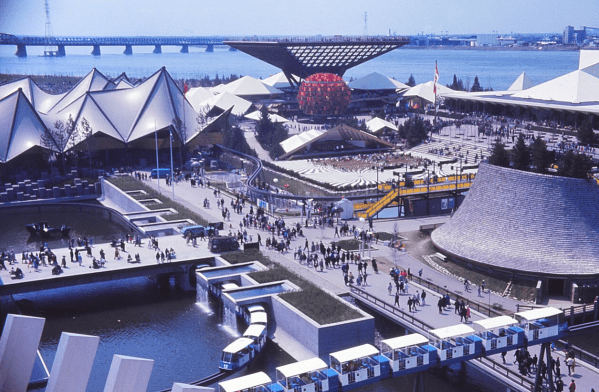
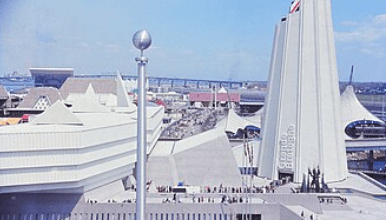
The Canadian section of Expo 67. The Western Provinces Pavilion, a forest, smelled so wonderful compared to smoggy city air!

I was 12 years old and I sometimes took the number 65 bus to those blissfully bright Expo isles alone, likely skipping school, and the bus stop was right under my 6th grade classroom window! I wasn’t too afraid to be found out. Didn’t my teacher say we’d learn more at Expo than at school?

Over that six month period from May to October 1967 I travelled the short bus and metro route to Expo 50 times, sometimes alone, sometimes with my brothers or other relations and sometimes with friends and their families. I recall that one mom was so afraid of losing her many tweenage charges in the swelling sea of thrill seekers she looped a long rope around our waists to keep us contained. How embarrassing!

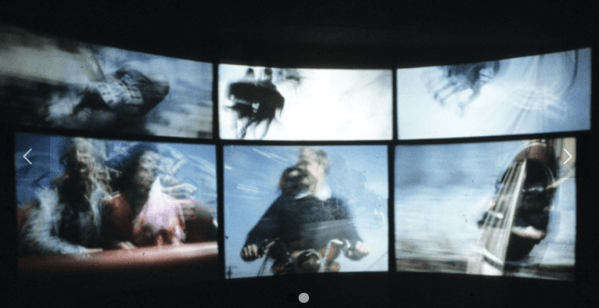
I wandered to the Expo site in all weather with a packed lunch since I had no extra money to spend.3 I liked the wide open Canadian and Ontario pavilions the best. I’d eat my sandwich on the Katimavik watching the rusty monster emerge from the lake adjacent. I experienced their exhilarating movies1 over and over again. The five Expo theme pavilions were a hit with me, too. 4I mostly avoided the popular national pavilions: the American, Russian, Czech and British pavilions with their long long line ups.

The movie We are Young in the Cominco Pavilion another favourite haunt of mine in the summer of 67. The exhibits explored the five senses. See link below that includes info about The Eighth Day at the Christian Pavilion and all the other landmark films that prepared us well for the future of media.

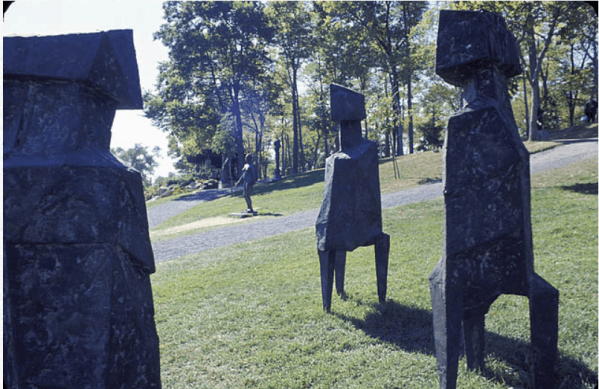
But I did like escaping to the sculpture garden behind the American pavilion. It was uncrowded, cool and peaceful in that place and all the avant-garde works of art, both life-like and abstract, were exciting to behold.2

One installation at the Sculpture Garden. The Watchers.Lynn Chadwick, UK 1960. No wonder I felt safe.

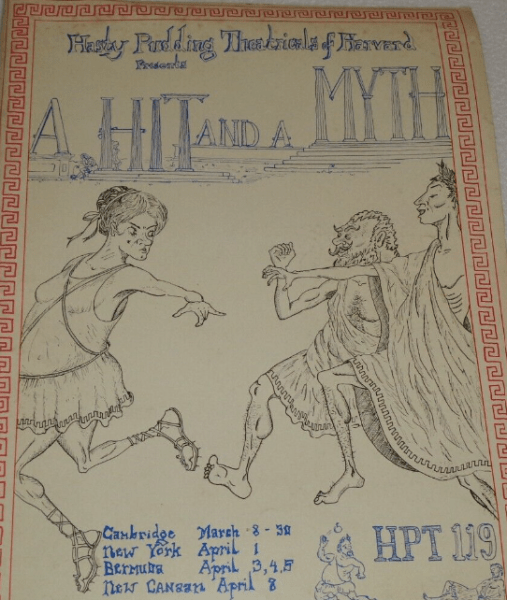
My older brother, a cutting-edge type, liked the Cuban pavilion for the vibes so we went there together, feeling slightly rebellious. He dragged me into the Christian pavilion one day and we saw a film with a monk setting himself on fire that depressed me for a days. And together we saw Harvard’s famous all-male Hasty Pudding troupe at an outdoor bandstand in a play called a Hit and a Myth that was quite bawdy. Although a good fit for my brother, it was bit mature (sic) for my tastes. I recall the energetic finale, Acalpulco, with a group of ‘grown men’ dressed like Carmen Miranda dancing in a conga line. Their unanchored brassieres kept riding up to their necks.

The list of songs inside this programme reveals that Acapulco was the penultimate song in the play, not the last. Characters in the play included Xerox and Tenintius and there were also Vestal Virgins. The Montreal Gazette said the play was written by the sons of Pulitzer Prize winning playwrights and would be of interest to anyone willing to get into the panty raid spirt. (I checked on Wikipedia: one writer, Timothy Crouse, became a journalist for Rolling Stone. The other, John Weidman, wrote for Sesame Street.)

Yes, I went alone to those glittering Expo Isles in the St. Lawrence, despite the fact that in the spring a policeman had visited our sixth grade classroom to tell us about the dangers lurking there. He said a girl could be drugged in a bathroom and then sold into white slavery. I’m guessing I never mentioned this to my father and mother. I wasn’t too worried being used to walking the big city streets on my own and not understanding the term white slavery – something to do with snow, I imagined. However, I did keep a look out for any suspicious Boris Badenof types around the Russian Pavilion.

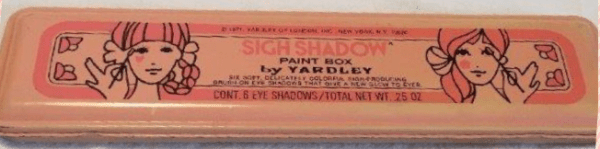
Yardley paintbox eye liner from the era. So obviously aimed at little girls like me. I still want one!

My father worked for Expo as a comptroller but I never visited the fair with him. He obviously was too busy. I did go with my mother, though, a few memorable times. On one occasion we saw Bobby Kennedy walk by surrounded by his team of FBI agents in dark glasses, and on another day we witnessed Haille Selassie, the Emperor of Ethiopia. He had a little dog following him. (I assume this wasn’t a coincidence. My mother wanted to see these famous figures.)

And on one very hot day my mom decided to visit the British pavilion. That place, more than any other, always had an especially long line up. This was the era of Swinging London, after all, and the pavilion included a MOD London exhibit with the Beatles (remember them?) and a Mini Minor Car. I was excited to go. I was a big fan of The Avengers with gorgeous Emma Peel karate-chopping Cold War baddies in her colourful Carnaby Street attire and of the Monkees TV show that featured Yardley commercials and “the London Look.”

The long line up at the British Pavilion. No shade. Wikipedia Commons.

My mom and I queued up realizing we probably had a very long time to wait. It was a hot day and in the line you couldn’t escape the sun. The person ahead of us was an ‘older’ woman with a young child – perhaps around 15 months old -who was not happy in the heat. The baby girl was kicking up a big fuss the whole time and would not be pacified, not in her stroller, not in her mother’s arms.

As was her way, my mother struck up a conversation with this woman.

She was British but this is where the similarity to Emma Peel or any other British ‘bird’ ended.

She was tall and thin, yes, but with wispy light brown hair and lots of stress lines around her eyes. Dowdy would be a good way to describe her attire. She was self-conscious about it, too. “I must look like the wreck of the Hesperus,” she said, combing back a rogue lock of hair with her hand.

This statement impressed me. Here was a smart British lady, just like my 6th grade teacher. And yes, in fact, this beleaguered mom was a teacher but in Toronto. She also had a 15 year old son who was off somewhere exploring the grounds – and she was divorced.

I started to feel sorry for her. She said she had driven to Montreal for just one day so her son could visit the Fair. Just one paltry day to see Expo, how sad! And all she wanted was to visit the pavilion of her homeland. Minutes, maybe hours ticked by and the long line inched forward. The little girl squirmed wildly in her mother’s arms, her shiny face getting redder and redder.

We were getting closer to the entrance and then my mother offered to do something very generous. She said WE would watch the baby for the woman in a shady area nearby so that she could visit the British pavilion in peace. (Our own visit would have to wait for another day.) And, what do you know, the woman took her up on the offer. I guess all that time in the line had made us seem safe and familiar to her.

The harried British mother passed through the turnstiles by herself and my mother and I and the baby found a big tree to sit under.

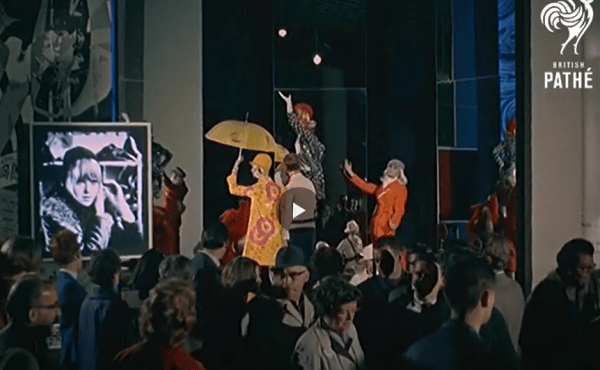
Detail of Mod Britain exhibit British Pathe video.

Then the lady returned and we said our goodbyes.

At Christmas she sent us a card with a long thank-you note written in impeccable teacher handwriting. (She had told us she didn’t have a phone. Too expensive.) I remember the note was on blue paper, maybe one of those aerograms popular in the day for overseas correspondence.

So, it seems, this overwhelmed mother did, indeed, appreciate my mother’s spontaneous act of kindness, as outrageous as it was – even for the 1960’s. I, myself, don’t recall being embarrassed at all.

  1. http://cinemaexpo67.ca/reimagining-cinema-film-at-expo-67/ https://www.nfb.ca/film/in_the_labyrinth

2. https://expo67.ncf.ca/expo_sculpture_index.html

3. ” Take a bag of ham sandwiches and a thermos of coffee to Expo- where there are 146 restaurants and snack bars, 46 food shops and 500 automatic vending machines to serve you,” says the opening line of the article “Easting Exotically and otherwise at Expo,” in the Star Weekly insert for February 11, 1967. The pic shows Indian, Japanese, Italian and Mexican chefs with their exotic fare: tacos, pizza, sushi and a meal with pilau and nan. (I think I ate all these things this past weekend.) A pic on the next page caption says :A snack bar in Expo terminology means glamorous dining, indeed. (So, no real cheap food at Expo.) Oddly, the advert in this article was for KLIK and Kam luncheon meat with a pic of little squares of this ‘meat’ on toothpicks on a pickle. How ironic.

4. Man the Explorer; Man the Producer; Man the Creator; Man the Provider. I recall Man and the Community had a revolving exhibit (Czech artist) with little wooden models of a man and a woman in bed and all their needs revolving around them on a belt. “The cause of all progress is laziness.” Reading a list of that place’s exhibits, it sounds amazing. I want to go back!

The Star Weekly insert wrote about the Man out of Control? exhibit in Man the Producer with it’s “maze of signs showing man besieged by the information explosion.” The article continues: “The question mark in the title is no accident. Will the devices of man swallow him up or will he remain in control?” Hmm. Why do I feel this question to be extremely timely?

The Other Side of the Street: a story inspired by Lovell’s Directory

Decarie between Isabella and Dupuis, June 1961. Archives de Montreal VM105-Y-3 545 001-010. My back porch is somewhere in there.

I spent my elementary school years living on Coolbrook, a one-way street in the Snowdon district of Montreal, adjacent busy Decarie.

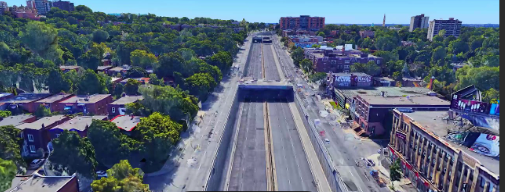
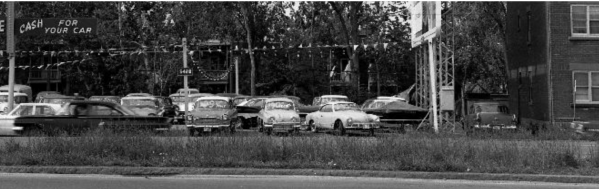
Before Decarie became “the trench” in time for Expo 67 it was a wide boulevard with a stretch of storefronts on the east side of my area including Young’s Vegetable Market and Green’s Pharmacy; and on the west side right behind my upper duplex apartment were a few used car lots as well as one empty lot where we children sometimes played. This lot, I remember, was strewn with dirty old toilet bowls and big baffling, almost supernatural chunks of quartz, but also sprinkled in between with enchanting pink hollyhocks and charming pussy willows. 1.

In those early days, I would cross Decarie at Isabella and skip down a few steps to the basement Decarie Handy Store to spend my 25 cent allowance on, usually, a MacIntosh Taffy or Cherry Blossom, ten cents each in those days. Any extra pennies would go to Lik-M-Aid, a sour powder in a paper tube.

My allowance didn’t permit me to buy the giant, perhaps healthier, Fruit and Nut bar I so craved. It cost 39 cents and I never thought to save up week to week.

The major commercial area in the neighbourhood was one and a half blocks south, up an incline on Queen Mary Road. There was a Woolworth’s on the corner of Coolbrook and Queen Mary with a lunch counter that featured enticing ads for banana splits for, yes, 39 cents. Again, too expensive for me although I imagine I could have always asked my Mom to buy the ingredients and make me one. She wasn’t cheap like my accountant Dad, who made us sign for our meagre allowance in a little booklet he kept for the purpose.

Nuway Tobacco Store with bit Export sign 1961, Montreal archives. There was a little hat shop tucked in beside it. An oddity in the 1960’s when hats were not in fashion especially among the young..

Every fall, we bought our school supplies at the Woolworth’s, sometimes a new pencil case. You could still get the old fashioned wooden ones with the sliding top or a newfangled plastic pouch with a zipper. I still get excited at the sight of an unsullied Hilroy scribbler.

The other stores of importance on Queen Mary was Black and Orange stationery shop, a dingy post-war style store but, still, all that potential in the pens and paper!

And the Zellers further up towards Cote des Neiges, also a bit of a dust bowl. Morgan’s Department store had a small shiny two story branch on Queen Mary, but that store was of no significance to me although my brother, fooling around with friends, once kicked in their showcase window.

And a little further up the street was the NDG library for boys and girls where I borrowed the horsey tome King of the Wind by Marguerite Henry over and over.

Yes, I remember the stores in my area with varying degrees of yearning, for sugar and for learning, but when it comes to the block of Coolbrook on which I lived, I only have half a memory of it.

That’s because I don’t recall one person, not one, who lived on the other side of the street. I suspect no children lived across the street in the 1960’s. Maybe whoever owned those duplexes refused to rent to families with children. And it was the baby boom era!

Corner Isabella and Decarie. Archives de Montreal. This was taken a few yards away to the right of the Decarie Handy Store.

Our duplex block of four homes, two lower, two upper, was one of a stretch of five or more owned by the same man, an unpretentious French Canadian, a Monsieur D. who dressed like a hobo. My mom also said he thought I was the loveliest little girl, so kudos to him. Monsieur D. was very cheap, it seems. He painted all the doors of his brown/red brick buildings dark brown and all the porches grey, casting a gloom over the entire block. He must have got a deal on paint, my mom said.1

Gibeau’s Orange Julep from other side of the trench. wikipedia commons
I lived smack in between two of Montreal’s most iconic structures, the Orange Julep
and the Snowden Theatre, below, in an otherwise dreary-looking neighbourhood.
I visited Orange Julep but once. The drink tasted sulphury to me.

It’s a condo today after lying in disrepair for ages. I saw the Lippizanner movie there.
Also maybe Sound of Music. I didn’t see many movies as a child.
Children were banned from theatres until 1962 in Quebec due to the Laurier Palace Fire of 1927

It didn’t help that in those days no one bothered to decorate their upper or lower balconies with pots of flowers except for the Italian man a half dozen doors down living in a gaudy new duplex (Lovell’s reveals he was a landscaper) and an unknown family in one of the few stand-alone houses on my street, up near Queen Mary Road, who had a very splashy flower garden in summer. One year it snowed in the middle of May and I recollect the sight of a lovely row of red tulips with a cushion of white on top as I passed this tiny cottage on my way to the Nuway Tobacco Store at the corner of Decarie and Queen Mary to buy my mom a carton of Du Maurier cigarettes.

Luckily, the trees along my stretch of street were tall and leafy and during the hot, humid Montreal summers the setting sun dappled the baking macadam with light. I could reach out over my balcony and touch a branch of my very own mystic maple. I do suspect the tree’s leaves protected me – a bit – from the ubiquitous 1960’s air pollution and the lead-laden fumes of the pink, turquoise and fire-engine red Corvairs, Thunderbirds and Mustang convertibles idling on the street below. These automobiles belonged to visitors as few families on our side of the street actually owned a car. Kids cost money, after all.

A glance at Lovell’s Directory on BANQ reveals to me the familiar surnames of families living around us. I recognize, too, the phone numbers, as I dialed many of them over and over during my childhood. The family names from across the street are new to me, of course. Mostly French, some English and one Finn. The breadwinner of the family is the only one listed on Lovell’s, but had any children lived there, French or English or Finnish, I would have seen them playing on the short sloping driveways or on the sidewalk or at least walking to school.

Yes, we kids played out on the street in those days, chanting to skipping games like“double dutch” on those short sloping driveways, bickering over the rules of hopscotch or “yoki” on the sidewalk. The boys sometimes played ball hockey right on the road.2

However, when it comes to the other side of the street, I have no recollection at all. Ain’t memory funny.

I recall not one incident, not one visual. Nothing has imprinted itself on my brain for life, such as when my neighbour’s German Shepherd got hit by a truck late at night and my friend’s mom sobbed loudly on the street and there was leftover blood and sawdust on the curb the next morning.

I don’t recall one bit of gossip about anyone on the other side of the street. On our side plenty: “Did you know the L family’s kids are ONLY fostered? Did you know that in the S family, the Mom makes more than the husband?” Did you hear that the W sons went with two girls they hardly knew on a car trip out West? Real shameful stuff it was!

I don’t even remember seeing anyone out shovelling the walk across the street in winter. And I stared at that side of the street for seven years from my tiny bedroom window. No one picking up garbage strewn around by a stray dog. No one leaving the house in the early morning, rubbers on feet, leather briefcase in hand, felt fedora on brylcreemed head to take the brown and yellow No. 65 bus to some downtown skyscaper like Place Ville Marie.

I have to smile: the 1966 Lovell’s reveals that there were quite a few vacant homes across the street from us. Is it possible that it was harder to rent that block on that side of Coolbrook because of us? Because there were so many boisterous, loud, unruly children (I count about fifteen) playing out on our small section of Coolbrook Street.

As in happens, in 1967, Expo year, while my British grandmother was visiting us from Malaya for the first and only time, my brother was playing ball hockey with a friend when he knocked over one of the Italian man’s pretty flower pots, red geraniums, I think, with a errant slap shot. Supposedly the man was enraged and ran out onto the street and hit my brother with a leather strap, the one and only genuinely violent act I ever heard of on our street- and, yes, it was on our side!

My grandmother, who herself had complained many times about the “shrill” Canadian children playing on the street, convinced my father to move out of the district and within months we were living in a smog-free ex-burb north of the city in a house with a huge yard with at least two weeping willows and more fir trees than I could count.

One broken porch ornament – and a rather Felliniesque incident – and the trajectory of my life took a dramatic turn, for better or for worse, who knows. For sure, my current Facebook friends would be totally different had my brother’s ball just skipped off the railing and missed that freakin’ flower pot! Life, just like hockey, can be a game of inches.

But, as someone who has lived in sleepy suburbs most of her life, I carry that time in the west end of the city deep inside of me, even if it’s only half a memory.

END

1. Our backyard area was especially ugly. It was expansive with a floor of gravel and dirt. Each family had a little yard, yes, with a grey fence about 15 feet by 25 feet, with grass. Our plot contained a giant tree, so no light, and nothing grew there despite my efforts at a garden. We neighbourhood girls would sling blankets over the fence and tie skipping ropes to the wires and play ‘horse.’

Right behind my backyard. Soon the apt at right would be domolished, I think, and that became the vacant lot

A newlywed couple moved in for a while and I recall one time watching from my second story back balcony as the young wife was chased off the porch by her husband who was holding a bucket of water. He caught up to her and swung the bucket and poured the it over her head. I could feel their euphoria. Oh, to be in love.

Beyond the yard was an over-grown alley way, my black cat, Kitty Kat’s, private jungle, where we once saw a pheasant that had flown down from the mountain, so said my mother, and beyond that alley the used car lot. The moms would let kids run wild while at play, as was the usual in the 1960’s, but they would dutifully call their children in for lunch from the backyard porches. One Mom had a bell.

Once I and a friend came upon a ‘hobo’ sleeping in one of the used cars behind our house. He had one leg and he said he was a war veteran. I stole a rather large chunk of left-over roast beef for him, from my house. When my mom wondered what had happened to her leftovers, I told her that I had given it to a stray dog – and she laughed. No fool I.

2. I recall once and only once a huge slimy Norway rat scuttling past us into the drainpipe a we played.. How did that huge thing fit in that tiny hole? A favourite game was yoki ( I thought Yogi) also called elastics or Chinese skipping, where we used a sewing elastic and manipulated it around our lower leg to rhymes. Classic skipping was popular, too, double dutch, etc. “My mother and your mother were hanging out the clothes. My mother gave your mother a punch in the nose. What colour was the blood.” This rhyme sticks in my head probably because my French Canadian mother wasn’t friends with any of the other mothers on the block. She had little in common with them, being French and also a working mother who played competitive bridge at the tony Boulevard Club.

There was a definite pecking order among the children playing on our section of the block in the form of arguments, fights, churlishness, and a lot of one-upmanship. I was a passive observer type, definitely at the lower end of the hierarchy. A good thing too: I recall the two alpha-girls in my group viciously fighting and literally pulling out handfuls of each other’s hair.

My brothers did play ON the road, classic road hockey which was safe on our quiet one-way street. One day a car honked at them and just as they were about to give the guy the finger they noticed it was John Ferguson, the legendary Canadiens enforcer. A rather dishevelled looking man whom we sometimes saw around was related to a playmate of mine. It was Doug Harvey, the Canadiens legend.

Pierre Lalonde, a young teen idol at the time, lived in the Italian man’s place for a few years in the 1960’s. He seemed shy – but he owned two flashy convertibles, both neon aqua and two motorcycles. (I worked in the same building as he did in the early 80’s – a TV station – and lived in the same town as him, in the 1990’s, often seeing him at the pool – but never once spoke to him. I did walk his dog as a child.)

All in the Family: The Butchers of Montreal

Marche St Laurent. Flicker Public domain

Every country has a foundation myth and so, too, have some families.

My mother’s family foundation myth was that her mother, Maria Gagnon Roy, was the daughter of a ‘master butcher’ and that she brought an enormous dowry of 40,000 dollars to her 1901 marriage to Jules Crepeau, a hardworking and ambitious 27 year old clerk at Montreal City Hall.

“Jules started out sweeping the floors at City Hall at eight years old,” my mom often said with a tear in her eye but according to his file there his first official post was in 1888 at 15 years old as messenger boy in the Health Department.*

My mother put so much store in this family myth that she even attributed her 5 foot 8 and a half inch height (tall for a French Canadian) to the fact she came from butchers. All that good steak they ate!

Left to right, Aunt Flo, my mom Marthe, Maria and Jules 1927ish.


The Father-in-Law: Maria’s Dad

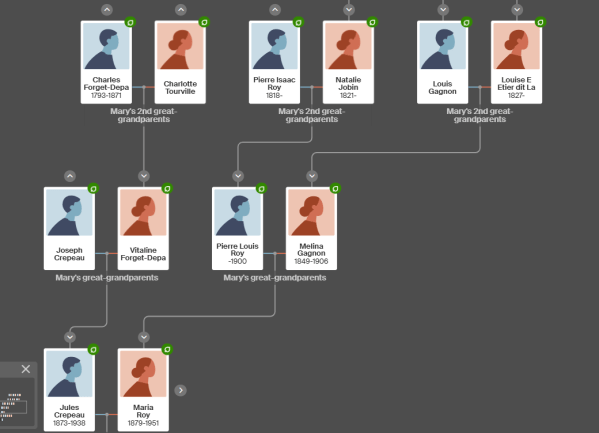
My great-grandfather, Louis Roy, (circa 1843 to 1900) was the son of Pierre Isaac Roy and Natalie Jobin of Montreal and he worked as a butcher from 1860 to 1900. He came from a long line of butchers. In 1865 Louis Roy married Melina Gagnon, whose mother, Eleanore Ethier dit Lamalice,1 came from butchers as well.

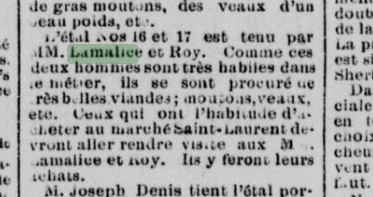
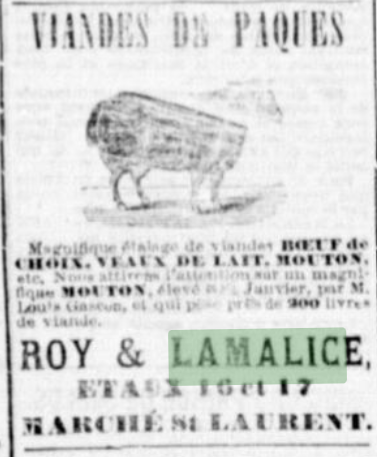
At first Louis worked alone at St. Laurent Market and then from 1881 to 1896 he partnered with a J. Lamalice, likely his cousin. Roy et Lamalice had two stalls, 16 and 17, at that market in the south central part of the city near what is now Chinatown. Their partnership was dissolved in 1896 when Louis’s son, also Louis, entered the profession.

Louis Gagnon was a mason, all other men on Maria’s side were butchers.

L. Roy and J. Lamalice paid a good sum of money, perhaps 200 dollars a year a piece,2 to have these two stalls at St. Laurent Market.

According to a University of Laval thesis,4 butchers in Montreal were politically influential. Public markets were designed around their needs, in large part because of the slew of health regulations around the slaughter and sale of meat. Retail butchers also profited greatly at these public markets, more so than their private counterparts, sometimes only having to work 2 or 3 days a week to pay the bills.

Louis Roy and his ‘small’ French Canadian family, wife Melina, son Louis and daughters Eugenie and Maria, lived at various addresses early on, then moved to 357 Amherst around 1880 and then in 1890 to 515 Amherst, a brand new ‘small cottage.’

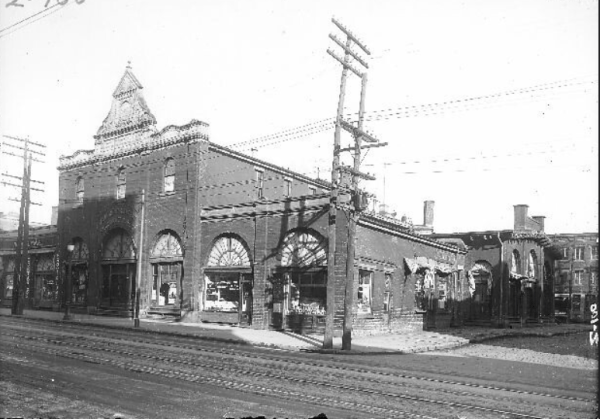
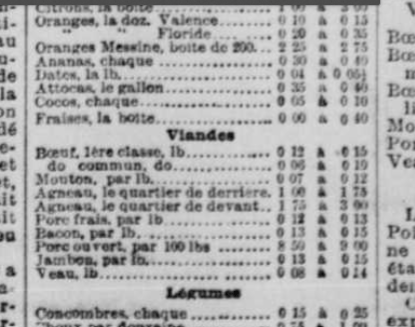
Price of meat Bonsecours Market, 1893


L. Roy et J Lamalice advertised regularly in all the Montreal papers, usually a little blurb like this.

Roy and Lamalice are very capable with very nice mutton, veal etc. Other ads focused on how beautifully the stall was decorated. (Clearly ladies did the shopping.)


They sometimes put in bigger ads

Choice beef, milk fed veal and mutton for Easter.


And they gave to charity, as well, Notre Dame Hospital and the Public Welfare are two examples I discovered.

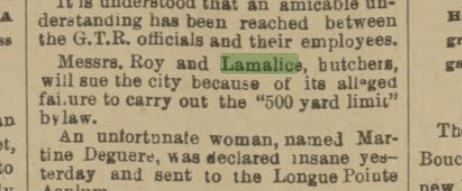
It may be significant that in 1891 Roy et Lamalice brought the City of Montreal to court. They complained that the City wasn’t doing enough to keep private butchers the mandated 500 yards away from the public markets.

They pay a license fee for a stall of 200 dollars, say Roy and Lamalice, as reported in Le Minerve.

I have to wonder if this is where Louis Roy, master butcher, first met – or maybe locked horns with – the City Hall up-and-comer Jules Crepeau, messenger boy in the Health Department – but a boy gifted with a superb memory for regulations and by-laws.3


In 1896, Jules Crepeau, Second Assistant City Clerk, was assigned the post of Secretary of Public Markets, a suitable promotion considering his Health Department roots.

In 1900, a year before his marriage to Maria Roy, he would be involved in his first scandal at City Hall, one that involved butchers. Men in that trade claimed that aldermen were illegally charging them 50 dollars to have their stalls moved at the prestigious Bonsecours Market. Jules testified in Court and denied knowing anything about it.


In 1900/1901, the newly widowed Melina Roy rented out her Amherst house (yes, to a butcher) and moved to Notre Dame street to live with her married daughter, Eugenie, her husband Jacques (James) Deslauriers (son of a butcher who was deceased). She brought her young adult children Maria and Louis along. The Census man came around while she was there.

The 1901 census has my grandmother Maria and her brother Louis erroneously listed under Deslauriers. Laura Lacombe is an orphaned cousin. She would live with Maria and Jules until her death in 1921, just a few months before my Mom’s birth.


The Marriage of Jules and Maria

After my grandparents Maria and Jules got married on July 1, 1901, widow Melina and her grown up son Louis moved back into 515 Amherst with the newlyweds.

In late 1901, Jules applied for a permit to build a three story brick building worth 3,000 dollars at 513 Amherst next door and the next year he would rent it out to three different families.

Maria would very soon give birth to my Uncle Louis. (Louis was baptized exactly nine months after the wedding.) My Aunt Alice would arrive a year after that and in 1905 the Crepeau family would move to St. Hubert Street near Marie-Anne.

Melina Roy and her son Louis, Melina’s orphaned niece Laura, and possibly the Deslauriers would stay at 515 Amherst for a year until Melina’s death in 1906 upon which time Jules would sell the ‘small cottage.’


The Dowry

A notarial record reveal there was, indeed, a 1901 marriage contract for Jules and Maria from June 27, a few days before the marriage, but of course there are no details so no proof of a 40,000 dollar dowry.

It does look like Jules came into some money early in his marriage. He builds that brick triplex and then moves in 1905 to what is still a very tony area with tall elegant stone townhouses.

Before his marriage, Jules was making around 700 dollars a year at City Hall, a middling/good salary for a family man although at one point he asked for 248 dollars in overtime because “over a forty day period I worked 348 hours until four in the morning and on Sundays.”*

Still, a 40,000 dollar diary for Maria’s marriage seems highly unlikely. (That’s 1,500,000 in today’s money.)

I am doubly skeptical about the big dowry because I did not find any contract listing for the 1897 marriage of Maria’s older sister, Eugenie, to Jacques (James) Deslauriers, merchant. This suggests Eugenie received no formal dowry.

Why the second daughter and not the first?

Also, If Louis Roy, successful master butcher, left behind a large estate why did Melina Roy rent out her modest Amherst home after he died and move in with her daughter Eugenie and the husband. To help with the grandchildren?

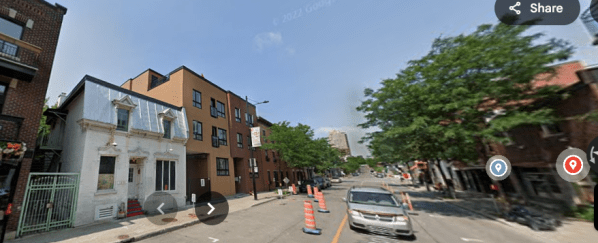
A modest street in 1900, Amherst today is called Attikan. The only remnant of an early era is this little ‘French Canadian” cottage on the corner where everyone lived in 1901.


Lovell’s Directory to the Rescue.

When I first looked for Jules and Maria on the 1901 automated census I found neither one. Maria was erroneously listed under Deslauriers and Jules wasn’t there.

So, it took me years, but eventually I consulted Lovell’s to discover that prior to his marriage Jules was living on Mentana Street in the Le Plateau Mont Royale with his widowed mother, Vitaline Forget Despaties Crepeau, and his three brothers, the older Isadore and the younger Roderick and Paul.

Isadore in that era is already working in insurance – as he would for the rest of his life. In 1898 Roderick is listed as a plumber, then a year later as a butcher. His brother Paul makes the Lovell’s listing in 1899 and is listed as a butcher working at “R. Crepeau and Freres.”

It’s all very suspicious because the highly regulated butcher trade wasn’t something you could jump in and out of. I suspect older brother Jules, son of a mere house painter, pulled some strings to get his younger brothers a short cut into that lucrative trade. (Neither man would remain a butcher for long.) If my grandmother’s family tree proves anything, it’s that the butchers of Montreal liked to keep it in the family!

So, I still have no concrete proof but it would not surprise me if my grandmother Maria’s dowry, whatever the true amount, was provided by a group of butchers (perhaps all members of her extended family) in return for Jules’ support at Montreal City Hall.

Prior to his marriage to my grandmother, Maria Roy, as I said, Jules had had plenty of chance to interact with these ‘politically influential’ tradesmen.

Anyway, that was simply business as usual in those days.

  1. Eleanore Ethier dit Lamalice was also a distant relation of Jules Crepeau through the Ethier line of Lachenai Seigneury. See my Why My Grandfather had a lot of Gaul on this site.
  2. This is the sum that Louis Roy cites in his 1896 complaint as reported in the French papers. It’s called a license of 200 dollars to have a stall at St Laurent Market. In the 1920’s the sum is just 50 dollars a stall, I discovered in another online item but by then the butchers are paying hefty income taxes, so they mention how high this income tax is in their complaints.
  3. Le Devoir says Jules’ mind was like a bank vault holding within all the city by-laws. This was in his 1938 obituary.
  4. YVES BERGERON:LES ANCIENNES HALLES ET PLACES DE MARCHÉ AU QUÉBEC :ÉTUDE D’ETHNOLOGIE APPLIQUÉE. University of Laval Thesis Canadian Thesis portal

5. Newsy items courtesy of BANQ newspaper archive.

Great Aunt Edie, the Wannabe Militant

Aunt Edie at left in October, 1913


On September 26, 1912, a tall, slim, beautiful and well-dressed young woman stepped off the train at Viger Station in Montreal to be met, well, by no one.

There was a group of local reporters on the platform but they were waiting for someone else to arrive, someone far less fetching, as it were.

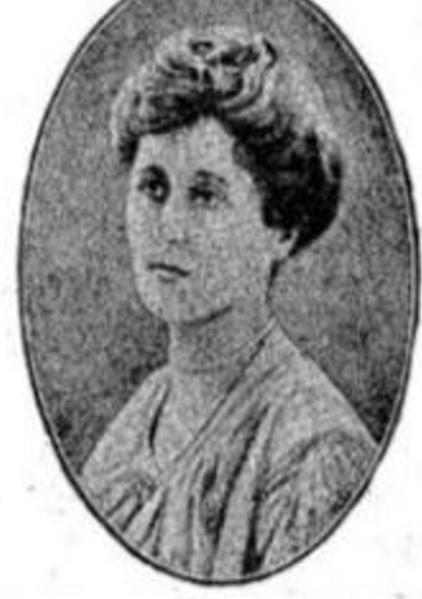
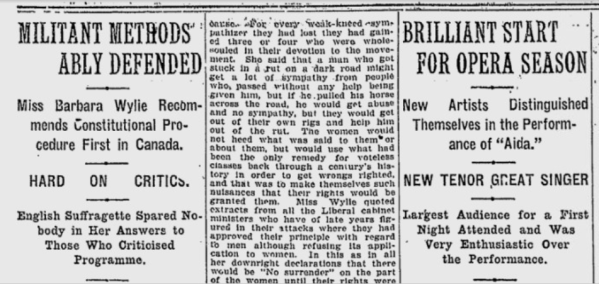
The journalists were expecting Barbara Wylie, a British suffragette. Wylie was one of Mrs. Pankhurst’s radical troops and British suffragettes were mostly manly, weren’t they?

Barbara Wylie 1912.

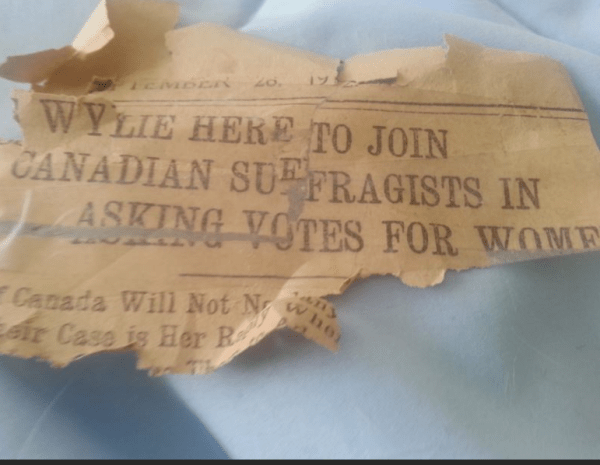
When the reporters realized that this stylish beauty was, indeed, Miss Wylie it caused quite a commotion according to a newspaper article in the Montreal Witness clipped by my husband’s great aunt Edith Nicholson.

The reporters immediately raced over and encircled the lovely lady.

Barbara Wylie did not disappoint on the radical front. The Scottish firebrand brashly answered questions about her reason for coming to Canada and glibly defended a British suffragette who recently had thrown a hatchet at British Prime Minister Asquith. “Had it hit the mark, it might have knocked some sense into him.”

Whoa!

Remnant of the Montreal Witness clipping.

When I first found the Witness newspaper report among Edith’s massive stash of yellowed newspaper clippings on the suffrage movement, it did not make an impression on me. I had heard of the British suffragettes, for sure. Who hadn’t? But, the name of Barbara Wylie meant nothing.

And I knew zilch about how, around 1910, some of Emmeline Pankhurst’s troops visited Montreal to try and convince “inert”1 Canadian suffragists that not-so-peaceful protest was actually the way to go.

Lets’ face it: there was nothing about Canadian women suffrage in my 1968 high school history book.

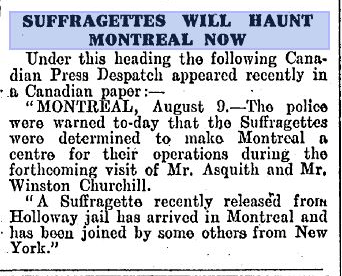
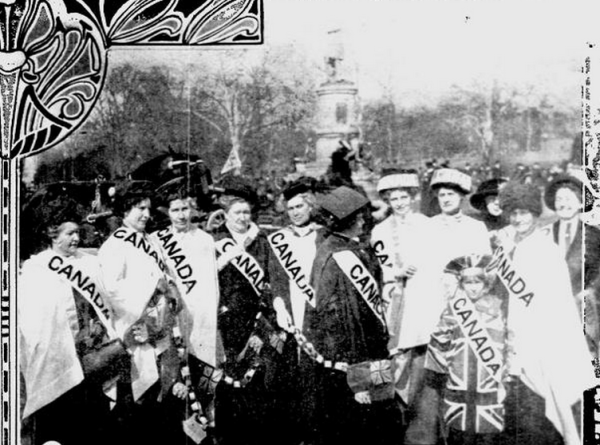
Haunt. Hmmm. Interesting choice of verb. Suffragettes were technically banned from coming to Canada. So the two suffragettes who did come,Caroline Kenney and Barbara Wylie, had Canadian relations and came on family visits.

Miss Barbara Wylie was head of the Edinburgh Chapter of Mrs. Pankhurst’s Women’s Social and Political Union. She came to Canada in 1912 on a year-long country-wide tour, but her loose-cannon ways did not get her far.

In Montreal, on November 4, 1912, Wylie climbed the speaker’s platform at the YMCA as a guest of the Montreal Local Council of Women. News reports say she was wearing a pretty powder blue silk dress, but her rhetoric was of the red-hot variety.2 “Why speak of men as brave and women as pure? Would it not be better to bring the idea into society that men can be pure and women brave?”

The meeting had to be adjourned early when a fist fight nearly broke out – between two men.

Edith Nicholson, 27, didn’t attend Wylie’s rowdy Montreal speech. A family letter reveals Edie returned home from Montreal to Richmond, Quebec on November 2. But the Montreal Witness clipping isn’t the only document I have that suggests Edie, an over-worked, under-paid teacher at Ecole Methodiste Westmount, was all for the “hysterical” window-smashing suffragettes.

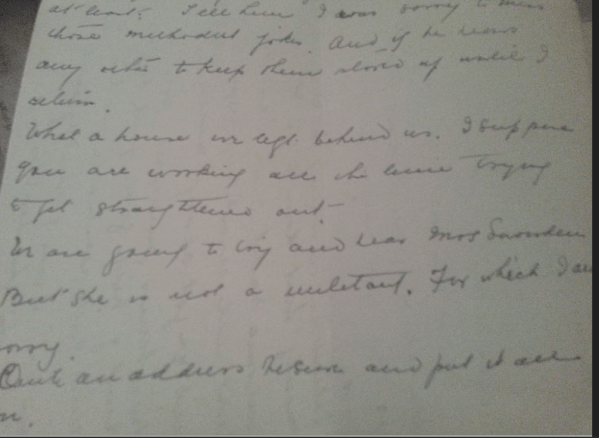
“So sorry” Mrs. Snowden was NOT a militant. May 1913 letter to Mom

On May 2, 1913, Edie is in Montreal with her two sisters, Marion and Flo, and she writes this in a letter home to her mom, Margaret: “We are going to hear Mrs. Snowden speak. But she is not a militant for which I am very sorry.”

This sentence, too, I might well have over-looked had it not been for that Wylie newsclipping because that fragile disintegrating memento prompted me to conduct more in-depth research on the messy, all-but-forgotten Montreal suffrage movement.

The first British suffragist brought in by the Montreal Council of Women was Mrs. Ethel Snowden, in 1909. Snowden was the young wife of a British Labour M.P. She spoke at Stevenson Hall.

Described in one report as “a daughter of the gods, divinely fair,” Snowden’s oratorical skills also impressed that day. She condemned the British militants, who were just beginning their ‘deeds, not words” path, saying “Mrs. Pankhurst has unleashed a Frankenstein monster.”

The Council soon passed an ambiguous resolution somewhat in favour of women suffrage.

Montreal Gazette places suffragette news beside opera news. You can make what you want of that.

Emmeline Pankhurst, herself, visited Montreal in December, 1911. She was brought in by Council President, Miss Carrie Derick (a closeted suffragette sympathizer) “so that women could hear the other side of the suffrage story.”

In her speech at Windsor Hall, the famed feminist, looking tired and frail, stated her case with eloquence but she made sure to avoid provocative language.

So afraid were Montrealers of Mrs. Pankhurst (whose troops back home were angry at Asquith over a broken promise) that the Council had to give away 200 tickets at the last minute and only broke even on the night. Mrs. Pankhurst’s fee was considerable too. After all, she was on the tour to raise money for lawyers.

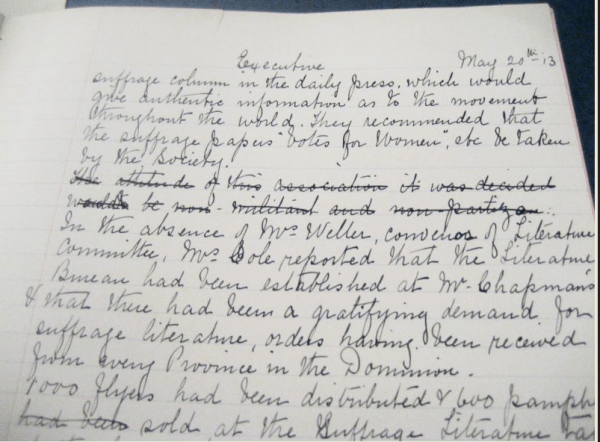
Minutes of MLCW launching Montreal Suffrage Associationat at the time of Mrs. Snowden’s second visit. Someone has crossed out the line where it says the organization is non-militant.(“Not relevant” Professor Derick said in the press.) They also intend to subscribe to WSPU Votes for Women Magazine and make money selling brochures. BANQ archives.

May, 1913 saw Mrs. Snowden’s second visit to Montreal. This time she spoke at St. James Methodist Church.

In the spring of 1913, Mrs. Pankhurst’s militants in England were in full battle mode, setting fire to post boxes, hunger-striking in prison and playing ‘cat and mouse’ with the police.

Mrs. Snowden calmed the fears of Montrealers in the audience, telling them not to worry, women wouldn’t suddenly want to run for Parliament with the vote (sic). “All men care about is money, but women care about the home, children and humanity,” she proclaimed. The vote for women, it seems, was all about saving babies.

This is exactly what the majority of women in the Montreal suffrage movement wanted to hear. These ladies were mostly well-off middle-aged matrons or unmarried teachers of a certain age. They were maternal suffragists, not equal-rights suffragettes, and they had worked very hard to keep any young, excitable unmarried women (even of their own class) out of the local movement.

These matrons did not like what they saw coming out of the UK or the U.S: the spontaneous marches in sundry small towns; the highly-publicized cross-country tramps; the gigantic uber-organized parades in major cities, including one with10,000 people that swept down 5th Avenue in New York led by a young suffragette goddess on horseback. They were especially afraid for/of their own daughters: A lengthy editorial in the Montreal Gazette described women’s colleges like McGill’s Royal Victoria College as”suffragette factories” churning out de-sexed females.

So, in March, 1913, they started up the Montreal Suffrage Association, an elite organization with a mandate to provide a ‘quiet and peaceful education of the people’ led reluctantly by, who else, Miss Carrie Derick – with a membership by invitation only.4

Ethel Snowden ended her 1913 speech by calling Mrs. Pankhurst’s troops “cavemen” giving the reporters their headline for the next day.

If Great Aunt Edie was in attendance that night in the large landmark Gothic Revival church on Ste. Catherine Street in Montreal, and I have no proof one way or another, she must have been mightily dismayed.

Great Aunt Edie 1971 toasting her niece’s marriage. In the 1920’s, she stepped out with Miss Carrie Derick according to a letter. They were both at McGill.
Edith’s name on membership list for Therese Casgrain’s provincial suffrage association, The League of Women’s Rights in 1940-41. Edie was by then respectable, working at Royal Victoria College, McGill as Assistant to the Warden. Of course, back in 1913, Edie wasn’t listed as a member of the Montreal Suffrage Association, but that doesn’t mean she didn’t join the more inclusive and militant-minded Montreal Suffrage League started up by Caroline Kenney, another British suffragette. But, soon War broke out and everything kind of fell apart, but that’s a whole other story.

Originally published in Beads in A Necklace, Genealogy Ensemble’s compilation of family stories.

Furies Cross the Mersey is my story about the British Suffragette Invasion of 1912 from 3 different points of view. This era was a study in Media Literacy, that’s for sure. Journalists broke every rule of their trade covering the ladies of the suffrage movement. (For example: Were young suffragette sympathizers ‘manly and desexed’ or ‘excitable and hormonal?) Suffragists and Suffragettes wanted to take away men’s alcohol (overt)and their right to have sex before marriage with prostitutes (tacit). “Why can’t men be pure.” Mrs. Pankhurst, a doctor’s wife, was upset at the fact so many virginal women contracted veneral disease as a wedding present.(Hence the law requiring blood tests before marriage.). Also, many of her husband’s patients in the north of England arrived at his surgery pregnant by incest.

Margaret Votes published on this website. (How did Margaret Nicholson feel about voting for the first time in 1920? Very happy! Her neighbours not so much:) ) Most Canadian women won the right to vote in 1918. (Some with men in the military, earlier, in 1917) Quebec women in their province only in 1940.

  1. “Inert” was the word used by Carrie Derick to describe the Canadian Suffrage Movement in 1912.
  2. The British suffragettes, many of them young, were careful to dress well, knowing that it is easy to diss a woman on her appearance. This lead to news reports on the various marches in the UK and US sounding like fashion news.
  3. The Montreal Local Council of Women launched the MSA in 1913, despite the fact this was not their mandate. They were supposed to be an umbrella for the various women’s organizations that had sprung up from the grass roots. I believe they launched the MSA because some other British Suffragettes, namely Caroline Kenney, sister of Annie Kenney, Emmeline Pankhurst’s working class lieutenant, were trying to start up a militant group (open to all) and even planning a march to Ottawa in the style of Rosalie Jones’s tramp.
    I know this because the Ottawa press covered their story, not the Montreal press. Another Kenney sister, Nell, had moved to Montreal (Verdun) with her journalist husband, Frank Randall Scott, in 1910, after he had swept her away to safety during a police action at a UK rally with Sir Winston Churchill, then the Home Secretary! His fonds are in the McCord Museum and include photographs of all the Kenney women – as well as the Royal Princes who came to visit in 1924. If you want to read more of their story read Furies Cross the Mersey, my book.

4. Carrie Derick is, famously, Canada’s first female university professor. A few other McGill professors were brought onto the Board of the Montreal Suffrage Association as well as some clergymen. The clergymen in particular hated – and feared – Mrs. Pankhurst. Many women on the Board secretly supported her, especially a Mrs. Weller, wife of a prosperous Westmount business man (electrical systems) who had made it a point to study the question in detail. She had invited Barbara Wylie into her home and she had visited the Suffragettes in England and had even given a speech about her visit.

The Canadian Contingent at the 1913 Suffrage Parade in New York City. Older matrons all with ‘token’ child, the niece of Flora Macdonald Denison. From the Toronto Sun.

Not…Quite…Forgotten

Driving into Helmsley.

The North Yorkshire town

Where my ancestors toiled

In the nearby fields

And laboured

In the limestone quarry

Or – in one case – bent over smartly

As footman to the local Earl

Is now a pristine tourist destination

For posh Londoners

(Who like to hunt partridge, grouse and pheasant)

With high-end clothing shops

And luxury gift boutiques

Lining the old market square

Two wellness spas

And at least one pricey Micheline-recommended restaurant

Serving up the likes of Whitby crab

(with elderflower)

Or herb-fed squab

On a bed of

Black Pudding.

The oh-so pretty North Yorkshire town

Where my two-times great-grandmother

A tailor’s wife

Bore her ten children

And worked ‘til her death at 71

As a grocer

(So says the online documentation)

Now has food specialty shops as eye-pleasing as any in Paris or Montreal

With berrisome cupcakes and buttery French pastries

(Some gluten-free, some vegan)

Mild Wendsleydale cheese

(From the udders of contented cows)

Locally-sourced artisanal game meats

Hormone-free, naturally

And free-range hen’s eggs with big bright orange yolks

That light up my morning mixing bowl like little suns gone super-nova.

And, for the culturally curious

Packages of the traditional North Country oatcakes

(Dry like cardboard if you ask me.)

It cannot be denied

Nary a wild rose nor red poppy is out of place

In this picturesque

Sheepy place

3000 years old!

(Apparently)

Where my great-grandfather

During WW1

Managed the Duncombe saw mill

Supplying timber for telephone poles

And trench walls.

Where because of the highly variable weather

(I’m assuming)

Rainbows regularly arched over the hills and dales

From Herriotville to Heathcliffetown,

Back then

As they

Do now.

(At least I met with one as I drove into my ancestral town– and thought it a good sign.)

Off-season,

This is a town for locals

Not for overseas imposters like us.

I was told…

The natives drive only short distances as a rule

From dirtier, busier places

like Northallerton

(but an hour away)

Through the awesome

(no hyperbole here)

Primeval forests and heathery plateaus

Of the much storied Moors

On narrow snaking highways.

Wearing rainproof quilted jackets in boring colours

They walk their well-behaved dogs

Spaniels mostly

In and out of ice cream shops

And cafes

Or up and down

the daunting (to me)

muddy

….medieval

…………..Fairy

…………………….Staircase

…………………………………..along

…………………………………………..the Cleveland

…………………………………………………………………….Way.

To visit quaint Rievaulx

And admire the Grade II Heritage cottages

With their bewitching thatched roofs

And wisteria-laced windows

Where the skeleton of the old Cisterian monastery

Rules the blue horizon

Like a giant antique crustacean trapped in grim History.

(Unlike myself, they do not pay the ten plus pounds to visit the Monastery ruins.

“And would you like to donate an extra 75p to the National Trust?”

Sure. Why not?)

They just like to walk their dogs.

Yes, all is picture-perfect these days

(It’s early October in 2024)

In my ancestral town

In the North of England

Where at least two in my family tree

Travelled the Evangelical Circuit

From Carlisle to Whitby

Preaching thrift and abstinence

And other old-fashioned values

To men and women with calloused hands

And a poor grasp of the alphabet.

Except, maybe, for the Old Methodist Cemetery

*no entrance fee required

Just around the corner from our charming air bnb

Where the crows, flocking for winter (I guess)

Caw maniacally in the moulting trees

And a black cat might cross your path

(It did for me)

And the old tombstones jut out helter-skelter like crooked mouldy teeth

From the soft-sinking Earth under which some of my ancestors lie,

Mostly

,,,,,,,But

Not ,,,,,,,,

,,,,,,,,,Entirely

Forgotten.,,,,,,,,,,

Fat Sandwiches and Cathedral Gongs

Turning the tables on genealogy writing.

My talented high school friend Gary and me circa 1980. He recommended me for the job at the radio station.
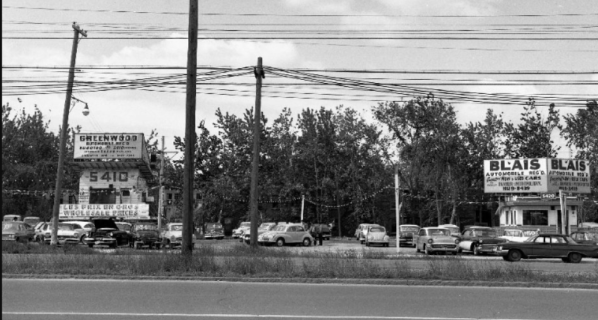

( A long time ago, I was asked by someone who knew I dabbled in genealogy why I didn’t write stories about myself for future generations so they wouldn’t have to ‘guess’. Back then, I didn’t see the point – but now I have grandchildren. )


It was sometime back in 1983 – imagine. Every Breath You Take by The Police was blaring over the airwaves and the beautiful FM secretary sprinted out of her stuffy office cubicle and ran down the hall pumping her skinny arms over her head in a victory dance. She was simply over the moon: The stodgy radio station she worked for was entering the modern age!

I was employed as an advertising copywriter for the same easy-listening FM station as well as for its affiliate, a once-proud but struggling sports talk station on the AM dial.

The FM station was by far the more successful of the two stations, keeping the owners afloat with its middle-of-the-road Paul Mauriat instrumentals aimed at an older audience.

But their faithful clientele were retiring and moving away to live near their children in Ontario or just plain passing away. (Ironically, a retirement community just over the Quebec border in Ontario was a major advertiser.) Hence the jarring format change.

That day, I overheard a staffer callously joke about how the station’s geriatric listeners were now frantically stumbling out of their easy chairs to turn the radio dial back to ‘their’ station.
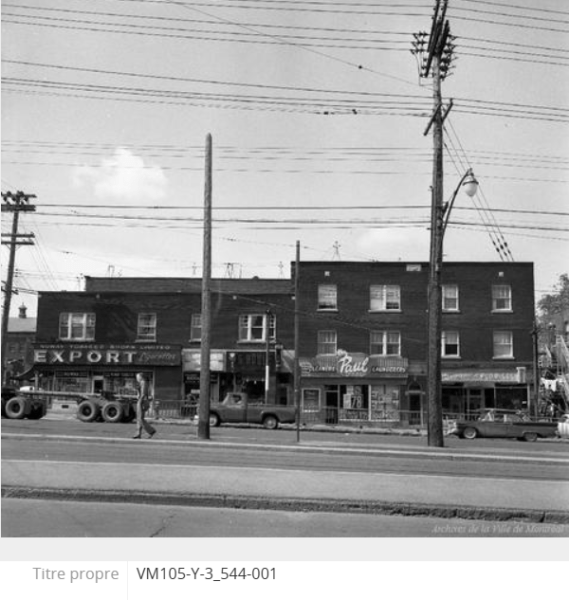
Back then I didn’t pay much attention to demographics or ratings but I did have a singular role in this FM station’s public profile.

Hourly ID’s in portfolio, typed on my Selectric.

I wrote dozens and dozens of their ‘lyrical’ hourly ID’s.

Originally penned by a veteran on-air personality, these ID’s were nothing but extra work for me and they came with no extra pay either, but I didn’t work in radio copy for the money (minimum wage) or for the praise (we got none). I worked for a chance to make a living, however meagre, as a writer and for the camaraderie among creatives and, yes, for the adrenaline rush.

(In those days, it seemed as if every advertising contract the salespeople brought into the copy office had to be conceived, written and produced “yesterday.” English Montreal radio salespeople were fighting over an ever-diminishing slice of the advertising pie – and in recessionary times. The clients were getting smaller and smaller – and pickier and pickier. These hourly ID’s allowed me to be creative (and corny) on my own terms – at my own rhythm.)

In the early 1980’s, our English FM Station was the “MUZAK” station of choice in Montreal, airing continuously in elevators all over town.

So, every lunch hour, when thousands of office workers spilled out of their own stuffy cubicles to score a coffee and sandwich and maybe a little city sunshine down below, they could not escape hearing one of my midday ID’s voiced in a warm creamy tone by one of our talented station announcers.

I kept these three “midday” ID’s for my portfolio.

Number 1: Midday in Montreal is when the babies come out. Winter newborns, bundled in their mother’s arms, rosy-cheeked cherubs, bright eyes wide in wonder. They are seeing the world for the very first time. The mystery of a budding flower, the majesty of a skyscraper, a lot for little eyes to take in. Midday in Montreal with the beautiful music of CICK. (I changed the name of the station, but you might know which one it is.)

Ok. I was 28, and although I strongly denied it back then, I was clearly wanting a family. But, if you consider I had held an infant in my arms only twice in all of my young life, both times while babysitting, I think I got it right. I know I got it right. I have a four month old granddaughter and she’s just as described.

Number 2: Midday in Montreal. School children straggle home from lunch in groups of two or three. Never taking the shortest route, they stop to pet a stray or to kick a stone around, forgetting as children often do, about time. Wandering home in zigs and zags,they finally arrive to steaming bowls of soup and fat sandwiches. Midday in Montreal. With the beautiful music of CICK.

This was a bit of a nostalgia, for sure. I, myself, in the 1960’s, had been a latchkey kid and I often had to make my own lunch, sometimes grilling POM bread over the blue flame of the gas stove. Yummy! By the 1980’s, I suspect even fewer kids went home for lunch. Still, judging from the meandering path my five year old granddaughter likes to take on our walks together, I think I nailed the dilly-dallying part.

Number 3: Midday in Montreal. The circular days are cut in half by the sound of a thousand clocks: ornate cuckoos in residential parlours, church bells and cathedral gongs, those quiet, creeping clocks in offices. As the sun reaches its highest point in the sky, a million pairs of eyes turn to the clock, acknowledging midday in Montreal, with the beautiful music of CICK.

I still like this one, although a smart-alek booth operator questioned whether cathedrals gonged at all. I directed him to Byzantium, my favourite Yeats poem. I had borrowed the phrase, you see.

The unpurged images of day recede;

The Emperor’s drunken soldiery are abed;

Night resonance recedes, night-walkers’ song

After great cathedral gong;

A starlit or a moonlit dome disdains

All that man is,

All mere complexities,

The fury and the mire of human veins.

Midnight, with the beautiful music of CICK 😉


Do you think Yeats would have been a better radio copywriter than me? Would the insomniac crowd have been seriously disturbed by Midnight ID’s in the style of his poem?

Anyway, after a year of dutifully tapping out these hourly ID’s on my trusty IBM Selectric typewriter (the one with the snazzy white “Correcto-type” band that enabled me to churn out my 30 and 60 second commercial scripts apace) I asked to be relieved of the task.

Like so many of my colleagues, I quit my copy job to try my luck in Toronto. Somehow, I ended up back in Montreal with a family – just as the economy was improving. What bad timing! For the next decade, I mostly worked remotely as a freelance writer -for rather good pay- for sundry commercial magazines producing quote-anecdote-statistic style articles on non-controversial topics that didn’t scare off the advertisers.

Occasionally, I got creative and punched out a timely satirical piece like Beat the Biological Clock for Salon Magazine. That number was written, yikes, over 20 years ago. Time sure does fly!

I guess I should get busy writing more of my ‘ancient histories’ for the girls.

End

Happiness in Marriage

A piece of speculative genealogy fiction

Antonia Willoughby, ancestor of Mr. Lumley Hodgson on his mom’s side.1


As is typical, I know little about the life of my great great grandmother, Ann Nesfield, a cook from North Yorkshire, UK except the basics: birth (1838), death (1912) marriage (1861) and children (10) but thanks to the Internet I know a great deal about her employer, Nathaniel Thomas Lumley Hodgson, a member of the landed gentry. So, just for fun, I have strung together this little fiction about my great great grandmother from some intriguing facts about Mr. Lumley Hodgson found online.

August 23, 1861. “Happiness in marriage in entirely a matter of chance.” I read that in a book by Miss Austen.

As it happens, I am getting married in less than a week to a tailor from the tiny village of Rievaulx, a man I hardly know, a Mr. Thomas Richardson. He visits my place of employ twice a year in the spring to make up my Master’s riding clothes.
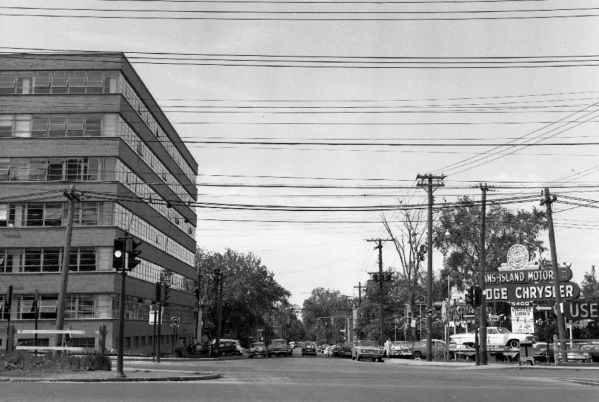
Although most of my Master’s clothing is bought in London, he prefers Mr. Richardson, who lives only 12 miles away, for his country apparel.

My name is Ann Nesfield. For many years now, I have been engaged as a cook at Mr. Nathaniel Thomas Lumley Hodgsons’ farm estate, Highthorne, near Husthwaite. It is a leisurely employment. I feed his small family, the household staff and the three farmhands. It is rare that important visitors come to stay, and if they do they come on business and sup at the local inn where they can haggle in manly fashion.
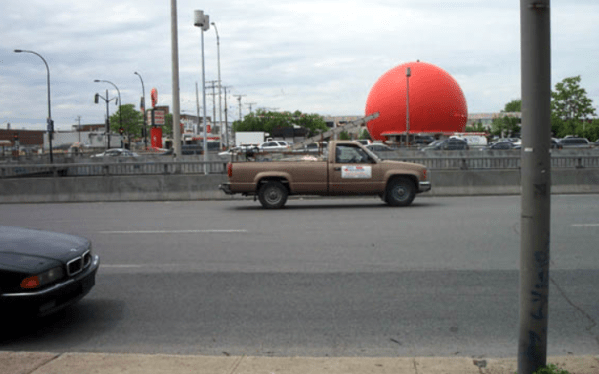
You see, Mr. Lumley Hodgson is a breeder of fine horses, of field hunters and of race horses. He trades mostly in the strong reliable Cleveland Bay, a local breed of which he is reet fond.

The Cleveland Bay, he informs everyone, was originally bred centuries ago by the local Cisterian Monks as a pack horse. Later, after the dissolution, the Cleveland was bred with some fleet and graceful Turkman stallions.

Today the Cleveland Bay is used in the field, both to hunt and to plow.

Mr. Hodgson seldom fails to tell his customers how 30 years ago he rode his own Cleveland Bay the one hundred and seventy five miles to and from Cambridge where he attended university.

If that doesn’t impress, he then relates the story of how another local man rode his Cleveland mare 70 miles a day for a week for jury duty in Leeds. Or how another man once burdened his beast with 700 pounds and rode 45 miles to Ilkley and back.

“The breed is being ruined,” Mr. L.H. likes to say, “by the London fashion for flashy carriage horses of 16.5 or 17 hands. Leggy useless brutes they are. All action and no go.”

Leggy Cleveland Bay Carriage Horses.

Mr. L.H. calls himself a farmer but he is a gentleman-farmer with a pedigree as impressive as his osses’. At Cambridge he shared lodgings with the great scientist Charles Darwin. This is also summat he usually tells a prospective client, for Mr. L.H. is a canny businessman and this association can only help him, considering his occupation.

There are rows and rows of stables on his 107 acre farm near Husthwaite that sits on one of the seven hills in the area. The main house, they say, was given as a reward many years ago to one of William the Conqueror’s faithful knights.

As I said, my Master’s household is small, made up of his wife Mary Darley (whose family owns many yackers of land in Yorkshire) two daughters, Julia, 22 and Emma, 8, as well as a nurse, a housemaid and a cook, yours truly.

At 23, I have been summat of a sister to Julia, who is sharp-witted but shy in company. She is destined never to marry. At least, there is never any talk of it, not since 1857 and the bachelor’s ball at the Yorkshire Union Hunt Club. So, on fine evenings, I am the one to accompany Julia out riding. We take two bay mares who she says are descended from the Darley Arabian, the daddy of all Thoroughbreds.

I am told I have a better seat than she does, but only by the groom, a Mr. Jack Bell. At breakfast time he likes to call out to me “Mornin’ Milady, grand day i’n’it”- a bit of a jape – and then he laughs showing a great gap where his front teeth should be.

A signed copy of the Voyage of the Beagle lies in a place of honour in Mr. Lumley Hodgson’s private library and has for decades. You can be sure I have never read it, but Julia has and told me all about it. She is the one who had me read Pride and Prejudice. She likes to lend me her favourite novels so she can explain them to me.

Over the years, I have heard (mostly overheard) so much about this Beagle book I feel as if I have read it and even been on the great sea voyage myself to the GA-LA-PA- GOS Islands and seen with my own eyes the strange and colourful creatures there.

Mr. Darwin has lately published another book called, I think, the Origin of Species. A copy arrived by messenger to Highthorne late last year.

This new book of Mr. Darwin’s has caused quite a stir locally. At a Methodist church service a month ago the minister bellowed that Darwin’s theory of evolution is blasphemous. Flippin’ ‘eck! The theory says we all come from monkeys! Mr. Lumley Hodgson – not in attendance – later told the minister that the theories in the book apply only to animals not to humans, but the minister was not satisfied. He said the question of the origin of all species was decided long ago and by an infallible source. He meant the Bible, of course. “God made the animals of the earth after their species as explained by Noah’s Ark.”

So, my Master, who can’t escape this connection with Mr. Darwin now, has decided to quit the farm for a while.

A few days ago he assembled the staff in the south hall and told us he is selling off his best hunters and other stock (including Emma’s comely Cobb pony and his prize Nag stallion) and moving his family to town for the winter. His excuse is that some of his horses have the equine flu (two have already been put down) and he thinks it might be catchin’ to humans.

No matter what the real reason for his takin’ his family to town, the result is that I am left in the lurch with no employment and no place to stay.

But just yesterday, Mrs. L. H. called me into her sitting room, the one with all the paintings of Julia’s frightsome-lookin’ ancestors, and pronounced, “Ann, you must marry Mr. Richardson, the tailor from Rievaulx. He is a respectable man who needs a wife. His sister, who has been housekeeping for him, has suddenly left for abroad. He says he is comfortably settled now in his own cottage and ready to marry and raise a family.”

X marks the spot where my illiterate ancestors Mary Jeferson (Jefferson)of Sneaton and Stephen Nesfield of Whitby, Ann Nesfield’s parents, signed their marriage certificate in 1830.)

I must have looked very confused because she continued: “You remember Mr. Richardson from the spring? He waxed ecstatic over your Lamb’s Tail Pie and Tipsy Trifle.” (I did. Seems to me he had eyes for Julia back then.) “He says he needs a wife schooled in numbers to help him keep the accounts. And as Rievaulx is an isolated place, he requires a strong healthy girl who can walk the trails back and forth to Helmsley herself on market day. He is often on the road, so you will not have the use of his carriage as you do here to go to market in Easingwold. Yes, you must marry Mr. Richardson and very soon, too. We can have the ceremony right here in Husthwaite. But first you must visit him in Rievaulx. You can stay at our cousins the Lumleys who have a big farm there.”

So, it is set. My days of making simple Yorkshire meals for a small, ‘appy family in a reet bonnie setting near Husthwaite- and cantering over the dales at darkening with my almost sister Julia – are over.

Highthorne Farm is now a holiday destination, as is Birdsall rectory Manor, near Malton, North Yorkshire where Emma and Julia Hodgson, both unmarried, spent their old age with their brother, Captain Lumley Hodgson, according to 1911 UK Census. Lumley Hodgson’s mother’s relations, the Middletons (Willoughby) owned that place. On that census, Ann Nesfield Richardson was a widow living with her youngest daughter at New Cottage, Rievaulx, running a grocery. She died a year later.

I am off to Rievaulx to marry and make childer with a stranger. Otherwise, all that is left for me is to flit home to Whitby and that I cannot do. My mother is long dead and my father is in line to finish off his days at the workhouse should none of my half-siblings take him in.

Mr. Lumley Hodgson, his ‘ead filled with other worries, has no objections and no opinions on the subject either, although he jokes, “It’s either Mr. Richardson or Mr. Bell for you, I fear.”

But, I ‘ave watched Mr. Bell as he slips the belly-band around the more skittish horses in his care with a firm but gentle hand, keepin’ his voice soft and melodious all the while and I ‘ave noticed how his muscular shoulders glisten after an honest day’s work and I do not think the joke to be as funny as that.

But Jack is a lowly farmhand and Mr. Richardson is a country tailor with a ready clientele and a sweet sunny cottage of his own, Abbot’s Well, with a fine prospect of the Rievaulx Monastery ruins. As I trot along on foot to Helmsley, my poke brimmin’ with dragonwort balm, tansy oil and other home-made potions to sell at market, I can watch from a distance as the Earl of Feversham’s family and friends go a-huntin’ o’er the heathery moors outfitted in all their finery on their own spirited Cleveland Bay/Thoroughbred crosses.

That is the selling point, according to Mrs. Hodgson: The cottage (complete with a little garden for growing my special herbs) and the mannerly profession.

But as Mrs. L. H. was quick to explain, this alliance is a major step up for me. I am but the daughter of a day labourer.

So, I hope Miss Austen is right, that it is ‘best to know as little as possible about the defects of your marriage partner,’ because I know almost nowt about this Mr. Thomas Richardson, except that he enjoys my tipsy trifle. (The trick is to use a lot of high quality whiskey). Still, that is as good a start as any, I reckon.

END

childer: children

Summat: something

Poke: bag

darkening: dusk

reet: very

nowt: nothing

Almost all of the entries for the Lumley-Hodgson’s in the press, mostly Yorkshire press, were related to Mr. L. H.’s businesses, horse and cattle breeding. By the 1870’s he was considered an expert ‘from the old school’ so his curmudgeonly opinions on the ‘horse question’ were much in demand and have left a long paper trail.

Yes, a notice in the paper in August 1861 said Mr. Lumley Hodgson was leaving Highthorne for ‘the health of his daughters.” (The girls were likely not frail, since Julia lived to a ripe old age and Emma was playing competitive doubles tennis in her thirties, I think.) And, yes, a week later, my great great grandmother, Ann Nesfield got married at Husthwaite.

There aren’t many entries in the ‘social notes’ for the ladies of the family despite their good breeding; In 1857, Julia Lumley-Hodgson attended the last? hunt and supper at the Yorkshire Union Hunt Club, (a horse-racing club) where the fashionable young could mingle.

A hunt ball was given in 1867 at Highthorne. And in 1875, Mrs. Lumley Hodgson and Miss Hodgson (likely the much younger Emma) attended a bachelor’s ball in York.

Mr. Lumley-H died in 1886. A notice to creditors was put in the paper, his farm stock, ‘valuable hunters’, and effects put up for auction and his farm “in excellent condition” advertised for let… perfect “for a gentleman fond of rural pursuits.” In 1891 his wife (and girls?) were at Birdsall Manor near Malton (owned by Lord Middleton, a L.H. relation) and Mrs. L.H. was seeking a groom of good character, who must be single to work there. In 1911, her son Captain Hodgson, a widower, was at Birdsall Manor with Julia and Emma, both still single ladies with “private income’ listed where occupation should be.

  1. A few reports suggest Mrs. Lumley Hodgson dealt in fine art. The portait above was owned by her, found on Archive.org in A History of the Works of Sir Joshua Reynolds, Getty Museum publication. The weirdest entry about Lumley-Hodgson was that as an infant he sued his mother, Jemima, for land. Another online entry about Highthorne says he leased it in 1815. He would have been seven!

The Darley Arabian was brought to England from the East by the Alton, Yorkshire branch of Darley’s. Mary was from the Muston Lodge branch. They come from the same family originally.