Unapologetically Canadian, Tracey Arial promotes creative entrepreneurship as an author, cooperative business leader, gardener, family historian and podcaster.
Résolument canadien, Tracey Arial promeut l'entrepreneuriat créatif en tant qu'auteure, chef d'entreprise coopérative, jardinière, généalogiste et podcasteuse.
The wedding of a thirty-six-year-old widower and his nineteen-year-old orphaned cousin took place the day before the Feast of St. Jean in 1750. The marriage bolstered a resilient family community that remained in the Saguenay through local strife, high taxes, and the burning down of their farm by the British in 1759. Together, the couple produced six children, including our ancestor, Marie-Anne, who was born in 1761.
The match may also have been one of many successful unions organized by the bride’s godmother, an Ursuline nun named Félicité Poulin.
Poulin was an 18th century career woman and eventually became known in religious circles as the “Mère de L’Assomption” (Mother of Assumption). She served in the St. Anne de Beaupré Shrine when her god-daughter was baptised there but became leader of her order by the time of the wedding. Her influence over the bride, whose name was Félicité Simard, would presumably have increased as Simard’s mother died when she was only seven years old. When Simard’s father died in 1741, Poulin may have taken over the responsibility for her marital prospects.
The groom was a farmer named Joseph Dufour. His mother and Simard’s grandmother were sisters, so Poulin would have at least known his reputation, if not him personally. She must have acted quickly after Dufour’s first wife, Marie Anne Tremblay, died in September 1749. Dufour’s wedding to Simard occurred only seven months later.
Jesuit Father Claude-Godefroi Coquart likely played a role too. During the winter of 1749, Coquart inspected the farm Dufour and three of his children were running on Crown land in La Malbaie (Murray’s Bay) along the Saguenay for the King of France. In a report dated the day after Dufour and Simard’s wedding, Coquart urgently requested that the King of France lower Dufour’s taxes. The farmer could starve, wrote the Jesuit. The requirement that Dufour send the King half the wool produced by eight of his own sheep wasn’t fair, he explained. Dufour and his three grown daughters were working “even beyond the limits of their strength.” (See the story Joseph Dufour’s Farm for a description.)
Was Coquart’s plea to the King a wedding gift? Did Poulin have anything to do with it? We don’t know.
I haven’t even confirmed whether Coquart and Poulin knew one another, but the Ursulines and the Jesuits were close colleagues in New France, so they probably did. Coquart moved into an Ursuline mission after he retired, though that was after Poulin had died.
Did the King eventually lower Dufour’s taxes? Did the family rebuild their farm after it was burned down? It’s not clear. All we know for sure is that the couple stayed in Malbaie and continued raising children there until Dufour’s death on April 1774, at 61 years of age.
Our direct ancestor Marie-Anne would have been only thirteen years old when her father died. Fifteen months later—on July 20, 1775—her mother and nineteen-year-old brother, Dominique Benjamin, died too. Like her mother, she became an orphan.
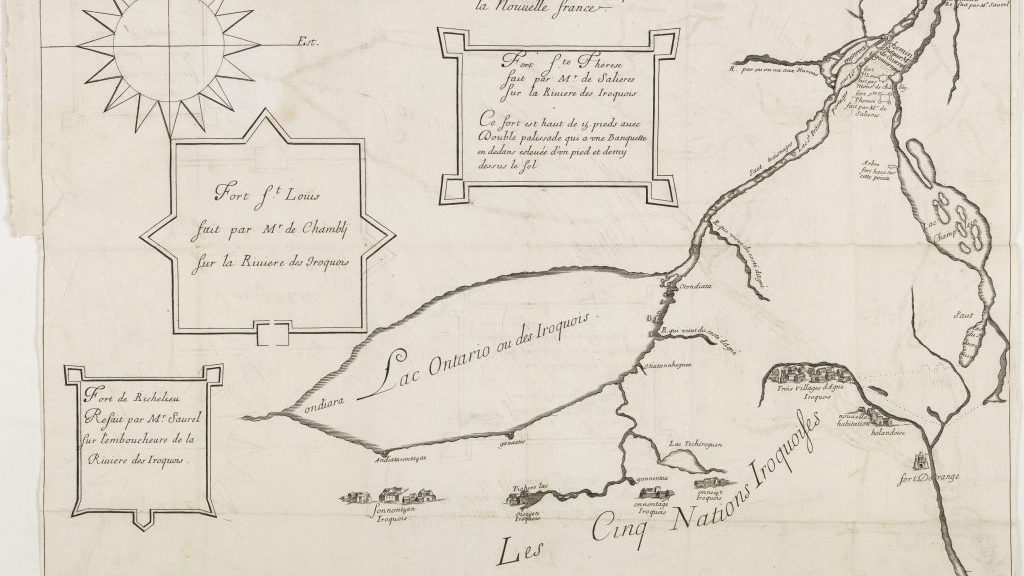
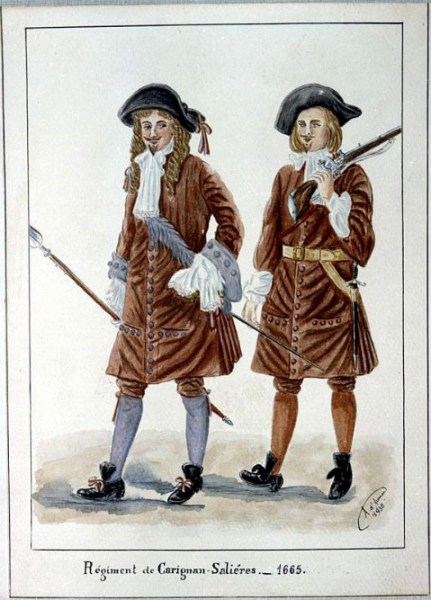
In 1665, 1,200 French soldiers arrived in New France to set up a series of fortresses along the Richelieu River to protect New France colonies in the Saint Lawrence Valley from the Five Nations of the Iroquois.
They were known as the Carignan-Salières Regiment and my ancestor Blaise Belleau dit LaRose was among them. He served in the La Tour Company, one of the 20 companies officially commanded by Marquis Henri de Chastelard de Salières. (Note: the regiment’s name came from a merger of the Salières Regiment with the regiment of Emmanuel Philibert of Savoy, Prince of Carignan, in 1660.)1
After Christmas 1664, Belleau left his parents (François Belleau and Marguerite Crevier) to join 1,099 soldiers in Marsal, Lorraine. They began marching across France in January 1665 to get to La Rochelle, where seven ships waited to carry them to New France. They were stationed on the Île d’Oléron and the Île de Ré prior to leaving.
On April 19, 1665, Belleau crossed the Atlantic Ocean on the Viex Siméon, a 200-ton ship piloted by Sieur Pierre Gaigneur. In addition to soldiers from the La Tour Company (probably eight officers and sub-officers: Captain, Lieutenant, Ensign, Sergeant, Corporal, Cadet, Drummer, and a Surgeon plus 50 soldiers), the ship carried passengers from the Chambly, Froment and Petit companies. They arrived in Quebec City on June 19.2
Another 200 men from four additional companies (Berthier, La Brisandière, La Durantaye and Monteil) arrived in Canada under the command of Alexandre de Prouville de Tracy, Lieutenant-General of the Antilles and New France on June 30. The rest of the soldiers continued arriving until the fall. (Note that some documents place my ancestor Belleau in the Berthier Company, which means he would have gone to the Antilles prior to getting to Quebec.)
The Regiment’s first task was to build forts Saint-Louis, Richelieu, and Sainte-Thérèse along the Richelieu River to block Iroquois intending to invade New France colonies. By late September, the forts were built and all the soldiers had arrived to fully station them. The Marquis de Tracy stationed others in Quebec City, Ville Marie (Montreal), and Trois-Rivières.
Although they initially served as defence forces, the following year, the regiment went on the offensive. By the winter of 1666, 500 to 600 soldiers, volunteers, and Indigenous allies headed towards Iroquois villages in what is now New York State. The cold and lack of food prevented them from continuing, however, and 60 men died en route. Despite that failure, some Iroquois Nations began negotiating peace treaties with New France. In September 1666, a second expedition of 1000 soldiers, 600 militiamen and 100 Hurons and Algonquins reached four abandoned Mohawk villages, which were burned to the ground. These attacks combined with smallpox and scarlet fever epidemics led the Mohawk Nation to sign a treaty with France in Quebec City on July 10, 1667. Eventually, all Five Iroquois Nations signed onto the treaty concluding the Beaver Wars and bringing a 17- to 18-year respite to New France.
The Carignan-Salières Regiment was recalled to France in 1668, but King Louis XIV offered land to soldiers and officers who wished to establish themselves in the new colonies. Belleau was among nearly 400 men who chose to demobilize and settle. He was also among another 283 men who married a Fille du Roi (King’s Daughter).
Blaise Belleau dit LaRose (also known as Bellot and Bezou) settled in the Sillery seigneury and built a home. He married Hélene Calais on September 25, 1673. By 1712, they had enough to donate a portion of land with a home to their son, Jean-Baptiste Bellot (Belleau), and his wife, Catherine Berthiaume.3
If you want to learn more about this period, the Fort Chambly National Historic Site demonstrates the military life during this era, and will reopen for general admission in spring 2026. (Note that Fort Chambly was built in 1711. It is located at 2 Richelieu Street, Chambly, QC J3L 2B9. The website is https://parks.canada.ca/lhn-nhs/qc/fortchambly.)
2Verney, Jack. The Good Regiment: the Carignan-Salières Regiment in Canada 1665-1668, McGill-Queen’s University Press, 1992.
38 mai 1712 [Document insinué le 30 août 1712], Cote : CR301,P755, Fonds Cour supérieure. District judiciaire de Québec. Insinuations – Archives nationales à Québec Id 81885, pièce provenant des registres des insinuations de la Prévôté de Québec, vol. 3 (Anciennement registres 7, 8, 9, 10, 11 et 12) (15 octobre 1709 – 24 mars 1715), pages 433-434, https://advitam.banq.qc.ca/notice/81885.
What made my ancestor think of using a black cross to mark homes of temperance?
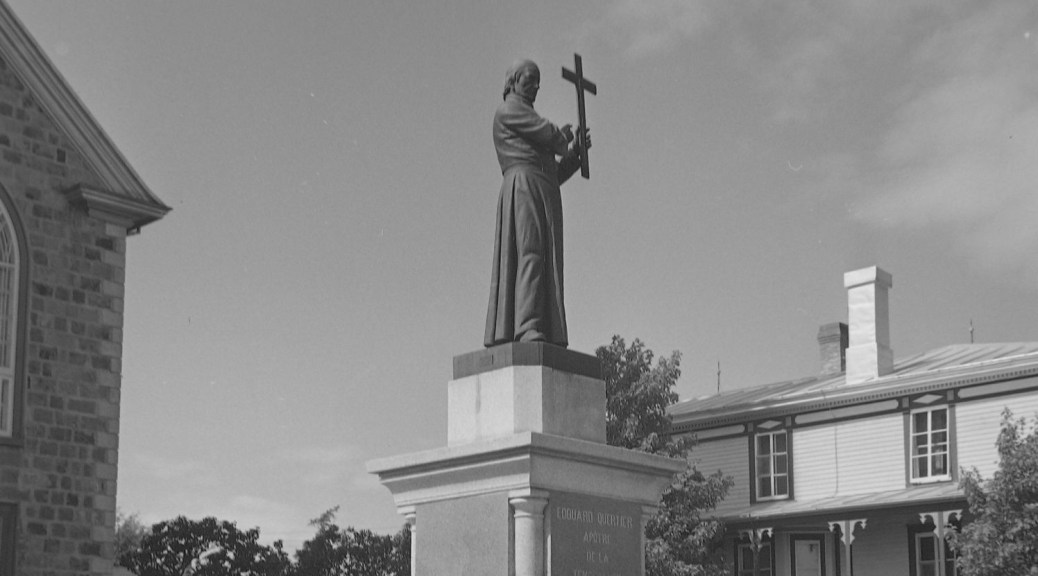
Edouard Quertier (Cartier) launched Quebec’s first official temperance society in 1842 by placing a giant black cross on the top of the escarpment in Saint-Denis-de-Kamouraska. So began an organization that would encompass 400,000 of 900,000 Canadian Catholics eight years later.(1)
The symbol created a tradition that continues in Quebec to this day. If you ever go into a home with a bare black cross hanging in the middle of the living room wall, you’ll know you’re in the house of people who do not drink alcohol.
But what gave him the idea?
1842 Arrival in St Denis
Quertier certainly wasn’t feeling inspired when he first arrived in the tiny hamlet or between 10 and 15 families at the edge of a cliff on the Saint Lawrence’s south shore.
How did I accept this arid rock?,” he wrote. “When I arrived [in October], there was not even a piece of board on which to place a bed or a table. I had to go down the slope and rent a small house, or rather a cabin. No matter! I waited there, until my lodging was acceptable.”(2)
Still, Quertier was no youngster when he arrived in Saint-Denis-de-Kamouraska. At 43 years old, he had had four previous jobs before his priesthood and 12 years of experience serving communities.
Both of his previous roles as parish priest were stressful.
As curate and then parish priest of Saint-Antoine in Montmagmy, he argued frequently with his patron, Father Charles Francois Painchaud.
His bishop got him out of that situation by appointing him parish priest of Sainte-Georges of Cacouna. There, a new church and presbytery were required, but building them was difficult due to arguments between residents who wanted religious leadership and those who believed in the strong separation of Church and State. Despite the conflict, Quertier was able to build a new church and presbytery within the village. He oversaw the presbytery stonemasons and carpenters and got the church walls well underway before resigning the post. His departure halted the building of the church for a time, but it resumed in 1845 and opened for worship in 1848. The belfry didn’t get added until 1892 and full consecration delayed until 1897, but that’s another story.(3)
The experience simply makes clear that Quertier knew he had to do something important quickly to make an impact on his new neighbourhood.
He decided to promote temperance as a movement.
Temperance in Quebec
The issue already had some momentum in Quebec. Popular people like Bishop Charles-August-Marie-Joseph de Forbin-Janson and Charels-Paschal-Télesphore Chiniquy had been telling stories about the evils of alcoholism in weekly masses since 1839. Community residents saw that frequent imbibing often led to fighting, lethargy, poverty, spousal abuse, theft and neighbourhood violence.
Unlike his predecessors, however, Quertier decided to formalize the movement with an official association he called “The Society of the Black Cross.” He created statutes, oaths for members and procedures for joining the society, including the requirement that each member display a plain black cross on the wall of the family living room.
For the next 15 years, Quertier’s campaign for temperance spread. So many French Canadian families displayed the black cross, it became a decor tradition. The Quebecois de Souche society includes a photo that shows the once prevalent look.(4)
Growth and Departure as Leader
In the meantime, Quertier continued building his parish. The wooden chapel that originally opened on December 24, 1841 got replaced by a stone gothic church in 1850.
Seven years after that, Quertier retired. By then, the Society of the Black Cross included believers in almost every parish in Quebec and Quertier’s own parish had grown to encompass 100 families containing “625 souls.”(5)
Temperance continued to be a key issue, not only in Quebec but across Canada. In Quebec, however, the secularism movement also had great strength in many communities. To avoid angering these groups, the Province of Canada passed the Canada Temperance Act that allowed any county or city to hold referendums to consider whether or not to forbid the sale of liquor. This would ensure that communities who wanted to stay dry could do so without forcing prohibition on the entire country.
Life after Death
Quertier spent the rest of his life in Saint-Denis-de-Kamouraska, which became Saint-Denis-de-la Bouteillerie in 2013. After his death in 1879 at 73 years old, the church entombed his body under the crypt of the church. A tombstone says in French:
Here lies lord Edouard Quertier, first parish priest of St. Denis, one of the first apostles of temperance. Died July 17, 1873, aged 73 years, 10 months, 12 days. For 15 years, he lived for you. Pray for him.”(6)
Quertier’s remains continued to draw enough visitors that the church got entirely rebuilt after a fire damaged it on March 9, 1886. Initially, they built a belfry to hold a 2027-pound bell that cost $425,000 the following spring, and new walls on those of the former church by October. Later, they’d add two more bells to the tower.
Quertiers’ campaign for temperance didn’t end when he died. Members of his Black Cross Society were among 20% of Quebec’s population that supported a federal referendum on prohibition in 1898.
The movement grew substantially during World War I.
Temperance, not Prohibition
The Quebec Government declared prohibition in 1919. Then it made several exceptions by legalizing the sale of light beer, cider, and wine in hotels, taverns, cafes, clubs and corner stores.
The prohibition law got repealed entirely to enable liquor sales through a government-run commission in 1921.
In many ways, by choosing control over strict adherence to abstinence, the government duplicated the practicality Quertier included within the original functioning of the Society of the Black Cross.
Any household that became a member of the temperance organization could get a special dispensation to serve alcohol during celebrations, such as baptisms, birthdays and weddings. If the parish priest agreed that a special occasion merited an exception, he would temporarily replace the plain black cross in a home with a white one. The white cross hung on the wall during the celebration. After the celebration ended, the priest would visit to exchange the white cross with a black one and return the home to a liquor-free location.(7)
This kind of flexibility enabled temperance to continue growing within Catholic communities in Quebec even after 1921. Some of its proponents resurrected Quertier in the form of a statue in front of his former church in 1925. The statue remains in place today.
(2) Julienne Barnard, “QUERTIER, ÉDOUARD,” in Dictionary of Canadian Biography, vol. 10, University of Toronto/Université Laval, 2003–,written in 1972, http://www.biographi.ca/en/bio/quertier_edouard_10E.html, accessed on July 18, 2020.
Most history books define the Battle of the Somme as a disaster, but French Canadians can claim it as their first military success.
It also represented the integration of a new kind of leadership in European battle tactics, one in which every soldier counted.
Both of those realities are due to the contribution of the 22nd Regiment, known colloquially as the Van Doos based on its French name “vingt-deux.” Today the unit holds an official French name, the Royal 22e Régiment, an important symbol of its identity and importance.
“It’s arguable that the tactics that the Van Doos taught the Canadians won the war,” said author and historian Desmond Morton, who had authored forty-seven books about Canada by the time he died in September 2019. “It was formed and was trained in a way that was uniquely French-Canadian. The Colonel of the Regiment was an ex-cadet of the Royal Military College…Tremblay had a different philosophy of leadership and he showed it.”
One of the most recognized leaders was Lieutenant Colonel Thomas-Louis Tremblay, who led the Van Doos during their WWI triumphs and left behind his French-language diaries to inspire followers.
Tremblay was the first to use tanks to get over and past enemy dug-outs during an artillery barrage. The tactic relied on every soldier being willing to move through active artillery and kill defenders individually in hand-to-hand combat. The brutal but effective operation enabled his unit to capture the village of Flers-Courcelette from the Germans on September 15, 1916. They held the position for two days.
The 22nd Batallion’s effectiveness in Courcelette persuaded General Sir Arthur William Currie, who was in charge of the Canadian Army, to change his thinking about Vimy Ridge. Tunnels, barbed wire and three rows of trenches protected the strategic site to such an extent that tit was considered largely impregnable by the British and French. The French-Canadian success at Courcelette made them think that maybe someone could capture the strategic site.
The following spring, the Van Doos and three other Canadian divisions moved toward the 14-km-long escarpment at 5:30 a.m. on Monday, April 9, 1917. It took four days, 3,598 deaths and 7,000 wounded men to capture the ridge.
Success was due primarily to training that ensured that every soldier knew what to do and did it, even as commanding officers died.
The Vimy capture may have relied on the Van Doo success at Courcelette, but the Van Doos themselves would never have existed without a private donation by prominent Montreal entrepreneur and philanthropist Arthur Mignault. In 1914, the head of the Franco-American Chemical Company donated $50,000 to create a regiment “composed of and officered by French Canadians.” His offer resulted in the creation of the 22nd Battalion (French Canadian) CEF on October 14, 1914. Mignault and then Opposition leader Sir Wilfred Laurier spent the next month recruiting a full contingent of more than 20,000 men who formed the bulk of Tremblay’s men.
Migneault, who made his fortune selling iron pills to women with anemia, had already enlisted with the 65th Regiment “Carabiniers Mont-Royal” five years earlier. After his 22nd Division success, he went on to subsidize the founding of two additional French-Canadian divisions, but they got folded into the 22e to replace casualties.
Migneault had hoped to be appointed to lead a battalion. Realizing that subsidizing infantry divisions wouldn’t make that happen, he decided to fund military hospitals. Just as the Van Doos were heading to war in early 1915, Mignault succeeded in encouraging the Canadian government to build a French Canadian stationary hospital near the German frontlines in Saint-Cloud. By November 1915, Mignault was on his way to France along with 100 men to set up the hospital.
Laval University followed suit with a second French Canadian Hospital, and both became so important, the French renamed part of Joinville-le-Pont near Paris the “quartier des Canadiens.”
Mignault not only realized his ambition to become a colonel, but a month before his death in 1937, the Royal Canadian Army Medical Corps promoted him to the honorary rank of Brigadier General. He was the first French Canadian to hold that rank.
Members of the Royal 22e Régiment fought in Italy and in the Pacific during World War II, in Korea, in the Gulf War, and in Afghanistan. They were also the first Regular Force regiment to mount the King’s Guard in London in 1940, and repeated the experience again for their hundredth anniversary in 2014. They also served during the Oka Crisis in 1990.
Today, the regiment forms the largest unit in the Canadian Army, with three Regular Force battalions, two Primary Reserve battalions, and a band. Its ceremonial home is La Citadelle in Quebec City, although members are stationed at Valcartier and other bases throughout Quebec.
The black-leather-lined plasticized bilingual identity card wacked my arm as it fell from the shelf. Until then, I had never really noticed the card among the many items my grandmother left me.
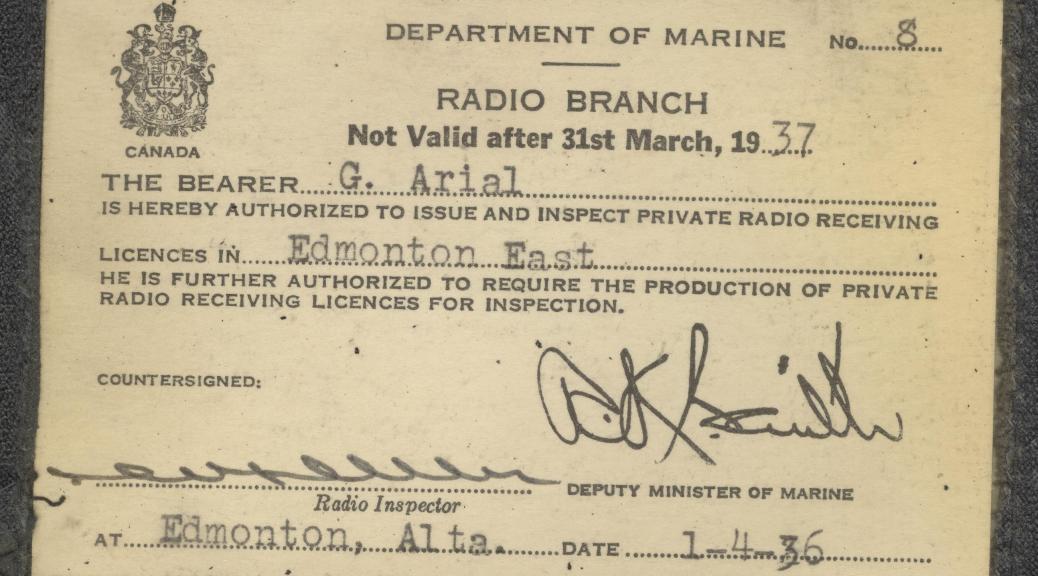
Luckily, its heavy construction protected the words on the card, which remain as legible as they were when my grandfather received it on January 4, 1936.
The Canadian federal “Department of Marine” issued the card to give my grandfather credibility as a radio inspector. It says:
“The bearer G. Arial is hereby authorized to issue and inspect private radio receiving licences in Edmonton East. He is further authorized to require the production of private radio receiving licences for inspection.”
Turns out that this little artifact hints at a short-lived controversy in Canadian history. The card expired on March 31, 1937, but it would be defunct before then.
The Department of Marine seems like an odd overseer of radio licences until you realize that early broadcasting began in the 1890s when Morse Code was used to enable ship-to-ship and ship-to-shore communication. The idea of a public broadcaster begin in May, 1907, when the Marconi station in Camperdown, Nova Scotia began broadcasting regular time signals to the public.
The “wireless telegraphy” industry continued to develop with private individuals investing in ham radios with no regulation. By June 1913, the federal government decided to regulate the industry to protect military communication.
When World War I began in August 1914, private licenses were banned altogether. Only the Marconi Wireless Telegraph Company of Canada, Ltd. kept operating during the war years, in part because it became a research arm of the military.i
After the war, the private industry blossomed, particularly in Western Canada. Many of the new broadcasters came from multiple religious communities, a situation the federal government tried to prevent by setting up a public broadcasting system through the Radio Broadcasting Act of 1932.
That act led to the establishment of a licensing commission called the Canadian Radio Broadcasting Commission under the leadership of Hector Charlesworth. Charlesworth’s group censored many religious groups and political groups, but none more than the Jehovah’s Witnesses.
Norman James Fennema described the controversy in his 2003 dissertation, Remote Control.
…in Canada we find a situation in which the original impetus for regulating radio broadcasting began with the specific aim of putting a rein on religious broadcasting. Originally directed at the radio activities of the Watchtower Bible and Tract Society, this expanded in the early 1930’s into a policy against the licensing of religious broadcasters, a policy initially justified on the basis of the scarcity of the broadcasting spectrum, but that survived the expansion of the system.ii
By 1935, Clarence Decateur Howe became both the Minister of Railways and Canals and the Minister of Marine,iii the ministry under which my grandfather’s job was created.
Howe favoured private broadcasting, and encouraged new private entities to flourish.
Prime Minister Mackenzie King preferred a public broadcast system however. In February, 1936, the Canadian Broadcasting Corporation (CBC) came into being, and my grandfather’s job ended.
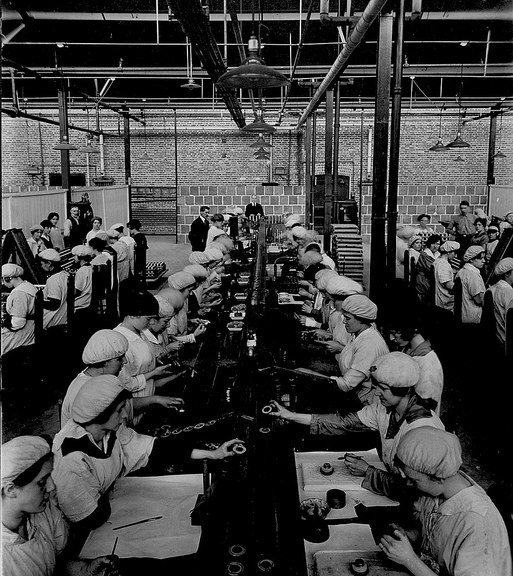
During World War I, 4,000 people, many of them women, assembled eight million fuses in a building locally known as “La Poudrière.” Given that the job required mounting a detonator cap over a gunpowder relay charge and attaching a safety pin (read more about WWI fuses here), the job was risky and monotonous at the same time.
Who were these people? How can we honour their work?
Recently, while looking through the records of World War I soldiers, I realized that their records may offer us ways to discover our homefront heroines. Several women moved to Verdun and lived within walking distance of the armament plant while their husbands or brothers served overseas.
Patrick Murray
When Ethel Henrietta Murray’s husband Patrick volunteered for the Canadian Over-Seas Expeditionary Force on Wednesday, April 12, 1916, the couple lived at 80 Anderson Street, in downtown Montreal.[1]
According to his military records, he died on October 29, 1917, driving with the 4th Brigade of the Canadian Field Artillery. She went by the first name Henrietta. Initially, she had moved to 1251 Wellington Street. Later, she lived at 956 Ethel Street.[2]
None of her addresses exist anymore, nor have I yet found any evidence explaining why she moved to Verdun. Based on her address and circumstances, however, I suspect that she—and three other women who lived nearby—worked at “la poudrière.”
La Poudrière
Locals call a building that currently houses 64 units for senior citizens “La Poudrière,” which means powder keg. The Canadien Slavowic Association (l’Association canadienne slave de Montréal) operates the space.
I haven’t yet looked into the records of the company to find out if there is a list of employees so that I can see if Ethel or Henrietta Murray appears on their rolls.
Other women I’d like to verify include Marjorie Victoria Stroude Luker, Ellen or Helen Elizabeth Winsper, and Mrs. John Sullivan. These three women also lived within walking distance of la poudrière between 1916 and 1919.
Military records include the addresses of these women because all of them received telegrams about loved ones being wounded or killed overseas.
Arthur Stroude
Marjorie’s husband Arthur was wounded in Italy on August 20, 1917, and then died of the flu in Belgium on December 2018. Although the couple lived in Point St. Charles when he signed up, her benefits were sent to her at 714 Ethel Street by the time he died.[3]
George Winsper
Ellen or Helen Elizabeth Winsper, the wife of George Winsper who died on November 7, 1917, had moved from Rosemont to 196 St. Charles Street in Pointe St. Charles by the time he died.[4]
William Wright
Two records mention the grief of Mrs. John Sullivan when Private William Wright, a steamfitter from Scotland, died in action at St. Julien on April 24, 1915. Neither have her first name. One document describes William, who was 21 when he died as the adopted child of Mr. and Mrs. John Sullivan. The one I think is correct mentions that she is his sister. Her address at the beginning of the war was 9 Farm Street, Point St. Charles, the same as his when he enlisted. His medals were sent to her at 431A Wellington St., Point St. Charles.[5]
If these women worked together, as is possible, they too risked their lives.
Employees with the British Munition Supply Company–which was created by The British Government under the auspices of The Imperial Munitions Board–faced the possibility of accidental explosions. Britain paid $175,000 in 1916 to construct a building that could contain shockwaves. It also included a saw-tooth roof to prevent sunlight from entering.[6]
British Munitions Limited
One description of their work comes from the biography of Sir Charles Gordon, who led the team that arranged for building construction.
The IMB had inherited from Sir Samuel Hughes’s Shell Committee orders for artillery shells worth more than $282 million, contracts with over 400 different factories, and supervision of the manufacture of tens of millions of shells and ancillary parts. Its most serious problem was acquiring time and graze, or percussion, fuses for the shells produced by its factories. There was no capacity to create and assemble these precision parts in Canada, and contracts with American companies had proved dismal failures.
The problem was given to Gordon to solve. He recommended that fuse manufacturing be done in Canada. The IMB set up its own factory in Verdun (Montreal) to make the delicate time fuses. Skilled workmen and supervisors were quickly brought over from Britain to train Canadian workers. British Munitions Limited, the IMB’s first “national factory,” was open for business by the spring of 1916. The last order from Britain, for 3,000,000 fuses, came in 1917 and the last fuses were shipped in May 1918. British Munitions was then converted by the IMB into a shell-manufacturing facility.[7]
Another source I read said that Dominion Textile Company purchased the site for its textile operations when the war ended in 1919. Two decades later, Defence Industries Limited revived the site for a shell factory during World War II, between 1940 and 1945. David Fennario’s book “Motherhouse” offers a good look at the women’s lives during this second wartime era.
[1] Attestation Paper, Library and Archives Canada, RG 150, #347740, Patrick Murray, a derivative copy of the original signed by Patrick.
[3] Attestation Paper and address card, Library and Archives Canada, RG 150, #1054006, Arthur Luker.
[4] Attestation Paper and address card, Library and Archives Canada, RG 150, #920146, George Winsper.
[5] Library and Archives Canada, RG 150, #26024, William Wright.
[6] “Usine à munitions pour retraités slaves” by Raphaël Dallaire Ferland, ttps://www.ledevoir.com/societe/354100/usine-a-munitions-pour-retraites-slaves, accessed September 22, 2018.
That was the first question that ran through my mind as I began to try to verify what seems to be indicated by a wedding photo of Jean-Baptiste Hurtubise and Marie-Berthe Charette from my grandmother.
My grandmother’s handwriting below the picture indicates: “Mom & Dad Hurtubise, January 7, 1915.”
Census records from 1901 indicate that they were both 25 years old at the time,[1] another fact I wonder about.
Why would a young man of that age be free to marry and settle down when World War I was in full force? Perhaps this is an indicator of how remote the war seemed to Francophone families in Canada prior to the conscription crisis of 1917.
By that time my great-grandfather would have two children and wouldn’t be required to serve. My grandmother, their first child, was born twelve months after they married.
In addition to her parents’ wedding photo, my grandmother kept only two other pictures. One is a photo of a church, presumably where the wedding took place. The other shows four large church bells. Why are they important?
Turns out that the church in the photo still exists, and it still serves a Franco-Ontarian population! I found it by referring to the census showing Marie-Berthe, called Martha, living in Clarence Creek in 1911.
According to Kim Kujawski, Clarence Creek, which is near Ottawa in Ontario, was founded in 1853 by French Canadian farmers from St. Augusine Quebec.
At the time of Jean and Martha’s marriage, it had two steeples, but now the smaller steeple on the right side is missing. I know the church is the same one, however, because a duplicate of my grandmother’s photo appears on the history page of the parish website. [2]
I’m extrapolating from the facts, but it seems as though Martha’s family were among 170 that remained within the parish after 80 others left in 1908. The bells were part of a renewal show of strength two years later. The families expanded their church, bought the bells and hired famed Montreal decorator Toussaint-Xénophon Renaud[3] to renew the interior. His work can still be seen today.
Sources:
[1] Data from the 1911 Census of Canada: her birthdate appears on Enumeration District 21, Cumberland Township, Russell, Ontario, Sarsfield Village, Léonard Village, Bear Brook Village, page 7, line 48; his on Enumeration District 112, Cumberland Township, Russell, Ontario, Sarsfield Village, Léonard Village, Bear Brook Village, page 3, line 25
I’ve never liked the taste of pink bubble gum, but I ate it anyway for years during my childhood and early teen years, just so I could blow bubbles and read the comic strips tucked inside.
We used to get free samples from the Dubble Bubble booth in the Canadian National Exhibition (CNE, or the “Ex”) Food Building. I loved the experience so much that I insisted on eating only that type of gum for the rest of the year.
Same with chocolate bars. No one could get me to eat anything other than Neilson brands, because they gave me a whole bag full of samples one day a year. My then love for Crispy Crunch, Cinnamon Danish, Jersey Milk and various other sugary treats began at the Ex.
Wikipedia has a good summary of the fair, which still takes place every year.
“The Canadian National Exhibition (CNE), also known as The Exhibition or The Ex, is an annual fair that takes place at Exhibition Place in Toronto, Ontario, Canada, on the third Friday of August leading up to and including Labour Day, the first Monday in September. With approximately 1.6 million visitors each year, the CNE is Canada’s largest annual community event and one of the top fairs in North America.1
We went to the Ex every September long weekend for four or five years in a row in the late 1960s and early 1970s because it was a cheap way for my very young parents to entertain two and then three young children. Most of the day was spent gorging our faces in the food building, but we also got to ride rides in the midway, see horses, milk cows and watch the air show.
I like to think that we also read some of the historical plaques on site. According to Jesse Munroe’s 2021 thesis, there are more than a hundred, but if we did, I don’t remember them. Munroe writes that I’m not missing much, given that they highlight a series of colonial events rather than the original people’s experiences that are most important.
The waterfront was always a gathering place where countless First Peoples came together to trade. Algonquian-speaking Anishnaabe held the lake and its islands in high esteem as a source for both food and spiritual renewal.2
My childhood memories of the food building certainly represented spirtual renewal, but looking back on it, I don’t think they encompassed anything that I now consider food. In those days, various companies offered samples of hotdogs, spaghetti, perogies, pizza, waffles and other meal-like substances, but most of the goodies I remember were candy or dessert.
We stopped going to the food building when my youngest sister was still so young that I’m not sure she even remembers it. Given that I used to leave with a massive bag of sugary substances that would last almost to Halloween, her long-term health is probably better off.
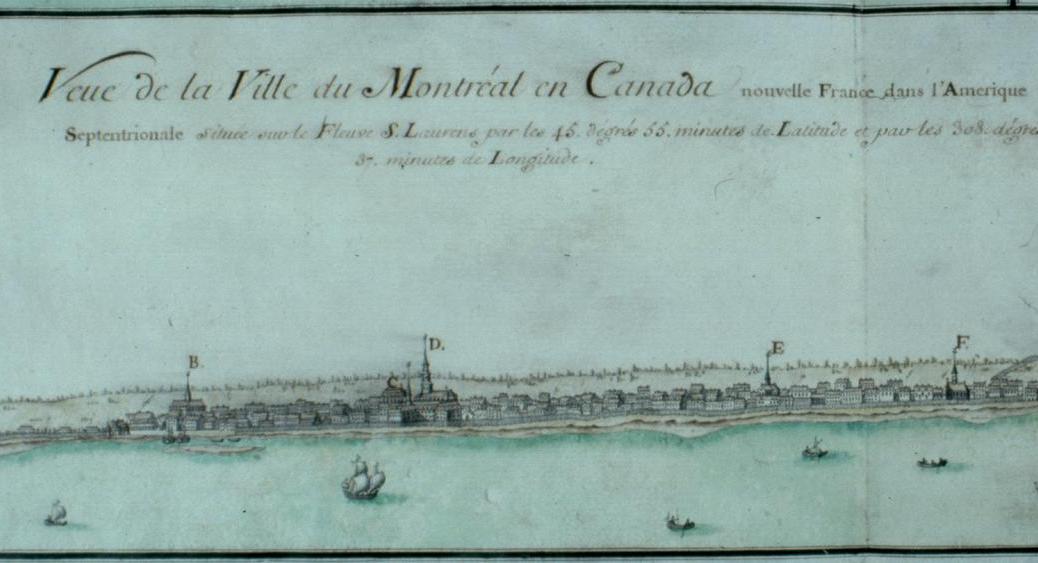
Recently, I’ve been wondering about the white slave who successfully escaped after allegedly burning down New France’s third Hotel-Dieu hospital and 45 homes in what is now Old Montreal in 1735.
I can’t help feel sorry for the man who was brought to Canada as an indentured slave (engagé or trente-six mois due to the thirty-six month duration of his contract) primarily because he was young, healthy, strong enough to serve as a labourer and poor. In return for his work, he got room and board, clothing and a salary, but he had no rights beyond that. His employers could send him anywhere to do just about anything; and according to New France law he had little recourse.
A brief summary of his life appears online in the Canadian Mysteries series dedicated to the fire.
Originally from Butenne in Franche-Comté, Claude Thibault was found guilty of salt trafficking [illegal sale of salt]. Condemned to end his days in the king’s galleys, his sentence was commuted to a life in exile in Canada. He arrived in Québec with a dozen other salt traffickers, including Jacques Jalleteau, in September 1732.
On the night of April 10, he was seen at the site of the fire, but disappeared when Angélique was arrested the following day. Despite warrants issued for a wanted person throughout the colony, Thibault was never again seen.1
I imagine he used his acumen to create a new life under a new name, perhaps in the fur-trading industry. After all, as a faux-saunier (salt smuggler), he had to develop a lot of entrepreneurial skills. As someone who purchased salt in low-tax regions and sold it on the black market in high tax regions, he had to be skilled at finding clients and creating a distribution hub without being caught by the King’s agents.
The King’s decision to set up an unfair tax regime began in 1680, when he decided to pass a law varying the taxes (gabelle) on salt per region. Salt was an important commodity at the time, and controlling it was an important economic lever. In addition to using it to spice and cure food, people in France also needed enough salt to tan animal skins. In some regions, such as Brittany, people could buy one “minot” (about 37 litres) of salt for as little as 1 livre, while citizens of Main, Anjou and other “high gabelle” regions had to pay as much as 61 livres per minot. The law even forced them to buy a minimum quantity of salt every year, whether they needed it or not.
Smugglers thrived in the seeming injustice, but if they were caught, punishment was severe. They faced fines beginning at 300 livres and leading to jail time of anywhere from 10 days to three months. At first, only the most serious convicts were exiled to New France, but in 1730, Jean Frédéric Phélypeaux, the Comte de Maurepas, began insisting that convicted faux-sauniers should be sorted, with the most healthy or those with useful skills be sent overseas as enslaved labourers on three-year contracts. Eventually, the scheme ended in when King Louis XV of France removed Maurepas from his job in 1749.
Unfortunately, Thibault was caught when Maurepas’ scheme was fully underway, and he had few other ressources to avoid exile.
Alain Racineau, who has studied salt traffickers like Thibault at length, describes most of them as poor rural people, primarily day labourers and small merchants struggling to survive.
They were recruited from the poorest levels of society: casual agricultural labourers, petty artisans and traders, unemployed vagabonds. They frequently affirmed that they had taken up smuggling “pour gagner leurs vies.”2
Thibault’s life didn’t get any easier once he arrived in New France. His contract was purchased by fur-trader and merchant Francois Poulin de Francheville and his wife Thérèse de Couagne, who owned several slaves. After M. Francheville died in late 1733, the widow decided to sell Thibault’s girlfriend to a friend in Quebec City. Plans were established for her to be sent away in the spring of 1734, after the ice melted from the Saint Lawrence River.
On February 22, 1734, Thibault and his lover decided to run away, setting fire to her bed as a distraction. They had hoped to reach the English colonies, but bad weather stopped them. They got stuck in Châteauguay and were eventually captured by three militia captains.
Thibault was thrown into jail on March 5 for breaking his contract. He was released on April 9, just one day before the large fire that began in the Francheville home on St. Paul Street.
Thibault disappeared just before his girlfriend got arrested, was convicted and executed. On April 19, authorities set up a manhunt
…given that we are in no State at present to forward the description of the said Thibault with the present order, the Said Captains will take care to arrest and Interrogate all Young men who are unknown vagabonds coming from the direction of Montréal toward Québec and passing through their area, to ask of Them their names and surnames, who they are, where they come from, and where They are going; and upon failure by the said passers-by to provide adequate Information on their persons, And for the slightest doubt or suspicion regarding their responses, And in consideration of public safety, We expressly ordain that the said Captains have them arrested Immediately, and taken under sound and due guard to the gaols of This city;3
They never found him.
Two years later, authorities officially took him off the most wanted list.
2Racineaux, Alain, ‘Du faux-saunage à la chouannerie, au sud-est de la Bretagne’, Mémoires de la Société d’histoire et d’archéologie de Bretagne, 1989.
3Archives nationales du Québec, Centre de Québec, Fonds des Ordonnances des intendants de la Nouvelle-France, E1, S1 P2622, Hocquart, Gilles, Ordinance given to the captains of the militia for the arrest of Claude Thibault, April 19, 1734, https://canadianmysteries.ca/sites/angelique/proces/rumeurcircule/1889en.html .
It constantly amazes me how technology can influence where people live.
When I was examining the lives of my great great grandparents and their predecessors on my fathers’ side for instance, I noticed that their moves usually followed easier travelling circumstances.
In 1815, for example, a small settlement known as Bear Brook arose along the border of a small creek by the same name. The area is now in Russell County. Initially, settlers from Montreal used the waterway to get there. By 1820, a new road from Montreal replaced it to link then-Bytown (Ottawa) through Cumberland, Clarence Point, Plantagenet Mills, L’Orignal and Hawkesbury.
My great great great grandparents were among many French-Canadian families from Lower Canada who travelled along the new road to settle in the area in 1854 to farm.
There must have been some Irish among them too, because part of the community was renamed Sarsfield twenty years later to honour Irish hero Patrick Sarsfield.
By then, loggers used the old creek and to float timber to mills in Carlsbad Springs. They were still doing so when Gustave Hurtubise was born in Sarsfield in 1884. Gustave, the elder brother of my great great grandfather was the first child from our family born in the town. Two years later, our cousin Sévère D’Aoust built the Roman Catholic Church in the village where my great grandfather Jean-Baptist would be christened. That same year, the community lobbied for a local stop along J.R. Booth’s Railway line in 1886. They built a small building to entice Booth.
Jean-Baptist Hurtubise arrived in Sarsfield on February 16, 1889. His future wife, Marie-Berthe (known as Martha) Gourdine, was born in a neighbouring town, Clarence Creek, October 3 the same year.
The year the youngsters turned eight, the Old Montreal Road got paved and engineers constructed the Canadian Northern Railroad through Cumberland to Hawkesbury.
They were only 16 years old when the two got married in Clarence Creek on January 7, 1915
My grandmother, Anne Marguerite Hurtubise was born in the same town the following November. Her sister Donna came a year and a half later.
The family left Sarsfield and moved to Cluny, Bow River, Alberta, sometime between Donna’s birth in 1917 and the 1921 Canadian Census. By this time, the train was established across the country, so they and others took it to go west.
Somehow, the couple got land and a home. In 1921, the Census reported that 31-year-old Jean owned a farm with a three-bedroom wooden house on it.1 It was located in section 7, township 22, range 21, Meridian 4. His wife Martha and the two girls didn’t work.
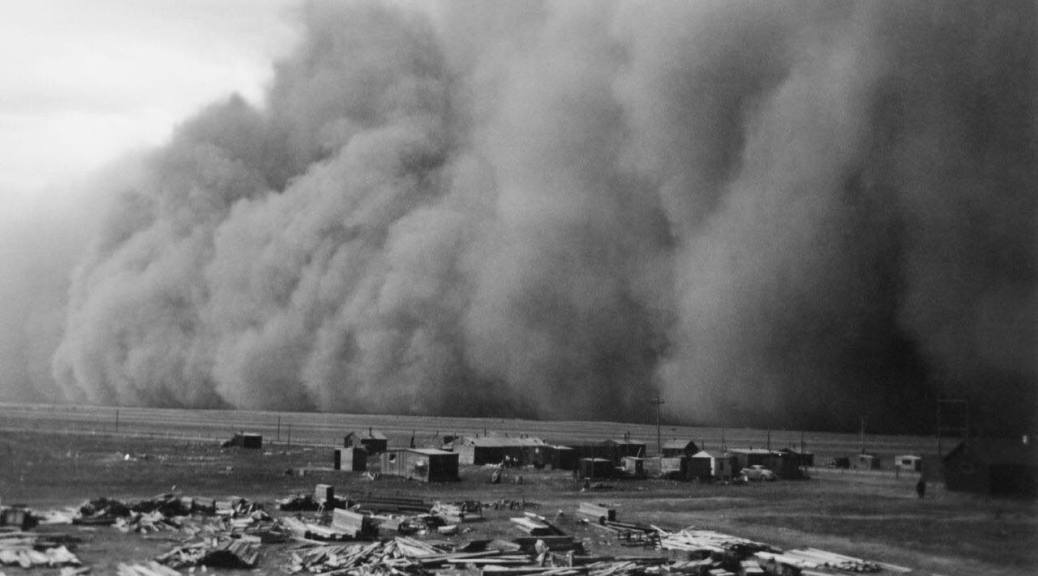
Unfortunately, they arrived just in time for five successive droughts that we now know as the Prairie Dry Belt Disaster.
In 1931 and 1932 they suffered from the dustbowl, when top soil was so dry that it blew into homes.
Then the locusts came in 1933.
I grew up listening to stories about those times, but got a better understanding of what they faced when looking at the photos on a University of Saskatchewan website https://drc.usask.ca/projects/climate/.
My great great grandparents were among 750,000 farmers who had to abandon their farms between 1930 and 1935.
By 1938, the family had moved to Edmonton and my grandfather and his wife had to depend on the incomes from their daughters’ jobs, my grandmother as a nurse and her sister as a clerk, to survive.
1Data from the 1921 Census of Canada, Enumeration District 2, Bow River, Alberta, section 7, township 22, range 21, Meridian 4, page 6, line 28.








 Genealogy Ensemble
