Unapologetically Canadian, Tracey Arial promotes creative entrepreneurship as an author, cooperative business leader, gardener, family historian and podcaster.
Résolument canadien, Tracey Arial promeut l'entrepreneuriat créatif en tant qu'auteure, chef d'entreprise coopérative, jardinière, généalogiste et podcasteuse.
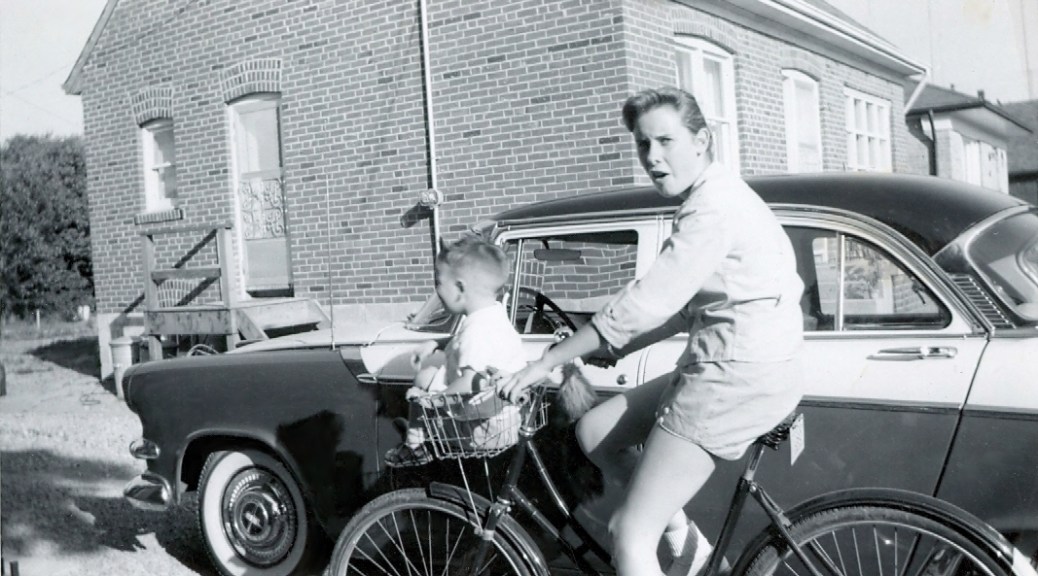
Bicycles have been on my mind this month. I’m trying to ride 1000 km to raise money for the Great Cycle Challenge in memory of my mom. One of the photos I use to describe her features her on her bike with her little brother in the basket.
The photograph is dated 1956 and there are some unusual elements about the bike, beyond how easily my uncle fits in that basket.
The first odd-looking thing is the license plate on the seat. Turns out that Toronto, where they lived, forced cyclists to buy license plates between May 20, 1935 and February 4, 1957. According to the City website,
The licensing process was quite complicated:
An individual was first required to apply for a license at City Hall.
They were then required to bring their bicycle to a police station, where a police officer would inspect the bicycle and complete the required paper work.
The paper work was returned to City Hall and a license was granted.
The individual would then submit a duplicate license to the same police station where the bicycle was examined.
Finally, a metal plate was issued for the year and affixed to the mudguard of the bike.
Moving to a new address, or transferring or exchanging a bicycle would require an individual to file updated information with the City. The cost of the yearly license was 50 cents, while the fine for not having a license on their bicycle was $5.00.1
The other interesting element is how hard it is to tell which manufacturer created this bike. Today, it would have at least one key decal to identify CCM, Humphrey, Schwinn, Standard Cycle or Raleigh. Still, I suspect it was probably a Canada Cycle and Motor Co. (CCM) product, given that that company purchased most of the other Ontario-based bicycle manufacturers in the preceding years.2
I remember when I wanted to get my first bike, my parents spoke about CCM as though there were no other choices for a solid bicycle. Given their preference, my second bike, and the first one I chose, was a CCM. We got it at Canadian Tire.
According to John McKenty, author of Canada Cycle & Motor: The CCM Story, the company began in Toronto in 1899, when Massey-Harris Manufacturing Co. president Walter Massey “bought four Canadian bike companies and merged them into one.”3
By 1983, interest in the company’s products had waned and it declared bankruptcy. The brand still exists, but it now belongs to Adidas.
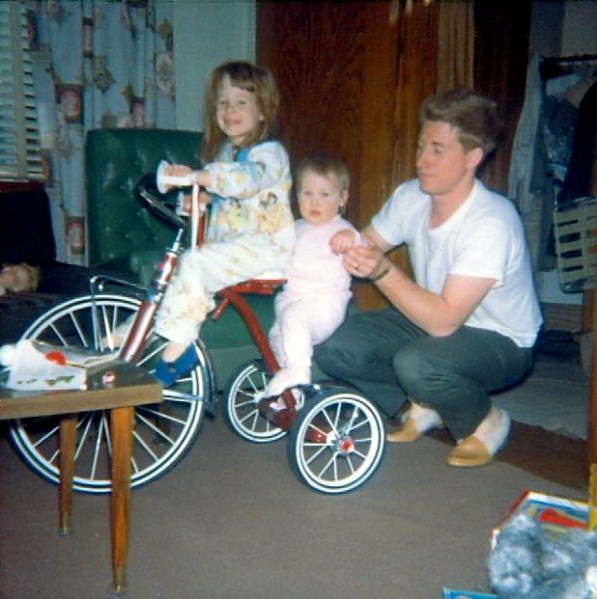
It’s astonishing how radically the style of bicycles has changed in the last fifty years. My first bike had three wheels, one of which was huge.
The one I chose had tall handlebars and a banana seat, something I can’t imagine riding these days.
Modern styles are significantly closer to the practical one that my mother rode.
Can the trajectory of Canada’s development be shown in miniature by looking at the life of a small community on the shores of the Seine River between Winnipeg, Manitoba and Grand Forks, North Dakota?
I hope so because the twists and turns in the nature of the town offer me hints about who my ancestors were and how they lived during a crucial period in the history of our country.
The town, which is now known as Ste. Anne, has served as a haven for Aboriginal, Métis, French, Immigrant, and Catholic peoples over the years. It changed its name to match the most important value held by a majority of its settlers and has been known as Oak Point, Pointe-des-Chênes, St. Alexandre, Ste.-Anne, Sainte-Anne-Pointe-des-Chênes and Ste.-Anne des Chênes.
I’m curious about the place because a family tree my grandmother left me says that my four-times great grandmother Marie Sophie (or Séraphie) Henault-Canada was born and died there. I haven’t found anything to confirm her data, but the 1870 Manitoba Census shows Sophie and her husband farming in the community. It also indicates Charles Enault was her father.[1] The Hudson Bay Company Archives show Charles Henault being in the community as of 1810.[2]
Ste. Anne’s location between the boreal forests of the Canadian Shield and the flat plains of the Red River always made it prime real estate for settlement. Nomads sought good hunting grounds and shelter from high winds close to the era’s key transportation infrastructure along the river and via trails. Later, the plains made for good year-round farming sheltered by high oak. Eventually, the area attracted entrepreneurs and became a bustling pioneer town. Gathering settlers attracted Catholic missionaries who turned the town into a full-blown Catholic parish. Today, the same community sits at the junction of two major highways and has become a suburban community of Winnipeg.
Sophie’s birth on April 6, 1818 may have taken place within a local First Nation. I’ve found traces of several in the area, including the Rouseau River Band, the Oak Point First Nation, the Saultaux First Nation and the Upper Fort Garry First Nation.[3]
It’s also possible that her father was a Voyageur who came to the area from another First Nation elsewhere in North America.
Her father and mother may also have been among Métis settlers known to winter in the area during that period.
As early as 1820, Métis families were wintering at Pointe-des-Chênes, southeast of St. Boniface on the Seine River. The area had a mix of mature forest and grasslands suitable for farming. The large oak groves served as a source of income for the settlers — lumber cut in the parish in 1820 was used for building a large chapel at St. Boniface.[4]
A combination of forests and plains enabled the family to pasture farmed livestock, cut timber for building materials and fuel, and hunt wild game.[5]
Scottish settlers who came under Lord Selkirk’s Red River Settlement plan were attracted by similar amenities, with many establishing farms and businesses in the region during Sophie’s childhood. Métis workers set up local farms after losing their jobs when the North Western and Hudson Bay companies merged in 1821.
Over the next thirty years, the lifestyles of the settlers and First Nations began to clash. By 1852, Oak Point settlers and the chief of the local First Nation, Saulteaux Chief Na-sa-kee-by-ness/ Na-sha-ke-penais/ ‘Flying Down Bird’/ Grandes Oreilles (son of Les Grandes Oreilles) had negotiated a treaty so that First Nations groups would move out of the area.[6]
My ancestors stayed put and continued to farm as the town grew rapidly. By 1856, when the Government of Canada chose to purchase Rupert’s Land from the Hudson’s Bay Company, it boasted a trading post, hotel, general store and jail.
The St. Alexander chapel opened in 1861 and began attracting Catholics. In the following decade, the town became the parish of Sainte Anne to attract additional settlers.
Still, my ancestors stayed and continued farming. The 1870 Hudson Bay Census shows Sophie and her husband Dominique Ducharme-Charron living on lot 27 with four of their children Johnny 19, Roger 17, Joseph 13 and Marie, 12. [7]
During the 1870s, Ste. Anne served as a stopover for travellers on their journey to Winnipeg along the famed Dawson Trail, a path linking Northern Ontario and the Red River Settlement. It was so heavily developed by 1881, Dominion surveyors maintained its traditional French-style long river-side lots instead of breaking it up into square lots.
If my grandmothers’ notes are accurate, Sophie died in Sainte Anne in 1882 at the age of 64 years, five months and ten days.
Today, 2,114 people live in her community and the land she once farmed has been paved over by the #12 and Trans Canada highways.
Some of the most interesting information about my ancestors comes from documents detailing what they ate.
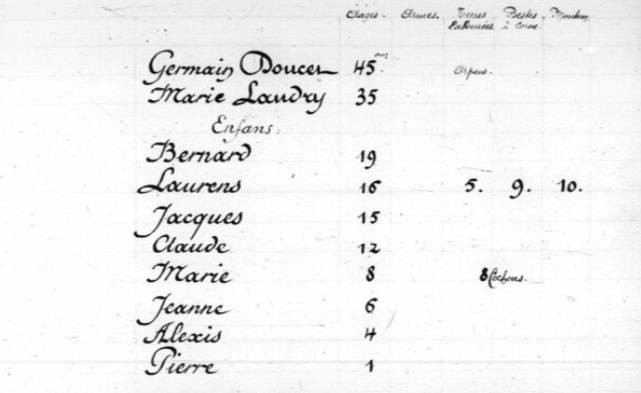
The 1686 Acadian Census, for example, shows my ancestor Alexis Doucet at four years old living in Port Royal with his parents and seven brothers and sisters on “5 arpents of cultivable land with 9 cattle, 10 sheep and eight pigs.”1
The census detailed our ancestors’ cattle and livestock along with the cultivated land because those elements were the primary elements of wealth in North America at that time. The settlers’ ability to nourish themselves determined whether they would be able to thrive, multiple, and permanently inhabit a place on behalf of whichever European colony to which they belonged.
Doucet’s family and their neighbours were ingenious at this task, as Caroline‐Isabelle Caron points out in her delightful booklet about Acadians in Canada.
Indeed, the Acadians set roots in the marshy salines left untouched by the First Nations, in the tidal flood plain which they proceed to dry and put into culture thanks to a complex system of dykes (levées) affixed with drying valves called aboiteaux. This technology was imported from France, probably from the Loudunais region where some early settlers originated. The vast network of dykes the Acadians created inside and beyond the marshlands before 1755, ensured the fertilization of vast meadows for the culture of wheat but also the growth of salt‐hay pastures, a particularly attractive source food for cattle. At this time, Acadian agriculture ranked among the most fertile in the world, boasting near constant, abundant crops.
A typical Acadian farm consisted of one house with one or two rooms on the first floor, a barn, outdoor latrines, a cellar, and a well. Dwellings were usually built up from the ground without foundation, the walls sided with whitewashed cob walls surmounted by a thatched roof. In addition to an enclosure to keep farm animals (chickens, sheep, pigs), the courtyard contained a fenced garden to grow legumes and root vegetables (carrots, turnips, radishes, but not potatoes), herbs (for both cooking and apothecary), and berries. The Acadians planted, among a vast array of fruit trees, the first apple trees the Annapolis valley is reputed for today.
Abundant food supply stimulated strong demographic growth. It is believed that between 1650 and 1755, the growth rate of the population increased annually by 4.5 percent. Birthrates alone explains this growth, the result of a near 100 percent marriage rate and very high fertility rates, as well as low mortality rates due to the quasi absence of epidemic diseases or famine, and easy access to arable land and drinking water. Despite tentative estimates, experts agree that the Acadian population grew from over 400 people in 1671 to more than 1400 in 1730, for a total of 10,000 to 18,000 people in 1755.2
By the way, the dykes made by Acadians like my ancestor, still exist today. The most successful examples allow only a third of the territory to be farmed, with the other two thirds dedicated to natural wetland rejuvenation and rough cover.3
These early settlers’ ingenuity at bringing old world technology to their new circumstances enabled them to cultivate land that wasn’t already being farmed by the First Nations communities already in the area. That fact meant that they weren’t seen as a threat by their First Nations neighbours and became friends and neighbours. Some of the French settlers fell in love with First Nations people, as Alexis’ grandmother had. According to recent DNA research, Germain’s last name “Doucet” is presumed to be an adopted name, because his father, Germain Doucet, definitely descended from First Nations.4
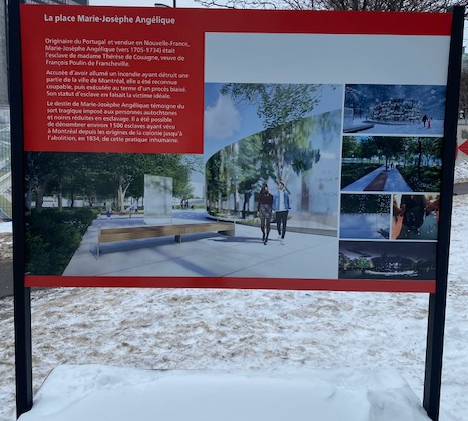
Since this story was originally published, the City of Montreal has added a poster next to Metro Champs de Mars to make it clear that Marie-Josèphe Angélique’s park will be within the Place de Montrealais!
Thanks to Annie for letting me know, and thanks for everyone who made sure that her story is not forgotten!
Original Story
For an hour on the first cold day of the year last month, I wandered around City Hall looking for the memorial park named after an enslaved woman whose torture led to her conviction for arson in 1734. She was then ridiculed, hanged, and her body was burned to ashes and thrown to the wind.
I couldn’t find it.
I’m not sure what happened from the time the park was created in 2012 to today, thirteen-and-a-half years later, but the one-time park still appears on Google Maps. In person, I couldn’t find anything to indicate where it might be.
According to various articles on the web, a green space just west of Champs de Mars métro station honours Marie-Josèphe Angélique’s memory. The official inauguration of the park took place on Aug. 23, International Day for the Remembrance of the Slave Trade and its Abolition, 2012.
As I walked through the area last month, the one-time park seemed to be encompassed in a massive construction site underway for Place des Montréalais, a new public space being created next to the Champ des Mars metro on Viger Street. The posters on site explaining the current project included nothing about Marie-Josèphe Angélique.
Despite being honoured with an award-winning film, a bronze plaque, lilies and a presentation by Governor General Michaelle Jean in 2006, and a public park created by the city of Montreal in 2012, she’s disappeared again.
Before this experience, I was already struggling to see Angélique as the symbol of freedom and resistance she serves for many, but I don’t want her to be forgotten. Did she set the fire or was she a convenient scapegoat? If she didn’t, who did? As I began exploring her story last month as part of a project for NANOWRIMO (the National Novel Writing Month), she served as a reminder of the kind of unnecessary suffering a biased political, policing and justice system can create. Despite the fact that she was a victim of slavery, hatred, spite, racism, class bullying and the worst that a mob could throw at her, her spirit remained strong and unrelenting.
Angélique proclaimed her innocence until the day she was tortured, throughout the court case, and through questioning. Despite that, three weeks after the fire, she was hanged, ridiculed publicly, then burned with her ashes tossed into the wind. Clearly, the authorities at the time wanted her punishment to be seen and remembered.
I read the details about Marie-Josèphe Angélique’s case on Torture and the Truth, a fabulous website set up in 2006 by multiple people, including one of my genealogical mentors, Denyse Beaugrand-Champagne and one of my historian mentors, Dorothy W. Williams. Both of these women have researched, written, spoken and taught many people about the history of Montreal and why studying it is so important.1
The site is one of thirteen different “historical cold cases” established for classrooms across Canada. It was created through the work of six writers, a photographer, an artist, and two translators collaborating with six funding agencies, seven production partners, and 15 archive and museum partners.
It is one of the best historical websites I’ve ever read. If you do nothing other than read through this site, you will get a good overview of the community, the victim arsonist, and life in early Montreal.
As I read about Angélique’s story, she sounded like just the kind of person anyone would like to get rid of. She was a woman who told people she would burn them alive in their homes. She said so to her owner for refusing to grant her freedom, to other slaves for making her work harder than she wanted and to others too. To anyone who slighted her, she threatened the worst thing she could think of. She would burn their homes down.
When 45 houses in her small community did in fact burn down, people blamed her. In retrospect, it may have been an accidental kitchen fire that caused the flames, but her words came back to haunt them all.
The fire began at 7 p.m. on a Saturday evening in spring, April 10, 1734. In only three hours, it destroyed 45 homes and businesses on Rue Saint Paul. Even the Hôtel-Dieu hospital and convent, where people initially took shelter, burned to the ground. Hundreds of people were left in the cold; supplies from many merchants burned, never to be seen again.
Plus, who knows how many caches of fur got wiped out. At that time, Montreal was the centre of the fur trade, more than half of which was illegal trading with the Dutch and English communities in Albany, Boston and other communities to the south. According to a 1942 thesis by Alice Jean Elizabeth Lunn, furs were stored in the backs of shops and even buried just beyond the Montreal wall, which was still under construction at that time, in order to be shipped without being seen by New France authorities. A lot of money went up in smoke that day.2
Everyone in Montreal knew about the fire, given that all the church bells throughout the city began ringing when it started and continued until it was over and people were safe again. Although stone buildings existed at the time, most of the buildings were made of wood; fire could destroy them all.
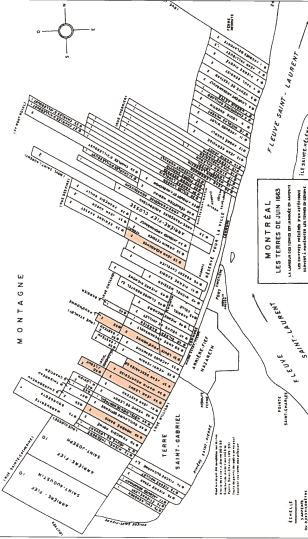
I had ancestors who lived in Montreal then, the Hurtubise clan on my father’s mothers side. One of them, Jean Hurtubise, the grandson of Étiennette Alton and Marin Hurtubese, was thirty-nine years old, ten years older than Angélique when the fire took place. He and his wife Marie-Jeanne (Marie-Anne ou Marianne) Tessereau had been married for seven years in 1734.
Jean was born in Ville Marie and lived in Montreal for his entire lifetime, so he and his family would have experienced the fire, at least from a distance. They certainly would have seen the ordinance compelling witnesses to appear, given that “it was posted and cried out everywhere in the city and its suburbs.”
Jean and his family farmed a 3×20 arpent property they bought three years earlier from Raphael Beauvais and Elisabeth Turpin on Rue Côte Saint-Antoine.”3 The property was in a part of Montreal that was considered the countryside at that time. Their home was then one of four wood houses on Côte Saint-Antoine in 1731.4
Given that the area was still very rural, and on a major hill, I can’t help but wonder. Did they see the smoke rising into the sky as the hospitals and 45 other buildings in Ville Marie were destroyed?
They certainly had strong links to Ville Marie, particularly the hospital. His grandmother, Etionnette Alton, had died there in her 84th year twelve years earlier. They couldn’t have helped wondering what would happen to others like her, being treated in the hospital that the fire destroyed. Were they among the crowd clamouring for revenge? Did they go to Ville Marie to see Angelique hanged? Did they watch her corpse burning? Did they see her ashes spread into the wind? Did they care at all?
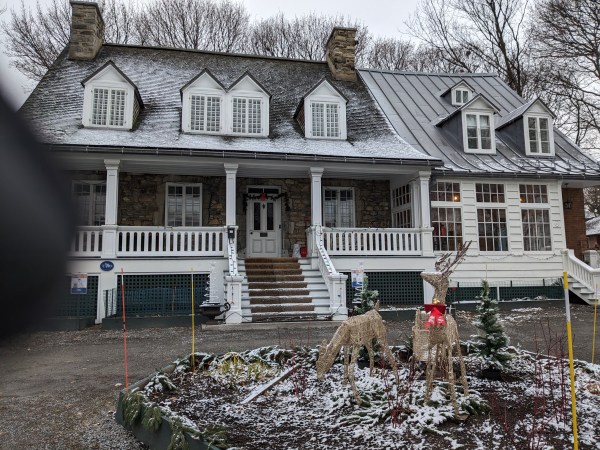
I can’t help but imagine that the controversial hanging effected all 2000 people who lived on the island that year. Five years after Angélique’s death, Jean built Hurtubise House, a storey-and-a-half fieldstone structure on land originally rented by his father in 1699 on Mount Royal. The family built the gabled home out of stone to protect themselves from fire, as required by a law passed the summer after Angelique’s death. You can still visit the home today.5
Sources
1 Beaugrand-Champagne, Denyse, Léon Robichaud, Dorothy W. Williams, Marquise Lepage, and Monique Dauphin, “Torture and Truth: Angélique and the Burning of Montreal,” the Great Unsolved Mysteries in Canadian History Project, 2006, https://www.canadianmysteries.ca/sites/angelique/accueil/indexen.html.
3 Roy, Pierre-Georges,, Inventaire des greffes des notaires du Régime français, Québec, R. Lefebvre, Éditeur officiel du Québec, 1942, 28 vol. ; 25-27 cm, Collections de BAnQ.
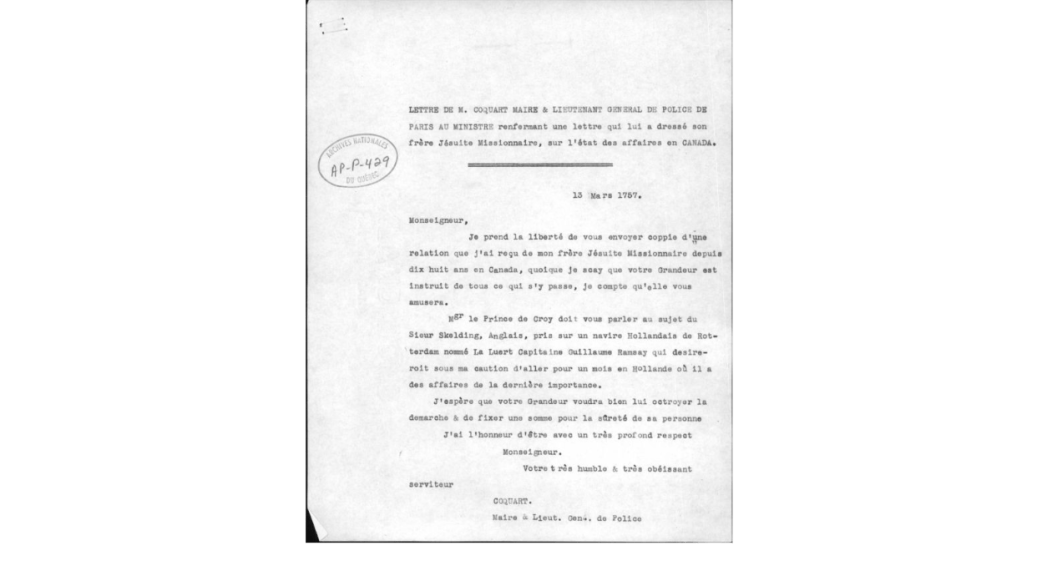
In the winter of 1749-1750, Jesuit Father Claude-Godefroi Coquart travelled through the Malbaie area of New France (now the province of Quebec) inspecting the lands owned by the King of France.
One of two farmers looking after this land was one of my ancestors, Joseph Dufour. Dufour’s farm was called “La Malbaie.”
Coquart’s written report to France describes the farm run by Dufour and his neighbours’ operation in great detail.
Author George McKinnon Wrong describes Coquart’s report on pages 17 and 18 of his 2005 book entitled “A Canadian Manor and Its Seigneurs The Story of a Hundred Years, 1761-1861”:
Father Coquart’s census is as rigorous and unsparing of detail as the Doomsday Book of William the Conqueror. He tells exactly what the Malbaie farm can produce in a year; the record for the year of grace 1750 is “4 or 6 oxen; 25 sheep, 2 or 3 cows, 1200 pounds of pork, 1400 to 1500 pounds of butter, one barrel of lard,”—certainly not much to help a paternal government. The salmon fishery should be developed, says Coquart. Now the farmers get their own supply and nothing more. Nets should be used and great quantities of salmon might be salted down in good seasons. Happily, conditions are mending. The previous farmer had let things go to rack and ruin but now one sees neither thistles nor black wheat; all the fences are in place. Joseph Dufour has a special talent for making things profitable. If he can be induced to continue his services, it will be a benefit to his employer. But he is not contented. Last year he could not make it pay and wished to leave. Nearly all his wages are used in the support of his family. He has three grown-up daughters who help in carrying on the establishment, and a boy for the stables. The best paid of these gets only 50 livres (about $10) a year; she should get at least 80 livres, M. Coquart thinks. Dufour has on the farm eight sheep of his own but even of these the King takes the wool, and actually the farmer has had to pay for what wool his family used. Surely he should be allowed to keep at least half the wool of his own sheep! If it was the policy of the Crown to grant lands along the river of Malbaie there are many people who would like those fertile areas, but there is danger that they would trade with the Indians which should be strictly forbidden.”
When he was twelve years old, the person who answered the census described my great, great grandpa as a French-speaking Roman Catholic person.1 As he grew up, I wonder whether that dual identity became even more firm and important to him, perhaps as a rebellious response to massive societal changes where he lived.
Isadore Azilda Doucet was born in 1869 in Ile Verte, fourteen years after the seigneurial system was officially abolished in Quebec. His home in the Témiscouata Valley on the south shore of the St. Lawrence River east of Quebec City was a key outpost for English-speaking Anglican Lords who purchased manors for colonial purposes and later became Quebec’s most important industrialists.
Researcher Maude Flamand Hubert describes the process underway during great great grandpa’s lifetime as follows:
Dans la première moitié du xixe siècle, l’accession à la propriété seigneuriale constitue encore la voie privilégiée afin d’acquérir ce statut socioéconomique tant convoité. Ce brassage s’effectue tout juste à la veille de l’abolition du régime seigneurial, en pleine période d’essor de l’industrialisation et d’une économie capitaliste de plus en plus orientée vers les marchés. Selon le modèle proposé par Serge Courville, comme de nombreux noyaux paroissiaux issus d’une colonisation seigneuriale timide, L’Isle-Verte prend véritablement son élan dans le deuxième quart du xixe siècle (Courville, 1990, p. 26).
In the first half of the 19th century, accession to seigneurial property was still the privileged way to acquire a coveted socioeconomic status. This mixing took place just on the eve of the abolition of the seigneurial regime, in the midst of a boom in industrialization and an increasingly market-oriented capitalist economy. According to the model proposed by Serge Courville, like many parish centres resulting from a timid seigneurial colonization, L’Isle-Verte really took off in the second quarter of the 19th century (Courville, 1990, p. 26).2
Reminders of the old system remained throughout great great grandpa’s lifetime. The area in which he lived once formed part of the Sieur Charles-Aubert de la Chesnaye manor, which was purchased by Alexander Fraser from Lord Caldwell on August 2, 1801.
Eight different waterfalls and a series of salt marshes attracted visitors to the largest settlement in the region, which served as a natural amphitheatre at the head of the Temiscouata Valley. It became a key military post during the wars of independence and the War of 1812.
Alexander Fraser died in 1837 and passed his manor on to his son, Malcolm Fraser. Malcolm died five years later, passing the region on to his brothers William and Edward.
Lord Elgin baptized the largest settlement in the area “Fraserville” in 1850.3 Settlement rapidly increased over the following decades, with schools, courthouses and communication services established. Canada’s first Prime Minister Sir John A. MacDonald lived in the town during the summers throughout the late 1800s.
By 1870, when great great grandpa was only a year old, the Grand Trunk Railway Company opened a terminal in the town creating a dependence on railways that would last for the following 150 years.
By the time he was 17 years old, the Témiscouata Railway connected his city with New-Brunswick. A big pulp and paper mill opened up shortly after.
Doucet lived in Fraserville Town when he turned 22 years of age, and at that time, he still defined himself as Roman Catholic and French-speaking.4 I don’t know what he did for a living, although perhaps he remained on the family farm, given my grandmothers’ farming life two generations later.
There were many other job opportunities around him, but between 1850 and 1919, the city saw large increases in its anglophone population. Perhaps they were the ones to get the well-paying forestry, paper mill and railway jobs.
By the time great great grandpa died on January 4, 1905, the community he lived in was commercial, secular and an industrial powerhouse. Yet the original Francophone farming community continued to thrive. The city reverted to its original name, Rivière-du-Loup, in 1919 and 98% of the current population speaks French.
1 Canada Census, 1881, database with images, FamilySearch (https://familysearch.org/ark:/61903/1:1:MVND-LJS : 2 March 2021), Isidore Doucet in household of Alfred Doucet, L’Isle-Verte, Témiscouata, Quebec, Canada; from “1881 Canadian Census.” Database with images. Ancestry. (www.ancestry.com : 2008); citing Alfred Doucet, citing Library and Archives Canada, Ottawa, Ontario.
2 Flamand-Hubert, Maude. Louis Bertrand à L’Isle-Verte (1811-1871): Propriété foncière et exploitation des ressources. PUQ, 2012.
Next month marks 370 years since my six times great grandfather and his brother volunteered to join a militia to protect the city of Montreal. Their voyage from France to our city would last five months and require two departures. They faced captivity, an epidemic and enough starvation and illness to cause the death of eight of their colleagues, but they survived.
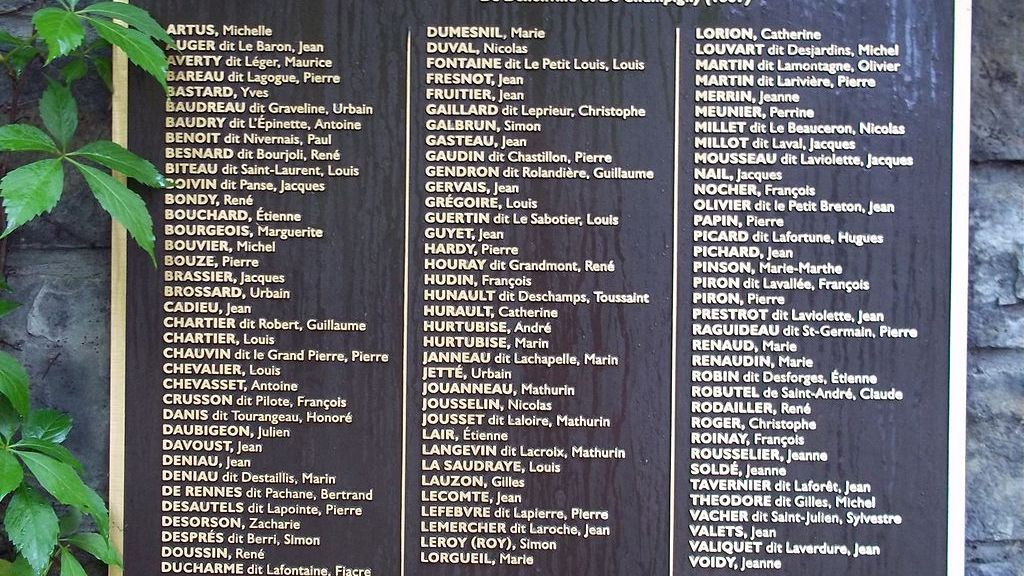
Marin Hurtubise and his brother André were among 154 men recruited by New France Governor Paul Chomedey de Maisonneuve to help protect the Fort Ville-Marie from Iroquois attacks. They signed five-year contracts with the Société de Notre Dame de Montréal to clear uncultivated land in New France for farming at a price of 100 livres per year1. Their employer, also known as the “Company of Montreal,” was originally founded in France in 1639 to establish a colony in Canada.
According to notes left behind by my grandmother, the Hurtubise brothers came from a town known as Sillé-le-Guillaume in Rouesse-Vasse, southwest of Paris in the Sarthe Departement in the Pays de la Loire region.
They travelled to St. Nazaire to join 120 other men and 14 women who set sail for New France on June 20, 1653. Among their ship mates was Marguerite Bourgeoys, a women with a desire to create schools in New France. She also founded the Notre Dame parish and set up housing for the filles du roi. In 1982, Pope Pius XII canonized her as Canada’s first female saint.
The trip in Captain Pierre le Besson’s ‘Saint-Nicolas-de-Nantes’ vessel2 did not go well.
Ships in that era were not the large luxury vessels we cruise on today. According to an unauthored essay that used to appear on the Maison Saint Gabriel website, they measured roughly 25-45 meters long and 8 meters wide. Passengers bunked in a single room at the back of the ship in unsanitary conditions in which everyone slept in their clothes. Buckets collected waste and vomit from those who couldn’t handle seasickness. Meals often consisted of dry biscuits, salt pork and fish.
In this case, the ship also leaked. The ‘Saint-Nicolas-de-Nantes’ took on so much water that after sailing 350 leagues (1600km), the crew had to return to Nantes. Passengers were left on an island off the coast of France to wait for another month until a replacement ship could be found. According to Marguerite Bourgeoys’ diary, some of the recruits deserted their posts and swam back to France.
“Sieur de Maisonneuve and all of his soldiers stopped on an island from which there was no escape. Otherwise, not a single one would have stayed. Some even set about swimming to save themselves since they were furious and believed they had been taken to perdition.”3
On July 20th, after a St. Marguerite’s day mass, the replacement ship set sail for the New World with the Hurtubise brothers and Marguerite Bourgeoys on board. This voyage, which featured many storms, an outbreak of the plague and eight deaths (Jacques Audru, Olivier Beaudoin, René Cadet, Jean Chaudronnier, Louis Doguet, Michel Lecomte, Joachim Lepallier and Pierre Moulières), doesn’t sound any better than the first, save for the sea-worthy vessel.
After 64 days, the ship landed at Cap-Diamant, on September 22, 1653. At that point, it seems that the ship was set on fire in the middle of the river. Bourgeoys’ writings imply that it got stuck so that high tide couldn’t even free it.
For the next two months, New France Governor Jean de Lauzon tried to keep the voluntary soldiers and marriageable women in Quebec to defend that city, in part by refusing to provide the barges needed to sail the Saint Lawrence River to Ville-Marie.
Eventually, de Maisonneuve prevailed. The group arrived at Ville-Marie on November 16th.4 They were all given land grants next to the Saint Laurence River. Later, Marin and five neighbours settled in Côte St. Antoine.5
André Hurtubise died six years after the brothers arrived in Montreal. Marin lasted 19 years, successfully marrying and having six children during that time. He died in Montreal on May 12, 1672.6
5MacKinnon, Janet S. The Settiement and Rural Domestic Architecture of Côte Saint-Antoine, 1675—1874, thesis 2004
6Find a Grave, database and images (https://www.findagrave.com/memorial/144617536/marin-hurtubise: accessed 02 May 2023), memorial page for Marin Hurtubise (26 Oct 1631–12 May 1672), Find a Grave Memorial ID 144617536, citing Ancien cimetière Notre-Dame (1672-1830), Montreal, Montreal Region, Quebec, Canada; Maintained by AW (contributor 47829810).
My grandfather was 26 years old when Canadian Prime Minister William Lyon Mackenzie King recommended the country declare war on Germany in a radio speech on Sunday, September 3, 1939. Seven days later, Canada officially declared war on Germany and created the Royal Canadian Air Force (RCAF) Special Reserve, which was placed on active service.
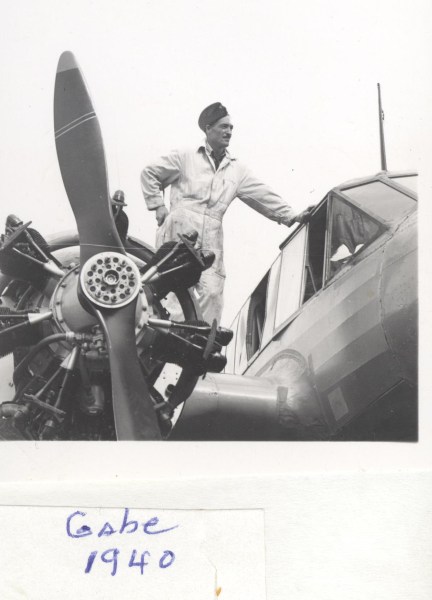
I’m not sure what Grandpa Joseph Isidore Alfred Gabriel Arial was doing that year, but he probably lived in Edmonton after his last known job as a radio inspector ended in February 1936. He may have built and renovated houses with his cousins.
Eventually, he would contribute to what would become the world’s largest flight training program, although like many military volunteers, he never considered his contribution worthwhile. I remember standing in his garage as a 12-year old hearing him tell me how he regretted not doing his part during World War II. It never occurred to me that he had actively served in the RCAF until decades later when I found his release papers. It turns out that he honourably served for from February 20, 1941 to September 5, 1945.
It turns out that he’s among a great many men who volunteered to go to Europe to fight and ended up staying in Canada to keep the British Commonwealth Air Training Plan (BCATP) operational.
Britain, Canada, Australia and New Zealand officially created the British Commonwealth Air Training Plan on December 17, 1939, King’s 65th birthday but efforts to get it going began even earlier than that.
According to Dunmore, the British Commonwealth Air Training Plan began just after Adolf Hitler became chancellor of Germany in January 1933. “The Air Ministry suggested a scheme whereby Canadian, South African, and New Zealand air force cadets could be granted short-service commissions, serve five years in the RAF, then return home for reserve services.”1
Shortly thereafter, in 1936, Vincent Massey, the Canadian High Commissioner to Britain presented British Air Minister Lord Swinton’s suggestion that some airmen be trained in Canada prior to joining the RAF.
Later in 1936, Scottish pilot RAF Group Captain Robert Leckie described a plan to create “a Flying Training School formed in Canada” in a memo to Air Commodore Arthur W. Tedder. In this memo, he pointed out that more than a third of the RAF officers in WWI had been Canadian. The idea was proposed, but the Canadian Cabinet rejected the plan in favour of a Canadian-run training school instead.2
In 1937, 15 Canadians were trained under the plan.
When Germany annexed Austria to the Third Reich in 1938, the Canadian government increased the number of Canadians able to join the RAF to 120 per year and later it went up to 138. That plan attracted a total of 400 Canadian pilots to the RAF.
It took from May 1938 until April 1939 to convince the Canadian Government to train up to 50 British pilots and 75 Canadian pilots. Eight flying clubs, in Calgary, Hamilton, Montreal, Regina, Toronto, Vancouver and Winnipeg were recruited to do the training. In August 1939, five RAF officers (Ken McDonald, Dick Waterhouse, Jackie Mellor, Desmond McGlinn and Leslie Smallman) crossed the Atlantic by ship from Southhampton, England to Montreal and then to Trenton to help set up navigation training in Canada.
By April 29, 1940 the first 168 RCAF recruits entered No. 1 Initial Training School in Toronto getting the BCATP air training plan fully underway. Just in time too. By June that year, France fell to the Nazis.
Over the next four years, Canada built more than 100 pilot training facilities in every province and territory.
“Looking back it is difficult to grasp the BCATP in all its dimensions,” wrote J.F. Hatch, in his 1983 book describing the project. “In themselves, the statistics are impressive: 131,553 [plus 5,296 RAF and Fleet Air Arm personnel trained prior to July 1, 1942] aircrew trained for battle, through a ground structure embracing 105 flying training schools of various kinds, 184 support units and a staff numbering 104,000. When war was declared the RCAF had less than two hundred aircraft suitable for training, many of them obsolete. In December 1943 there were 11,000 aircraft on strength of the BCATP.”3
I suspect that my grandfather kept many of those planes flying as an air mechanic in Fort William. Clearly this work contributed greatly to the allied war effort, but most of the stats about its importance talked about front-line combatants, not the 6,000 behind-the-scenes people who made the project operational.
The Canadian Government post about the project, for example says: “Of the Canadians trained in the BCATP, 25,747 would become pilots: 12,855 navigators; 6,659 air bombers; 12,744 wireless operators; 12,917 air gunners, and 1,913 flight engineers.”4
Also, several of the daily diaries for this period include the arrival of billiard tables, the building of skating rinks, sports tournaments and multiple leisure activities,5 so perhaps it’s no wonder that volunteer soldiers who served on these bases felt like they sat out the war.
1 Dunmore, Spencer. Wings for Victory: The Remarkable Story of the British Commonwealth Air Training Plan in Canada. Toronto, Ont.: McClelland & Stewart, 1994, p10.
2 Dunmore, Spencer. Wings for Victory: The Remarkable Story of the British Commonwealth Air Training Plan in Canada. Toronto, Ont.: McClelland & Stewart, 1994, pp24,25,26.
3 Hatch, F. J. The Aerodrome of Democracy: Canada and the British Commonwealth Air Training Plan, 1939-1945. Ottawa: Directorate of History, Dept. of National Defence, 1983, 222 pages.
An eight-day heat wave that remains the hottest on record may have shortened the life of my great great granddad, who was 96 years old that year.
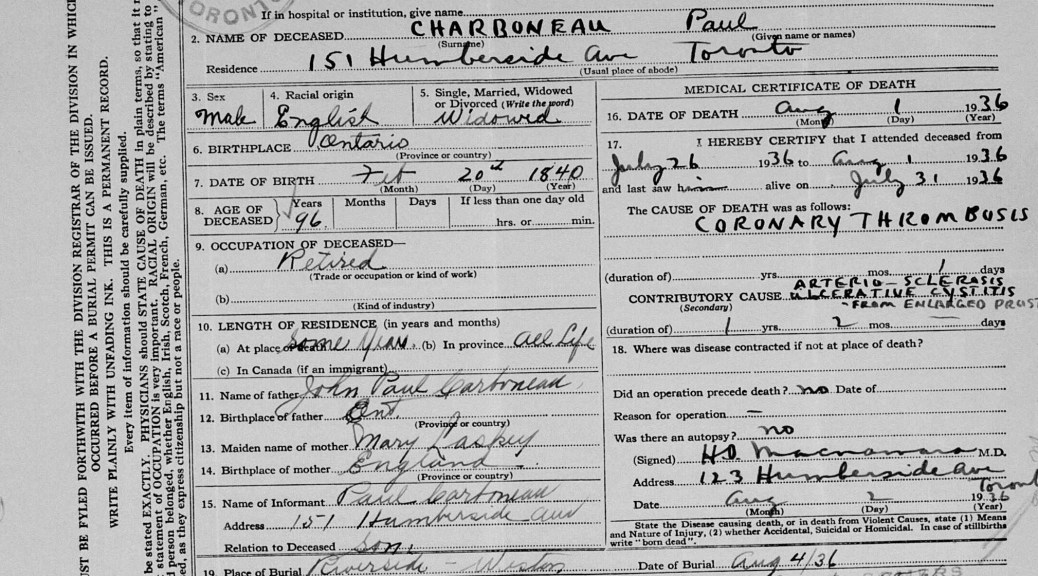
Paul Charboneau died in Toronto, Ontario on August 1, 1936. His death took place four years to the day after his beloved wife Keziah passed away, despite her being 16 years younger than he.1
The couple met and married in Orangeville, Ontario, where their families lived when they were born. The community was then known as Grigg’s Mill before the town itself was officially incorporated in 1863.2 Her family were immigrants—her dad hailed from Scotland, her mom from Ireland. They lived in a mixed farm, like many common in those days. His mom, Mary Laskey. also was an immigrant from England. His dad, another Paul Charboneau, was born in Ontario and may have been the man of the same name who got a land grant from serving in the War of 1812, although I haven’t confirmed that yet. It’s not clear whether they too owned a mixed farm or if they lived in the village while he worked felling timber or taking care of the water mills.
Either way, Paul and Keziah probably knew each other growing up, perhaps at church, since both families worshipped in the Church of England. They married in 1878 and stayed in Orangeville for almost a decade. A census three years after their marriage describes Paul as a cooper, someone who builds barrels for a living.
Orangeville’s heyday diminished by the turn of the 20th Century (although it revived to attract my parents in the 1970s; I grew up in the town).
Sometime prior to 1901, Paul and Kezia moved with nine of their ten children to Weston, Ontario, a then town that now forms part of the greater Toronto area. (My mom’s side of the family lived in Weston for another four generations after Paul and Kezia moved there, including most of her life and the first seven years of mine.)
By then, Paul worked as a labourer. Their first son had married and moved to Toronto with his wife several years earlier.
In the summer of 1936, Grandad Paul was living in a cottage-style home at 151 Humberside Ave. in Weston. Late in July, he went into the Humberside hospital where he died with coronary thrombosis due to arteriolar sclerosis and ulcerative cystitis from an enlarged prostrate.
The poor 96-year-old man must have been very uncomfortable dealing with bladder issues during that record hot summer. Multiple heat waves took place, including the biggest one prior to his death.
Temperatures in Toronto reached 105°F (40.6°C) during three of the eight days that made up with heat wave. Heat-related issues directly killed 275 Torontonians that week, in addition to harming people like my great great grandfather who suffered other ailments.
Hot temperatures remained in place well into August, long after my great great granddad died. The heat wave that summer killed 1,693 people in North America, which puts it sixth on the list of the worlds ten deadliest heat waves ever.3
Can I learn anything about my great great great grandmother’s life, despite having only a name, a birthplace and a rough idea of where she lived as she raised her children?
That challenge led me to a fascinating thesis about the Irish Protestant Identity in Ontario written in 2010 by Brenda Hooper-Goranson. Hooper-Goranson’s research describes how many Irish women of Mary’s time ensured a lasting Irish identity in Canada that differed from that in the homeland.
Thanks to Ms. Hooper-Goranson, I have been able to imagine the life of women like my ancestor in general terms even if her actual life and personality remain obscure.
An Irish Protestant identity was transferred to Canada as solidly intact as any Irish Catholic identity was and it can even be argued that the former outlasted the latter with regard to late nineteenth-early twentieth century Canadianizing influences,” wrote Hopper-Goranson in the introduction of her thesis. “That distinctive presence was changed or softened in only one regard. In time, with the space and distance that Canada afforded, abrading homeland identities might be abridged, and Irish Protestant and Irish Catholic on new soil found opportunities to simply be ‘Irish’.1
People like Mary maintained connections to family in Ireland, helped foster relationships with neighbours, brought recipes, seeds, textiles and furniture from their home country to their new communities and fostered religious practices and apprenticeships in their children.
Whether Mary herself did such things isn’t certain. We do know that she was born in Ireland, thanks to the 1932 death certificate of her daughter.2 That same document mentions her husband’s Scottish roots, the family religion of Brethren, their daughter’s 1856 birth in Orangeville, Canada West and her death in Weston, Ontario.
Those facts allowed me to make several assumptions about my great great grandmother’s life that enabled me to read Hooper-Goranson’s thesis with an eye to imagining more. We know for sure that Mary Willard travelled from Ireland to Canada West at some point, and the decision probably wasn’t hers. A father, a husband—in those days, women didn’t often get to set their own destinies.
Where she lived in Ireland, whether she lived in other places too, whether she married her Scottish husband in Europe or elsewhere, whether they met on a specific journey or after separately travelling to North America isn’t clear. All I know for sure is that Mary Willard identified as Irish; her faith was Protestant; and she and her husband lived in Canada West when her daughter was born. Given that her daughter died in the Grand River region not far from her birth, it’s likely that her parents lived in the same region for most of their lives.
We do know that in the 1800’s, Canada attracted more migrants from Ireland than any other country in the world. When possible, these migrants tended to settle together with others of the same religion, many in Canada West, which became Ontario.
Irish hostilities between Protestants and Catholics became prevalent late in that century. Fenians raided Canada West from Irish communities in the northern states beginning in 1866. Riots broke out in Toronto in 1875, during the Jubilee March and in 1878, when O’Donavon Rossa visited the city to give a speech.
In most Canada West communities, however, Hooper-Goranson argues that the challenges of felling forests, building homes, subsistence farming and mourning the losses from fevers and disease blurred the lines between groups. Often, a general homesickness for Ireland linked Catholic and Protestant settlers together into a common identity.
Class structures brought to the New World from Europe when Mary Willard lived fell apart in a matter of months, primarily to the amount of work required just to stay alive. Women of all stations did everything required to run a household, including helping grow crops for food, making candles, producing soap, grinding sugar, baking bread, milking cows, knitting or spinning clothes and preparing flour or wool. People offering domestic assistance had so many possible positions, they could be choosy.
…the observations of lrish Protestant immigrant James Reford show that he too, took note of a change in the social climate in America when he complained that even Irish Catholic servants “from the bogs of Connoght” expected certain comforts and conveniences far different from Home. “If you want a girl to do housework the first question is have you got hot and cold water in the house, stationary wash tubs, wringer? Is my bedroom carpeted [with] bureau table wash stand and chairs … and what privileges and the wages? … The writer makes the charge that such girls are too ambitious, and deceitful about their previously humble origins.3
Despite the amount of hard work, Irish women in Upper Canada worked hard to match the fashion trends back in Ireland.
After joining her husband in Canada in 1836, Margaret Carrothers wrote several years later from London, Upper Canada, encouraging her mother to make the journey herself with the remittance pay she sent home. Part of her enticement was the reassurance that her mother could look the part of the Irish lady even on the frontier. Although Margaret requested her mother bring the latest patterns of capes, sleeves, cloaks, and bonnets she delighted that ” … Dress of every kind is worn the same here as with you only much richer and gayer …… this has become a very fashionable place you would see more silks worn here in one day than you would see in Maguires bridge in your lifetime and could not tell the difference between the Lady and the Servant Girl as it is not uncommon for her to wear a Silk Cloak and Boa and Muff on her hands and her Bonnet ornamented with artificial flowers and vail.4
Whether hostilities arose or not often depended on whether communities included nationalities beyond Catholic and Protestant Irish. In those cases, rather than differentiating between themselves, Irish settlers saw themselves as a common group against the others.
There were many occasions where Irish Protestants and Irish Catholics found cause with one another enough to march together in support or defiance of Tenants Leagues, Famine Relief, Confederation, Fenianism, Irish politics and personages, and of course, St. Patrick’s Day was held sacred to both.5
Generations of women built up and maintained national communities as religious differences diminished. They married Irish men, stayed in contact with family members in Ireland, collected Irish recipes, crafted Irish patterns onto clothing and household items, learned Irish Dancing and celebrated holidays with neighbours.
Traditionally, Irish families make their plum pudding on the last Sunday in November before the beginning of Advent. Everyone in the household is supposed to stir the mixture, which contains 13 ingredients to represent Christ and his Disciples.
My great granny Charlotte used to make one every year. I remember it being blacker than fruit cake and with a yummy rum topping.
Sadly, her recipe either was never written down or, if it was, it has since been lost. I’ve been trying to duplicate the flavour ever since.
Haven’t managed to get it right yet, but here’s my closest guess so far.
Christmas Plum Pudding
Ingredients
1 cup (250g) brown sugar
Grated zest and juice of 2 oranges
1 cup (250g) dried currants
2 cups (500g) raisins, ideally different colours
1/2 cup (125g) candied cherries
1 can (350ml) stout (I use Buckwheat beer because I can’t eat gluten)
2 cups (250g) all-purpose flour
2 tsp. ground cinnamon
2 tsps nutmeg
ground cloves
1 cup (250g) butter, softened
4 eggs, lightly beaten
1 small apple, peeled, cored, and shredded
Directions
Grease and line three pudding bowls or the cooking vessels of your choice.
Mix everything together except for the eggs and the stout.
Beat the eggs and slowly add them to the mixture.
Pour the stout in slowly, mixing the whole time. This is a good time to get the family involved.
Cover with a clean tea towel and leave overnight.
The next day, preheat the oven to 350 degrees F (130C).
Pour the mixture into the pudding bowls.
Place deeper pans full of water in the oven. Put the bowls into the water so that they are about 2/3rds covered.
Steam for 6 hours.
Set aside in a cool dark place to dry.
On Christmas day, steam the puddings for about 3 hours or until cooked through.
Cut and serve with rum topping.
Rum Topping
Ingredients
1/ cup softened butter
1 cup sugar
2 eggs, beaten
3/4 cup rum, brandy or sherry
1/4 tsp nutmeg
Directions
Combine the sugar and butter with a hand mixer until fluffy and light.
Beat in eggs.
Add rum, brandy or sherry and nutmeg.
Cook over boil water for 5 minutes or so, stirring constantly past the curdling point until the sauce looks smooth.
Pour over the Christmas pudding.
Sources
1Hooper-Goranson, Brenda C. 2012. “No Earthly Distinctions : Irishness and Identity in Nineteenth Century Ontario, 1823-1900.” Dissertation, Library and Archives Canada = Bibliothèque et Archives Canada. McMaster University.
2 “Ontario Deaths, 1869-1937 and Overseas Deaths, 1939-1947,” database with images, FamilySearch (Ontario Deaths, 1869-1937), Deaths > 1932 > no 3918-5556 > image 1593 of 1748; citing Registrar General. Archives of Ontario, Toronto.
4Linen Hall Library, Belfast, Edward N. Carrothers, “Irish Emigrants Letters From Canada, 1839-1870”, (Belfast Northern Ireland, 1951), pp.4-5. Margaret Carrothers, London, U.C. to Mrs. Kirk [Patrick?] Maguiresbridge, Ireland, December 25, 1839.







 Genealogy Ensemble