All posts by Tracey Arial

Unapologetically Canadian, Tracey Arial promotes creative entrepreneurship as an author, cooperative business leader, gardener, family historian and podcaster. Résolument canadien, Tracey Arial promeut l'entrepreneuriat créatif en tant qu'auteure, chef d'entreprise coopérative, jardinière, généalogiste et podcasteuse.

Getting Quotes from Attestation Papers

Attestation papers include declarations or oaths military recruits said out loud

Fourteen days after Canada declared War on Italy and the same day France signed an armistice with the country, my grandfather Richard Charles Himphen left his job as a baker’s helper to enlist in The Irish Regiment of Canada.

He said a declaration out loud, in front of someone whose name looks like Mr. Armstrong Cafo, although it might also be Captain M. Armstrong.

…I hereby engage to serve in the Canadian Active Service Force so long as an emergency, ie, war, invasion, riot or insurrection, real or apprehended, exists, and for the period of demobilization after said emergency ceases to exist, and in any event for a period of not less than one year, provided His Majesty should so require my services.”

Then he said:

I Richard Charles Himphen do solemnly promise and swear (or solemnly declare) that I will be faithful and bear true allegiance to His Majesty.”[1]

I know he said those words because they’re on his attestation papers. Although since no one crossed out one or the other I don’t know whether he “solemnly promised and swore” or “solemnly declared.” I suspect he did both because he was reading from the paper and it says both, but I don’t know.

(Note: If you want to read more about Richard Himphen, I have stories about his life here and here.)

Good Stories Need Quotes

Unless you have an ancestor who participated in a court case or worked as an actor, singer or writer, it can be difficult to obtain quotes from his or her life.

Military recruits, however, usually had to say declarations and oaths out loud in front of a witness and both had to sign to make enlistment legal. If that happened, the declarations and oaths will be on their attestation papers.

You also have the name of the witness if you can read his or her signature.

World War II

Most attestation papers include declarations and/or oaths, but not all. The attestation paper of Harry Denis Davy who enlisted in the Royal Canadian Air Force on February 14, 1919 doesn’t include either an attestation or an oath. Then again, it’s possible that there was a third page missing from his service record.[2]

James Fredrick Devitt served with the same unit and his attestation papers included a declaration and oath.

I James Patrick Devitt do solemnly declare that the foregoing particulars are true, and I hereby engage to serve on active service anywhere in Canada, and also beyond Canada and overseas, in the Royal Canadian Air Force for the duration of the present war, and for the period of demobilization thereafter, and in any event for a period of not less than one year, provided His Majesty should so long require my services.”[3]

Soldiers in other wars said different things.

World War I

During WWI, on October 29, 1915, bank clerk John Glass said:

I hereby engage and agree to serve in the Canadian Over-Seas Expeditionary Force, and to be attached to any arm of the service therein, for the term of one year, or during the war now existing between Great Britain and Germany should that war last longer than one year, and for six months after the termination of that war provided His Majesty should so long require my services, or until legally discharged.”

Boilermaker Arthur Luker said the exact same thing on June 24, 1916.

Steamfitter William Wright said the same thing on September 21, 1914.

Henry Hadley Jr.’s file doesn’t include an oath or declaration. He signed a Officers’ Declaration Paper on December 9, 1915 instead.

South African War

South African war recruits swore at least two declarations and two oaths. Farmer Henry Smith Munro, for example, swore on October 6, 1899 that he would:

…well and truly serve our Sovereign Lady The Queen in the Canadian Contingent for Active Service, until lawfully discharged, and that I will resist Her Majesty’s enemies, and cause Her Majesty’s peace to be kept on land and at sea, and that I will in all matters appertaining to my service faithfully discharge my duty, according to law. So help me God.[4]

Then, on December 24, 1901, he said:

I Henry Smith Munro, do sincerely promise and swear (or solemnly declare) that I will be faithful and bear true allegiance to His Majesty, King Edward VII, His Heirs and Successors and that I will faithfully defend Him and them in Person, Crown and Dignity, against all enemies and will obey all orders of the Officers set over me.[5]

Abbreviations Can be Tricky

As you go through the form, you definitely want to refer to a Canadian Archives’ abbreviations page to understand everything on the form.

Pay careful attention to marital status. Often, wives or husbands had to send letters to the recruiting office giving permission for someone to enlist. These letters are wonderful sources of direct information about your ancestor.

Also, look carefully for typical fields that remain blank. This might indicate that your ancestor intentionally left the field blank to make sure they would not be rejected. Eliza Richardson describes why nurses left several blanks on their attestation forms during World War I.

The Nursing Sisters who did not fit the camc requirements of age, education, and marital status bypassed regulations by deliberately abstaining from marking down pertinent information on their attestation forms. It is only through pairing Toman’s statistics with the personal accounts of Nursing Sisters in the form of letters, memoirs and photographs that these inconsistencies become clear and a more accurate picture of the composition of the Nursing Sisters becomes possible.”[6]

Look for Historical Context

After collecting information from the attestation papers of your relatives, you may want to do a search of academic papers on Google scholar to figure out how the information you learn fits within common assumptions about historical trends.

Now that attestation papers have been more widely digitized, historians have been examining them for health and sociological information. New interesting papers are constantly appearing.

A simple search informed me about a decades-long discussion questioning why statistics show soldiers at the beginning of World War I being shorter than those who served in the Anglo-Boer War even though there were only 14 years between the beginning of one war and the end of the second.

Last February, Martine Mariotti,  Johan Fourie and Kris Inwood from the Australian National University and the universities of Stellenbosch and Guelph came up with a theory to explain the discrepancy in their article Military Technology and Sample Selection Bias.

We posit that new technologies, and the changes in military strategy entailed by those technologies, explain the difference. The Anglo-Boer War, also termed ‘the last gentleman’s war’, was the last war to use cavalry lancers, a military strategy where height is a particular advantage. In contrast, the mechanization of weapons during WWI  meant that soldiers’ heights were no longer so important. In this case, improvements to military technology help to explain the apparent decline in stature between the two wars.[7]

If you have an ancestor who served as a soldier in WWI or the Anglo-Boer War, you might want to mark down his height and compare it to the average height of soldiers at that time. Then you can comment on whether he fits the general trend or not. You might also try to figure out whether his task was height-dependent.

Next Steps

If you want help writing stories about your ancestors using attestation papers, I’m offering a course that begins at the end of the month. You can find more information on my Teachable page. There’s also a free course about my four-step system for writing profiles on that same page.

In the meantime, I’d love to hear what you discover about Canadian military attestation papers in the comments.


Sources

[1] Himphen, Richard Charles; Library and Archives Canada, R112, volume 30826.

[2] Davy, Harry; Library and Archives Canada, RG-24, volume 25178.

[3] Devitt, James Frederick; Library and Archives Canada, RG-24, volume 25203.

[4] Munro, Henry Smith; Department of Veterans Affairs fonds, RG38, volume 11170, T-2079, p1.

[5] Munro, Henry Smith; Department of Veterans Affairs fonds, RG38, volume 11170, T-2079, p10.

[6] Richardson, Eliza. “Sister Soldiers of the Great War: The Nurses of the Canadian Army Medical Corps (Book Review)” by Cynthia Toman,” Canadian Military History: Vol. 27 : Iss. 1, Article 9. Available at: http://scholars.wlu.ca/cmh/vol27/iss1/9, accessed January 5, 2019.

[7] Fourie, Johan, Martine Mariotti and Kris Inwood. “Military Technology and Sample Selection Bias,” Stellenbosch Working Paper Series No. WP03/2018, February 2018, https://www.ekon.sun.ac.za/wpapers/2018/wp032018

 

The Kings’ Daughters: They came to populate New France*

As she boarded the great ship Phoénix de Flessingue in May 1663, Catherine Barré knew she would never return to her hometown of La Rochelle, France.

Did she worry about the ship sinking? Would pirates attack during the six-week journey overseas? What kind of life did she imagine might be waiting for her in New France? How could she agree to marry a man, Maurice Rivet, sight unseen? Did she wonder what their life raising a family together might be like?

I am among Catherine’s 12th generation descendants from my father’s side. Thinking about her courage and resiliency gives me strength, even as I notice myself sharing her impulsive faith-led need to act, sometimes with less information than is desirable.

Despite that flaw, Catherine’s life seems to have worked out, with a few major hiccups.

Escape to New France

Her first hiccup made her choose to be a pawn in King Louis X1V’s scheme to populate New France. In exchange for her agreement to marry and raise a family, she received 10 pounds for her own use, 30 pounds for clothing and grooming paraphernalia and free passage overseas at a cost of 60 pounds.[1]

Today, she’s known as a “King’s Daughter.” More than 800 women travelled to New France during the decade beginning in 1663.

Catherine was among the first women who chose to travel to New France under the sponsorship of her king, but 262 other women made similar choices in the previous three decades. The private “Company of 100 Associates” sponsored them.

Why did these women choose to leave everything they knew in France? We don’t know.

In Catherine’s case, however, it seems likely that she faced persecution due to her religion. Abjuration records place her among thirteen Protestants sent to New France from La Rochelle.[2]

Huguenot Persecution

During this period, the practice of Protestantism by people called the Huguenots was discouraged in France, although not yet illegal. The peace set up by King Henry IV’s Edict of Nantes became eroded over time until his grandson King Louis XIV revoked it in 1685, removing religious freedom entirely. Bishops in New France begged French Finance Minister Jean-Baptiste Colbert to expel the Protestants from the colony as well, but he wouldn’t do it. Many Huguenots were literate craftsmen and business owners who were needed in New France. Also, sending Huguenots overseas eliminated their influence in France. There were no regulations against Huguenot worship in New France until 1676.

Whatever the reason for her departure from France, the daughter of Jean Barré and Marie Epy arrived in Quebec City on June 30, 1663, aboard the Phoénix.

How to Select a Suitor?

She may have had to take a boat ride down the St. Lawrence, stopping from town to town to meet eligible bachelors,[3] although since she was already betrothed, that may not have been necessary. It sounds like a bizarre 15th-century version of speed-dating.

In addition to eventually renouncing her religion, Catherine also renounced the initial man she chose to wed. Or perhaps he renounced her, although that is less likely. Whichever the case, Duquet annulled the contract between Catherine and Maurice Rivet on November 17, 1664.[4]

Vachon wrote a contract between Catherine and Mathurin Chaillé on December 30, 1664.[5]

Marriage Contracts Prior to the Wedding

During this period, all couples signed marriage contracts prior to their church weddings, as Suzanne Boivin Sommerville pointed out in her comment about this story here. She wrote:

“A marriage contract is a legal _promise_ to marry as soon as possible in the Holy, Roman, and Apostolic Catholic Church. It was not the sacrament and legal act of marriage. It could be, and often was, annulled before any religious rite took place. Some women annulled more than one contract before settling on a husband…prospective spouses were the ones to cancel the contract, even at the advice of witnesses or family, not the Church.”[6]

Catherin married Mathurin Chaillé on January 11, 1665 “as soon as could be allowed after the Seasons of Advent and Christmas” wrote Boivin Sommerville.

Boivin Sommerville has prepared a wonderful PowerPoint presentation and several blog posts about the culture and norms in early New France on the French Canadian Heritage Society of Michigan website. Her work is well-worth-reading.

Catherine and Mathurin had their first child, a son nine months after their wedding.

Jean Barré Chaillé

My direct relative was their fourth child, Jean Barré Chaillé. He came along nine years later in 1674. By then the family lived in Sillery after being evicted from their farm on the seigneurie of Beauport.[7]

The couple had six children in total. One son died at 10 years old, but the rest married and had families of their own.

Three of the families lived in Portneuf near their parents, but my ancestor Jean and his brother Henri moved to Montreal. I like to imagine Catherine and her husband Mathurin visiting them on occasion, but haven’t yet found evidence of that.

Summer Deaths

Both Catherine and her husband Mathurin died within a week of each other in the summer of 1707. She was 63 years old. There were record-breaking heatwaves in England and France in July[8], when the couple died, so I wonder if something similar happened in Quebec to cause their deaths?

NOTE:

*I have updated this story based on comments by Suzanne Boivin Sommerville, who has prepared a wonderful PowerPoint presentation and several blog posts about the culture and norms in early New France on the French Canadian Heritage Society of Michigan website. Boivin Sommerville made several points about my errors in her wonderfully-detailed comment about my story here. Yes, Suzanne, you’re right, the initial version of this story didn’t make the difference between a marriage contract and a legal marriage clear, even though I do understand that there was a difference and that women had the right to cancel contracts they made prior to meeting their intended betrothed. Also, there is no indication of why she chose not to marry Rivet. I apologize that it’s taken me so long to update the piece as you so rightly suggested.

Footnotes

[1] Gousse, S., & Wien, T. (n.d.). Filles du Roi. Retrieved from https://www.thecanadianencyclopedia.ca/en/article/filles-du-roi/ on July 18, 2018.

[2] Dawson, Nelson-M. “The “Filles Du Roy” Sent to New France: Protestant, Prostitute or Both?” Historical Reflections / Réflexions Historiques 16, no. 1 (1989): 55-77. http://www.jstor.org/stable/41298906, p64.

[3] Most French Canadians are descended from these 800 women | CBC Canada 2017. (2017, March 30). Retrieved from https://www.cbc.ca/2017/canadathestoryofus/most-french-canadians-are-descended-from-these-800-women-1.4029699 on July 18, 2018.

[4] Inventaire des contrats de mariage du Régime français conservés aux Archives judiciaires de Québec, Volume 1, Roy, Pierre-Georges, 1870-1953 Québec, 1937-1938, p85.

[5]Dee, E. (n.d.). The Families of Beauport – The Chailles. Retrieved from http://www.oocities.org/weallcamefromsomewhere/Beauport/chaille_family.html on July 18, 2018.

[6] Boivin Sommerville, Suzanne, comments about this story here. Boivin Sommerville has prepared a wonderful PowerPoint presentation and several blog posts about the culture and norms in early New France on the French Canadian Heritage Society of Michigan website.

[7] Dee, ibid.

[8] Maruske, James. A Chronological Listing of Early Weather Events retrieved from https://wattsupwiththat.files.wordpress.com/2011/09/weather1.pdf, on 2018.


Who were Marie Sophie Henault-Canada’s parents?

Who were Marie Sophie Henault-Canada’s parents?

My struggle answering this question typifies the trouble I’ve had researching all of my First Nation ancestors. See my stories about St. Anne and Louis Riel .

It’s clear that my four-times great grandmother Marie Sophie (or Séraphie) Henault-Canada was born in the Red River Settlement on April 6, 1818, to parents Marie and Charles Henault-Canada. But who was her father and where did he come from? And who was her mother?

According to notes left to me by my grandmother, Sophie was born to Marie Gris, who was born in an unidentified location on October 30, 1802, and Charles Henault-Canada, who was born in 1793 in Berthier, Quebec. I haven’t been able to find records of his birth in Quebec, so I’m not sure whether that information is accurate.

In fact, it’s hard to confirm any of the information because the documents I’ve found so far seem to conflict and some information can’t be confirmed.

The 1870 Manitoba Census shows a Manitoba-based location in which Sophie was born that looks a bit like “territorial something,” that could refer to the Red River Settlement. In that document, Marie is listed as “Marie Henault” and she appears next to her husband, Charles Henault. Marie, Charles and Sophie are all described as French-speaking Catholic Métis.[1]

Marie and Charles both have 1810 listed as their birthdates in the 1870 Manitoba Census, a rather extraordinary coincidence I think.  Marie Hénault is listed in the 1870 Manitoba Census as 60 years old, however, so the birthdate for her might be correct. If it is, a different Marie may have been Sophie’s mother.

A Hudson Bay Company Census conducted the same year[2] doesn’t list a Marie Henault, but it does show Marie Gris living on a farm on lot 8 in Pointe-des-Chênes with her daughter, granddaughter and another woman and her child. A second house on the same lot is home to Sophie’s aunt Catherine and her husband Francois Ducharme.[3]

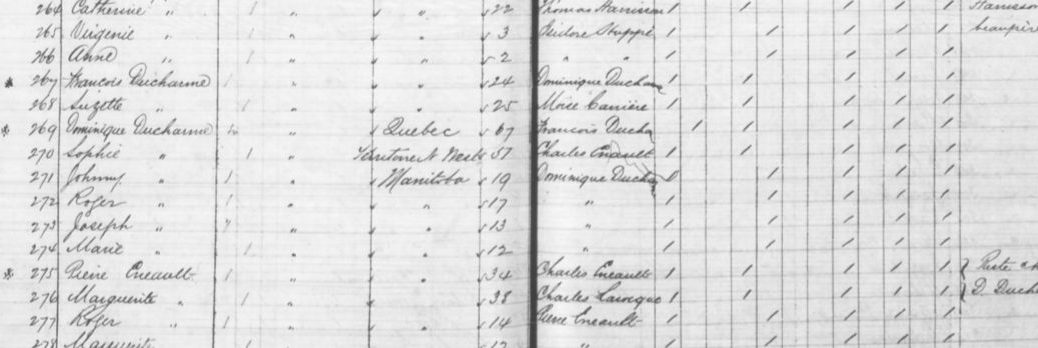
Her older daughter Sophie was married to Dominique Ducharme-Charron by then. The couple was living on lot 27 with four of their children Johnny 19, Roger 17, Joseph 13 and Marie, 12.[4]

The Hudson Bay Census also lists Sophie’s father, Charles Henault/ Heneault/ Haineault/ Henault dit Canada/ Enaud dit Canada/ Enaud/ Enault “Métis, born 1810; farmer in his life time” as dead, although the document doesn’t say when exactly he died. My grandmother doesn’t show a date for that either. Perhaps he died that very year, 1870?

The date 1810 next to Charles’ name might refer to the date he arrived in the Red River Settlement rather than his birthdate. He may have come from elsewhere to Manitoba to work for the North West Company Fort Gibraltar trading post, which was set up in 1809.  Or maybe it’s correct because my grandmother also shows his father, Pierre Énault-Canada as born in Berthier on August 9, 1730, which would be possible if his son were born in 1810. She shows his father as another Pierre Énault-Canada and his mother as Marguerite Piette-Tremp, whose parents and grandparents are all identified, though with no dates.

Hall’s appendix gives me access to two other potential ancestors beyond my grandmother’s notes. Her father was a Cree man named Thomas Gris and her mother was Marie Nepissing. Then again, if this Marie is not Sophie’s mother, they are not my ancestors.

Guess I have a bit of work to do.


[1] Canada, L. A. (2016, June 23). 1870 Census of Manitoba. Retrieved January 23, 2018, from http://data2.collectionscanada.gc.ca/1870/pdf/e010985547.pdf.

[2] Hudson’s Bay Company Archives, E.6/1-16. Land records of the Red River Settlement sent to the Governor and Committee, 1811–1871.

[3] The 1870 Manitoba Census identifies Catherine and Francois living in St. Anne as Métis, French-speaking and Catholic. It also shows Catherine’s father as Charles Henault, lines 126, 127, p231,5. The information was collected on October 27, 1870, and residence was established as of July 16, 1870.

[4]http://data2.collectionscanada.gc.ca/1870/pdf/e010985551.pdf


Québec Genealogical eSociety: A New Type of Family Research Society

I just joined the Québec Genealogical eSociety for $45 Cdn.

Johanne Gervais, a professional genealogist who is passionate about researching Quebec records, founded this online research society last month. It operates in both English and French.

In addition to participating in webinars, the membership will give me access to two important Quebec databases: the BMS2000 and the PRDH database.

According to the website:

The BMS2000 database contains:

BMS records (births, marriages and deaths) from 24 genealogical societies of Québec. Close to 10 million BMS records have been collected.

The PRDH database (The Research Program in Historical Demography) contains:

A repertory of vital events, 1621–1849, for Québec, which includes approximately 2.3 million baptismal, marriage, and burial certificates registered in Catholic parishes prior to 1850. Also included are approximately 26,000 Protestant marriages recorded before 1850 and more than 20,000 certificates of various other types: census records, marriage contracts, confirmations, and lists of immigrants.

A genealogical dictionary of families, 1621-1824 for Québec, which offers a reconstruction of the history of all families who settled in the St. Lawrence Valley, or roughly the current territory of today’s province of Québec, from the beginning of French colonization to 1824.

A repertory of couples and filial relations, 1621–1824 for Québec, which specifies for each spouse the names of his or her parents and the names of his or her other spouses, if applicable, with a link to these couples. In addition, a list of the couple’s children who married before 1824 is supplied, with a link to their first marriage.

If you want to learn more about the society, visit their website or stop by their table at RootsTech2018.

Congratulations on your launch Johanne!

Genealogy Standards

For years, I found the differences between primary and secondary sources confusing. Add the fact that you can have original and derivative versions of both and that either can be negative or positive proof and it all sounds like mumble jumble to someone who isn’t used to them all. Luckily, the glossary within the Board for Certification of Genealogists “Geneology Standards” manual makes all the important distinctions very clear.

For example, on page 72, the glossary defines “primary information” as:

A report of an event or circumstance by an eyewitness or participant; the opposite of secondary information.

This is just one of many confusing nonfiction research terms that are clearly defined in very simple language. The chapters within this pithy guide cover how to plan and research a story. It also shows how to properly cite sources. Several pointers throughout the guide clarify some of the most challenging nonfiction research challenges.

If you want to document, research and write stories about ancestors’ experiences, the guide is a must-have. In my opinion, it’s equally useful for any obsessive nonfiction researcher and writer who wants to communicate carefully and accurately.

Board for Certification of Genealogists Genealogy Standards. Edited by Thomas W. Jones. Washington: Turner Publishing Company, 2014. ISBN 978-1-630-26018-7


Sad death

One of the first Canadian women who enlisted into the Royal Canadian Air Force committed suicide less than a year later.

Ten days after her 29th birthday, Hazel Winnifred Webb Seymour left a steady job with the Bell Telephone Company of Canada to enlist in the Canadian Women’s Auxiliary Air Force. The unit operated under the motto: “we serve that men may fly.”

Ten months later, she swallowed three bottles of cleansers (iodine, cresol and carbolic acid) while in the hospital for hysteria. She died on September 10, 1942.

When she joined the Royal Canadian Air Force (RCAF), Webb Seymour seemed like the perfect candidate. She was healthy, high-school educated, the right age and height, and well-trained in administrative duties. She was married, and had been for seven years, but the couple had no children as he was deployed overseas.

Her early days in the Air Force reinforced her aptitude for the job. One test resulted in the comment:

“One of the best on the course – always cheerful and will make a wonderfully reliable and good N.C.O. Suitable for a difficult station.”

An “assessment of character” completed in March 1942 also contained high praise: “industrious, capable, willing worker,” “highly resourceful,” and “merits accelerated promotion.”

Four months later, Seymour was admitted to the Station Hospital with something so serious, she stayed for eight days. From then on, she went in and out of hospitals, both civilian and military, until her suicide.

During an inquest about her death, Flight Lieutenant Allan Campbell Blair described what happened in the final three days of her life.

“It was considered that before she should be discharged on the grounds of this nervous disorder that it would be worthwhile to give her another chance and to this end was admitted to Station Hospital again to be kept under observation and the be employed doing small jobs about the hospital which was thought might be of benefit to her. She was apparently responding and there was, in my opinion, no need to restrict her freedom about the hospital. There was no evidence or intentions from her that she was planning self destruction. On September 10, at 1205 hours as Dr. Williams and myself were leaving the hospital we encountered her in the hall holding an iodine soaked stained towel to her mouth and she stated that she had just drunk three bottles of poison….”[1]

After she died, her mother wrote to the military needing help.

“The funeral refund has not been sent to me and I really need that amount to help with my winters’ coal, if I can get any.”[2]

Despite those pleas, the only cheque to the family reimbursed $154.16 they paid for Webb Seymour’s funeral.


Note: This story is a mini-version of a chapter in Tracey’s upcoming book: Steady Hands, Brave Heart: World War II’s effect on Canada.

[1] Seymour, Hazel Winnifred; Library and Archives Canada, RG-24, volume 28621, testimony, Allan Campbell Blair, C3966.

[2] Seymour, Hazel Winnifred; Library and Archives Canada, RG-24, volume 28621, letter, Pearl Web, August 28, 1943.

Enjoying the Story of Westmount

I began looking for traces of the Huguenots that my grandmother always told me were in the family. First, I looked for anyone born in Blois, Orléans, Paris, Rouen or Tours France sometime after the Affair of the Placards. These are the towns in which people posted signs questioning Catholic dogma overnight on October 17, 1534. The incident set off the reformation and eventually led to hangings and mass migration of Protestants out of France.

Unfortunately, my genealogical records don’t extend far into France during the 1500s, so that research will be for another day.

My journey through the Hurtubise side of my family, however, led me upon a wonderful history of Westmount called A View of Their Own: The Story of Westmount, written by Aline Gubbay in 1998. The little guide introduced me to several early maps of Montreal I hadn’t seen before, Montreal’s Mohawk name “”Kawanote Teiontiakon” and a hint about how some of my distant ancestors lived. Gubbay describes the geology of Montreal in a way that allows you to really imagine how things used to be.

The western part of the island was distinguished by a little mountain Westmount — some 600 feet high, formed by an outcropping of a larger rise, Mount Royal. Iroquoians had discovered that the slope of the little mountain, facing south-east, was sheltered from the strongest northern winds, a factor which, together with abundant water from the mountain springs, made for a richly fertile soil where they could cultivate their traditional crops of beans and corn. (p 11)

My ancestors get a small mention on page 15:

One by one the families arrived, settling along the Indian trail now given the name of Côte St. Antoine. They included names such as Des Carries (sic), Prud’homme, Leduc, Pierre et Jean Hurtubise, and St. Germain.

(Fascinating how Gubbay missed the French word “et” in her paragraph, something I frequently do in my texts. Bilingualism can be quite troubling sometimes.)

She continues:

Most of the men were artisans, recruited from towns of northern France for their skills as stonemasons, millers, brewers, but they soon acquired the new skills necessary to clear and cultivate the land. In winter, after the land had been cleared, the trunks of the trees were gathered, carried down to the water and lashed together on the rim of a frozen lake, Lac St. Pierre. When the ice melted in the spring the lumber was floated through a short inlet to the St. Lawrence River and rafted along the shore for sale at Ville Marie, now renamed Montreal.

If you have Clarks, Dawsons, Dionnes, Elgins, Enslies, Hays, Hendersons, Lighthalls, Mackays, Monks, Murrays, Newnhams, Ohmans, Parés, Shearers, Smithers or Timmins in your family, you’ll find gems about their lives in this book. If you appreciate reading about the Town of Westmount, the borough of NDG or Montreal history, this is definitely a story you’ll want to discover.

At only 151 pages, A View of their Own: The Story of Westmount is a quick and easy read. Gubbays smooth writing style and her use of many anecdotes make it entertaining as well. I highly recommend it.

Happy on the farm

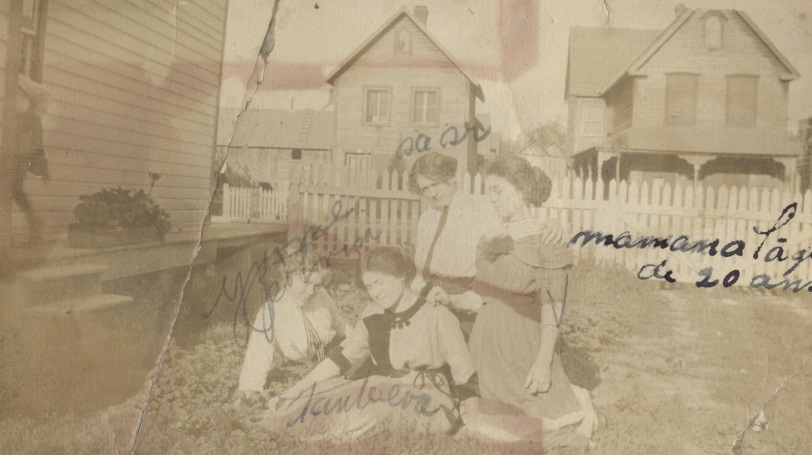
When my aunt turned ninety-six a few years ago, I prepared a short bio of her life, including photos of the farm where she grew up, baptism`s, confirmations and a wonderful photo of four people working in a farm yard.

Handwriting on the photo says “maman a l’age de 20 ans” and “papa” to identify my great grandmother, Marie-Berthe Charette and my great grandfather,  with her two sisters “tante Eva” and “tante Ida.”

They are all on their knees, looking at the photographer. Jean is staring towards Marie-Berthe, who was also called Martha, with an extremely happy look on his face.

The shot is the only happy photo I have of the couple. In every other shot, they look solemn or downright miserable.

Martha was born on October 3, 1889, so if the note about her age is correct, the photo would have have been taken in 1909 or 1910, five years prior to their marriage. There’s no indication where the photo was taken. It could have been his parents’ farm, her parents’ farm, or given that they are also in the shot, perhaps even the farm where his brother Gustave and her sister Ida moved after they were married.[1]

Both Charette farms were in Clarence Creek, where their families had lived since at least 1891. His family farm was located in Sarsfield, a town right next door near the current Ottawa, Ontario.

The first Hurtubese/Charette couple was already married by the time of the happy photo in my grandmother’s photo album. Later, it would be Jean-Baptiste and Martha’s turn, then his younger brother Francois and her younger sister Dora.

All three couples would eventually follow middle Charette son Ernest, who began farming in Alberta.

My cousin says his mother used to talk about a horse and buggy ride after their family lost a farm due to a train expropriation. My aunt spoke to him about remembering her mom’s tears. I don’t know whether that trip precipitated their move to Alberta or took place afterwards.

All I know for sure is that after this photo was taken, the couple had two little girls, Donna and Marguerite. Then, sometime after their second daughters’ birth in 1917 and the 1921 Canadian Census, they bought a farm with a three-bedroom wooden house on it in Bow River, Alberta.[2]

After that, their life took a turn for the worse, and they lost everything. The dust bowl, the Depression, locusts…take your pick, they saw it all.

By 1941, the family was renting part of a house in Edmonton. He did odd jobs to get through the war years and beyond. They remained in Edmonton until her death in 1957 and his in 1959.

————————-

[1] Data from the 1911 Census of Canada, Enumeration District 21, Cumberland Township, Russell, Ontario, Sarsfield Village, Léonard Village, Bear Brook Village, page 7, line 48.

[2] Data from the 1921 Census of Canada, Enumeration District 2, Bow River, Alberta, section 7, township 22, range 21, Meridian 4, page 6, line 28.

Our book “Beads in a Necklace” launches today!

I’m so excited. Our book comes home from the printer today and we’re planning a fun celebration of its existence tonight.

Here’s how we’ve described our creation on the backcover:

Book back cover photo

A Fun Collaboration

This work came to shape slowly over time. Lucy Anglin, Barb Angus, Marian Bulford, Janice Hamilton, Claire Lindell, Sandra McHugh, Dorothy Nixon, Mary Sutherland and I have been gathering monthly for five years. Together, we’ve learned how to craft our research into our ancestors into compelling literary non-fiction  that anyone might enjoy reading.

Late last year, we began speaking about the possibility of putting our favourite stories together into a book.

Today, our dream takes shape. In this work, you’ll meet several of our ancestors, including:

  • Fille du roi Anne Thomas, who married master carpenter Claude Jodoin in Montreal way back in 1666;
  • Felicité Poulin, 18th-century career woman, Ursuline nun and matchmaker;
  • Stanley Bagg, Massachusetts-born merchant who helped build the Lachine Canal in the 1820s;
  • Gospel singer Edward McHugh, whose 1910-period debut at the Montreal Hunt Club launched an international career; and
  • William Anglin, respected Victorian-era Kingston, Ontario surgeon and wannabe thought-reader.

For more information, refer to our book webpage.

Official Book Launch Tonight

Tonight from 7 until 9 p.m., we’ll be celebrating our creation in the hall of the St. John the Baptist Church, 233 St. Claire Street in Pointe-Claire. If you’re in Montreal, feel free to join us for wine, cheese, sandwiches, home-made treats and a couple of readings from the book.

We’ve also put together some photographs and heritage items for a display to highlight some of the stories.

A self-published limited edition paperback will be on sale for $20.

To Get Your Copy

It’s on sale for $20 in Montreal at

  • Livres Presque 9/Nearly New Books, 5885 Sherbrooke O; Montreal, Quebec H4A 1X6, (514)482-7323;
  • Coles, 366 Avenue Dorval, Dorval, QC H9S 3H8;
  • Clio, Plaza Point-Claire, 215 N. St. Jean, Pointe-Claire, Quebec H9R 3J1; and
  • May’s Studio, 459 Main Road, Hudson, Quebec.

The Ontario Genealogical Society has a digital copy available for $3.80.

An Amazon Kindle edition is also available for $3.89.

Hope you enjoy reading our work as much as we enjoyed writing it. I’d love to hear your comments below.

Etiennette Alton’s Verdun Years

Imagine my surprise to discover that my ancestors lived in my neighbourhood more than three hundred years ago.

At that time, Verdun’s Crawford Park was a very different place than it is today. Today, the neighbourhood encompasses about 1000 people in about 20 city blocks between the St. Lawrence River to the aquaduct in the north and between the Douglas Research Institute and the borough of LaSalle to the west. In 2006, more than 20,000 people lived here.

When my ancestor Étiennette Alton lived here, however, the neighbourhood was known as the fief de Verdun and it extended further north through Angrignon Park and the St. Jacques Escarpment.

She moved here after marrying her second husband, Barthélémy Vinet dit La Reinte on Monday, June 13, 1672. She already had three sons and a daughter from her first marriage. Her fifth child, their first son, Martin was born a little later the same year.

The family were among 83 families in the neighbourhood, according to the 1681 census.

The census reads :

« Barthelemy Vinet 48; Etiennet Alton, sa femme 42; enfants : Pierre 20, Jean 16, Louis 14, Marie 11, Martin 9, Gunégonde 7, Madeleine 6, Guillaume 3; 3 fusils; 18 bêtes à cornes; 20 arpents en valeur. »

The couple had five more children in the following fifteen years. They could afford them. Her husband worked for Sieur Jean-Baptiste Migeon de Branssat, an attorney and later judge with the manor of Montréal.

At that time most men—including Vinet, Migeon, and Montreal Governor Francois-Marie Perrot—earned significant portions of their income from hunting and selling furs. The market for furs, however, was diminishing.

In 1676, a new law forced fur traders to obtain licences, although few bothered to do so.

A year later, Migeon was appointed judge and asked to create a public inquiry into the fur trade industry. During that inquiry, he discovered that most elite, including the Governor himself, were illegally involved in the fur trade. The Governor responded by accusing Migeon of breaking the same laws and putting him under house arrest to halt the inquiry before its results could be known.