Category Archives: Canadian Province

Miss Lindsay – Part 3

Miss Marguerite Lindsay, working as a summer volunteer teacher, went missing from the Grenfell Mission in Cartwright, Labrador, in August 1922. Her body was finally discovered four months later, in December 1922.

The nearby authorities in Battle Harbour were notified immediately, as was her family in Montreal. When her body was gently pried loose from its frozen grave, they were stunned to discover a bullet wound in Miss Lindsay’s chest.

John Martin, the young trapper who found her body, was unable to provide any more information upon further questioning. When interviewed over 50 years later, he recalled his sad discovery that day by remarking: “Twas a remarkable place where she was found. There was a pool (Salt Water Pond) with two big junipers beside it. It was only about 15 minutes walk from the (Muddy Bay) boarding school.”1

Journalists suddenly had ample new fodder for their newspapers, and the story of Miss Lindsay dramatically bounced back into the headlines. Murder? Suicide? Accidental death?

In no time at all, a bullet wound in her chest evolved into riveting stories of “foul play,” a “love affair gone wrong,” or “shot through the heart” and other sensational headlines that sell newspapers. However, the possibility of a tragic and fatal accident was barely mentioned, as that version wouldn’t satisfy scandal hungry readers.

After three inconclusive investigations, Detective Head Constable Byrne was dispatched to Cartwright nine months later, in September 1923. Twenty-two local Cartwright people were interviewed in an effort to gather more information and rule out the rumours of foul play and murder.

Fifty years later, in 1976, Ida Sheppard recalled that time in another interview “I was workin’ at the Muddy Bay School when Miss Lindsay got lost. We were all cryin’ for her ‘cause we fair loved her, she was such a nice person.” This poignant statement seems to echo the sentiment of the people of Cartwright even to this day.2

Eventually Detective Byrne concluded the following in his statements to the press:

          “The presumption is that Miss Lindsay on her way to take a bath in Salt Water Pond into which the brook flows, stopped to shoot some muskrat which abound in the river, and that she fell on the firearm which she was known to have carried.”3

           “The postmortem examination held at Cartwright showed that a bullet had entered the left side, passed through the heart and out on the other side of the body. From this it is concluded that Miss Lindsay must have fallen on the weapon as it was almost impossible to turn it on herself in the direction.”4

In her coat pocket were a dozen bullets that would fit her Browning pistol, also supporting the accidental death theory.5

Detective Byrne terminated his investigation with the statement: “The postmortem disclosed nothing which would tend to indicate deliberate suicide.”6

Once the sea ice had melted in June 1923, permitting navigaton once again, Miss Lindsay’s body (preserved in salt) was transported to St. John’s, Newfoundland. There a funeral was held for Miss Lindsay before her body was taken by train back to her family in Montreal.

           “As the cortege wound its way to the railway station, citizens stood with uncovered heads evidencing their respect for the departed heroine and sympathy for the sorrowing relatives at home. Marguerite Lindsay will rank with the great women of the world who have given their lives for others”. 7

She was finally laid to rest in the family plot in the Mount Royal cemetery in Montreal where, as it happens, I went to visit her recently.

So whether someone today strolls by “Miss Lindsay’s Marsh,” fingers her name on the local church’s plaque8, listens to a song written in her honour9 or reads a poem written by school children… the Cartwright community continues to honour Marguerite’s memory almost 100 years after her death.

Now that’s a legacy!

The grave of Helen Frances Marguerite Lindsay

1“I found Miss Lindsay,” John Martin, 1976, Cartwright, Labrador. Researcher Doris Saunders.

2“We Fair Loved Her,” Ida Sheppard, 1976, Happy Valley, Labrador. Researcher Doris Saunders.

3Evening Telegram, “Miss Lindsay’s Death Accidental,” September 24,1923.

4Evening Telegram, “Miss Lindsay’s Death Accidental,” September 24,1923.

5Evening Telegram, “Miss Lindsay’s Death Accidental,” September 24,1923.

6Evening Telegram, “Miss Lindsay’s Death Accidental,” September 24,1923.

7Evening Telegram, “Miss Lindsay’s Death Accidental,” September 24,1923.

8St. Peter’s Anglican Church, Cartwright, Labrador

9“Somewhere Beyond the Hills,” words and music by Harry Martin

Notes:

Miss Marguerite Lindsay 

By: Adam Dyson and Brandon Cabot (Grade 4 – Henry Gordon Academy, Cartwright, Labrador)

Once on a summer day in 1922,

A fine young lady died and only a few know.

What happened to her is a mystery,

And will every be part of Cartwright’s history.

Harry Martin wrote a song, we really thank him.

They know that the chance she was alive was very slim.

The newspaper says a mystery was found,

The dogs found her body in a snowy mound.

She went for a walk 15 minutes away,

From a land she loved called Muddy Bay.

She never came back, not even the next day,

She was supposed to catch a boat heading far far away.

She was found by the edge of a big marsh,

The winters were violent an her death was harsh.

Miss Lindsay and her life at Muddy Bay,

Is a mystery that is unsolved today.

Somewhere Beyond the Hills 

Words and Music – Harry Martin of Cartwright, Labrador

Have you ever wondered, as you listened to the wind,
What secrets does she carry, what sad things had she seen?
Well, I’ve listened to her stories a thousand times before,
But still, I have to question her once more.

What happened on that summer’s day in 1922?
Has been talked about by many but the truth is known by few;
And those who knew the answer have been silenced by the years,
But suspicion on the wind have reached my ears.

Someone said somebody knew but when he spoke he lied,
Others said they saw them talking on the day she died;
When the darkness found her she was silent, cold and still,
And her body lay somewhere beyond the hill.

Somewhere in some city a grey-haired mother prays,
Please, God, protect my angel in that land so far away;
But tonight her youngest daughter lies asleep beneath the snow,
In a winter land so far away from home.

Then one cold December day a mystery was unveiled;
They found the poor young maiden there beside a trapper’s trail;
Her body, cold and lifeless, had a bullet through the breast,
Now, the reason why won’t let this poor soul rest.

I have often wondered, as I listened to the wind,
What secrets did she carry, what sad things had she seen?

But those who knew the answers are no silent, cold and still,

And the secret lies somewhere beyond the hill.

Protestants in Quebec

Recently, the news media reported that Quebec Premier François Legault stated that “all” French Canadians are Catholic. While it is true that, historically, almost all francophone Quebecers were Catholic, today many are lapsed Catholics while others are atheists. There are also those who, for a variety of reasons, switched from the Catholic Church to a Protestant religion.

In my own case, I became a Protestant in my mid-forties. My father, Lionel Gagné, was also a Protestant. At a young age, he lost both his Catholic parents and was placed in a Catholic orphanage in east-end Montreal. At about the age of seven or eight, he was taken in by a Huguenot teacher and his wife, a Presbyterian from Massachusetts, who were teachers at a bilingual Protestant College in Pointe-aux-Trembles. This college was operated and financed at the time by McGill University and the Presbyterian Church of Canada.

Like many people, Premier Legault is probably not aware that a small minority of French Quebecers had Protestant ancestors, many of whom were forced to give up their religion when they settled here. Genealogist Michel Barbeau has estimated that about 320 Huguenots, or French-speaking Protestants, settled in New France between 1634 and 1763. See the database of names he identified as Huguenots: http://pages.infinit.net/barbeaum/fichier/index.htm). You can read more about the history of the Huguenots on Barbeau’s website Our Huguenot Ancestors, http://pages.infinit.net/barbeaum/huga/index.htm

Many of these people came to North America to escape from persecution in Europe, however, they did not find life much easier in New France. Many were forced to abjure, or renounce, their religion and others became Catholic after marrying in the Catholic Church. Those who remained Protestant were banned from certain trades, while some had their possessions confiscated.

Here are links to two of my research guides to the Huguenots of New France:

https://genealogyensemble.com/2014/04/02/huguenot-refugees/

https://genealogyensemble.com/2015/02/03/register-of-abjurations/

The following article describes the early Protestant churches of Quebec City:

https://genealogyensemble.com/2019/02/03/the-protestant-churches-of-quebec-city-1629-1759/

In addition to being a list of French-language Protestant churches and their ministers, the research guide below includes an excellent article by Réne Péron about the lives of Protestants in New France, a list of books and authors who have written on the subject, and contact information for the archives of Protestant churches where you can find church registries:

https://genealogyensemble.com/2015/11/22/french-protestant-churches-in-quebec/

The following research guide is a list of villages, towns and townships across Quebec where people from a variety of origins, including Huguenots, settled:

https://genealogyensemble.com/2015/04/08/british-irish-scottish-loyalist-american-german-scandinavian-dutch-huguenot-families-in-lower-canada-and-quebec-1760/

In 2020, I will be posting a series of articles about the Huguenots in Europe. The first will focus on the Protestants of Paris and surrounding region in the 16th and 17th centuries.

Miss Lindsay – Part 2

In June 1922, Miss Marguerite Lindsay arrived as a summer volunteer with the Grenfell Mission in Cartwright, Labrador. Two months later she went missing.

When Miss Lindsay didn’t return from her afternoon walk that fateful day, an extensive search took place immediately. All of Cartwright took part and did their utmost to find her.

Indeed, Marguerite was held in such great affection by the local children and their families that a thorough search of the area was made by her boy pupils, who combed the shoreline and nearby woods inch-by-inch.

Reverend Gordon, with several others, took a motorboat and cruised along the Cartwright shore without luck. They concluded that she must have drowned, perhaps by hitting her head while swimming or falling down some cliff into the fast tidal currents, which then carried her away.

It wasn’t long before the news got out. On August 15, 1922, The Evening Telegram in St. John’s, Newfoundland, published the first of many articles about the fate of Miss Marguerite Lindsay with the headline: “Tragedy at Cartwright – Volunteer Teacher Supposed Drowned.” This was the type of sensational story that sold newspapers and, for the next year, the media worldwide went wild with it.

In one extreme case of yellow journalism, several American tabloids published an article which originated in Britain, devoting an entire page to an appalling story with this ridiculous headline:

“Kidnapped by Savage Eskimos – Beautiful Canadian Girl Suffers As Tragic a Fate As Ever Befell a White Woman; Carried Off by the Dreaded “Fish Fang” Tribe Into the Trackless Wastes of Labrador.” 1

IMG_1576

The article described, in horrific fictional detail, Miss Lindsay’s new life as the captive wife of one of the imaginary savages. One can only hope that her family didn’t read these newspapers.

A month after her disappearance, in September 1922, my great uncle Stanley Lindsay, another of Marguerite’s brothers, arrived in Cartwright by ship. Unfortunately, nothing was accomplished by his northern trip except the melancholy satisfaction of learning firsthand that no effort was spared to trace his sister. He simply thanked the good people of Cartwright for all they had done.

Imagine their relief at his kind words.

Upon Stanley’s return, the Lindsay family held a memorial service in Montreal at the Church of St John the Evangelist in October 1922. Reverend and Mrs. Gordon attended the “impressive ceremony” on behalf of The Grenfell Mission and the people of Cartwright.

Helen Frances Marguerite Lindsay 1896-1922

On December 13, 1922, four months after her disappearance, Marguerite’s body was discovered by John Martin, one of two trappers whose dogs dug deep into the snow by the shoreline. The frost had heaved her body upward out of the bog.

Sadly, Miss Lindsay’s boy pupils had been searching within ten yards of her body but the Indian Tea bushes native to the area had hidden her.2

She was fully clothed, her exposed frozen face was disfigured and… she had a bullet hole in her chest.

Miss Lindsay – Part 1

Miss Lindsay – Part 3

how i came to write miss lindsay’s tale

1 The Springfield News Leader 10 Dec 1922 – https://newpapers.com/newspaper/39664723

2The Evening Telegram 24 Sept 1923

Notaries in Lower Canada

The Notaries of Quebec who Served among Loyalist, British, Scottish, Irish, Germanic and American Families during the British Military Period in Lower Canada

Beginning with the French regime (1635) and continuing after the British conquest (post Plains of Abraham,1759,) the people of Quebec were privy to a judicial system that guaranteed the setting down in writing of marriage contracts, wills and testaments, after-death inventories, business engagements, leases, sales, purchases of houses or farms, etc. Transactions of all types were recorded by notaries within the three judicial districts of New France: Quebec City, Montreal and Trois-Rivières.

Many of the post-conquest documents are available at the Bibliothèque et Archives nationales du Québec (BAnQ) online or on microfilm.

After the British conquest of 1759, Governor James Murray at Quebec City, Thomas Gage at Montreal, and Ralph Burton at Trois-Rivières began the process of interviewing notaries who had been previously appointed under the French regime by Governor Pierre de Rigaud, Marquis de Vaudreuil-Cavagnal.

The majority of French-born notaries elected to return to France while most of the native-born notaries decided to stay. These native-born notaries were interviewed once again by the Chief Justice and Attorney General.

This research guide to British military period notaries in Lower Canada will guide you directly to the relevant BAnQ webpages containing biographies of these individuals, along with descriptions of the contents of their respective fonds.

Click here to see the attached pdf research guide: Notaries Loyalists British Scottish research guide

******

Here are some of the many expressions you will encounter among notarial acts written in the French language:

Abandon – Action in which one renounces, relinquishes, or dispenses with a property, farm, house, barns, farm equipment, farm animals.

Acceptation – Action in which one agrees to accept the final transfer of rights or assets

Acte de dernières volontés – (final wishes) See Testament

Acte soussigné privé – Agreement reached by two parties (persons) without the intervention of a court official (public officer)

Adoption – Adoption

Contrat de mariage – Marriage contract

Curatelle – Judicial acts – Authority given to an adult individual by the justice system (Regional Court House) or by an assembly of family members in order for the selected person to be the administrator of all assets, funds and capital for those who are not capable of managing their own assets

Inventaire – After-death inventory

Jugement – Acte judiciaire – Judgement, verdict, decision, ruling, pronouncement

Partage – The allocation to a group of people (family members, in most cases) of assets, funds, capital, lands, farms, houses, barns, farm animals

Testament – Wills and testaments

Tutelle – Authority accorded to a person by law or by the wishes of a testator or by an assembly of family members in order for that person to be the guardian of a emancipated minor and for the chosen person to be the overseer and administrator of all assets and funds obtained through a will from the minor’s parents.

*****

Please note:   Some of the notarial acts can be viewed online, others can be accessed on microfilm or microfiche at various repositories of the Bibliothèque et Archives nationales du Québec (BAnQ). At the BAnQ, all files downloaded are free. All dossiers requested by email are also viewed for free. See details at the conclusion of this research guide.

In addition, some notarial acts of Quebec can be viewed online at Ancestry.ca (Ancestry.com), Généalogie Québec (Genealogy Quebec) or FamilySearch.org. The latter is free to anyone who completes the online membership request, giving access to all databases stored there.

The notaries included in the attached research guide are those who, throughout their careers, dealt with Loyalist, French, British, Irish, Scottish, German, Scandinavian and non-Loyalist American families in various regions of Quebec and Lower Canada. The selection process was carried out at the Grande Bibliothèque de Montréal, the Collection nationale du Québec (Bibliothèque nationale du Québec) and BAnQ Vieux-Montréal (Archives nationales du Québec).

You may encounter a Restriction de consultation (legal restriction) to certain notarial acts. Legal access restrictions are usually found among the notaries who served the elite families of Quebec during the British military period or the Lower Canada period. For example, if you count the fur barons of Montreal among your ancestors, you may encounter legal restrictions on many of the notarial acts that refer to them. Many of these restrictions were still in effect in 2019 and only direct family lineage descendants can access some of these notarized documents, such as wills (testaments), business transactions, after-death inventories and estate settlements. Over the years, some family members might have lifted such restrictions imposed when the acts were first recorded.

An asterisk after a notary’s name denotes an association with, or professional services rendered to, British governors such as Jeffery Amherst, James Murray, Guy Carleton, Frederick Haldimand, Lord Dorchester (Guy Carleton), or with British generals,  British administrators, Lieutenant Governors or Chief Justices. These include Conrad Gugy, Thomas Dunn, William Gregory, William Hey, George Suckling, P.A. Irving, Hector Theophilus de Cramahé, Henry Hamilton, Henry Hope, Alured Clarke, Adam Mabane, Walter Murray, Samuel Holland, François Mounier, James Cuthbert, Benjamin Price, Francis Massères and others.


The Wedding Trip

The itinerary of my grandparents’ 1906 honeymoon sounds more like a business trip than a romantic get-away, nevertheless, they both seemed to enjoy their trip to Chicago, Toronto and Montreal.

The bride and groom were Dr. Thomas Glendenning Hamilton 33, a Winnipeg physician (usually known by his initials, T.G.,) and Lillian May Forrester, 26, a nurse. Lillian trained at the Winnipeg General Hospital, graduating in May, 1905, but she resigned from nursing when they became engaged.

The bride, Lillian Forrester
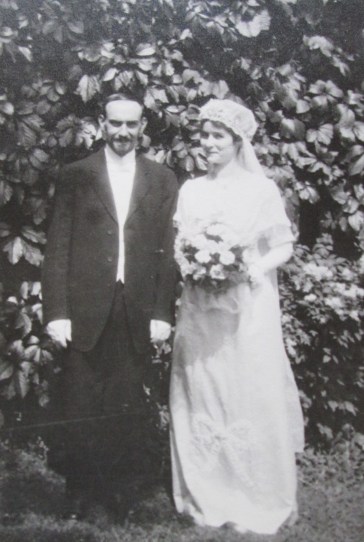
Lillian on her wedding day.

The wedding took place at the Winnipeg home of the bride’s uncle, lawyer Donald Forrester, at 4:30 p.m. on Nov. 26, 1906: According to the newspaper, “The bride, who wore a pretty gown of white net over taffeta and carried bride’s roses, was given away by her father, Mr. John Forrester, of Emerson…. There were no attendants, only the immediate relatives of the happy couple being present.” Following the brief Presbyterian service, the bride changed into a red and grey travelling outfit and they left for their honeymoon on the 5:20 train.

Lillian kept a diary of the wedding trip, leaving out any romantic details. They spent their wedding night on the train to St. Paul and reached Chicago late the following evening. Staying at the 16-story Great Northern Hotel, they visited Marshall Field’s department store, viewed the impressive tower of the Montgomery Ward Building and attended a play. They also visited the 1,400-bed Cook County Hospital which, Lillian noted, treated 25,000 patients a year and did an average of 10 operations per day. They then headed to Detroit for a brief stopover, and Toronto, where they began by exploring the area around Queen’s Park and the University of Toronto.

Niagara Falls was on their honeymoon bucket list. T.G. and Lillian spent a snowy day there, seeing both the Canadian and American falls. They dressed in waterproof clothing to access the back of the falls, and took a cable elevator car to view the Whirlpool Rapids.

After several nights in Toronto with T.G.’s Aunt Lizzie Morgan, they boarded a train for Montreal. Lillian noted some of the towns they passed through en route, including Belleville, where she was born.

It was now early December, and there was a heavy snowfall in Montreal, nevertheless they took the street car to Notre Dame Cathedral, which they found to be “as grand and beautiful as we anticipated.” Lillian ordered 50 visiting cards – she would need them in her new social role as the wife of a busy physician – and she visited several stores “and spent her first pin money.”  She described Morgan’s department store as “the most beautiful store we have ever seen. The art gallery, glass room, electrical room and furniture department are all exceedingly fine.”

T.G. was planning on running for election to the school board in Winnipeg, so he took advantage of the trip to do some research. While Lillian was shopping, he interviewed the Superintendent of Schools.

No visit to Montreal is complete without a trip up Mount Royal. T.G. and Lillian went to the top in a sleigh and enjoyed “a splendid view of city, canal, river and Victoria Bridge.” On the way back downtown, they visited the Royal Victoria Hospital, ”a beautiful, well equipped building” with 300 beds.  The next day they explored the Redpath Museum, had dinner at the Windsor Hotel (one of the city’s best) and took the overnight train back to Aunt Lizzie’s in Toronto.

It was a Sunday so, after church, T.G.’s cousin accompanied them to visit relatives. The following day, T.G. met with the Superintendent of School Buildings in Toronto and with a former principal of Wellesley Public School, said to be the most handsome and modern school building in Toronto.

Over the next few days they visited more family members and St. Andrew’s Presbyterian Church in Scarborough, where T.G.’s father and grandparents were buried, as well as the farmhouse where T.G. spent his childhood. On their final day in the city, they attended a lecture on new developments in vaccines.

Finally, they headed west to Chicago and Minneapolis. Back in Winnipeg, Lillian’s brother picked them up at the train station and they went to buy furniture.

The last entry of the trip diary was dated almost a month after their wedding: “Dec. 22. Had tea at 8 a.m. in our own house.”

Note: a slightly longer version of this article is posted on my family history blog, writinguptheancestors.blogspot.com.


Researching Quebec Loyalists at the BAnQ

Loyalist families settled in Quebec following the end of the American Revolution in 1783. At that time, Quebec was under British rule.

For a complete listings of United Empire Loyalists fonds which can be viewed at various repositories of the Bibliothèque et Archives nationales du Québec (BAnQ), go to the catalogue search page https://cap.banq.qc.ca/fr/ and search for the word Loyalist.

The collection includes books, theses, essays and papers. Some of the items in this collection have been reproduced on microfiche from old documents originating in other archives, libraries or historical societies in the provinces of Quebec, Ontario, Nova Scotia, New Brunswick and Prince Edward Island. A fair number of these papers were first published in the 19th century by historians, scholars, archivists and lecturers.

Between 60% to 70% of the material regarding the Loyalists stored at the various repositories of BAnQ in Montreal address Loyalist families who settled in Upper Canada (Ontario), Nova Scotia, New Brunswick and Prince Edward Island. I am mainly interested in Loyalists who settled in Quebec

The compilation attached here, “Researching Quebec Loyalists at the BAnQ,” lists 168 books, historical documents and other material available at the BAnQ in Montreal concerning the Loyalists who settled in what is now the Province of Quebec. Quebec Loyalists at the BAnQ

Please note: In order to borrow books or CDs from the Grande Bibliothèque de Montréal, one must obtain a BAnQ membership card. It is free to all residents of the Province of Quebec. For researchers residing outside of Quebec, temporary memberships can be issued with limited borrowing options. See my post Genealogy Ensemble dated Nov. 17, 2019, Exploring la Grande Bibliothèque.

Only at the Grande Bibliothèque de Montréal can a visitor borrow a book or CD.

The other repositories of the BAnQ in the Montreal region are:  the Collection nationale (du Québec) housed within the same building as the Grande Bibliothèque de Montréal; BAnQ Vieux-Montréal (Archives nationales du Québec on Viger Avenue in Old Montreal); BAnQ Rosemont La Petite-Patrie at 2275 Holt Street and, opening in 2020, the Bibliothèque Saint-Sulpice at 1700 St. Denis Street near Sherbrooke Street (east). At these repositories, material can only be viewed on location.

   Contents of the compilation

Page 2   Grande Bibliothèque de Montréal

Page 3   Collection nationale

Page 10 BAnQ Vieux-Montréal

Page 11 BAnQ Rosemont-La Petite-Patrie

 Page 11 BAnQ Online Digitized Books

 Page 12 BAnQ – Sir John Johnson and the British Governors during and following the great Loyalist migration.


Exploring la Grande Bibliothèque

BAnQ

The Library and National Archives of Quebec, known as La Bibliothèque et Archives nationales du Québec (BAnQ), is located at two separate locations in Montreal. The main library building (La Grande Bibliothèque) is situated in a sprawling, modern facility near the Berri-UQAM metro stop. The Archives de Montréal, one of the BAnQ’s ten archival centers in Quebec, is located on Viger Street in Old Montreal.

Click here to see what materials the archives contain: http://www.banq.qc.ca/archives/

Quebec’s Heritage Collection, known as La Collection Nationale, is kept in in two highly-controlled wood-paneled areas within the Grande Bibliothèque. Some of these precious materials are available for public viewing, but only on-the-spot. Click here for more information about this collection:

http://www.banq.qc.ca/collections/collections_patrimoniales/collection_nationale/

BAnQ’s vast collection include dossiers from the birth of New France in 1604 onward, and many other books and documents of interest to genealogists with Québecois ancestors.

Many of BAnQ’s  resources can be accessed online by anyone, anywhere, for free; other resources require a subscription. However, the family history section is available only in French.

http://www.banq.qc.ca/archives/genealogie_histoire_familiale/ressources/bd/index.html?language_id=3

When an English version of a page is available, you can click on the box in the upper right hand of the page for English. If a page is only available in French, you can copy and paste the text you don’t understand into an online translation tool such as Google Translate.

Membership at BAnQ is free to Quebecers, and available to anyone else for a subscription fee. However, only Quebecers can subscribe to online services requiring a log-in. When you join BAnQ, you will be given a membership card with a number on the back that can be used to log into library services online at MY ACCOUNT or to borrow books, view multimedia, etc. on-site.

Non-residents of Quebec can nevertheless join BAnQ and subscribe to all services by paying for a subscription ($50 for three months, $100 for a year). However, online access to digital resources requiring login, including the borrowing of e-books, is granted only to subscribers who reside in Quebec. You can find all rates by clicking Here.

To find out how to join the BanQ from a distance, or to ask any other question, see this page: http://www.banq.qc.ca/outils/nous_joindre/index.html

BAnQ’s collection includes books in the English language about the people of the British Isles, Germany, France, the Netherlands, the Scandinavian countries, the Baltic States, Switzerland, Belgium, Italy, Spain, Greece, Portugal, France, Poland and other countries of Eastern Europe. Once subscribers have obtained their BAnQ subscriber’s card, they can take home as many as 25 books or CDs.

About the BAnQ

Some 8,000 daily visitors or 46,000 visitors per week visit this superb repository of books, documents and CDs that opened in 2005.

Approximately four million books or CDs are borrowed every year from the Grande Bibliothèque de Montréal.

In excess of two million books can be read on location or borrowed at this repository.

Click on the link below for detailed information on all the services that a BANQ subscription has to offer, including access to collections and equipment offered on-site at the Grande Bibliothèque, at BAnQ Rosemont–La Petite-Patrie and at the BAnQ archives facilities, and to use online services that require a log-in.

 www.banq.qc.ca/services/pret/carte/index.html?language_id=1

The Grande Bibliothèque is closed on Mondays and open 8am to 10pm on weekdays and 8am to 6 pm on weekends. For more detailed information, click here:

http://www.banq.qc.ca/aide/information_generale/faq/index.html?language_id=1

BAnQ  475, boulevard De Maisonneuve Est (Berri-UQAM metro stop)
Montréal (Québec) H2L 5C4

Telephone: 514 873-1100 (Montréal region)
or 1 800 363-9028 (elsewhere in Québec)
http://www.banq.qc.ca/accueil/

For more information, consult these posts on the Genealogy Ensemble blog:

https://genealogyensemble.com/2018/09/30/using-the-banqs-pistard-to-research-your-ancestors-life/

https://genealogyensemble.com/2018/09/16/searching-the-banq-for-books-and-documents/

Miss Lindsay – Part 1

In June 1922, young Marguerite Lindsay travelled from Montreal, Quebec to Cartwright, Labrador, for a summer of volunteer work. Two months later she went for an afternoon walk and disappeared.

Marguerite, aged 25, had volunteered as a teacher with The Grenfell Mission in Cartwright. The International Grenfell Mission is a non-profit organization that was formed in 1892 by British medical missionary Sir Wilfred T. Grenfell to provide healthcare, education, religious services, rehabilitation and other social services to the fisherman and coastal communities of northern Newfoundland and Labrador.1

She taught the older girls sports such as swimming and cricket and ran the recreation program at the Labrador Public School at Muddy Bay, 10 km from Cartwright. Miss Annette Stiles, an American and the other summer volunteer, worked as the school’s nutritionist and cook.

Marguerite was my grandfather’s baby sister. The youngest of six children born to Mary Heloise Bagg and Robert Lindsay, she grew up privileged in a prominent English Montreal family. Her brother, my grandfather, was an Anglican priest in Montreal.The Priest

Marguerite Lindsay and her brother Sydenham circa 1922
Marguerite Lindsay and her brother Sydenham – photo taken in Montreal, Quebec – circa 1917

An article in The Montreal Standard newspaper described Marguerite as being “popular in Boston, London and Montreal Society.” She attended a girls’ school near Boston and, in 1918, actively took part in The Sewing Circle (making quilts for charity) and The Vincent Club (supporting women’s health issues). Later she volunteered with the Canadian Red Cross in England during WW1. Her fine education and choice of social circles and volunteer work were evidence of not only her elite upbringing but her ingrained kindness towards others.

In June 1921, a year before her departure for Labrador, Marguerite returned home by ship after a three month visit to England. She was only 24 years old at that time and most likely already considered a spinster!

Her marriage prospects were not good, since after The Great War, there was an excess of females over males of about 5,500 in English Montreal alone. 2 The women’s rights movement had already made progress for women’s suffrage, education and entry into the workplace. Might these changes in society have encouraged Marguerite’s decision to pursue her teaching? Perhaps she learned about The Grenfell Mission itself during her last trip to England. But how on earth did she convince her protective parents to allow such an adventure? Did her brother (the priest) approve of the idea, support her calling and aid in her plea?

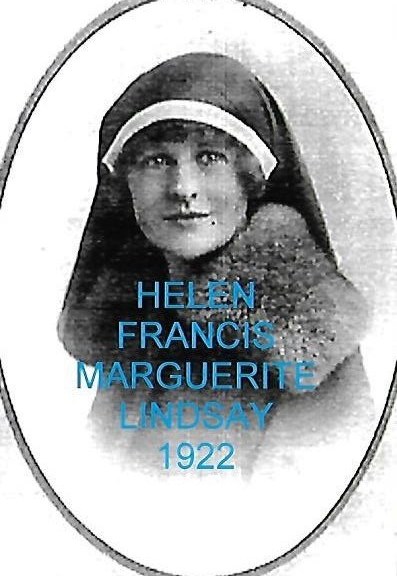
Marguerite Lindsay 1922
The Grenfell Mission photo of volunteer Miss Helen  Frances Marguerite Lindsay

The two young volunteers, Marguerite and Annette, were under the direction of the Reverend Henry Gordon. He and his wife ran the school in Muddy Bay. Annette, perhaps a little homesick, described the area as “a bay surrounded by spruce-clad hills, resembling Lake George (New York), warmly sheltered from the Arctic winds.”3

Annette wrote an article depicting some of her experiences with Marguerite and the local people. It was published in an issue of the journal Among the Deep Sea Fishers. She described food demonstrations held for the adults and nature outings with the children in their collective care noting that “the children’s enthusiasm was very contagious – a great contrast to the boredom of some in more civilized places.” And then she continued:

Miss Lindsay was a very good swimmer and the older children loved her teaching them this as well as loving to work with her in the mornings … even on cold days they would beg to go in (the water) and the little ones would join in the chorus: “O! Miss, take I in swimmin’ too!”

It was a hot day on August 4, 1922, when Marguerite left her fellow teacher and friend in Cartwright possibly to go for a swim somewhere along the Sandwich Bay shores. She often took walks alone and was known to be a young lady very capable of taking care of herself. However, that evening when she hadn’t returned in time for the evening meal, a search party was organized immediately.

Miss Lindsay was missing!

(Updated by author – 2021-07-18)

1FindingGrenfell.ca – accessed October 19, 2019

2Westley, Margaret W. Remembrance of Grandeur–The Anglo-Protestant Elite of Montreal 1900-1950, p. 126

3 Stiles, Annette – “The Cartwright Expert Cook” – Among the Deep Sea Fishers, January 1923

JOHN HAMILTON GRAHAM First Grand Master of the Grand Lodge of Quebec

My family is a Masonic Family. My grandfather immigrated to Canada as a Mason. My Canadian-born father was a Mason. My husband is a Mason today. My husband and I are also educators and members of the Quebec Provincial Association of Teachers. The story of John Hamilton Graham resonates with us on several levels. It was thus an honour to be asked by the Grand Lodge of Quebec to research Graham’s history and write his story for the 150th anniversary of his installation as their first Grand Master.IMG_3699[295]

John Hamilton Graham

The Graham family  loved the view from their home on the hill overlooking the town of Richmond and the valley of the St. Francis River: the gently rolling hills, the scattered farms, the foliage ablaze with fall colours at this time of year: reds, oranges and golds. The house was on the campus of St. Francis Academy, a prestigious grammar school for boys where Hamilton Graham was headmaster. Affiliated with McGill University, the curriculum included two years of university courses. It served a vast district extending from Chicoutimi on the Saguenay River to the New England States.

Scottish born John Hamilton Graham and his American wife, Almira Jones, emigrated from Northfield, Vermont when, in 1858, Graham accepted a teaching position at the school. Their first-born, Mira was just a year old. Her siblings, Abigail, George, James and Caroline, were all born in Richmond. I assume the boys attended the grammar school while the girls went to school in the village.

Richmond was largely settled by New England colonists in the late 1700s so the Graham family must have felt at home among their neighbours.  Graham arrived as a Presbyterian and a Mason and soon joined the local church and the St. Francis Lodge. As she grew, Mira likely led her siblings in trying to weasel out various Masonic secrets. “Just show me the secret handshake, daddy”. But off daddy would go to another night at Lodge with none of them any wiser. His Masonic career included becoming the Master of St. Francis Lodge, the Deputy Grand Master of the Eastern Townships District and, ultimately, the Registrar of the Grand Lodge of Canada.

In 1862, Graham was made headmaster of St. Francis Academy. His interest in education, however, went well beyond discipline and instruction in his own school. While teaching in Vermont he had taken an active part in the movement to establish normal schools in the state and served at different times as president of three teachers’ associations. He continued to work with teacher  associations in Canada and in 1870, he and Jasper Nicolls, president of the St. Francis Teachers’ Association, established the Provincial Association of Protestant Teachers known today as the QPAT, the Quebec Provincial Association of Teachers. Graham was the first president. As president, he protested the Roman Catholic dominance of education in the province, the underfunding of Protestant institutions, the importation of textbooks rather than the development of Quebec texts, and the separation of church and state in our schools. Clearly a man ahead of his time.

In 1872 Graham resigned as headmaster to run as a Liberal in the federal constituency of Richmond and Wolfe. He was referred to as a “Scotch Radical”. Following his defeat, he found a job as a railroad manager, Richmond being the railroad center of the area, and devoted much of his free time to private teaching, to writing, and to Freemasonry. He was awarded honorary degrees from the University of Vermont and McGill University.

With the coming of confederation, Graham took the lead in a movement to create a grand lodge in the new province of Quebec. The founding of the Grand Lodge of Quebec aroused a great storm within Canadian freemasonry because the new institution was created out of, and in competition with, The Grand Lodge of Canada. Graham engaged in ongoing disputes with several lodges in Quebec that continued to act under warrants from the grand lodges of Canada, Scotland and England.

In 1869, one hundred and fifty years ago, Graham became the first Grand Master of the Grand Lodge of Quebec. Hopefully his wife and children were they proud of his achievement and did not resent the hours and days away from family that it took him to get there.

Graham was widowed in 1881. His eldest daughter Mira was 24 and a teacher, Abigail was 21, George 18, James 14, and little Caroline only 4. Likely Mira kept house for her father following her mother’s death and raised her youngest sister. I suspect, too, that this responsibility limited her chances of marriage.

The 1891 census records Graham as a lodger in a boarding house without any of his children. Later records show all siblings, save for Mira, married and living in various parts of the United States until their deaths. Where Mira ended is unknown.

In August 1899, Graham died suddenly at age 75 in Hartford Connecticut during a visit to New England. His body was returned to Richmond where it lay in state at the Town Hall. The funeral was the largest in the region for many years: local Masons, prominent Masonic officers from all over Quebec, family, friends and neighbours. He was buried beside his wife in St. Anne’s Cemetery and given full masonic rites at the gravesite. Ten years later the Grand Lodge of Quebec unveiled a monument to him.

In the Dictionary of Canadian Biography, Graham’s career is described as following a pattern established by many Scots Presbyterians in Canada in the 19th century: hard work and a taste for controversy producing modest success.

Sources:

The Dictionary of Canadian Biography. http://biographi.ca/en/bio/graham_hamilton_12E.html

The Sherbrooke Examiner: http://numerique.banq.qc.ca/patrimoine,details/52327/2985600?docpos=4

Townships Heritage WebMagazine. http://townshipsheritage.com/aeticle/st=francis-college

Healy, Esther. St. Francis College. The Legacy of a Classical College. 1854-1898. https://openlibrary.org/

Hamilton Graham. Ancestry.ca

Conversations with Jody Robinson, Archivist, The Eastern Townships Resource Centre, Bishop’s University, Lennoxville, QC. www.townshipsarchives.ca


La Fermière Louise Mauger

Louise_Mauger_sculpture

Women are rarely commemorated with a statue. There is one, La Fermière, in front of Marche Maisonneuve in Montreal’s East End. It depicts a woman holding a basket of produce. It was sculpted by Alfred Laliberté and he dedicated it to Louise Mauger, as a glorification of traditional rural values. She was one of the early settlers of Montreal and not the only person celebrated with a monument. Louise was my eight times great grandmother.

1024px-Marché_Maisonneuve_3
La Fermiere statue in front of Marche Maisonneuve

Both Louise (1598) and her husband Pierre Gadoys (1594) were born in Saint Martin d’-Inge in Perche, France. They came to New France about 1636 as part of a settlement initiative by Robert Giffard de Moncel, the first Seigneur of colonial New France. Records have them living and farming on the Beauport Seigneurie in 1636 and Pierre employed by the Société Notre-Dame de Montréal pour la Conversion des Sauvages, at Sainte-Foy or Sillery from 1643 to 1645.

Tracing families back is quite easy in Quebec as the church records of births, marriages and deaths, kept from the beginning of the colonies have been well preserved. My maternal grandmother was a Bruneau and her direct male line goes back to Francois Bruneau, my seven-time great grandfather, who arrived in New France in 1659.

The Bruneau family tree is just part of my story. There are all the women back through the tree who were only a name, their families not mentioned. A seventh times great grandfather is one of 256 grandfathers which means there are also 256 grandmothers who have their own stories.

I started with Sophie Marie Prud’homme who married Barnabé Bruneau, my two times great grandparents. Tracing back the Prud’homme line I arrived at Louis Prud’homme who arrived in New France in the 1640s, where he met and married Roberte Gadoys. Roberte came from France in the 1630s with her father Pierre Gadoys, her mother Louise Mauger and her brother Pierre.

Pierre Gadoys (Gadois, Gadoua) my 8th time’s great grandfather moved his family to Montreal shortly after this because of the many attacks by the Huron and Algonquin on settlers around Quebec City. Montreal was fortified. In 1648, he was the first person to be granted land in Montreal (Ville-Marie) by the governor, Paul de Chomedey de Maisonneuve. He was known as the “Premier Habitant or first farmer”1. The 40 arpents grant was from the current St Paul Street north to the Petite Riviere between St. Pierre and Bleury. In 1666 he was granted another 60 arpents for helping Charles LeMoyne fight the Iroquois.

Just as important as the first farmer is the first farmer’s wife. Louise had a lot of work to do. The couple had six children, possibly seven. Roberte, Pierre and Etienne (is the question mark) were born in France, while Francois, Jeanne and Joseph on the Seigneurie of Beauport and Jean-Baptiste was born in Sainte-Foy when Louise was 43. Jeanne died at birth, Joseph died in his first month and there is no other information about Francois. According to the 1667 census they had 40 acres under cultivation, six cows and a hired servant.

While Pierre Gadoys died in 1667, Louise lived another 23 years and died in Montreal at the age of 92.

Pierre also has a monument but it is a small trapezoid stone marker in Place d’Youville installed in 1992 as part of Montreal’s 350th celebration. It looks more like a concrete form used to block off a road than a commemoration. It is not a lovely bronze statue in the middle of a fountain.

Bibliography:

1. Dollier de Casson, Francois. Histoire du Montreal 1640-1672. pg 88

Jean-Jacques Lefebvre, “GADOYS, PIERRE,” in Dictionary of Canadian Biography, vol. 1, University of Toronto/Université Laval, 2003–, accessed November 29, 2018, http://www.biographi.ca/en/bio/gadoys_pierre_1E.html.

Fournier, Marcel. 1642-1643 Les Origins de Montréal Diffusion au Canada, 2013.

Le Bulletin Recherches Historique Vol XXXIII Levis – Mars 1927 Nos 3 Les Colons de Montreal de 1642-1667 pgs. 180,181.

PRDH-RAB; Origine des Familles Canadiennes; Parchemin Ancestry accessed January 2019.

Sulte, Benjamin: Histoire des Canadiens Français [1608-1880]: origine, histoire, religion, guerres, découvertes, colonisation, coutumes, vie domestique, sociale et politique, développement, avenir January 1, 1882 Wilson et Cie

Senécal, Jean-Guy(senecal@fmed.ulaval.ca); Sep 27, 1998, compilation OCR de trois documents Word disponible en ligne, ses documents se référant principalement au Tome IV & V, Chapitre IV du livreHistoire des Canadiens-Française de Benjamin Sulte, édition 1977.

Notes:

The statue La Fermière was made by Alfred Laliberte in 1915. It was part of a continent-wide city beautification project.

Pierre Gadoys’ sister Françoise was married to Nicholas Godé. They were present at the founding of Montreal.

It is possible but not proven that Pierre and Louise were in Montreal in May of 1642 for the founding ceremony. Their son Pierre, then 11, was said to have attended with his Aunt and Uncle, Francoise and Nicholas Godé. It was thought that Louise was not at the ceremony as she was attending to Jean Baptiste who was only a year old. Pierre first settled in Sillery with his family but had gone to Montreal in the early 1642 and then returned to Sillery as he was there in 1645.

After his death, Saint-Pierre street was named in his honour.

1666 Census – Pierre Gadois the eldest, 72, inhabitant; Louise Moger, 68, his wife; Jean-Baptiste, 25, gunsmith; Pierre Villeneuve, 25, hired servant. 

1667 Census – Pierre Gadoys, 65; Louise Mauger, his wife, 65; Pierre Villeneuve, domestic, 24; 6 cattle, 40 acres under cultivation.  She was buried March 18, 1690 in Montreal. 

Pierre Gadoys: 1594 – Oct 20 1667 Married 1627 de Igé, Saint-Martin, Orne, France.

Louise Mauger: 1598 – Mar 18 1690

Roberte Gadoys: Baptised Sept 15 1628 France – Sept 14, 1716 Montreal

Pierre Gadois: Nov 17, 1631 or 1632 France– May 18, 1714 Montreal

Etienne Gadois: Baptised Nov 17 1631 France – ? Are Pierre and Etienne the same person??

Francois Gadois: Dec 2 1632 Quebec – ?

Jeanne Gadois: June 26 1638 – June 26, 1638 Quebec

Joseph Godois: Sept 28 1639 – Oct 1639 Quebec

Jean-Baptiste Gadois: Mar 1, 1641 Quebec – April 15 1728 Montreal.

The inscriptions on Pierre Gadois Monument In Place d’Youville, Montreal reads, C’est d’ici que Le 4 Janvier 1648 Maisonneuve determina les bornes de la premiere concession accordee a Pierre Gadoys il fixait ainsi l’orientation des rues de la future Ville” and on another side, Stele erigee grace a L’Ordre des Arpenteurs- Geometres du Quebec, a L’Association des Detaillants de Monuments du Quebec, aux Archives Nationales du Quebec, aux Productions D’Amerique Francaise et Au Groupe de Recherche de Raymond Dumais Archivist.”