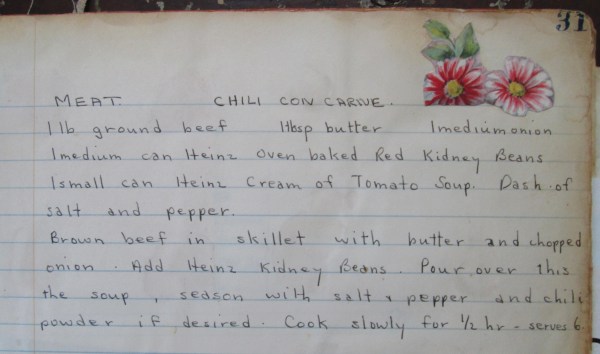
One of my favourite recipes in Mom’s recipe book is for chilli con carne. It has only a few ingredients: hamburger, kidney beans, onions, Heinz tomato soup, salt, pepper and chilli powder but only if desired. With fresh rolls and tomato slices, it was a meal we often had at the cottage, without the chilli powder. I was surprised to see that there was no Campbell’s tomato soup in the recipe.
Mom’s famous Chilli Con Carne!
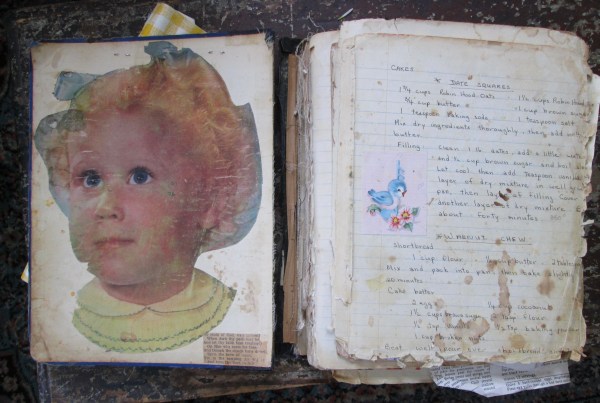
Mom started this book when she got married in 1948. It contains recipes cut out of magazines and newspapers, her handwritten recipes and ones collected from friends and family. In her later years, she mostly cooked from memory but sometimes would open the book just to check.
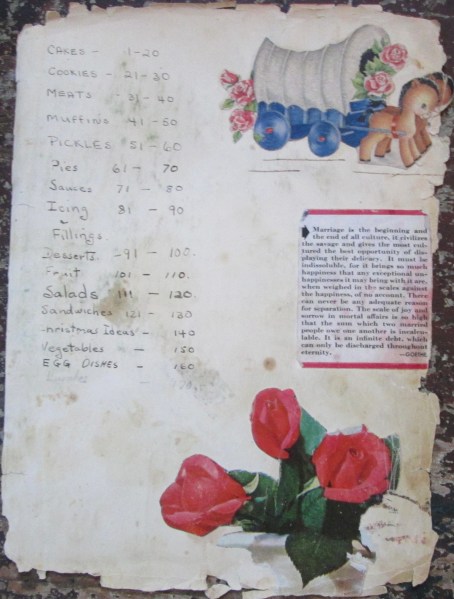
The indes page
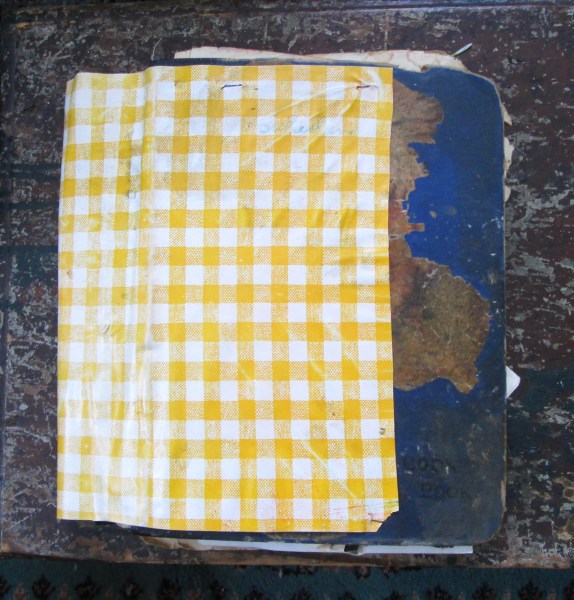
The book is now falling apart. It has been taped and covered with mactac but those adhesives don’t hold forever. The favourite recipes are worn, smudged with sticky fingerprints and ingredients. The newspaper clippings are starting to disintegrate.
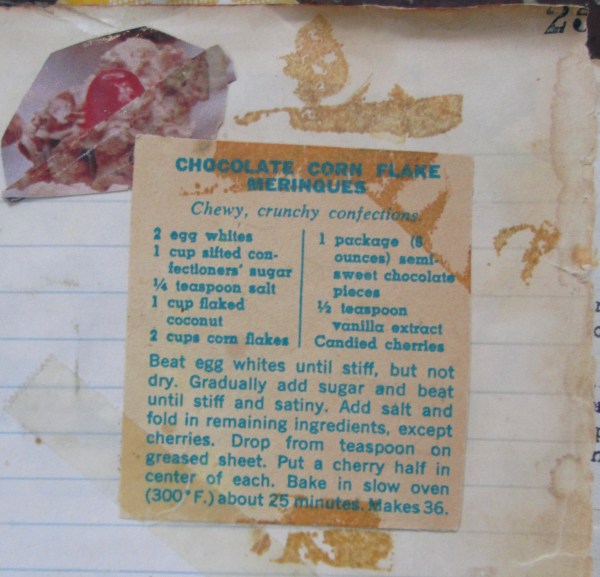
A favourite Christmas treat
My mother’s recipe book used to travel back and forth from Montreal to our cottage in the Laurentians. When Mom moved into a senior residence, it remained in Dunany. I then took charge of it, not wanting to leave it to the mice over the winter.
I thought I would make a book or calendar of some of the recipes as they all have stories to tell. Funny how most of them are for sweets. Main dishes at home were mostly roasted meat and boiled potatoes, which didn’t require recipes.
As kids, we would ask Mom what was for supper but all we really wanted to know was what was for dessert. Would it be a cake, a pie, a pudding, a cobbler, squares, cookies and ice cream or my least favourite, canned fruit? We had to eat our dinner before we got dessert but we always had dessert.
Inside front cover and sweets
Mom’s planned menus were similar each week. She would make a list and only buy what was on the list. On Sundays, we had a roast at noon with potatoes, vegetables, gravy and then omelet, pancakes or bread broiled with cheese and bacon for supper. Monday was usually chicken, with one cut up for six people. Tuesdays meant leftover roast and on Wednesdays the menu varied with veal patties, liver, sausages or pork chops. We ate leftover roast again on Thursdays, sometimes being shepherd’s pie. On Fridays, we always ate fish even though we were not Catholic. This was our least favourite meal as it mostly consisted of frozen white fish, sometimes with a soup sauce. On Saturdays, we had hamburgers, usually without buns.
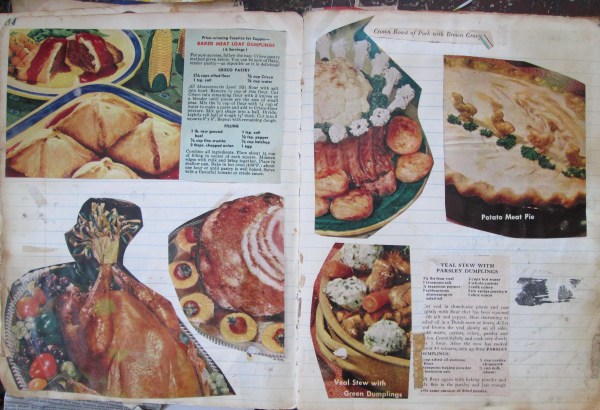
Our meals didn’t look like these pictures
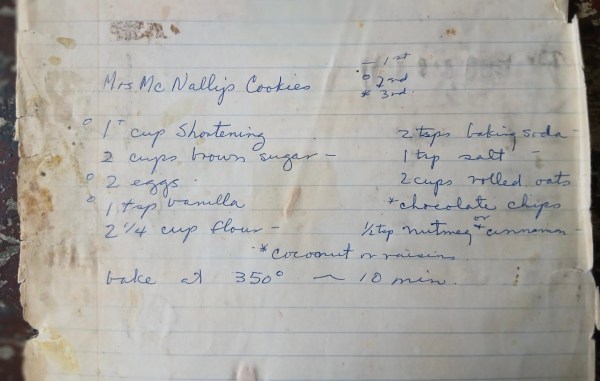
Mrs McNally’s cookie recipe came from the mother of a university friend of mine. Eileen’s mother used to send cookies back with her daughter, much to the enjoyment of her roommates. It is a basic oatmeal cookie with raisins, nuts, chocolate chips, cinnamon and nutmeg. It became my mother’s go-to recipe and she added whatever was in her pantry. The cookies were often stored in a ceramic cookie jar in the kitchen. Dexterity was needed to quietly raise the top and sneak a cookie.
Mrs McNally’s Cookies
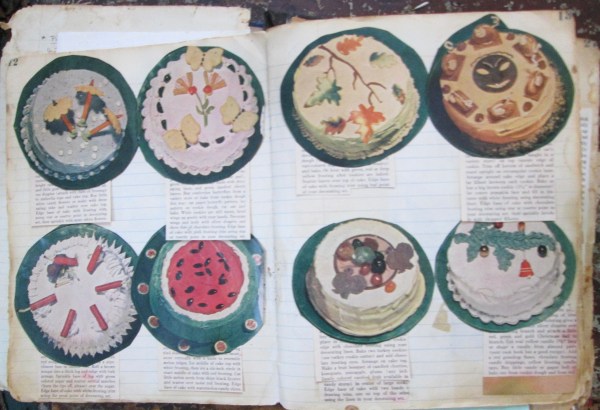
There are many pictures of decorated cakes. Mom took a class but only made a few very fancy cakes. Most were just plain iced layer cakes. She made some doll cakes with a Tammy or Debbie doll (we never had a Barbie doll) in the center of an angel food cake with fancy icing for her skirt. She also put money between the layers of cake, wrapped in wax paper. Pennies, nickels and dimes with one quarter. She would mark on the cake plate where to find the quarter and show the Birthday person.
Very fancy decorated cakes
Rhubarb upside-down cake replaced pineapple upside-down cake when my mother got the recipe from her sister. We always had this dessert in the spring and summer with rhubarb from the garden. Rhubarb and chives were the only edible things my mother grew.
Mom was an excellent pie maker. Her book does contain a booklet on how to make pie crust. She mastered this skill in no time. She would make all her fruit pies without looking at a recipe. I preferred blueberry and raspberry pies made from berries she picked around our cottage. Apple was my father’s favourite. One day, she anxiously watched as he cut into a pie and asked if it was ok. “When is your pie not alright? ” answered my father.
There would often be a little sugar pie made with the leftover pie crust sprinkled with sugar, cinnamon and little pats of butter. Pieces were eaten right out of the oven if you were lucky enough to be around.
There were definitely things we didn’t like, such as porridge every morning before school but we were well fed!
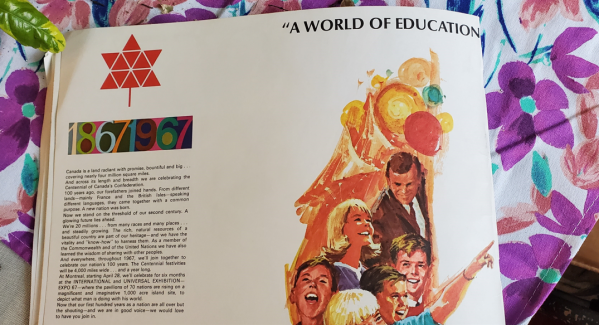
A World of Education, page from a pamphlet given out to school children in 1967 about Expo 67.
My mother, Mary-Marthe, would put herself out for people. At the check-out counter of the grocery store; on the bus; in the park my mother was not shy about helping out others. She sometimes forced spontaneous acts of kindness on complete strangers, often to my childish embarrassment.
This habit, I imagine, she picked up from her own mother, Maria, a pious French Canadian who married well in 1901 and was generous with food and home-remedies.
The story goes that in the 1920’s my mother’s Sherbrooke Street West grey stone had a mark on the gate that indicated to homeless men, or ‘tramps’ as they called them, that a hearty meal was in store for them should they knock at the back door.
I most vividly recall an incident that unfolded in the summer of 1967, the year of Expo 67, the World’s Fair, when I was a young adolescent and because of my prickly age extra prone to being embarrassed by my mother.
My family lived in Montreal and we all had ‘ passports’ so we could visit the nearby World’s Fair anytime we wanted.
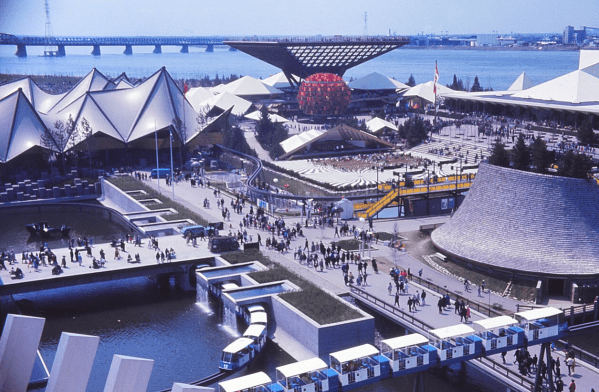
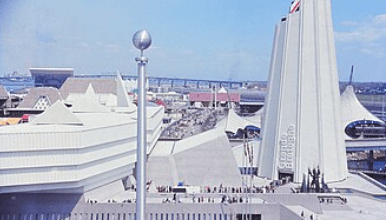
The Canadian section of Expo 67. The Western Provinces Pavilion, a forest, smelled so wonderful compared to smoggy city air!
I was 12 years old and I sometimes took the number 65 bus to those blissfully bright Expo isles alone, likely skipping school, and the bus stop was right under my 6th grade classroom window! I wasn’t too afraid to be found out. Didn’t my teacher say we’d learn more at Expo than at school?
Over that six month period from May to October 1967 I travelled the short bus and metro route to Expo 50 times, sometimes alone, sometimes with my brothers or other relations and sometimes with friends and their families. I recall that one mom was so afraid of losing her many tweenage charges in the swelling sea of thrill seekers she looped a long rope around our waists to keep us contained. How embarrassing!
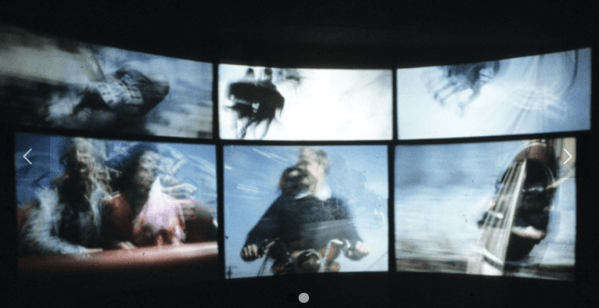
I wandered to the Expo site in all weather with a packed lunch since I had no extra money to spend.3 I liked the wide open Canadian and Ontario pavilions the best. I’d eat my sandwich on the Katimavik watching the rusty monster emerge from the lake adjacent. I experienced their exhilarating movies1 over and over again. The five Expo theme pavilions were a hit with me, too. 4I mostly avoided the popular national pavilions: the American, Russian, Czech and British pavilions with their long long line ups.
The movie We are Young in the Cominco Pavilion another favourite haunt of mine in the summer of 67. The exhibits explored the five senses. See link below that includes info about The Eighth Day at the Christian Pavilion and all the other landmark films that prepared us well for the future of media.
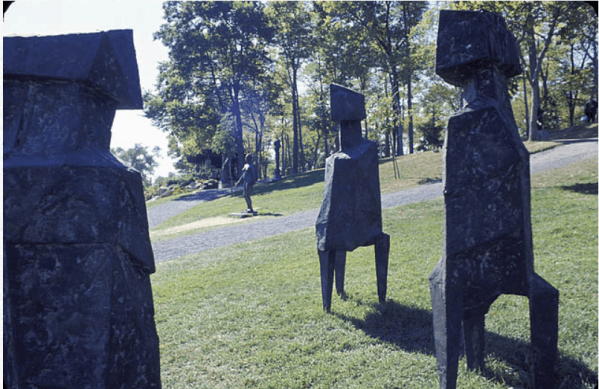
But I did like escaping to the sculpture garden behind the American pavilion. It was uncrowded, cool and peaceful in that place and all the avant-garde works of art, both life-like and abstract, were exciting to behold.2
One installation at the Sculpture Garden. The Watchers.Lynn Chadwick, UK 1960. No wonder I felt safe.
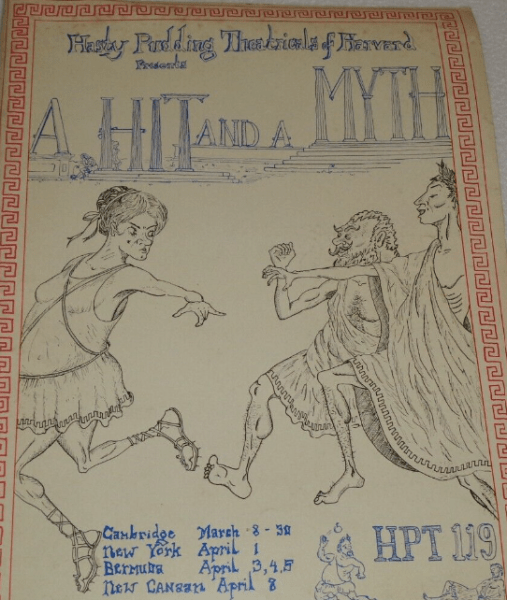
My older brother, a cutting-edge type, liked the Cuban pavilion for the vibes so we went there together, feeling slightly rebellious. He dragged me into the Christian pavilion one day and we saw a film with a monk setting himself on fire that depressed me for a days. And together we saw Harvard’s famous all-male Hasty Pudding troupe at an outdoor bandstand in a play called a Hit and a Myth that was quite bawdy. Although a good fit for my brother, it was bit mature (sic) for my tastes. I recall the energetic finale, Acalpulco, with a group of ‘grown men’ dressed like Carmen Miranda dancing in a conga line. Their unanchored brassieres kept riding up to their necks.
The list of songs inside this programme reveals that Acapulco was the penultimate song in the play, not the last. Characters in the play included Xerox and Tenintius and there were also Vestal Virgins. The Montreal Gazette said the play was written by the sons of Pulitzer Prize winning playwrights and would be of interest to anyone willing to get into the panty raid spirt. (I checked on Wikipedia: one writer, Timothy Crouse, became a journalist for Rolling Stone. The other, John Weidman, wrote for Sesame Street.)
Yes, I went alone to those glittering Expo Isles in the St. Lawrence, despite the fact that in the spring a policeman had visited our sixth grade classroom to tell us about the dangers lurking there. He said a girl could be drugged in a bathroom and then sold into white slavery. I’m guessing I never mentioned this to my father and mother. I wasn’t too worried being used to walking the big city streets on my own and not understanding the term white slavery – something to do with snow, I imagined. However, I did keep a look out for any suspicious Boris Badenof types around the Russian Pavilion.
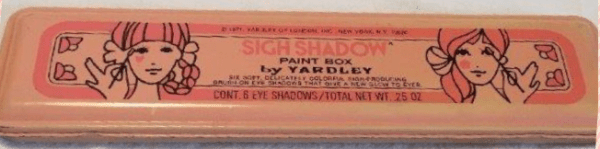
Yardley paintbox eye liner from the era. So obviously aimed at little girls like me. I still want one!
My father worked for Expo as a comptroller but I never visited the fair with him. He obviously was too busy. I did go with my mother, though, a few memorable times. On one occasion we saw Bobby Kennedy walk by surrounded by his team of FBI agents in dark glasses, and on another day we witnessed Haille Selassie, the Emperor of Ethiopia. He had a little dog following him. (I assume this wasn’t a coincidence. My mother wanted to see these famous figures.)
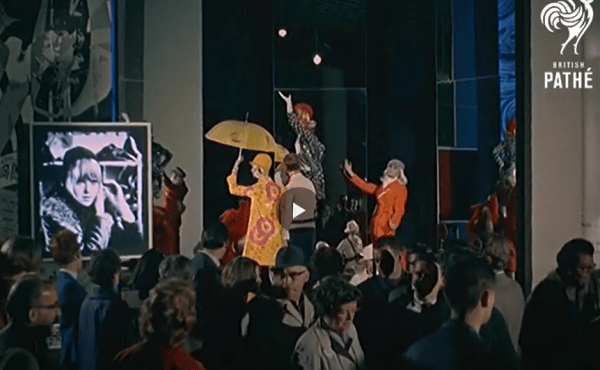
And on one very hot day my mom decided to visit the British pavilion. That place, more than any other, always had an especially long line up. This was the era of Swinging London, after all, and the pavilion included a MOD London exhibit with the Beatles (remember them?) and a Mini Minor Car. I was excited to go. I was a big fan of The Avengers with gorgeous Emma Peel karate-chopping Cold War baddies in her colourful Carnaby Street attire and of the Monkees TV show that featured Yardley commercials and “the London Look.”
The long line up at the British Pavilion. No shade. Wikipedia Commons.
My mom and I queued up realizing we probably had a very long time to wait. It was a hot day and in the line you couldn’t escape the sun. The person ahead of us was an ‘older’ woman with a young child – perhaps around 15 months old -who was not happy in the heat. The baby girl was kicking up a big fuss the whole time and would not be pacified, not in her stroller, not in her mother’s arms.
As was her way, my mother struck up a conversation with this woman.
She was British but this is where the similarity to Emma Peel or any other British ‘bird’ ended.
She was tall and thin, yes, but with wispy light brown hair and lots of stress lines around her eyes. Dowdy would be a good way to describe her attire. She was self-conscious about it, too. “I must look like the wreck of the Hesperus,” she said, combing back a rogue lock of hair with her hand.
This statement impressed me. Here was a smart British lady, just like my 6th grade teacher. And yes, in fact, this beleaguered mom was a teacher but in Toronto. She also had a 15 year old son who was off somewhere exploring the grounds – and she was divorced.
I started to feel sorry for her. She said she had driven to Montreal for just one day so her son could visit the Fair. Just one paltry day to see Expo, how sad! And all she wanted was to visit the pavilion of her homeland. Minutes, maybe hours ticked by and the long line inched forward. The little girl squirmed wildly in her mother’s arms, her shiny face getting redder and redder.
We were getting closer to the entrance and then my mother offered to do something very generous. She said WE would watch the baby for the woman in a shady area nearby so that she could visit the British pavilion in peace. (Our own visit would have to wait for another day.) And, what do you know, the woman took her up on the offer. I guess all that time in the line had made us seem safe and familiar to her.
The harried British mother passed through the turnstiles by herself and my mother and I and the baby found a big tree to sit under.
Detail of Mod Britain exhibit British Pathe video.
Then the lady returned and we said our goodbyes.
At Christmas she sent us a card with a long thank-you note written in impeccable teacher handwriting. (She had told us she didn’t have a phone. Too expensive.) I remember the note was on blue paper, maybe one of those aerograms popular in the day for overseas correspondence.
So, it seems, this overwhelmed mother did, indeed, appreciate my mother’s spontaneous act of kindness, as outrageous as it was – even for the 1960’s. I, myself, don’t recall being embarrassed at all.
3. ” Take a bag of ham sandwiches and a thermos of coffee to Expo- where there are 146 restaurants and snack bars, 46 food shops and 500 automatic vending machines to serve you,” says the opening line of the article “Easting Exotically and otherwise at Expo,” in the Star Weekly insert for February 11, 1967. The pic shows Indian, Japanese, Italian and Mexican chefs with their exotic fare: tacos, pizza, sushi and a meal with pilau and nan. (I think I ate all these things this past weekend.) A pic on the next page caption says :A snack bar in Expo terminology means glamorous dining, indeed. (So, no real cheap food at Expo.) Oddly, the advert in this article was for KLIK and Kam luncheon meat with a pic of little squares of this ‘meat’ on toothpicks on a pickle. How ironic.
4. Man the Explorer; Man the Producer; Man the Creator; Man the Provider. I recall Man and the Community had a revolving exhibit (Czech artist) with little wooden models of a man and a woman in bed and all their needs revolving around them on a belt. “The cause of all progress is laziness.” Reading a list of that place’s exhibits, it sounds amazing. I want to go back!
The Star Weekly insert wrote about the Man out of Control? exhibit in Man the Producer with it’s “maze of signs showing man besieged by the information explosion.” The article continues: “The question mark in the title is no accident. Will the devices of man swallow him up or will he remain in control?” Hmm. Why do I feel this question to be extremely timely?
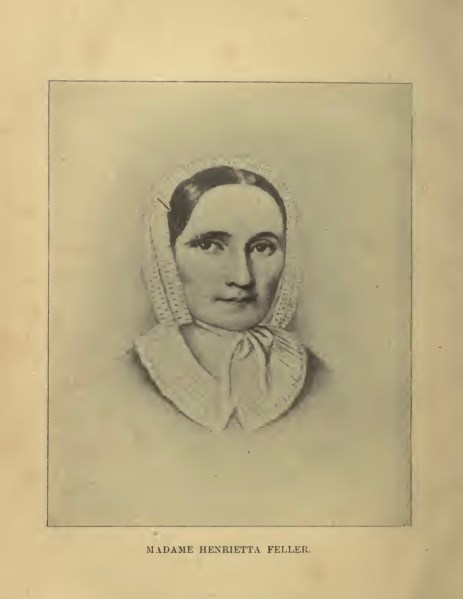
A young Protestant widow from Switzerland came to Canada in 1835 to convert the heathens. If it wasn’t for Henriette Feller, my family might still be speaking French and attending Roman Catholic services.
Henriette Odin (1800 – 1867) was born in Montagny, a village, outside of Lausanne, Switzerland. Her Protestant ancestors had been driven out of France when Louis XIV revoked religious freedoms and many took refuge in Switzerland. Her father was the director of the Vantonal Hospital at Lausanne.
“Wisdom and love distinguished both parents and their influence on the family was of the happiest kind.”
As a teenager, Henriette began visiting in the hospital and her tender and gentle demeanour was a comfort to the patients. She learned to change dressings and considered becoming a nurse but then she had a religious awakening.
Henriette married Louis Feller, a widower, in 1822. He was the head of a prison and had a son and two daughters. Their daughter Elize died as a young child and soon after, Louis died of typhoid fever. Louis Feller left all his assets to Henriette. They both gave their lives to a Christian Evangelical sect that wanted to spread the love of Jesus Christ. If you loved Jesus, everything else would be alright. The Swiss government didn’t approve and persecuted those who espoused the evangelical faith.
At an opportune time, Monsieur Henri Olivier and his wife came to Henriette’s Church, Henri as a pastor. He held missionary prayer meetings and under the Société des Missions d’Evangeliques de Lausanne, instructed young men for missionary service.
“Whose business is it to go to the heathen for whom we pray and give?”
The North American Indians became their prime missionary endeavour. Soon Henri, his wife and two young men were sent to Canada to convert the indigenous population to Protestantism using the word of Jesus from the New Testament. The young men went west but the Oliviers preferred to stay in Montreal and work on converting the French Roman Catholics. Henriette corresponded regularly with Mme Olivier, who encouraged her to follow them to Canada. In 1835, Henriette and a young missionary, Louis Roussy, sailed to New York, a journey of 33 days. They then travelled up the Hudson River to Lake Champlain, on the Richelieu River to St Jean, a long tedious journey to La Prairie in an old coach and finally across the St Lawrence River in a primitive boat to be met in Montreal by the Oliviers.
Converting Catholics was hard work, with very limited success because of the strong position of the clergy in the everyday lives of the French Canadians. Henriette thought they could do more good in the rural areas south of Montreal, where the priests and the churches were far apart. Henri Olivier soon returned to Switzerland but Henriette Feller and Louis Roussy stayed.
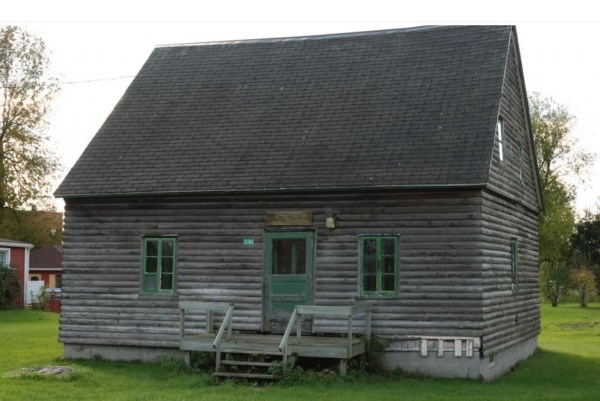
The Levecque family, in Grand Ligne, south of Montreal, offered Henriette their attic space with a room for her to live in and another for the school. She taught the children during the day using the bible and at night, the adults climbed to her room and read and discussed the New Testament.
The Leveque family house used as Henriette’s first school
Troubles escalated with the local Catholics during the rebellion of 1837. Those at the mission were threatened and forced into exile in the United States. They found sympathy for their cause in Champlain, New York and were able to raise money and received continued support from the Americans.
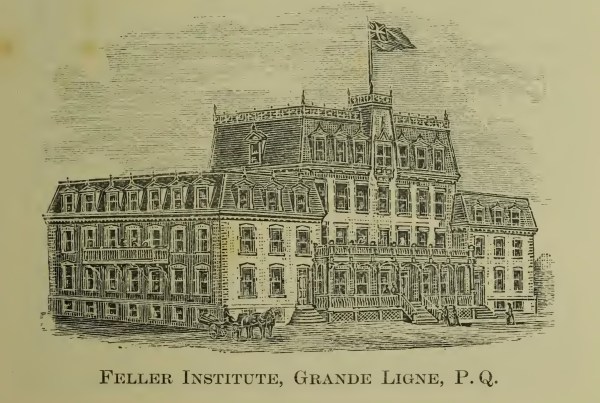
When things quieted down, they returned to Grande Ligne to find the houses emptied, animals taken and crops gone. With the help of several friends of the Mission, they rebuilt. The new construction, a much larger, substantial stone building, housing the mission and the school, opened in 1840. This was the begining of the Feller Institute.
While Henriette, known as Mere (Mother), continued to teach, Louis Roussy, as a colporteur, spread the word of God through the distribution of Bibles. My family lore said that one day, he and Eloi Roy visited my great-great grand mother, Sophie Marie Prudhomme Bruneau. She was interested in what they told her and invited them to stay the night. Her husband Barnabé Bruneau then joined in the discussions and eventually, my great-great grandparents and all their 13 children converted to Protestantism.
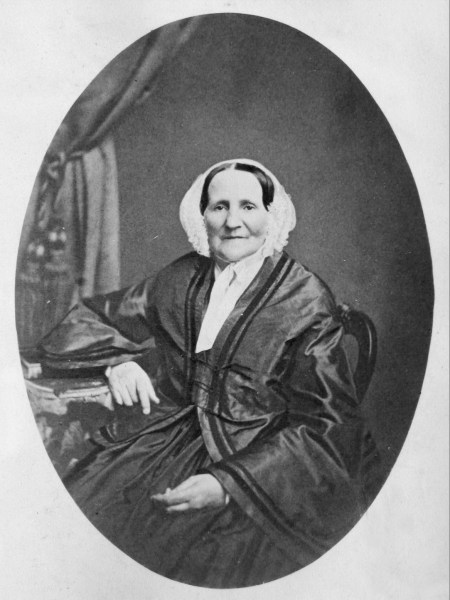
Henriette Feller
The hard work took its toll on Henriette’s health, which was a constant source of anxiety for her close associates. She had pneumonia several times and never completely recovered, even after a trip home to Switzerland. She suffered a stroke in 1865 and although bedridden, was still the driving force for the school until her death in 1868. Henriette Feller is buried in the Grande Ligne Cemetery with many of her converts, including some of my ancestors. Most of my family is protestant to this day.
“Although Madame Feller occupied a somewhat anomalous position, for her influence was well-nigh all-powerful, and few ventured to contradict or oppose one in whom the tenderness of woman and the firmness of man were so happily united, she never overstepped apostolic limits.”
Notes:
Walter N. Wyeth, D.D. Henrietta Feller and The Grand Ligne Mission, Philadelphia, PA. 1898. printed and Bound by C.J. Krehbeil & Co. Cincinnati, Ohio.
Paul Villard M.A., M. D., D. D. Up to the Light the story of French Protestantism in Canada. 1928. Ryerson Press, Toronto, Canada.
PHILIP G.A. GRIFFIN-ALLWOOD Wesley Memorial United Church Cramp Memoir of Madame Feller 244. Mère Henriette Feller (1800-1868) of La Grande Ligne and Ordered Ministry in Canada.
Historical Sketch of the Grande Linge Mission by the President 1893
That was the first question that ran through my mind as I began to try to verify what seems to be indicated by a wedding photo of Jean-Baptiste Hurtubise and Marie-Berthe Charette from my grandmother.
My grandmother’s handwriting below the picture indicates: “Mom & Dad Hurtubise, January 7, 1915.”
Census records from 1901 indicate that they were both 25 years old at the time,[1] another fact I wonder about.
Why would a young man of that age be free to marry and settle down when World War I was in full force? Perhaps this is an indicator of how remote the war seemed to Francophone families in Canada prior to the conscription crisis of 1917.
By that time my great-grandfather would have two children and wouldn’t be required to serve. My grandmother, their first child, was born twelve months after they married.
In addition to her parents’ wedding photo, my grandmother kept only two other pictures. One is a photo of a church, presumably where the wedding took place. The other shows four large church bells. Why are they important?
Turns out that the church in the photo still exists, and it still serves a Franco-Ontarian population! I found it by referring to the census showing Marie-Berthe, called Martha, living in Clarence Creek in 1911.
According to Kim Kujawski, Clarence Creek, which is near Ottawa in Ontario, was founded in 1853 by French Canadian farmers from St. Augusine Quebec.
At the time of Jean and Martha’s marriage, it had two steeples, but now the smaller steeple on the right side is missing. I know the church is the same one, however, because a duplicate of my grandmother’s photo appears on the history page of the parish website. [2]
I’m extrapolating from the facts, but it seems as though Martha’s family were among 170 that remained within the parish after 80 others left in 1908. The bells were part of a renewal show of strength two years later. The families expanded their church, bought the bells and hired famed Montreal decorator Toussaint-Xénophon Renaud[3] to renew the interior. His work can still be seen today.
Sources:
[1] Data from the 1911 Census of Canada: her birthdate appears on Enumeration District 21, Cumberland Township, Russell, Ontario, Sarsfield Village, Léonard Village, Bear Brook Village, page 7, line 48; his on Enumeration District 112, Cumberland Township, Russell, Ontario, Sarsfield Village, Léonard Village, Bear Brook Village, page 3, line 25
I am spending this week madly rushing around to get ready for Easter Sunday. My husband is Greek and we celebrate Easter with Greek traditions on this day. Forty guests are expected at our house for the celebrations.
The star of the show will be a lamb on a spit. The “lamb team” starts early in the morning to prepare the lamb, filling the inside cavity with herbs, onions, and lemon, and then sewing it up. It will turn on the spit for many hours. We used to take turns turning the lamb but now we have an electric motor to do the job.
Courtesy Greek Boston
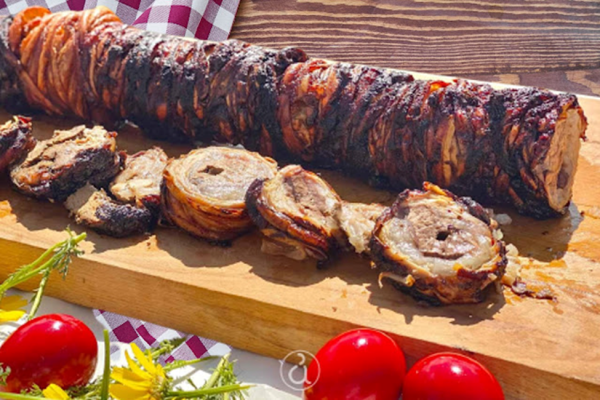
My husband and his uncle will also prepare the kokoretisi early Sunday morning. Kokoretsi is also roasted on the spit. Kokoretsi is a traditional dish of lamb intestines wrapped around seasoned offal, including sweetbreads, hearts, lungs, and kidneys.1 Everyone loves it, although I have to confess that I do not find it appetizing. Surprisingly none of the younger people in our family are interested in learning how to make it. In a decade or so, kokoretsi may no longer be served.
I found a picture of kokoretsi on the My Greek Food Recipes blog, one of my favourite sites for Greek recipes:
Of course, the lamb will be accompanied by many Greek favourites such as tzatziki, spanakopita, lemon potatoes in the oven, and more.
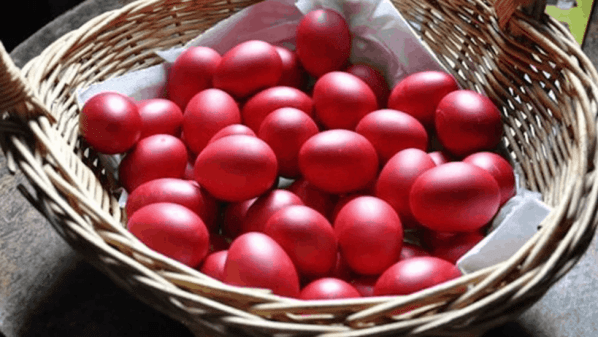
Another highlight of the day will be the Tsougrisma, a game played by bashing eggs together. Easter eggs are dyed red, representing the blood of Christ shed on the cross.2 Once dyed, red eggs are woven and baked into tsoureki, a three-braided Easter bread representing the Holy Trinity.3 The rest of the eggs are used as a table decoration and are used to play Tsougrisma, which means “clashing” and “cracking” in Greek. The cracking tradition symbolizes the resurrection of Christ and birth into eternal life.4
Courtesy Greek City Times
To play the game, each players holds an egg, finds another player and taps the end of the egg lightly against the other player’s egg. They then tap together the ends that are not broken. They then move on to other players until both ends of their egg are broken. The person who has an unbroken egg at the end wins the game.5
Of course, the Easter Bunny also visits us on this important day. The children are always very excited to hunt for Easter eggs in the back yard.
I am really looking forward to this day of celebration with our family and friends.
One spring day in 1819, a young man named Benjamin Workman stood on the dock at Belfast, Ireland, trying to decide where he should immigrate to in North America. He had relatives in the United States, but before he booked his passage, he wanted to check on the safety of the vessels that were scheduled to leave soon.
He noted that the captain of the New Orleans-bound ship appeared to be drunk, the mate of the ship going to New York swore profusely, and the crew of vessel going to Philadelphia ignored his questions, but the captain of the Sally, bound for Quebec, impressed him favourably, so that’s the ship he chose. He later noted that this had been a lucky choice since yellow fever was widespread in American port cities that year.1
Benjamin left Ireland on April 27 and arrived in Montreal a few weeks later. He was 25 years old and had 25 guineas (a coin worth one pound, one shilling) in his pocket.
This photo of Dr. Ben Workman appears in Christine Johnston’s book The Father of Canadian Psychiatry, Joseph Workman.
His choice of Canada turned out to be a good decision: within 10 years, all of his eight younger siblings and both of their parents had followed him. The Workmans were all hard-working, ambitious and smart, and they took advantage of the opportunities available to them in their new homeland. Four of Ben’s brothers (Alexander, Joseph, William and Thomas) became prominent in business, medicine and politics. His only sister, Ann (1809-1882), married Irish-born Montreal hardware merchant Henry Mulholland and was my great-great-grandmother.
Benjamin’s parents were Joseph Workman (1759-1848) and Catherine Gowdey (1769-1872). Ben was born on Nov. 4, 17942 in the village of Ballymacash, County Antrim, near Lisburn, where the family lived in a small house near the top of a hill.
Joesph was a teacher in Ballymacash, but he left teaching for a job as a manager for a local landowner, and as a deputy clerk of the peace for the area. Without its only teacher, the local school had to close, so young Ben started studying on his own, reading the Bible and geography books while his father helped him with arithmetic. When Ben was 11, Joseph apprenticed him to a linen weaver, but it soon became clear that Ben had no talent in that field. What he really wanted to do was study. Eventually, Ben went back to school, where he excelled in grammar and the classics. After he graduated, he found a teaching job in Belfast, then another position near Lisburn.
Ben’s decision to leave Ireland was influenced by an event that took place in 1817. As he was eating his evening meal at his parents’ home, a dozen beggars came in the gate and asked for food and money. Perhaps realizing how widespread poverty was in Ireland, he began to think about going to North America.3
Montreal suited Ben well: other Irish and Scottish immigrants arrived there around the same time, and there were work opportunities for all. He immediately found a teaching job, but after that school’s owner disappeared with its funds, several parents who had noticed what a good teacher Ben was started a new school, with Ben as headmaster.
The Union School, as it was called, was unique. For one thing, girls were admitted, although they were taught separately by a female teacher. It was also successful. By the spring of 1820, it had 120 pupils, and it remained the largest English school in Canada for 20 years.4 Several of its graduates went on to have distinguished careers in business and politics. In 1824, Ben became the sole owner of the school, but he eventually turned over the responsibility of running it to his brother Alexander, who had come to Montreal in 1820.
In 1829, Benjamin switched careers and became a newspaper editor, partnering with a friend to purchase a weekly Montreal newspaper, the Canadian Courant. It had been founded in 1807 as the Canadian Courant and Montreal Advertiser. Ben published the newspaper until 1834, using it to promote his liberal religious views, social welfare issues, and the temperance movement. When the paper ceased publication, Ben blamed distillers, saying that their advertising had dried up because of his support for temperance.
Meanwhile, Ben experienced several tragedies in his personal life, as he was married twice and became a widower twice. He married Margaret Manson, a teacher at the Union School, in 1823. The couple had no children and Margaret died seven years later. He married Mary Ann Mills on October 14, 1838, in Franklin, Michigan, and the couple had three children: Mary Matilda, born in July 1840; a son, Joseph, who was born in November 1841 and died at age 10 months; and Annie, born in July 1843. Mary Ann died two months after Annie’s birth, and Ben’s mother, Catherine, looked after his two daughters.
Soon after that, Ben took up his third career — as a druggist. For several years in the 1840s, Lovell’s city directory of Montreal listed “B. Workman & Co., chemists and druggists”, located at 172 St. Paul Street, corner Customs House Square.5 Meanwhile, he studied medicine at McGill University, graduating in 1853, at age 59. He was henceforth known as Benjamin Workman M.D., which helps differentiate him from several other Benjamins in the family.
During these years as a pharmacist and doctor, Ben demonstrated compassion and generosity, often providing care to people who were too poor to pay. Then, in 1856, he reinvented himself again and moved to Toronto, where he assisted his brother Joseph run the Provincial Lunatic Asylum, the largest and most progressive psychiatric hospital in Canada at the time.
Benjamin is buried in Montreal’s Mount Royal Cemetery, near the Workman family plot. JH photo.
Benjamin Workman is probably best remembered as the founder of the Unitarian Congregation in Montreal. In Ireland, the Workman family had attended the Non-Subscribing Presbyterian Church of Ireland in Dunmurry. Its members strongly believed in freedom of thought in religion.6
When Ben first arrived in Montreal, there were not enough Unitarians to organize a congregation, so he attended the St. Gabriel Street Presbyterian Church. When the city’s Unitarian congregation was permanently established in 1842, he played a key role.7
In 1855, Ben got into a disagreement with the congregation’s minister, Rev. John Cordner, a man he himself had recruited for the job. Benjamin argued that Cordner had excessive authority, and when the rest of the congregation sided with their minister, Ben withdrew from the church. Soon after, he moved to Toronto, joining the Unitarian congregation his brother Joseph had helped to found there. He got along well with the Toronto congregation’s members and their minister, and he ran the Sunday School there for many years.
Ben lived with his daughter Anne in Uxbridge Ontario at the end of his life, dying there on Sept. 26, 1878, several weeks short of his 84th birthday. He was buried a few days later next to the large Workman family plot at Montreal’s Mount Royal Cemetery.
The children of Joseph and Catherine Workman were: Benjamin (1794-1878), Alexander (1798-1891), John (1803-1829), Joseph (1805-1894), William (1807-1878). Ann (1809-1882), Samuel (1811-1869), Thomas (1813-1889), Matthew Francis (1815-1839).
Benjamin kept a journal in which he recorded his memories of growing up in Ballymacash, and an account of the Workman family’s 200-year history in Ireland.A large online database called A Family Orchard: Leaves from the Workman Tree, https://freepages.rootsweb.com/~database/misc/WORKMAN.htm, includes a family history going back to the 1600s, that was part of Ben’s journal. The late Calgary researcher Frederick Hunter prepared this site and database.
Catherine Gowdey’s name has been spelled in various ways, including Gowdie and Gowdy.
Thank you to Christine Johnston, former archivist and historian of the First Unitarian Congregation of Toronto, and author of a biography of Ben’s brother Joseph.
Sources:
1. Christine I. M. Johnston, The Father of Canadian Psychiatry: Joseph Workman, Victoria: The Ogden Press, 2000, p. 16.
6. Christine Johnston, The Father of Canadian Psychiatry: Joseph Workman, p. 15.
7. Christine Johnston. “The Irish Connection: Benjamin and Joseph and Their Brothers and Their Coats of Many Colours,” CUUHS Meeting, May 1982, Paper #4, p. 2.
As far as I can tell, Ismael Edgard Bruneau (1887 – 1967), my great uncle, was the first doctor in our family and maybe still the only doctor. His father wanted him to follow in his footsteps and become a minister, so when Edgar entered McGill in 1907, he registered for an Arts degree. During his university years, he decided he would rather be a doctor. He finished his Arts degree in 1910 while concurrently studying medicine and received that degree in 1912.
Edgar, as he became known, was the first of ten children of Ismael Bruneau and Ida Girod, my great-grandparents. He was born in Green Bay, Wisconsin, where his father served as a French Presbyterian minister. The family moved to Holyoke, Massachusetts, Quebec City and Montreal, where he did most of his schooling.
Ismael & Ida Bruneau with children Edgar top left, Hermonie, Helevetia, Sydney and Beatrice
He interned in Montreal and Ottawa and then practiced for a short time in Swift Current, Saskatchewan.
Dr Edgar Bruneau demonstrating techniques
When WWI began, he joined up with friends from McGill in the McGill Machine Gunners unit and was sent overseas in 1915. His father was unhappy with his decision to be a regular soldier and thought he should at least use his medical degree. Soon after arriving in England, he transferred to the Royal Army Medical Corp as a first lieutenant. This certainly didn’t keep him safe, as he served in France and Italy, being wounded twice and also severely gassed. Captain Bruneau was sent home to Canada in mid-1918. While in England, he visited with his Uncle Ernest Girod and became engaged to his cousin Marie but that relationship was over before he sailed home.
Edgar opened an office in Montreal as a general practitioner where he stayed his whole career. He lived on Park Avenue and had an office in his house with reception rooms on the ground floor and living space on the upper floor.
He also volunteered at the Montreal Dispensary through the 1920s. This clinic, established in 1850, gave health care to the poor. It was in downtown Montreal on St. Antoine Street, run by volunteer doctors and supported solely by donations. In the late 1920s, the Dispensary had financial difficulties and nearly closed but survived when it received a bequest of $10,000.
In the late thirties, Edgar suffered from a tubular disease in which the kidneys were damaged by lack of oxygen and blood flow, and so, for three years, he had to give up his practice. He was a much-loved doctor, as his patients visited him whether or not they needed care.
Edgar married Marie Eveline Lemoine in 1923. Before their marriage, they were in a car accident. He was driving on a street with streetcars when the traffic policeman gave him the signal to proceed. Unfortunately, the way was not clear and the car was hit by a streetcar. Eveline was thrown against the windshield, badly cut and she lost vision in one eye. Edgar felt responsible for her, so they married. Still, the marriage lasted 31 years until her death in 1954. Edgar was very social and attended all family gatherings but Eveline never did..
Six of the Bruneau children; Back row, Herbert & Gerald. Front row, Sydney, Edmee, Helvetia & Edgar ~1960.
One night, in the late 1950s, Edgar fell, going downstairs to his basement to fix the furnace. He broke his leg and wasn’t discovered until his housekeeper arrived in the morning. His brother Herbert wrote that when he was found, his leg was black and although the doctors saved it at that time, it resulted in gangrene. Edgar, like most of his siblings, had developed type II diabetes, which resulted in poor circulation in his legs. He first had his toes removed, then later, after many operations, most of his leg was amputated.
Edgar spent his final years at the St Anne’s Veteran’s Hospital in St Anne de Bellevue, Quebec. My sister said she never wanted to visit him as one of us told her he hung his leg in a stocking on his door at Christmas. Edgar is buried in Montreal’s Mount Royal Cemetery alongside his wife
Notes:
Recollections by Victor Herbert Bruneau , May 19, 1976.
Edgar was a keen fisherman.
He joined the Masonic Order and became a Shriner.
He was very musical; played the organ for his father’s services from the age of ten and he could play any tune he heard on the piano. He was popular with his comrades during the war and a good host afterwards.
I have no pictures of Evelyn. Edgar went to all the family functions and was very social but never Evelyn. She did play bridge and was mentioned in the newspaper as an attende at Karnac bridges put on by the Shriners.
Every country has a foundation myth and so, too, have some families.
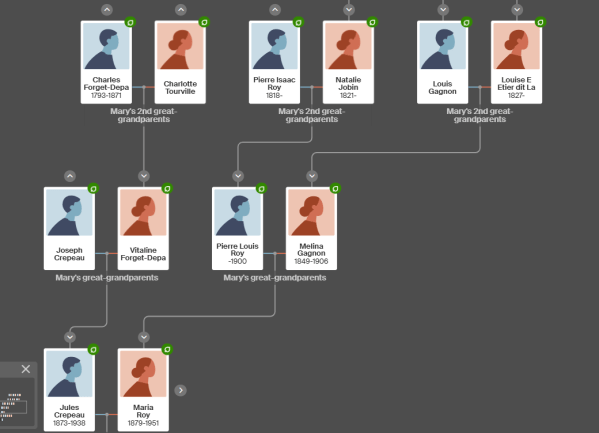
My mother’s family foundation myth was that her mother, Maria Gagnon Roy, was the daughter of a ‘master butcher’ and that she brought an enormous dowry of 40,000 dollars to her 1901 marriage to Jules Crepeau, a hardworking and ambitious 27 year old clerk at Montreal City Hall.
“Jules started out sweeping the floors at City Hall at eight years old,” my mom often said with a tear in her eye but according to his file there his first official post was in 1888 at 15 years old as messenger boy in the Health Department.*
My mother put so much store in this family myth that she even attributed her 5 foot 8 and a half inch height (tall for a French Canadian) to the fact she came from butchers. All that good steak they ate!
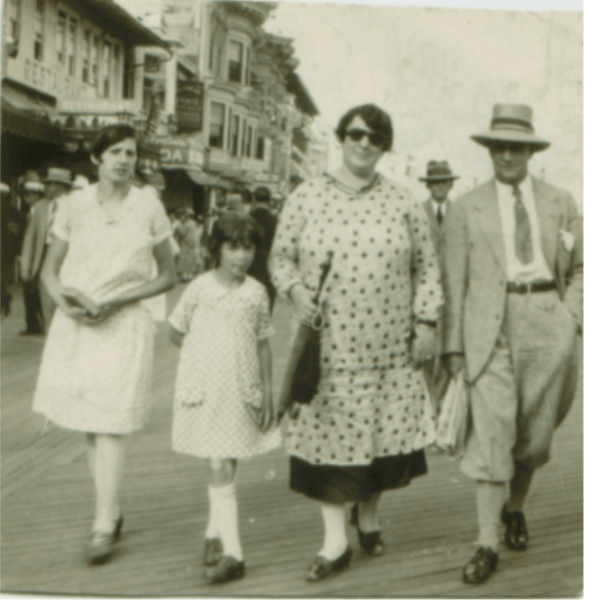
Left to right, Aunt Flo, my mom Marthe, Maria and Jules 1927ish.
The Father-in-Law: Maria’s Dad
My great-grandfather, Louis Roy, (circa 1843 to 1900) was the son of Pierre Isaac Roy and Natalie Jobin of Montreal and he worked as a butcher from 1860 to 1900. He came from a long line of butchers. In 1865 Louis Roy married Melina Gagnon, whose mother, Eleanore Ethier dit Lamalice,1 came from butchers as well.
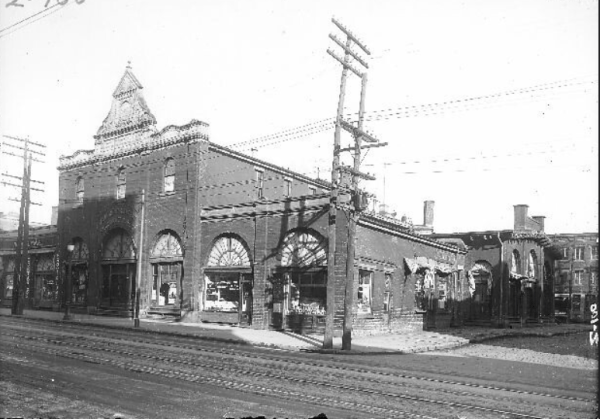
At first Louis worked alone at St. Laurent Market and then from 1881 to 1896 he partnered with a J. Lamalice, likely his cousin. Roy et Lamalice had two stalls, 16 and 17, at that market in the south central part of the city near what is now Chinatown. Their partnership was dissolved in 1896 when Louis’s son, also Louis, entered the profession.
Louis Gagnon was a mason, all other men on Maria’s side were butchers.
L. Roy and J. Lamalice paid a good sum of money, perhaps 200 dollars a year a piece,2 to have these two stalls at St. Laurent Market.
According to a University of Laval thesis,4 butchers in Montreal were politically influential. Public markets were designed around their needs, in large part because of the slew of health regulations around the slaughter and sale of meat. Retail butchers also profited greatly at these public markets, more so than their private counterparts, sometimes only having to work 2 or 3 days a week to pay the bills.
Louis Roy and his ‘small’ French Canadian family, wife Melina, son Louis and daughters Eugenie and Maria, lived at various addresses early on, then moved to 357 Amherst around 1880 and then in 1890 to 515 Amherst, a brand new ‘small cottage.’
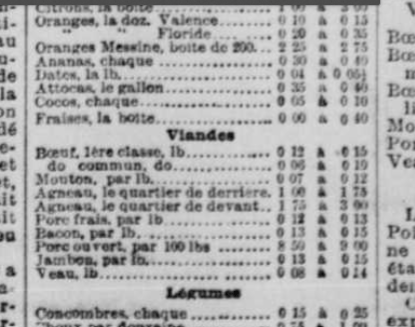
Price of meat Bonsecours Market, 1893
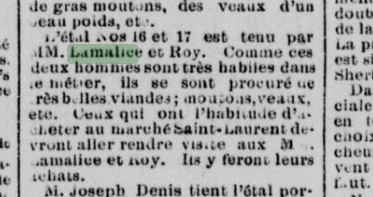
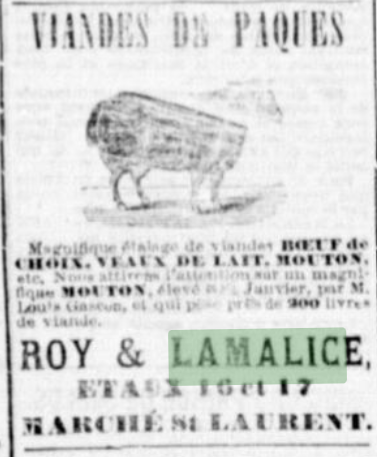
L. Roy et J Lamalice advertised regularly in all the Montreal papers, usually a little blurb like this.
Roy and Lamalice are very capable with very nice mutton, veal etc. Other ads focused on how beautifully the stall was decorated. (Clearly ladies did the shopping.)
They sometimes put in bigger ads
Choice beef, milk fed veal and mutton for Easter.
And they gave to charity, as well, Notre Dame Hospital and the Public Welfare are two examples I discovered.
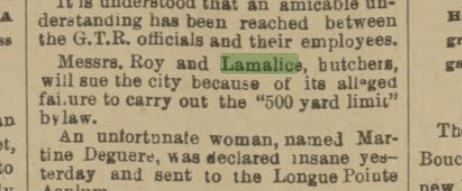
It may be significant that in 1891 Roy et Lamalice brought the City of Montreal to court. They complained that the City wasn’t doing enough to keep private butchers the mandated 500 yards away from the public markets.
They pay a license fee for a stall of 200 dollars, say Roy and Lamalice, as reported in Le Minerve.
I have to wonder if this is where Louis Roy, master butcher, first met – or maybe locked horns with – the City Hall up-and-comer Jules Crepeau, messenger boy in the Health Department – but a boy gifted with a superb memory for regulations and by-laws.3
In 1896, Jules Crepeau, Second Assistant City Clerk, was assigned the post of Secretary of Public Markets, a suitable promotion considering his Health Department roots.
In 1900, a year before his marriage to Maria Roy, he would be involved in his first scandal at City Hall, one that involved butchers. Men in that trade claimed that aldermen were illegally charging them 50 dollars to have their stalls moved at the prestigious Bonsecours Market. Jules testified in Court and denied knowing anything about it.
In 1900/1901, the newly widowed Melina Roy rented out her Amherst house (yes, to a butcher) and moved to Notre Dame street to live with her married daughter, Eugenie, her husband Jacques (James) Deslauriers (son of a butcher who was deceased). She brought her young adult children Maria and Louis along. The Census man came around while she was there.
The 1901 census has my grandmother Maria and her brother Louis erroneously listed under Deslauriers. Laura Lacombe is an orphaned cousin. She would live with Maria and Jules until her death in 1921, just a few months before my Mom’s birth.
The Marriage of Jules and Maria
After my grandparents Maria and Jules got married on July 1, 1901, widow Melina and her grown up son Louis moved back into 515 Amherst with the newlyweds.
In late 1901, Jules applied for a permit to build a three story brick building worth 3,000 dollars at 513 Amherst next door and the next year he would rent it out to three different families.
Maria would very soon give birth to my Uncle Louis. (Louis was baptized exactly nine months after the wedding.) My Aunt Alice would arrive a year after that and in 1905 the Crepeau family would move to St. Hubert Street near Marie-Anne.
Melina Roy and her son Louis, Melina’s orphaned niece Laura, and possibly the Deslauriers would stay at 515 Amherst for a year until Melina’s death in 1906 upon which time Jules would sell the ‘small cottage.’
The Dowry
A notarial record reveal there was, indeed, a 1901 marriage contract for Jules and Maria from June 27, a few days before the marriage, but of course there are no details so no proof of a 40,000 dollar dowry.
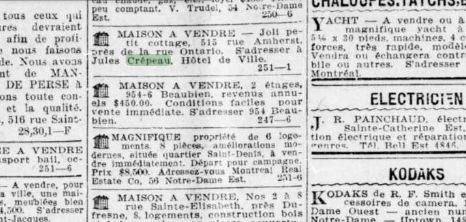
It does look like Jules came into some money early in his marriage. He builds that brick triplex and then moves in 1905 to what is still a very tony area with tall elegant stone townhouses.
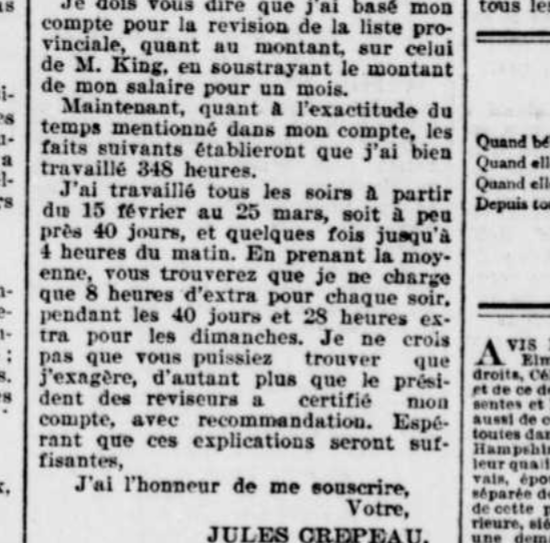
Before his marriage, Jules was making around 700 dollars a year at City Hall, a middling/good salary for a family man although at one point he asked for 248 dollars in overtime because “over a forty day period I worked 348 hours until four in the morning and on Sundays.”*
Still, a 40,000 dollar diary for Maria’s marriage seems highly unlikely. (That’s 1,500,000 in today’s money.)
I am doubly skeptical about the big dowry because I did not find any contract listing for the 1897 marriage of Maria’s older sister, Eugenie, to Jacques (James) Deslauriers, merchant. This suggests Eugenie received no formal dowry.
Why the second daughter and not the first?
Also, If Louis Roy, successful master butcher, left behind a large estate why did Melina Roy rent out her modest Amherst home after he died and move in with her daughter Eugenie and the husband. To help with the grandchildren?
A modest street in 1900, Amherst today is called Attikan. The only remnant of an early era is this little ‘French Canadian” cottage on the corner where everyone lived in 1901.
Lovell’s Directory to the Rescue.
When I first looked for Jules and Maria on the 1901 automated census I found neither one. Maria was erroneously listed under Deslauriers and Jules wasn’t there.
So, it took me years, but eventually I consulted Lovell’s to discover that prior to his marriage Jules was living on Mentana Street in the Le Plateau Mont Royale with his widowed mother, Vitaline Forget Despaties Crepeau, and his three brothers, the older Isadore and the younger Roderick and Paul.
Isadore in that era is already working in insurance – as he would for the rest of his life. In 1898 Roderick is listed as a plumber, then a year later as a butcher. His brother Paul makes the Lovell’s listing in 1899 and is listed as a butcher working at “R. Crepeau and Freres.”
It’s all very suspicious because the highly regulated butcher trade wasn’t something you could jump in and out of. I suspect older brother Jules, son of a mere house painter, pulled some strings to get his younger brothers a short cut into that lucrative trade. (Neither man would remain a butcher for long.) If my grandmother’s family tree proves anything, it’s that the butchers of Montreal liked to keep it in the family!
So, I still have no concrete proof but it would not surprise me if my grandmother Maria’s dowry, whatever the true amount, was provided by a group of butchers (perhaps all members of her extended family) in return for Jules’ support at Montreal City Hall.
Prior to his marriage to my grandmother, Maria Roy, as I said, Jules had had plenty of chance to interact with these ‘politically influential’ tradesmen.
Anyway, that was simply business as usual in those days.
Eleanore Ethier dit Lamalice was also a distant relation of Jules Crepeau through the Ethier line of Lachenai Seigneury. See my Why My Grandfather had a lot of Gaul on this site.
This is the sum that Louis Roy cites in his 1896 complaint as reported in the French papers. It’s called a license of 200 dollars to have a stall at St Laurent Market. In the 1920’s the sum is just 50 dollars a stall, I discovered in another online item but by then the butchers are paying hefty income taxes, so they mention how high this income tax is in their complaints.
Le Devoir says Jules’ mind was like a bank vault holding within all the city by-laws. This was in his 1938 obituary.
YVES BERGERON:LES ANCIENNES HALLES ET PLACES DE MARCHÉ AU QUÉBEC :ÉTUDE D’ETHNOLOGIE APPLIQUÉE. University of Laval Thesis Canadian Thesis portal
5. Newsy items courtesy of BANQ newspaper archive.
The Province of Quebec is breathtakingly beautiful. I have been all over the province and I am constantly amazed.
One of my favourite trips was when, in 1982, after we had moved into our first house, we decided to leave all the angst of being a first-time home owner at a young age and go on a road trip. We decided to visit the Gaspé Peninsula. We simply loved our trip. The countryside was stunning and the Gaspésians showed us a warm welcome.
Courtesy Tripadvisor
Did your ancestors settle or live on the Gaspé Peninsula? The first European to arrive in the Gaspé was Jacques Cartier when he landed in Gaspé Bay in 1534 to plant a cross and claim the land for the King of France. The Iroquois occupied the area. It is believed that the name Gaspé derives from a Micmac word meaning “land’s end.” 1
When the Gaspé belonged to New France, there were only about 400 fishermen living there. Harvests were plentiful and the coastal high winds were excellent for drying cod. However, James Wolf and his forces attacked the residents in 1758, destroying their homes and possessions and sending them back to France.2
Still, some Gaspesians managed to hide from the authorities and remained on the peninsula until 1763 when it became a British territory. They were joined by Acadians who fled from the British who had implemented a compulsory deportation order for all Acadians in Nova Scotia. In 1784, a significant number of Loyalists, fleeing the American Revolution, settled on the Gaspé Peninsula.3
If your ancestors came from the Gaspé, here are some sites that can help you with your research:
The Quebec Genealogy eSociety has extensive links and resources (requires a membership). Some of the resources include births, marriages, deaths and some census records, and newspapers: https://genquebec.com/en
GoGaspé is a site devoted to the Gaspé Peninsula with a tab that directs you to history and genealogy links and resources. Local Gaspesian genealogists and historians have contributed to this site: https://gogaspe.com/
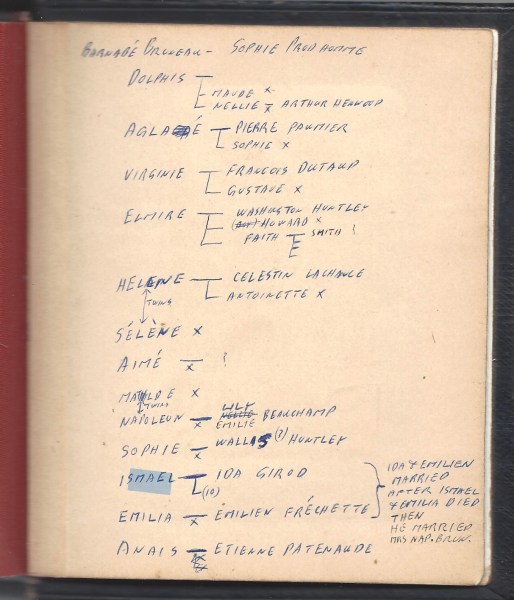
I have written stories about twelve of Barnabé Bruneau and Marie Sophie Prudhomme’s thirteen children. That just leaves Helene (1849 -1929). Helene was child number nine or perhaps number ten. I just realized that she and Selene Joseph were the second set of twins in the family. They were born on December 20, 1849.
I haven’t found much information about Helene other than she appeared to be a devoted wife and mother. She married at twenty-six but before, had spent some time in New York City as photographs can attest. Was she also a French teacher or governess like her sisters?
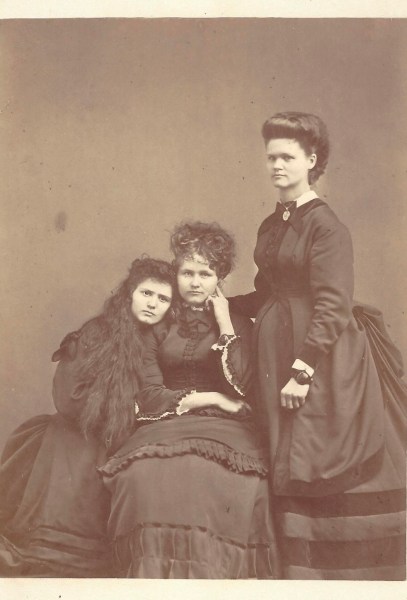
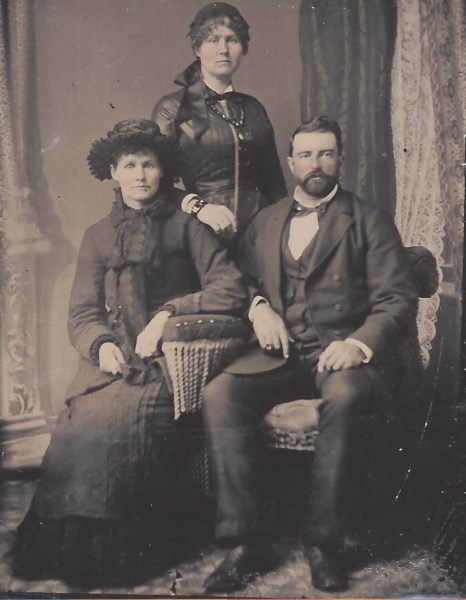
Sophie, Helene and Matilde Bruneau, New York City
Helene married Célestin Pépin dit Lachance ( known as Lachance). He was born in Joliette (1847-1915) to Celestin Lachance and Elisabeth Payette. His parents converted to Protestantism in 1852 when he was a young child. He attended the l’Institute Evangelique Francais de Pointe-aux-Trembles. After he graduated, he became a Colporteur for two years for the French Canadian Missionary Society. He had aspirations of becoming a minister
Celestin & Helene Lachance
In 19th century America, the word colporteur (the borrowing of a French word meaning “peddler”) came to be used for door-to-door peddlers of religious books and tracts and is still used today. The Missionary Society trained the colporteurs and future pastors as there wasn’t a French Protestant seminary. Celestin abandoned his studies in 1867, possibly because he had tuberculosis and his doctor recommended he only work outside in the fresh air. If he did have TB, the fresh air did him good as he lived almost another 50 years. He worked all over Quebec in the logging and forestry industry. Helene accompanied him everywhere during their marriage.
Helene & Celestin Lachance and Helen’s sister Anais
Although he gave up missionary work he remained a religious Presbyterian the rest of his life. He read the Bible every morning and night. During his last illness, he read the whole Bible twice in nine months.
Helene was originally a Baptist as her parents also converted to Protestantism when she was a child. She is later recorded as being a Presbyterian.
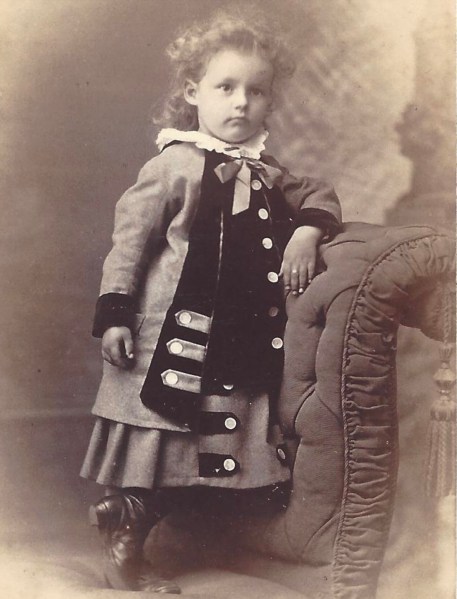
Celestin and Helene had only one daughter, Helene Marie Antoinette (1876 – 1916). This curly-haired child grew up but never married. She attended Royal Arthur School in Montreal. Antoinette attended English schools because the family was Protestant, so she couldn’t attend French Catholic schools. In 1892, she won the prize in French for second intermediate girls, besting Nellie Wilson, who won the awards for most of the other subjects. She didn’t have Antoinette’s advantage of a French background. At the closing of the ceremony, the commissioner said, “It was well to be clever but still better to be good.” Antoinette died at only forty years of age. She lived with her parents her whole life and never seemed to have an occupation.
Antoinette Lachance
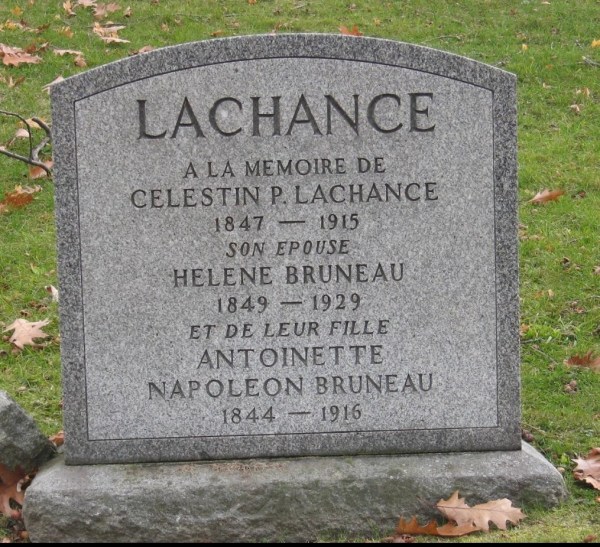
After Celestin and Antoinette died, Helene lived in Verdun, Quebec until her death, on June 4, 1929. The family is buried in Mont-Royal cemetery in Montreal along with Helene’s brother Napoleon.
Mount Royal Cemetery Montreal
Notes:
In the back of the little photo album in a list of the children, it actually said twins, which had never registered with me.
Back page of photo album
1871 Census: Celestin was 22 and living with his parents and sibling in St Charles Borromée, Joliette, Quebec. Year: 1871; Census Place: St Charles Borromée, Joliette, Quebec; Roll: C-10036; Page: 15
Helene and Celestin were married in 1875 and recorded as French Evangelicals.
Antoinette was born in October 2, 1876 and baptized at 9 years old in 1885.
According to Find a Grave: her full name was Helene Marie Antoinette Lachance born in St Constant Quebec.Ancestry.com. Canada, Find a Grave® Index, 1600s-Current [database on-line]. Lehi, UT, USA: Ancestry.com Operations, Inc., 2012.Original data: Find a Grave. Find a Grave®. http://www.findagrave.com/cgi-bin/fg.cgi accessed August 28, 2024.
1891 Census: The Lachances were living in Ste. Conegonde Hochelaga, Quebec. Celestin was a Commis au Bois, a wood clerk, Helene was a wife and both members of the Free Church.
Year: 1891: Census Place: Ste Cunégonde Town, Hochelaga, Quebec, Canada; Roll: T-6396; Family No: 227Ancestry.com. 1891 Census of Canada [database on-line]. Lehi, UT, USA: Ancestry.com Operations Inc, 2008. Aug 28, 2024.
1901 Census: Celestine, Helene and Antoinettte (Marie-A ) were living in Ottawa, where Celestin was listed as a foreman and Antoinette, had no occupation. Year: 1901; Census Place: Ottawa (City/Cité) Dalhousie (Ward/Quartier), Ottawa (City/Cité), Ontario; Page: 19; Family No:189 Source InformationAncestry.com. 1901 Census of Canada [database on-line]. Lehi, UT, USA: Ancestry.com Operations Inc, 2006. Aug 28, 2024.
Montreal Star: Royal Arthur Closing Exercises, June 22, 1892 Wednesday, pg. 3. Newspapers.com accessed Sept 9, 2024.
Le Devoir: Celestin Lachance obituary, March 26, 1915 pg 2. Newspapers.com accessed September 9, 2024
Montreal Star Obituary: Helene Lachance, June 6, 1929 page 11. Accessed Oct 22, 2024.
Jean-Louis Lalonde: Lachance, Celestin (1849-1915) SHPFQ Societe d’Histoire du Protestantisme Franco-Quebecois. Octobre 12, 2020.







 Genealogy Ensemble
