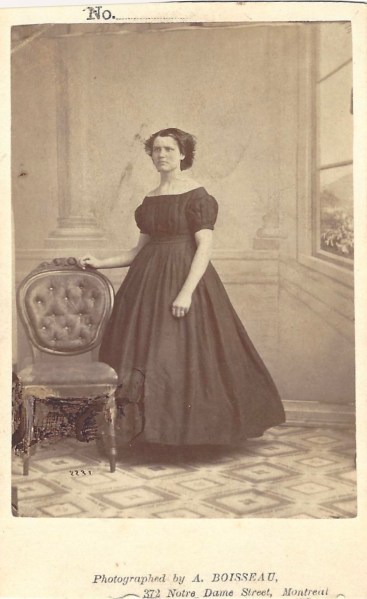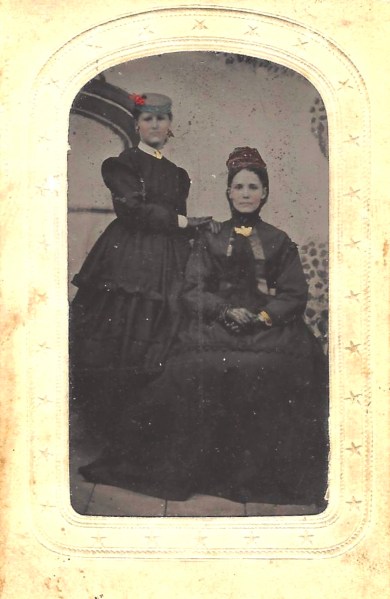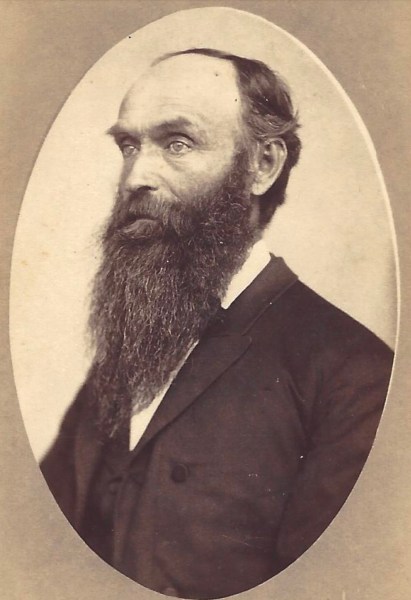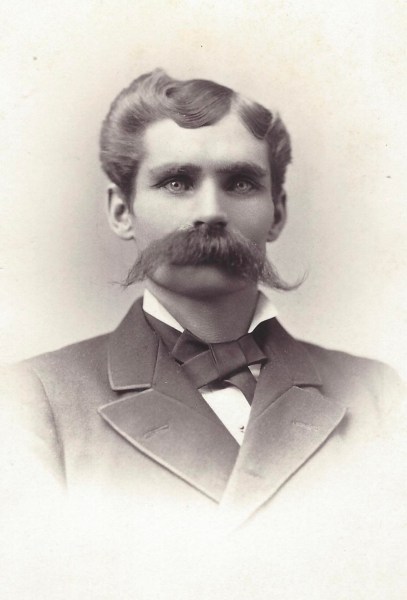
There are many William Sutherlands in my family. My great-great-grandfather William Sutherland ( 1816-1887) son of William Sutherland (1749-1840) came to Canada in 1845 with his wife Elizabeth Mowat. They followed the Scottish naming pattern of calling the first son after the husband’s father so his eldest son was William and then his eldest son was also William.
My grandfather, son of Donald was also named William. He thought the family had way too many Williams, Willies, Wills and even a Bill so he took the second name, Harkness, after his mother. There was just one mention of his first cousins, William Sutherland and his sister Annie in my grandfather’s diary. “Went to Rose Ave, Annie was there from N.Y. but Willie away in Florida.” That’s all I knew.
Luckily, cousin William also seemed to have added a middle name maybe Everard or Ewart. So instead of the thousands of William Sutherlands, he can be found as William Everard or William E Sutherland.
William first crossed the border into the United States in 1889 when he was just 16. He probably went for a job or maybe an adventure. He was born in Mildmay, Bruce County, Ontario. His grandfather and then his father owned the family farm which his father sold and moved the family to Toronto when he was a child.
William is then found in New York City, where his sister Annie later joins him.
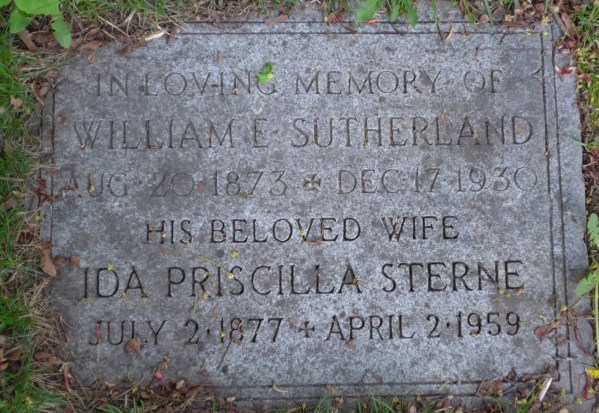
William married Ida Priscilla Sterne in New York in 1913. Priscilla was also a Canadian from Carrick, Bruce County. She and William must have known each other growing up. Priscilla immigrated to the US by herself in 1899. She was a milliner and had her own business making hats. After her father’s death in 1905, her mother came to the US, along with a sister and a brother.
The couple didn’t have any children, having married later in life. William was 39 and Priscilla 35.
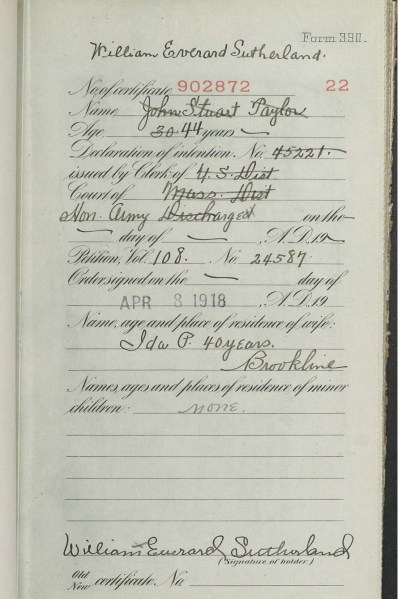
William became a naturalized American in April 1918 through the Alien Soldier’s Naturalization Act. He joined the US Army in 1899 during the Spanish-American war. Any alien who enlists in the US armed forces and is honourably discharged could apply for citizenship without a previous declaration of intention and with only one year of residence. His proof of service and discharge is the strangest document I have ever seen. It had a name crossed out and William Everard Sutherland written above. Other information was also crossed out. This document was accepted as there is a copy of his Naturalization certificate. I don’t know why he never made a declaration of intention as he had been in the US for almost 40 years. Priscilla also became an American.
This was the proof that he was honorably discharged from the US Army which allowed him to become a Naturalized US citizen under the Alien Soldiers Naturalization Act; Section 2166.
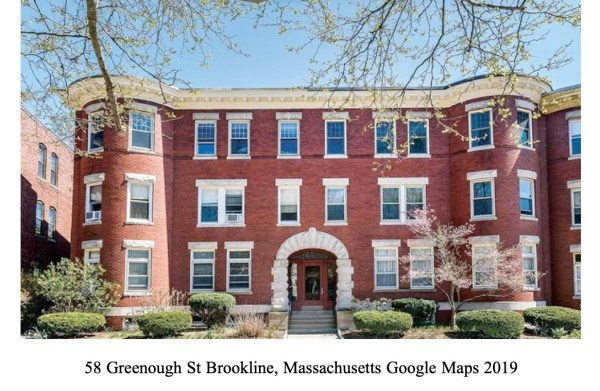
Around 1917, he and Priscilla moved to Brookline Massachusetts, They lived at 58 Greenough Street. A three story apartment (now condo) building is at that address according to Google maps. It is a very nice red brick building with bay windows. The condos now sell for a million dollars. The couple had done well as Priscilla was no longer working and William was the boss working in construction as an electrician. They even had room for Priscilla’s mother to spend time with them.
They finally ended up in Florida, around Miami and Palm Beach. William was president of a building company so they were not early retirees. He later had health problems, stopped working and applied for an invalid’s pension from the US Army. When William died of heart disease in 1930 his body was sent back to Canada for burial. Priscilla applied for a widow’s pension and continued to live in Palm Beach until her death 29 years later. Her body was also returned to Canada and is buried with her husband in Toronto’s Mount Pleasant Cemetery.
Now I have to find his sister Annie.
Notes:
William’s parents William Sutherland and Jessie Johnson lived at 21 Rose Ave in Toronto. His siblings, Agnes, Isabel, Jessie and Davison were all living at home in the 1920s.
William H. Sutherland’s diary 1920-1924 in the hands of the author.
William registered for the draft during the First World War even though he was 45 years old. I don’t think he served again, as the war ended less than three months later.
My grandfather William Harkness Sutherland called his only son Donald after his father but added William as a second name!
Year: 1910; Census Place: Boston Ward 24, Suffolk, Massachusetts; Roll: T624_625; Page: 13a; Enumeration District: 1634; FHL microfilm: 1374638Ancestry.com. 1910 United States Federal Census [database on-line]. Lehi, UT, USA: Ancestry.com Operations Inc, 2006. Mar 20, 2020.
Year: 1920; Census Place: Brookline, Norfolk, Massachusetts; Roll: T625_721; Page: 4A; Enumeration District: 172 Ancestry.com. 1920 United States Federal Census [database on-line]. Provo, UT, USA: Ancestry.com Operations, Inc., 2010. Images reproduced by FamilySearch.
Ancestry.com. U.S., City Directories, 1822-1995 [database on-line]. New York City 1922. Lehi, UT, USA: Ancestry.com Operations, Inc., 2011.
National Archives and Records Administration (NARA); Washington, D.C.; Index to Naturalization Petitions and Records of the U.S. District Court, 1906-1966, and the U.S. Circuit Court, 1906-1911, for the District of Massachusetts; Microfilm Serial: M1545; Microfilm Roll: 24Ancestry.com. U.S. Naturalization Records Indexes, 1794-1995 [database on-line]. Provo, UT, USA: Ancestry.com Operations, Inc., 2007. Accessed March 20, 2020.
National Archives and Records Administration (NARA); Washington D.C.; NAI Number: M1368Ancestry.com. Massachusetts, State and Federal Naturalization Records, 1798-1950 [database on-line]. Provo, UT, USA: Ancestry.com Operations, Inc., 2011. accessed March 20, 2020.
New England Historic Genealogical Society; Boston, Massachusetts; Massachusetts Vital Records, Marriage Record 1911–1915; Volume: 621 accessed on Ancestry March 20, 2020.
My talented high school friend Gary and me circa 1980. He recommended me for the job at the radio station.
( A long time ago, I was asked by someone who knew I dabbled in genealogy why I didn’t write stories about myself for future generations so they wouldn’t have to ‘guess’. Back then, I didn’t see the point – but now I have grandchildren. )
It was sometime back in 1983 – imagine. Every Breath You Take by The Police was blaring over the airwaves and the beautiful FM secretary sprinted out of her stuffy office cubicle and ran down the hall pumping her skinny arms over her head in a victory dance. She was simply over the moon: The stodgy radio station she worked for was entering the modern age!
I was employed as an advertising copywriter for the same easy-listening FM station as well as for its affiliate, a once-proud but struggling sports talk station on the AM dial.
The FM station was by far the more successful of the two stations, keeping the owners afloat with its middle-of-the-road Paul Mauriat instrumentals aimed at an older audience.
But their faithful clientele were retiring and moving away to live near their children in Ontario or just plain passing away. (Ironically, a retirement community just over the Quebec border in Ontario was a major advertiser.) Hence the jarring format change.
That day, I overheard a staffer callously joke about how the station’s geriatric listeners were now frantically stumbling out of their easy chairs to turn the radio dial back to ‘their’ station.
Back then I didn’t pay much attention to demographics or ratings but I did have a singular role in this FM station’s public profile.
Hourly ID’s in portfolio, typed on my Selectric.
I wrote dozens and dozens of their ‘lyrical’ hourly ID’s.
Originally penned by a veteran on-air personality, these ID’s were nothing but extra work for me and they came with no extra pay either, but I didn’t work in radio copy for the money (minimum wage) or for the praise (we got none). I worked for a chance to make a living, however meagre, as a writer and for the camaraderie among creatives and, yes, for the adrenaline rush.
(In those days, it seemed as if every advertising contract the salespeople brought into the copy office had to be conceived, written and produced “yesterday.” English Montreal radio salespeople were fighting over an ever-diminishing slice of the advertising pie – and in recessionary times. The clients were getting smaller and smaller – and pickier and pickier. These hourly ID’s allowed me to be creative (and corny) on my own terms – at my own rhythm.)
In the early 1980’s, our English FM Station was the “MUZAK” station of choice in Montreal, airing continuously in elevators all over town.
So, every lunch hour, when thousands of office workers spilled out of their own stuffy cubicles to score a coffee and sandwich and maybe a little city sunshine down below, they could not escape hearing one of my midday ID’s voiced in a warm creamy tone by one of our talented station announcers.
I kept these three “midday” ID’s for my portfolio.
Number 1: Midday in Montreal is when the babies come out. Winter newborns, bundled in their mother’s arms, rosy-cheeked cherubs, bright eyes wide in wonder. They are seeing the world for the very first time. The mystery of a budding flower, the majesty of a skyscraper, a lot for little eyes to take in. Midday in Montreal with the beautiful music of CICK. (I changed the name of the station, but you might know which one it is.)
Ok. I was 28, and although I strongly denied it back then, I was clearly wanting a family. But, if you consider I had held an infant in my arms only twice in all of my young life, both times while babysitting, I think I got it right. I know I got it right. I have a four month old granddaughter and she’s just as described.
Number 2: Midday in Montreal. School children straggle home from lunch in groups of two or three. Never taking the shortest route, they stop to pet a stray or to kick a stone around, forgetting as children often do, about time. Wandering home in zigs and zags,they finally arrive to steaming bowls of soup and fat sandwiches. Midday in Montreal. With the beautiful music of CICK.
This was a bit of a nostalgia, for sure. I, myself, in the 1960’s, had been a latchkey kid and I often had to make my own lunch, sometimes grilling POM bread over the blue flame of the gas stove. Yummy! By the 1980’s, I suspect even fewer kids went home for lunch. Still, judging from the meandering path my five year old granddaughter likes to take on our walks together, I think I nailed the dilly-dallying part.
Number 3: Midday in Montreal. The circular days are cut in half by the sound of a thousand clocks: ornate cuckoos in residential parlours, church bells and cathedral gongs, those quiet, creeping clocks in offices. As the sun reaches its highest point in the sky, a million pairs of eyes turn to the clock, acknowledging midday in Montreal, with the beautiful music of CICK.
I still like this one, although a smart-alek booth operator questioned whether cathedrals gonged at all. I directed him to Byzantium, my favourite Yeats poem. I had borrowed the phrase, you see.
The unpurged images of day recede;
The Emperor’s drunken soldiery are abed;
Night resonance recedes, night-walkers’ song
After great cathedral gong;
A starlit or a moonlit dome disdains
All that man is,
All mere complexities,
The fury and the mire of human veins.
Midnight, with the beautiful music of CICK 😉
Do you think Yeats would have been a better radio copywriter than me? Would the insomniac crowd have been seriously disturbed by Midnight ID’s in the style of his poem?
Anyway, after a year of dutifully tapping out these hourly ID’s on my trusty IBM Selectric typewriter (the one with the snazzy white “Correcto-type” band that enabled me to churn out my 30 and 60 second commercial scripts apace) I asked to be relieved of the task.
Like so many of my colleagues, I quit my copy job to try my luck in Toronto. Somehow, I ended up back in Montreal with a family – just as the economy was improving. What bad timing! For the next decade, I mostly worked remotely as a freelance writer -for rather good pay- for sundry commercial magazines producing quote-anecdote-statistic style articles on non-controversial topics that didn’t scare off the advertisers.
Occasionally, I got creative and punched out a timely satirical piece like Beat the Biological Clock for Salon Magazine. That number was written, yikes, over 20 years ago. Time sure does fly!
I guess I should get busy writing more of my ‘ancient histories’ for the girls.
I used to hate Sundays. I had to go to Sunday school. I really didn’t understand why I had to attend because my parents just dropped me off. That’s right. They didn’t even go to church. And no one asked me if I wanted to go.
After they picked me up, things got worse. It was homework time until lunch. Of course, I could have done my homework on Friday night but Fridays were reserved for movies on the television and reading in bed with a flashlight until all hours.
And worst of all, some Sunday afternoons were for Visiting the Elderly Relatives. In my mind, my aunts and uncles were ancient. Plus my brother, being a boy and older than me, was apparently able to take care of himself, as he always seemed to be absent from these visits. So I would sit in the living rooms of my aunts and uncles, with no toys or any other amusements, and listen to the adults talk.
I now cherish the memories of these visits because they provided me with an appreciation of the social history of Montreal, as well as significant events such as the Depression and World War II.
The stories about the Depression are the ones that struck me the most. During the Depression, a quarter of Canada’s workforce was unemployed.1 My dad, Edward McHugh, was a young man out of work in Montreal and he joined his older brother and sister in Drummondville, to work for the Celanese. At the peak of the Depression, the Celanese employed 1,757 workers.2
None of the McHughs had cars in those days so they must have travelled back and forth to Drummondville by train. And Uncle Thomas McHugh married a local girl. I can just imagine the McHughs, from Verdun, arriving in Drummondville for the wedding. I doubt very many people spoke English in Drummondville at the time. The culture shock must have been intense.
My aunts and uncles, even into the 1960s, were thankful that they were able to have had some work during the Depression. Uncle Al Scott worked for the Northern Telecom for 40 years, although with reduced hours during the Depression. Luckily Uncle Frank McHugh worked for the Montreal Tramway Company so he was able to keep working during the Depression. He was a tram driver for tram number 24 that started in Montreal West and crossed the city on Sherbrooke Street. His job was safe.
Dad’s siblings loved to have a good time and the Depression did not stop them. My Aunt Elsie used to describe their card parties. There was only one bottle of scotch, some ginger ale, one can of salmon and one loaf of sliced white bread. My aunt was able to spread the salmon so thinly that she could make sandwiches out of the whole loaf of bread.
It was very clear to me that the Depression was a very frightening time in their lives. During this period, the future must have seemed bleak. Life was a struggle to make ends meet. But they made the most of it and persevered. Today I feel lucky to have listened and to remember their stories.
Would my 19th-century ancestor Sophie Bruneau Huntley be posting pictures on social media, taking selfies and showing off her new purchases if she were alive today? I think the answer is, maybe yes!
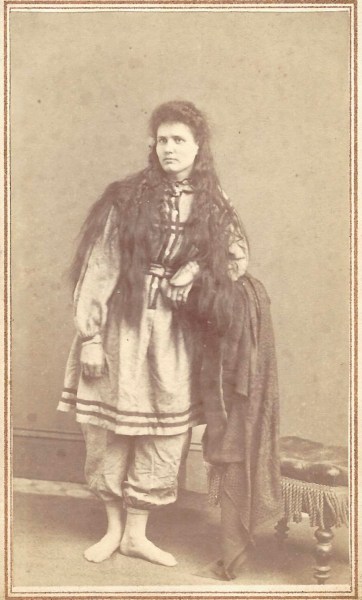
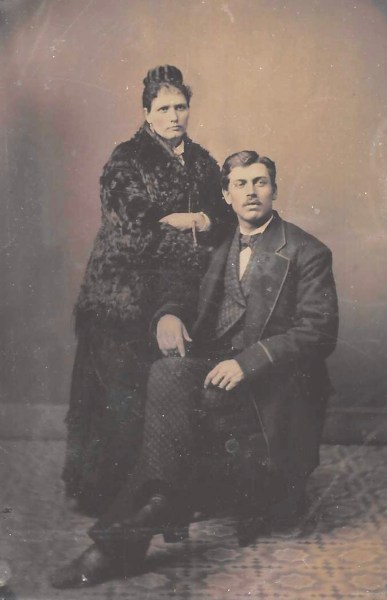
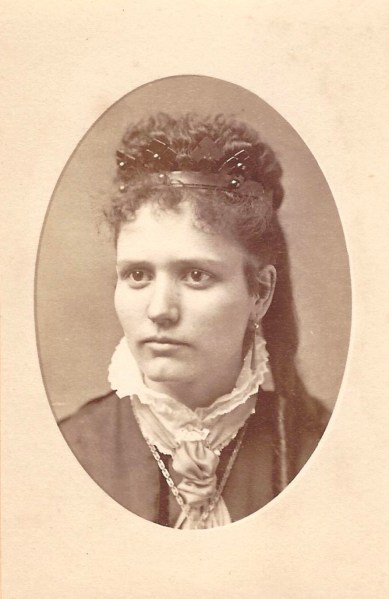
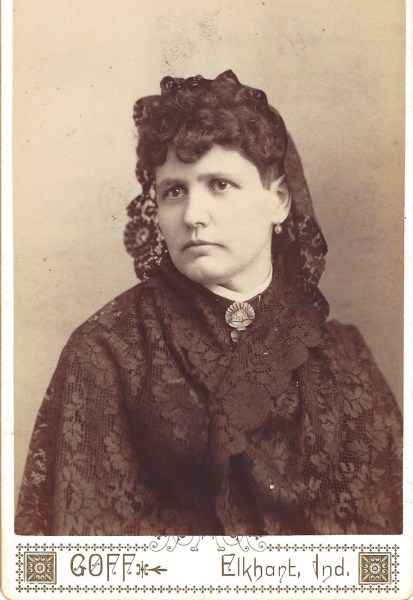
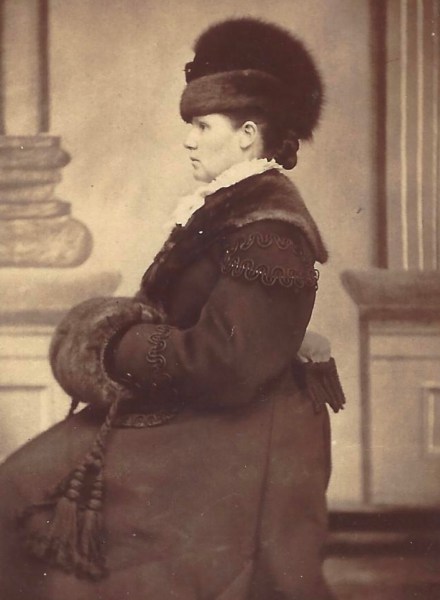
Sophie was born in 1847, so all her early pictures were taken in photographic studios. These were not spontaneous pictures but rather specific setups with long exposures. There are several pictures of Sophie in the family photo albums. Many were taken in New York. My favourite is Sophie in a bathing costume displaying her very long hair and bare feet. There were no mischievous smiles but rather hard stares. Still, it appears she had fun during her photo shoots.
Sophie Bruneau
My great-great grandparents Barnabe Bruneau and Sophie Marie Prudhomme had 13 children and Sophie was number eight. She lived with her parents on their farm in St. Constant, Quebec until after the 1871 census. Pictures from New York studios came soon after. I assume Sophie worked in New York as a teacher or a French governess like her sisters, Virginia and Elmire, when she arrived in the United States in 1875 at 27 years old.
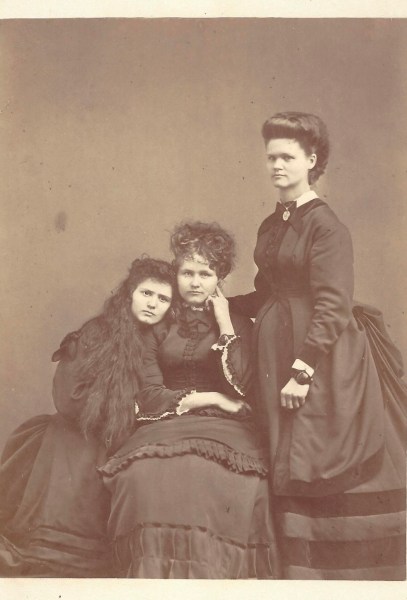
Sisters: Sophie, Helene & Mathilde
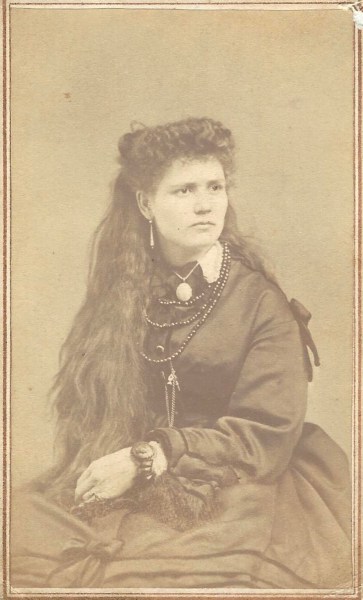
Sophie in New York
Sophie and her sister Elmire, married two Huntleys, Washington and Wallace? (Walworth). I assumed that they were brothers who married sisters. On family trees and photos he was called Wallace but it seems he was George Walforth Huntley (1854-1933), Washington’s younger brother and seven years younger than Sophie. Andrew Washington Huntley Elmire Bruneau’s husband was born in Mooers NY to Andrew Huntley and Calista Blodgett and there was a George Walworth Huntley in the family. If this is Sophie’s husband, they could also have met because her sister Aglae was living in Mooers Forks, New York with her husband.
Sophie and George W. Huntley
Sophie, Elmire, and their husbands lived in several places in the United States but ended up in Los Angeles.
Sophie and Walworth lived in Elkhart, Indiana as Sophie is mentioned in the Personal and Society column of the Indianapolis Journal, “Mrs. George W. Huntley is spending a month in Montreal.” The beginning of the column discussed women’s dress which probably interested Sophie. “What with shirtwaist blazers, neckties and caps the women, middle-aged and young are fast becoming what Light facetiously denominated “self-made men.” George was a railroad conductor and owned his own house according to the 1900 census.
Sophie Huntley
They later lived in Toledo, Ohio where George was a customs collector and finally moved to Los Angeles, California. Sophie became a naturalized American because her husband was a US citizen.
They never had any children.
Sophie Bruneau Huntley
Her age was fluid in all the documents. Her husband was seven years younger but sometimes she was younger and sometimes the age difference was much smaller. Her death record in December 1921 said she was 68; in the 1920 census, she was only 63 while actually being 74.
A death notice in a Los Angeles paper, “Sophie B. Huntley died December 28, 1921, beloved wife of George W. Huntley, funeral from residence La Veta Terraces.” Her death notice was also in Elkhart, Indiana and Toledo, Ohio newspapers. George continued to live in Los Angeles with his housekeeper Mary Dietrick until his death in 1933.
Notes:
“Canada Census, 1871”, , FamilySearch(https://www.familysearch.org/ark:/61903/1:1:M4KT-F5V : Sun Mar 10 23:41:04 UTC 2024), Entry for Barnabe Bruneau and Sophie Bruneau, 1871. Sophie 23 at home no occupation.
California, County Birth and Death Records, 1800-1994″, , FamilySearch(https://www.familysearch.org/ark:/61903/1:1:QG49-NZN3 : Sat Mar 09 23:29:28 UTC 2024), Entry for Sophie B Huntley and Barnabee Barneau, 28 December 1921.
What is in a name? Aglae Bruneau (1837 – 1906) was the oldest of 13 children in my great-grandfather’s family. How did her parents Barnabe Bruneau and Sophie Marie Prud’homme come up with that name? Aglae is a name of Greek origin meaning splendour, brilliance and the shining one. She was one of Zeus’s three daughters, with her sisters Euphrosyne and Thalia known as the three graces. Apparently, it is not as strange a name as I thought, as the BAnQ (Bibliothèque et Archives nationales du Québec) website has many references to Aglaes even other Aglae Bruneaus.
Aglae seated and her youngest sister Anais
Aglae was born on her parent’s farm in St. Constant, Quebec. The family was Catholic as recorded in the 1851 census but converted to Protestantism soon after. Aglae married Pierre Charles Paumier (1828 – 1914) in the First Baptist Church in Montreal in 1860. He was born in France and immigrated to the United States in 1856. He had a farm in Mooers Forks, New York close to the Quebec border. It is possible that they met at religious services held at the Felleur Institute in Grande Ligne, Quebec as French Protestants often moved back and forth across the border for religious events.
Pierre Charles Paumier
On many of the US census, Pierre Paumier is listed as a farmer but was he originally a Baptist minister from France? My great uncle, Sydney Bruneau, wrote in his recollections “One of my aunts had married a Baptist minister from France, a man who made no secret of loving his pipe and his homemade brew of well-fermented cider, to the no small scandal of his congregation. When he was informed of complaints which had reached the higher authorities, he lost no time in preaching his farewell sermon, flaying his listeners without mercy for their narrowness of mind and their intolerance of the harmless pleasures of life, and retired to a farm where he grew his own tobacco and lived to a ripe old age.”
Like many of Aglae’s siblings, they only had one child Sophie F. Paumier. The family continued to live on their farm which Pierre owned outright and Aglae “kept house” until she died in 1906.
It appears that after Aglae died Sophie and her father sold the farm, packed up and moved to California, as they were living in Los Angeles according to the 1910 census. Two of Aglae’s sisters had also moved west to California. Pierre owned the house and neither he nor his daughter had an occupation listed so he continued to be a man of some means. In some directories, he is listed as Rev. Peter Pomier. Sophie died in LA only five years after her father.
The name Aglae has not been used again in our family. Aglae herself called her daughter Sophie after her mother rather than naming her after another Greek goddess.
Notes:
Census of 1851 (Canada East, Canada West, New Brunswick and Nova Scotia) for Image No.: e002302444 Archives Canada.
Bruneau A. Sydney. Walking With God in Dequen. Page 6. A memoir of his early childhood through the summer of 1910. Written by A. Sydney Bruneau in the late 1960s and transscribed by his granddaughter Virginia Greene, in January 2017. The author has a copy.
Tobacco was grown in Upstate New York and in Quebec and Ontario in the mid to late 1800’s. This shade tobacco was used commercially as cigar wrappers.
When I was a teenager, I came across a book in my parents’ house called Intention and Survival, written by T. Glen Hamilton, my grandfather. Inside a plain beige cover, the text was illustrated with grainy black and white photographs. Many of them showed a middle-aged woman, her eyes closed, with a white substance coming from her mouth or nostrils. Tiny images of the faces of deceased individuals seemed to be embedded in this substance.
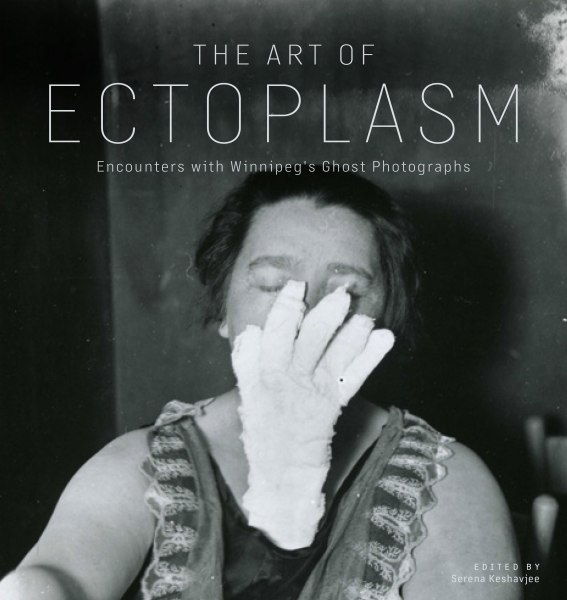
Those photos gave me nightmares, and for decades, I have been trying to figure out what to make of them. Now, a new book called The Art of Ectoplasm: Encounters with Winnipeg’s Ghost Photographs is helping me understand them.
Edited by Serena Keshavjee, a professor of art and architectural history at the University of Winnipeg, and published by the University of Manitoba Press, The Art of Ectoplasm looks at the context in which my grandparents researched and photographed psychic phenomena, including that white substance called ectoplasm. The book describes their work and the many artistic projects it has inspired.
Published on large-format paper, the book itself is a work of art. The black and white, sepia and contemporary colour photographs almost glow. Most of the old photos were taken during séances held at the Hamiltons’ Winnipeg, Manitoba home 100 years ago. Shot in a darkened room, lit by flash, with large-format cameras, these are sharp, high-contrast images that can be seen as both documentary photos and as art. Meanwhile, the 300-page text explores the history of these séances and includes an extensive bibliography.
Dr. Thomas Glendenning Hamilton (1879-1935), known to most of his friends as T.G., was a family physician and surgeon, president of the Manitoba Medical Association and member of the Manitoba Legislative Assembly. He was a strict Presbyterian and elder of his church. He and his wife, Lillian (Forrester) Hamilton (1880-1956), had four children, including twin boys. Everyone in the household got sick during the 1918-1919 influenza pandemic, and one of the twins, three-year-old Arthur, died of the flu.
At the time, many people were strongly religious and believed in personal survival after death. Some tried to communicate with deceased loved ones. Alhough T.G.’s experiments in telepathy date from 1918, before the influenza pandemic, Arthur’s death may have stimulated the Hamiltons’ interest in the psychic field. Lillian started experimenting with table movements and rapping, and eventually T.G. was encouraged to participate. He decided to take a scientific approach. He prepared a room in the family home where the conditions could be carefully controlled and, in 1923, he began to conduct a series of experiments related to telekinesis, trance and mediumship that included the appearance of ectoplasm. These séances took place once or twice a week over a twelve-year span.
Lillian encouraged and collaborated with her husband, conducted research to make sense of alleged trance communications, did much of the organizing and often chaperoned the mediums. After T.G.’s death, she compiled the notes taken during the séances, as well as the photographs, her husband’s speeches and other material. She also continued to attend séances. She has received little public credit for her contributions, but that is beginning to change as Katie Oates, of Western University in London, Ontario, contributed a chapter in this book that focuses on Lillian’s role.
In 1979, T.G. and Lillian’s daughter, Margaret Hamilton Bach (1909-1986), donated the original photographic plates and documents to the archives at the University of Manitoba. Since then, the university has received many other collections of material related to psychical research and, as archivist Brian Hubner writes in The Art of Ectoplasm, the city has become known as “weird Winnipeg, an unlikely centre of the paranormal”.
Shelley Sweeney, archivist emerita and retired head of the University of Manitoba Archives and Special Collections, notes that the Hamilton Family Fonds has inspired a variety of projects, including books, plays and visual arts. It is the most utilized collection of personal records held by the archives, and photographs from the Hamilton collection have been exhibited in museums around the world.
In another article, Esyllt W. Jones, a professor of history and community health sciences at the University of Manitoba, puts the Hamiltons’ séances into the context of the couple’s grief following their child’s death. She also shows how their experience was an example of the trauma caused by the pandemic and the loss of loved ones during World War I.
Miniature face in ectoplasm of C.H. Spurgeon, with medium Mary Marshall, taken by T.G. Hamilton, May 1, 1929. UMASC H.A.V. Green Fonds
Thanks to the movie Ghostbusters, the word ectoplasm became popular in the 1980s, long after T.G.’s research involving ectoplasm took place between 1928 and 1934. Ectoplasm has been described as a vaporous substance that appears from the mouth or other orifices of a medium. Formless at first, it can change to resemble muslin or cotton batting before being reabsorbed into the medium’s body. T.G. thought of it as a living thing, directed by an internal intelligence. Ectoplasm has not been tested in a laboratory and, since World War II, it has not been considered a topic for credible scientific study.
The scientific methods that T.G. used in his “laboratory” are outdated today, but during his lifetime, as editor and contributor Keshavjee writes, psychical research was considered within the bounds of accepted scientific inquiry. There was a large body of literature on the topic and a number of well-respected scientists of the era accepted that strange things happened in the séance room. But, Keshavjee suggests, when the Hamilton séance activities began to be directed by an unseen personality called Walter, T.G.’s claims that he followed scientific methods lost credibility.
Today, questions about fraud hang over many psychic activities. Some people are convinced the Hamilton séances were fraudulent, others believe they were genuine. For the most part, this book accepts the Hamilton séance photographs without trying to address the issue.
In his chapter defending the Hamilton family psychical research legacy, Walter Meyer zu Erpen, founder of the Survival Research Institute of Canada and an archivist who has spent more than 30 years investigating these events and the people involved, concludes that the ectoplasm photographed by the Hamiltons was genuine.
Whether the appearance of ectoplasm was proof of survival after death is another question. In general, Keshavjee writes, there is little basis for belief that psychic phenomena inherently provide evidence of life after death. Meyer zu Erpen admits he is taking a middle-of-the-road position when he suggests that, in the Hamilton séances, only the ectoplasm samples with miniature faces of the deceased contribute to evidence for survival of human personality beyond death.
T.G. was convinced, however, that what he experienced in the séance room could only be the work of surviving spirts. For him, and for Lillian, survival was a fact.
The Art of Ectoplasm did not answer all my concerns, but for anyone interested in the Hamilton séances from an artistic, historical or psychical research perspective, it is worth going beyond the amazing photos and reading the text.
Full disclosure: as family historian, my research has been quoted several times in The Art of Ectoplasm and my father edited Intention and Survival.
The Art of Ectoplasm is available from the University of Manitoba Press, https://uofmpress.ca/books. It can also be ordered from Amazon, Indigo and other booksellers.
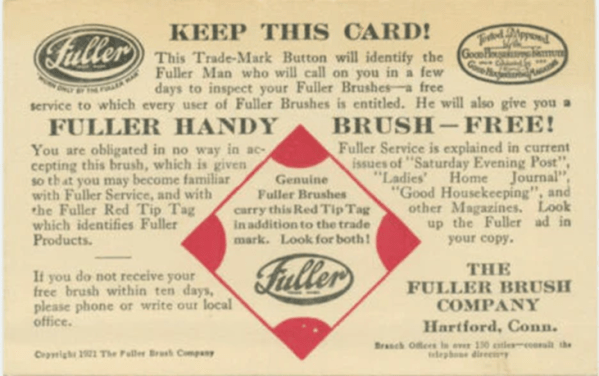
The advertisement in the February 24, 1928 edition of the Montreal Star called for three reliable men to apply for a special sales campaign for the Fuller Brush Company.
My dad, Edward McHugh, probably answered an advertisement similar to this one when he finished school in the late 1920s. He worked as a Fuller Brush salesman for two years in Montreal. Alfred Fuller founded the Fuller Brush Company in 1906. The company produced good quality brushes and increased its sales force by advertising for salesmen. But the secret of its selling success was that each salesman (they preferred men in those days) had to sign a pledge in which they promised that “I will be courteous; I will be kind; I will be sincere; I will be helpful.”1
The salesmen left cards like this one when no one was home:
As you can see in the above picture, my dad was a snazzy dresser. Knowing him, he probably took a lot of care with his appearance when he was out selling brushes. I remember him polishing his shoes every morning before going to work.
I assume that he succeeded fairly well at selling Fuller Brushes.2 But he must have been restless and in search of adventure because he left Montreal after just two years of selling brushes. Just travelling to Bermuda would have been quite an adventure in itself. He would have started his trip by going to New York City by train where he would then take an ocean liner. The Furness Bermuda Line and operated regular passenger and mail service between New York and Hamilton, Bermuda at the time.3
Edward must have encountered some challenges selling Fuller Brushes in Bermuda as he ended up working as a bell hop in a hotel that catered to rich patrons from the U.S. and Canada. The tips he earned helped him pay for business college when he returned home to Montreal.4
The Princess Hotel, Hamilton, Bermuda5
By the time Dad completed his business and accounting courses, Canada was in the Great Depression. He again got itchy feet again and moved to Drummondville, Quebec with his older brother, Thomas McHugh, his sister, Sarah Jane McHugh, and her husband, Jack Day. In Drummondville, he did not work as a Fuller Brush salesman, a bell hop, or in business or accounting. He apprenticed as an electrician at the Celanese and worked there for eight years until 1940, when he enrolled in the Royal Canadian Air Force as an aircraft mechanic at the outset of World War II. The RCAF trained my dad in aircraft hydraulics and he was assigned to Bomber Command stationed in Yorkshire, England, for the remainder of the war.6
It is no surprise that Dad did not become an aircraft mechanic after the war. He loved being an electrician and his started his own electrical company, Provincial Engineering. He eventually sold his portion of the business. I remember him saying, “the boss always gets paid last.” After that, he joined a firm and worked in a supervisory capacity on the electrification of towns in regional Quebec such as Sept-Iles and Chibougamau.
Dad was curious and loved trying new things. He never backed down from a challenge.
When my dad retired, he and my mom travelled to Bermuda regularly for their winter getaways. He must have enjoyed going back and perhaps even having a meal or two at the hotel he worked at when he was a young bell hop.
“Selene J. Bruneau brother of A.B. Bruneau who has been visiting at his mother’s, in St. Constant, near Montreal, Canada, for the past six weeks returned home this morning. His many friends will be glad to hear his health is much improved.” as reported in the Fall River Evening Daily News 1880. Unfortunately, two years later Selene died at only 31 years of age.
Selene (1850-1882) was the first of Barnabé Bruneau and Sophie Marie Prudhomme’s 13 children to die. According to his obituary, he died of consumption, at his mother’s in St-Constatnt. What used to be called consumption is tuberculosis or TB. It became known as the wasting disease as those afflicted seemed consumed by their disease as bacteria grew in their lungs and digestive tract. They lost energy, coughed up blood and slowly died. “The slow progress of the disease allowed for a “good death” as those affected could arrange their affairs.”
Most typical 19th-century victims of TB lived in tenements and or worked in factories, places where the disease spread quickly because of close contact and poor hygiene. Even when TB was known to be a contagious disease, people ignored public health campaigns to quarantine the sick and continued to spit on the streets. Selene, not a typical victim, lived in Fall River Massachusetts in a house with his brother Amie’s family. Although some of his older brothers had come to the US earlier and worked in factories, Selene worked in Aime’s jewellery store as a watchmaker.
He seemed content living in the United States as he had the support of some family, friends and a good job although he never married. Selene petitioned for naturalization and took his oath allegiance in 1879 with Aime and his wife Mary as witnesses.
Selene Bruneau in Montreal QC
It appears Selene went home to his mother’s to try and recuperate from his illness. This was before there were any sanitoriums for TB patients. The first one in the US opened in Saranac Lake, New York in 1884 and the first one in Canada, Muskoka Cottage Sanitorium, Ontario in 1897. These sanitoriums isolated infected patients and provided nutritious food, plenty of rest and fresh air. Selene undoubtedly was given this treatment by his mother but at this time 80% of those who developed active TB died from it
The BCG vaccine against TB (Bacille Calmette-Guérin) was first used in humans in 1922. In Canada, only Quebec and Newfoundland had mass vaccinations of school children from the 1950s to the 1970s. In 1944 streptomysin was isolated, the first antibiotic effective against tuberculosis. Medical professional’s hopes that the disease could be eliminated were dashed in the 1980s with the rise of drug-resistant strains. Surgery was also used where infected portions of the lungs were cut out which produced some cures, relieved pain and various anatomic obstructions. Still today, worldwide, there are over ten million new cases of TB a year.
Selene’s burial place is in the St Blaise Sur Richelieu Cemetery, the Baptist Cemetery in Grande Ligne associated with the Feller Institute, alongside his parents and some of his siblings. His mother outlived him by ten years.
Selene wasn’t a lucky name. His brother Ismael called one of his sons, Selene Fernand and this child died early, in his first year of life. My grandmother told us it was his strange name that killed him although he was called Fernand and not Selene. This from a family with girls called Helvetia, Hermanie and Edmee. Little did she know it was the Selene that was the problem!
Fall River Daily Evening News 14 August, 1882 Monday Page 2. Selene J Bruneau Obituary.
United States, New England Petitions for Naturalization Index, 1791-1906″, , FamilySearch(https://www.familysearch.org/ark:/61903/1:1:VXRD-LZ2 : Tue Nov 14 02:51:28 UTC 2023), Entry for Selene J Bruneau.Oath of Alliengence to the US Oct 11, 1879 Bristol County Superior Court, Taunton, Massacheuttes.
In Canada, vaccinations of all children 10-14 continued until 2005 when it was decided the TB rates in the general population had fallen to such a low level that universal BCG vaccination was nolonger needed.
M. tuberculosis infection is spread almost exclusively by the airborne route. The droplets may remain suspended in the air and are inhaled by a susceptible host. The duration of exposure required for infection to occur is generally prolonged (commonly weeks, months or even years). The risk of infection with M. tuberculosis varies with the duration and intensity of exposure, the infectiousness of the source case, the susceptibility of the exposed person, and environmental factors. Although treatment courses are prolonged, effective treatment of the individual with active TB disease can reduce the infectiousness after two weeks.
When my great-great grandfather Stanley Clark Bagg died in 1873, his wife and five children inherited large tracts of farmland on the island of Montreal, land that they made a family business of selling.1 But misunderstandings over who owned what and how to keep track of the income created a lot of difficulties.
Stanley Clark Bagg (I usually refer to him as SCB to differentiate him from his father, Stanley Bagg, and his son, Robert Stanley Bagg,) had inherited most of this property from his grandfather John Clark (1767-1827).2 But there were conditions attached to some of these bequests: Clark’s 1825 will stated that land that comprised the Durham House property, and land comprising Mile End Farm, should pass down through three generations of descendants before it could be sold. The legal term for this, in civil law, is a substitution. However, a change in the law, passed in 1866, limited substitutions to two generations.3 That meant that the generation of Robert Stanley Bagg and his sisters Katharine, Amelia, Mary and Helen were the last generation affected by the substitutions and they could do what they liked with these properties.
The substitution clause referring to Durham House was part of the 1819 marriage contract between SCB’s parents, in which John Clark gave that property to his daughter as a wedding present.4 (It is shown in dark green on the map below.)
Robert Stanley Bagg, # II-57308.1, 1880, Notman & Sandham, McCord-Stewart Museum; Bagg family collection.
When SCB died at age 53, none of his family members was ready to manage these properties. His only son, Robert Stanley Bagg, or RSB, (1848-1912) had recently graduated in law, but he had no experience in renting or selling properties. Furthermore, neither the notary who completed the inventory of SCB’s estate in 1875,5 nor SCB’s widow, nor his children were aware of the substitutions. The Durham House and Mile End Farm properties were treated as though they were no different than the other properties belonging to the late SCB’s estate.
The 22-acre Durham House property (lots 19–28 and 101–115, cadastre of the Saint-Laurent ward) was located north of Sherbrooke Street, on the west side of today’s Saint-Laurent Boulevard. SCB had subdivided part of it and sold lots from it as early as 1846. In 1889, RSB, who was an executor of his father’s estate, subdivided the Upper Garden of Durham House (lot 19, Saint-Laurent ward) and began to sell those lots. He signed the property documents as “R. Stanley Bagg for the estate,” and his mother, Catharine Mitcheson Bagg, also signed.
But the Durham House property actually belonged jointly to the five Bagg siblings. It was not part of SCB’s estate, and his widow could not inherit this land, sell lots from it or acquire income from it. Yet that is what she did: the name Dame Catharine Mitcheson, widow of Stanley Clark Bagg, appeared on five deeds of sale in 1889.
It is not clear who discovered the error, but perhaps someone close to the Bagg family took a good look at the property documents and noticed these details. SCB’s middle daughter, Amelia Bagg, was to marry Joseph Mulholland the following year, and he worked as a real estate agent for the Stanley Clark Bagg Estate. Also, Joseph’s brother-in-law, John Murray Smith, was about to purchase several of the Durham House lots. Any one of these people could have discovered the marriage contract and John Clark’s will, which SCB had registered at the provincial land registry office.6
This map shows details of several of the late Stanley Clark Bagg’s properties in 1875, when an inventory was made of his estate. Durham House and its upper garden, as well as a small part of the Mile End Farm and SCB’s home, Fairmount Villa, are overlaid over a modern map of the island of Montreal. Mile End Lodge had been John Clark’s home. At that time, the densely populated part of Montreal was south of Sherbrooke Street. Mount Royal Park, opened in 1876, is on the left. Map created by Justin Bur, based on two open data sources: physical geography from CanVec, Natural Resources Canada and modern streets from Geobase, City of Montreal.
As soon as they became aware of the situation, the Bagg siblings tried to remedy it with a notarized document called a Ratification.7 It said that, as the actual owners, they ratified and approved the five sales made by their mother. A few weeks later, in January and April of 1890, the Bagg siblings sold five lots to John Murray Smith and four to James Baxter, and this time, the vendors named in the deeds were correct.
Next, Catharine and her five children took a step to sort out the income from lots from the Durham House property that SCB had sold in his lifetime. They did not involve a notary, but tried to look after the issue as a family, signing a document called an Indenture on May 12, 1890.8
The indenture stated that neither Catharine nor her children had known about the marriage contract until December, 1889. The Bagg children (by now all were adults) declared the love and affection they had for their mother and their desire to settle the matter amicably, and released her from all claims and demands. For her part, Catharine agreed to repay to her children the capital sums she had received from the sale of these properties. Because she had paid taxes and expenses on them, the children made no claim for the interest payments she had received.
Action Demanded
No doubt confident that everything had been resolved, RSB took his wife and two young daughters on an extended trip to England, leaving his mother and sisters to handle offers for land sales during his absence. After his return, however, the family dispute blew up once more, this time over the Mile End Farm property. Two of the married sisters, Katharine Sophia Mills and Mary Heloise Lindsay, hired a notary to represent their interests.
Notary Henry Fry sent a complaint on their behalf to the three living executors of SCB’s will — Catharine Mitcheson Bagg, Robert Stanley Bagg and notary J.E.O. Labadie – demanding immediate action. Dated July 22, 1891 and titled Signification and Demand,9 this document stated that the executors of SCB’s will were bound, upon his death, to deliver over the Durham House and Mile End Farm properties to his children, and to produce an account of the administration of these properties.
Catharine Mitcheson Bagg, #71147, 1883, William Notman & Son, McCord-Stewart Museum; Bagg family collection.
It stated that the executors “have wholly failed and neglected to render such account, but on the contrary, have, since the death of the said Stanley Clark Bagg, continued in possession of the said substituted property and have even sold and alienated portions thereof and have received the consideration money of such sales and have received and retained the entire revenues therefrom and that although they have been recently requested to render such account, the said executors have neglected and refused to do so.”
The executors had until August 10 to provide an account of the property belonging to the substitutions. They must have met this demand because no further complaints have turned up. Furthermore, the Bagg siblings seem to have found a better solution to their dilemma: they partitioned the Durham House property and sold a large chunk of the Mile End Farm.
In September 1891, the remaining unsold lots of the Durham House property were grouped into five batches, and the five siblings pulled numbers out of a hat to determine who got which ones.10 They could then sell these lots, or keep them, as they pleased.
Two months later, the five siblings sold 145 arpents of land, including most of the Mile End Farm and a section of the adjoining Black Gate Farm, to Clarence James McCuaig and Rienzi Athel Mainwaring,11 These Toronto land developers had plans to develop an exclusive housing development they called Montreal Annex in the area.12
As for keeping track of property sales, Amelia, the middle Bagg sibling who was now married to Joseph Mulholland, took on that responsibility. Starting in 1892, she kept a ledger in which she wrote down the dates, names of purchasers and prices paid for each of the lots that were part of the Mile End Farm and Durham House properties.13
The Indenture, the Deed of Ratification and several other documents mentioned in this article were donated to the archives of the McCord Stewart Museum in Montreal around 1975 by my cousin.
This article was written in collaboration with urban historian Justin Bur. Justin has done a great deal of historical research on the Mile End neighbourhood of Montreal (around Saint-Laurent Blvd. and Mount Royal Ave.) and is a longtime member of the Mile End Memories/Memoire du Mile-End community history group (http://memoire.mile-end.qc.ca/en/). He is one of the authors of Dictionnaire historique du Plateau Mont-Royal (Montreal, Éditions Écosociété, 2017), along with Yves Desjardins, Jean-Claude Robert, Bernard Vallée and Joshua Wolfe. His most recent article about the Bagg family is La famille Bagg et le Mile End, published in Bulletin de la Société d’histoire du Plateau-Mont-Royal, Vol. 18, no. 3, Automne 2023.
Sources:
Stanley Clark Bagg will, J.A. Labadie, n.p. no 15635, 7 July 1866
John Clark will, Henry Griffin, n.p. no 5989, 29 August 1825
In 1866 the government of Lower Canada enacted the Civil Code. This was a compilation and revision of the civil law inherited from the French regime; article 932 of the code put a two-generation limit on substitutions.
Marriage contract between Stanley Bagg and Mary Ann Clark, N.B. Doucet, n.p. no 6489, 5 August 1819
Stanley Clark Bagg inventory, J.A. Labadie, n.p. no 16733, 7 June 1875
John Clark’s will and the marriage contract between Stanley Bagg and Mary Ann Clark are still publicly available at the Registre foncier du Québec. John Clark’s will had been transcribed there in 1844 (Montréal ancien #4752). The marriage contract (Montréal Ouest #66032) was transcribed in 1872. SCB’s will was transcribed into the register (Montréal Ouest #74545) in 1873.
Deed of Ratification, Adolphe Labadie, n.p. no 2063, December 12, 1889, register Montreal Est #25109, McCord Stewart Museum (P070/66,3) This notary was a son of notary J.E.O. Labadie, who was an executor of the will, and grandson of notary J.A. Labadie, who had handled SCB’s will and the inventory of his estate.
Indenture, May 12, 1890, McCord Stewart Museum (P070/B6,3).
Signification and Demand, Henry Fry, n.p. no. 2234, 22 July 1891, McCord Stewart Museum (P070/B6,3).
Deed of Partition, John Fair, n.p no 3100, Sept. 10, 1891, register Montreal Est #29503, McCord Stewart Museum (P070/B8,4).
Deed of Sale, William de Montmollin Marler, n.p. #17571, 20 November, 1891, register Hochelaga-Jacques-Cartier #40225
Justin Bur, Yves Desjardins, Jean-Claude Robert, Bernard Vallée, Joshua Wolfe, Dictionnaire historique du Plateau Mont-Royal (Montreal, Éditions Écosociété, 2017), p 271.
Some of the most interesting information about my ancestors comes from documents detailing what they ate.
The 1686 Acadian Census, for example, shows my ancestor Alexis Doucet at four years old living in Port Royal with his parents and seven brothers and sisters on “5 arpents of cultivable land with 9 cattle, 10 sheep and eight pigs.”1
The census detailed our ancestors’ cattle and livestock along with the cultivated land because those elements were the primary elements of wealth in North America at that time. The settlers’ ability to nourish themselves determined whether they would be able to thrive, multiple, and permanently inhabit a place on behalf of whichever European colony to which they belonged.
Doucet’s family and their neighbours were ingenious at this task, as Caroline‐Isabelle Caron points out in her delightful booklet about Acadians in Canada.
Indeed, the Acadians set roots in the marshy salines left untouched by the First Nations, in the tidal flood plain which they proceed to dry and put into culture thanks to a complex system of dykes (levées) affixed with drying valves called aboiteaux. This technology was imported from France, probably from the Loudunais region where some early settlers originated. The vast network of dykes the Acadians created inside and beyond the marshlands before 1755, ensured the fertilization of vast meadows for the culture of wheat but also the growth of salt‐hay pastures, a particularly attractive source food for cattle. At this time, Acadian agriculture ranked among the most fertile in the world, boasting near constant, abundant crops.
A typical Acadian farm consisted of one house with one or two rooms on the first floor, a barn, outdoor latrines, a cellar, and a well. Dwellings were usually built up from the ground without foundation, the walls sided with whitewashed cob walls surmounted by a thatched roof. In addition to an enclosure to keep farm animals (chickens, sheep, pigs), the courtyard contained a fenced garden to grow legumes and root vegetables (carrots, turnips, radishes, but not potatoes), herbs (for both cooking and apothecary), and berries. The Acadians planted, among a vast array of fruit trees, the first apple trees the Annapolis valley is reputed for today.
Abundant food supply stimulated strong demographic growth. It is believed that between 1650 and 1755, the growth rate of the population increased annually by 4.5 percent. Birthrates alone explains this growth, the result of a near 100 percent marriage rate and very high fertility rates, as well as low mortality rates due to the quasi absence of epidemic diseases or famine, and easy access to arable land and drinking water. Despite tentative estimates, experts agree that the Acadian population grew from over 400 people in 1671 to more than 1400 in 1730, for a total of 10,000 to 18,000 people in 1755.2
By the way, the dykes made by Acadians like my ancestor, still exist today. The most successful examples allow only a third of the territory to be farmed, with the other two thirds dedicated to natural wetland rejuvenation and rough cover.3
These early settlers’ ingenuity at bringing old world technology to their new circumstances enabled them to cultivate land that wasn’t already being farmed by the First Nations communities already in the area. That fact meant that they weren’t seen as a threat by their First Nations neighbours and became friends and neighbours. Some of the French settlers fell in love with First Nations people, as Alexis’ grandmother had. According to recent DNA research, Germain’s last name “Doucet” is presumed to be an adopted name, because his father, Germain Doucet, definitely descended from First Nations.4