Category Archives: Quebec

Is There a Doctor in the House?

Ismael Edgard Bruneau

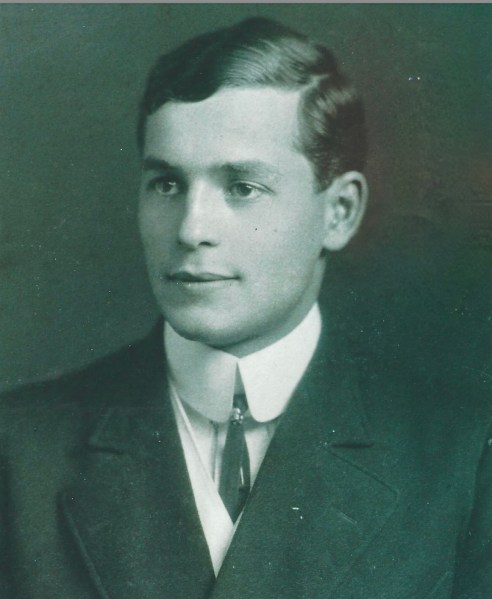
As far as I can tell, Ismael Edgard Bruneau (1887 – 1967), my great uncle, was the first doctor in our family and maybe still the only doctor. His father wanted him to follow in his footsteps and become a minister, so when Edgar entered McGill in 1907, he registered for an Arts degree. During his university years, he decided he would rather be a doctor. He finished his Arts degree in 1910 while concurrently studying medicine and received that degree in 1912.

Edgar, as he became known, was the first of ten children of Ismael Bruneau and Ida Girod, my great-grandparents. He was born in Green Bay, Wisconsin, where his father served as a French Presbyterian minister. The family moved to Holyoke, Massachusetts, Quebec City and Montreal, where he did most of his schooling.

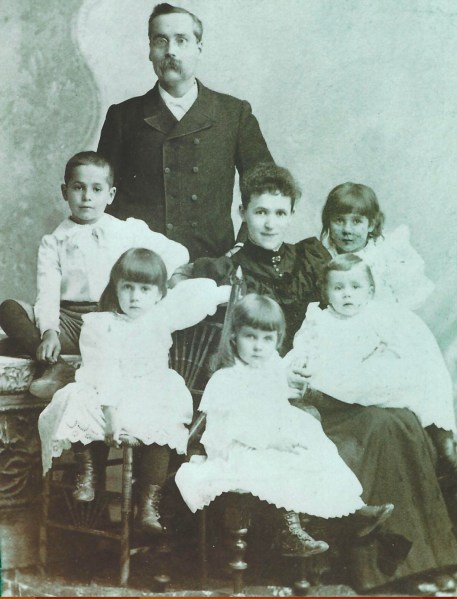
Ismael & Ida Bruneau with children Edgar top left, Hermonie, Helevetia, Sydney and Beatrice

He interned in Montreal and Ottawa and then practiced for a short time in Swift Current, Saskatchewan.

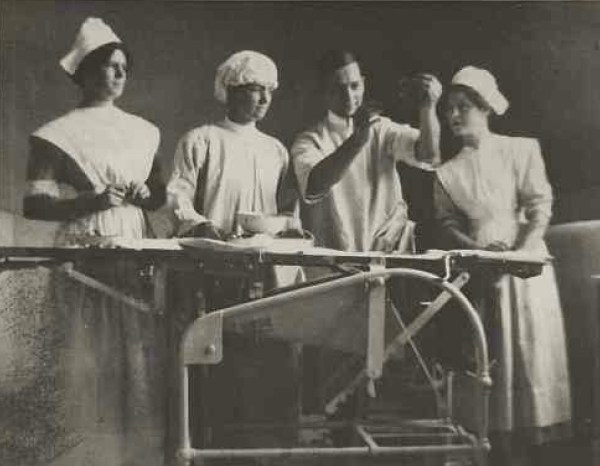
Dr Edgar Bruneau demonstrating techniques

When WWI began, he joined up with friends from McGill in the McGill Machine Gunners unit and was sent overseas in 1915. His father was unhappy with his decision to be a regular soldier and thought he should at least use his medical degree. Soon after arriving in England, he transferred to the Royal Army Medical Corp as a first lieutenant. This certainly didn’t keep him safe, as he served in France and Italy, being wounded twice and also severely gassed. Captain Bruneau was sent home to Canada in mid-1918. While in England, he visited with his Uncle Ernest Girod and became engaged to his cousin Marie but that relationship was over before he sailed home.

Edgar opened an office in Montreal as a general practitioner where he stayed his whole career. He lived on Park Avenue and had an office in his house with reception rooms on the ground floor and living space on the upper floor.

He also volunteered at the Montreal Dispensary through the 1920s. This clinic, established in 1850, gave health care to the poor. It was in downtown Montreal on St. Antoine Street, run by volunteer doctors and supported solely by donations. In the late 1920s, the Dispensary had financial difficulties and nearly closed but survived when it received a bequest of $10,000.

In the late thirties, Edgar suffered from a tubular disease in which the kidneys were damaged by lack of oxygen and blood flow, and so, for three years, he had to give up his practice. He was a much-loved doctor, as his patients visited him whether or not they needed care.

Edgar married Marie Eveline Lemoine in 1923. Before their marriage, they were in a car accident. He was driving on a street with streetcars when the traffic policeman gave him the signal to proceed. Unfortunately, the way was not clear and the car was hit by a streetcar. Eveline was thrown against the windshield, badly cut and she lost vision in one eye. Edgar felt responsible for her, so they married. Still, the marriage lasted 31 years until her death in 1954. Edgar was very social and attended all family gatherings but Eveline never did..

Six of the Bruneau children; Back row, Herbert & Gerald. Front row, Sydney, Edmee, Helvetia & Edgar ~1960.

One night, in the late 1950s, Edgar fell, going downstairs to his basement to fix the furnace. He broke his leg and wasn’t discovered until his housekeeper arrived in the morning. His brother Herbert wrote that when he was found, his leg was black and although the doctors saved it at that time, it resulted in gangrene. Edgar, like most of his siblings, had developed type II diabetes, which resulted in poor circulation in his legs. He first had his toes removed, then later, after many operations, most of his leg was amputated.

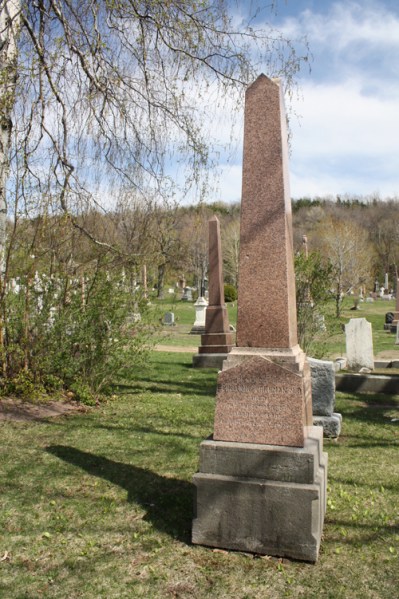
Edgar spent his final years at the St Anne’s Veteran’s Hospital in St Anne de Bellevue, Quebec. My sister said she never wanted to visit him as one of us told her he hung his leg in a stocking on his door at Christmas. Edgar is buried in Montreal’s Mount Royal Cemetery alongside his wife

Notes:

Recollections by Victor Herbert Bruneau , May 19, 1976.

Edgar was a keen fisherman.

He joined the Masonic Order and became a Shriner.

He was very musical; played the organ for his father’s services from the age of ten and he could play any tune he heard on the piano. He was popular with his comrades during the war and a good host afterwards.

I have no pictures of Evelyn. Edgar went to all the family functions and was very social but never Evelyn. She did play bridge and was mentioned in the newspaper as an attende at Karnac bridges put on by the Shriners.

All in the Family: The Butchers of Montreal

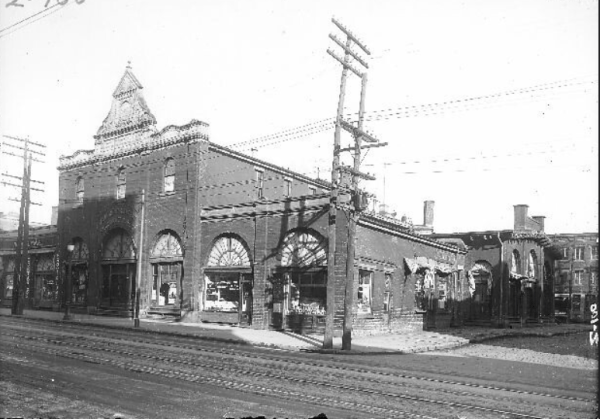
Marche St Laurent. Flicker Public domain

Every country has a foundation myth and so, too, have some families.

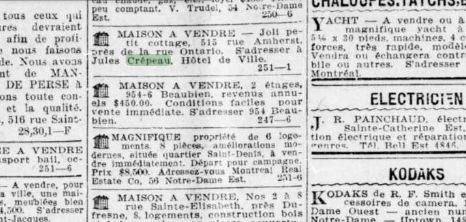
My mother’s family foundation myth was that her mother, Maria Gagnon Roy, was the daughter of a ‘master butcher’ and that she brought an enormous dowry of 40,000 dollars to her 1901 marriage to Jules Crepeau, a hardworking and ambitious 27 year old clerk at Montreal City Hall.

“Jules started out sweeping the floors at City Hall at eight years old,” my mom often said with a tear in her eye but according to his file there his first official post was in 1888 at 15 years old as messenger boy in the Health Department.*

My mother put so much store in this family myth that she even attributed her 5 foot 8 and a half inch height (tall for a French Canadian) to the fact she came from butchers. All that good steak they ate!

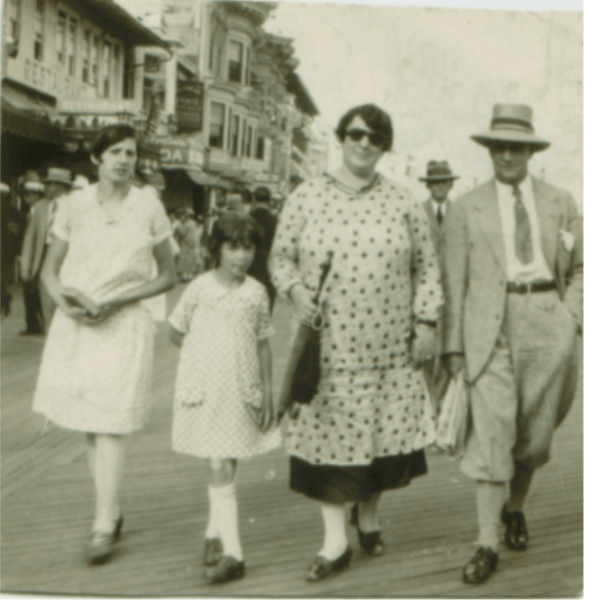
Left to right, Aunt Flo, my mom Marthe, Maria and Jules 1927ish.


The Father-in-Law: Maria’s Dad

My great-grandfather, Louis Roy, (circa 1843 to 1900) was the son of Pierre Isaac Roy and Natalie Jobin of Montreal and he worked as a butcher from 1860 to 1900. He came from a long line of butchers. In 1865 Louis Roy married Melina Gagnon, whose mother, Eleanore Ethier dit Lamalice,1 came from butchers as well.

At first Louis worked alone at St. Laurent Market and then from 1881 to 1896 he partnered with a J. Lamalice, likely his cousin. Roy et Lamalice had two stalls, 16 and 17, at that market in the south central part of the city near what is now Chinatown. Their partnership was dissolved in 1896 when Louis’s son, also Louis, entered the profession.

Louis Gagnon was a mason, all other men on Maria’s side were butchers.

L. Roy and J. Lamalice paid a good sum of money, perhaps 200 dollars a year a piece,2 to have these two stalls at St. Laurent Market.

According to a University of Laval thesis,4 butchers in Montreal were politically influential. Public markets were designed around their needs, in large part because of the slew of health regulations around the slaughter and sale of meat. Retail butchers also profited greatly at these public markets, more so than their private counterparts, sometimes only having to work 2 or 3 days a week to pay the bills.

Louis Roy and his ‘small’ French Canadian family, wife Melina, son Louis and daughters Eugenie and Maria, lived at various addresses early on, then moved to 357 Amherst around 1880 and then in 1890 to 515 Amherst, a brand new ‘small cottage.’

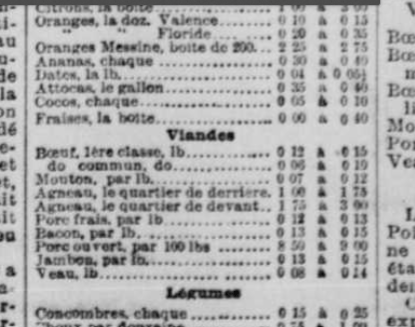
Price of meat Bonsecours Market, 1893


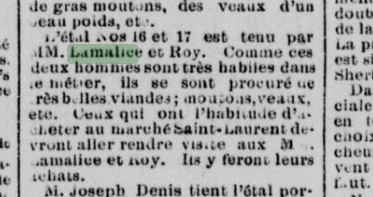
L. Roy et J Lamalice advertised regularly in all the Montreal papers, usually a little blurb like this.

Roy and Lamalice are very capable with very nice mutton, veal etc. Other ads focused on how beautifully the stall was decorated. (Clearly ladies did the shopping.)


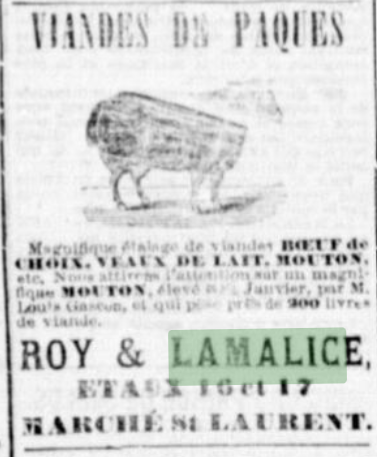
They sometimes put in bigger ads

Choice beef, milk fed veal and mutton for Easter.


And they gave to charity, as well, Notre Dame Hospital and the Public Welfare are two examples I discovered.

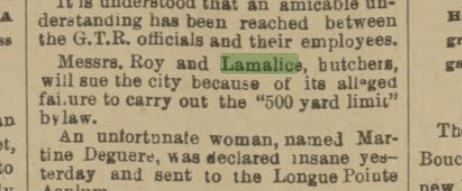
It may be significant that in 1891 Roy et Lamalice brought the City of Montreal to court. They complained that the City wasn’t doing enough to keep private butchers the mandated 500 yards away from the public markets.

They pay a license fee for a stall of 200 dollars, say Roy and Lamalice, as reported in Le Minerve.

I have to wonder if this is where Louis Roy, master butcher, first met – or maybe locked horns with – the City Hall up-and-comer Jules Crepeau, messenger boy in the Health Department – but a boy gifted with a superb memory for regulations and by-laws.3


In 1896, Jules Crepeau, Second Assistant City Clerk, was assigned the post of Secretary of Public Markets, a suitable promotion considering his Health Department roots.

In 1900, a year before his marriage to Maria Roy, he would be involved in his first scandal at City Hall, one that involved butchers. Men in that trade claimed that aldermen were illegally charging them 50 dollars to have their stalls moved at the prestigious Bonsecours Market. Jules testified in Court and denied knowing anything about it.


In 1900/1901, the newly widowed Melina Roy rented out her Amherst house (yes, to a butcher) and moved to Notre Dame street to live with her married daughter, Eugenie, her husband Jacques (James) Deslauriers (son of a butcher who was deceased). She brought her young adult children Maria and Louis along. The Census man came around while she was there.

The 1901 census has my grandmother Maria and her brother Louis erroneously listed under Deslauriers. Laura Lacombe is an orphaned cousin. She would live with Maria and Jules until her death in 1921, just a few months before my Mom’s birth.


The Marriage of Jules and Maria

After my grandparents Maria and Jules got married on July 1, 1901, widow Melina and her grown up son Louis moved back into 515 Amherst with the newlyweds.

In late 1901, Jules applied for a permit to build a three story brick building worth 3,000 dollars at 513 Amherst next door and the next year he would rent it out to three different families.

Maria would very soon give birth to my Uncle Louis. (Louis was baptized exactly nine months after the wedding.) My Aunt Alice would arrive a year after that and in 1905 the Crepeau family would move to St. Hubert Street near Marie-Anne.

Melina Roy and her son Louis, Melina’s orphaned niece Laura, and possibly the Deslauriers would stay at 515 Amherst for a year until Melina’s death in 1906 upon which time Jules would sell the ‘small cottage.’


The Dowry

A notarial record reveal there was, indeed, a 1901 marriage contract for Jules and Maria from June 27, a few days before the marriage, but of course there are no details so no proof of a 40,000 dollar dowry.

It does look like Jules came into some money early in his marriage. He builds that brick triplex and then moves in 1905 to what is still a very tony area with tall elegant stone townhouses.

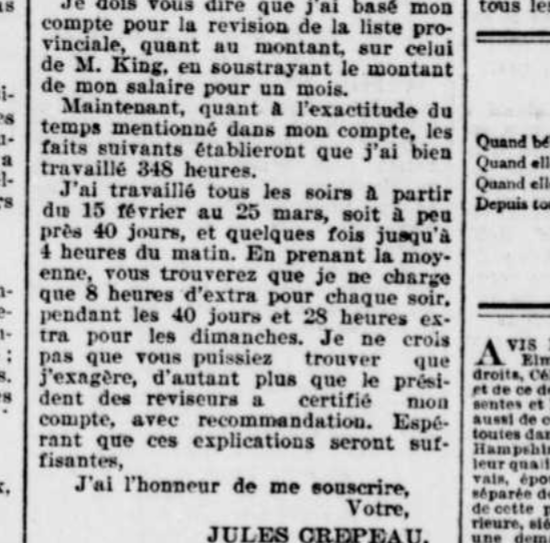
Before his marriage, Jules was making around 700 dollars a year at City Hall, a middling/good salary for a family man although at one point he asked for 248 dollars in overtime because “over a forty day period I worked 348 hours until four in the morning and on Sundays.”*

Still, a 40,000 dollar diary for Maria’s marriage seems highly unlikely. (That’s 1,500,000 in today’s money.)

I am doubly skeptical about the big dowry because I did not find any contract listing for the 1897 marriage of Maria’s older sister, Eugenie, to Jacques (James) Deslauriers, merchant. This suggests Eugenie received no formal dowry.

Why the second daughter and not the first?

Also, If Louis Roy, successful master butcher, left behind a large estate why did Melina Roy rent out her modest Amherst home after he died and move in with her daughter Eugenie and the husband. To help with the grandchildren?

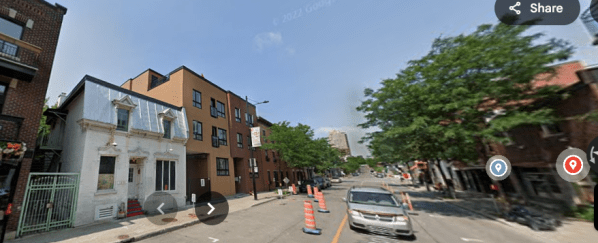
A modest street in 1900, Amherst today is called Attikan. The only remnant of an early era is this little ‘French Canadian” cottage on the corner where everyone lived in 1901.


Lovell’s Directory to the Rescue.

When I first looked for Jules and Maria on the 1901 automated census I found neither one. Maria was erroneously listed under Deslauriers and Jules wasn’t there.

So, it took me years, but eventually I consulted Lovell’s to discover that prior to his marriage Jules was living on Mentana Street in the Le Plateau Mont Royale with his widowed mother, Vitaline Forget Despaties Crepeau, and his three brothers, the older Isadore and the younger Roderick and Paul.

Isadore in that era is already working in insurance – as he would for the rest of his life. In 1898 Roderick is listed as a plumber, then a year later as a butcher. His brother Paul makes the Lovell’s listing in 1899 and is listed as a butcher working at “R. Crepeau and Freres.”

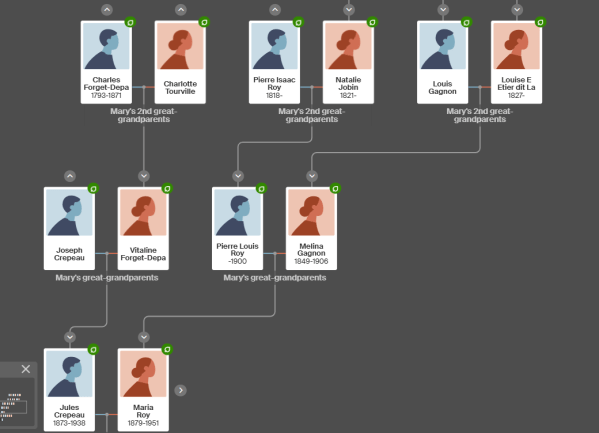
It’s all very suspicious because the highly regulated butcher trade wasn’t something you could jump in and out of. I suspect older brother Jules, son of a mere house painter, pulled some strings to get his younger brothers a short cut into that lucrative trade. (Neither man would remain a butcher for long.) If my grandmother’s family tree proves anything, it’s that the butchers of Montreal liked to keep it in the family!

So, I still have no concrete proof but it would not surprise me if my grandmother Maria’s dowry, whatever the true amount, was provided by a group of butchers (perhaps all members of her extended family) in return for Jules’ support at Montreal City Hall.

Prior to his marriage to my grandmother, Maria Roy, as I said, Jules had had plenty of chance to interact with these ‘politically influential’ tradesmen.

Anyway, that was simply business as usual in those days.

  1. Eleanore Ethier dit Lamalice was also a distant relation of Jules Crepeau through the Ethier line of Lachenai Seigneury. See my Why My Grandfather had a lot of Gaul on this site.
  2. This is the sum that Louis Roy cites in his 1896 complaint as reported in the French papers. It’s called a license of 200 dollars to have a stall at St Laurent Market. In the 1920’s the sum is just 50 dollars a stall, I discovered in another online item but by then the butchers are paying hefty income taxes, so they mention how high this income tax is in their complaints.
  3. Le Devoir says Jules’ mind was like a bank vault holding within all the city by-laws. This was in his 1938 obituary.
  4. YVES BERGERON:LES ANCIENNES HALLES ET PLACES DE MARCHÉ AU QUÉBEC :ÉTUDE D’ETHNOLOGIE APPLIQUÉE. University of Laval Thesis Canadian Thesis portal

5. Newsy items courtesy of BANQ newspaper archive.

The Gaspé Peninsula

The Province of Quebec is breathtakingly beautiful.  I have been all over the province and I am constantly amazed.

One of my favourite trips was when, in 1982, after we had moved into our first house, we decided to leave all the angst of being a first-time home owner at a young age and go on a road trip. We decided to visit the Gaspé Peninsula. We simply loved our trip. The countryside was stunning and the Gaspésians showed us a warm welcome.

Courtesy Tripadvisor

Did your ancestors settle or live on the Gaspé Peninsula? The first European to arrive in the Gaspé was Jacques Cartier when he landed in Gaspé Bay in 1534 to plant a cross and claim the land for the King of France. The Iroquois occupied the area. It is believed that the name Gaspé derives from a Micmac word meaning “land’s end.” 1

When the Gaspé belonged to New France, there were only about 400 fishermen living there. Harvests were plentiful and the coastal high winds were excellent for drying cod. However, James Wolf and his forces attacked the residents in 1758, destroying their homes and possessions and sending them back to France.2

Still, some Gaspesians managed to hide from the authorities and remained on the peninsula until 1763 when it became a British territory. They were joined by Acadians who fled from the British who had implemented a compulsory deportation order for all Acadians in Nova Scotia. In 1784, a significant number of Loyalists, fleeing the American Revolution, settled on the Gaspé Peninsula.3

If your ancestors came from the Gaspé, here are some sites that can help you with your research:

The Quebec Genealogy eSociety has extensive links and resources (requires a membership). Some of the resources include births, marriages, deaths and some census records, and newspapers: https://genquebec.com/en

GoGaspé is a site devoted to the Gaspé Peninsula with a tab that directs you to history and genealogy links and resources. Local Gaspesian genealogists and historians have contributed to this site: https://gogaspe.com/

Jacques Gagné’s compilation about the Channel Islanders on this blog: https://genealogyensemble.com/2016/08/21/the-channel-islanders-of-eastern-quebec/

Jacques Gagné’s tips on researching your Gaspé ancestors on this blog:https://genealogyensemble.com/2019/01/20/tips-on-researching-gaspe-ancestors/

Musée de la Gaspésie: https://museedelagaspesie.ca/en/index.php

Sources for information about settlement of the Gaspé Peninsula.

  1. The Canadian Encyclopedia, Lee, David, 7 February 2006, https://www.thecanadianencyclopedia.ca/en/article/gaspe-peninsula#:~:text=In%201784%20about%20400%20English,dependence%20on%20the%20fishing%20industry, accessed 11 February 2025
  2. The Canadian Encyclopedia, Lee, David, 7 February 2006, https://www.thecanadianencyclopedia.ca/en/article/gaspe-peninsula#:~:text=In%201784%20about%20400%20English,dependence%20on%20the%20fishing%20industry, accessed 12 February 2012
  3. The Canadian Encyclopedia, Lee, David, 7 February 2006, https://www.thecanadianencyclopedia.ca/en/article/gaspe-peninsula#:~:text=In%201784%20about%20400%20English,dependence%20on%20the%20fishing%20industry, accessed 12 February 2012

A Little About Helene Bruneau

Helene in New York City

I have written stories about twelve of Barnabé Bruneau and Marie Sophie Prudhomme’s thirteen children. That just leaves Helene (1849 -1929). Helene was child number nine or perhaps number ten. I just realized that she and Selene Joseph were the second set of twins in the family. They were born on December 20, 1849.

I haven’t found much information about Helene other than she appeared to be a devoted wife and mother. She married at twenty-six but before, had spent some time in New York City as photographs can attest. Was she also a French teacher or governess like her sisters?

Sophie, Helene and Matilde Bruneau, New York City

Helene married Célestin Pépin dit Lachance ( known as Lachance). He was born in Joliette (1847-1915) to Celestin Lachance and Elisabeth Payette. His parents converted to Protestantism in 1852 when he was a young child. He attended the l’Institute Evangelique Francais de Pointe-aux-Trembles. After he graduated, he became a Colporteur for two years for the French Canadian Missionary Society. He had aspirations of becoming a minister

Celestin & Helene Lachance

In 19th century America, the word colporteur (the borrowing of a French word meaning “peddler”) came to be used for door-to-door peddlers of religious books and tracts and is still used today. The Missionary Society trained the colporteurs and future pastors as there wasn’t a French Protestant seminary. Celestin abandoned his studies in 1867, possibly because he had tuberculosis and his doctor recommended he only work outside in the fresh air. If he did have TB, the fresh air did him good as he lived almost another 50 years. He worked all over Quebec in the logging and forestry industry. Helene accompanied him everywhere during their marriage.

Helene & Celestin Lachance and Helen’s sister Anais

Although he gave up missionary work he remained a religious Presbyterian the rest of his life. He read the Bible every morning and night. During his last illness, he read the whole Bible twice in nine months. 

Helene was originally a Baptist as her parents also converted to Protestantism when she was a child. She is later recorded as being a Presbyterian.

Celestin and Helene had only one daughter, Helene Marie Antoinette (1876 – 1916). This curly-haired child grew up but never married. She attended Royal Arthur School in Montreal. Antoinette attended English schools because the family was Protestant, so she couldn’t attend French Catholic schools. In 1892, she won the prize in French for second intermediate girls, besting Nellie Wilson, who won the awards for most of the other subjects. She didn’t have Antoinette’s advantage of a French background. At the closing of the ceremony, the commissioner said, “It was well to be clever but still better to be good.” Antoinette died at only forty years of age. She lived with her parents her whole life and never seemed to have an occupation.

Antoinette Lachance

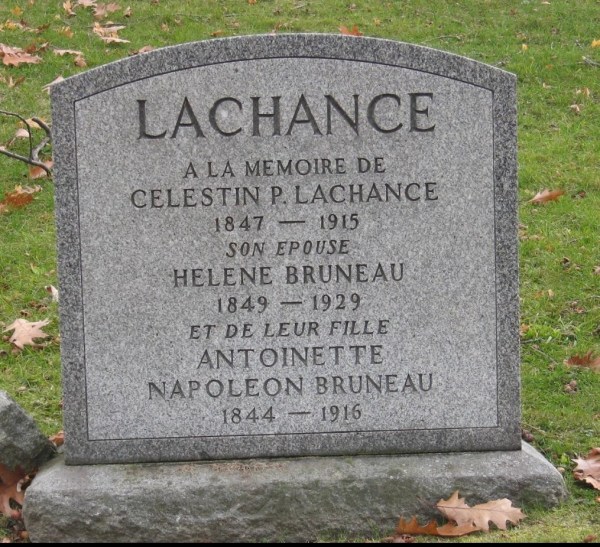
After Celestin and Antoinette died, Helene lived in Verdun, Quebec until her death, on June 4, 1929. The family is buried in Mont-Royal cemetery in Montreal along with Helene’s brother Napoleon.

Mount Royal Cemetery Montreal

Notes:

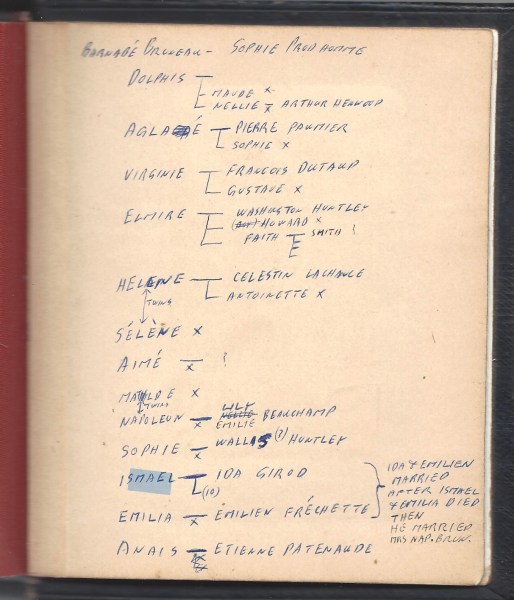
In the back of the little photo album in a list of the children, it actually said twins, which had never registered with me. 

Back page of photo album

1871 Census: Celestin was 22 and living with his parents and sibling in St Charles Borromée, Joliette, Quebec. Year: 1871; Census Place: St Charles Borromée, Joliette, Quebec; Roll: C-10036; Page: 15

Helene and Celestin were married in 1875 and recorded as French Evangelicals.

Antoinette was born in October 2, 1876 and baptized at 9 years old in 1885.

According to Find a Grave: her full name was Helene Marie Antoinette Lachance born in St Constant Quebec.Ancestry.com. Canada, Find a Grave® Index, 1600s-Current [database on-line]. Lehi, UT, USA: Ancestry.com Operations, Inc., 2012.Original data: Find a Grave. Find a Grave®. http://www.findagrave.com/cgi-bin/fg.cgi accessed August 28, 2024.

1891 Census: The Lachances were living in Ste. Conegonde Hochelaga, Quebec. Celestin was a Commis au Bois, a wood clerk, Helene was a wife and both members of the Free Church. 

Year: 1891: Census Place: Ste Cunégonde Town, Hochelaga, Quebec, Canada; Roll: T-6396; Family No: 227Ancestry.com. 1891 Census of Canada [database on-line]. Lehi, UT, USA: Ancestry.com Operations Inc, 2008. Aug 28, 2024.

1901 Census: Celestine, Helene and Antoinettte (Marie-A ) were living in Ottawa, where Celestin was listed as a foreman and Antoinette, had no occupation. Year: 1901; Census Place: Ottawa (City/Cité) Dalhousie (Ward/Quartier), Ottawa (City/Cité), Ontario; Page: 19; Family No:189 Source InformationAncestry.com. 1901 Census of Canada [database on-line]. Lehi, UT, USA: Ancestry.com Operations Inc, 2006. Aug 28, 2024.

Montreal Star: Royal Arthur Closing Exercises, June 22, 1892 Wednesday, pg. 3. Newspapers.com accessed Sept 9, 2024.

Le Devoir: Celestin Lachance obituary, March 26, 1915 pg 2. Newspapers.com accessed September 9, 2024

Montreal Star Obituary: Helene Lachance, June 6, 1929 page 11. Accessed Oct 22, 2024.

Jean-Louis Lalonde: Lachance, Celestin (1849-1915) SHPFQ Societe d’Histoire du Protestantisme Franco-Quebecois. Octobre 12, 2020.

All the photographs are family photos in the hands of the author.

The Harvester Scheme and the Empire Settlement Act

Who would have thought that finding the immigration records of my grandparents would have led to me to learn about two British government initiatives designed to promote emigration to Canada in the 1920s?  I was browsing the Library and Archives Canada web site and found digitized records of Form 30 that recorded the entry of every immigrant between July 1921 and December 1924.1  I was thrilled to find the form that my grandfather, George Thomas Deakin, signed in August 1923, and the one that my grandmother, Grace Graham Hunter, signed in February 1924.

My grandfather’s form indicated that he came to Canada as part of the Harvester Scheme.  In 1923, Canada had a bumper wheat crop and North America could not provide the labour needed to harvest the crop.  Under the Harvester Scheme, the two major Canadian railway companies entered into an agreement with the British government to transport 12,000 workers out west where they would earn $4.00 per day plus board.  This was considered a successful scheme as 11,871 migrants came to Canada to work on the farms in Western Canada. The harvest was successfully completed and 80% of the harvesters stayed and were considered “successfully assimilated.”2

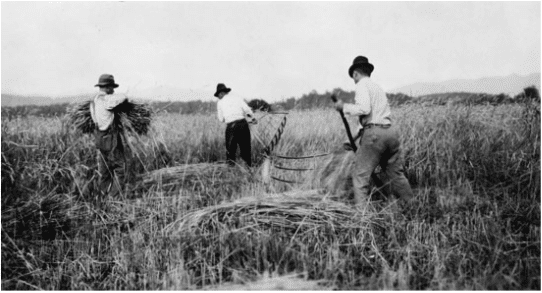
Source: The Farm Collector

Like the Harvester Scheme, The Empire Settlement Act was also an initiave to provide Canada with badly needed labour. It was passed by the British Parliament in 1922 and its purpose was to provide an incentive for migrants to settle in the colonies.  Canada badly needed farm labourers and domestic workers.  At that time, the Canadian government favoured immigrants from Great Britain as a means of ensuring the predominance of British values.  In the early 1920s, it was difficult for Canada to attract immigrants from Great Britain as Britain was enjoying a period of prosperity right after World War I.  Another reason was the prohibitive cost of transatlantic transportation.  Even passage in third class would have been expensive for a farm labourer or a domestic worker.3

My grandmother came to Canada to enter into domestic service as a cook and her destination in Montreal was the government hostel.  Hostels were located in major urban areas across Canada.  These hostels were partially funded by the provinces and immigrants from Great Britain were allowed free dormitory accommodation for 24 hours after their arrival.  Young ladies were looked after by the Superintendent of the hostel and referred to a church worker.  They were also referred to Employment Services of Canada who would find them employment.4

1 Library and Archives Canada:  http://www.collectionscanada.gc.ca, accessed March 2013.

2 Foster, John Elgin, 1983, The Developing West:  Essays on Canadian History in Honor of Lewis H. Thomas, University of Alberta, accessed March 2013.

http://www.pier21.ca/research/immigration-history/empire-settlement-act-1922, accessed March 2013.

4 Crawford, Ruth, 1924, “Canada’s Program for Assimilation”, The Rotarian, May 1924, p. 16, accessed March 2013

Enslaved by Poverty

Recently, I’ve been wondering about the white slave who successfully escaped after allegedly burning down New France’s third Hotel-Dieu hospital and 45 homes in what is now Old Montreal in 1735.

I can’t help feel sorry for the man who was brought to Canada as an indentured slave (engagé or trente-six mois due to the thirty-six month duration of his contract) primarily because he was young, healthy, strong enough to serve as a labourer and poor. In return for his work, he got room and board, clothing and a salary, but he had no rights beyond that. His employers could send him anywhere to do just about anything; and according to New France law he had little recourse.

A brief summary of his life appears online in the Canadian Mysteries series dedicated to the fire.

Originally from Butenne in Franche-Comté, Claude Thibault was found guilty of salt trafficking [illegal sale of salt]. Condemned to end his days in the king’s galleys, his sentence was commuted to a life in exile in Canada. He arrived in Québec with a dozen other salt traffickers, including Jacques Jalleteau, in September 1732.

On the night of April 10, he was seen at the site of the fire, but disappeared when Angélique was arrested the following day. Despite warrants issued for a wanted person throughout the colony, Thibault was never again seen.1

I imagine he used his acumen to create a new life under a new name, perhaps in the fur-trading industry. After all, as a faux-saunier (salt smuggler), he had to develop a lot of entrepreneurial skills. As someone who purchased salt in low-tax regions and sold it on the black market in high tax regions, he had to be skilled at finding clients and creating a distribution hub without being caught by the King’s agents.

The King’s decision to set up an unfair tax regime began in 1680, when he decided to pass a law varying the taxes (gabelle) on salt per region. Salt was an important commodity at the time, and controlling it was an important economic lever. In addition to using it to spice and cure food, people in France also needed enough salt to tan animal skins. In some regions, such as Brittany, people could buy one “minot” (about 37 litres) of salt for as little as 1 livre, while citizens of Main, Anjou and other “high gabelle” regions had to pay as much as 61 livres per minot. The law even forced them to buy a minimum quantity of salt every year, whether they needed it or not.

Smugglers thrived in the seeming injustice, but if they were caught, punishment was severe. They faced fines beginning at 300 livres and leading to jail time of anywhere from 10 days to three months. At first, only the most serious convicts were exiled to New France, but in 1730, Jean Frédéric Phélypeaux, the Comte de Maurepas, began insisting that convicted faux-sauniers should be sorted, with the most healthy or those with useful skills be sent overseas as enslaved labourers on three-year contracts. Eventually, the scheme ended in when King Louis XV of France removed Maurepas from his job in 1749.

Unfortunately, Thibault was caught when Maurepas’ scheme was fully underway, and he had few other ressources to avoid exile.

Alain Racineau, who has studied salt traffickers like Thibault at length, describes most of them as poor rural people, primarily day labourers and small merchants struggling to survive.

They were recruited from the poorest levels of society: casual agricultural labourers, petty artisans and traders, unemployed vagabonds. They frequently affirmed that they had taken up smuggling “pour gagner leurs vies.”2

Thibault’s life didn’t get any easier once he arrived in New France. His contract was purchased by fur-trader and merchant Francois Poulin de Francheville and his wife Thérèse de Couagne, who owned several slaves. After M. Francheville died in late 1733, the widow decided to sell Thibault’s girlfriend to a friend in Quebec City. Plans were established for her to be sent away in the spring of 1734, after the ice melted from the Saint Lawrence River.

On February 22, 1734, Thibault and his lover decided to run away, setting fire to her bed as a distraction. They had hoped to reach the English colonies, but bad weather stopped them. They got stuck in Châteauguay and were eventually captured by three militia captains.

Thibault was thrown into jail on March 5 for breaking his contract. He was released on April 9, just one day before the large fire that began in the Francheville home on St. Paul Street.

Thibault disappeared just before his girlfriend got arrested, was convicted and executed. On April 19, authorities set up a manhunt

…given that we are in no State at present to forward the description of the said Thibault with the present order, the Said Captains will take care to arrest and Interrogate all Young men who are unknown vagabonds coming from the direction of Montréal toward Québec and passing through their area, to ask of Them their names and surnames, who they are, where they come from, and where They are going; and upon failure by the said passers-by to provide adequate Information on their persons, And for the slightest doubt or suspicion regarding their responses, And in consideration of public safety, We expressly ordain that the said Captains have them arrested Immediately, and taken under sound and due guard to the gaols of This city;3

They never found him.

Two years later, authorities officially took him off the most wanted list.

1Beaugrand-Champagne, Denyse, Léon Robichaud, Dorothy W. Williams, Marquise Lepage, and Monique Dauphin. “Torture and Truth: Angélique and the Burning of Montreal,” Great Unsolved Mysteries in Canadian History Project, 2006, https://canadianmysteries.ca/sites/angelique/contexte/references/personnages/2229en.html

2Racineaux, Alain, ‘Du faux-saunage à la chouannerie, au sud-est de la Bretagne’, Mémoires de la Société d’histoire et d’archéologie de Bretagne, 1989.

3Archives nationales du Québec, Centre de Québec, Fonds des Ordonnances des intendants de la Nouvelle-France, E1, S1 P2622, Hocquart, Gilles, Ordinance given to the captains of the militia for the arrest of Claude Thibault, April 19, 1734, https://canadianmysteries.ca/sites/angelique/proces/rumeurcircule/1889en.html .

R. Stanley Bagg, Tory Politician

Robert Stanley Bagg (1848-1912), was a Montreal businessman, sportsman and life-long Tory. A newspaper report of his death noted, “He was a staunch Conservative both in and out of power, and some years ago was president of the Liberal-Conservative Club giving a great deal of his time to the work of organizing as well as well as to public discussion. He was well known amongst the French-Canadian people and spoke French almost as fluently as his mother tongue.”1

My great-grandfather’s interest in politics was not limited to reading about the issues of the day in the newspaper (The Gazette was a die-hard Conservative-leaning publication) or debating issues privately with his friends. Stanley became actively involved in the Liberal-Conservative Club after it was founded in 1895 as a rallying point for English and French-speaking Conservatives in Montreal. The club took a leading role in the Dominion (federal) election of 1896, and the Quebec campaign of 1897. No doubt to Stanley’s dismay, the Conservatives lost in both elections.

The Conservatives had been the party of Canada’s first prime minister, Sir John A. MacDonald, who is said to have been a personal friend of Stanley’s father, Stanley Clark Bagg (1820-1873). They were in power until 1896, when Sir Wilfrid Laurier’s Liberals defeated them, and Laurier remained prime minister for the next 15 years. One of the main differences between the two parties was that the Conservatives promoted loyalty to the British Empire, independence from the United States and protectionism in trade, while the Liberals were in favour of free trade.

Robert Stanley Bagg, portrait by Adam Sheriff Scott. Bagg family collection.

Stanley played a role in many party activities, especially after his retirement from the family real-estate business at the turn of the century. Trained as a lawyer, he frequently chaired public meetings, he served for several years in the early 1900s as president of the Liberal-Conservative Club, and he twice attempted to run for a seat in the House of Commons in Ottawa. The first time was during the Dominion election of 1896 in the St. Lawrence riding, east of Mount Royal. This was the area where Stanley’s ancestors had lived and owned property for almost a century. Stanley was the third candidate in the riding, and the nomination papers he submitted showed he had considerable support among both English and French-speaking party members. However, four days later, when it became apparent that the other Conservative candidate had broader support, Stanley withdrew his name.

In 1905, The Gazette anticipated that Mr. R. Stanley Bagg might run as an independent candidate for the provincial legislature vacancy in the St. Lawrence division caused by the death of the incumbent.2 The newspaper’s prediction was wrong, however, and he did not run. A few years later, in the federal election of 1908, Stanley did put his name in for the Conservative nomination for the St. Lawrence division. This time, Henry Archer Ekers, the outgoing mayor of Montreal, won the nomination by a narrow margin, and Stanley called on the meeting to make the choice unanimous.

Although he never did run for office, Stanley appears to have been a popular speaker at Conservative party functions, and the newspapers reported on his speeches on several occasions.

When he addressed a meeting during the 1897 provincial campaign, The Montreal Star summed up his remarks:

“Mr. R. Stanley Bagg was the last speaker. In a really eloquent and polished speech this gentleman drew a picture of the possibilities of the Province of Quebec under good government. Especially strong were his commendations of the Flynn educational programme, which would bestow that priceless boon of education upon the poor as well as upon the rich. This education would enable the growing generation to intelligently study the questions appertaining to the government of the province, and when the young people became enfranchised, such study would enable them to vote for honest government, for the party and platform that best represented the best interests of Quebec.“3

In January 1900, Stanley was president-elect of the Liberal Conservative Club and a general election was coming soon. In remarks to a meeting, he pledged to put forward the interests of the club, the Conservative party and the county, adding that the Conservative party was the “true patriotic party of Canada.”4

Later that year, during the Dominion election campaign, The Montreal Star quoted his remarks to a Tory campaign rally: “Never in the history of Canada has there been an election so important, so fraught with vital interest in the whole Dominion, as that in which the people of this country are now engaged. The relations between Canada and the Mother Country are, at the present time, peculiar. The South African (Boer) war afforded Canada an opportunity to demonstrate Canadian loyalty and Canadian valour, and today we have as a result an exceptional chance to secure favours from the Mother Country, which never before presented itself. The Imperial sentiment is strong throughout the Empire and the British people are disposed to accord to the colonies trade concessions the value of which to ourselves cannot be overestimated.

“There is but one way in which Canada can benefit from this opportunity, and that way lies through the return of the Conservative party to power. The Conservative party is pledged to use its best efforts to secure a mutual imperial preferential tariff …. The Conservative party stands for protection, for stability in the tariff, for patriotism and for progress.…”5

Eleven years later, Stanley again focused on the topic of reciprocity (free trade) with the U.S. In an hour-long address, he noted that, as someone who had taken part in a large number of election campaigns and given close and continuous study to public affairs, he had been invited to give his views on the great question now before the voters. He “emphatically urged that reciprocity be thrown out. He not only showed that the pact would be commercially injurious to Canada, but appealed to the patriotism of the electors, their spirt as Canadians and Britons. He reminded them, amidst ringing applause, how Sir John A. Macdonald had denounced the attempts of Liberal leaders to bring about unrestricted reciprocity in 1891 as ‘veiled treason’.”6

These accounts of Stanley’s speeches may seem old fashioned today, but I was pleased to discover them as they provided a window into my ancestor’s thoughts. He clearly identified as Canadian and British, although his ancestors also included Americans and Scots.

This story is also posted on http://www.writinguptheancestors.ca

See also:

Janice Hamilton, “Horses, Snowshoes and Family Life”, Writing Up the Ancestors, Sept 21, 2024, https://www.writinguptheancestors.ca/2024/09/horses-snowshoes-and-family-life.html

Janice Hamilton, “The Silver Spoon”, Writing Up the Ancestors, ”, June 12, 2024, https://www.writinguptheancestors.ca/2024/06/the-silver-spoon.html

Sources:

  1. “R. Stanley Bagg Died Yesterday,” The Gazette, (Montreal, Quebec), July 23, 1912, digital image, https://www.newspapers.com/image/419604976 accessed Aug. 4, 2024.
  • “St. Louis Division; Mr. Parizeau’s Supporters Enthusiastic.” The Montreal Daily Star (Montreal, Quebec), 10 May, 1897, p. 4, digital image, https://www.newspapers.com/image/740883625 accessed Oct. 1, 2024.

Fat Sandwiches and Cathedral Gongs

Turning the tables on genealogy writing.

My talented high school friend Gary and me circa 1980. He recommended me for the job at the radio station.


( A long time ago, I was asked by someone who knew I dabbled in genealogy why I didn’t write stories about myself for future generations so they wouldn’t have to ‘guess’. Back then, I didn’t see the point – but now I have grandchildren. )


It was sometime back in 1983 – imagine. Every Breath You Take by The Police was blaring over the airwaves and the beautiful FM secretary sprinted out of her stuffy office cubicle and ran down the hall pumping her skinny arms over her head in a victory dance. She was simply over the moon: The stodgy radio station she worked for was entering the modern age!

I was employed as an advertising copywriter for the same easy-listening FM station as well as for its affiliate, a once-proud but struggling sports talk station on the AM dial.

The FM station was by far the more successful of the two stations, keeping the owners afloat with its middle-of-the-road Paul Mauriat instrumentals aimed at an older audience.

But their faithful clientele were retiring and moving away to live near their children in Ontario or just plain passing away. (Ironically, a retirement community just over the Quebec border in Ontario was a major advertiser.) Hence the jarring format change.

That day, I overheard a staffer callously joke about how the station’s geriatric listeners were now frantically stumbling out of their easy chairs to turn the radio dial back to ‘their’ station.

Back then I didn’t pay much attention to demographics or ratings but I did have a singular role in this FM station’s public profile.

Hourly ID’s in portfolio, typed on my Selectric.

I wrote dozens and dozens of their ‘lyrical’ hourly ID’s.

Originally penned by a veteran on-air personality, these ID’s were nothing but extra work for me and they came with no extra pay either, but I didn’t work in radio copy for the money (minimum wage) or for the praise (we got none). I worked for a chance to make a living, however meagre, as a writer and for the camaraderie among creatives and, yes, for the adrenaline rush.

(In those days, it seemed as if every advertising contract the salespeople brought into the copy office had to be conceived, written and produced “yesterday.” English Montreal radio salespeople were fighting over an ever-diminishing slice of the advertising pie – and in recessionary times. The clients were getting smaller and smaller – and pickier and pickier. These hourly ID’s allowed me to be creative (and corny) on my own terms – at my own rhythm.)

In the early 1980’s, our English FM Station was the “MUZAK” station of choice in Montreal, airing continuously in elevators all over town.

So, every lunch hour, when thousands of office workers spilled out of their own stuffy cubicles to score a coffee and sandwich and maybe a little city sunshine down below, they could not escape hearing one of my midday ID’s voiced in a warm creamy tone by one of our talented station announcers.

I kept these three “midday” ID’s for my portfolio.

Number 1: Midday in Montreal is when the babies come out. Winter newborns, bundled in their mother’s arms, rosy-cheeked cherubs, bright eyes wide in wonder. They are seeing the world for the very first time. The mystery of a budding flower, the majesty of a skyscraper, a lot for little eyes to take in. Midday in Montreal with the beautiful music of CICK. (I changed the name of the station, but you might know which one it is.)

Ok. I was 28, and although I strongly denied it back then, I was clearly wanting a family. But, if you consider I had held an infant in my arms only twice in all of my young life, both times while babysitting, I think I got it right. I know I got it right. I have a four month old granddaughter and she’s just as described.

Number 2: Midday in Montreal. School children straggle home from lunch in groups of two or three. Never taking the shortest route, they stop to pet a stray or to kick a stone around, forgetting as children often do, about time. Wandering home in zigs and zags,they finally arrive to steaming bowls of soup and fat sandwiches. Midday in Montreal. With the beautiful music of CICK.

This was a bit of a nostalgia, for sure. I, myself, in the 1960’s, had been a latchkey kid and I often had to make my own lunch, sometimes grilling POM bread over the blue flame of the gas stove. Yummy! By the 1980’s, I suspect even fewer kids went home for lunch. Still, judging from the meandering path my five year old granddaughter likes to take on our walks together, I think I nailed the dilly-dallying part.

Number 3: Midday in Montreal. The circular days are cut in half by the sound of a thousand clocks: ornate cuckoos in residential parlours, church bells and cathedral gongs, those quiet, creeping clocks in offices. As the sun reaches its highest point in the sky, a million pairs of eyes turn to the clock, acknowledging midday in Montreal, with the beautiful music of CICK.

I still like this one, although a smart-alek booth operator questioned whether cathedrals gonged at all. I directed him to Byzantium, my favourite Yeats poem. I had borrowed the phrase, you see.

The unpurged images of day recede;

The Emperor’s drunken soldiery are abed;

Night resonance recedes, night-walkers’ song

After great cathedral gong;

A starlit or a moonlit dome disdains

All that man is,

All mere complexities,

The fury and the mire of human veins.

Midnight, with the beautiful music of CICK 😉


Do you think Yeats would have been a better radio copywriter than me? Would the insomniac crowd have been seriously disturbed by Midnight ID’s in the style of his poem?

Anyway, after a year of dutifully tapping out these hourly ID’s on my trusty IBM Selectric typewriter (the one with the snazzy white “Correcto-type” band that enabled me to churn out my 30 and 60 second commercial scripts apace) I asked to be relieved of the task.

Like so many of my colleagues, I quit my copy job to try my luck in Toronto. Somehow, I ended up back in Montreal with a family – just as the economy was improving. What bad timing! For the next decade, I mostly worked remotely as a freelance writer -for rather good pay- for sundry commercial magazines producing quote-anecdote-statistic style articles on non-controversial topics that didn’t scare off the advertisers.

Occasionally, I got creative and punched out a timely satirical piece like Beat the Biological Clock for Salon Magazine. That number was written, yikes, over 20 years ago. Time sure does fly!

I guess I should get busy writing more of my ‘ancient histories’ for the girls.

End

Sundays and the Great Depression

I used to hate Sundays. I had to go to Sunday school. I really didn’t understand why I had to attend because my parents just dropped me off. That’s right. They didn’t even go to church. And no one asked me if I wanted to go.

After they picked me up, things got worse. It was homework time until lunch. Of course, I could have done my homework on Friday night but Fridays were reserved for movies on the television and reading in bed with a flashlight until all hours.

And worst of all, some Sunday afternoons were for Visiting the Elderly Relatives. In my mind, my aunts and uncles were ancient. Plus my brother, being a boy and older than me, was apparently able to take care of himself, as he always seemed to be absent from these visits. So I would sit in the living rooms of my aunts and uncles, with no toys or any other amusements, and listen to the adults talk.

I now cherish the memories of these visits because they provided me with an appreciation of the social history of Montreal, as well as significant events such as the Depression and World War II.

The stories about the Depression are the ones that struck me the most. During the Depression, a quarter of Canada’s workforce was unemployed.1  My dad, Edward McHugh, was a young man out of work in Montreal and he joined his older brother and sister in Drummondville, to work for the Celanese. At the peak of the Depression, the Celanese employed 1,757 workers.2

None of the McHughs had cars in those days so they must have travelled back and forth to Drummondville by train. And Uncle Thomas McHugh married a local girl. I can just imagine the McHughs, from Verdun, arriving in Drummondville for the wedding. I doubt very many people spoke English in Drummondville at the time. The culture shock must have been intense.

My aunts and uncles, even into the 1960s, were thankful that they were able to have had some work during the Depression. Uncle Al Scott worked for the Northern Telecom for 40 years, although with reduced hours during the Depression. Luckily Uncle Frank McHugh worked for the Montreal Tramway Company so he was able to keep working during the Depression. He was a tram driver for tram number 24 that started in Montreal West and crossed the city on Sherbrooke Street. His job was safe.

Dad’s siblings loved to have a good time and the Depression did not stop them. My Aunt Elsie used to describe their card parties. There was only one bottle of scotch, some ginger ale, one can of salmon and one loaf of sliced white bread. My aunt was able to spread the salmon so thinly that she could make sandwiches out of the whole loaf of bread.

It was very clear to me that the Depression was a very frightening time in their lives. During this period, the future must have seemed bleak. Life was a struggle to make ends meet. But they made the most of it and persevered. Today I feel lucky to have listened and to remember their stories.

1 https://en.wikipedia.org/wiki/Great_Depression_in_Canada

2 http://www.patrimoine-culturel.gouv.qc.ca/rpcq/detail.do?methode=consulter&id=14311&type=pge#.WSNY7Gg1-Uk

Sophie Bruneau Huntley Not Camera Shy

Sophie Bruneau Bathing Beauty

Would my 19th-century ancestor Sophie Bruneau Huntley be posting pictures on social media, taking selfies and showing off her new purchases if she were alive today? I think the answer is, maybe yes!

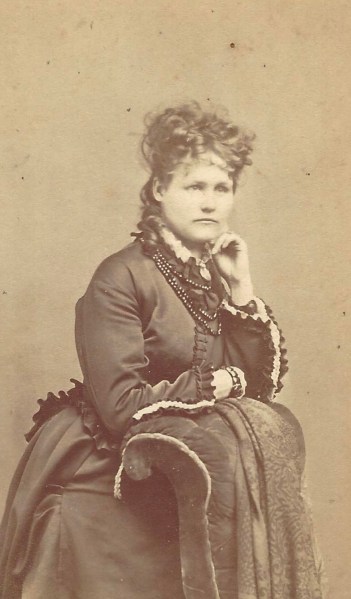
Sophie was born in 1847, so all her early pictures were taken in photographic studios. These were not spontaneous pictures but rather specific setups with long exposures. There are several pictures of Sophie in the family photo albums. Many were taken in New York. My favourite is Sophie in a bathing costume displaying her very long hair and bare feet. There were no mischievous smiles but rather hard stares. Still, it appears she had fun during her photo shoots.

Sophie Bruneau

My great-great grandparents Barnabe Bruneau and Sophie Marie Prudhomme had 13 children and Sophie was number eight. She lived with her parents on their farm in St. Constant, Quebec until after the 1871 census. Pictures from New York studios came soon after. I assume Sophie worked in New York as a teacher or a French governess like her sisters, Virginia and Elmire, when she arrived in the United States in 1875 at 27 years old.

Sisters: Sophie, Helene & Mathilde
Sophie in New York

Sophie and her sister Elmire, married two Huntleys, Washington and Wallace? (Walworth). I assumed that they were brothers who married sisters. On family trees and photos he was called Wallace but it seems he was George Walforth Huntley (1854-1933), Washington’s younger brother and seven years younger than Sophie.  Andrew Washington Huntley Elmire Bruneau’s husband was born in Mooers NY to Andrew Huntley and Calista Blodgett and there was a George Walworth Huntley in the family. If this is Sophie’s husband, they could also have met because her sister Aglae was living in Mooers Forks, New York with her husband.

Sophie and George W. Huntley

Sophie, Elmire, and their husbands lived in several places in the United States but ended up in Los Angeles.

Sophie and Walworth lived in Elkhart, Indiana as Sophie is mentioned in the Personal and Society column of the Indianapolis Journal, “Mrs. George W. Huntley is spending a month in Montreal.” The beginning of the column discussed women’s dress which probably interested Sophie. 
“What with shirtwaist blazers, neckties and caps the women, middle-aged and young are fast becoming what Light facetiously denominated “self-made men.” George was a railroad conductor and owned his own house according to the 1900 census. 

Sophie Huntley

They later lived in Toledo, Ohio where George was a customs collector and finally moved to Los Angeles, California. Sophie became a naturalized American because her husband was a US citizen.

They never had any children.

Sophie Bruneau Huntley

Her age was fluid in all the documents. Her husband was seven years younger but sometimes she was younger and sometimes the age difference was much smaller. Her death record in December 1921 said she was 68; in the 1920 census, she was only 63 while actually being 74.

A death notice in a Los Angeles paper, “Sophie B. Huntley died December 28, 1921, beloved wife of George W. Huntley, funeral from residence La Veta Terraces.” Her death notice was also in Elkhart, Indiana and Toledo, Ohio newspapers. George continued to live in Los Angeles with his housekeeper Mary Dietrick until his death in 1933.

Notes:

“Canada Census, 1871”, , FamilySearch(https://www.familysearch.org/ark:/61903/1:1:M4KT-F5V : Sun Mar 10 23:41:04 UTC 2024), Entry for Barnabe Bruneau and Sophie Bruneau, 1871. Sophie 23 at home no occupation.

“United States Census, 1900”, , FamilySearch(https://www.familysearch.org/ark:/61903/1:1:MMBY-BMK : Thu Apr 11 19:55:49 UTC 2024), Entry for George W Huntly and Sophie B Huntly, 1900 Dubois Indiana.

United States Census, 1910″, , FamilySearch(https://www.familysearch.org/ark:/61903/1:1:MLFZ-MKV : Thu Mar 07 18:33:20 UTC 2024), Entry for George W Huntley and Sophie B Huntley, 1910.Toledo, Ohio. 

United States Census, 1920″, , FamilySearch(https://www.familysearch.org/ark:/61903/1:1:MHQD-HJK : Fri Mar 08 21:37:57 UTC 2024), Entry for George W Huntley and Sophie B Huntley, 1920.

California, County Birth and Death Records, 1800-1994″, , FamilySearch(https://www.familysearch.org/ark:/61903/1:1:QG49-NZN3 : Sat Mar 09 23:29:28 UTC 2024), Entry for Sophie B Huntley and Barnabee Barneau, 28 December 1921.

Sophie was said to be 68 in Norwalk Los Angeles.

“United States Census, 1930”, , FamilySearch(https://www.familysearch.org/ark:/61903/1:1:XC8Z-8NW : Sun Mar 10 08:02:55 UTC 2024), Entry for George W Huntley and Mary Dietrick, 1930.

“California Death Index, 1905-1939”, , FamilySearch(https://www.familysearch.org/ark:/61903/1:1:QKS9-QWHL : Sun Mar 10 22:34:41 UTC 2024), Entry for George W Huntley, 7 1933.

“United States Census, 1850”, , FamilySearch(https://www.familysearch.org/ark:/61903/1:1:MCT1-9GL : Sat Mar 09 13:02:44 UTC 2024), Entry for Andrew Huntley and Calista Huntley, 1850.

Indiianapolis Journal Sunday Aug 31, 1890 page 3 in Personal and Society for Elkhart, Indiana Newspapers.com April 22, 2024.

First Deguerreotype in 1837

William Henry Talbot patents the Calotype process, the first negative-positive process making possible the first multiple copies in 1841. 

When the first mass-produced cameras were available in 1900 people started taking snapshots.