The advertisement in the February 24, 1928 edition of the Montreal Star called for three reliable men to apply for a special sales campaign for the Fuller Brush Company.
My dad, Edward McHugh, probably answered an advertisement similar to this one when he finished school in the late 1920s. He worked as a Fuller Brush salesman for two years in Montreal. Alfred Fuller founded the Fuller Brush Company in 1906. The company produced good quality brushes and increased its sales force by advertising for salesmen. But the secret of its selling success was that each salesman (they preferred men in those days) had to sign a pledge in which they promised that “I will be courteous; I will be kind; I will be sincere; I will be helpful.”1
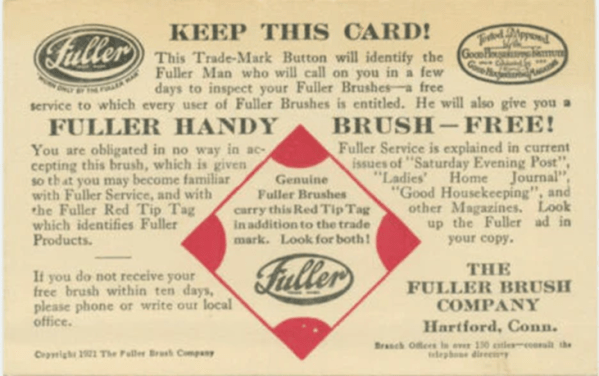
The salesmen left cards like this one when no one was home:
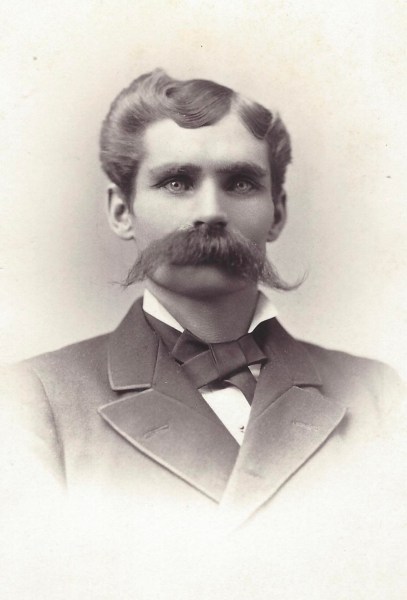
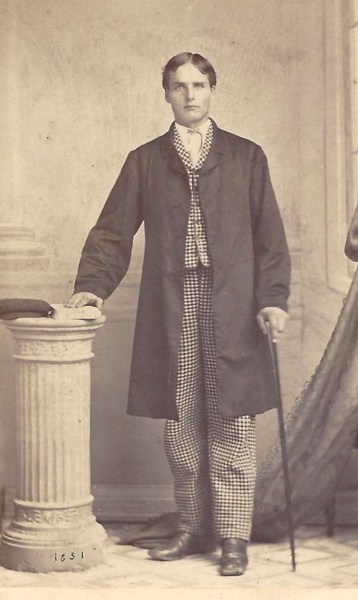
As you can see in the above picture, my dad was a snazzy dresser. Knowing him, he probably took a lot of care with his appearance when he was out selling brushes. I remember him polishing his shoes every morning before going to work.
I assume that he succeeded fairly well at selling Fuller Brushes.2 But he must have been restless and in search of adventure because he left Montreal after just two years of selling brushes. Just travelling to Bermuda would have been quite an adventure in itself. He would have started his trip by going to New York City by train where he would then take an ocean liner. The Furness Bermuda Line and operated regular passenger and mail service between New York and Hamilton, Bermuda at the time.3
Edward must have encountered some challenges selling Fuller Brushes in Bermuda as he ended up working as a bell hop in a hotel that catered to rich patrons from the U.S. and Canada. The tips he earned helped him pay for business college when he returned home to Montreal.4
The Princess Hotel, Hamilton, Bermuda5
By the time Dad completed his business and accounting courses, Canada was in the Great Depression. He again got itchy feet again and moved to Drummondville, Quebec with his older brother, Thomas McHugh, his sister, Sarah Jane McHugh, and her husband, Jack Day. In Drummondville, he did not work as a Fuller Brush salesman, a bell hop, or in business or accounting. He apprenticed as an electrician at the Celanese and worked there for eight years until 1940, when he enrolled in the Royal Canadian Air Force as an aircraft mechanic at the outset of World War II. The RCAF trained my dad in aircraft hydraulics and he was assigned to Bomber Command stationed in Yorkshire, England, for the remainder of the war.6
It is no surprise that Dad did not become an aircraft mechanic after the war. He loved being an electrician and his started his own electrical company, Provincial Engineering. He eventually sold his portion of the business. I remember him saying, “the boss always gets paid last.” After that, he joined a firm and worked in a supervisory capacity on the electrification of towns in regional Quebec such as Sept-Iles and Chibougamau.
Dad was curious and loved trying new things. He never backed down from a challenge.
When my dad retired, he and my mom travelled to Bermuda regularly for their winter getaways. He must have enjoyed going back and perhaps even having a meal or two at the hotel he worked at when he was a young bell hop.
“Selene J. Bruneau brother of A.B. Bruneau who has been visiting at his mother’s, in St. Constant, near Montreal, Canada, for the past six weeks returned home this morning. His many friends will be glad to hear his health is much improved.” as reported in the Fall River Evening Daily News 1880. Unfortunately, two years later Selene died at only 31 years of age.
Selene (1850-1882) was the first of Barnabé Bruneau and Sophie Marie Prudhomme’s 13 children to die. According to his obituary, he died of consumption, at his mother’s in St-Constatnt. What used to be called consumption is tuberculosis or TB. It became known as the wasting disease as those afflicted seemed consumed by their disease as bacteria grew in their lungs and digestive tract. They lost energy, coughed up blood and slowly died. “The slow progress of the disease allowed for a “good death” as those affected could arrange their affairs.”
Most typical 19th-century victims of TB lived in tenements and or worked in factories, places where the disease spread quickly because of close contact and poor hygiene. Even when TB was known to be a contagious disease, people ignored public health campaigns to quarantine the sick and continued to spit on the streets. Selene, not a typical victim, lived in Fall River Massachusetts in a house with his brother Amie’s family. Although some of his older brothers had come to the US earlier and worked in factories, Selene worked in Aime’s jewellery store as a watchmaker.
He seemed content living in the United States as he had the support of some family, friends and a good job although he never married. Selene petitioned for naturalization and took his oath allegiance in 1879 with Aime and his wife Mary as witnesses.
Selene Bruneau in Montreal QC
It appears Selene went home to his mother’s to try and recuperate from his illness. This was before there were any sanitoriums for TB patients. The first one in the US opened in Saranac Lake, New York in 1884 and the first one in Canada, Muskoka Cottage Sanitorium, Ontario in 1897. These sanitoriums isolated infected patients and provided nutritious food, plenty of rest and fresh air. Selene undoubtedly was given this treatment by his mother but at this time 80% of those who developed active TB died from it
The BCG vaccine against TB (Bacille Calmette-Guérin) was first used in humans in 1922. In Canada, only Quebec and Newfoundland had mass vaccinations of school children from the 1950s to the 1970s. In 1944 streptomysin was isolated, the first antibiotic effective against tuberculosis. Medical professional’s hopes that the disease could be eliminated were dashed in the 1980s with the rise of drug-resistant strains. Surgery was also used where infected portions of the lungs were cut out which produced some cures, relieved pain and various anatomic obstructions. Still today, worldwide, there are over ten million new cases of TB a year.
Selene’s burial place is in the St Blaise Sur Richelieu Cemetery, the Baptist Cemetery in Grande Ligne associated with the Feller Institute, alongside his parents and some of his siblings. His mother outlived him by ten years.
Selene wasn’t a lucky name. His brother Ismael called one of his sons, Selene Fernand and this child died early, in his first year of life. My grandmother told us it was his strange name that killed him although he was called Fernand and not Selene. This from a family with girls called Helvetia, Hermanie and Edmee. Little did she know it was the Selene that was the problem!
Fall River Daily Evening News 14 August, 1882 Monday Page 2. Selene J Bruneau Obituary.
United States, New England Petitions for Naturalization Index, 1791-1906″, , FamilySearch(https://www.familysearch.org/ark:/61903/1:1:VXRD-LZ2 : Tue Nov 14 02:51:28 UTC 2023), Entry for Selene J Bruneau.Oath of Alliengence to the US Oct 11, 1879 Bristol County Superior Court, Taunton, Massacheuttes.
In Canada, vaccinations of all children 10-14 continued until 2005 when it was decided the TB rates in the general population had fallen to such a low level that universal BCG vaccination was nolonger needed.
M. tuberculosis infection is spread almost exclusively by the airborne route. The droplets may remain suspended in the air and are inhaled by a susceptible host. The duration of exposure required for infection to occur is generally prolonged (commonly weeks, months or even years). The risk of infection with M. tuberculosis varies with the duration and intensity of exposure, the infectiousness of the source case, the susceptibility of the exposed person, and environmental factors. Although treatment courses are prolonged, effective treatment of the individual with active TB disease can reduce the infectiousness after two weeks.
When my great-great grandfather Stanley Clark Bagg died in 1873, his wife and five children inherited large tracts of farmland on the island of Montreal, land that they made a family business of selling.1 But misunderstandings over who owned what and how to keep track of the income created a lot of difficulties.
Stanley Clark Bagg (I usually refer to him as SCB to differentiate him from his father, Stanley Bagg, and his son, Robert Stanley Bagg,) had inherited most of this property from his grandfather John Clark (1767-1827).2 But there were conditions attached to some of these bequests: Clark’s 1825 will stated that land that comprised the Durham House property, and land comprising Mile End Farm, should pass down through three generations of descendants before it could be sold. The legal term for this, in civil law, is a substitution. However, a change in the law, passed in 1866, limited substitutions to two generations.3 That meant that the generation of Robert Stanley Bagg and his sisters Katharine, Amelia, Mary and Helen were the last generation affected by the substitutions and they could do what they liked with these properties.
The substitution clause referring to Durham House was part of the 1819 marriage contract between SCB’s parents, in which John Clark gave that property to his daughter as a wedding present.4 (It is shown in dark green on the map below.)
Robert Stanley Bagg, # II-57308.1, 1880, Notman & Sandham, McCord-Stewart Museum; Bagg family collection.
When SCB died at age 53, none of his family members was ready to manage these properties. His only son, Robert Stanley Bagg, or RSB, (1848-1912) had recently graduated in law, but he had no experience in renting or selling properties. Furthermore, neither the notary who completed the inventory of SCB’s estate in 1875,5 nor SCB’s widow, nor his children were aware of the substitutions. The Durham House and Mile End Farm properties were treated as though they were no different than the other properties belonging to the late SCB’s estate.
The 22-acre Durham House property (lots 19–28 and 101–115, cadastre of the Saint-Laurent ward) was located north of Sherbrooke Street, on the west side of today’s Saint-Laurent Boulevard. SCB had subdivided part of it and sold lots from it as early as 1846. In 1889, RSB, who was an executor of his father’s estate, subdivided the Upper Garden of Durham House (lot 19, Saint-Laurent ward) and began to sell those lots. He signed the property documents as “R. Stanley Bagg for the estate,” and his mother, Catharine Mitcheson Bagg, also signed.
But the Durham House property actually belonged jointly to the five Bagg siblings. It was not part of SCB’s estate, and his widow could not inherit this land, sell lots from it or acquire income from it. Yet that is what she did: the name Dame Catharine Mitcheson, widow of Stanley Clark Bagg, appeared on five deeds of sale in 1889.
It is not clear who discovered the error, but perhaps someone close to the Bagg family took a good look at the property documents and noticed these details. SCB’s middle daughter, Amelia Bagg, was to marry Joseph Mulholland the following year, and he worked as a real estate agent for the Stanley Clark Bagg Estate. Also, Joseph’s brother-in-law, John Murray Smith, was about to purchase several of the Durham House lots. Any one of these people could have discovered the marriage contract and John Clark’s will, which SCB had registered at the provincial land registry office.6
This map shows details of several of the late Stanley Clark Bagg’s properties in 1875, when an inventory was made of his estate. Durham House and its upper garden, as well as a small part of the Mile End Farm and SCB’s home, Fairmount Villa, are overlaid over a modern map of the island of Montreal. Mile End Lodge had been John Clark’s home. At that time, the densely populated part of Montreal was south of Sherbrooke Street. Mount Royal Park, opened in 1876, is on the left. Map created by Justin Bur, based on two open data sources: physical geography from CanVec, Natural Resources Canada and modern streets from Geobase, City of Montreal.
As soon as they became aware of the situation, the Bagg siblings tried to remedy it with a notarized document called a Ratification.7 It said that, as the actual owners, they ratified and approved the five sales made by their mother. A few weeks later, in January and April of 1890, the Bagg siblings sold five lots to John Murray Smith and four to James Baxter, and this time, the vendors named in the deeds were correct.
Next, Catharine and her five children took a step to sort out the income from lots from the Durham House property that SCB had sold in his lifetime. They did not involve a notary, but tried to look after the issue as a family, signing a document called an Indenture on May 12, 1890.8
The indenture stated that neither Catharine nor her children had known about the marriage contract until December, 1889. The Bagg children (by now all were adults) declared the love and affection they had for their mother and their desire to settle the matter amicably, and released her from all claims and demands. For her part, Catharine agreed to repay to her children the capital sums she had received from the sale of these properties. Because she had paid taxes and expenses on them, the children made no claim for the interest payments she had received.
Action Demanded
No doubt confident that everything had been resolved, RSB took his wife and two young daughters on an extended trip to England, leaving his mother and sisters to handle offers for land sales during his absence. After his return, however, the family dispute blew up once more, this time over the Mile End Farm property. Two of the married sisters, Katharine Sophia Mills and Mary Heloise Lindsay, hired a notary to represent their interests.
Notary Henry Fry sent a complaint on their behalf to the three living executors of SCB’s will — Catharine Mitcheson Bagg, Robert Stanley Bagg and notary J.E.O. Labadie – demanding immediate action. Dated July 22, 1891 and titled Signification and Demand,9 this document stated that the executors of SCB’s will were bound, upon his death, to deliver over the Durham House and Mile End Farm properties to his children, and to produce an account of the administration of these properties.
Catharine Mitcheson Bagg, #71147, 1883, William Notman & Son, McCord-Stewart Museum; Bagg family collection.
It stated that the executors “have wholly failed and neglected to render such account, but on the contrary, have, since the death of the said Stanley Clark Bagg, continued in possession of the said substituted property and have even sold and alienated portions thereof and have received the consideration money of such sales and have received and retained the entire revenues therefrom and that although they have been recently requested to render such account, the said executors have neglected and refused to do so.”
The executors had until August 10 to provide an account of the property belonging to the substitutions. They must have met this demand because no further complaints have turned up. Furthermore, the Bagg siblings seem to have found a better solution to their dilemma: they partitioned the Durham House property and sold a large chunk of the Mile End Farm.
In September 1891, the remaining unsold lots of the Durham House property were grouped into five batches, and the five siblings pulled numbers out of a hat to determine who got which ones.10 They could then sell these lots, or keep them, as they pleased.
Two months later, the five siblings sold 145 arpents of land, including most of the Mile End Farm and a section of the adjoining Black Gate Farm, to Clarence James McCuaig and Rienzi Athel Mainwaring,11 These Toronto land developers had plans to develop an exclusive housing development they called Montreal Annex in the area.12
As for keeping track of property sales, Amelia, the middle Bagg sibling who was now married to Joseph Mulholland, took on that responsibility. Starting in 1892, she kept a ledger in which she wrote down the dates, names of purchasers and prices paid for each of the lots that were part of the Mile End Farm and Durham House properties.13
The Indenture, the Deed of Ratification and several other documents mentioned in this article were donated to the archives of the McCord Stewart Museum in Montreal around 1975 by my cousin.
This article was written in collaboration with urban historian Justin Bur. Justin has done a great deal of historical research on the Mile End neighbourhood of Montreal (around Saint-Laurent Blvd. and Mount Royal Ave.) and is a longtime member of the Mile End Memories/Memoire du Mile-End community history group (http://memoire.mile-end.qc.ca/en/). He is one of the authors of Dictionnaire historique du Plateau Mont-Royal (Montreal, Éditions Écosociété, 2017), along with Yves Desjardins, Jean-Claude Robert, Bernard Vallée and Joshua Wolfe. His most recent article about the Bagg family is La famille Bagg et le Mile End, published in Bulletin de la Société d’histoire du Plateau-Mont-Royal, Vol. 18, no. 3, Automne 2023.
Sources:
Stanley Clark Bagg will, J.A. Labadie, n.p. no 15635, 7 July 1866
John Clark will, Henry Griffin, n.p. no 5989, 29 August 1825
In 1866 the government of Lower Canada enacted the Civil Code. This was a compilation and revision of the civil law inherited from the French regime; article 932 of the code put a two-generation limit on substitutions.
Marriage contract between Stanley Bagg and Mary Ann Clark, N.B. Doucet, n.p. no 6489, 5 August 1819
Stanley Clark Bagg inventory, J.A. Labadie, n.p. no 16733, 7 June 1875
John Clark’s will and the marriage contract between Stanley Bagg and Mary Ann Clark are still publicly available at the Registre foncier du Québec. John Clark’s will had been transcribed there in 1844 (Montréal ancien #4752). The marriage contract (Montréal Ouest #66032) was transcribed in 1872. SCB’s will was transcribed into the register (Montréal Ouest #74545) in 1873.
Deed of Ratification, Adolphe Labadie, n.p. no 2063, December 12, 1889, register Montreal Est #25109, McCord Stewart Museum (P070/66,3) This notary was a son of notary J.E.O. Labadie, who was an executor of the will, and grandson of notary J.A. Labadie, who had handled SCB’s will and the inventory of his estate.
Indenture, May 12, 1890, McCord Stewart Museum (P070/B6,3).
Signification and Demand, Henry Fry, n.p. no. 2234, 22 July 1891, McCord Stewart Museum (P070/B6,3).
Deed of Partition, John Fair, n.p no 3100, Sept. 10, 1891, register Montreal Est #29503, McCord Stewart Museum (P070/B8,4).
Deed of Sale, William de Montmollin Marler, n.p. #17571, 20 November, 1891, register Hochelaga-Jacques-Cartier #40225
Justin Bur, Yves Desjardins, Jean-Claude Robert, Bernard Vallée, Joshua Wolfe, Dictionnaire historique du Plateau Mont-Royal (Montreal, Éditions Écosociété, 2017), p 271.
Napoleon Bruneau died tragically on a Sunday night in 1916. The La Presse newspaper reported the train accident at Delson Junction on the CPR line but no details were given. This was not far from his home in St-Constant, Quebec. Was he coming home or going to Montreal? What happened? Did he fall on the tracks? He was almost 72 years old so he should have known better than to get in front of a train!
He and his twin sister Mathilde were the 5th and 6th children of Barnabe Bruneau and Sophie Marie Prudhomme. He lived his whole life in St-Constant, south of Montreal. It seems he inherited the family farm after his parent’s deaths.
Napoleon and his sister Sophie Bruneau
Descriptions of Napoleon included being a farmer, a Free Will Baptist, a veterinarian and a justice of the peace. He was appointed a justice of the peace in 1902 for the district of Montreal which included St-Constant. It is possible he studied to be a veterinarian and didn’t just learn as an apprentice. A school for veterinarians was established in Quebec in 1866 with one of his cousins, Orphyr Bruneau as one of the lecturers. In 1876 courses were also offered in French when the school was under the McGill University Department of Agriculture. The Veterinary school, later associated with The University of Montreal, moved to Oka in 1928 and to its present location in Saint-Hyacinthe in 1947.
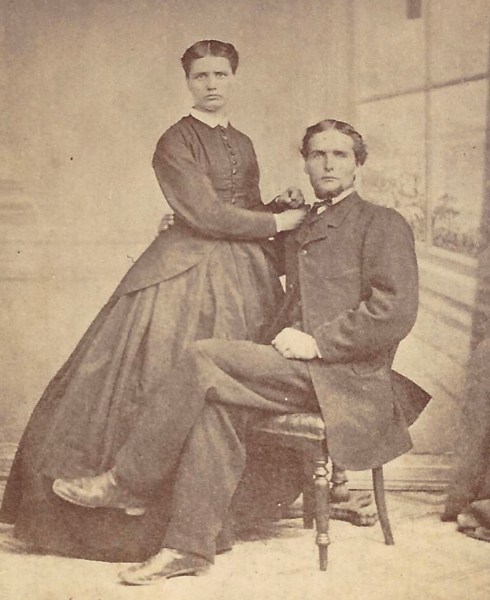
One would think that a tall handsome man with many interests and a farm would easily find a wife, so I found it strange that he didn’t marry until he was 66. His brother, Reverand Ismael Bruneau performed the ceremony at his Protestant Church, L’Eglise St Jean Baptiste de Montreal. Napoleon’s wife Emilie Beauchamp was 42 at the time, so it isn’t surprising that they didn’t have children. Emilie was born in Grenville, Quebec, on the Ottawa River. She probably met Napoleon in Montreal where she lived with her parents and sister Lily. Emilie had an uncle who was a French Protestant minister so it is quite possible that they met through the church.
My great-grandfather, Ismael Bruneau was upset with Emilie after Napoleon died as he wrote in a letter to his son Sydney.
“You know your Uncle Napoleon made me the heir of all his estate except for $500, which I must give after the death of his widow as follows; $300 to my sister Helene, $100 to my sister Virginie and $100 to my sister Elmire. But his widow has everything during her lifetime. As she is a great deal younger than I, it is almost probable that I shall never enjoy this myself. They say she is already neglecting the house which is going to ruin and according to the law she must maintain it in good condition as it was at the time of the death of her late husband.”
Unfortunately, Ismael didn’t enjoy any of his inheritance as he died two years after Napoleon. Emilie only died in 1951. I don’t know what happened to the property as she married Emilien Frechette in 1929 and he had his own house and farm. Emilien had been married to two other Bruneau women, Emilina Bruneau, Ismael’s sister and and Ida Girod Bruneau Ismael’s wife.
Napoleon was buried in Mount Royal Cemetery with his sister Helene, her husband Celestin Lachance and their daughter Antoinette and not with his twin Mathilde in the Baptist cemetery in Grand Ligne. Emilie isn’t buried with Napoleon or even with Emilien Frechette and his first two wives, rather her final resting place is with her parents in the Beauchamp Cemetery in Marelan in the Laurentians near Grenville.
I haven’t yet found answers to questions about his tragic end.
Notes:
Napoleon Bruneau Obituary: LaPresse January 16, 1916.
Napoleon Bruneau’s death determined to be accidental. The Montreal Gazette, Tuesday, January 25, 1916. Page 7.
when searching for information on the train accident I found another Napoleon Bruneau who was also killed by a train. This accident happened in Huntington, Pennsylvania in 1908. He was decapitated and horribly mangled.
Appointed Justice of the Peace: Montreal Star Monday, June 23, 1902. page 10. Accessed Newspapers.com March 20, 2023.
Letter from Ismael Bruneau to his son Sydney Bruneau. Quebec, February 21, 1917. A copy in the hands of the author.
Orphyr Bruneau one of Napoleon’s first cousins the son of his father Barnabe’s brother Medard.
There are notarial documents, Quittances which are receipts where Napoleon gave most of his siblings 300 piastres each, beginning two years after his mother died. These dispersals occurred from 1894 to 1904. Some received less and I haven’t found the documents for his sisters Aglae and Sophie. His brother Selene had already died and had no heirs. I am unsure if these were money paid to his siblings because he received the farm.
Three hundred piastres were 300 dollars. This would be the equivalent of over $10,000 today. Quebec used the word piastres on official documents into the 20th century. Even later it was used as a slang equivalent to the English word buck.
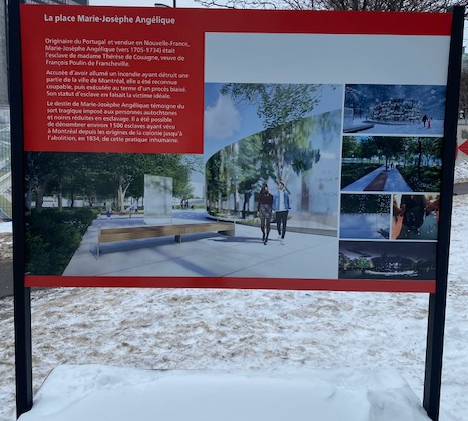
Since this story was originally published, the City of Montreal has added a poster next to Metro Champs de Mars to make it clear that Marie-Josèphe Angélique’s park will be within the Place de Montrealais!
Thanks to Annie for letting me know, and thanks for everyone who made sure that her story is not forgotten!
Original Story
For an hour on the first cold day of the year last month, I wandered around City Hall looking for the memorial park named after an enslaved woman whose torture led to her conviction for arson in 1734. She was then ridiculed, hanged, and her body was burned to ashes and thrown to the wind.
I couldn’t find it.
I’m not sure what happened from the time the park was created in 2012 to today, thirteen-and-a-half years later, but the one-time park still appears on Google Maps. In person, I couldn’t find anything to indicate where it might be.
According to various articles on the web, a green space just west of Champs de Mars métro station honours Marie-Josèphe Angélique’s memory. The official inauguration of the park took place on Aug. 23, International Day for the Remembrance of the Slave Trade and its Abolition, 2012.
As I walked through the area last month, the one-time park seemed to be encompassed in a massive construction site underway for Place des Montréalais, a new public space being created next to the Champ des Mars metro on Viger Street. The posters on site explaining the current project included nothing about Marie-Josèphe Angélique.
Despite being honoured with an award-winning film, a bronze plaque, lilies and a presentation by Governor General Michaelle Jean in 2006, and a public park created by the city of Montreal in 2012, she’s disappeared again.
Before this experience, I was already struggling to see Angélique as the symbol of freedom and resistance she serves for many, but I don’t want her to be forgotten. Did she set the fire or was she a convenient scapegoat? If she didn’t, who did? As I began exploring her story last month as part of a project for NANOWRIMO (the National Novel Writing Month), she served as a reminder of the kind of unnecessary suffering a biased political, policing and justice system can create. Despite the fact that she was a victim of slavery, hatred, spite, racism, class bullying and the worst that a mob could throw at her, her spirit remained strong and unrelenting.
Angélique proclaimed her innocence until the day she was tortured, throughout the court case, and through questioning. Despite that, three weeks after the fire, she was hanged, ridiculed publicly, then burned with her ashes tossed into the wind. Clearly, the authorities at the time wanted her punishment to be seen and remembered.
I read the details about Marie-Josèphe Angélique’s case on Torture and the Truth, a fabulous website set up in 2006 by multiple people, including one of my genealogical mentors, Denyse Beaugrand-Champagne and one of my historian mentors, Dorothy W. Williams. Both of these women have researched, written, spoken and taught many people about the history of Montreal and why studying it is so important.1
The site is one of thirteen different “historical cold cases” established for classrooms across Canada. It was created through the work of six writers, a photographer, an artist, and two translators collaborating with six funding agencies, seven production partners, and 15 archive and museum partners.
It is one of the best historical websites I’ve ever read. If you do nothing other than read through this site, you will get a good overview of the community, the victim arsonist, and life in early Montreal.
As I read about Angélique’s story, she sounded like just the kind of person anyone would like to get rid of. She was a woman who told people she would burn them alive in their homes. She said so to her owner for refusing to grant her freedom, to other slaves for making her work harder than she wanted and to others too. To anyone who slighted her, she threatened the worst thing she could think of. She would burn their homes down.
When 45 houses in her small community did in fact burn down, people blamed her. In retrospect, it may have been an accidental kitchen fire that caused the flames, but her words came back to haunt them all.
The fire began at 7 p.m. on a Saturday evening in spring, April 10, 1734. In only three hours, it destroyed 45 homes and businesses on Rue Saint Paul. Even the Hôtel-Dieu hospital and convent, where people initially took shelter, burned to the ground. Hundreds of people were left in the cold; supplies from many merchants burned, never to be seen again.
Plus, who knows how many caches of fur got wiped out. At that time, Montreal was the centre of the fur trade, more than half of which was illegal trading with the Dutch and English communities in Albany, Boston and other communities to the south. According to a 1942 thesis by Alice Jean Elizabeth Lunn, furs were stored in the backs of shops and even buried just beyond the Montreal wall, which was still under construction at that time, in order to be shipped without being seen by New France authorities. A lot of money went up in smoke that day.2
Everyone in Montreal knew about the fire, given that all the church bells throughout the city began ringing when it started and continued until it was over and people were safe again. Although stone buildings existed at the time, most of the buildings were made of wood; fire could destroy them all.
I had ancestors who lived in Montreal then, the Hurtubise clan on my father’s mothers side. One of them, Jean Hurtubise, the grandson of Étiennette Alton and Marin Hurtubese, was thirty-nine years old, ten years older than Angélique when the fire took place. He and his wife Marie-Jeanne (Marie-Anne ou Marianne) Tessereau had been married for seven years in 1734.
Jean was born in Ville Marie and lived in Montreal for his entire lifetime, so he and his family would have experienced the fire, at least from a distance. They certainly would have seen the ordinance compelling witnesses to appear, given that “it was posted and cried out everywhere in the city and its suburbs.”
Jean and his family farmed a 3×20 arpent property they bought three years earlier from Raphael Beauvais and Elisabeth Turpin on Rue Côte Saint-Antoine.”3 The property was in a part of Montreal that was considered the countryside at that time. Their home was then one of four wood houses on Côte Saint-Antoine in 1731.4
Given that the area was still very rural, and on a major hill, I can’t help but wonder. Did they see the smoke rising into the sky as the hospitals and 45 other buildings in Ville Marie were destroyed?
They certainly had strong links to Ville Marie, particularly the hospital. His grandmother, Etionnette Alton, had died there in her 84th year twelve years earlier. They couldn’t have helped wondering what would happen to others like her, being treated in the hospital that the fire destroyed. Were they among the crowd clamouring for revenge? Did they go to Ville Marie to see Angelique hanged? Did they watch her corpse burning? Did they see her ashes spread into the wind? Did they care at all?
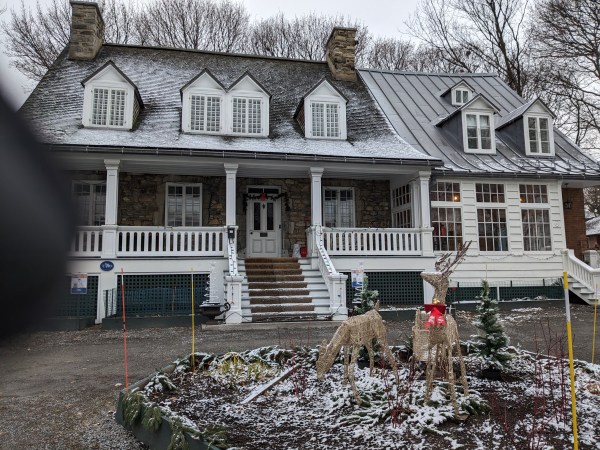
I can’t help but imagine that the controversial hanging effected all 2000 people who lived on the island that year. Five years after Angélique’s death, Jean built Hurtubise House, a storey-and-a-half fieldstone structure on land originally rented by his father in 1699 on Mount Royal. The family built the gabled home out of stone to protect themselves from fire, as required by a law passed the summer after Angelique’s death. You can still visit the home today.5
Sources
1 Beaugrand-Champagne, Denyse, Léon Robichaud, Dorothy W. Williams, Marquise Lepage, and Monique Dauphin, “Torture and Truth: Angélique and the Burning of Montreal,” the Great Unsolved Mysteries in Canadian History Project, 2006, https://www.canadianmysteries.ca/sites/angelique/accueil/indexen.html.
3 Roy, Pierre-Georges,, Inventaire des greffes des notaires du Régime français, Québec, R. Lefebvre, Éditeur officiel du Québec, 1942, 28 vol. ; 25-27 cm, Collections de BAnQ.
Written by Janice Hamilton, with research by Justin Bur
Note: there were three generations named Stanley Bagg, so for the sake of brevity I use their initials: SCB for generation two, Stanley Clark Bagg, and RSB for generation three, Robert Stanley Bagg.
Be careful what you wish for, especially when it comes to writing a will and placing conditions on how your descendants are to use their inheritance. That was a lesson my ancestors learned the hard way.
It took a special piece of provincial legislation in 1875 and what appears to have been a family crisis before these issues were finally resolved many years later.
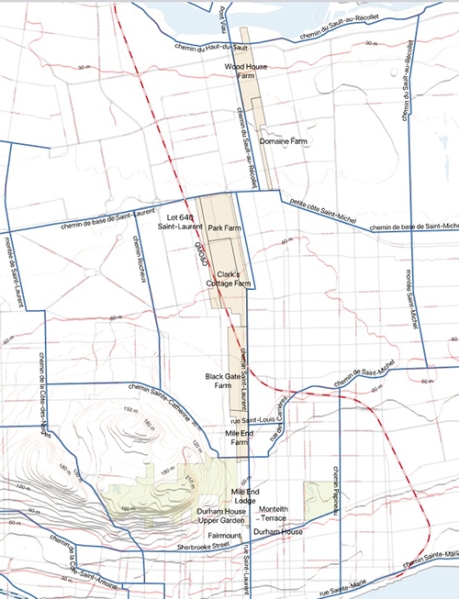
The estate at the heart of these problems was that of the late Stanley Clark Bagg (1820-1873), or SCB. He had owned extensive properties on the Island of Montreal. Several adjacent farms, including Mile End Farm and Clark Cottage Farm, stretched from around Sherbrooke Street, along the west side of Saint Lawrence Street (now Saint-Laurent Boulevard), while three other farms extended along the old country road, north to the Rivière des Prairies. SCB had inherited most of this land from his grandfather John Clark (1767-1827). Although he trained as a notary, SCB did not practise this profession for long, but made a living renting and selling these and other smaller properties.
This map shows the extent of the late Stanley Clark Bagg’s properties, shaded in beige, in 1875, when an inventory was made of his estate. These properties are overlaid over a modern map of the island of Montreal. At that time, the actual city of Montreal was south of Sherbrooke Street, extending down to the banks of the Saint Lawrence River. The slope of Mount Royal is just west of the SCB estate. Map created by Justin Bur, based on two open data sources: physical geography from CanVec, Natural Resources Canada and modern streets from Geobase, City of Montreal.
At age 52, SCB suddenly died of typhoid. In his will, written in 1866, he named his wife, Catharine Mitcheson Bagg (1822-1914), as the main beneficiary of his estate, to use and enjoy for her lifetime, and then pass it on to their descendants. He also made her an executor, along with his son Robert Stanley Bagg (RSB, 1848-1912). There were two other executors: Montreal notary J.E.O. Labadie and his wife’s brother, Philadelphia lawyer McGregor J. Mitcheson.
But SCB’s estate was large and complicated, and no one was prepared to handle it. RSB had recently graduated in law from McGill and was continuing his studies in Europe at the time of his father’s death. As for Catharine, she became involved in decisions regarding property sales over the years, but she must have felt overwhelmed at first.
Notary J.A. Labadie spent two years doing an inventory of all of SCB’s properties, listing where they were located, their boundaries, and when and from whom they had been acquired, but he did not mention two key documents. One of these was the marriage contract between SCB’s parents, the other was John Clark’s will.
John Clark, a butcher, was born in County Durham, England and came to Montreal around 1797. Bagg family collection.
In the marriage contract, John Clark gave a wedding present to his daughter, Mary Ann Clark (1795-1835), and her husband, Stanley Bagg (1788-1853): a stone house and about 22 acres of land on Saint Lawrence Street. Clark named the property Durham House. But it was not a straight donation; it was a substitution, similar to a trust, to benefit three generations: Mary Ann’s and Stanley’s child (SCB), grandchildren (RSB and his four sisters) and the great-grandchildren. Each intervening generation was to have the use and income from the property, and was responsible for transmitting it to the next generation. That meant SCB could not bequeath it in his will because his children automatically gained possession, and so on, with the final recipients being the great-grandchildren.
In his 1825 will, Clark had made an even more restrictive condition regarding the Mile End Farm. This time the substitution was intended to be perpetual “unto the said Mary Ann Clark and unto her said heirs, issue of her said marriage and to their lawful heirs entailed forever.”
Perhaps Clark imposed these conditions on his descendants for sentimental reasons. Durham House was his daughter’s family home, and Stanley Bagg had probably courted Mary Ann on the Mile End Farm while he was running a tavern there with his father. Or maybe Clark simply believed that these provisions would give the best financial protection to his future descendants. SCB must have thought this was a good idea because his will also included a substitution of three generations.
Clark and SCB did not foresee, however, that the laws regarding inheritances would change. In fact, the provincial government changed the law regarding substitutions a few months after SCB wrote his will. This new law limited substitutions to two generations. Meanwhile, when SCB died in 1873, no one seems to have remembered that the substituted legacies Clark had created even existed.
Stanley Clark Bagg, Montreal, QC, 1863, William Notman, McCord Stewart Museum #1-5660.1
Real estate sales practices also changed over the years. Clark had written a codicil specifying that any lot sales from the Mile End Lodge property, where he and his wife lived and which he left to her, were subject to a rente constituée. The buyer paid the vendor an amount once a year (usually 6% of the redemption value), but it was like a mortgage that could never be paid off. In the early 1800s this had been a common practice in Quebec, designed to provide funds to the seller’s family members for several generations.
SCB similarly stipulated that nothing on the Durham House property could be sold outright, but only by rente constituée. By the time he died, some of the properties located near the city outskirts were becoming attractive to speculators and to people wanting to build houses or businesses, but the inconvenience of a rente constituée was discouraging sales. It became clear that the executors had to resolve the issue.
They asked the provincial legislature to pass a special law. On February 23, 1875, the legislature assented to “An Act to authorize the Executors of the will of Stanley C. Bagg, Esq., late of the City of Montreal, to sell, exchange, alienate and convey certain Real Estate, charged with substitution in said will, and to invest the proceeds thereof.” (According to the Quebec Official Gazette, this was one of about 100 acts that received royal assent that day after having been passed in the legislative session to incorporate various companies and organizations, approve personal name changes, amend articles in the municipal and civil codes, etc.)
This act allowed the executors of the SCB estate, after obtaining authorization from a judge of the superior court, and in consultation with the curator to the substitution, to sell land outright, provided that the proceeds were reinvested in real estate or mortgages for the benefit of the estate. In other words, the rente constituée was no longer required, and sales previously made by the estate were considered valid.
No more changes were made until 1889, when family members realized that part of SCB’s property actually belonged to his children, and not to his estate, and a family dispute erupted. The story of how they resolved this issue and remained on good terms will be posted soon.
I could not have written this article without the help of urban historian Justin Bur. Justin has done a great deal of historical research on the Mile End neighbourhood of Montreal (around Saint-Laurent Blvd. and Mount Royal Ave.) and is a longtime member of the Mile End Memories/Memoire du Mile-End community history group (http://memoire.mile-end.qc.ca/en/). He is one of the authors of Dictionnaire historique du Plateau Mont-Royal (Montreal, Éditions Écosociété, 2017), along with Yves Desjardins, Jean-Claude Robert, Bernard Vallée and Joshua Wolfe. His most recent article about the Bagg family is La famille Bagg et le Mile End, published in Bulletin de la Société d’histoire du Plateau-Mont-Royal, Vol. 18, no. 3, Automne 2023.
Documents referenced:
Mile End Tavern lease, Jonathan Abraham Gray, n.p. no 2874, 17 October 1810
Marriage contract between Stanley Bagg and Mary Ann Clark, N.B. Doucet, n.p. no 6489, 5 August 1819/ reg. Montreal (Ouest) 66032
John Clark will, Henry Griffin, n.p. no 5989, 29 August 1825
Stanley Clark Bagg will, J.A. Labadie, n.p. no 15635, 7 July 1866
Stanley Clark Bagg inventory, J.A. Labadie, n.p. no 16733, 7 June 1875
Quebec legislation: 38 Vict. cap. XCIV, assented to 23 February 1875
My very Gallic Grandpapa, Jules Crepeau (1879-1938) proud descendant of the Redones of Eastern Brittany in the Iron Age, among other Gallic Tribes.
Judging from her family tree, my late mother, Marie Marthe Crepeau was a bona fide French Canadian de souche.1
Her father, Jules Crepeau, son of an entrepreneur painter from Laval and her mother, Maria Roy of Montreal, daughter of a master-butcher, have trees that go right back to the boat in France – and yes, mostly to Normandy, Poitou and Ile de France. Classic!2
And yet, according to Ancestry’s (beta) chromosome browser, my mother was not 100 percent “French.”
I’ve provided my own spit to the platform and apparently chromosomes 3 and 12 on her side are English (but that does include the North of France) and chromosomes 17 and 18 are Norwegian (Norsemen -Northmen-Normandy, perhaps?) And a swath of chromosome 2 is indigenous American, making me less than one percent indigenous.
Lately, I’ve subscribed to an interesting infotainment3 website that really dives into a person’s ethnicity from all angles and over a slew of time periods: Ancient, Bronze , Iron and Modern Ages. Sure, I get Eure, Finistere and Vendee (Normandy, Brittany and Poitou) in spades, but I get just about every other area of France, too – as well as some Spanish, French Corsican and French Basque.4
My mom’s French Canadian family tree supports some of this. From the ten percent sample I traced back to France I get natives of Limousine, Aquitaine, the Mid-Pyrenees, Picardy, Bourgogne, Haute-Marne, Bayonne, Les Rhones Alpes, as well as the Canadian North (Innu).5
And let’s not forget my ancestor the legendary pioneer river pilot Abraham Martin dit L’Ecossais (he of the Plains of Abraham fame) who may have been from Scotland. My mom has him at least twice in her tree.
A while back, I figured out that my Mom’s paternal Crepeau line (father’s father’s father, etc.) can be traced back to Vendee but it is likely of Sephardic Jewish ethnicity and hails originally from Spain. 6
View from Hubou farm (or close). These pioneer farms on the North Shore of Montreal were a narrow stretch of river away from the Eastern tip of Laval Island, and just a bit more north of the Eastern tip (Pointe aux Trembles) of Montreal Island.
In New France, my grandpapa Crepeau’s maternal tree can be traced to the original families at the Lachenaye (Terrebonne) Seigneury (est.1673) north east of Montreal, four founding farmer families in particular: Ethier (Poitou-Charentes), Forget (Normandy), Hubou (Ile de France) and Limoges (Rhones Alpes). My mother’s DNA is largely a mish-mash of these families’ genes, for they inter-bred down through the centuries. Basil Crepeau my mom’s 4 x GG was a slightly later arrival at Lachenaye who moved in beside the Hubous.
Jules and family before my mom was born circa 1920. Maria Roy (Gagnon) his wife was also connected to the Lachenaye tribe through Ethier.
Now DNA distributes down the generations in very complicated and irregular ways especially where endogamy or founder effect is concerned8 and judging from my many French Canadian ‘cousins’ on Ancestry, my mom may have gotten a disproportionate amount of her genetic material from the Hubou founder family at Lachenaye Seigneury. A great majority of my DNA cousins on that platform are connected to me through her 2nd great grandfather, Michel Hubou dit Tourville.9
As it happens, Michel’s pioneer ancestor was one Mathieu Hubou dit Deslongchamps, a master-armourer from Normandy who was married to one Suzanne Betfer who was…wait for it… a gal from Gloucester, UK.
Now, ain’t that fun! A bona fide English Fille de Roi!!
THE END
1. de souche a controversial label that means from the roots.
(Hereditary disorders in the population of Quebec II Contribution of Perche)
The very first pioneers, the 2,700 super founder families, 1608-1680, were 95 percent French. The later 17th and 18th century founder families were 80-85 percent French but the non-French includes Acadians.) The first 2,700 founder families contributed to 2/3rds of the modern gene pool of French Canadians, but geography and natural boundaries kept families within even smaller gene pools. Indigenous DNA contributed one percent of French Canadian DNA. Regions can have super-founder families that contributed even more to the modern gene pool.
3. Your DNA Portal
4.These ethnicity estimates are based on complex science but the various results have to be taken with a grain of salt. Even if the original science is spot on, these results depend on what sample of your DNA is taken and how far back the algorithm is examining. I liken it to making a complicated stew from various ingredients, letting it simmer for a long time and then trying to deconstruct what it was made from. Maybe you put parsnips, carrots and parsley in the recipe, but these ingredients are already related genetically so it’s not easy to pull apart. Still, taken as a whole the results I get are telling: My mother’s ancestors were mostly from Gaul, especially the tribes Redones and Veneti in Brittany. Hardly a surprise as that’s what my Mom had always been told, that her people were from Brittany. I also get Gaul Santones who lived in Charentes. So spot on!
5. Nos Origines and Drouin
6.My mother is no outlier French Canadian in this respect, at least according to a recent paper that maintains that the Huguenot and Acadian populations are largely made-up of Sephardic Jews escaping the Inquisition. Investigating the Sephardic Jewish ancestry of colonial French Canadians through genetic and historical evidence. Hirschman.
https://nameyourroots.com/home/names/Crespo (Spanish roots likely Sephardic) The name means Curly Haired One. My mom knew that. She did have very curly hair as did her father so that trait passed down through the ages.
The Crepeaus (Crespeaus, Crespo’s Crepspin) are not the only possible Spanish line my mother has in her tree. For instance, her mother’s maternal Gagnon line goes back to one Lily Rodrigue in Normandy, a surname some say is Spanish derived. Another line goes to a Domingo in Bayonne, near the Spanish border. That name is Spanish/Italian and found in Southern France. I also have Navarre or Navarro. ADDED August 2025. I recently got two distant cousins – not related themselves on Ancestry Crespo and Crespim. Both mostly Spanish (very little 2 percent French) with 3 percent Sephardic Jew. Seems to prove my point.
7. Roy is the second most common surname in Quebec. http://leroy-quebec.weebly.com/the-surname-leroy.html . Gagnon is the third most common name and my direct pioneering ancestor hails from Perche in the North of France where he was a leading citizen, apparently.
8. Supposedly, all things being equal, we have only a 47 percent chance of inheriting DNA from an 8th GG, and inherited DNA from 8th GG’s amounts to a fraction of 1 percent but a high degree of endogamy or ‘founder effect’ clearly changes that, judging from the info in the studies in the links I have posted here.
9. On Ancestry, 60 percent of my closer DNA cousins are connected to me through Michel Hubou Tourville and his wife, but it should be noted that a full 400 family trees on Ancestry contain his name. It appears that his descendants moved to the US and did their family trees! Also, these ‘cousins’ tend to have my other Lachenaye names like Ethier and Forget and Limoges in their trees, so impossible to parse.
Endogamy or consanguity? I’ve discovered that my grandfather Jules Crepeau likely had some double first cousins: his mother Vitaline Forget Despaties married Joseph Crepeau and Vitaline’s brother Adolphe Forget Despatie married Joseph’s sister, Alphonsine. I wonder if this happened further up the line. Wouldn’t that have messed with the DNA estimates! If such cousins marry it is closer to consanguinity than endogamy.
Some branches of family trees flourish while others wither and die out. I have traced one branch of my tree back to Pierre Gadois and Louise Mauger, two of my one thousand and twenty four 8th great-grandparents who arrived in Quebec in 1636. This couple has many thousands of descendants alive today, probably even more. But even though some of my great-grandparents had many children there aren’t the expected number of cousins. I have only seven first cousins while a friend says she has more than fifty. My granddaughter has only two so far.
Barnabé Bruneau and Sophie Marie Prudhomme my two-times great-grandparents had 13 children. They all survived to adulthood. One would have expected that they would all marry and have a number of children. Even if they each had only four children, that would be 52 cousins but that is not what happened.
Barnabe & Sophie Marie Bruneau
These 13 siblings only had 17 children with 10 of the children born to Ismael Bruneau and Ida Girod. Seven of their ten children have descendants alive today. I haven’t counted up how many relatives this is but quite a number. It is hard to keep track of your second and third cousins and those once removed as they marry and have children.
When my great uncle Herbert Bruneau, Ismael’s son, drew up a family tree in the 1960s, he wasn’t able to find a record of any of his cousin’s children. He thought that he and his sibling’s descendants were the only branches.
When I had my DNA analyzed by Ancestry, one of my matches, “Shedmore” rang a bell. Ancestry said he was a 4th – 6th cousin but in fact, his great-grandmother Elmire Bruneau was my great-grandfather Ismael’s sister and so we are third cousins. The tree did have another branch.
Elmire Bruneau Huntley
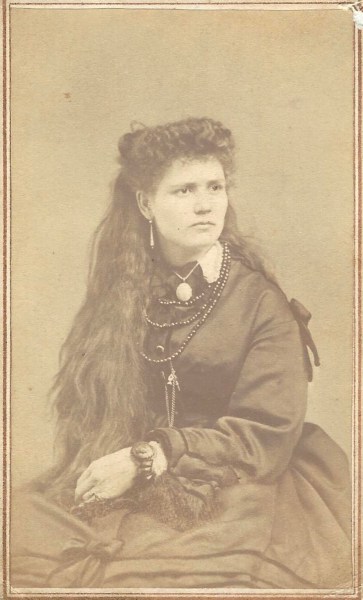
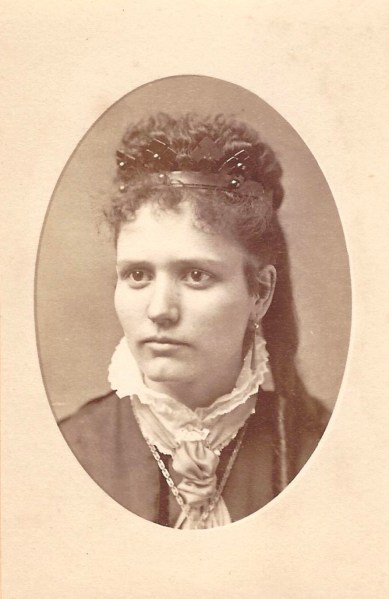
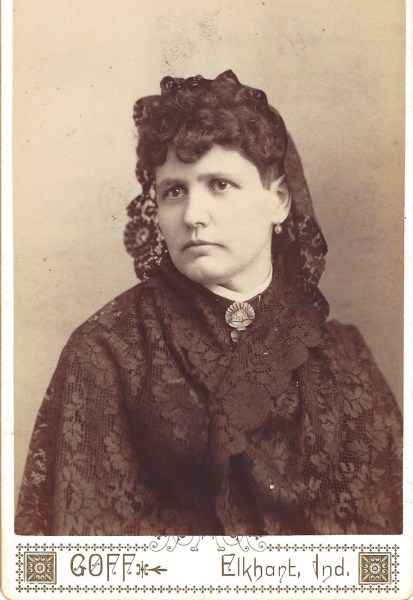
Elmire, born in St-Constant, Quebec, immigrated to the United States in 1864 and worked in New York City as a French governess. She is said to have met Andrew Washington Huntley around 1867 in the choir of the Plymouth Church in Brooklyn Heights. His family lived in Mooers, New York. He was a veteran of the Civil War having served in a number of units from 1862-1865. This couple moved many times during their marriage according to census records. First to Wells, Minnesota, then to Bridport, Vermont to farm, then Chicago, Illinois where he was a ticket agent on the Electric Railroad and finally to Los Angeles, California. Elmire died there in 1922. Her body accompanied by her daughter Faith, went by train back to Bridport, Vermont where she was buried beside her son Howard.
Andrew Washington Huntley
Howard died at 18 without children. It was her daughter Faith, who married Smith C. Shedrick and had four children, Etta Elmere, Howard S., Helena F. and Howard H. who kept the family tree growing. “Shedmore” turned out to be Etta’s son. He does not have any children but his brother had three children, five grandchildren and some great-grandchildren so Elmire’s Bruneau line lives on. Both Helena and Howard also married so there might be even more twigs on those branches.
Faith and Howard Huntley
It is nice to have cousins. Some might not be close but you do have a family connection. Reach out to your cousins, you never know who you will find or what they may know.
Notes:
All photographs are from Ismael Bruneau and Ida Girod’s albums in the possession of the author.
Year: 1870; Census Place: Clark or Wells, Faribault, Minnesota; Roll: T132_3; Page: 1440 Ancestry.com. 1870 United States Federal Census [database on-line]. Lehi, UT, USA: Ancestry.com Operations, Inc., 2009. Images reproduced by FamilySearch.Accessed Nov 22, 2021.
Year: 1900; Census Place: Chicago Ward 21, Cook, Illinois; Roll: 271; Page: 17; Enumeration District: 0638 Ancestry.com. 1900 United States Federal Census [database on-line]. Lehi, UT, USA: Ancestry.com Operations Inc, 2004. Accessed Mar 29, 2022.
Year: 1910; Census Place: Oak Park, Cook, Illinois; Roll: T624_239; Page: 21b; Enumeration District: 0077; FHL microfilm: 1374252 Ancestry.com. 1910 United States Federal Census [database on-line]. Lehi, UT, USA: Ancestry.com Operations Inc, 2006. AccessedNov 22, 2021.
Year: 1920; Census Place: Los Angeles Assembly District 73, Los Angeles, California; Roll: T625_114; Page: 17A; Enumeration District: 393 Ancestry.com. 1920 United States Federal Census [database on-line]. Provo, UT, USA: Ancestry.com Operations, Inc., 2010. Images reproduced by FamilySearch. Accessed Nov 22, 2021.
My father, Edward McHugh, didn’t really talk about his family’s trip of a lifetime. After all, Dad wasn’t even born yet. But it must have been discussed by everyone when he was a boy. In 1911, the first member of the family, Mary Ann McHugh, moved from Dundee, Scotland to Montreal.
At the time, booking agents in the United Kingdom advertised and recruited potential immigrants to Canada. There was an acute need of domestic help and agricultural workers. Between 1890 and 1920, Canada experienced its third wave of immigration and its peak was between 1911 and 1913, just before World War I.1 The following type of advertisement was common in the newspapers.2
Booking agent advertisement
Maybe one of these advertisements gave the McHugh family the idea to emigrate to Canada. Or maybe Mary was ready for an adventure. She was just 21 when she disembarked from the SS Grampian that had left Glasgow on June 24, 1911 and arrived in Quebec City on July 9, 1911. She would have had a medical exam when she arrived to ensure that she was in good health and did not have an infectious disease. Conditions for immigration to the colonies were well known in the United Kingdom. The February 11, 1911 edition of the Hamilton Observer, in its article, Canadian Notes, People Prohibited, details the reason some potential immigrants could expect to be refused by Canada. The article explains the booking agent’s liability for the immigrants that arrived in Canada for a period of three years following their arrival:
“The following classes of people are prohibited from landing … feeble minded, idiotic, insane, or who have been insane within five years, afflicted with any loathsome, contagious, or infectious disease; anyone who is a pauper, who is destitute, who is a professional beggar or vagrant.”3
All of the members of the McHugh family worked in the jute mills in Dundee. The 1911 census indicates Mary was a jute weaver, which probably meant that she operated a jute weaving machine.4 She lived with her mother, Sarah Jane McLaughlin, and her brothers, Edward and Francis. They lived at 1 Tait Lane, Dundee. Her other brother, Thomas, my grandfather, lived with his wife and seven children at 9 Tait Lane.
The picture below shows the jute weaving machine.5
Mary must have been satisfied with her new life in Montreal, Quebec. Within a year, her mother and her two brothers, along with my grandfather, had followed her to Canada. Six months later, my grandmother, Elsie Orrock, and her seven children joined her husband, Thomas, in Montreal.
The McHughs lived close together in Dundee and they also lived close together in Verdun, Quebec. While I will never know for sure why they decided to emigrate, I can guess that they wanted a life that was not as hard as the one working in the jute mills. There are a few clues that this was not a spur of a moment decision but a planned family decision.
Mary left first and, if it did not suit her to live in Canada, she would have been able to easily return to Dundee. Her mother and brothers were still there. By the time her mother emigrated, along with her three sons, they arrived with $150 CAD, about $4,750 in today’s dollars. Browsing through the passenger lists, I can see that they had a lot more money than many of their fellow passengers. 6 They were not a rich family, so this amount of money would have taken some time to save up.
Coincidentally my grandfather joined the Freemasons in 1910 and achieved a Master Mason diploma and a Mark Mason diploma.7 By that time, he already had six children. He worked long hours in the jute mill, including Saturdays. Why would he join the masons when he was already a very busy man providing for his family, plus taking care of his widowed mother, and his siblings who still lived at home? There is no evidence that he ever joined the masons when he arrived in Canada. I believe that it is possible that he joined the masons to in case he needed the contacts to find employment. As he quickly found work, his busy family life prevented him from pursuing his membership in the masons.
Only one of my grandfather’s siblings stayed in Scotland, Sarah Jane McHugh. She was not living with the other McHughs at the time of the 1911 census. But she remained close to the family. Surprisingly, she travelled to Montreal to be a witness at her brother’s wedding at the Notre Dame Basilica in Montreal on May 8, 1913.8 That would have been quite a trip for Sarah Jane to make.
My aunt, Sarah Jane McHugh, was delighted to host the linen shower to celebrate her daughter, Dawna Day’s upcoming marriage to Ralph Dodds. The happy couple announced their engagement in October 1947. Ralph had recently been discharged after serving in the Royal Canadian Navy for over six years. The couple’s wedding would take place in Vancouver, Ralph’s home town. Dawna was from Montreal.
Ralph was just 20 when he started his navy career in Esquimalt, British Columbia in 1939.1 With the advent of World War II, the Esquimalt Navy base became the largest naval training center in western Canada. 2 Ralph Dodds trained to become a signalman would have learned all aspects of military communications in the Canadian Navy. He would have used semaphore flags, read and transmitted morse code messages, and assured radio communications.3 During his training, Ralph would not have predicted that he would participate in the sinking of a German U-boat during the Battle of the Atlantic, that he would be on a destroyer that participated in a sea fight on D-Day, or that the destroyer he was on would be shipwrecked off the coast of Iceland.
King George VI presents the King’s Colours to the Royal Canadian Navy at Beacon Hill Park, Victoria, 1939. Photo: CFB Esquimalt Naval and Military Museum collection
While Ralph was assigned to a naval station, and to a corvette (small destroyer), for most of his naval career, he was assigned to the HMCS Skeena.
HMCS Skeena, D59, Government of Canada website, Ships’ histories
The HMCS Skeena was commissioned in 1931 in Portsmouth, U.K. and was one of the first two ships built to Canadian order. With the outbreak of the war, the Skeena initially performed domestic escort duties. In May 1940, she was sent to Plymouth, U.K. and became part of the Western Approaches Command, taking part in the evacuation of France and escorting convoys in British waters. She was later assigned to continuous convoy duty.
During one of its escort duties in the Atlantic, the Skeena destroyed U-boat U-588. This happened during ON-115 (ON means Outbound to North America). There were twelve escort ships for a trade convoy of 43 merchant ships that left Liverpool on July 12, 1942. On July 29, seven U-boats of the Wolfpack Wolf had spotted them. This Wolfpack was quickly joined by another six U-boats of the Wolfpack Pirat. The Wolf Pack tactic, or the “Rudeltaktik,” was devised to attack the Allied convoy system by forming into position effecting a massed organized attack.4 This particular battle resulted in the loss of three of the ships in the convoy and significant damage to two of the ships in the convoy. One of the damaged ships returned to the U.K. and one was escorted to St. John’s, Newfoundland. The Skeena, on which Ralph was a signalman, and the HMCS Wetaskiwin, an escort corvette, destroyed U-boat 588 with depth charges (antisubmarine missiles) on July 31. The hostilities lasted until August 3 when the U-boats lost contact with the convoy due to misty weather. The convoy with the remaining ships reached Boston on August 8, 1942.5
The sinking of American freighters, Edward Rutledge, Tasker H. Bliss and Hugh L. Scott at Fedala Roads, November 12, 1942
Commodore Leonard Murray congratulating the ship’s companies of HMCS Skeena and HMCS Wetaskiwin for sinking the German submarine U-588 on 31 July 1942. St. John’s, Newfoundland, Aug. 4, 1942. (NAC PA-115347)
The Skeena also participated in a hot sea fight in the Channel on D-Day. The Skeena’s assignment was to prevent enemy U-boats from attacking Allied ships while the Invasion of France was being carried out.
“Torpedoes were shooting about in the Channel and missed the Skeena by only a matter of feet,” said Ralph in an interview he gave to the Vancouver Sun.
The destroyer also had to contend with German Dorniers (bombers) that were bombing the destroyers in the Channel. One of the aerial missiles fell so close to the Skeena that shrapnel was later found on the deck.6
Ships and blimps sit off the coast of France on D-Day, June 6, 1944. War Footage From the George Stevens Collection at the Library of Congress
After five years of war, the HMCS Skeena met her end as she sheltered from a violent gale with 15-metre waves off the coast of Iceland, at Videy Island on October 24, 1944. Even though the crew had thrown out a second anchor to secure the ship, the Skeena smashed into the rocks. When the crew abandoned ship, the men were unable to hold the lines. Some crew members were smashed into the rocks, while others were tossed into the sea. Fifteen sailors died.7 Ralph Dodds survived.