When I say that my grandfather, Thomas McHugh, worked as a cipher, Bletchley Park, MI5, Russian spies immediately come to mind. He was neither a Russian spy nor did he work as a cipher during the war. His employer was the Bank of Montreal, and it was his first job when he came to Canada in 1912.
The decision to immigrate to Canada was not easy for Thomas. He was in his mid-30s and already had seven children, between the ages of one and fifteen. For over 40 years, the jute manufacturers of Dundee, Scotland, had been providing employment for his parents, aunts, uncles, siblings, wife, and for him. However, by the early 1900s, he was facing a precarious future for his children.
By that time, Dundee had suffered a serious decline in the textile industry and more significantly, the jute industry. Jute was imported from India; however, the mill owners realized that it would lower production costs to open mills in India to prepare the jute and import the finished product to Scotland. Once mills were established in India, the jute production in the mills in Dundee decreased substantially.1
So when Thomas arrived in Canada, a little ahead of his wife and his children, he was eager and prepared to do any job that he could. The Bank of Montreal had its headquarters in Montreal, Quebec. At the beginning of the 20th century, the bank had significant dealings with Great Britain and there were correspondence and banking instructions back and forth between Canada and Great Britain daily. These instructions were mainly sent by telegraph overnight. Some of these instructions were confidential, and it was preferred that they remain so. Overnight instructions reduced the number of people who would have access to them. And the time difference between Montreal and the United Kingdom meant that the banks in London and Edinburgh were open for business while Montreal was still asleep.
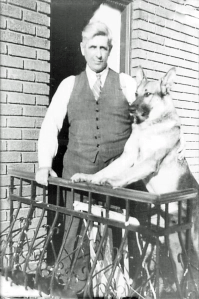
Thomas with Pal in Verdun
Even in those days, the banks were concerned about security, privacy and confidentiality. The banking instructions and transactions that were transmitted by telegraph were encrypted. It was the job of the cipher clerk to decipher them so that the bank staff could then ensure that the instructions were carried out as required.
To be a cipher clerk, one had to be reliable, meticulous and honest, and maintain the confidentiality of the bank’s business above all else. To decipher the information, the clerk used a cipher handbook and worked overnight, making it a difficult job for a man with a family.
So while my grandfather, the cipher, did not work in espionage, I still think that his first job in Canada was rather interesting.2
In the 1871 census in the United Kingdom, categories of disability were added to the census questions. These categories included the deaf and dumb, blind, imbecile or idiot, and lunatic.1 Imbecile, idiot, and lunatic are pejorative terms today but in the 19th century, they were medical terms used to indicate mental health conditions. Idiots and imbeciles had learning disabilities. Lunacy was a term used broadly to denote anyone with a mental illness.2
James Kinnear Orrock, my 2X great-uncle, was committed to the Dundee Royal Lunatic Asylum on December 9, 1888. Superintendent James Rorie declared that he was a pauper and that he was delusional. James’ mother, Mary Watson, my 2X great-grandmother, requested that he be committed.4 Not unlike today, the police were involved. A constable declared that he had been violent and incoherent. It is obvious from the notice of admissions that James was experiencing psychotic episodes.
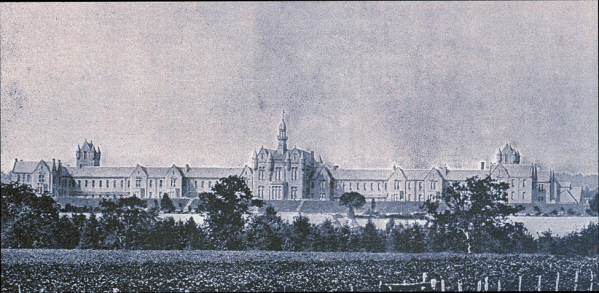
Westgreen Asylum, Liff, Dundee, Scotland in 1897, Westgreen Asylum, Liff, Dundee, Scotland in 1897
James was just 30 when he was admitted to the asylum. Sadly, he remained there until his death in 1930 when he was 72.5 It is distressing that he lived in this institution more than half his life. While little was known about mental illness at the time, the asylum offered the patients safety and hope. Specialist registrar Amy Macaskill states “What is clear is that they wanted to offer a degree of care and protection and containment for people who were causing difficulty at home and were in some level of distress.”6 The asylums cared for people who were depressed, anxious, delusional, as well as those suffering from other conditions such as epilepsy, alcoholism, and syphilis.7
The Dundee Royal Lunatic Asylum had separate quarters for men and women. The pauper wards for men each had a day room, with a number of single rooms with windows overlooking the airing court. The windows provided the only ventilation. The rooms were not heated but there were open fire places in the corridors. There were weaver shops in a separate building where some patients made packing cloth. Male patients also did stone breaking and some worked on the grounds. They were paid with tobacco and beer. There was a billiard room and dancing parties for the patients, attended by both men and women. A chaplain provided services on Sundays.8
When James was admitted, he was certified a pauper lunatic. This certification gave him access to psychiatric care, but it does not necessarily mean that he was a pauper. His admission records indicate that he was a seaman and he could have been gainfully employed. The Board of Governors of the asylums assessed each patient’s finances. If any financial assistance was required, then the patient was declared a pauper. If the patient or their family was assessed as being able to entirely finance their own care, they were classified as private patients. Private patients benefitted from better food, were able to wear their own clothes, and could be discharged if the person paying for their care wanted their discharge. Unfortunately, while a technical and legal label, the term “pauper lunatic” carried a stigma and deterred people from seeking help.9
We have come a long way in our care for those suffering from mental illness since the 19th century. The Lunacy (Scotland) Act 1857 formed mental health law in Scotland from 1857 until 1913. Its purpose was to provide official oversight of mental health institutions and to ensure that they were adequately funded.10
My father, Edward McHugh, didn’t really talk about his family’s trip of a lifetime. After all, Dad wasn’t even born yet. But it must have been discussed by everyone when he was a boy. In 1911, the first member of the family, Mary Ann McHugh, moved from Dundee, Scotland to Montreal.
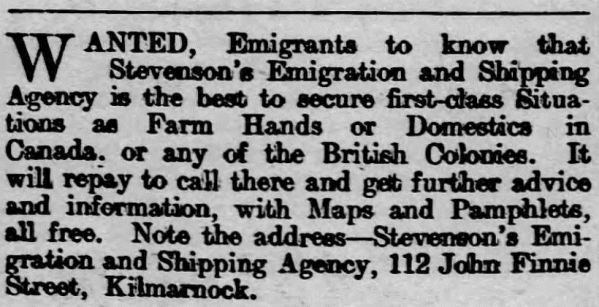
At the time, booking agents in the United Kingdom advertised and recruited potential immigrants to Canada. There was an acute need of domestic help and agricultural workers. Between 1890 and 1920, Canada experienced its third wave of immigration and its peak was between 1911 and 1913, just before World War I.1 The following type of advertisement was common in the newspapers.2
Booking agent advertisement
Maybe one of these advertisements gave the McHugh family the idea to emigrate to Canada. Or maybe Mary was ready for an adventure. She was just 21 when she disembarked from the SS Grampian that had left Glasgow on June 24, 1911 and arrived in Quebec City on July 9, 1911. She would have had a medical exam when she arrived to ensure that she was in good health and did not have an infectious disease. Conditions for immigration to the colonies were well known in the United Kingdom. The February 11, 1911 edition of the Hamilton Observer, in its article, Canadian Notes, People Prohibited, details the reason some potential immigrants could expect to be refused by Canada. The article explains the booking agent’s liability for the immigrants that arrived in Canada for a period of three years following their arrival:
“The following classes of people are prohibited from landing … feeble minded, idiotic, insane, or who have been insane within five years, afflicted with any loathsome, contagious, or infectious disease; anyone who is a pauper, who is destitute, who is a professional beggar or vagrant.”3
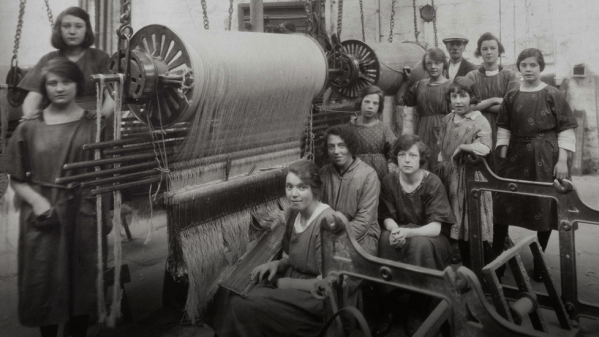
All of the members of the McHugh family worked in the jute mills in Dundee. The 1911 census indicates Mary was a jute weaver, which probably meant that she operated a jute weaving machine.4 She lived with her mother, Sarah Jane McLaughlin, and her brothers, Edward and Francis. They lived at 1 Tait Lane, Dundee. Her other brother, Thomas, my grandfather, lived with his wife and seven children at 9 Tait Lane.
The picture below shows the jute weaving machine.5
Mary must have been satisfied with her new life in Montreal, Quebec. Within a year, her mother and her two brothers, along with my grandfather, had followed her to Canada. Six months later, my grandmother, Elsie Orrock, and her seven children joined her husband, Thomas, in Montreal.
The McHughs lived close together in Dundee and they also lived close together in Verdun, Quebec. While I will never know for sure why they decided to emigrate, I can guess that they wanted a life that was not as hard as the one working in the jute mills. There are a few clues that this was not a spur of a moment decision but a planned family decision.
Mary left first and, if it did not suit her to live in Canada, she would have been able to easily return to Dundee. Her mother and brothers were still there. By the time her mother emigrated, along with her three sons, they arrived with $150 CAD, about $4,750 in today’s dollars. Browsing through the passenger lists, I can see that they had a lot more money than many of their fellow passengers. 6 They were not a rich family, so this amount of money would have taken some time to save up.
Coincidentally my grandfather joined the Freemasons in 1910 and achieved a Master Mason diploma and a Mark Mason diploma.7 By that time, he already had six children. He worked long hours in the jute mill, including Saturdays. Why would he join the masons when he was already a very busy man providing for his family, plus taking care of his widowed mother, and his siblings who still lived at home? There is no evidence that he ever joined the masons when he arrived in Canada. I believe that it is possible that he joined the masons to in case he needed the contacts to find employment. As he quickly found work, his busy family life prevented him from pursuing his membership in the masons.
Only one of my grandfather’s siblings stayed in Scotland, Sarah Jane McHugh. She was not living with the other McHughs at the time of the 1911 census. But she remained close to the family. Surprisingly, she travelled to Montreal to be a witness at her brother’s wedding at the Notre Dame Basilica in Montreal on May 8, 1913.8 That would have been quite a trip for Sarah Jane to make.
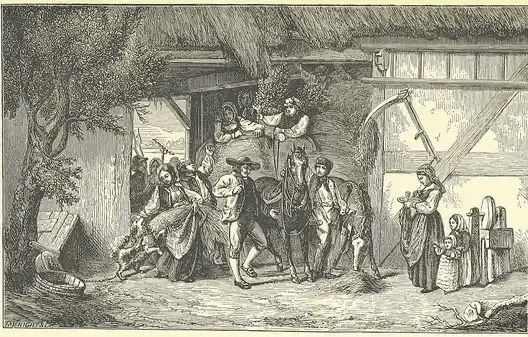
James Orrock, my two-times great-grandfather, was a farm labourer in Scotland in the mid 1800s. Agricultural labourers did not work all their lives on one farm. It was common for farm servants, both men and women, to attend farm hiring fairs. They would then hire themselves out to the highest bidder.1
Hiring Fair
According to the 1851 census, James worked on a farm in the village of Marykirk, Kincardineshire.2 His wife-to-be, also a farm servant, worked on a different farm located in the same village. They married two years later. By then they had moved to Kirken, in County Angus.3 Mary and James went on to have seven children and it is no surprise that their children were born in different villages, as James would have moved from job to job, always as a farm servant. The various censuses indicate that James worked as a ploughman, farm servant, or agricultural labourer. His family followed him as he moved for work. In 1863, their daughter, Martha Linn died of small pox at the age of three.4 Two years later tragedy struck again when James died at the age of 33 from tuberculosis.5
When Mary became a widow, her situation would have been precarious. James had been sick for a long time and had been unable to work. Mary had to find a way to provide for her children. Farm servants were usually lodged at the farm where they worked. Families often had small dwellings, with a small yard, where they could have a garden and a henhouse. With the death of James, Mary would have also lost her home. It is no surprise that she moved to Arbroath, perhaps in the hope of working in the jute and sailcloth mills. At the time of James’ death, demand for jute was high due to the American Civil War6 and work was available in the mills. Mary would soon learn that, while Arbroath provided employment, it also provided additional worries about her son, James.
The 1871 census shows Mary living with four of her six remaining children in Arbroath.7 Her eldest son, Alexander, 17, worked as a farm servant in a village about 10 km away, in Kirkden.8 Ann and Jemima, 16 and 14, would have been working. David and Jane were in school. But where was James, only 12 at the time?
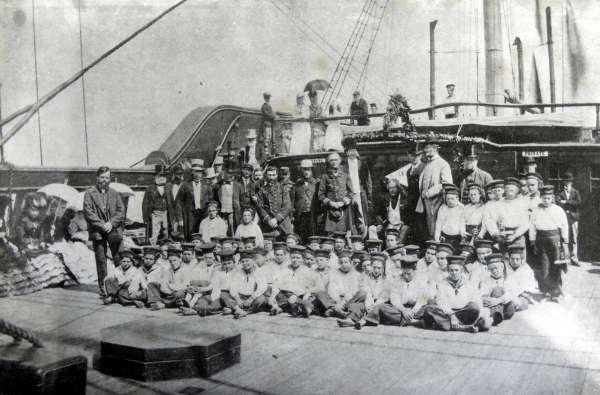
I found James in the 1871 census listed as an inmate at the Mars Training Ship for Homeless and Destitute Boys, about 35 km away from his family.9 This ship was moored on the river Tay at Woodhaven Harbour, Wormit, Fife from 1869 to 1929.10
The HMS Mars was built in 1848 and saw military service in the Crimean War. Deemed surplus in 1869, it became a training ship with space for 400 boys with the objective to take destitute and homeless boys off the streets of Dundee, Edinburgh, and Glasgow and train them for service in the Royal Navy or the Merchant Marine at their discharge at age 16.11
The Mars Training Ship was an initiative put forth by Lord Provost William Hay and members of the elite. Truancy and vagrancy were rife in the cities of Scotland, due to overcrowding, unemployment, and poverty. The inmates of the Mars were often picked up for truancy or for begging and were sent to the training ship for five years by magistrates. The boys were poor, orphans, beggars, or homeless or sometimes they had just fallen in with the wrong crowd.12
Mars Training Ship Institution 13
The move from farm life to a bigger urban centre would have been difficult for James. He was 12 when he shows up as an inmate in the Mars Training Ship and he was probably sent there at the age of 10 or 11. There is no way to know why he ended up there. We know that his family was poor. It is probable that he wandered the streets while his mother and two sisters worked long hours in the jute mills. He may have been a difficult child as he suffered from mental illness later on in life.14
The Mars Training School was an industrial school, as opposed to a reform school. The boys did not have a criminal record; however, in some ways they were prisoners. All of the boys were very poor and many of them were homeless. For those who did have homes, they were deliberately given very little opportunity to maintain connections with family and friends.15
Upon arrival on the ship, a medical officer examined the boys once they were stripped. The children then washed, put on their uniforms, and were assigned a number. From then on, they were only referred to by their number. Even the boys called each other by their numbers.16
The day on the Mars ship would begin early, at 5:30 a.m. The boys scrubbed the deck, had breakfast, and then said their prayers. In the morning they learned English, arithmetic, geography, and music. The afternoons were dedicated to practical skills such as shoe repairing, clothing and sail-making, woodworking, metalworking, tailoring and seamanship. The boys were attended by doctors and dentists and were well fed. There was less disease onboard than in the crowded and unsanitary cities of Dundee, Edinburgh, and Glasgow. To further reduce the chance of disease, the boys would make an annual trip to Elie, a coastal town, allowing a skeleton crew to fumigate and clean the ship. 17
James would have been discharged from the ship when he was 16. Records of his later life did, indeed, indicate that he worked as a seaman.18
National Records of Scotland, 1851 census, Parish of Marykirk, County of Kincardineshire, James Orrock, Scotland’s People, downloaded 27 March 2023.
National Records of Scotland, Old Parish Registers, Church of Scotland marriages, Kirken, James Orrock and Mary Watson, Scotland’s People, downloaded 27 March 2018.
National Records of Scotland, 1863 Deaths, Parish of Dunnichen, County of Forfar, Martha Linn Orrock, Scotland’s People, downloaded 8 March 2023.
National Records of Scotland, 1865 Deaths, Parish of Dunnichen, County of Forfar, James Orrock, Scotland’s People, downloaded 9 April 2018.
The Textile Industry of Arbroath since the Early 18th Century, Turner, W.H.K., The Abertay Historical Society, 1941, p.15
National Records of Scotland, 1871 census, St. Vigeans, Arbroath, Mary Orrock (Watson), Scotland’s People, downloaded 16 March 2023.
National Records of Scotland, 1871 census, Kirkden, Angus, Alexander Orrock, Scotland’s People, downloaded 23 March 2023.
National Records of Scotland, 1871 census, Woodhaven, Forgan, Fife, 1871 census, James Orrock, Scotland’s People, downloaded 15 March 2023.
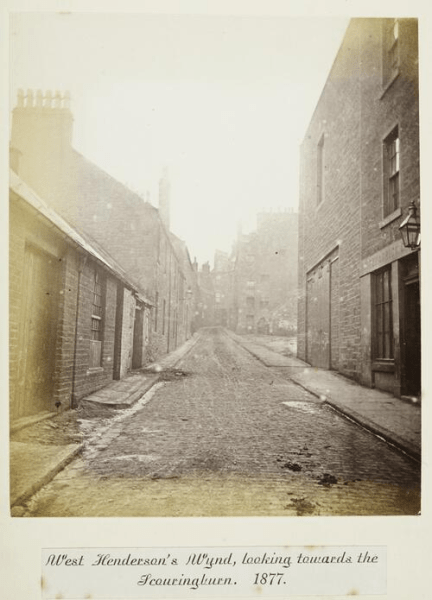
The McHugh brothers were just in their early twenties when they left County Sligo, Ireland to try their luck in Dundee, Scotland.1 When John and Edward McHugh arrived in Dundee, they had lodgings on Scourin Burn. Edward was a tinsmith and John, my 2X great-grandfather, was a sailcloth weaver. 2 A burn is a watercourse and the name Scourin Burn, or ‘cleansing burn’ probably referred to the process of scouring (textile term for cleaning the yarn) the yarn before dyeing as the nearby jute factories used the burn for this purpose. Scourin Burn no longer exists in modern Dundee and is now called Brook Street.3
Malcolm’s Pend, from the Scouringburn, Dundee, Photograph James Valentine (1815-1879), created 1877, Courtesy Scottish National Portrait Gallery, no copyright infringement intended
The McHugh brothers were part of a wave of Irish immigrants to Dundee, a city with a thriving jute industry, which had earned the nickname “Juteopolis.” By 1850 there were 47 spinning mills and eight power-loom factories employing some 11,000 people, as well as 4,000 handlooms. Linen goods, especially canvas, were exported to the Mediterranean, Australia, America, and the West Indies.4 Jute was a versatile fabric and used for everything, including the ropes made by the British Navy, sacking, tents, gun covers, sand bags, and horse blankets.5
Work in the mills was grim with the workday lasting twelve hours, from 6:00 a.m. to 6 p.m., with additional shifts on Saturday. It was not unusual for workers to bring sacks home to sew at night. 6 Three quarters of the workers were women and children, who could be employed at cheaper rates than the men. Injuries and accidents were commonplace. Dust would be everywhere and the machinery produced heat, grease and oil fumes, leading to a condition that was known as “mill fever.” The constant noise of the machinery led to many workers going deaf. 7 The booming jute industry provided plenty of work, but there was a shortage of housing due to the large influx immigrants. Wages remained low. Overcrowding meant that many migrants boarded with other families in cramped rooms.8
John settled in Dundee and married Mary Garrick, also from Ireland, in 1845. They both worked in the jute factories. It is no surprise that John and Mary raised their family close to the jute mills. In 1861 they still lived very close to Scourin Burn, in Henderson’s Wynd.9
West Henderson’s Wynd, looking towards the Scouringburn [Dundee]. 1877, James Valentine Photographic Collection, Courtesy of the University of St Andrews Libraries and Museums, ID: VGA-122-40a
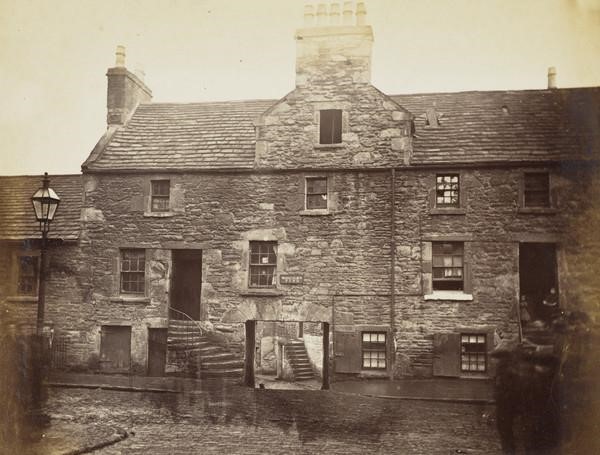
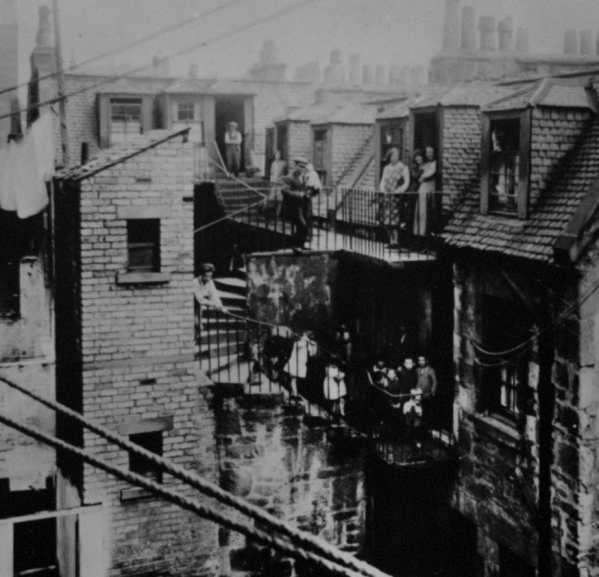
John and his family lived in tenement housing all their lives. Tenement housing was hastily built to accommodate the rapid growth of the city due to the influx of workers. The construction quality was poor and the living spaces were small. It was not uncommon for families to share flats. As it was not profitable for landlords to build brand new affordable housing for the workers, pre-existing tenements were subdivided into smaller rooms, making living space even more crowded.10
“In 1861 with 91,664 inhabitants Dundee had only five WCs, and three of them were in hotels. All water in the city was drawn from wells of which the chief, the Lady Well, was heavily polluted by the slaughterhouse. Of the total housing stock of Scotland 1% had no windows, which meant that 8,000 families were without access to natural light. “11
Tour Scotland website, no copyright infringement intended
In the photograph of the tenement above, people are gathered on the outside staircase and the platforms or “platties.” Outside staircases were a way of saving space inside the building. In the photo, you can see how tiny each of the flats are.
In the 1800s, several cholera epidemics swept Dundee. Poor sanitary conditions were a direct cause of these epidemics. Dundee was a crowded and smelly city and, as in the above photograph, toilets were outside the flats and shared by many families living in the same tenement block. There were very few public facilities available for bathing. Disease was everywhere and it was believed that foul smells carried the disease. Inadequate sewerage and drainage facilities, and poor water supplies contributed to the increasing unsanitary conditions in Dundee and with its rapidly growing population.12
By the early 20th century, housing in Dundee continued to be problematic. Even though houses without windows had disappeared by 1881, overcrowding continued to be a problem. The 1911 census reveals that 72% of Dundonians lived in crowded conditions, in a one or two roomed home. Only 32% of the population of London lived in a one or two roomed home.13 In 1911, my grandparents had seven children and were living in a two roomed flat in Dundee.
My McHugh ancestors lived in Dundee about 72 years, from around 1840 to 1912. During their time in Dundee, every member of the family worked in the jute factories. In 1912, they emigrated to Canada and found jobs in other industries.
Death of brother Thomas McHugh in Sligo, Ireland, 1871. Deduced from Ancestry public member tree. To date, this cannot be confirmed.
1841 Census, Scotland, Scotland’s People, entry for John McHugh, National Records of Scotland, referenced January 2, 2021.

 Genealogy Ensemble