Category Archives: Genealogy

Montreal, Quebec City, Trois-Rivières in the Early Days of British Canada

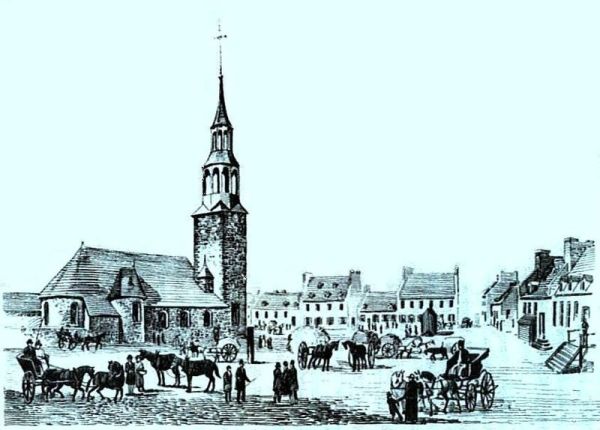
Early View of Montreal

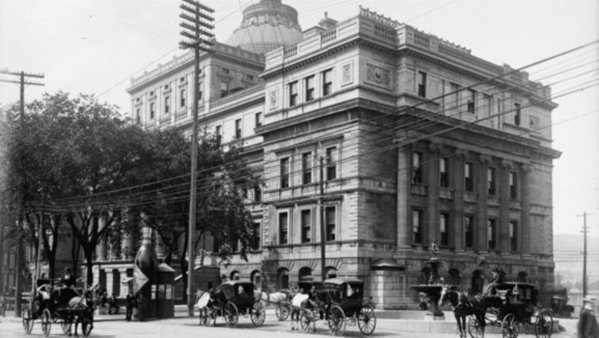
Montreal Today

Above photo found at https://www.edrawmind.com/article/history-of montreal.html

Ordinances, proclamations, etc. issued by the military governors
of Quebec, Montreal, Trois-Rivieres, from the capitulation of
Quebec until the establishment of civil government on
August 10, 1764

The following database contains links to authors who have written on the subject of the Capitulation of Quebec and the aftermath. Also included are numerous biographies of the people who played a major role during that period.

Click the link below to access the database in a new window,

The Judicial Archives during the French Regime of New France 1644-1693

Montreal’s Old Courthouse

Along the north side of Notre Dame East near Jacques-Cartier Square, three courthouses stand together. The most interesting is the neoclassical Old Courthouse, Montreal’s oldest palace of justice (1856) which is now an annex of the Montreal City Hall, and a preferred spot for wedding photos. The “New Courthouse”  from the 1920s, used for criminal trials before being turned into a conservatory and later a court of appeal, and the oversized Palais de Justice, built in 1971 when concrete and smoked glass were the rage. by  Dick Nieuwendyk  of The Montreal Times

The Judicial Archives during the French Regime of New France

1644-1693  &  1693-1769

In 2022, students at McGill University, Université de Montréal, Université Laval, Concordia University, UQAM (Université du Québec à Montréal), Université de Sherbrooke, Université du Québec à Trois-Rivières and at Chicoutimi, these students would be in a position to attend classes which in part address the Judicial Archives during the French regime of New France (1644-1759).

 Among genealogical societies across Québec, the following societies:

Société de généalogie de Québec at Quebec City, Société généalogique canadienne-française in Montréal, Société de généalogie de l’Estrie at Sherbrooke, are most likely teaching their members about the Judicial Archives of New France.

************

The content of the link was constructed for family lineage researchers who have graduated from traditional genealogy search engines. It is a powerful dossier for family lineage searches who have graduated from the traditional Church & Civil Registers of acts of birth, baptism, marriage, death, and burials.

Contents of the database link below:

Royal Jurisdiction of Montreal 1693-1769

Guide to Court Records

Bailiwick Dossiers of Montreal

Transcripts of trial proceedings

Inventories of judgments of the High Judiciary Council of New France 1717-1760

Inventories of Ordinances issued by the Government Stewards of New France

Inventory of insinuations of the Provost of Québec

Bailiwick Dossiers of Montréal recorded by Notaries

Inventories of notary registries of the French Regime

Notaries & Clerk Registrars of the Court – Judicial District of Montreal – 1668-1760

Repositories in Canada

Understanding Mary, My Protestant Irish Ancestor

Can I learn anything about my great great great grandmother’s life, despite having only a name, a birthplace and a rough idea of where she lived as she raised her children?

That challenge led me to a fascinating thesis about the Irish Protestant Identity in Ontario written in 2010 by Brenda Hooper-Goranson. Hooper-Goranson’s research describes how many Irish women of Mary’s time ensured a lasting Irish identity in Canada that differed from that in the homeland.

Thanks to Ms. Hooper-Goranson, I have been able to imagine the life of women like my ancestor in general terms even if her actual life and personality remain obscure.

An Irish Protestant identity was transferred to Canada as solidly intact as any Irish Catholic identity was and it can even be argued that the former outlasted the latter with regard to late nineteenth-early twentieth century Canadianizing influences,” wrote Hopper-Goranson in the introduction of her thesis. “That distinctive presence was changed or softened in only one regard. In time, with the space and distance that Canada afforded, abrading homeland identities might be abridged, and Irish Protestant and Irish Catholic on new soil found opportunities to simply be ‘Irish’.1

People like Mary maintained connections to family in Ireland, helped foster relationships with neighbours, brought recipes, seeds, textiles and furniture from their home country to their new communities and fostered religious practices and apprenticeships in their children.

Whether Mary herself did such things isn’t certain. We do know that she was born in Ireland, thanks to the 1932 death certificate of her daughter.2 That same document mentions her husband’s Scottish roots, the family religion of Brethren, their daughter’s 1856 birth in Orangeville, Canada West and her death in Weston, Ontario.

Those facts allowed me to make several assumptions about my great great grandmother’s life that enabled me to read Hooper-Goranson’s thesis with an eye to imagining more. We know for sure that Mary Willard travelled from Ireland to Canada West at some point, and the decision probably wasn’t hers. A father, a husband—in those days, women didn’t often get to set their own destinies.

Where she lived in Ireland, whether she lived in other places too, whether she married her Scottish husband in Europe or elsewhere, whether they met on a specific journey or after separately travelling to North America isn’t clear. All I know for sure is that Mary Willard identified as Irish; her faith was Protestant; and she and her husband lived in Canada West when her daughter was born. Given that her daughter died in the Grand River region not far from her birth, it’s likely that her parents lived in the same region for most of their lives.

We do know that in the 1800’s, Canada attracted more migrants from Ireland than any other country in the world. When possible, these migrants tended to settle together with others of the same religion, many in Canada West, which became Ontario.

Irish hostilities between Protestants and Catholics became prevalent late in that century. Fenians raided Canada West from Irish communities in the northern states beginning in 1866. Riots broke out in Toronto in 1875, during the Jubilee March and in 1878, when O’Donavon Rossa visited the city to give a speech.

In most Canada West communities, however, Hooper-Goranson argues that the challenges of felling forests, building homes, subsistence farming and mourning the losses from fevers and disease blurred the lines between groups. Often, a general homesickness for Ireland linked Catholic and Protestant settlers together into a common identity.

Class structures brought to the New World from Europe when Mary Willard lived fell apart in a matter of months, primarily to the amount of work required just to stay alive. Women of all stations did everything required to run a household, including helping grow crops for food, making candles, producing soap, grinding sugar, baking bread, milking cows, knitting or spinning clothes and preparing flour or wool. People offering domestic assistance had so many possible positions, they could be choosy.

…the observations of lrish Protestant immigrant James Reford show that he too, took note of a change in the social climate in America when he complained that even Irish Catholic servants “from the bogs of Connoght” expected certain comforts and conveniences far different from Home. “If you want a girl to do housework the first question is have you got hot and cold water in the house, stationary wash tubs, wringer? Is my bedroom carpeted [with] bureau table wash stand and chairs … and what privileges and the wages? … The writer makes the charge that such girls are too ambitious, and deceitful about their previously humble origins.3

Despite the amount of hard work, Irish women in Upper Canada worked hard to match the fashion trends back in Ireland.

After joining her husband in Canada in 1836, Margaret Carrothers wrote several years later from London, Upper Canada, encouraging her mother to make the journey herself with the remittance pay she sent home. Part of her enticement was the reassurance that her mother could look the part of the Irish lady even on the frontier. Although Margaret requested her mother bring the latest patterns of capes, sleeves, cloaks, and bonnets she delighted that ” … Dress of every kind is worn the same here as with you only much richer and gayer …… this has become a very fashionable place you would see more silks worn here in one day than you would see in Maguires bridge in your lifetime and could not tell the difference between the Lady and the Servant Girl as it is not uncommon for her to wear a Silk Cloak and Boa and Muff on her hands and her Bonnet ornamented with artificial flowers and vail.4

Whether hostilities arose or not often depended on whether communities included nationalities beyond Catholic and Protestant Irish. In those cases, rather than differentiating between themselves, Irish settlers saw themselves as a common group against the others.

There were many occasions where Irish Protestants and Irish Catholics found cause with one another enough to march together in support or defiance of Tenants Leagues, Famine Relief, Confederation, Fenianism, Irish politics and personages, and of course, St. Patrick’s Day was held sacred to both.5

Generations of women built up and maintained national communities as religious differences diminished. They married Irish men, stayed in contact with family members in Ireland, collected Irish recipes, crafted Irish patterns onto clothing and household items, learned Irish Dancing and celebrated holidays with neighbours.

Traditionally, Irish families make their plum pudding on the last Sunday in November before the beginning of Advent. Everyone in the household is supposed to stir the mixture, which contains 13 ingredients to represent Christ and his Disciples.

My great granny Charlotte used to make one every year. I remember it being blacker than fruit cake and with a yummy rum topping.

Sadly, her recipe either was never written down or, if it was, it has since been lost. I’ve been trying to duplicate the flavour ever since.

Haven’t managed to get it right yet, but here’s my closest guess so far.

Christmas Plum Pudding

Ingredients

  • 1 cup (250g) brown sugar
  • Grated zest and juice of 2 oranges
  • 1 cup (250g) dried currants
  • 2 cups (500g) raisins, ideally different colours
  • 1/2 cup (125g) candied cherries
  • 1 can (350ml) stout (I use Buckwheat beer because I can’t eat gluten)
  • 2 cups (250g) all-purpose flour
  • 2 tsp. ground cinnamon
  • 2 tsps nutmeg
  • ground cloves
  • 1 cup (250g) butter, softened
  • 4 eggs, lightly beaten
  • 1 small apple, peeled, cored, and shredded

Directions

  1. Grease and line three pudding bowls or the cooking vessels of your choice.
  2. Mix everything together except for the eggs and the stout.
  3. Beat the eggs and slowly add them to the mixture.
  4. Pour the stout in slowly, mixing the whole time. This is a good time to get the family involved.
  5. Cover with a clean tea towel and leave overnight.
  6. The next day, preheat the oven to 350 degrees F (130C).
  7. Pour the mixture into the pudding bowls.
  8. Place deeper pans full of water in the oven. Put the bowls into the water so that they are about 2/3rds covered.
  9. Steam for 6 hours.
  10. Set aside in a cool dark place to dry.
  11. On Christmas day, steam the puddings for about 3 hours or until cooked through.
  12. Cut and serve with rum topping.

Rum Topping

Ingredients

  • 1/ cup softened butter
  • 1 cup sugar
  • 2 eggs, beaten
  • 3/4 cup rum, brandy or sherry
  • 1/4 tsp nutmeg

Directions

  1. Combine the sugar and butter with a hand mixer until fluffy and light.
  2. Beat in eggs.
  3. Add rum, brandy or sherry and nutmeg.
  4. Cook over boil water for 5 minutes or so, stirring constantly past the curdling point until the sauce looks smooth.
  5. Pour over the Christmas pudding.

Sources

1Hooper-Goranson, Brenda C. 2012. “No Earthly Distinctions : Irishness and Identity in Nineteenth Century Ontario, 1823-1900.” Dissertation, Library and Archives Canada = Bibliothèque et Archives Canada. McMaster University.

2 “Ontario Deaths, 1869-1937 and Overseas Deaths, 1939-1947,” database with images, FamilySearch (Ontario Deaths, 1869-1937), Deaths > 1932 > no 3918-5556 > image 1593 of 1748; citing Registrar General. Archives of Ontario, Toronto.

3Hooper-Goranson

4Linen Hall Library, Belfast, Edward N. Carrothers, “Irish Emigrants Letters From Canada, 1839-1870”, (Belfast Northern Ireland, 1951), pp.4-5. Margaret Carrothers, London, U.C. to Mrs. Kirk [Patrick?] Maguiresbridge, Ireland, December 25, 1839.

5Hooper-Goranson

Seigneuries of New France and of Quebec 1654-1854

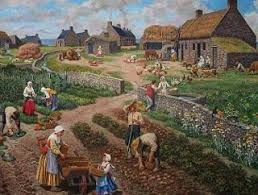
An aerial view of the seigneurial system in New France

The database below consists of the following:

Introduction to Seigneuries & Seigneurs of New France – 1654-1854

Table of Contents:

    Introductionp.   1-11
    Censitaires Recordsp. 11-12
    Inventory of Concessionsp. 12-14
    Notariesp. 14
    Authorsp. 14 – 124
    History Linksp. 124- 140
    Regional Genealogy Links by Countyp. -140 161
    Repositories in Francep. 161-163
    Repositories in Canadap. 163-166


The authors’ section consists of bilingual notations:

  • numerous biographical sketches of the seigneurs
  • published books, articles and theses on the subject
  •  regional studies
  • immigration
  • habitants and merchants

Grand Voyers – Road Commissioners

Account by the Grand Voyer, Lanouiller de Boisclerc, 1735

At the onset of the 18th Century, the road system in New France crisscrossed only a minute part of the sprawling territory.There were the «rangs» of course, and short stretches of road here and there, but no thoroughfare linking the capital city of Québec to Montreal. In 1706, the Conseil supérieur (grand council) decreed that a road be built along the river shoreline bear settlements. Thanks to ste statute labour of his «corvées du roy», the Grand Voyer (senior road surveyor) Eustache Lanouiller de Boisclerc began work in 1731. When construction was completed in 1737, the chemin du Roy was 7.4 metres wide and streched over 280 kilometers, crossing through 37 seignories.\ https://www.lecheminduroy.com/en/history

The contents of the database below consists of :

Inventory of Minutes of Grand Voyers meetings………… p.4

Grand Voyers  –  Road Commissioners…………………………p.4 – 17

Maps  – county, regional, township, seigniories ……………p.17 – 42

Authors – who wrote about the Chemin du Roy  ………….p.42 – 103

History Links ……………………………………………………………… p.103 – p.118

Quebec Genealogical Societies …………………………………. p. 118 – 122

Publishers France – Canada ………………………………………..p.122 – 145

French Canadian Genealogy ……………………………………… p.145 – 157

                Fichiers Origines links for all 95 departments in France

Repositories in Canada ………………………………………………. p.157 – 159

Halloween Fairy

A family van pulled up outside the front of our house on Halloween night in 2020. A tiny fairy, dressed in white, leaped from the van completely beside herself, jumping up and down and waving at us in our living room window. She and her buddies ran to the goodie tray, picked something, and ran back again pausing to wave again before piling back into the van.

Pure Joy!

Generations of children have enjoyed Halloween over the years and perhaps the planning of costumes took priority in their lives even when their worlds seem to be falling apart.

For example, the children dressed in costumes depicting soldiers and nurses during World War 1 –

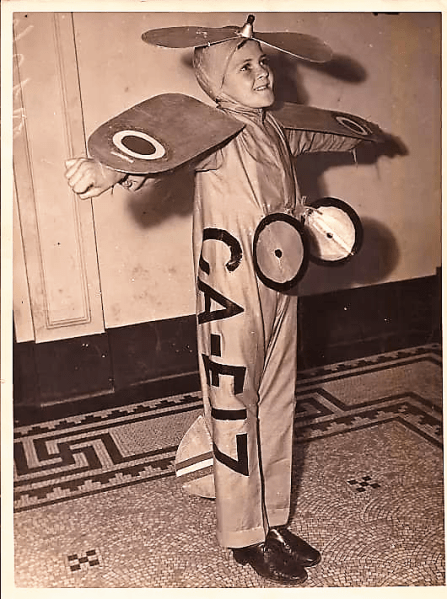
While during World War 2, the costumes became a little more intricate like this young boy dressed as an airplane –

Every year, I dusted off the sewing machine and happily pursued my daughter’s Halloween costume project. I especially remember the cat costume and the dalmatian (Walt Disney’s 101) costume as two of her favourites which were enjoyed time and time again afterward as part of the “dress-up” box.

In 2020, the whole world was held hostage by the Coronavirus. Halloween became a real challenge to those who wanted to celebrate the children’s special night. You really had to use your imagination if you wanted to distribute candy to the “trick-or-treaters”. Some folks even invented cardboard chutes that delivered candy to the children safely distanced from their front doors. 

But we had something else in mind.

Our grandkids in England spent the evening safely  at home in costumes with a feast of ghoulish fajitas, carved “jack-o-latern” red peppers and witches fingers for dinner with “vampire teeth cookies” for dessert. Their photos inspired us to make something special happen for our local children daring to go door-to-door during the pandemic.

We set up our display at the end of the driveway on Halloween afternoon. Our painted pumpkin displayed high on a stool and, a little lower down at kiddie height, a small table with a goodie tray filled with chocolate bars and chips and a sign inviting the children to help themselves.

As the final touch, we brought out a tall double lamp and plugged it into the house outlet with a long extension cord. The upper lamp pointed towards the sky and the lower lamp aimed directly on the pumpkin and candy.

I proudly posted a photo of our Halloween setup on social media. “Is this an all-you-can-eat buffet?” commented someone jokingly. Perhaps, but that would depend on if the children were greedy or not. If the first child emptied the tray into their bag then it would be lights out for the rest of the night.

Halloween 2020 – We watched the activity from our living room window behind the bush

But that did not happen.

A steady stream of neighbourhood children on foot were the first to stop by. Their mothers gently urging them to only take a couple treats. Then they happily skipped away after a quick wave in thanks.

After a few hours, my husband checked on the candy supply and reported that we still had half our stash left.

Near the end of the evening, another van pulled up filled with slightly older kids. Again they all waved their thanks to us in the window after helping themselves.

We both became quite emotional every time a child waved back at us, and during those moments, everything seemed right in the world.

At the end of the evening, we were delightfully surprised to find a single bag of chips left on the tray. No one was greedy afterall.

Everyone had left something for the next person.

And for one magical evening children and adults alike could forget what was going on in the world.

I still smile whenever I think of that tiny fairy.

My Old Yellow Bowl

This is my favourite mixing bowl. As you can see old, battered chipped and stained….. but It is not just any bowl. Oh no! This bowl has a history, this mixing bowl is over 50 years old, and this mixing bowl is VINTAGE!

Still quite sturdy and in daily use, but definitely showing its age a little like it’s owner.

Its history starts at RAF Northolt, a station in South Ruislip two miles from Uxbridge in the London Borough of Hillingdon Western London. England. Today, the station still handles many civil flights plus Royal and VIP transport to and from London. This is where my husband, a Royal Air Force Air Cartographer and I were based a few years after our marriage. (1)

When our first child was born, we were assigned married quarters at RAF Northolt, and as you are ‘marched in’ to your furnished house an officer accompanies you. He has a list of all the contents within the house, which as you inspect the house, he points out and writes down the condition of each item. Hours later we can take possession. When we leave the same happens, in reverse and the condition of each item is noted and whether we have to pay a fee for misuse or damage.

Because service people get posted frequently, all essentials and furnishings within a married quarter house are provided including this T. G. (Thomas Goodwin) Green Pottery Company mixing bowl which is 31.115 cm (12 1/4 inches) wide. As you can see, it had a large chip on the edge and then had the beginning of a tiny crack inside the bowl, which, over the years has become larger.

The officer made a note that it would be replaced however, it never was but I continued to use it.

A few years later, when we were ‘marched out’ all was in order and no fees were incurred. However, the officer decided that the mixing bowl was to be discarded, as it had a large chip in the edge so, I asked if I could have it. The officer agreed. It was mine!

On the bottom, the date 1971 – the year my eldest son was born, so it is of sentimental value to me – and a three-prong black mark. This broad arrow was used in England (and later Britain), apparently from the early 14th century, and more widely from the 16th century, to mark objects purchased from the monarch’s money, or to indicate government property.. (2)

Whilst my vintage mixing bowl is not in great condition, I know that the vintage gripstand mixing bowl is highly sought after today, and sells online for over100$ Canadian or 26 pounds sterling.

I found the following ad on Etsy just this week and it sold! However, more reasonable prices can be had online.

I use this bowl daily for my baking and cooking I just love it. Traditional Cane Bowls were an item invented in the late 19th century by the precursor of the Mason Cash Company, which was incorporated in Church Gresley in England in 1901.  T. G. Green & Co Ltd originally operated from the village of Church Gresley, South Derbyshire between 1864 and 2007.

Church Gresley is medieval village and former civil parish in the Southern District of Derbyshire, England. Gresele is recorded in the Domesday Book. Its first element is of uncertain origin, possibly the Old English grēosn meaning gravel and lēah meaning a woodland clearing. Churchegreseleye was first recorded in 1363 and distinguishes it from Castle Gresley. A priory of Augustine canons was founded at Gresley in the reign of Henry I by William de Gresley, son of Nigel de Stafford. It was suppressed in 1536 in the Dissolution of the Monasteries. (3)

T. G. Green is more famous for their blue and white striped ‘Cornish Kitchen Ware’ produced from the early 1920s (then known as ‘E-Blue’) which, as a child, I remember from my own home and my Granny’s house too. Mugs, plates, cups and saucers teapots, the company made it all.

Sadly now however the old pottery site lies in ruins, the land under private ownership, never likely to ever see the production again, and the last of the South Derbyshire potteries has gone, although as it nears its 100th anniversary the traditional Cornishware is still manufactured and sold through a new T. G. Green & Co Ltd. (4)

My bowl is made from local light brown clay also known as yellow ware and is a ‘Gripstand’ version patented in 1906 it has a wedge in the base, which allows the bowl to be tilted and held at an angle that allows for an easier whisk or stirring.

As my bowl is sorely in need of repair, I think it is about time I find a china repair shop and get the chip and the crack on the inside repaired so I can continue to use it for many more years.

Who knows, maybe pass it along to my eldest grandson, Devon or my granddaughter, Molly-Marguerite aged 9 or her brother Louis-Ryan aged 11, all of whom I am thrilled to know, show a great deal of interest in cooking and baking.

SOURCES

(1) “Northolt predates the establishment of the Royal Air Force by almost three years, having opened in May 1915, making it the oldest RAF base. Originally established for the Royal Flying Corps, it has the longest history of continuous use of any RAF airfield. Before the Second World War outbreak, the station was the first to take delivery of the Hawker Hurricane. The station played a key role during the Battle of Britain, when fighters from several of its units, including No 303 Polish Fighter Squadron, engaged enemy aircraft as part of the defence of London. It became the first base to have squadrons operating Supermarine Spitfire aircraft within German airspace” https://en.wikipedia.org/wiki/RAF_Northolt’

(2) https://en.wikipedia.org/wiki/Broad_arrow

(3) https://en.wikipedia.org/wiki/Church_Gresley#Priory_and_church

(4) https://en.wikipedia.org/wiki/Cornishware

The following link is to the T. G. Green pottery archive museum.

http://www.gresleypottery.uk/

An Early Settler in New France

Monument of Samuel de Champlain on the boardwalk

On my parent’s wedding anniversary, September 6, 1948, when the colors of autumn were at their finest, our family visited Quebec City and walked along the famous boardwalk. There, as a youngster I gazed upward at the monument of Samuel de Champlain.1. and wondered about this impressive statue. Who was this man?  Little did I know then just how much he contributed to the development of New France. What made my ancestors choose to settle here?

In the early years many men and women settled in places like Chateau Richer near Quebec City, Ile d ’Orleans, in Trois Rivieres during the mid 1600s and, Montreal around 1666.

 As time went on, these new inhabitants, skilled pioneers, explorers, and settlers scattered across this vast country. Today you will find my ancestors including the  Fortins who arrived in 1651, Jodouins – 1666, along with Jutras – 1646, Cholets and Pilons 1700.

Quebec City was the very first settlement of New France. At the request of Samuel de Champlain, during the winter of 1634, Trois Rivieres, the second settlement was chosen. Champlain realized that the delta of the St. Maurice River, had already known to be a strategic point and a meeting place for fur traders along the St. Lawrence.  Later Montreal was founded by Paul de Maisonneuve in 1642. 

During that first summer, Champlain sought the assistance of Monsieur de Laviolette who arrived in Trois Rivieres in July with the responsibility to oversee the construction of a trading post that would also provide protection for the inhabitants

By 1646 Trois Rivières welcomed Pierre Esprit Radisson, the explorer and his two sisters,

Elizabeth and Francoise and his half- sister, Marguerite Hayet. They all settled, married and raised their families in this fledgling settlement.

In the story “A Woman of Courage”4, very little was noted about Marguerite Hayet’s first husband, Jean Veron de Grandmesnil, born Jan 26, 1620 5.. in Saint Martin de Mesnil-Oury, (today: Saint Martin des Noyes in the diocese of Lisieux, Normandy, France) and there is a commune named Grandmesnil in the arrondisment of Lisieux. His parents are unknown.

Jean Veron, a soldier arrived in 1644, one of the few who knew how to sign. He was one of the fourteen settlers to receive a concession at Cap De La Madeleine. In addition, he owned land in Trois-Rivières, and had at least 7 concessions granted over his brief lifetime.6.

Jean  Veron de Grandmesnil and Marguerite Hayet were married on 25th of November 1646 .7.

Acknowledgement of a marriage contract between 

Marguerite Hayet and Jean Veron de Grandmesnil.8.

.

Marguerite and Jean’s three children.9.

 Jean Véron de Grandmesnil , François Marguerie and Claude David were granted on June 2, 1647  by the governor of New France, Charles-Jacques Huault de Montmagny, acting   on behalf of the Compagnie des Cent-Associés, to clear Saint-Quentin Island (then called Pigs Island), in the delta of the St. Maurice River.10.

The Governor of New France  land grant June 2, 1647:

The map showing the mouth  of the St. Maurice River and Saint Quentin Island

During an expedition against the Iroquois on August 19, 1652 11.. led by Governor Guillaume Duplessis Kerbonot, Jean de Grandmesnil was killed at the young age of 32 and buried the same day. His widow, Marguerite had three young children, Marguerite 4, Etienne 3, and Guillaume 1 year old.10.

A year later, on August 23, Marguerite married Medard Chouart des Groseilliers 12.. who partnered with her half-brother Pierre Esprit Radisson and together they founded the Hudson Bay Company.

Sources:

1.https://upload.wikimedia.org/wikipedia/commons      /9/92/ Statue_de_Samuel De_Champlain%2C_Qu%C3%A9bec.jpg

2.Family photograph by Karl Victor Lindell

3.https://fr.wikipedia.org/wiki/Laviolette https://www.werelate.org/wiki/Person:Pierre_Guillet_(1)

4.https://genealogyensemble.com/2022/08/16/a-woman-of-courage/https://genealogyensemble.com/2022/06/22/motherhood-in-new-france/https://wordpress.com/post/genealogyensemble.com/11313https://wordpress.com/post/genealogyensemble.com/10998 https://genealogyensemble.com/2020/03/11/allegiances  \

5.Fichiers origins.com

6. https://www.wikitree.com/wiki/V%C3%A9ron-43 Numerous Notarial Acts https://www.naviresnouvellefrance.net/html/vaisseaux2/soldats/soldatsVerZ.html

7.   http://www.genealogy-unmontreal.ca https://www.fichierorigine.com/            

8.   https://www.jackandpatt.com/freeman/p2593.htm

9.   www.prdh-igd.com

10 .map of St. Maurice River

11 . https://www.wikitree.com/wiki/V%C3%A9ron-43

Research Sources:

https://www.werelate.org/wiki/Person:Pierre_Guillet_(1)

www.prdh-igd.com

https://www.naviresnouvellefrance.net/html/vaisseaux2/soldats/soldatsVerZ.html

https://sites.google.com/site/trifluviana/chronologie-1/chronologie-1535-1699

https://gw.geneanet.org/perron?n=veron+de+grandmesnil&oc=&p=jean

https://sites.google.com/site/trifluviana/chronologie-1/chronologie-1535-1699

http://www.risingmoon.net/NiquetteEichstaedtSS07-o/g7/p7774.htm

http://www.francogene.com/ymtx/gfangfna.php?no=000229

Results for Jean Veron de Grandmesnil

https://advitam.banq.qc.ca/resultats?state=eyJzZWFyY2hTdGF0ZSI6eyJwYWdlIjoxLCJzZWFyY2hUeXBlIjoiU0lNUExFIiwic2VhcmNoUGFyYW1zIjp7ImNyaXRlcmlhIjpbeyJuYW1lIjoidGV4dE5ldHRveWUiLCJzb2xyU2VhcmNoVHlwZSI6IkNPTlRJRU5UX1RPVVNfTEVTX01PVFMiLCJ2YWx1ZSI6IkplYW4gVmVyb24gZGUgR3JhbmRtZXNuaWwiLCJvcGVyYXRvciI6ImV0In0seyJuYW1lIjoiY290ZUNvbXBsZXRlIiwic29sclNlYXJjaFR5cGUiOiJDT1RFX0lORkVSSUVVUiIsInZhbHVlIjoiSmVhbiBWZXJvbiBkZSBHcmFuZG1lc25pbCIsIm9wZXJhdG9yIjoib3UifV0sImNvZGVzQ2VudHJlQXJjaGl2ZSI6W119fX0%3D

https://numerique.banq.qc.ca/resultats

Amy Eagle “Auntie”

Minnie and Amy Eagle 1885

Amy Eagle, my grandmother Minnie’s sister never married and lived at 69 Seaton Street, Toronto for most of her life. During one visit to Montreal in the 1950s, to celebrate birthdays, her house was robbed. She blamed her sister, accused her of orchestrating it and never traveled again.

Amy was the introvert to Minnie’s extrovert. They were close in age, with Amy born in March 1882 and Minnie in November 1883. They did most things together with Amy following Minnie’s lead. Both worked for Ryrie Brothers Jewellers. Minnie worked on jewelry repair and construction with their Uncle, Jim Bailey, while Amy worked in bookkeeping. They often went out with friends but they were mostly Minnie’s friends.

Amy Eagle

Singing was the love of Amy’s life. She sang in the Toronto Mendelssohn Choir and the Canadian National Exhibition Chorus under Dr H. A. Fricker. She must of had a good voice as the Mendelssohn Choir had yearly auditions, even for current choir members. The choir often toured the northern US with trips to Chicago, Philadelphia, Cincinnati and New York. This was one thing Amy did alone as Minnie couldn’t sing. She enjoyed these trips and sent many postcards. She saved her collection of choir medals and pins. When the Exhibition Chorus ended in 1934 it seemed she stopped her singing.

Their mother worried when Minnie got married that Amy would become more of a recluse.

Amy didn’t approve of William Sutherland and they had to tiptoe around her before their marriage. She came around when the children arrived. She was called Auntie. She loved her nieces and nephew and enjoyed visiting them in Montreal and their visits to Toronto.

We enjoyed the girls visit so much and it did Amy so much good, going out so much. About this winter my principal reason for staying at home is the Mendelssohn Choir business, and it is really the only thing she belongs too to take her out regularly. The only exercise she gets for walking and she loves it so much and if she ever staid out a season she would not go again.”

When her Mother Eliza Jane Eagle died in 1931, Amy continued to live alone in the house on Seaton Street. It was a narrow three-storied semi -detached with little rooms, lots of stairs, and the toilet tank on the wall had a long pull chain.

69 Seaton Street, Toronto, Ontario

She didn’t work after Minnie got married but she continued her bookkeeper’s ways. She kept records of everything she bought all recorded in a fine hand. She even had a box of lace with the date and price of purchase of each little piece. She recorded who was buried where in the cemetery plots. She promised to tell my Aunt Bet the stories of the family coming to Canada from Ireland but unfortunately never got around to it.

In her early eighties she suffered from lung cancer but wouldn’t go to the hospital because her mother went in and never came out. She still lived alone and had become feeble, unable to shop, cook or clean. My mother and grandmother went up to see her. They didn’t have a key. They rang the bell and could see Auntie in the hall trying to crawl to the door. My mother broke a small window and unlocked the door. Although Auntie was relieved to see them she was mad that her window was broken. She remained in her home until the end, with visits from the doctor and the VON. Auntie died March 16, 1965.

Amy and Minnie 69 Seaton Street 1963

My parents went up later to clear the house and put it up for sale. According to Auntie’s account book, she had recently taken out one thousand dollars. She had paid the newspaper boy and had given Mom money for a taxi, but that was all the money that was accounted for. They looked everywhere for it; in dressers, cupboards and desks and in all the little boxes they contained. Finally in the arm of an old kitchen chair, known as the “mouse chair”, wrapped in a rag was the money. They actually found $1151 in her house.

My parents laid in bed on garbage day and listened to the truck door open and close again and again and wondered what family treasures they might have thrown away.

Bibliography:

Letters and postcards written to family members over the years and in the possession of Mary Sutherland.

Eagle, Eliza Jane. Letter to Minnie Sutherland. 24 Sept. 1925. MS. Toronto, Ontario.

Personal recollections of Bet Van Loben Sels, Elizabeth Sutherland Somers and Mary Sutherland.

Of interest: Dr J.N. Humphrey’s account was $19 and the VON $54, not much money to stay in your own home. From Mills and Mills Barristers, Solicitors, ETC. Toronto 2, Canada. Estate of Amy Eagle – disbursements June 3, 1965.

An Ordinary Man

1882 store book page as a single man.

“When the courting at midnight has ended

And he stands with his hat in his fist

And she lovingly lingers beside him,

To wish him ta-ta and be kissed,

How busy his thoughts of the future,

You betchya his thoughts he don’t speak,

He is wondering how they can manage,

To live on six dollars a week.”

(little poem etched in pencil in one of Norman’s early ‘store books’)

Norman Nicholson, my husband’s great grandfather liked to keep track of things: Indeed, that was his one extraordinary trait. He kept track of his every expense, business or household, over five decades (right down to 5 cents tossed to a tramp). He kept balances, inventories, invoices and lists from 1881 when he left home to live on his own to 1921 at this death at home in Richmond, Quebec.

He kept all this information in dozens of ledgers, diaries and notebooks and he kept these booklets neatly arranged in a trunk under the window in his daughter’s room. ( I know because it said so in one of the many letters he kept, which the daughter in her turn kept, and which eventually fell into my hands as the wife of his great grandson.)

Norman in Masonic Regalia circa 1905

That’s how history-challenged I came to have a real appreciation for the life of a 1st generation Canadian living in the Eastern Townships of Quebec at the turn of the 20th century, that is Norman Nicholson, son of Malcolm Nicolson, he who came to this country in 1841 at age 26 with his parents and 8 siblings after being cleared from the family farm on the nearly treeless Isle of Lewis, Hebrides; who walked from Port St Francis to Flodden and settled on crown land, earning money by burning wood for potash and clearing trails through the forest.

That’s how I’ve come to understand that my husband’s great grandfather, Canadian-born, Canadian schooled Norman Nicholson, successful hemlock bark dealer, turkey salesman, bill collector for a local doctor, Town Public Works Clerk, Inspector for the Transcontinental Railway and The Quebec Streams Commission (I have all the documentation) was a work-a-day sort, devoted husband to the spirited feminist-minded Margaret McLeod, (also a Lewis descendant) doting father to three feisty and ambitious daughters Edith, Marion, Flora and one lost soul of a son, Herb.

He was the kind of ordinary man who lives a full life, with all its joys and sorrows and broken dreams, and dies, the memory of him quickly fading to black until, one day, (with any luck at all) a glimmer, as a great great grandson, flipping through the brittle pages of a photo album, points to one particular picture and asks. “Who’s this ‘sick-looking’ dude with the white moustache and beard?” And the boy’s middle aged father answers: “Oh, that’s Norman Nicholson, your great great grandfather, or at least, I think it is.”

“Was he a general or something, too?” the boy asks referring to the man’s mason uniform – because the boy is related to General Douglas MacArthur on another branch of his family tree.

“No, Norman Nicholson was just an ordinary man.”

Cost of setting up house 1883. 45 dollars for furniture

Now, after scanning the ledgers and reading all his diaries, that I can confirm: ordinary, in every possible way. Not a hero like Alexander Mackenzie, the Lewis born explorer, for whom a great Canadian river is named, although Norman did have a thing for bodies of water. From his 1912 diary: List of Rivers East of Cochrane, Abitibi River, Sucker Creek, Mistango River, Low Bush Creek

Not a villain like Lewis descendant Donald Morrison, the Megantic Outlaw, subject of Canada’s largest ever manhunt and at least two books and one documentary, although Norman did have a part in the man’s post capture defense.

From an 1889 press clipping: Let it be hereby resolved that Norman Nicholson be appointed by the Richmond Royal Caledonia Society to press the authorities for an interview with Donald Morrison.

Neither famous, nor infamous, neither scoundrel nor saint; ergo NOT the kind of man whose exploits are chronicled for future generations in plodding high school history texts or low budget straight to cable documentaries; just a loyal husband, protective father, dutiful citizen. An ordinary man, the kind of man who reaches a point in life where he feels the need to lay down the law to his kids: November 14, 1902 Future Regulations: All must be up and downstairs by 7:30 o’ clock in the morning, Sunday included, breakfast at 7:30. The kind of man who, lonely on the job in middle age, writes love letters to his wife: “I don’t want a concrete hall or a little birch canoe; just want a place with you by the fireside.”

Very very ordinary. No, not the stuff of history books or even good caricature, although it would be easy to characterize Norman as the quintessential penny pinching Scot (someone who believes his bank book to be the best kind of reading) but that characterization would be totally unfair.

Norman Nicholson may have been a practical man:

Price of ash for 1899: 8 cents for 12 inch;10 cents for 13 inch; 12 cents for 14 inch.

1913 Trip to Boston to see Grand Lodge: ticket to Montreal, 2.55, street car 05, ticket to Newport, 3.25. Dinner on train .60

with a petty side:

number of times Dr. Kellock was away from his congregation in year 1897: 24 January in Boston; 21 March in Spencerville; 24 October in Toronto;

October 18, 1899. Date McMorine had his water cut off in his store by M. McDonald tinsmith.

But he also was a romantic:

Nothing to do Margaret, Dar..ling, nothing to do. Let’s take a trip on memory’s ship back to the by gone days. Let’s sail to the old village, anchor outside the school door. Look in and see, that’s you and me, a couple of kids once more.

See? An ordinary man of conflicting passions, just like you and me, the kind of man who has but one chance to have something flattering written about him and that’s at the end of his life:

From the Richmond Guardian June, 1922:

The death occurred suddenly last Friday morning in Montreal of Mr. Norman Nicholson, one of the most respected citizens of this place…

And then that’s it, finito, no more, except, perhaps, for an epitaph on a tombstone in a far-flung country cemetery no one ever visits.

RIP Norman Nicholson, my husband’s great grandfather. An oh-so ordinary man, except for this one extraordinary trait, this compulsion to keep track of things, to leave a paper trail for posterity – if mostly in list form.

END

LIST Cost of LIving 1900 Richmond Quebec.

1900 accounts, family of six, children in teens. Wife Margaret got a hefty allowance with her purchases going unnoted, but I see no mention of material or sewing notions in the list and Margaret sewed her daughter’s clothes for the most part. In 1900 the Nicholsons were comfortably middle class with a fine house, but their fortunes would soon fail with the end of the hemlock bark industry.

January

1/3 of a beef, 106 pounds 6.35

Skating rink 10

6 lbs pork 25

2 beef tongues 20

Marion for Rink 10

Postage 12

79 lbs pork from Bromfield 4.35

Sunday School 04

Church plate 05

Scribbler for Flora 05

1 lb sulphur 05

Hairdressing 15

Membership Board of Trade 1.00

Treat of cigars 25

Fare to Sherbrooke and return 1.35

Copy book Flora 08

Scribbler Edith 05

Marion skating rink 10

½ lb Black tea 18

Sunday school 04

1 Ladies Jacket 8.50

1 pair gent’s overshoes 2.00

¼ lb candies 05

1 lb frosting sugar 08

1 lb baking soda 04

¼ lb peppermint 05

Sunday School 04

Church concert 60

Postage 20

1 paper of pins 05

I pocket handkerchief 08

Herbert 05

Postage 25

1 jar molasses 14

Mending Marion’s boots 25

February

Sunday School 04

Bridge toll 02

¼ pound candies 05

Times for one year 1.00

Maggie 25

½ pound Black tea 18

Marion for rink 10

Sunday School 03

¼ lbs cream of tartar 09

1 lbs currants 10

1 bottle Powell’s medicine 25

Maggie 50

W. Daigle for hauling bark 15

1 writing pad 15

1 pair rubbers Edith 45

1 pair rubbers Marion 45

1 loaf break 05

1 lb crackers 08

1 pint oysters 20

Cough candies 02

Scribbler for Marion 05

Postage 02

Maggie 50

1 loaf bread 05

1 bag fine salt 10

Sunday school 02

Church Collection 10

100 lbs salt 05

1 whisk 15

1 loaf bread 06

¾ pounds walnuts 10

Maggie for Church 2.10

1 lamp chimney 07

1 bottle M. Liniment 25

Maggie 06

½ black tea

1 pair laces 04

4 gallons coal oil 75

10 lbs corn meal 15

10 lbs Graham flour 25

5 gallons Coal Oil 95

1 hockey stick 30

Herbert for Dictionary 15

Maggie 10

½ loaf bread 06

1 lbs ginger snaps 10

¼ pound Ceylon Pepper 10

Postage 06

Flora and Marion 05

1 package Corn Starch 09

¼ lbs cream of tarter

Hair dressing 15

Marion for rink 10

March

1 jar molasses 12

1 doz eggs 20

Maggie 10

Chinaman for laundry 14

Sunday School 04

Patriotic Fund for Hockey 60

1 pair rubbers Herbert 60

Maggie 40

Marion and Flora 10

Sutherland for Miss Wilson 1.00

Postage 20

Mending tins 05

Missionary meeting 05

Skating rink 05

Maggie 25

¼ pounds cream of tartar 10

Sunday School 03

Maggie for concert 10

1 cake shaving soap 07

1 lbs soda 04

½ lbs Black tea

¼ lbs cream of tartar 09

1 bottle vanilla 10

5 pounds sugar 25

Maggie 25

5 lbs butter McKee 1.00

Marion 05

Herbert for Sharpening skates 05

Maggie 1.00

5 lbs G Flour 10

6 ½ lbs butter 1.45

Mending Herbert’s boots 25

1 loaf bread 10

Cough candies 05

1 quart milk 05

Skating rink 20

Maggie 22

9 ½ lbs butter 2.00

Flora 05

1 bags fine salt 10

Maggie 50

1 bag flour 2.25

49 pounds oats 49

5 lbs sugar 25

Sunday School 04

½ lbs Black tea

Postage 10

Postal notes 05

Subscription to Herald `1.50

Subscription to Westminster

Pady Jim 25

12 ¾ cords wood 35.25

I scrubbing brush 10

April

5 lbs sugar 25

Maggie 10

1 pair of rubbers Flora 35

Sunday School 04

½ gal Coal oil 10

1 bottle ammonia 05

1 lamp burner 10

1 doz herrings 25

20 lbs Graham Flour 50

1 bag rolled oats 25

5 Gal Coal Oil 95

20 pounds corn meal 30

Flora 05

Small writing pad 05

1 box crackers 25

½ pound candies 10

Scrubbing floor 25

Herbert for sugar 10

Maggie 20

Hair dressing 15

1 jar molasses 15

½ lbs Black tea 18

2 lbs tapioca 10

Postage 27

Sunday School 07

Herbert for Birthday 25

Maggie 10

1 Gallon syrup 65

3 lbs sugar maple 24

3 pairs shoe laces 08

2 pair stockings 60

5 lbs sugar 25

Sugar scale 40

Maggie 2.60

1 pair rubbers 60

Maggie 35

To Sunday School 03

2 dozen eggs 30

1 package popcorn 05

F Lyster for milk 95

Fir dressing Herbert 15

5 lbs sugar 25

Maggie 1.00

Hauling manure 20

Postage 10

Sunday School 03

Bill of goods bought by Dan 32

1 box crackers 25

1 spool thread 10

1 can corn beef? 25

3 ¾ lbs steak 47

Sunday school 04

Candies 04

May

5 lbs sugar 25

½ lbs Black tea 18

¼ pounds ginger 09

1 bag potatoes 45

¼ ream bill paper 05

Daigle for manuring 40

Edith 50

Herbert suit of clothes 4.00

Spading garden 1.00

Mending M and F. Shoes 70

Garden seeds 40

2 pairs shoes Edith and Marion 3.00

1 necktie for funeral 25

Maggie 25

Seeds got by Dr. Cleveland 50

1 package envelopes 07

Post office box 1.00

Sunday School 03

2 scribblers 10

1 bag oatmeal 1.90

1 lb flour 4.50

Mending boots 1.25

Pass Book 10

Postage 09

10 lbs graham flour 30

¼ lbs cream of tartar 25

2 lbs steak 25

3 ½ pounds S. Ham 25

Military dinner 75

3 gallons Maple Syrup 1.95