Category Archives: genealogy

Researching Great-Grandfather Benjamin

Have you seen those ads for Ancestry reminding you that you may be like your ancestors? Logical, isn’t it? My 2X great-grandfather, Benjamin Knight and I have something in common. We did not move very far. Benjamin never strayed further than 20 miles from where he was born, just like me.

Benjamin Knight was born in Lapley, Staffordshire, England in 1835. In 1851, 251 people lived in Lapley. The village included 47 houses.1 In the same year, Benjamin,16, still lived in Lapley, working as a servant at the vicarage, the home of John Rate and his wife. This made me wonder how a vicar could afford a servant. Research tells me that vicars in the 1800s in England were relatively well off. They became vicars by being appointed by a patron and the vicar’s housing was provided by the patron. They also had a “living,” an income for life. This income, although usually not remunerative, was assured and steady. The term describing the right to appoint a clergyman to a living was called an advowson and considered a form of property to be bought, sold, and inherited. In addition to his living and free lodging, the vicar could also increase his income through tithes, teaching or cultivating gardens or the glebe (acreage provided by the parish). Parishioner also paid the vicar for ceremonies such as baptisms, marriages, and burials.2

John Rate’s patron was a member of the Swinfen family that owned Lapley Hall, the manor in the village.3 It is also no surprise that the vicar and his wife would have needed servants as the vicar would have been very active in the community.

Lapley Hall, National Heritage List for England, Listing no. 1178246

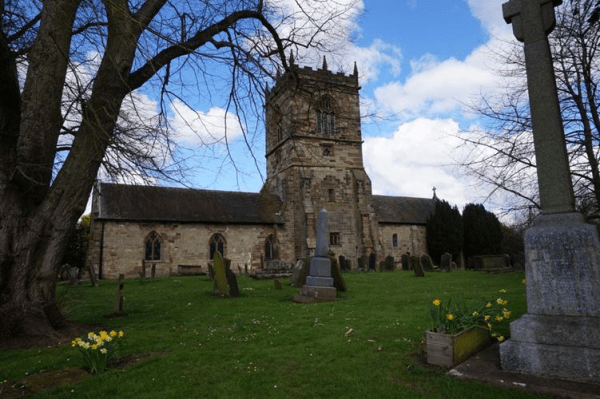
The vicarage was attached to the Church of England’s All Saints Church, which has an interesting history. Benedictines established and founded Lapley Priory on the site of the current church at the very end of the Anglo-Saxon period, as a satellite house of their Abbey of Saint-Remi or Saint-Rémy at Reims, France. King Henry V put an end to the priory in 1415.4 It is believed that the current church building in Lapley probably dates from the late 11th or 12th century.5

Church of All Saints, Lapley, National Heritage List for England, Listing no. 1374057

The 1851 census not only shows Benjamin as working as a servant at the vicarage; his future wife also worked there, as a house servant.6 Surprisingly, they only married nine years later, in 1860 and at that time, Jane was 40 and Benjamin was 25.7 Vicar John Rate officiated at the ceremony. Sadly, they were married a little over a year when Jane died on October 31, 1861. Jane’s death certificate states that the cause of death was unknown.8 Surprising, on the registration of her burial in the Parish of Lapley, the vicar writes that the cause of death was an accumulation of fat around the heart. This is the first time I have ever seen a cause of death in a church’s registration of burial but it seems that Vicar John Rate took the time to enter in all causes of death in the parish register. For example, the parishioner who was buried a few days before Jane died of English cholera. Oddly, no one else seemed to die of cholera in the village at that time.

Benjamin recovered quickly from the death of his wife and went on to marry Jane Everall on June 10, 1862 in Wolverhampton, where Jane lived.9 A little twist to the story: Jane Everall was a witness to Benjamin and Jane Watson’s wedding two years earlier.10 Benjamin and Jane Watson had no children but Benjamin and Jane Everall had eleven, one of which was my great-grandmother, Alice Mary Knight, born in 1876.11 Both of Benjamin’s wives were named Jane and they became Jane Knight in the records, adding a layer of complexity to the research.

Great Grandfather Benjamin worked in service all his life. He worked as a servant, a groom, and a gardener. After their marriage, Benjamin and Jane, his second wife, moved to Wolverhampton, about eleven miles away from Lapley.12 Later on they moved to West Bromwich, another 10 miles away, but the birth place of Jane. I assume that family living in this village was a factor in their decision to move.

Jane Everall also predeceased Benjamin in 1902.13 Benjamin died in 1908 in the Union Workhouse of West Bromwich.14 People ended up in a workhouse because they were too poor and too ill to take care of themselves and no one from the family would take care of them. Benjamin died of senile decay so he was certainly too ill and probably too weak to live alone. Still, it is surprising that he died in a workhouse as he had eleven children. Benjamin’s youngest son, Benjamin, was present at his death.15

  1. GB Historical GIS / University of Portsmouth, History of Lapley in South Staffordshire | Map and description, A Vision of Britain through Time, http://www.visionofbritain.org.uk/place/8383, accessed 19 July 2022.
  2. Grace, Maria, Random Bits of Fascination, https://randombitsoffascination.com/, accessed 19 July 2022.
  3. Genuki, John Marius Wilson, Imperial Gazetteer of England and Wales – 1870-2, Lapley in 1872, https://www.genuki.org.uk/big/eng/STS/Lapley/Gaz1872, accessed 20 July 2022.
  4. Wikipedia, Priory of Lapley, https://en.wikipedia.org/wiki/Lapley_Priory, accessed 20 July 2022.
  5. Wikipedia, Lapley, England, https://en.wikipedia.org/wiki/Lapley, accessed 20 July 2022.
  6. Findmypast, Census, Lands & Substitutes, 1851 Census of England and Wales, Benjamin Knight, accessed 3 July 2022.
  7. Findmypast, Birth, Marriage & Death (Parish Registers), Registration of marriage of Benjamin Knight and Jane Watson, 28 June 1860, accessed 07 July 2022.
  8. Registration of the death of Jane Watson, Superintendent Registrar’s District of Penkridge, Registrar’s District of Brewood, County of Stafford, ordered from the General Register Office of the U.K. and received 18 July 2022.
  9. Family Search, England, Staffordshire, Church Records, 1538-1944″, database with images, FamilySearch (https://www.familysearch.org/ark:/61903/1:2:QPSL-KHBC : 8 July 2020), Entry for Jane Everall and Benjamin Knight, 1862, accessed 21 July 2022.
  10. Findmypast, Birth, Marriage & Death (Parish Registers), Registration of marriage of Benjamin Knight and Jane Watson, 28 June 1860, accessed 07 July 2022.
  11. Certificate of birth registration, Alice Mary Knight, Registration District of West Bromwich, Sub-district of West Bromwich North-East, County of Stafford, 04 May 2021.
  12. Registration of birth of Harry Knight (first born in 1863), Superintendent Registrar’s District of Wolverhampton, Registrar’s District of Wolverhampton West, County of Stafford, ordered from the General Register Office of the U.K. and received 07 July 2021.
  13. Assumed from other family trees, Ancestry.
  14. Registration of death Benjamin Knight, Registrar’s District of West Bromich, Registrar’s Sub-district of West Bromwich North East, County of Stafford, ordered from the General Register Office of the U.K. and received 15 May 2021.
  15. Ibid.

The Quebec Act

Governor James Murray & Governor Guy Carleton & Monsignor Jean-Olivier Briand at Quebec City and the Quebec Act

https://www.ville.quebec.qc.ca/en/citoyens/patrimoine/quartiers/saint_jean_baptiste/interet/plaines_abraham_inoubliable_bataille_1759.aspx

The following database contains information about the province of Quebec  from the time of the 1759 British Conquest at the Plains of Abraham in Quebec City until Confederation.

Consisting of :

Information about the key players and the implementaion of the Quebec Act of 1774.

A link to a copy of the Quebec Act.

Authors who wrote biographical sketches about those whomade a difference., those who wanted to have an inclusive society in 1759 in British Quebec and those who did not.

Authors who wrote historical accounts,  immigration of those seeking a better future and the consequences of the Quebec Act of 1774.

Genealogy Resource links.

History links

Canadian Repositories

Click the link below to access the database,

Joseph Mitcheson, Yeoman Farmer

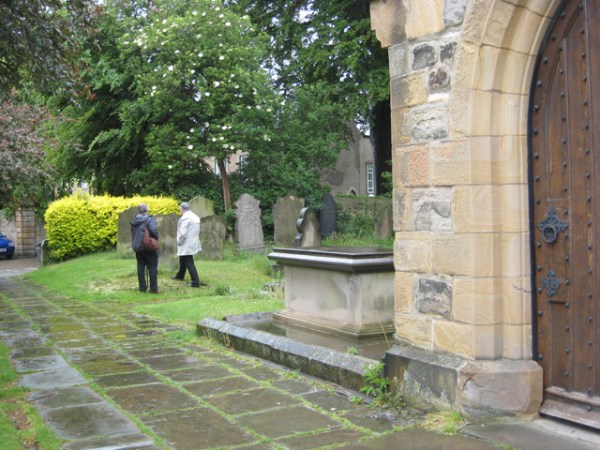
We reached Whickham Parish Church in County Durham, England at the end of a long day of exploration. I knew that two of my ancestors had been baptized in the little Norman-style church, but I didn’t know whether any family members were buried in its surrounding large cemetery. The weather was cool and rainy and the church was locked, so, after giving the cemetery a quick glance, we turned to leave. At that point, our guide drew our attention to an old gravestone to the left of the church door. 

“What you say the family name was?” he asked.

“Mitcheson,” I replied.

The Philipson/Mitcheson headstone, Whickham Parish Church. JH photo

Only part of the inscription was legible, but enough remained to identify the couple buried there. This was the grave of my ancestors Joseph Mitcheson (1746-1821) and his wife Margaret Philipson (1756-1804). I like to imagine that, knowing we had come all the way from Canada, Joseph and Margaret were trying to get our attention. They didn’t want us to leave without finding them.

This couple is of special significance to my family tree.  Two of their children, Mary Mitcheson Clark and Robert Mitcheson, moved to North America, and both are my direct ancestors. In 1844, Mary’s grandson, Stanley Clark Bagg, of Montreal, married his first cousin once removed, Catharine Mitcheson, daughter of Robert Mitcheson, of Philadelphia.1 This makes Joseph and Margaret simultaneously my four-times and five-times great-grandparents.

I know almost nothing about Margaret, and only a few bare facts about Joseph. He was born and baptized in Lanchester Parish, County Durham, in 1746, the youngest son of gentleman farmer Robert Mitcheson and his wife, Mary..2

When Robert died in 1784, he left most of his estate to Joseph.3 Joseph became what is known as a yeoman farmer, meaning he owned a small amount of property. Socially, a yeoman was notch above a tenant farmer, but below a gentleman.

Joseph Mitcheson, of Lanchester Parish, married Margaret Philipson, of Whickham Parish, by licence at Whickham Parish Church in 1774.4 They eventually had six children – four girls and two boys.

Before his father’s death, Joseph’s family seems to have moved frequently. According to family notes, Mary (1776-1856) was born at Stowe House in the hamlet of Cornsay, Lanchester Parish. Again according to family stories, Robert (1779-1859) was born at Eland Hall, Ponteland, near Newcastle. I can’t confirm either of these accounts, but both children were baptized in Whickham. All of the couple’s other children – Margaret (1781-1864), William (1783-1857), Elizabeth (1786-?) and Jane (1793-1825) — were baptized at Lanchester Parish Church, so the family must have been living in the Lanchester area by 1781.

Fortunately, County Durham has kept its records of land tax returns. These lists showed who owned each property, who lived on it and whether the occupant was the owner or a tenant. In 1789, Joseph was living in Lanchester Parish on a property owned by John Stephenson, Esq., who may have been the husband of his aunt Jane Mitcheson. Meanwhile, Joseph was getting income from three properties that he rented out: a farm in Iveston that he had inherited from his father, and another farm in Witton Gilbert,5 both located in Lanchester Parish.

In addition, his wife had inherited property in the town of Swalwell from her parents. Married women’s property belonged to their husbands, so legally it belonged to Joseph and he collected rent from the house, or houses, on this land. Swalwell, a township in Whickham Parish on the River Derwent, was an important iron manufacturing center in the 18th century.

The tax records show that, by 1798, Joseph and his family had moved to the Iveston, where It appears he farmed the land: in the will, written in 1803, he bequeathed his “implements of husbandry”, as well as the household goods and furniture, to his wife.6

Margaret died in 1804 and perhaps Joseph decided to give up farming after her death and move into town. The Durham tax records of 1810 show the farm properties at Iveston and Witton Gilbert were occupied by renters and Joseph was living on his Swalwell property, although it now belonged to his son Robert, an iron manufacturer.

Harold and Geoff take a close look at the family gravestone. JH photo

When Joseph died in 1821, he left cash to his daughters and the farm in Witton Gilbert to his middle son, William. William lived in London, so he rented the farm to a tenant farmer. Joseph left the bulk of his estate to his older son, Robert, although by this time, Robert had settled in Philadelphia. The 1824 land tax records show that Robert rented out both the properties in Swalwell and in Iveston.

Two final remarks:  I suspect that Joseph Mitcheson and Margaret Philipson’s grave was in a prominent location in Whickham Parish Cemetery because of her family’s prominence. The grave is near the front door of the church where everyone coming and going could see it.  (See the link below to the story of the Philipson family, “Can Two Wrongs Make a Right?”)

My other thought is that, while Joseph was a farmer like his father, his children were the first generation to break new trails. In Montreal, Mary and her husband, John Clark, invested in real estate. In Philadelphia, Robert was involved in several different business ventures as a merchant, a manufacturer and a landlord. Meanwhile, son William was an anchor manufacturer. Did Joseph and Margaret encourage their children to be adventurous and to leave County Durham, or were the next generation just fortunate to live at a time when new opportunities beckoned? That is a question I can’t answer.

See also:

Janice Hamilton “Can Two Wrongs Make a Right?” Writing Up the Ancestors, May 4, 2022, https://www.writinguptheancestors.ca/2022/05/can-two-wrongs-make-a-right.html

Janice Hamilton “Robert Mitcheson’s Last Will and Testament” Writing Up the Ancestors, March 1, 2022, https://www.writinguptheancestors.ca/2022/03/robert-mitchesons-last-will-and-testament.html

Janice Hamilton “Mary Mitcheson Clark” Writing Up the Ancestors, May 16, 2014, https://www.writinguptheancestors.ca/2014/05/mary-mitcheson-clark.html

Janice Hamilton “The Mitcheson Family of Limehouse” Writing Up the Ancestors, Jan. 21, 2015, https://www.writinguptheancestors.ca/2015/01/the-mitcheson-family-of-limehouse.html

Janice Hamilton “The Mitcheson Sisters” Writing Up the Ancestors, May 18, 2022, https://www.writinguptheancestors.ca/2022/05/the-mitcheson-sisters.html

Janice Hamilton “Master Mariners in the Family” Writing Up the Ancestors, June 13, 2022,  https://www.writinguptheancestors.ca/2022/06/master-mariners-in-the-family.html

This article is also posted on Writing Up the Ancestors.

Notes:

My husband and I made that trip in 2009. Our guide that day in Durham was retired professional genealogist Geoff Nicholson. Later, Geoff e-mailed me the whole memorial inscription, copied by the Northumberland and Durham My Family History Society in 1995. It said, “In memory of Margaret, wife of Joseph Mitcheson of Swalwell who died June 23 1804 aged 49? years. The above Joseph Mitcheson died June 1821 aged 77 years”

Sources:

1. Historical Society of Pennsylvania; Philadelphia, Pennsylvania; Historic Pennsylvania Church and Town Records; Reel: 1078, database, Ancestry.com (http://:Ancestry.ca, accessed Dec. 22, 2019,) entry for Stanley Clark Bagg, 9 Sept. 1844; citing Historic Pennsylvania Church and Town Records. Philadelphia, Pennsylvania: Historical Society of Pennsylvania.

2. England, Select Births and Christenings, 1538-1975, Ancestry.com (www.ancestry.ca, database on-line, entry for Joseph Mitchinson, Lanchester, accessed May 2, 2022), citing England, Births and Christenings, 1538-1975. Salt Lake City, Utah: FamilySearch, 2013.

3. Robert Mitcheson’s will is stored at Durham University Archives and can be viewed online. Search for it at http://familyrecords.dur.ac.uk/nei/data/simple.php and view it on Familysearch.org. “England, Durham, Diocese of Durham Original Wills, 1650-1857,” images, FamilySearch (https://familysearch.org/ark:/61903/3:1:S3HT-67DQ-481?cc=2358715&wc=9PQL-ZRH%3A1078415794 : 7 July 2014), DPRI/1/1784/M5 > image 3 of 3; Special Collections, Palace Green Library, Durham University, Durham. (accessed Feb. 28, 2022).

4 England, Select Marriages, 1538-1973 Ancestry.com (www.ancestry.ca, database on-line, entry for Joseph Mitcheson, accessed May 2, 2022), citing England, Marriages, 1538–1973. Salt Lake City, Utah: FamilySearch, 2013.

5. Durham County Records Office. Quarter Sessions – Land Tax Returns, Chester Ward West 1759-1830, www.durhamrecordsoffice.org.uk, search for Mitcheson, viewed April 19, 2022.

6. Will of Joseph Mitcheson, yeoman, Iveston, Durham, The National Archives, Wills 1384-1858 (http://nationalarchives.gov.uk, search for Joseph Mitcheson, accessed Nov. 18, 2010), The National Archives, Kew – Prerogative Court of Canterbury, 9 February, 1822.

Garrison Anglican Church Montreal 1760- 1764

Rev. John Ogilvie’s Baptismal and Marriage Records

Montreal

The following database consists of extensive records of baptisms, marriages, and deaths by the Reverend John Ogilvie and Ministers at the Garrison Anglican Chuch in Montreal, Quebec City, Trois Rivieres, and Sorel.

A list of Protestant Cemeteries is included, followed by numerous authors who have written about the lives of Ministers and Governors of the time.

Click the above link to access the file in a new window.

Finding Ancestors in Manor Land (Seigneurial) Records

If you have ancestors who lived along the St. Lawrence River between 1627 and 1970, it’s worth asking who owned the place where they lived. Often, you’ll discover that a colonial structure that began in France determined their rents, obligations and many other living experiences.

France’s Seignorial Regime

The colonialization of Quebec took place primarily under the French land ownership system known as “the seigneurial regime.” It began in North America in 1627 and continued in one way or another until 1970.

When European explorers and religious leaders arrived what we now call Quebec, they aimed to conquer territory permanently on behalf of patrons. Colonialists created manors for farming and religious settlements. Large tracts became private property where exclusive groups could hunt, log or trap. Other lots became militarized defence zones. Disagreements were rampant from day one.

Following the borders of colonization to figure out where to look for records during this period can be a challenge. In many ways, modern day genealogists face the same multiplicity of sources and analyses that cadastral surveyors faced after the British Conquest.

British Era

In 1673, British surveyors had to codify the rights and obligations inherent in the way the seigneurial regime was enacted in New France with a requirement under treaty terms to protect inhabitants who wished to remain in conquered territories. By examining French, British and cadastral records and interviewing the people then living on the territory, surveyors found multiple competing claims for the same tracts of land. They found it difficult to determine property boundaries that took into consideration the rights and obligations of landlords and tenants in a pure rent for land property distribution system. How much land per tenant is a landlord’s obligation to supply an operating mill worth? How do you evaluate the necessity to raise sheep on a certain part of a property in terms of acres of land? How do you define the borders of traditional Indigenous hunting lands while keeping intact promises to more recent European colonialists?

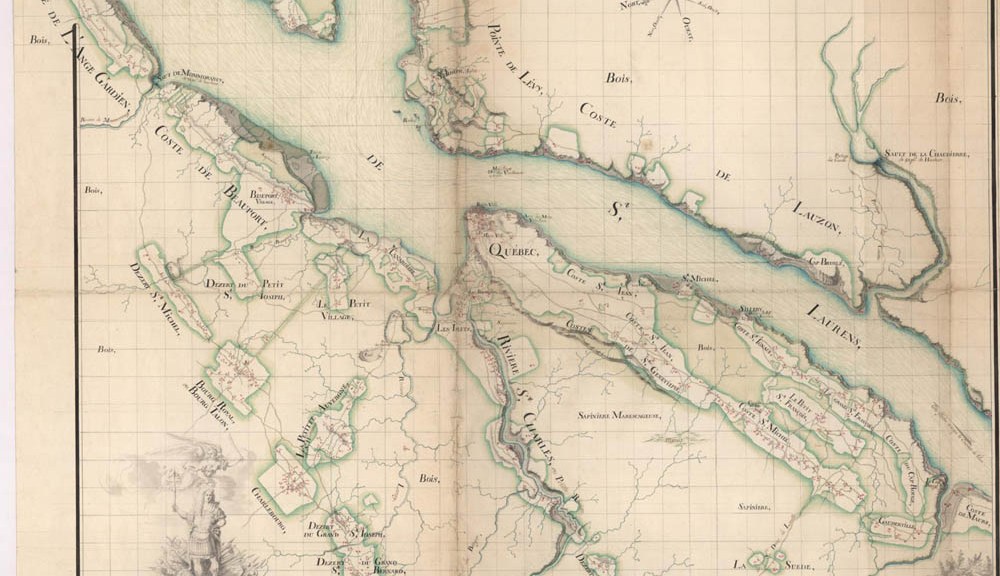
Unlike those surveyors, we no longer have access to the families who rented land from manor Lords or hunted on traditional lands. Instead, we have to scour the maps notes on they left behind, along with the notarial acts, land grants, pledge records, oaths of allegiance and censuses surveyors examined more than 250 years ago.

Historical Context

If they exist and we can find them. Today, original records might be held by First Nations, the British, French or Canadian governments, Catholic institutions, military organizations, provincial archives, ministries or libraries, educational institutions or private companies.

If we find legible documents, we have to interpret them, remembering that as European monarchs began dividing the territory between themselves, the area now known as Quebec went under different names. Some of these names are used for different territories today.

When Jacques Cartier landed in 1535, he named the major river now known as the St. Lawrence “the Canada River” despite naming France’s new colony the same. Canada’s first settlement was Quebec, followed by Montreal and Trois-Rivières, which remain in roughly the same locations as the modern-day cities. By 1608, much of North America became known as New France, which consisted of the colonies of Acadia, Canada, Hudson’s Bay, Louisiana and Newfoundland. As France ceded territory to Britain, New France shrunk to its most populated region along the Saint Lawrence Valley.

When France ceded their North American territory to the British in 1673, surveyors got to work trying to figure out how to divide up the land. They came up with so many ambiguities and complexities, that the British Government retained the seigneurial system even after they introduced a township system in 1774.

The American War of Independence began a year later and lasted for seven years. In 1783, an influx of English-speaking British Loyalists began purchasing property in the colony. Tensions with the new settlers and original inhabitants led successive governments to divide the territory into Upper and Lower Canada in 1791.

The war of 1812 followed. Multiple land grants occurred, but all were on properties beyond previously-existing manors.

How the Hudson’s Bay Company Lost its Seignorial Land Rights

Tensions for land resources didn’t get tense in Upper Canada until 1828, when Napoleanic wars led to a shortage of wood in Britain. By that time, William Price, a British Citizen who served in the militia during the War of 1812 owned a local timber company in Malbaie. Meanwhile, the Hudson’s Bay Company rented vast forests in Saguenay that it wasn’t logging. The governor held a commission to look at the territory in 1828, which led to a petition from 250 Malbaie residents to open up the land for logging a year later. By 1835, the territory still wasn’t logged, so 1,800 people signed another petition to open up the territory to private logging. The Hudson’s Bay Company attempted to set up logging operations in 1836 but couldn’t get the project underway. By 1837, 21 people, including Alexis Tremblay dit Picoté and Thomas Simard, set up the Société des Pinières du Saguenay logging company, which became known as the Société des Twenty-one. Over the next five years, the men not only logged the territory, but also built houses on the land they cleared. In 1842, the government cancelled their lease with the Hudson’s Bay Company and sold the land to the farmers. A year later, William Price purchased their logging company.

How Seigneuries Disappeared

Twelve years later, in 1854, the government officially ended the ability of seigneurs to create new rental contracts, but didn’t cancel contracts already in place.

Some seigneurs got paid for contracts for more than a century after the regime ended. A 1928 inquiry showed that 60,000 tenants continued payments to more than 190 different seigneurs. The government decided to set up a commission to loan cities, towns and county councils enough money to pay out their contracts. The cities then set up an extra tax to collect the payments from tenants over a 41-year period.

The last municipality paid the last manor payment in 1970.

If you want to research ancestors who lived on seigneurial lands, you’ll need to keep a few French terms in mind when searching through the various resources. Here’s a list of both for your information.

Glossary

Acquet: Goods inherited or otherwise obtained prior to marriage

Aveu et dénombrement : Inventory, to be conducted by Manor holders when the property changed hands

Cens: Rent

Communauté de biens: commonly-held goods

Compagnie des Cent-associes: Company of 100 Associates, the Company of New France, named after 100 merchants, financiers and politicians who paid 3,000 livres each to underwrite a company in operation from 1627 until 1663.

Concessions en Fi’ef et Seigneurie, Foi et Hommages et Dénombrements: Registers of fealty and homage pledges a Lord made to the King when he received the land.

Corvées: one to four days of compulsory work per year during the sowing, haying or harvesting season

claration de fiançailles: oral promise to marry

Douaire: dower or widow rights to be paid by a future husband to his future bride in the case of his death; this amount could not be taken by creditors in the case of bankruptcy

droit de réunion: right to repossess

Fief: estate

Engagés – indentured servants. Usually found in notarial records signed by labourers, carpenters, masons and domestic servants in France for work in New France (Nouvelle France), Acadia (Acadie), and Louisiana (Louisiane). Contracts usually lasted three years and included cost of passage, wages, lodging and food. There are 4,000 people who came to Canada under these terms between 1630 and 1789. Note that after 1714, ship captains were required to transfer 3, 4 or 6 servants to New France, depending on the size of the vessel. Ship captains then sold these servants to whomever would pay for them once they got to New France. Between 1714 and 1721, ship Captains had to pay 200 lires per missing engagé; after 1721 the fee dropped to 60 lires.

Fiançialles: marriage bonds, oral promise of marriage, engagement

Lods: a tax due when a land was sold or transferred to another tenant (also called lods)

Propres: Items legally owned by a man and women when they married that would not be jointly owned after marriage

Rhumb de vent: the measurement of a territory perpendicularly and diagonally from a river.

Sépulture: burial

Seigneuries: manor lots

Syndicat national du rachat des rentes seigneuriales, or SNRRS: National Commission for the Repurchase of Seigneurial Rentes

Tonnelier: a cooper, which is a carpenter who makes wooden barrels. Most manors had at least one cooper, who would make barrels for flour, grain, vinegar, wine and spirits.

Ventes: transfer fee (also called lods)

Primary Sources in Canada

Bibliothèque et Archives nationales du Québec (BanQ)

https://www.banq.qc.ca/accueil/

  • Advitam. “Seigneuries” https://advitam.banq.qc.ca/notice/315651.
  • Advitam. “Autres seigneuries.” https://advitam.banq.qc.ca/notice/573685.
  • Advitam. “Seigneuries.” https://advitam.banq.qc.ca/notice/229007.
  • Marriage Contracts of Quebec: Contrats de mariage des districts judiciaires de Québec, de Beauce, de Charlevoix, de Montmagny et de Thetford Mines, 1636-1953
  • Superior court records: Fonds Cour supérieure. District judiciaire de Québec. Insinuations, registres des insinuations de la Prévôté de Québec, vol. 1 (Anciennement registres 1, 2 et 3) (1er mars 1667 – 25 septembre 1696), folios 109-109v.
  • Superior court records: Fonds Cour Supérieure. District judiciaire de Montréal. Cote CN601. Greffes de notaires, 1648-1967.; District: Montréal; Title: Saint Martin, Antoine Adhemar dit (1668-1699) Cote CN601. Greffes de notaires, 1648-1967.; District: Montréal; Title: Saint Martin, Antoine Adhemar dit (1668-1699)com. Quebec, Canada, Notarial Records, 1637-1935
  • Parish Records:Fonds Paroisse Notre-Dame-de-Foy, 1662-1976, Cote : P48, Id 298582
  • Parish Records: Paroisse Sainte-Famille, Ile d’Orléans – registres d’état civil, 1666-1790, ZQ1,S28 #184 : 12 avril 1666 au 7 octobre 1727.
  • Parish Records: Paroisse Notre-Dame-de-Montréal, 1657-[vers 1850], Cote : P1000,D1277 Id 696688 et Registres d’état civil, 1642-1948, Cote : ZQ106, Id 420864 et Index alphabétique des confirmés de Notre-Dame-de-Montréal, de 1676 et 1678 – s.d. 11 pages Numéro : 301330
  • Notarial records: Montréal (Québec : district judiciaire). Notariat, 008127867_003_M99W-KP4, Jan 1, 1657–May 14, 1669; notary Claude Aubert, 1652-1692; notary Bénigne Basset, 1658-1672; notary Pierre Raimbault, 1698-1727; notary Antoine Adhémar, 1673-1712.
  • Fonds Cour Supérieure. District judiciaire de Montréal. Cote CN601. Greffes de notaires, 1648-1967.; District: Montréal; 

Library and Archives Canada

  • Canada, Library and Archives. “Settlement,” July 28, 2015. https://www.bac-lac.gc.ca/eng/discover/exploration-settlement/new-france-new-horizons/Pages/settlement.aspx.
  • Collection Jacques Henri Fabien (MG 25 G231), La collection sur microfilm se compose de renseignements généalogiques pour la période de 1657 à 1974.
  • Cases of indentured servants who left their masters (extraits d’arrêts du Conseil supérieur concernant les engagés qui quittent le service de leurs maîtres) 00003916294, fol. 56-57v sur microfilm Centre des archives MG1-C11A, 1663-1702 Microfilm reel number: F-2.
  • New France Archive Collection: https://nouvelle-france.org/eng/Pages/new-france-archives.aspx, including the correspondence and memoirs of Jean Talon
  • Rules, arrests and declarations made in Paris (Recueils de réglements, édits, déclarations, et arrêts : concernant le commerce, l’administration de la justice, & la police des colonies françaises de l’Amérique, & les engagés : avec le Code noir, et l’addition audit code, France, Chez les Libraires associés, Paris), 1765, MG1-C11A. Microfilm reel number: F-2.

McCord Museum

Archived Collections: http://collections.musee-mccord.qc.ca/en/keys/collections/

  • Seigneurie de Sorel Fonds (P109)
  • Seigneurs de Rouville Fonds (P107)

Parks Canada

St. Paul University, Centre for Vatican II and 21st Century Catholicism

Vatican Archives of the Sacred Congregation “de Propaganda Fide” 1622-1846, PFcongressi_1831-1836_p.407-526, https://ustpaul.ca/upload-files/RCRHC/PFcongressi_1831-1836_p.407-526.pdf.

University of Montreal, Programme de recherche en démographie historique (PRDH) Research Programme in Historical Demography

Primary Sources in France

Archives de Bordeaux

https://archives.bordeaux-metropole.fr/

Amirauté de La Rochelle

https://archives.charente-maritime.fr/

Archives départementales du Calvados (14)

https://archives.calvados.fr/

Archives départementales de Charente-Maritime (17)

https://la.charente-maritime.fr/

https://blogues.banq.qc.ca//instantanes/2013/08/22/le-premier-depart-des-filles-du-roy-pour-quebec-a-partir-de-la-rochelle/

Archives départementales du Finistère (29)

https://recherche.archives.finistere.fr/archives/search

Archives départementales de Gironde (33)

https://archives.gironde.fr/

Parish and state registers (les registres paroissiaux et l’état civil), 1538-1935

Archives nationales

https://www.archives-nationales.culture.gouv.fr/

Primary Sources in the United States

Creighton University, Omaha, Nebraska

English translation of The Jesuit Relations and Allied Documents, 1610-1791, http://moses.creighton.edu/kripke/jesuitrelations/, edited by Reuben Gold Thwaites, secretary of the State Historical Society of Wisconsin, computerized transcription by Thom Mentrak, historical interpreter at Ste. Marie among the Iroquois living history museum, Liverpool, New York, 1898-1901.

Internet Archive, San Francisco, California

https://archive.org/

The Internet Archive operates as a free catalogue of everything on the Internet since 1996. It also operates as a public library.

Secondary Sources

Academic papers

Coleman, Emma L. “A Seigneury of New France.” The New England Quarterly, vol. 10, no. 1, 1937, pp. 133–138. JSTOR, http://www.jstor.org/stable/360151.

Gettler, Brian. “Money and the Changing Nature of Colonial Space in Northern Quebec: Fur Trade Monopolies, the State, and Aboriginal Peoples during the Nineteenth Century.” Histoire Sociale/Social History 46 (November 1, 2013): 271–93. https://doi.org/10.1353/his.2013.0057.

McInnis, Marvin. “Peasant, Lord and Merchant: Rural Society in Three Quebec Parishes, 1740–1840. By Allan Greer. Toronto: University of Toronto Press, 1985. Pp. Xvi, 304. 15.00 Paper.” The Journal of Economic History 46, no. 2 (June 1986): 571–72. https://doi.org/10.1017/S0022050700046696.

Books

Greer, Allan. The People of New France. University of Toronto Press, 1997.

Harris, Cole. Seigneurial System in Early Canada: A Geographical Study. McGill-Queen’s Press – MQUP, 1984.

Jetté, René. Dictionnaire généalogique des familes du Québec. Montréal: Les Presses de l’Université de Montréal, 1983.

Jugements et délibérations du Conseil Souverain de la Nouvelle-France. Volume 1. Québec: Gouvernement du Québec, 1932.

Lunn, Alice Jean Elizabeth. Economic Development In New France, 1713-1760. PhD, MeGill University, 1942. https://escholarship.mcgill.ca/concern/theses/np193978n.

Mathews, Geoffrey J., Historical Atlas of Canada, vol. 1, From the Beginning to 1800, editor R. Cole Harris. Toronto, Ontario: University of Toronto Press, 1987. The map is plate 51. FHL book 971 E7h

Noël, Françoise. Christie Seigneuries: Estate Management and Settlement in the Upper Richelieu Valley, 1760-1854. McGill-Queen’s University Press, 1992. 

Roy, Pierre Georges, Inventaire des Concessions en Fi’ef et Seigneurie, Foi et Hommages et Dénombrements Conservés aux Archives de la Province de Québec (Inventory of fief and manor concessions, fealty, promises and debts to the King at the Archives of the Province of Québec as of 1929) 6 vols. Beauceville, Québec: l’Eclaireur, 1927-1929, http://www.patrimoinequebec.ca/Archive/BIBLIOTHEQUE/23-inventairedesconcessions6.pdf.

Sulte, Benjamin. Histoire des Canadiens-Français. Wilson & Cie, Editeurs, Montréal, 1882, ISBN 0885450183; Editions Elysse, 1977.

Sawaya, Jean-Pierre. La fédération des Sept Feux de la vallée du Saint-Laurent: XVIIe au XIXe siècle, Sillery, Québec: Septentrion, 1998.

Trudel, Marcel. La population du Canada en 1666. Recensement reconstitué. Québec: Septentrion, 1995.

Websites

Borealia. “Beyond the ‘System’: The Enduring Legacy of Seigneurial Property,” October 9, 2018. https://earlycanadianhistory.ca/2018/10/09/beyond-the-system-the-enduring-legacy-of-seigneurial-property/.

Borealia. “Mapping Land Tenure Pluralism in the St. Lawrence River Valley,” September 26, 2018. https://earlycanadianhistory.ca/2018/09/26/mapping-land-tenure-pluralism-in-the-st-lawrence-river-valley/.

Bosher, J.F., Men and ships in the Canada trade 1660-1760, Canadian Parks Service, the French version.

French-Canadian Heritage Society of Michigan (FCHSM), https://habitantheritage.org/index.php

Genealogy Ensemble: https://genealogyensemble.com/ (particularly https://genealogyensemble.com/2020/03/22/quebec-windmills-and-seigneuries/, https://genealogyensemble.com/2020/05/06/the-antoine-pilon-home/, https://genealogyensemble.com/2021/04/07/what-legacy-stems-from-our-quebec-pioneers/, https://genealogyensemble.com/2021/03/24/an-outstanding-pioneer/, and https://genealogyensemble.com/2020/09/09/marin-boucher-pioneer-of-new-france/.

Mathieu, Jacques. “Seigneurial System | The Canadian Encyclopedia,https://www.thecanadianencyclopedia.ca/en/article/seigneurial-system.

New France, New Horizons, http://www.archivescanadafrance.org/, a bilingual site set up by the Direction des Archives de France (Paris) et les Bibliothèque et Archives Canada (Ottawa) to commemorate the 400th anniversary of New France in 2004. The search function still works.

Séminaire du Québec, http://www.seigneuriedebeaupre.ca/, https://charlevoixmontmorency.ca/portraits-seminaire-de-quebec/.

Southwestern Quebec Genealogical Resources, https://www.swquebec.ca/land_grant/land_grants.html.

Quebec Heritage Repertoire, https://www.patrimoine-culturel.gouv.qc.ca/rpcq/

Notaries Appointed by the Governors of British Quebec – 1760 – 1789

An example of a notarial act

Notaries of Quebec Appointed by the Governors of Quebec 1760-1789 at the beginning of the British Regime.

Definition: Notarial records are private agreements (contracts), written by notaries, who are considered legal professionals. This collection consists of notarial records for Quebec from the years 1637 to 1935. Each notary set up practice and kept sets of records for documents they created. Ancestry.ca

Notaries This database lists the notaries appointed in the following

Districts of Quebec – Montreal -Trois-Rivieres – Joliette – Kamouraska – Montmagny – Richelieu – Saguenay – Saint Hyacinthe – Terrebonne

Authors Numerous authors have written about these notaries and indicated the sources where their documents can be found and researched on various websites.

This database has focused on the availability of the greater portion of these documents that are located at BanQ Numerique These are indicated at the end of the link: ex: Doc online.

Click the link below to access the database and open in a new window.

Note:

Governor Frederick Haldimand’s portrait is missing from the above document.

Happy Canada Day

Recently the Governor-General of Canada appointed Nancy Karetak LIndell, Membership in the Order of Canada in recognition of her contribution to Canadians in the far north. She is the wife of my nephew, Jon Lindell, who passed away shortly after she became a member of Parliament. Nancy Karetak Lindell served for more than a decade as a member of Parliament and now lives in Arviat, Nunavut close to family members.

Her activities, contributions and dedication to the people of the north continues to this day.

It is with great pride as a Canadian that I share this news having learned of it through this week’s Nunatsiaq News that featured the article below.

A former Nunavut politician, Nancy Uqquujuq Karetak-Lindell is one of 85 Canadians to be appointed to the Order of Canada this year. She is seen wearing a traditional tuilik made by her mother Rhoda Karetak. (Photo courtesy of Hinaani Design)

NEWS  JUN 29, 2022 – 9:30 AM EDT

Nancy Karetak-Lindell appointed to Order of Canada

Click on the link below : Nunatsiaq News to open the article in a new window.

A History of Plymouth Gin

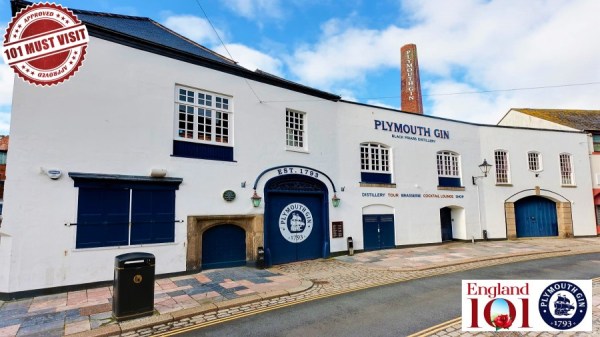
…or, to be historically correct “The Black Friars Plymouth Gin Distillery” however, we locals just call it Plymouth Gin. I was born in historical Plymouth at the end of WW2 and among our history lessons was, of course, the history of England and Plymouth in particular. (1)

Plymouth’s history goes back to very early times. In 1866 several caves were discovered in the Plymouth area, containing the bones of animals that no longer live on these Islands. along with the human remains were the bones of a lion, hyena, cave bear and rhinoceros, which show man lived in this district as far back as the early stone age. Saxons settled in the area and by 926 AD ruled the whole of Devon.

Plymouth was attacked, raided and ruled, by others many more times…but that is another story, this story is about the Plymouth Gin Distillery, the oldest working gin distillery in England.

In the 13th century, friars arrived in Plymouth. Friars were like monks but instead of withdrawing from the world, they went out to preach and help the poor. There were also Carmelites in Plymouth, known as White Friars and Franciscans or Grey Friars. During the middle ages, because the Dominicans wore a black ‘cappa’ or cloak over their white habits they became known as the ‘Black Friars’

The Friar is still used somewhere on every bottle of Plymouth Gin today

The Plymouth Gin distillery building dates back to the early 1400s and was formally a monastery inhabited by the Black Friars. The most intact part of the distillery is the Refectory Room a medieval hall with a hull-shaped timber roof built in 1431 and is one of the oldest buildings in Plymouth.

In 1536 the time of the dissolution of the monasteries, the former home of the Black Friars was put to a variety of other uses including the first non-conformist meeting place, a debtors’ prison, a meeting hall and a centre for Huguenot refugees who fled France and came to Plymouth.

In 1620 It has been suggested that the Pilgrim Fathers spent their last night in England in the distillery and they made the short walk down to the harbour to set sail to America on the Mayflower, where they founded a new Plymouth.

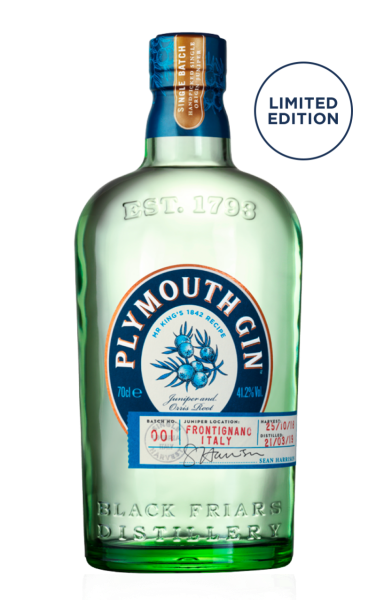
Plymouth Gin Bottle

The original distilling business was owned by Fox and Williamson and in 1793 when a certain Mr Coates joined the establishment, Plymouth Gin started being distilled and soon the business became known as Coates & Co,. until March of 2008, when the French Pernod Ricard took over the company.

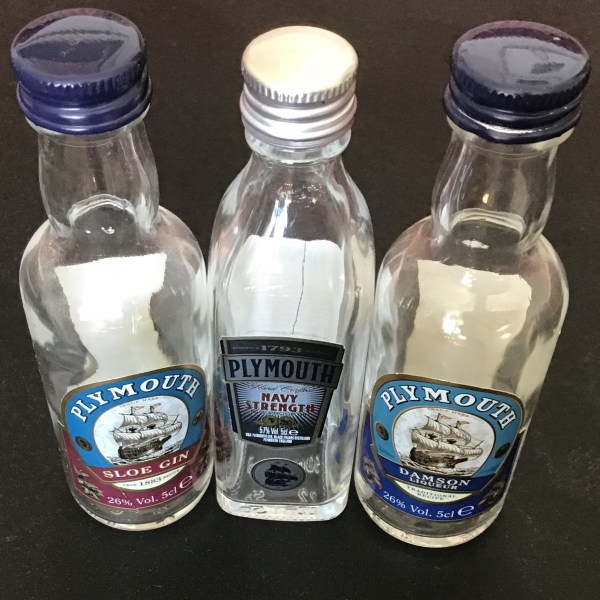
My three miniature souvenir bottles from my last visit to Plymouth – Empty!

Some of the many fascinating botanicals that make up the unique taste of Plymouth Gin are Juniper berries, Coriander seeds, orange and lemon peels, angelica root, green cardamom, and orris root. Its gin is also ‘Appellation Controlee’ meaning it can not be made anywhere, except Plymouth, Devon, England.

Made with single-origin juniper, picked on a single day, from a single mountain location in Frontignano, Italy, only one batch will ever be made.

One of the oldest continuous buyers of Plymouth Gin is the Royal Navy. Almost all Navy Gin is linked to Plymouth thus Plymouth and the Royal Navy have a long history. The Royal Navy’s ‘rum ration’ or ‘tot’ was usually rum for the ratings but the officers drank Gin.

Spot the Friar

This was a huge business for British distillers. By 1850 the Royal Navy was said to be buying over 1,000 barrels of Plymouth Gin a year, and during the Napoleonic Wars, Vice Admiral Horatio Lord Nelson ordered barrels of Plymouth Gin for his officers. However, on the 31 st July 1970, that tradition ended. Modern Naval ships carry sophisticated weaponry where a push of the wrong button or an unsteady hand could result in WW3, so it was decided to end the daily Rum ‘tot’ that the ratings had been drinking for over 300 years!

On that day, sailors, drinking their last free ration of rum, wore black arm bands, drank their tot and threw the glasses into the sea. I have no idea what the officers did with their Gin! (2)

The Mayflower ship forms Plymouth Gin’s trademark label today. Black Friars is indisputably the oldest working gin distillery with records of a ‘mault-house’ on the premises going back to 1697. Today, Plymouth Gin is known worldwide. Just the other day, to my surprise, I heard VPR – Vermont Public Broadcasting Service – advertise Plymouth Gin on its station.

At the moment, no doubt due to the Covid delays, it is hard to find Plymouth Gin in Montréal, as the SAQ (Société des alcools du Québec or Quebec Liquor Corporation) where I usually buy it, is sold out!

Today, Black Friars offers a range of tours, ranging in price from a 40-minute, £7 inspection through to an in-depth, 2.5-hour “Master Distiller’s” outing (£40) where visitors get to create (and take away) their own bespoke gin. The distillery complex also has its own cocktail bar and brasserie. (3)

SOURCES

(1) https://en.wikipedia.org/wiki/Plymouth_Gin

(2) https://economictimes.indiatimes.com/magazines/panache/how-pussers-rum-became-the-official-drink-of-the-british-royal-navy/articleshow/66196337.cms?utm_source=contentofinterest&utm_medium=text&utm_campaign=cppst

(3) www.britainallover.com/2015/11/black-friars-distillery-plymouth/

The YouTube link below is a tour with the Master Distiller.

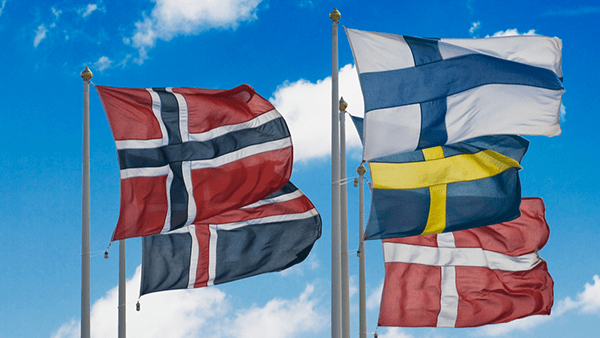
Scandinavian & Baltic States Families of Quebec 18th, 19th & 20th Centuries

Norway – Sweden – Finland – Denmark – Iceland – Estonia – Latvia & Lithuania


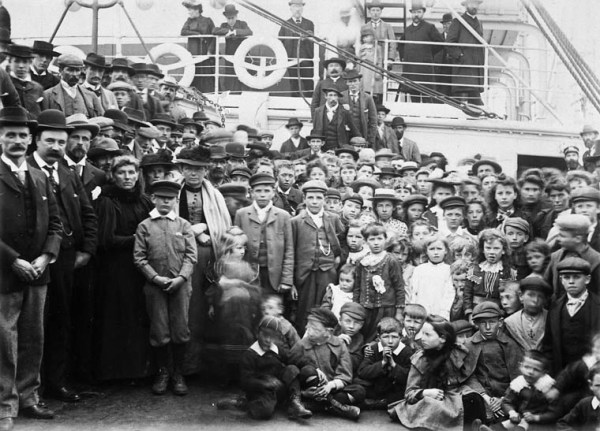
Coming to Canada

Norway

The offer of Canadian land parcels to settlers in the 1890s attracted Norwegians to come to Canada. Before that time, Norwegians would cross the Atlantic Ocean, land in Quebec City, then migrate south to the United States. As the American Midwest and Northwest became more populated, and immigration policies more restrictive, the Canadian Prairies became the next destination for many Norwegians.

Sweden

Swedish immigration to Canada began in the 1870s with the first rural Swedish colony, Scandinavia, near the town of Erickson in Manitoba. Originally named New Sweden, Scandinavia was established by three men who organized dwellings to house the first settlers.

Like their Scandinavian counterparts, Swedish immigrants first arrived and settled in the United States and then travelled north to settle in Canada. A large influx of Swedish immigrants from the states of Minnesota and North Dakota migrated to the Canadian Prairie provinces in the 1920s.

Finland

It is very difficult to determine the exact date of arrival of the first Finnish settler to Canada. However, Finns began settling in large numbers in the 1880s. During this period, many Finns who had arrived in the United States in the 1860s crossed the border into Canada. By 1890, many communities of Finnish Canadians had formed. The largest of those communities were Nanaimo, British Columbia; New Finland, Saskatchewan; Port Arthur, Toronto, and Sault Ste. Marie in Ontario.

Denmark

Although there are early accounts of Danes working as trappers in Canada, little documentation exists that describes their experiences. By the 1860s, political unrest, religious divide, and the promise of a better life in America, all contributed to the migration of Danish people to Canada and the United States.

Iceland

Leif Eriksson was the first Icelander to set foot in what would become Canada. Wineland, the first settlement of Icelandic origin, was established in 1003, and Snorri Þorfinnsson is the first known European born in L’Anse aux Meadows, Newfoundland.

In 1872, Sigtryggur Jonasson traveled to the Muskoka region of Ontario and a group of 100 Icelanders later joined him there. Not satisfied with their settling attempts in Ontario, the Icelanders moved west to Manitoba and established the first lasting Icelandic colony on the continent. 

Estonia

From 1900 to 1944, fewer than 3000 Estonians immigrated to Canada. Approximately 72, 000 Estonian political refugees fled to Sweden and Germany in 1944 to escape Russian communism. Of these, nearly 14, 000 immigrated to Canada between 1946 and 1955

Approximately 72, 000 Estonian political refugees fled to Sweden and Germany in 1944 to escape Russian communism. Of these, nearly 14, 000 immigrated to Canada between 1946 and 1955. Balts, mostly Estonians, Latvians, and Lithuanians, were among the first displaced persons selected by Canadian immigration during the Second World War (WWII).

Lithuania 
Lithuania is a small country on the southeastern coast of the Baltic Sea. The first recorded Lithuanian immigrants to Canada were soldiers serving in the British army in the early 19th century. The 2016 census reported 59, 285 people of Lithuanian origin in Canada (11, 185 single and 48, 100 multiple responses). At the end of the 19th century and the beginning of the 20th, many Lithuanians, fleeing Tsarist police or to improve their livelihoods, immigrated to Canada and settled in Nova ScotiaOntario,and western Canada   
Latvia
Between 1921 and 1945, 409 Latvians arrived to Canada, although in the 1941 census listed 975 people claimed Latvian origin. After the Second World War in 1947, many Latvians moved to Canada as war refugees. This migration, which accounted for 92% of Latvians who immigrated to the country between 1921 and 1965, ended in 1957. Many of these Latvians worked in the agricultural areas during their first years in Canada, but soon settled in cities. By 1961, only 10% of those immigrants lived in rural zones and farms (6% in rural areas and 4% on farms). The majority of Latvian immigrants in Canada in 1991 were women, 775 more women than men.[1
Information : Library and Archives Canada
 

Click on the above link to access the database that consists of authors who have written about those who immigrated to Quebec.

Motherhood in New France

A Short Life of Dedication

In the waning years of the 16th century, Pierre Esprit Radisson, my eighth great grandfather was born in France. He was a cloth merchant of modest means living in the parish of Saint Nicolas des Champ, Paris Frances.

In the year 1633, he married Madeleine Henault, the widow of Sebastien Hayet. She brought to the marriage her young toddler, Marguerite. Together they had three more children, Francoise (1636), Elisabeth (1638), and Pierre Esprit, the famous fur trader and explorer (1640).

Recently the following biographical sketches about members of the Radisson family were added to our blog.

https://genealogyensemble.com/2021/10/06/a-very-young-marriageable-girl/    Elisabeth Radisson

https://genealogyensemble.com/2021/11/03/claude-jutras-dit-lavallee/    Claude Jutras, Elisabeth’s husband

https://genealogyensemble.com/2020/03/11/allegiances/     Pierre Esprit Radisson, Elisabeth’s brother

Pierre Senior died in 1641 at the age of 51 leaving Madeleine to care for the four children. Within five years she also passed away. (1646) What was going to happen to the youngsters? Marguerite was now 15 years of age, while Francoise, Elisabeth, and Pierre were still very young.

The three sisters, despite their young age, became “marriageable young girls”. They arrived in New France during the summer of 1646 and were welcomed into the community of Three Rivers (Trois Rivieres) that had been settled in 1634 by Samuel de Champlain. The location was ideal, the midpoint between Quebec City and the burgeoning Ville Marie (Montreal1642).

Very little information is known about the early years of Francoise Radisson, other than in 1649 the record shows that she became her nephew Etienne’s godmother. He was the son of her half-sister, Marguerite.

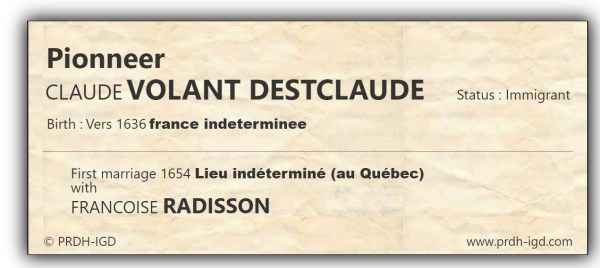
In 1653 at the age of seventeen, Francoise married Claude Volant de Saint Claude, a soldier from France, also 17. No records of their marriage contract nor written records of their marriage have been found.

A typical document containing information about the Volant Family

The young couple set out to have a family and before long they were blessed with a set of twin boys, Pierre, and Claude, born November 8, 1654. Two and half years later, on July 28th, 1657, a daughter, Francoise saw the light of day, but at the age of five and a half, she died. There is no indication of what caused her death, but, typhoid and smallpox were common diseases causing the loss of life.

In November of 1659 another daughter, Marguerite and was welcomed after the pain of losing their first daughter. Four years later in July of 1663, another daughter also named Francoise was born. Her life came to an abrupt end, having lived only three months. In the fall of 1664, the family rejoiced when their healthy young son Etienne joined the family. Almost five years later Jean Francois was born, followed by Nicolas in 1671 and then young fellow Charles Ignace rounded out the family on November 7, 1673.

For nearly twenty years Francoise bore nine children having given birth to three daughters and six sons. No doubt there were moments of deep grief, along with times of jubilation for the family. The childbearing years took a heavy toll on Francoise.

In the last years of her life, she became ill and Claude soon realized the need for help and hired a housekeeper to care for her and the five young children still living at home. When the leaves of autumn are at their finest, most splendid colors, Francoise died October 3rd, 1677at the young age of forty-one.

During her lifetime, she lived to see her two eldest sons become priests, but not long enough to see them ordained, nor to witness their many accomplishments. She must have been quite ill when her daughter Marguerite was married in the summer of 1675 and perhaps unable to attend the celebrations. She may have rejoiced seeing her first granddaughter when Marguerite gave birth before her mother’s passing, but she died before seeing the second granddaughter and was spared knowing that Marguerite died shortly thereafter.

Francoise’s will above was prepared on the 12th of August 1677 prior to her death in October of the same year.

A soldier

https://www.prdh-igd.com/

Francoise’s steadfast husband, Claude Volant became a prominent member of the Three Rivers community. He was granted a Seigneury along the St. Lawrence river also named a churchwarden. Numerous interesting notarial records may be found in his name. Perhaps the most important one consisted of his being named tutor of his children still living at home.https://www.prdh-igd.com/

 Request from Claude Vollant (Volant), Sieur de Saint-Claude, for the election of a tutor to property and persons at the meeting of May 11, 1678 by Gilles Boyvinet (Boivinet), King’s adviser… (04T, TL3,S11,P1681)1)

https://numerique.banq.qc.ca/patrimoine/archives/52327/3388226

Above is a small section of a four-page notarial document naming Claude Volant, the father of the five children as the tutor for his children living at home.

https://numerique.banq.qc.ca/patrimoine/archives/52327/3388226

Below are several notarial land transactions by Claude Volant, Sieur de Saint Claude.