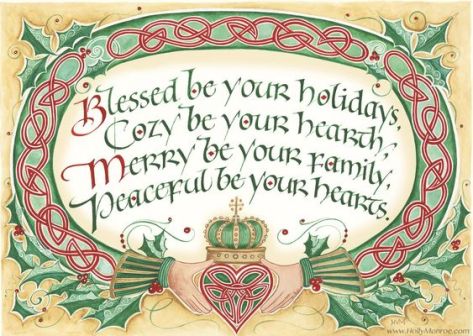
Happy Holidays

Imagine Christmas being cancelled? As we all face lockdown restrictions, we can easily imagine how the Scots felt in 1580 when John Knox banned the celebration of Christmas.
Except that his ban lasted 400 years.
Knox led the Presbyterian movement during the Reformation when Scotland officially split from the Roman Catholic Church. He saw Christmas as a Roman Catholic celebration and wanted none of it. Parliament backed him. In 1640, an Act of the Parliament of Scotland abolished the “Yule vacation and observation thereof in time coming.”1 Christmas Day only became a public holiday in 1958. It took almost two decades more to get Boxing Day, which happened in 1974.2
The celebration of Hogmanay, or the coming of the new year, took on a greater significance.
There are a few theories about the origin of the word Hogmanay. The Scandinavian word for the feast preceding Yule was Hoggonott. The Flemish words hoog min dag mean great love day. Some believe that the origin of the word Hogmanay can be traced back to the Anglo-Saxon Haleg monath or Holy Month or the Gaelic words for new morning, oge maidne. Many believe that the source is French, homme est né for man is born. In France, the last day of the year when gifts were exchanged, was called aguillaneuf and in Normandy, this was called hoguignetes.3
My father, Edward McHugh, was usually the “first-footer.” He stepped across the threshold after midnight, bearing gifts. Traditionally, to ensure good luck, the first-footer is a tall and dark-haired male. No one wanted to welcome a fair-haired first-footer, as they were associated with the Viking invasions.4 My father brought gifts of coal and a herring, but some of the other traditional gifts include shortbread, a black bun, and whiskey to toast the new year.5
My Scots grandmother also traditionally cleaned her home from top to bottom, literally sweeping out the old. And if anyone in the family had any outstanding debts, they had to be paid by midnight.
Saining is the practice of blessing your house and livestock for the New Year. Anyone can bless their house, as long as they use magical water from a river that has been crossed by both the living and dead. And you will have to find some juniper bushes to burn throughout your house.6
At Hogmanay parties hundreds of years ago, bonfires would be lighted and tar barrels would be rolled downhill. These fire ceremonies represented rebirth and new beginnings. Sometimes animal hides were wrapped around sticks and lit on fire. It was thought that the smoke would ward off evil spirits. 7
Every year Edinburgh hosts its Torchlight Procession to recreate the fire ceremonies. This year, it will be on-line so we can all enjoy the celebrations.8
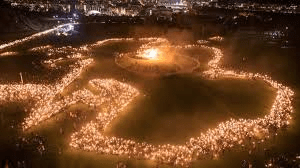
Edinburgh’s Torchlight Procession, 20189
Of course, it would not be a party without ceiladh dancing in Scotland. The word ceilidh means simply ‘gathering’ or ‘party.’ So essentially, it is a gathering that features music and dancing. 10
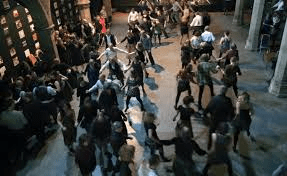
Ceiladh dancing at Edinburgh Torchlight Procession 11
The partying and hospitality that goes on at Hogmanay is a way of wishing family, friends, and strangers a Guid New Year.
I wish you all a very Guid New Year.
These institutions are highly active in the field or Oral History :
In full partnership and cooperarion, BAnQ with all of the groups and above educational institutions listed have agreed to post online at BAnQ Numérique, as dossiers at BAnQ Advitam, as documents or books at BAnQ Catalogue, and papers penned by professors, authors, historians, university students, college students in both the English and French languages, all addressing: Oral Interviews.
the following is what can be found at BAnQ addressing Oral History.
Click below to access database:
One of my favourite photos of the ancestors shows a man wearing a top hat, a dog by his side. Sent to me by a cousin about a dozen years ago, the image was identified as “Great-grandfather Robert Hamilton.” That was my great-great-grandfather, the Scottish-born weaver who immigrated with his young family to Scarborough, Upper Canada in 1830.
I thought it would make the perfect cover photo for the book I am writing about the history of the Hamilton family. Most studio portraits taken in the late 1800s were uniformly stiff. Although this man has a serious expression, the image is unusual for its painted background, and dog is appealing.
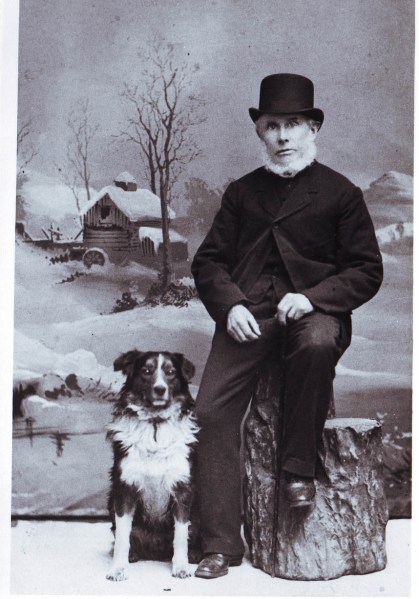
But was the man in the photo really Robert Hamilton (1789-1875) the immigrant? After all, he had a son named Robert Hamilton (1824 -18731) and his grandson was also Robert Hamilton (1856-1908.) I forwarded the photo to several distant cousins who have researched the family, and to Rick Schofield, archivist at the Scarborough Historical Society, in east-end Toronto.
Rick was the first to reply, probably horrified that I might have already gone ahead with the cover. I speculated that the photo might have been taken in the 1850s, and Rick pointed out that there were no photo studios in Scarborough then, and travel by horse to Toronto would have been quite a challenge. He asked what the original photo looked like (I didn’t know) and pointed out that, in the 1850s, Daguerrotype, Ambrotype (glass) and tintype photos were the most common, as well as albumen type and card-mounted photos.
I then forwarded the image to several other relatives, including cousin Alison in Dallas, Texas. It turned out she has an original carte de visite of this photo that includes the name place where it was taken: J.J. Milliken Photo Studio, Toronto.
A quick search online showed that this studio was in business in the 1890s. Since Robert Hamilton the immigrant died at age 86 in 1875, and his son Robert Hamilton died of typhoid fever in 1871, that left grandson Robert Hamilton, a farmer in Southwestern Ontario.
Case closed, I thought. Until I realized, not so fast. If the photo was misidentified as the wrong Robert Hamilton, how could I even be sure this person’s name was Robert Hamilton? This could be a picture of any family member, perhaps the husband of one of the daughters, a cousin, or even a close friend. All I can say for sure is that this photo was taken in the 1890s, by a Toronto photo studio, and was probably a picture of a member of the Hamilton family.

I recently used the photo of the man in the top hat on this blog. It has now been replaced with a verified picture of Robert Hamilton the immigrant, taken when he was an old man. This photo is included in a history of Scarborough that was published in 1896. At that time, the editor would have been able to check the sitter’s identity with residents who remembered him.
So, who wrote the wrong identity on the photo sent to me years ago? Probably my Aunt Margaret or Uncle Glen Hamilton. Both were proud of their Scottish origins and interested in the family’s history, but neither of them actually did the hard slog of genealogy, looking up and sorting out births, marriages and deaths. They would not have realized that their great-grandfather died years before this photo was taken.
They made an assumption and I didn’t question it for many years. Lesson learned.
The Genealogy Ensemble Banner
Several of the photos in the Genealogy Ensemble banner up top include members of the Hamilton family. At far left, my father, Jim Hamilton, and his twin, Arthur, in 1918; a Catholic church in Quebec, photo by Barry McGee; Gwendolyn Bagg, my grandmother on my mother’s side, on her wedding day in 1916; left to right, three cousins in Winnipeg: Margaret Hamilton, Isabel Hamilton and Olive Hamilton, around 1915; Jim Hamilton’s baby book; Whickham Parish Church, County Durham, England; OPR birth record of Alexander Tocher, Grange, Banffshire, 1754, http://www.scotlandspeople.gov.uk.
Notes and Sources
1. David Boyle, editor, The Township of Scarboro, 1796-1896, Toronto, 1896 (http://www.archive.org/stream/cu31924028900970/cu31924028900970_djvu.txt)
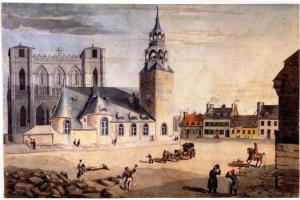 the-british-isles-american-european-immigrants
The following database contains a collection of selected works by authors who wrote about the many nationalities who immigrated to Canada from the late 1700’s to today.
Below is a brief sample of authors and the title of their books.
Douglas J. Borthwick Montreal its history : to which is added biographical sketches, .
Patrick Donovan – The Irish – Irish Famine Orphans in Canada
Mary Alice Downie – Chinese in Montreal: Early voices
Dany Fougères – Montreal – A history of a North American City
Laurent Busseau – Montreal’s Italian Community – Guido Nincheri
Collectif (various authors) – List of notaries whose notarial records are deposited at the archives of the city and district of Montreal
Collectif (various authors) – 1881 – Montreal Guide Book with Map
Jacques Lacoursière – People’s History of Quebec
John McConniff – 1890 – Montreal – Illustration, history, scenery, grand institutions – Vol 1 & 2 & 3 & 4
Ken McGoogan – Flight of the Highlanders – The Making of Canada Montreal’s Jewish community from the 1880s to 1945
Denis Vaugeois – The first Jews in North America. The extraordinary story of the Hart family 1760-1860
Click the following link to access the database.
the-british-isles-american-european-immigrants-to-quebec-from-1759 montreal-regions
In the five years since her arrival from England in 1961, Elizabeth Fulcher married my widowed father, mothered his four children and had a baby of her own.
Although her roles as wife and mother of seven kept my stepmother plenty busy, Elizabeth continued her interest in teaching. In 1969, with two babies of her own, she organized a nursery school counselling the parents while they observed their children at play. However, it proved to be stressful and more difficult than she imagined.
Instead, Elizabeth taught herself the necessary bookkeeping skills to look after my father’s accounting needs in his engineering company thereby reducing his operating expenses. In compensation, Elizabeth allocated the rental income from Tom’s office tenants to her household budget which had remained unchanged since the day they married.
My father Tom grew up during the Depression which most likely left an impression on him. He worked long hours running his company in order to support his growing family and always managed his money carefully. Never would he consider debt to make ends meet.
Fortunately, Elizabeth knew how to ration pretty much everything from growing up in wartime England. Many of the same clothes were worn by child after child. Various craft projects littered the kitchen counter between meals. We all enjoyed the trunk full of old fancy clothes which provided endless hours of dress-up skits over the years.
Her only request? Once a month they wined and dined out… just the two of them.
At one point, Elizabeth received an inheritance from her family in England. She quietly used the money to pay for necessary repairs around the house. Alternately, Tom invested his family inheritance to provide a family nest egg for emergencies. The arrangement seemed to work well for them.
In 1976, Tom sold the Knowlton cottage after 20 years of memorable family summers, and bought land in Franklin, Vermont, with the proceeds. He designed and built a large shell of a two-story house with a deck spanning the entire width of the upper floor overlooking a fabulous view of the nearby fields and the mountains in the distance.

Over time, Elizabeth saw to the finishing touches like walls, cupboards and a septic tank making it into more of a home. Together they blazed trails in the woods, planted gardens and, for a time, beekeeping produced the family honey. What a sight to see Elizabeth handling the large red tractor like a pro… sometimes towing a trailer full of kids!

The children eventually brought their children to enjoy autumn walks, bonfires, winter sledding, berry picking, crafts, games and the breathtaking view. A wall of photos captures some of these memories – even a family wedding.
Elizabeth graduated from McGill University in 1988, at age fifty, with a Degree in Special Education. She continued teaching children with learning disabilities part-time for a while and felt secure that she could support herself if need be.
After Tom died in 1995, Elizabeth joined The Unitarian Church near her in Montreal. She volunteered actively for ten years in variety of ways. In 2015, the church awarded her “The Unsung Hero Award” to acknowledge and celebrate her efforts. Even today she volunteers her time with their “Caring Committee” and organizes visits with anyone in need of some company.

This year, due to the Coronavirus lockdown, the family was unable to gather at the house in Vermont for our usual Thanksgiving turkey dinner feast. Instead, Elizabeth enjoyed time with a whole bunch of us on a “Zoom” meeting and afterwards sent this heartwarming note to all her stepchildren, children and grandchildren:
“I feel as if I have been with all of you (on the Zoom video) and am really lucky to have such a wonderful family. You may not realize it but you all are the most significant aspect of my life. I did not want a career, I wanted a family and I am so pleased with the way you live and your authenticity. With love from Elizabeth, Mum or Nanna”.
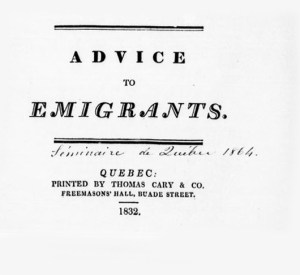
The database consists of the many authors who wrote about immigration to Canada.
Below is a sampling of the titles and their content.
Robert J. Fraser – Scots of the Seaway Valley – As others see us >
J.I. Little – Borderland Religion – The emergence of a Canadian identity 1792-1852
Burton Lang – Old and new placenames of South Western Quebec
Harvey Mann – Samuel Jacobs (Schmuel Jacobs) – The Jew of St. Denis (Saint-Denis-sur-Richelieu) 1761-1786
J. L. Hubert Neilson – Sorel – St-Jean-sur-Richelieu – Laprairie – The Royal Canadian Volunteers 1794-1802
Click the link below to open the database:

The Fenians were a group of Irish Patriots living in the United States having left Ireland during the Potato Famine and the crop failures. Millions of Irish citizens immigrated to the United States, Canada and Australia.
This secret society had one goal in mind and that was Irish independence from Britain. They began by launching several small attacks beginning in 1866. In Canada. The Fenians were taken seriously and Britain and Canada had spies infiltrate the Fenians. The Canadians had 10,000 volunteers called up for duty. However, these volunteers were poorly trained and lack supplies including rifles. Several days later the Fenians crossed the border near Huntingdon and as they were advancing they realized that opposition was converging on them.
The Battle of Ridgeway was the largest raid fought by Canadians. They defeated the Fenians at Pidgeon Hill.
There was a lull for several years and then in 1870. 13,000 volunteers were called up to defend the borders. The Fenians remained largely an effective group.
Click here to access a database of Authors who have written about the Fenian Raids in Quebec.
Click on the above link to access the many authors who have written books on the Fenian raid.
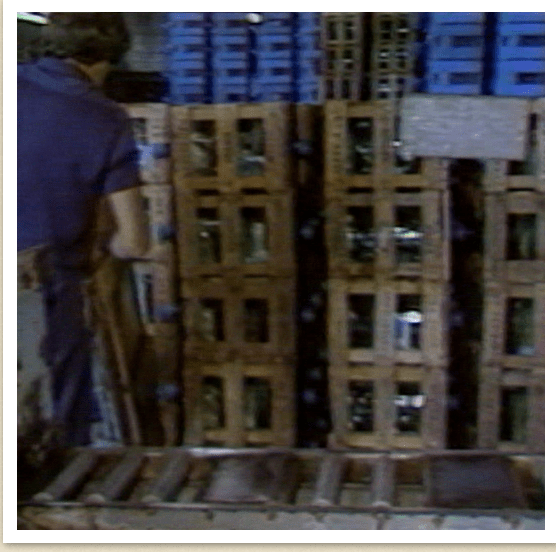
Pic above: Bottled water on an assembly line of large glass water bottles at the Laurentian Spring Water Company, circa 1986.
The image above was captured from a 1986 television news report aired on the centenary of the founding of the landmark Montreal company, Laurentian Spring Water. Laurentian was the first bottled water company in North America!
Laurentian was a family business and my father-in-law was a shareholder. His father, Thomas Wells, or Fuddy, had been President of the Company in the first part of the 20th century.
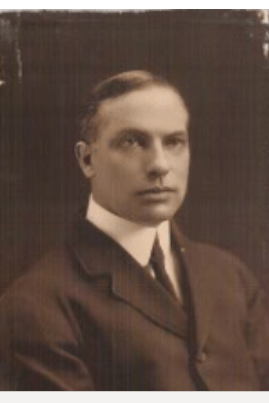
This homage didn’t make for the most exciting news item: an assembly line and a talking head, the current General Manager discussing the history of Laurentian.
The GM said that the company was founded a century earlier when a certain Mr. Robert C. White, a shoe manufacturer, accidentally discovered a wonderful gusher of fresh water 250 feet down while digging under his business on Craig Street. Lots of water was needed in shoe manufacturing.
But, as it happens, this water was especially fresh, from a 5000 year old aquifer the man on the TV said, originating far away in the Laurentian Mountains, hence the company name.
He explained that horses were used to power the drill down into the earth. By the 1980’s, there were two wells, one 250 feet down and one 500 feet down.
While researching my story MILK AND WATER (where I have Thomas Wells and my grandfather, Jules Crepeau, Director of City Services, discuss water and Montreal politics in 1927 while waiting for the Prince of Wales outside a speak-easy) I learned that Montreal island has many such aquifers. Whether or not they originate in the Laurentians is debatable.
Around 1900, during a time of typhoid, Robert White exploited this wholesome mountain imagery to break into the home-water market, by advertising that he had the PUREST water in town. The scientists out at Macdonald College in Ste Anne de Bellevue had tested it, apparently.
Up until then, White had used his glorious geyser to create a ritzy public bath where City aldermen from around the corner at City Hall conducted private meetings while sweating it off – and an elite swimming pool for water polo competitions and such. Women were allowed in on Wednesdays.
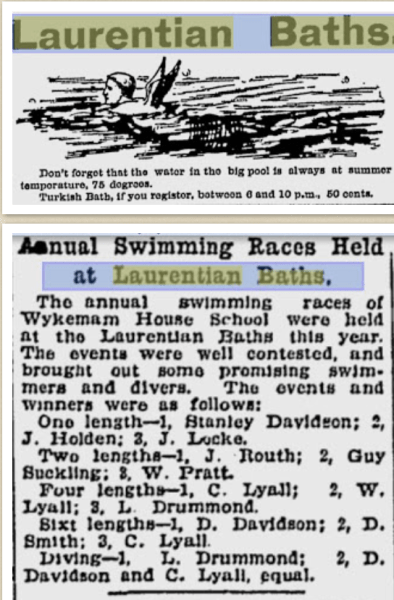
“PURITY” was a loaded concept back in the early 1900’s in North America. It had to do with tainted food, a genuine issue, tainted alcohol, typhoid and cholera epidemics, and also fears and racist beliefs about immigrants from Southern Europe and elsewhere. Ivory Soap and its 99.9999 percent pure slogan was born in that era, one of many, many new products advertised as pure in places like the Ladies’ Home Journal.
Robert White, who died in 1904, was Fuddy’s Uncle, it appears. According to family lore, he had a disinterested son so he brought Fuddy in from Ingersoll, Ontario. Fuddy was the son of a top Ingersoll lawyer who was from Cambridgeshire, England.
My husband’s grandfather had a gift of the gab, but the 1911 census has him down as an accountant for the company earning 7,000 a year, a lot of money in those days.
It is said that 1,500.00 a year was the minimal salary to keep a family of four in dignity. Few families in the City made that amount of money, even with both the Mom and Dad working. And even fewer had such small families. Still, my father-in-law maintained that it was Fuddy’s wife’s dowry that allowed them to live the high life in tony Westmount in the Roarin’ Twenties.
By that decade, Fuddy was a member of many prestigious clubs, including the St. George’s. Back in 1903, the St George’s Club had sued the city of Westmount, a dry city, claiming that as a private club they had every right to serve alcohol.
Fuddy participated in lawn-bowling and curling (and boozing) all in the name of the big schmooze.
My father-in-law claimed Fuddy regularly visited the restaurants around the Mount Royal Hotel and greased the palms of the waiters so that they would serve Laurentian brand soft drinks. Soft drinks were originally created to cut the bad taste of bootlegged liquor.
Fresh water was not considered a human right or even a necessity in the big city in the Victorian era. Water pipes were brought in to keep fires at bay and preserve businesses. Water fountains were placed on Mount Royal only to keep fathers from heading off to the tavern to quench their thirst.
Private homes had to find their own water, either digging a well or getting it from the St. Lawrence River. The poor people of Montreal, many of whom lived ‘below the hill’ in Griffintown, often had no source at all of drinking water, and many still used privies, holes in the ground, as toilets. But filthy water they had a’plenty, every Spring, when their homes flooded. Montreal had the highest infant mortality rate in the Western World due to intestinal diarrhea from contaminated water and milk and the working class suffered the most.
Wealthier people could pay private water sellers to lug barrels up from the river for them. If you did have a tap at your disposal, the water was suspect as the City disposed of its waste very near where it accessed its tap water.
No surprise then that in the early 1900’s Montreal had a series of game-changing typhoid epidemics that took a toll on both rich and poor communities. This made it easy for Laurentian to start selling water to homes. They played it up in the newspaper.

My father-in-law also claimed that during one of the epidemics Laurentian gave water away to anyone who wanted it. I found no newspaper ads suggesting this.
The man on the TV in 1986 said something very interesting. He said that by the 1980’s, thanks to enormous efforts over the decades by the City to provide all households with potable water, Laurentian was selling only to offices, but they were hoping to once again sell to households.
Hmmm. Something was happening here! There were no typhoid epidemics in the 1970s’. Walkerton would only happen a decade later.
It was all about finding new markets. And, as we all know, new markets were found, with the help of a widely-circulated myth (with iffy origins) that everyone needs to drink eight glasses of pure water daily to clear out their kidneys. Meanwhile plastic water bottles fill the oceans and the relatively new idea that fresh water is a universal human right and not a commodity to be hoarded and exploited, is being challenged.
The family-owned business was soon sold to the Labrador company, now Labrador Source. My father-in-law inherited a small fortune and helped us buy our first house.
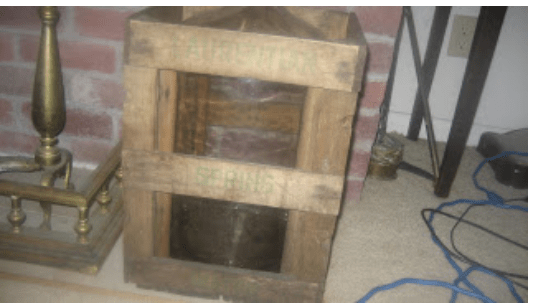
Family heirloom: A Laurentian Crate in our living room. Glass bottle of course.
Michele Dagenais of the University of Montreal is the expert in Montreal’s Water history. I used many of his papers to write my own book. You can buy Montreal:City of Water here. As it happens, Professor Dagenais also wrote a book about early Montreal CIty Hall, where he discussed my Grandfather, Jules Crepeau and his job as Director of City Services.
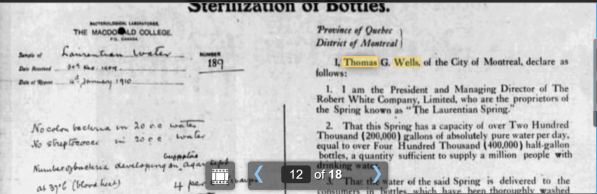
The company’s advertising, especially during the typhoid epidemics, was quite savvy, even experimental for the time. Here during 1911 in the Montreal Star, my husband’s grandfather pledges that their water is pure, showing a document from Macdonald College.
Twenty Confederate soldiers attacked the village of St. Albans, Vermont on October 19, 1864. The raid was planned to avenge assaults on Southern cities, to obtain money needed by the Confederacy, and to cause confusion and panic on the Northern border. The raiders robbed three banks of more than $200,000, killed one citizen and wounded two others, stole a number of horses, and tried unsuccessfully to burn down the town. The Confederates, with Vermonters in close pursuit, escaped across the Canadian border. Eventually several were captured and arrested by Canadians. MilitaryHistoryNow.com
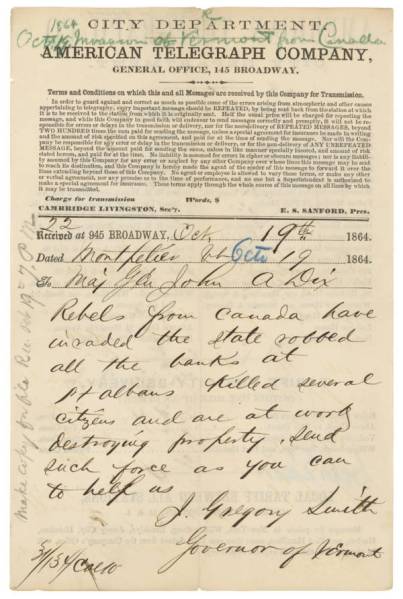
Click below to access St. Alban’s Raid of 1864.
 Genealogy Ensemble