I was too young to know my maternal Great-Grandfather, Thomas Bevan. However, I do have some memories of him – mainly in his casket – in the front room of his house at number nine, Pellow Place Stoke, Plymouth Devon. The coffin stayed in the house for 7 days before the burial. My gran said I had to kiss him goodbye so that I would have pleasant memories of him and no nightmares!
Thomas was born in the little ancient town of Okehampton in West Devon on the Northern edge of Dartmoor and had a population of less than 6,000 in 2011.
The name Okehampton means settlement or estate (tun) on the River Okement and was founded by the Saxons. The earliest written record of the settlement is from 980 AD. The early form of the name Okementone is recorded in the Domesday Book of 1086, and later in 1167 and 1275 as Okemento(a).
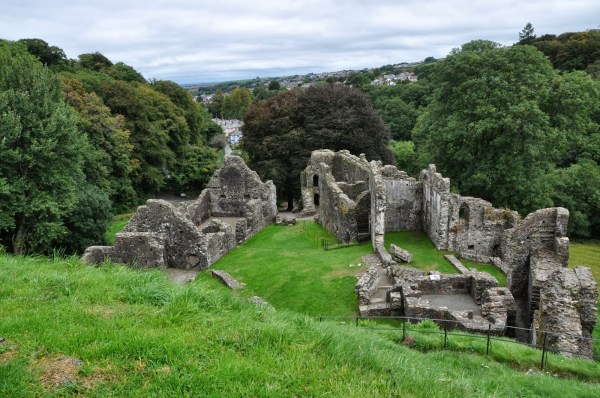
Like many towns in the West Country, Okehampton grew on the medieval wool trade. Notable buildings in the town include Okehampton Castle, now a ruin, established by the Norman Sheriff of Devon, Baldwin FitzGilbert. following a revolt in Devon against Norman rule.
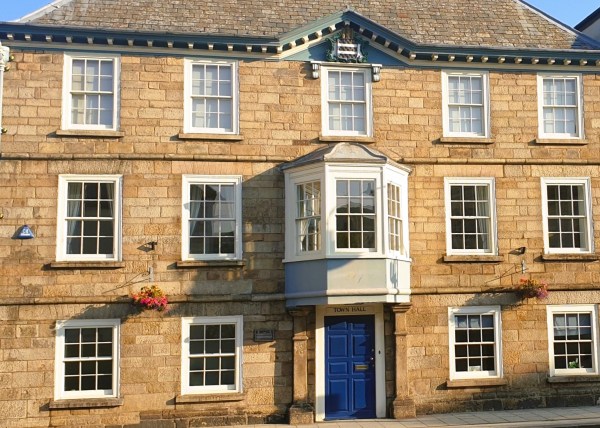
The 17th-century Okehampton Town Hall.
My Granny used to pronounce it as “Okenton”. Apparently, as late as the 1930’s the older people of the district pronounced it “Okington” or “Okenton” I asked Granny why she said it that way, and she said that was how her Father pronounced it. (1)
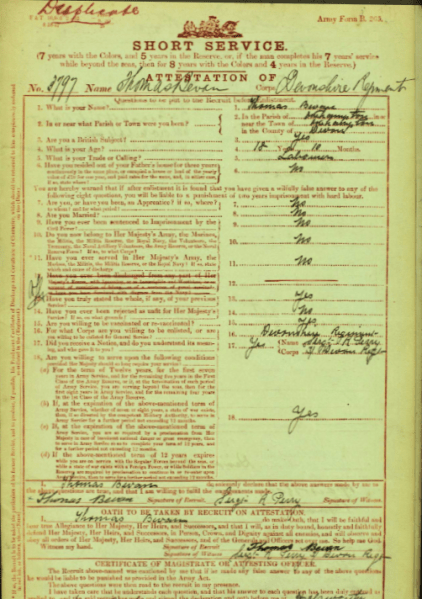
On the 18th of October, 1893, when Thomas was 18 years and 10 months old, he joined the Devonshire Regiment for ‘Short Service’.
The term “short service” refers to a type of enlistment in the British Army, introduced in 1870. It allowed soldiers to serve for a shorter time than the standard 12 years of service. Thomas served for eight years and then joined the Royal Navy at age 25.
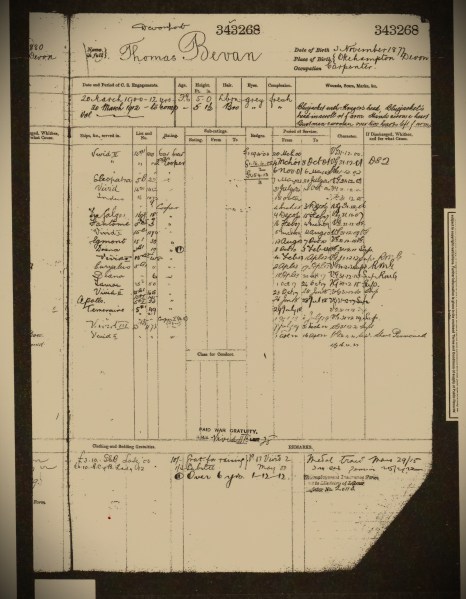
According to his records, when he joined the Royal Navy for a 12-year engagement on the 20th of March 1900, two years were added to his birth year. He was born in 1875 but his Royal Navy service Records show 1877.
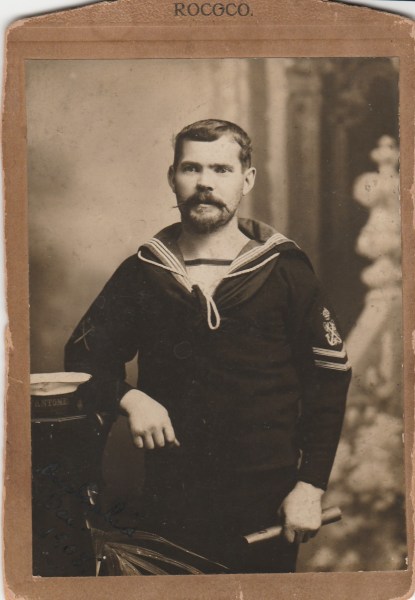
Thomas became a Cooper and Master Carpenter on HMS Vivid II. This was a shore establishment, in the Devonport Dockyard in Plymouth, where I was born and lived. He may have learned of the rules regulations and history of the Royal Navy whilst there and probably picked up the basics of his trade too. According to his Service Record below, he served on many different ships and finished his service 12 years later, also on HMS Vivid III. (2)
Thomas Bevan’s Royal Navy Service Record
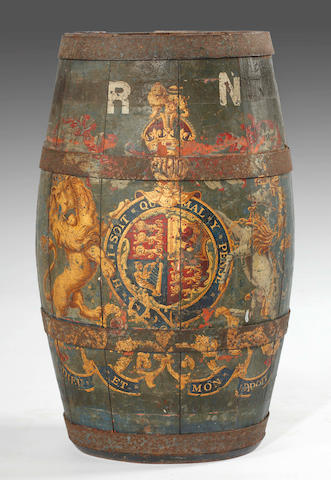
Granny told me that Thomas made and repaired wooden barrels, casks and other containers. The daily Rum ration for the Royal Navy, called the ‘tot’ for the crew was stored in a barrel such as Thomas would have made. The daily tot was abolished in 1970; I remember it made headlines in England. The reason was concerns that the intake of strong alcohol would lead to unsteady hands when working machinery.
A Scarce Royal Navy Rum Barrelmade of English oak painted overall in blue faded to green on the front. Bound with four iron bands, the front was painted with post-1901 Royal Arms and R.N. and retained trace imprints of earlier bands.
Thomas lived with his wife, Lilian, their daughter Edith O’Bray (my Granny) and her husband Percival Victor (my Grandfather) in the early 1950’s in Plymouth at number nine Pellow Place Stoke. I lived with my parents five doors down from them at number four.
Although my Granny, Edith was born in 1900, her mother Lillian was single. Lillian’s father, a gardener named Thomas Symons, went to the Royal Navy to find the child’s father. Thomas had no idea he was a father as he was at sea for three years. When Thomas did arrive home on HMS Cleopatra in 1904 he married Lillian and the family went on to have six more children. Granny was already four years old then. The following link explains those circumstances.
My Granny, his daughter, told me that her father tragically died in her house, whilst asleep in his chair. Everyone had gone shopping and when they arrived home, the house smelled of gas and Thomas was dead. Apparently, gas had leaked into the house, killing him. She told me he was a kind, quiet man.
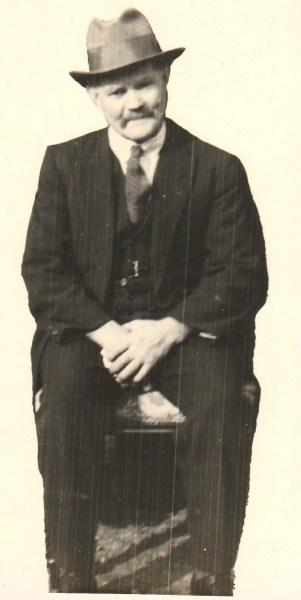
The photo below of him at 71, was taken about one year before his unfortunate death on the 31st of May, 1947.
The Royal Navy in the year 1900 had several tradesmen who were responsible for the maintenance of the ships and their equipment. One such trade was that of acooper. A cooper is someone who makes wooden, staved vessels, held together with wooden or metal hoops and possessing flat ends or heads. Examples of a cooper’s work include casks, barrels, buckets, tubs, butter churns, vats, hogsheads, firkins, tierces, rundlets, puncheons, pipes tuns butts, troughs pins and breakers.
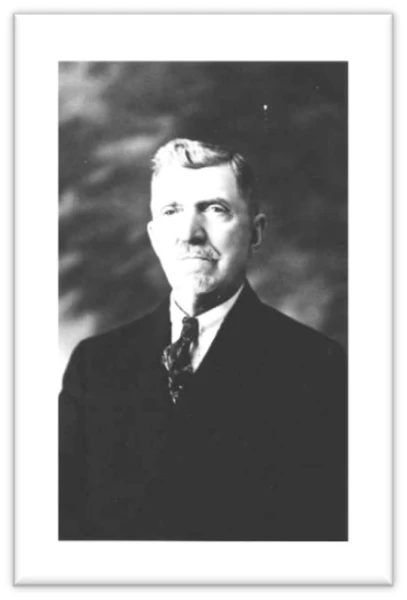
In the late nineteenth and early twentieth century, many enthusiastic young men with entrepreneurial spirits set out to make their fortunes. L.J Jodouin, my maternal; grandfather was among them. It was said that where there was a need he found a way to fulfill it. L.J.’s business ventures were a great success.
Louis Joseph Jodouin was born in 1861 in Montebello, Quebec, the third of five children of Joseph Jodouin and Leocadie Fortin. When he was a young man his family moved to Hull, Quebec where he was schooled by the Christian Brothers and attended college in nearby Ottawa.
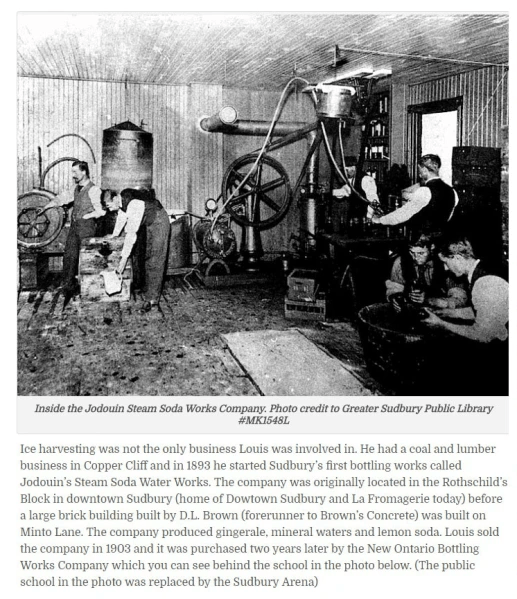
In 1891, at the age of twenty-seven, he went to Sudbury, Ontario where in nearby Copper Cliff prospectors found nickel and mines were being opened. It is there he started his first enterprise, L. J. Jodouin Bottling Works. With six employees he bottled and sold ginger ale, lemon soda, cream soda, and mineral water. Due to the influx of miners, the Sudbury area was a new and growing community, and L.J.’s business was profitable
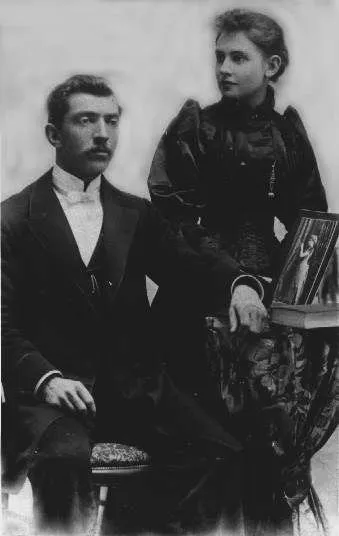
Louis and Louisa
1893
With financial security assured the young man decided it was time to seek a bride and start a family. Although the couple had the same grandfather and different grandmothers, they received dispensation and were married in Saint Columbkille Cathedral in Pembroke, Ontario in January of 1893. The young couple settled in Sudbury where they built their home and raised nine children, three boys and six girls.
In 1903 the bottling works were sold to the Taylor and Pringle Company of Owen Sound. His next venture was an ice business. He built a huge icehouse in the rear of his home along with a stable for the horses. At the time people had wooden iceboxes where the top section was lined with metal and large blocks of ice were placed within. Foods that needed to be kept cold were placed on shelves below. Ice was delivered regularly in the same manner as milk and bread from house to house by horse-drawn wagons and later years by truck.
Over the years Louis Joseph had many enterprises. He built a boathouse on Lake Ramsey, a large lake nearby. He rented boats and canoes. He ran a water taxi service and a huge gasoline-powered barge to transport large quantities of building and personal supplies for the people building cottages along the lake. The boat house was also used for storing huge blocks of ice during the winter months.
The ice business was my grandfather’s lifelong enterprise and the most successful. A key to the success was the annual contracts with both railways. The Canadian Pacific and the Canadian National Railways. This arrangement continued until the mid-1940 when the trains acquired powered refrigeration.
My cousin Madelyn Percival described how Grandfather would spend his days.
“In the winter months, Grandfather would often go out on Lake Ramsey to oversee the ice operations wearing his long raccoon coat and fur hat and fur mitts, but for the most part, he ran the business from a rocking chair near the dining room window overlooking the backyard where the horses were kept so he could see all the action!”
He was a good employer, and an active citizen, a town councilor, a school trustee, a voluntary fireman, and a member of the Board of Health. He played in the town band, sang in the church choir, and was an avid lacrosse player until he was hit in the head and lost his hearing.
“L.J. bought one of the first motor cars in Sudbury, although he could not drive because of his deafness. His eldest daughter, Alice Percival was the first woman driver in Sudbury and for many years she was his chauffeur.”
In 1943 on the eve of his seventy-ninth birthday Grandpa Jodouin passed away. His son, Arthur, continued the ice business into the late 1950s and early 60s supplying the many cottagers in the area until electricity became available.
References:
Ancestry.com Quebec, Canada Viral and Church Records. Drouin Collection 1921-1968 database online.
Sudbury Star newspaper article., Author, Gary Peck. “The Not-so-distant Past, Jodouin Steam Soda Water Works.” October 2, 1981
Ancestry.com. Ontario, Canada, Catholic Church Records. Drouin Collection 1802-1967 database online.
Archives of Ontario, Toronto, Canada Registration of Marriage, 1869-1928 Series MS032:Reel 70 source ancestry.com and Genealogical Research Library( Brampton, Ontario, Canada Ontario Canada Marriages Ancestry.com Operations In.,2010.
Excerpts from an interview with the author and her cousin Madelyn Percival Smith , Louis Joseph’s granddaughter, Toronto Canada, August 2010.
Below is a video: cutting ice on Lake Ramsey
This biographical sketch of my maternal grandfather was first published in our book “Beads in a Necklace” published in 2017 by our Genealogy Ensemble group. It seems appropriate to include it in our ongoing blog.
Napoleon Bruneau died tragically on a Sunday night in 1916. The La Presse newspaper reported the train accident at Delson Junction on the CPR line but no details were given. This was not far from his home in St-Constant, Quebec. Was he coming home or going to Montreal? What happened? Did he fall on the tracks? He was almost 72 years old so he should have known better than to get in front of a train!
He and his twin sister Mathilde were the 5th and 6th children of Barnabe Bruneau and Sophie Marie Prudhomme. He lived his whole life in St-Constant, south of Montreal. It seems he inherited the family farm after his parent’s deaths.
Napoleon and his sister Sophie Bruneau
Descriptions of Napoleon included being a farmer, a Free Will Baptist, a veterinarian and a justice of the peace. He was appointed a justice of the peace in 1902 for the district of Montreal which included St-Constant. It is possible he studied to be a veterinarian and didn’t just learn as an apprentice. A school for veterinarians was established in Quebec in 1866 with one of his cousins, Orphyr Bruneau as one of the lecturers. In 1876 courses were also offered in French when the school was under the McGill University Department of Agriculture. The Veterinary school, later associated with The University of Montreal, moved to Oka in 1928 and to its present location in Saint-Hyacinthe in 1947.
One would think that a tall handsome man with many interests and a farm would easily find a wife, so I found it strange that he didn’t marry until he was 66. His brother, Reverand Ismael Bruneau performed the ceremony at his Protestant Church, L’Eglise St Jean Baptiste de Montreal. Napoleon’s wife Emilie Beauchamp was 42 at the time, so it isn’t surprising that they didn’t have children. Emilie was born in Grenville, Quebec, on the Ottawa River. She probably met Napoleon in Montreal where she lived with her parents and sister Lily. Emilie had an uncle who was a French Protestant minister so it is quite possible that they met through the church.
My great-grandfather, Ismael Bruneau was upset with Emilie after Napoleon died as he wrote in a letter to his son Sydney.
“You know your Uncle Napoleon made me the heir of all his estate except for $500, which I must give after the death of his widow as follows; $300 to my sister Helene, $100 to my sister Virginie and $100 to my sister Elmire. But his widow has everything during her lifetime. As she is a great deal younger than I, it is almost probable that I shall never enjoy this myself. They say she is already neglecting the house which is going to ruin and according to the law she must maintain it in good condition as it was at the time of the death of her late husband.”
Unfortunately, Ismael didn’t enjoy any of his inheritance as he died two years after Napoleon. Emilie only died in 1951. I don’t know what happened to the property as she married Emilien Frechette in 1929 and he had his own house and farm. Emilien had been married to two other Bruneau women, Emilina Bruneau, Ismael’s sister and and Ida Girod Bruneau Ismael’s wife.
Napoleon was buried in Mount Royal Cemetery with his sister Helene, her husband Celestin Lachance and their daughter Antoinette and not with his twin Mathilde in the Baptist cemetery in Grand Ligne. Emilie isn’t buried with Napoleon or even with Emilien Frechette and his first two wives, rather her final resting place is with her parents in the Beauchamp Cemetery in Marelan in the Laurentians near Grenville.
I haven’t yet found answers to questions about his tragic end.
Notes:
Napoleon Bruneau Obituary: LaPresse January 16, 1916.
Napoleon Bruneau’s death determined to be accidental. The Montreal Gazette, Tuesday, January 25, 1916. Page 7.
when searching for information on the train accident I found another Napoleon Bruneau who was also killed by a train. This accident happened in Huntington, Pennsylvania in 1908. He was decapitated and horribly mangled.
Appointed Justice of the Peace: Montreal Star Monday, June 23, 1902. page 10. Accessed Newspapers.com March 20, 2023.
Letter from Ismael Bruneau to his son Sydney Bruneau. Quebec, February 21, 1917. A copy in the hands of the author.
Orphyr Bruneau one of Napoleon’s first cousins the son of his father Barnabe’s brother Medard.
There are notarial documents, Quittances which are receipts where Napoleon gave most of his siblings 300 piastres each, beginning two years after his mother died. These dispersals occurred from 1894 to 1904. Some received less and I haven’t found the documents for his sisters Aglae and Sophie. His brother Selene had already died and had no heirs. I am unsure if these were money paid to his siblings because he received the farm.
Three hundred piastres were 300 dollars. This would be the equivalent of over $10,000 today. Quebec used the word piastres on official documents into the 20th century. Even later it was used as a slang equivalent to the English word buck.
My very Gallic Grandpapa, Jules Crepeau (1879-1938) proud descendant of the Redones of Eastern Brittany in the Iron Age, among other Gallic Tribes.
Judging from her family tree, my late mother, Marie Marthe Crepeau was a bona fide French Canadian de souche.1
Her father, Jules Crepeau, son of an entrepreneur painter from Laval and her mother, Maria Roy of Montreal, daughter of a master-butcher, have trees that go right back to the boat in France – and yes, mostly to Normandy, Poitou and Ile de France. Classic!2
And yet, according to Ancestry’s (beta) chromosome browser, my mother was not 100 percent “French.”
I’ve provided my own spit to the platform and apparently chromosomes 3 and 12 on her side are English (but that does include the North of France) and chromosomes 17 and 18 are Norwegian (Norsemen -Northmen-Normandy, perhaps?) And a swath of chromosome 2 is indigenous American, making me less than one percent indigenous.
Lately, I’ve subscribed to an interesting infotainment3 website that really dives into a person’s ethnicity from all angles and over a slew of time periods: Ancient, Bronze , Iron and Modern Ages. Sure, I get Eure, Finistere and Vendee (Normandy, Brittany and Poitou) in spades, but I get just about every other area of France, too – as well as some Spanish, French Corsican and French Basque.4
My mom’s French Canadian family tree supports some of this. From the ten percent sample I traced back to France I get natives of Limousine, Aquitaine, the Mid-Pyrenees, Picardy, Bourgogne, Haute-Marne, Bayonne, Les Rhones Alpes, as well as the Canadian North (Innu).5
And let’s not forget my ancestor the legendary pioneer river pilot Abraham Martin dit L’Ecossais (he of the Plains of Abraham fame) who may have been from Scotland. My mom has him at least twice in her tree.
A while back, I figured out that my Mom’s paternal Crepeau line (father’s father’s father, etc.) can be traced back to Vendee but it is likely of Sephardic Jewish ethnicity and hails originally from Spain. 6
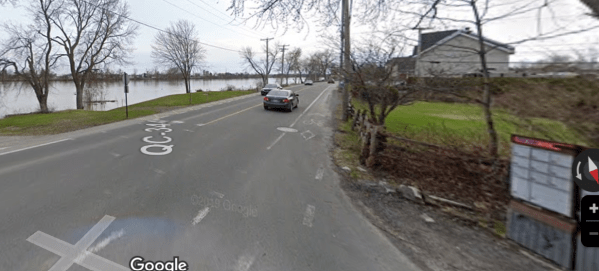
View from Hubou farm (or close). These pioneer farms on the North Shore of Montreal were a narrow stretch of river away from the Eastern tip of Laval Island, and just a bit more north of the Eastern tip (Pointe aux Trembles) of Montreal Island.
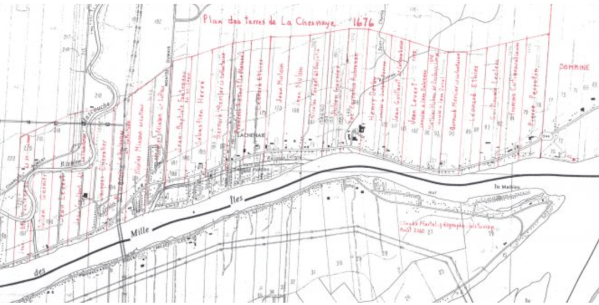
In New France, my grandpapa Crepeau’s maternal tree can be traced to the original families at the Lachenaye (Terrebonne) Seigneury (est.1673) north east of Montreal, four founding farmer families in particular: Ethier (Poitou-Charentes), Forget (Normandy), Hubou (Ile de France) and Limoges (Rhones Alpes). My mother’s DNA is largely a mish-mash of these families’ genes, for they inter-bred down through the centuries. Basil Crepeau my mom’s 4 x GG was a slightly later arrival at Lachenaye who moved in beside the Hubous.
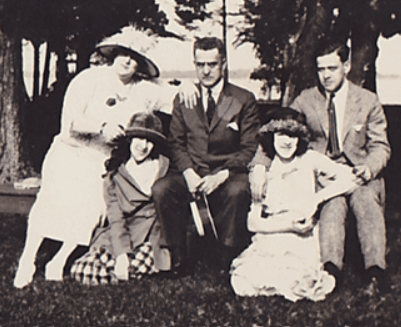
Jules and family before my mom was born circa 1920. Maria Roy (Gagnon) his wife was also connected to the Lachenaye tribe through Ethier.
Now DNA distributes down the generations in very complicated and irregular ways especially where endogamy or founder effect is concerned8 and judging from my many French Canadian ‘cousins’ on Ancestry, my mom may have gotten a disproportionate amount of her genetic material from the Hubou founder family at Lachenaye Seigneury. A great majority of my DNA cousins on that platform are connected to me through her 2nd great grandfather, Michel Hubou dit Tourville.9
As it happens, Michel’s pioneer ancestor was one Mathieu Hubou dit Deslongchamps, a master-armourer from Normandy who was married to one Suzanne Betfer who was…wait for it… a gal from Gloucester, UK.
Now, ain’t that fun! A bona fide English Fille de Roi!!
THE END
1. de souche a controversial label that means from the roots.
(Hereditary disorders in the population of Quebec II Contribution of Perche)
The very first pioneers, the 2,700 super founder families, 1608-1680, were 95 percent French. The later 17th and 18th century founder families were 80-85 percent French but the non-French includes Acadians.) The first 2,700 founder families contributed to 2/3rds of the modern gene pool of French Canadians, but geography and natural boundaries kept families within even smaller gene pools. Indigenous DNA contributed one percent of French Canadian DNA. Regions can have super-founder families that contributed even more to the modern gene pool.
3. Your DNA Portal
4.These ethnicity estimates are based on complex science but the various results have to be taken with a grain of salt. Even if the original science is spot on, these results depend on what sample of your DNA is taken and how far back the algorithm is examining. I liken it to making a complicated stew from various ingredients, letting it simmer for a long time and then trying to deconstruct what it was made from. Maybe you put parsnips, carrots and parsley in the recipe, but these ingredients are already related genetically so it’s not easy to pull apart. Still, taken as a whole the results I get are telling: My mother’s ancestors were mostly from Gaul, especially the tribes Redones and Veneti in Brittany. Hardly a surprise as that’s what my Mom had always been told, that her people were from Brittany. I also get Gaul Santones who lived in Charentes. So spot on!
5. Nos Origines and Drouin
6.My mother is no outlier French Canadian in this respect, at least according to a recent paper that maintains that the Huguenot and Acadian populations are largely made-up of Sephardic Jews escaping the Inquisition. Investigating the Sephardic Jewish ancestry of colonial French Canadians through genetic and historical evidence. Hirschman.
https://nameyourroots.com/home/names/Crespo (Spanish roots likely Sephardic) The name means Curly Haired One. My mom knew that. She did have very curly hair as did her father so that trait passed down through the ages.
The Crepeaus (Crespeaus, Crespo’s Crepspin) are not the only possible Spanish line my mother has in her tree. For instance, her mother’s maternal Gagnon line goes back to one Lily Rodrigue in Normandy, a surname some say is Spanish derived. Another line goes to a Domingo in Bayonne, near the Spanish border. That name is Spanish/Italian and found in Southern France. I also have Navarre or Navarro. ADDED August 2025. I recently got two distant cousins – not related themselves on Ancestry Crespo and Crespim. Both mostly Spanish (very little 2 percent French) with 3 percent Sephardic Jew. Seems to prove my point.
7. Roy is the second most common surname in Quebec. http://leroy-quebec.weebly.com/the-surname-leroy.html . Gagnon is the third most common name and my direct pioneering ancestor hails from Perche in the North of France where he was a leading citizen, apparently.
8. Supposedly, all things being equal, we have only a 47 percent chance of inheriting DNA from an 8th GG, and inherited DNA from 8th GG’s amounts to a fraction of 1 percent but a high degree of endogamy or ‘founder effect’ clearly changes that, judging from the info in the studies in the links I have posted here.
9. On Ancestry, 60 percent of my closer DNA cousins are connected to me through Michel Hubou Tourville and his wife, but it should be noted that a full 400 family trees on Ancestry contain his name. It appears that his descendants moved to the US and did their family trees! Also, these ‘cousins’ tend to have my other Lachenaye names like Ethier and Forget and Limoges in their trees, so impossible to parse.
Endogamy or consanguity? I’ve discovered that my grandfather Jules Crepeau likely had some double first cousins: his mother Vitaline Forget Despaties married Joseph Crepeau and Vitaline’s brother Adolphe Forget Despatie married Joseph’s sister, Alphonsine. I wonder if this happened further up the line. Wouldn’t that have messed with the DNA estimates! If such cousins marry it is closer to consanguinity than endogamy.
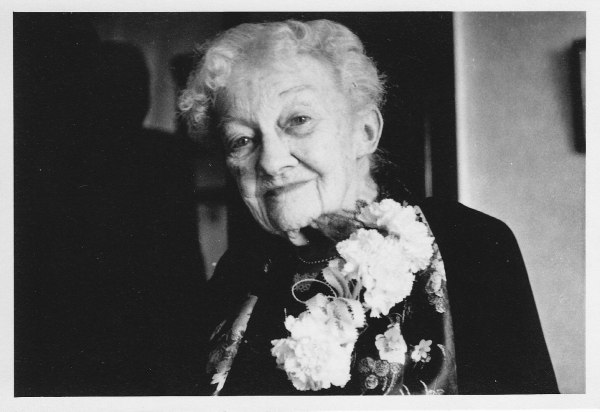
I recently discovered two photos of “Amy” in my dusty old boxes of family memorabilia. The first captured her elderly wrinkled face with a twinkle in her eye and a flower corsage adorning her left shoulder and the other portrayed a 29-year old Amy dressed in a formal gown complete with a silk fan also with a flower corsage on her left shoulder. Inscribed on the reverse side of this second photo, written in Amy’s scrawl, was “Bob with love Amy – Xmas 1894.”
It turns out that Amy C. Lindsay (1865-1960) was my great grandfather Robert Lindsay’s (1855-1931) half sister. His mother Henrietta Dyde died within months of losing her fourth child and, a couple of years later, his father Robert A. Lindsay (1826-1891) married a young Charlotte Vennor (1843-1912) who became stepmother to his three boys – Robert, Charles and Percival – all under the age of ten. Over time, Robert A. and Charlotte had five more children, with Amy being their first born and ten years junior to Robert.
Who the heck was “Bob”?
Amy never married, so “Bob” could not have been a lost love in WW1, as she was 50 years old at that time. The most plausible explanation could be a gift to her older half brother Robert – “Bob” – and that’s the reason why the photo ended up in with my family.
My guess is that she idolized her oldest half-brother and gifted him that special photo which somehow survived the test of time to be found by me in my dusty old boxes. Mystery solved!
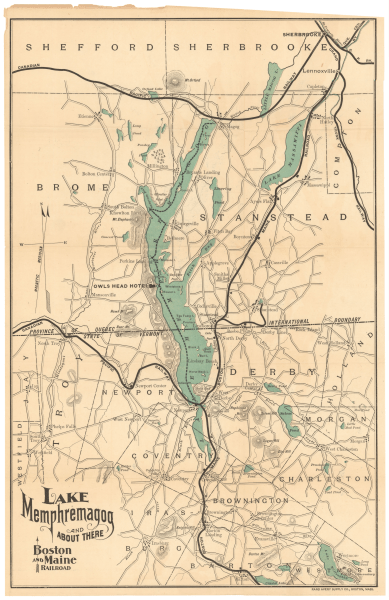
In 1873, when Amy turned eight, her parents bought a huge summer estate property called Woodland on Lake Memphremagog just south of Georgeville, Quebec. Lake Memphremagog1 is in the Eastern Townships just 72 miles east of Montreal, Quebec. It is 31 miles long, from north to south, spanning the international border between Quebec and Vermont but is predominately in Quebec.
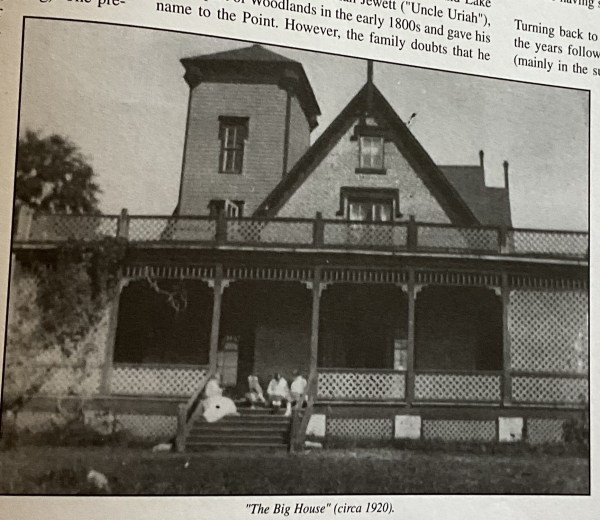
Amy’s father acquired “Woodland” from the original owner William Wood and it consisted of 280 acres of land bordering on the waterfront. William Wood had built a large red brick manor house that a neighbour described as a “barrack with a steeple.” Regardless of how it looked, it became home to several generations of the Lindsay family until the early 1960’s when it was replaced. They affectionately called it “The Big House.”
During this time, several other wealthy English speaking families acquired farm properties in the area and established their summer residences there as well. Woodland became a full functioning farm complete with livestock and crops all managed by hired hands. Over time, various third parties managed the farm until well into the 20th century, which left the family with plenty of free time on their hands.
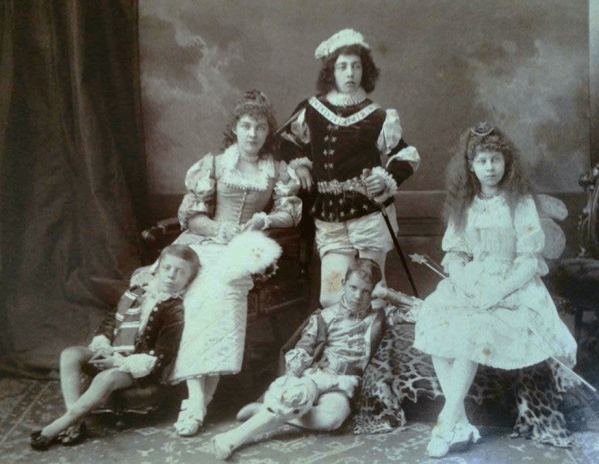
The Lindsay family took up residence in the Big House every summer. Amy’s father worked as an accountant for the Bank of Montreal and evidently could be spared for the long summer months to enjoy time with his family. “Apparently Robert Lindsay followed a daily routine of walking around the property with his entire family in tow according to size.” On another special occasion the whole family dressed up in fancy costume clothes for a party.
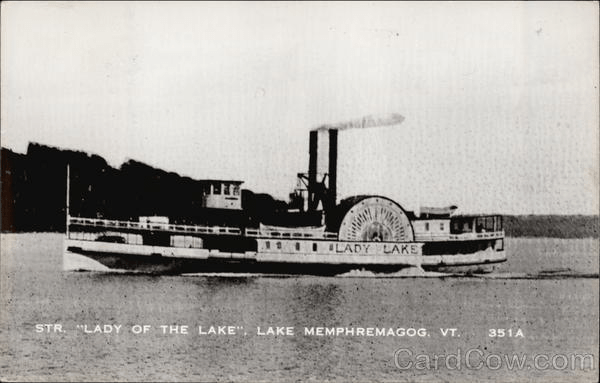
The grand “Lady of the Lake” steamer would sail twice daily on Lake Memphremagog stopping at private docks and thus providing the family with lake excursions right from the front doorstep of the “Big House.”
The Lindsay family (including mother-in-law Vennor who rescued Woodland financially in 1885) enjoyed the property until Robert’s death in 1891. Mrs. Vennor died four years after him and the property devolved to the four surviving grandchildren: Amy, Douglas, Cecil and Edith. (Their brother Sydenham died young while trying to save a drowning victim.)
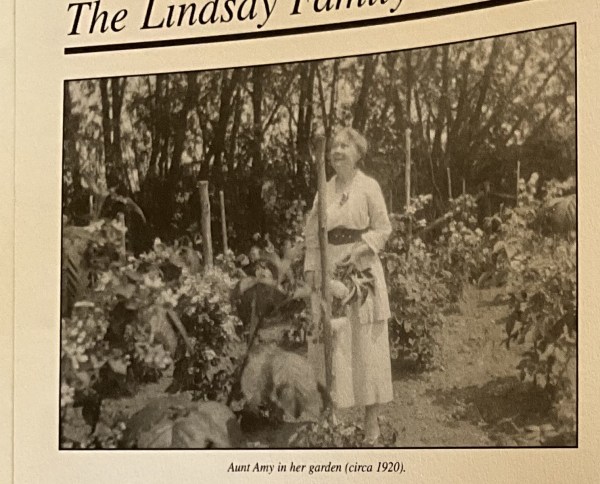
According to her family, “Amy was a small lady, well liked and well respected by most… She loved the lake and Georgeville and spent almost all her summers there… She lived in the Big House and had a beautiful English country garden nearby where she liked to spend many hours puttering about.”2
Although Amy never had children of her own, her many nieces and nephews doted on their “Aunt Amy.” After her mother died in 1913, her nephew took her to Paris and they stayed at the Hotel Pas de Calais, a four-star boutique hotel, right in the heart of tourist Paris. Nothing but the best for Aunt Amy!
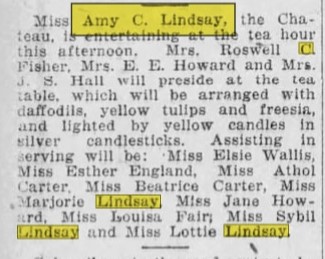
According to an article in the Montreal Star, when Amy hosted a social tea at The Chateau (across from the Ritz-Carlton Hotel), “the tea table was arranged with daffodils, yellow tulips and freesia and lighted by yellow candles in silver candlesticks.” What made it even more special were her five adult nieces assisting her in the serving of tea. She must have been very proud!
Woodland stayed in the Lindsay family until 2020 with several generations enjoying the spectacular property and family legacy. The road leading to their property was aptly named “Chemin Lindsay” and remains so today.
Although Amy spent extended summers with the multi-generational Lindsay family at Woodland, she lived the rest of the year in the downtown area in Montreal known as “The Golden Square Mile.”3 She seemed to move around quite a bit but always within the same area first staying with her mother until her death and then sometimes with her sister Edith (Carter) after that. Although in 1920 she enjoyed “wintering” at the Ritz-Carlton Hotel!
Amy eventually settled for her last 20 years in the Maxwelton Apartments on Sherbrooke Street near McTavish across from the McGill University campus while summering at Woodland until she died in 1960 at age 95.
According to the family, she obtained her first TV late in life and became an avid hockey fan! What a thrill it must have been to watch that first televised hockey game in 1952!
Amy on the Georgeville dock 1955 at age 90
In her last will and testament, written in 1896 when she inherited one quarter of Woodland, she bequeathed “Bob” her cherished set of Waverly books by Sir Walter Scott. He died long before her and, unfortunately, they were not to be found in my dusty old boxes!
Genealogy Ensemble, ( https://www.genealogyensemble.com) our collaborative blog began almost a decade ago. To this day it is still going strong. Nine ladies and one gentleman participate regularly. We, ladies, write stories about our ancestors, while our friend, Jacques Gagne, compiler and researcher prepares informative databases for posting on our blog.
The ladies meet once a month during the school year to discuss our stories. Over the years as our blog has grown with our published stories, we have come to realize that there are several among us who have common ancestors. Janice Hamilton and Lucy Anglin are cousins, Barb Angus and Sandra McHugh have ancestors in Scotland and Marian Bulford writes about hers in the United Kingdom. Dorothy Nixon, Mary Sutherland, Tracey Arial, and I, along with Jacques Gagne have French Canadian ancestors. Great diversity!
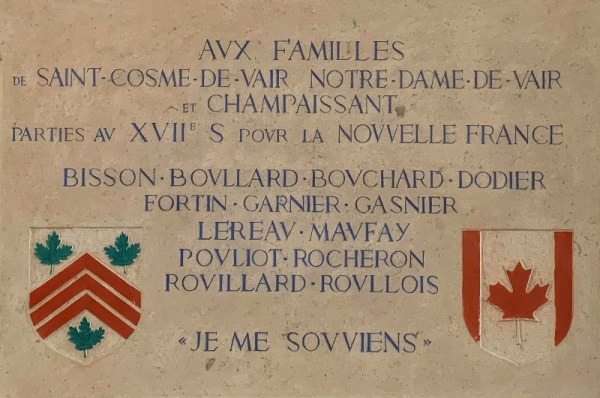
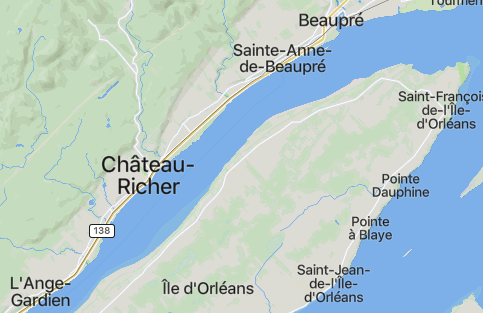
Jacques and I have discussed our ancestors knowing that they came to New France within a few years of each other and settled in the Sainte Anne de Beaupre area.
Initially, being a neophyte writer, and researcher, better skills were required, and completing the branches of our family trees was needed before tackling the relationship between Jacques’ ancestors and mine.
”That time has come”.“
Yes!” We are related going back more than 372 years when Julien Fortin, my 7th great-grandfather, a butcher, who in 1651, followed in the footsteps of Louis Gagne, the baker, Jacques’ great-grandfather who sailed to the New World in 1644 and settled in New France. Both men had occupations that would be welcomed in small communities.
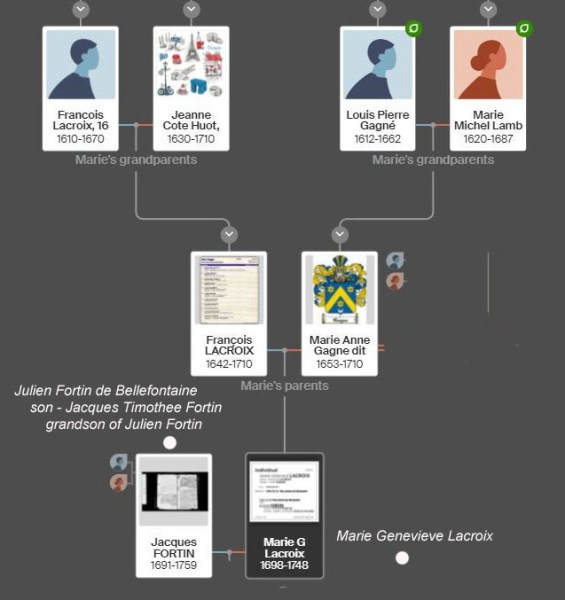
The following graphics and details below tell the story of our ancestors; Jacques’ and mine. I have chosen to use the graphics from my private Ancestry.ca family tree to indicate these connections.
The stories of our 7th Great Grandfathers and their families are intertwined.
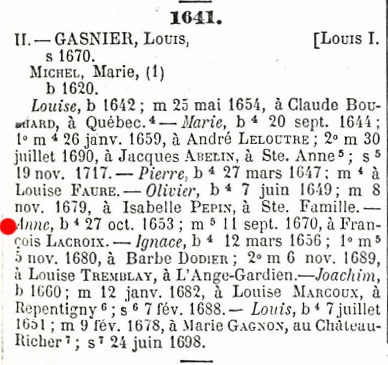
Louis Gagné, his wife Marie Michel, and their daughter Anne Gagné
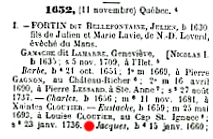
Julien Fortin de Bellefontaine, his wife Geneviève Gamache, and their grandson Jacques Fortin
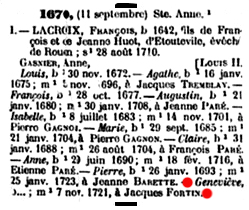
Francois Lacroix, his wife Jeanne Huot, and their son Francois Normand Lacroix
Louis Gagné, Marie, Michel, Julien Fortin, Genevieve Gamache, Francois Lacroix, Jeanne Huot, and their son, Francois Normand were born in France.
The others were born when their families arrived in New France.
Louis Gagné married Marie Michel in France and arrived here in 1644.
In 1651 Julien Fortin arrived and in 1652, married Geneviève Gamaache “ une fille a marier’ who had arrived with her brother, Nicolas Gamache.
Louis Gagné and Julien Fortin along the way eventually found themselves and their families living around Chateau Richer and Saint Anne de Beaupre, east of Quebec City. Both families owned land along the shore of the St. Lawrence River.
GAGNE
FORTIN
Jacques Fortin is the son of Jacques Timothee Fortin and the grandson of Julien Fortin and Geneviève Gamache.
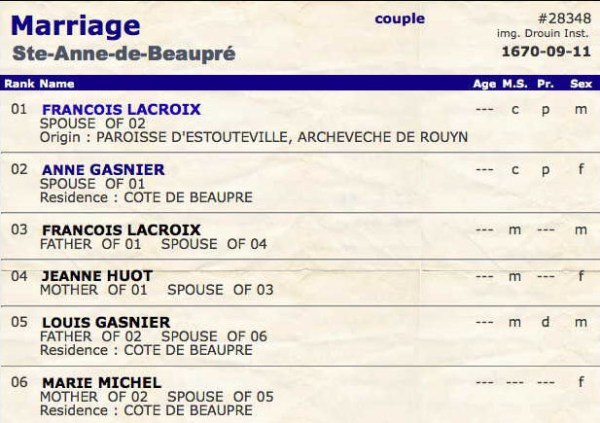
LACROIX
MARRIAGES
François Lacroix was a “domestique.” Servants working in a home, agricultural servants and personal servants.
Any person at the service of another, without specifics. François Lacroix was employed as a domestic for Pierre Gagnon.
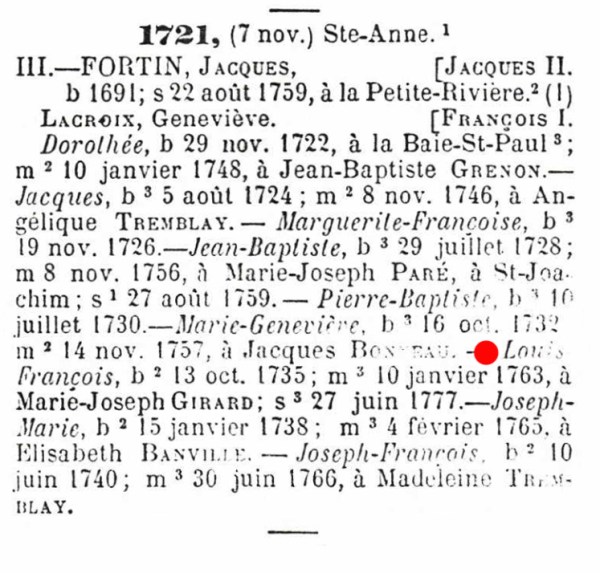
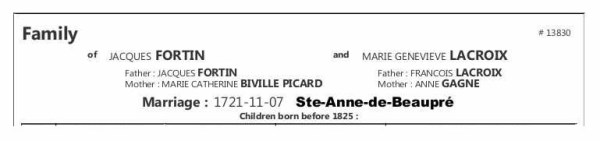
Genevieve Lacroix was the daughter of François Lacroix and Anne Gagné.
Louis François Fortin is the son of Jacques Fortin and Geneviève Lacroix
Continuing the relationship chart to the Author
François Xavier Fortin – 3rd gg Montebello, Quebec
Moyse Hypolite Fortin – 2nd gg Rigaud, Quebec
François Evariste Fortin – 1st gg Pembroke, Ontario
Louise Seraphina Fortin’s – my grandmother, Louis Joseph Jodouin – my grandfather Sudbury, Ontario
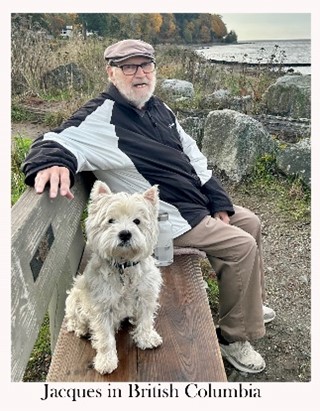
Dedicated to our good friend, Jacques Gagné who has recently moved to British Columbia to be near family. He will continue to grace our blog with his databases. We at Genealogy Ensemble wish him well.
Some branches of family trees flourish while others wither and die out. I have traced one branch of my tree back to Pierre Gadois and Louise Mauger, two of my one thousand and twenty four 8th great-grandparents who arrived in Quebec in 1636. This couple has many thousands of descendants alive today, probably even more. But even though some of my great-grandparents had many children there aren’t the expected number of cousins. I have only seven first cousins while a friend says she has more than fifty. My granddaughter has only two so far.
Barnabé Bruneau and Sophie Marie Prudhomme my two-times great-grandparents had 13 children. They all survived to adulthood. One would have expected that they would all marry and have a number of children. Even if they each had only four children, that would be 52 cousins but that is not what happened.
Barnabe & Sophie Marie Bruneau
These 13 siblings only had 17 children with 10 of the children born to Ismael Bruneau and Ida Girod. Seven of their ten children have descendants alive today. I haven’t counted up how many relatives this is but quite a number. It is hard to keep track of your second and third cousins and those once removed as they marry and have children.
When my great uncle Herbert Bruneau, Ismael’s son, drew up a family tree in the 1960s, he wasn’t able to find a record of any of his cousin’s children. He thought that he and his sibling’s descendants were the only branches.
When I had my DNA analyzed by Ancestry, one of my matches, “Shedmore” rang a bell. Ancestry said he was a 4th – 6th cousin but in fact, his great-grandmother Elmire Bruneau was my great-grandfather Ismael’s sister and so we are third cousins. The tree did have another branch.
Elmire Bruneau Huntley
Elmire, born in St-Constant, Quebec, immigrated to the United States in 1864 and worked in New York City as a French governess. She is said to have met Andrew Washington Huntley around 1867 in the choir of the Plymouth Church in Brooklyn Heights. His family lived in Mooers, New York. He was a veteran of the Civil War having served in a number of units from 1862-1865. This couple moved many times during their marriage according to census records. First to Wells, Minnesota, then to Bridport, Vermont to farm, then Chicago, Illinois where he was a ticket agent on the Electric Railroad and finally to Los Angeles, California. Elmire died there in 1922. Her body accompanied by her daughter Faith, went by train back to Bridport, Vermont where she was buried beside her son Howard.
Andrew Washington Huntley
Howard died at 18 without children. It was her daughter Faith, who married Smith C. Shedrick and had four children, Etta Elmere, Howard S., Helena F. and Howard H. who kept the family tree growing. “Shedmore” turned out to be Etta’s son. He does not have any children but his brother had three children, five grandchildren and some great-grandchildren so Elmire’s Bruneau line lives on. Both Helena and Howard also married so there might be even more twigs on those branches.
Faith and Howard Huntley
It is nice to have cousins. Some might not be close but you do have a family connection. Reach out to your cousins, you never know who you will find or what they may know.
Notes:
All photographs are from Ismael Bruneau and Ida Girod’s albums in the possession of the author.
Year: 1870; Census Place: Clark or Wells, Faribault, Minnesota; Roll: T132_3; Page: 1440 Ancestry.com. 1870 United States Federal Census [database on-line]. Lehi, UT, USA: Ancestry.com Operations, Inc., 2009. Images reproduced by FamilySearch.Accessed Nov 22, 2021.
Year: 1900; Census Place: Chicago Ward 21, Cook, Illinois; Roll: 271; Page: 17; Enumeration District: 0638 Ancestry.com. 1900 United States Federal Census [database on-line]. Lehi, UT, USA: Ancestry.com Operations Inc, 2004. Accessed Mar 29, 2022.
Year: 1910; Census Place: Oak Park, Cook, Illinois; Roll: T624_239; Page: 21b; Enumeration District: 0077; FHL microfilm: 1374252 Ancestry.com. 1910 United States Federal Census [database on-line]. Lehi, UT, USA: Ancestry.com Operations Inc, 2006. AccessedNov 22, 2021.
Year: 1920; Census Place: Los Angeles Assembly District 73, Los Angeles, California; Roll: T625_114; Page: 17A; Enumeration District: 393 Ancestry.com. 1920 United States Federal Census [database on-line]. Provo, UT, USA: Ancestry.com Operations, Inc., 2010. Images reproduced by FamilySearch. Accessed Nov 22, 2021.
“Obviously a club does not change from a dump of second hand books to a pan-Malaysia institution without care and attention.” Malaya, 1966. British Malaysia Association. Tribute to Dorothy Nixon, former secretary of the Kuala Lumpur Book
Dorothy Forster Nixon 1895-1971
One morning not long ago, I received an email from a young woman in Malaysia. She wanted to know about my grandmother, also Dorothy Nixon, who had been ‘secretary’ of the Kuala Lumpur Book Club back in the day. The woman was a librarian-in-training and she told me that “Granny” was a great inspiration to her.
I wasn’t at all surprised because about ten years earlier I had received a similar email from the former Director of the Malaysian National Library. This illustrious person was researching my grandmother’s life as a retirement project.
It seems that my County Durham born grandmother, Dorothy Forster, who moved to Malaya in 1921 to marry Yorkshireman Robert Nixon1, a rubber planter, is something of a legend in modern Malaysia, at least among librarians.
In 2003, sheer serendipity led me to start my own research into my colonial grandmother. I was a prolific freelance writer back then and it was my habit to enter my name “Dorothy Nixon” into Internet search engines to check out where my essays and articles may have landed.
On this occasion, I stumbled upon a mention of another Dorothy Nixon, my father’s mother. It was on Amazon.co.uk in a review of a book by historian Margaret Shennan about Colonial Malaya “Out in the Midday Sun”. In the book Shennan mentions my grandmother but only once and only in connection with an ugly incident at Changi internment camp during WWII. She gets her name wrong, too: Dorothy Dixon. The reviewer, a Mr. Smith, corrected this typo and described my grandmother as ‘the endlessly helpful secretary of the Kuala Lumpur Book Club.”
I had met Dorothy only once in 1967 at 12 years old when she came to visit us in Montreal. She was cranky and super-critical of all things Canadian – especially of my ‘shrill’ playmates skipping or biking out on our Snowdon area street – and we did not hit it off at all, so you can imagine how confused I was by this description of her.
So, I tracked down Mr. Smith, a former rubber planter. He told me all about the KL Book Club’s subscription arm where book-boxes were assembled and sent out to people holed up in the jungle in their far-away plantations, a service much appreciated during the 1950’s Communist Emergency.
He further described my grandmother as having a fine and nuanced understanding of literature. She always studied the members’ tastes, he said, in order to recommend books to them.
I eventually wrote a story about “Granny” that got published in the Globe and Mail. That’s how the Director knew to contact me. In return for my help this nice lady mailed me an article from the Malaysia Library Review 1952 co-written by my grandmother about history of the KLBC: “The Kuala Lumpur Book Club: A Pioneer.”
The article explains how the Book Club started out as an informal back-room book exchange for Brits and evolved over the decades into a full-fledged government funded community resource, housed in a two story air-conditioned art deco building near the famed Royal Selangor Club in Kuala Lumpur.
Between the wars there were four libraries in Malaya, including the KLBC and the Raffles Library in Singapore. Although these places were set up for Britishers, members were debating whether it was time to allow locals to join, if only government officials.
The newspaper record 2 reveals that my grandmother, who worked at the Book Club from 1937 to 1966, was instrumental in opening up the library to Asians, male and female, especially students. This is likely why she is so admired today in Malaysia.
In the 1930’s and 40’s, the KLBC had a reputation among some Colonials as a light-weight institution that provided low-brow literature to rubber planters’ wives, who were bored to death with servants to do everything and their school-age children away in England.3
Dorothy, who attended a co-educational Quaker school in England, did indeed have many Tamil and Chinese servants at her husband’s Selangor rubber estate, some of whom watched over my father until he was sent away to school in Cumberland at five years old.
She did, indeed, attend many drunken garden parties and polo matches in the 20’s and 30’s – but eventually during the Great Depression she found something more important to do. For a smidge under three decades she worked at the Book Club 7 days a week, 9 am to 7 pm. In the evening she strolled over to the Royal Selangor Club (in the company of her male friend, an eminent lawmaker) where she scored their cricket games!
Popular Australian author Di Morrissey includes a bit about my grandmother in her 2010 novel.
Today, if you google “Dorothy Nixon” and “Kuala Lumpur Book Club” many many MANY citations will come up from scholars and journalists thanking my grandmother for help researching their books.
These authors are especially grateful for access to her personal collection of Malaysiana. Apparently, my grandmother was an expert in all things Malayan, a real scholar herself who was always invited to Prime Minister Tunku Abdul Rahman’s birthday bashes, and who at mid-20th century repeatedly made the Malaysia Who’s Who.
So, not lazy at all
Video about Malaya in 1952 with images of my Grandmother scoring cricket at the end.
END
1) Men working in Malayan plantations were encouraged (forced) by their Companies to go home to find a British wife even if they were happy with other arrangements. My grandfather, Robert, found Dorothy Forster, the daughter of an itinerant Primitive Methodist Preacher who had circulated through his hometown of Helmsley, North Yorkshire in 1912-1914. When she arrived in Malaya, late 1921, Dorothy discovered Robert had an Asian ‘mistress’ as they said back then. Upon his marriage, he did not give her up,apparently. (Re: my Aunt Denise.) She got pregnant with my father immediately.
2. The Malaysia Straits Times is online with a database and many articles citing my grandmother, some with photos, most of them in connection with the Cricket. This link to an article, written in 1966, is a tribute to her work as KL Book Club Librarian and in Montreal in 1967 when she visited us she wasted no time in showing it to my mother. She was obviously in search of respect from us. Indeed, judging from her ‘diary’ searching for respect seems to have been her life’s goal.
3) British Colonial wives were much looked down up in rubber country, described as undeserving parvenus, women who would be sweeping out a three bedroom cottage back home in Somerset were they not in Malaya lazing in their airy bungalows, waited on hand-and-foot by servants. Yet, these Colonial Wives were given little to do and forbidden to meddle in local affairs in fear they would cause scandal or upset the entrenched hierarchy of the British, Malays, Chinese Tamils. The British believed it was necessary to send their children away to England as soon as possible for schooling and to avoid their contracting a tropical illness. By the time my father’s younger brother was born, he got to go to a British school in Malaya set up in the hills, considered a healthier milieu.
with research from the Riverside Historical Society
updated Nov. 11, 2024
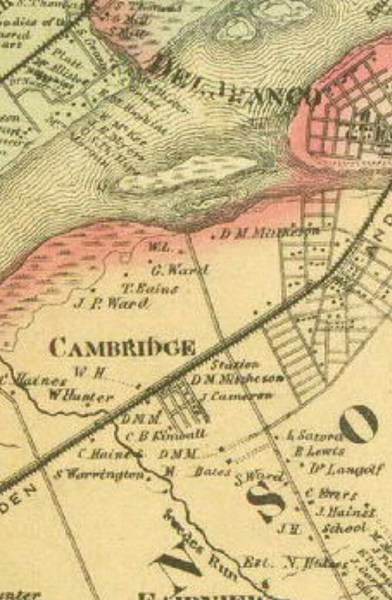
The New Map of the Consolidated City of Philadelphia, published in 1855 by R.L. Barnes. In 1854, various small, incorporated towns located outside the original old City of Philadelphia became incorporated into the City of Philadelphia. Now Philadelphia was not only a city but also known as the County of Philadelphia. Image courtesy RHS (see note below)
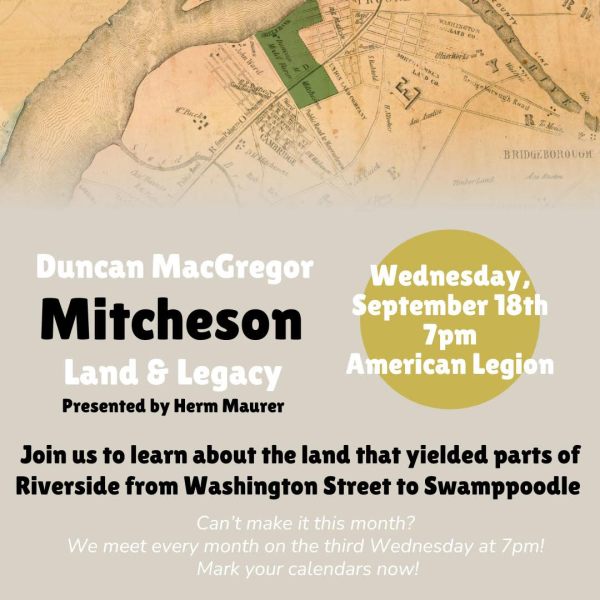
Occasionally someone who knows more about one of my ancestors than I do finds my family history blog and gets in touch. That is what happened this summer when Herman Maurer, a member of the Riverside Historical Society in New Jersey, reached out to tell me that my ancestor had founded his town.
Three years ago, Herman wrote a book called Progress to Riverside: A Story of Our Town’s Past to mark Riverside Township’s 125th anniversary. In the course of his research, he ran across 19th century Philadelphia real estate agent Duncan M. Mitcheson.1
Riverside, New Jersey is a suburban township located across the Delaware River from Philadelphia. In the early 1850s, Duncan and his brother McGregor J. Mitcheson purchased property next to Riverside and subdivided it into cottage lots. This area became the village of Cambridge. Duncan planned the street layout, including today’s busy Chester Avenue, Front Street, Brown, Main and Arch Streets still carry the names that Duncan chose 170 years ago.
Numerous Cambridge deed transfers recorded in the local county clerk’s office between the 1850s and mid-1880s, with the signatures of both Mitcheson brothers on them, convinced Herman that Duncan and his brother McGregor were the primary developers of the village of Cambridge.
This was a surprise to me since I knew very little about Duncan. Now it became clear that he was a successful businessman who embraced modern ideas at a time of rapid changes in society.
Duncan McGregor Mitcheson (1827-1904) was the middle child of Robert Mitcheson and Mary Frances McGregor. Born in northern England and in Scotland, they were married in Philadelphia around 1818. Duncan’s older sister, Catharine Mitcheson Bagg, was my two-times great-grandmother.
The Mitcheson family lived in Spring Garden, in the northern part of Philadelphia. The family’s home was large and, after their parents died around 1860, Duncan’s older brother, Reverend Robert M. Mitcheson, and his wife and children lived there. Duncan lived with them until Robert died in 1877. In the 1880 census, when he was age 53, Duncan appears to have been staying in a rooming house. Later Philadelphia city directories show that he lived on Spruce Street, near the old part of the city, and had an office nearby on Walnut Street. He never married. Like his two brothers, Duncan attended the University of Pennsylvania, but unlike them, he did not graduate.3 He dropped out in 1842, at the end of his second year. University attendance was rare then: there were only 26 students, all male, in Duncan’s freshman class.
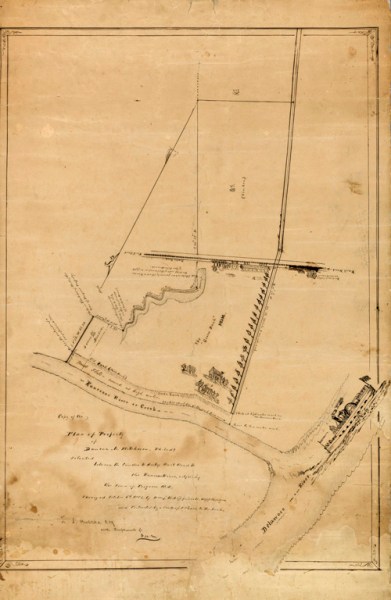
Map, dated Oct. 6, 1853, showing Duncan’s Green Bank Farm overlooking Roncocas Creek and the Delaware River. Duncan sent this map to another Philadelphia real estate developer, Samuel Bechtold Jr., as a complimentary copy. Bechtold was the developer of Progress (now known as Riverside). This map has recently been conserved.
Duncan began his career as a merchant, but an 1861 Pennsylvania business directory identified him as a conveyancer: someone who draws up deeds and leases for property transfers. He was listed as a real estate agent for most of his career.
The Riverside Historical Society’s research revealed that Duncan invested $5000 in land in New Jersey, with an initial purchase of 80 acres, in 1853. He and his brother then formed a real estate partnership to develop the village of Cambridge. An advertisement for these building lots appeared in the Philadelphia newspaper Public Ledger on March 24, 1853. The lots were “located on the Camden and Amboy Railroad, about one mile below Rancocas Creek and the Town of Progress and within a quarter of a mile of the River Delaware, upon a very healthy, dry and level site that will require no filling up, nor grading and can be reached in about half an hour from the Walnut Street Wharf.”
The lots were advertised at the “remarkably low rates” of $25 and $30 each. The $30 lots were 20 feet by 100 feet, while the $25 lots were slightly smaller. A few larger lots were available at $60 and $100 each.
On November 4, 1854, another ad in the Public Ledger noted that the Cambridge lots were near the water, opposite the splendid riverside mansions of Philadelphia’s 23rd Ward. Duncan also reassured potential buyers that the lots were a safe investment. “From the continued increase of the population of Philadelphia, and the consequent increased demand for Houses and Lots, and as well as from the fact that thousands now living in this city could not only have more room, enjoy better health, but live less expensively at Cambridge.”
Duncan also owned farmland on three sides of Cambridge, and he was one of the larger landowners in the town of Progress in the 1850s. In January, 1854 he purchased 180 acres of vacant land for $15,000. That property, located between Rancocas Creek, the railroad, Chester Avenue and Tar Kiln Run, was known as Green Bank Farm, or Duncan M. Mitcheson’s Model Farm.
This was a period of technological and scientific innovation. The Great Exhibition, held in London, England in 1851, had showcased developments in many fields, including agriculture. These advances were badly needed: food production had to become more efficient to feed growing urban populations. Duncan’s model farm may have featured agricultural innovations such as a McCormick reaper that could rapidly harvest large quantities of crops. And perhaps Duncan was a member of the Model Farm Association, formed in 1860 to establish a model farm, botanic garden and agricultural school in Pennsylvania.
In the spring of 1854, Duncan purchased another 80 acres of vacant land for $6000, extending Green Bank Farm past the railroad tracks. In addition, he, or possibly his brother, owned a nearby property named Rob Roy Farm, after the famous Scottish outlaw and folk hero Rob Roy McGregor.
How the Mitcheson brothers acquired the funds to buy so much land is not known, but their father owned properties in England and in Philadelphia. Robert Mitcheson senior died in 1859 and in his will, he forgave an $8000 mortgage he held on Duncan’s farm.
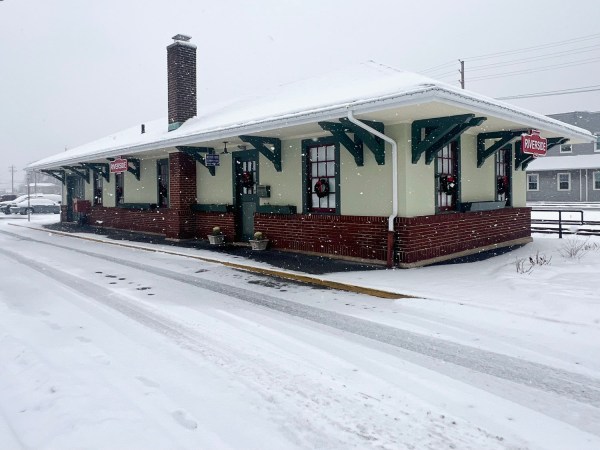
Riverside Train Station. photo by Herman Maurer
In 1859, the Drake Well, the first commercial oil well in the U.S., was drilled in north-western Pennsylvania. That well sparked the first petroleum boom in the United States, creating a wave of investment in drilling, refining and marketing. Duncan saw an opportunity to make money. In February, 1865 he placed the following ad in the Philadelphia Inquirer: “OIL LANDS FOR SALE—located in Venango and Clarion Counties (Pennsylvania). Companies are about to be formed, secure choice lands by addressing or writing to: Duncan M. Mitcheson, real estate office at the northeast corner of Fourth and Walnut Streets, Philadelphia. Also 1,000, 20,000 and 50,000 acres in West Virginia.”
He placed another ad a month later: “CHOICE Oil Tract…Eighty Acres. For sale in fee simple lots situated on the Bennyhoff Creek, Venango County, of which the greater part is boring grounds. This eighty-acre tract will be divided to suit and sold fee simple, with unquestionable titles…”
In July, 1866 Duncan advertised another speculative deal in the Philadelphia Inquirer: 1250 interests, valued at $100 each, in The Virginia Gold Mining Company of Colorado. The company’s property was located near Central City, Colorado, founded in 1859 during the Pike’s Peak Gold Rush.
In 1893, when he was 70 years old, Duncan sold almost 1000 vacant building lots in Cambridge for the sum of one dollar to his deceased brother McGregor’s two grown children, Joseph McGregor Mitcheson and Mary Frances Mitcheson. During the first two decades of the 20th century, they sold many of the Cambridge properties to families who had recently emigrated from Poland.
Joseph, a bachelor, was a Philadelphia lawyer and a commander in the U.S. naval reserve. Mary Frances married accountant Arthur L. Nunns in 1904. The couple were childless and when she died in 1959, at age 84, she gave a million dollars to the Protestant Episcopal Diocese of Pennsylvania. It was the largest bequest it had ever received.4 During my 2013 visit to Philadelphia, the head of St. James School, a tuition-free, private Episcopalian middle school, told me that gift Is still benefiting the community.
As for Duncan, the 1900 census showed that he had retired. He died in 1904 and was buried, along with his parents and other family members, at St. James the Less Episcopal Church Cemetery in Philadelphia.
Note: The images of both maps were provided by the Riverside Historical Society. The Green Bank Farm map was recently conserved through a 2023 grant funded by the Burlington County Board of Commissioners.
Herman Maurer, Progress to Riverside: A Story of Our Town’s Past, Riverside Historical Society Inc. 2020, p. 13.
Philadelphia, Pennsylvania, City Directory 1889, entry for Mitcheson, Duncan M., Ancestry.com, citing U.S. City Directories, 1822-1995 (online database), accessed Oct. 1, 2024.
University of Pennsylvania, 1894. entry for Duncan MacGregor Mitcheson. Ancestry.com, citing US. College Student Lists, 1763-1924 (online database), accessed Oct. 1, 2024.

















 Genealogy Ensemble
