
When John Hanington died in 1825 at just 28 years of age, he left his pregnant wife without a husband, his baby girl without a father and William Hanington without his son and business partner.
John drowned when a squall capsized his boat while piloting to a ship across the harbour in Shediac. The following year, his body was discovered on the shores of PEI across from Shediac. He was identified by his clothing.
In 1818, Shediac, New Brunswick, was a burgeoning isolated coastal settlement in the earliest stages of transitioning from a wilderness outpost into an industrial Maritime hub.
By that time, my three times great-grandfather, William Hanington (1759-1838), had already spent over thirty years building a life and business in Shediac Bay, since his arrival from England in 1785. He was a businessman with many interests which impacted the local community, ultimately shaping the economy while he held important public positions along the way.
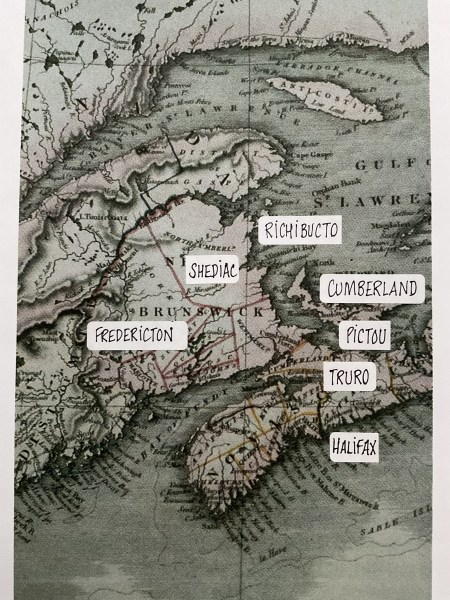
William’s businesses involved trading goods, selling timber and building ships. He kept in touch with several Maritime merchants often travelling from Shediac to places like Pictou, Halifax, Truro and Fredericton. And travel wasn’t easy in those days!
John, William’s second eldest son, lived in Halifax, Nova Scotia, and followed his father’s footsteps into the family’s trading business. I recently discovered, in my “dusty old boxes” of family memorabilia, this handwritten letter from William to his son from over 200 years ago, dated October 28, 1818, giving John business instructions:
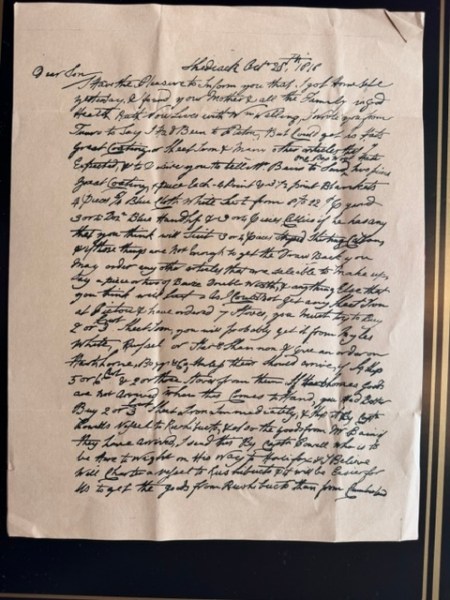
William’s letter-page one – October 28, 1818 – Shediack
William began the letter with an update on the family news. He also mentioned that Ruth (John’s sister) had moved in with William Welling (I think as house help as she marries John Bateman later that year). These bits of family information, subtly woven into the business notes, add a more personal touch to the letter.
William’s letter quickly shifted back to business. He had stopped in Truro and then headed to Picton to look for supplies. He hadn’t found the items he needed: hats, good-quality coating cloth, sheet iron, along with several other articles he had expected to find there.
So, he wrote John a detailed list of what to buy in Halifax:
- a box of wool hats,
- some good coating cloth,
- blankets,
- blue and white cloth,
- handkerchiefs,
- calico and striped shirting cotton.
If these weren’t enough to fill the ship, John was being entrusted to pick out other items he thought would sell well in Shediac.
William clearly knew what his customers wanted and what could be bought and sold for a good profit.
Since William hadn’t been able to get any sheet iron in Pictou, and he’d already ordered seven stoves, John had to find “two or three hundredweight of sheet iron” in Halifax. William suggested getting it from one of two merchants – Myles White, Russel or Star & Shannon.
Finally, getting everything shipped was another challenge… and so was the weather.
In his letter, William meticulously planned which ships would transport which goods and their destinations. It resembles a miniature shipping ledger, detailing the ships, captains, merchants, and their cargoes as they navigate between ports.
Along with the imported goods, William’s business also included lumber. His client, Mr. Wright, had asked for 2,000 tons of lumber for the spring. But William could only send a partial order as he hadn’t got his Timber License yet. Talk about being proactive … or illegal!
The letter wraps up with a few more instructions to John – such as buying “some good English cheese” at auction at a good price and keeping it until it could ship to Shediac.
Finally near the end of letter, William writes out of nowhere “Please send 1,000 darning needles” – as if it had slipped his mind with so much going on!
The letter also illustrates how William managed his huge business network:
- His dealings stretched from Halifax and Pictou to Truro, Richibucto, Cumberland and Fredericton.
- He bought goods from other countries, sold salt, arranged shipments, traded lumber all while he chased after timber rights.
- Ships and captains could be managed but good weather could not!
At the heart of it all was his 21-year-old son John in Halifax following his father’s instructions and dealing with the merchants. His accidental death, seven years later, must have impacted William in countless ways.
This letter gives us a small peek into the life of the Hanington family in 1818—a time when Shediac was becoming a big hub for trade and shipbuilding, and when William set the stage for a family enterprise that would last for generations.
What makes this ordinary 200-year old letter so valuable to the Hanington family story is that it puts William Hanington right in the middle of his everyday life in 1818 and not just as another name in the family tree.
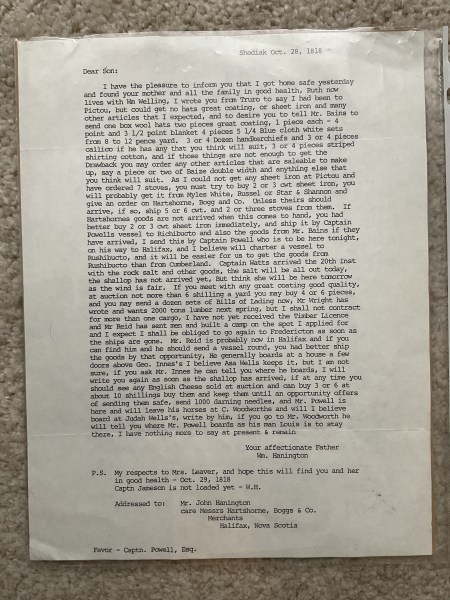
Typed version of William’s letter

