Category Archives: Montreal

Huntly Ward Davis, Montreal Architect

With additional research from Justin Bur

Huntly Ward Davis (1875-1952) was a Montreal architect who designed elegant downtown homes, banks and institutional buildings in the first half of the 20th century. Some of those buildings still stand today, others have disappeared. Many of Montreal’s heritage buildings, built when the city was Canada’s most important business and banking center, have been demolished and replaced by high-rise office towers and apartment buildings. As a result, Davis has been largely forgotten by the public, but his descendants – my cousins – are proud of his architectural legacy.

Huntly Ward Davis. Bagg family collection

Huntly was born in Montreal on October 22, 1875, the oldest son of Moses Davis (c. 1847-1909), head of a customs brokerage firm, and Lucy Elizabeth Ward (1850-1924). Moses was originally from St. Andrews, Quebec, a village on the Ottawa River between Ottawa and Montreal.1  

His mother’s father was well known in business and in politics. James Kewley Ward (1819-1910), was born on the Isle of Man, located in the Irish Sea. James immigrated to New York State in 1842 and married his first wife, Elizabeth King, there. The family moved to Lower Canada in the early 1850s and James bought a lumber mill on the Maskinongé River, northeast of Montreal.

Elizabeth died when daughter Lucy was four years old. James remarried and he and his second wife, Lydia Trenholm, had a large family. Lucy’s granddaughter later recalled how warm and compassionate Lucy was, so perhaps she grew up helping her younger siblings.

In the 1870s, the Ward family moved to Montreal, where James opened a sawmill on the Lachine Canal and expanded his business interests to cotton. A Liberal in politics, he served as mayor of the village of Côte St. Antoine (now the City of Westmount) from 1875 to 1884, and in 1888 he was appointed to the Legislative Council of Quebec. He was known for his generosity to charities.2

Moses Davis and Lucy Ward were married in Montreal in 1874, and Huntly, the eldest of their three sons, was born the following year. Huntly attended school in Montreal, then studied architecture in Boston, graduating from the Massachusetts Institute of Technology in 1898. He returned to Montreal and eventually went into partnership with architect Morley Hogle. After Hogle’s sudden death in 1920, Huntly worked on his own.3 He was a member of the Quebec Association of Architects and of the Royal Architectural Institute of Canada.

House at 1814 Sherbrooke Street W. near St. Mathieu, designed by Hogle and Davis in 1908. The ground floor window was added later and the house is still there today. Photo, taken 1986, from Repetoire d”architecture traditionelle sur le territoire de la Commununaute Urbaine de Montreal, Architecture domestique 1, Les Residences.

Huntly married Evelyn St. Clair Stanley Bagg (1883-1970), eldest daughter of Robert Stanley Bagg and his wife Clara Smithers, on Oct. 26, 1910, at Montreal’s Anglican Church of St. James the Apostle. The following day, The Gazette’s society reporter called the event “one of the prettiest of the season’s fashionable weddings” and described the bride’s ivory satin gown, embroidered with seed pearls.4

Huntly and Evelyn lived in an apartment building that Huntly had designed on Summerhill Avenue, a short street off Côte des Neiges Road, just up the hill from the house where Evelyn had grown up. Evelyn lived on Summerhill for the rest of her life and the couple’s granddaughter still remembers the spacious eight-room apartment and the furniture Huntly had designed.

Huntly and Evelyn also had a country house at Ste. Marguerite, in the Laurentian mountains north of the city. That was where Huntly died, suddenly, on October 12, 1952, at age 76.5 His name is on a plaque in the Bagg family mausoleum at Mount Royal Cemetery.

Huntly and Evelyn had one daughter, Clare Ward Davis (1911-2007). As an adult, she often repeated expressions she had learned from him as a child that reflected his simple sense of justice: “never assume”; “I divide, you choose”; and “a nectarine is a plum’s mistake”.

This down-to-earth approach to life was alsoreflected in the buildings he designed. Son-in-law Norton Fellowes, who was also a Montreal architect, prepared an obituary of Huntly, focusing on his professional activities and published in the Royal Architectural Institute of Canada Journal.

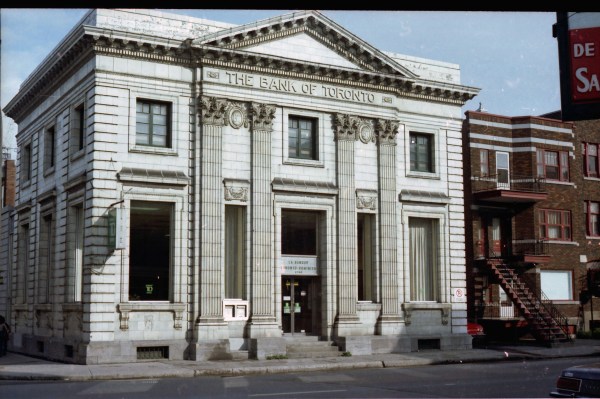
Norton wrote, “In the early years of the 20th century, Mr. Davis was a ‘contemporary architect’ for during this era of post-Victorian vulgarity, he allied himself with that small group of young architects who saw beyond the ornate fashion of the day and consistently designed quiet, dignified town houses, country homes, banks and institutes of learning, always in the tradition of fine craftsmanship and classical proportion. The Greenshield and Townsend country houses still grace the bays of Lake Manitou in the Laurentians and the main building of the Children’s Memorial Hospital, the Trafalgar Institute, the Walter Molson residence on McGregor Street, and the head office of the Bank of Toronto in Montreal are all still permanent monuments to a man who followed the highest traditions of the profession.

“During the last few years, although well beyond the age when others retire, Mr. Davis, at the age of 75, was still young enough to understand the trend to more functional design and it was not surprising that in 1952, he designed and supervised the building of several small, efficient new branches for the Bank of Toronto in the Montreal area. Mr. Davis thus worked with dignity and courage for a full half century as a member of the architectural profession.”6

Hogle and Davis designed this branch of the Bank of Toronto in Montreal’s Hochelaga-Maisonneuve district. It features a white vitrified terracotta facade. Source: : l’Atelier d’histoire Mercier-Hochelaga-Maisonneuve (AHMHM).

Neither is it surprising that he designed at least one building for his wife’s family. The Bagg family had extensive properties in Montreal, mostly in the Mile End area, just east of Mount Royal, but they also owned a few properties downtown. In 1926, Huntly designed a brown brick apartment block on Ste-Catherine Street West, near Guy, for the Stanley Bagg Corp. It was three stories, with small shops on the ground floor.

He may have been involved with another project on land that belonged to the Baggs, a commercial building at the southwest corner of Ste-Catherine Street and Peel. It was built in 1911, shortly after Huntly and Evelyn were married, however, no architect’s name was mentioned in any newspaper reports or in the building’s lease. All building permits were destroyed in a 1922 fire at city hall.

The gleaming, white vitrified terracotta façade (a treatment popular between 1910 and 1915) of the H&M clothing store still stands out at this busy intersection in the heart of downtown. Thousands of people pass by it every day. Although his name was never officially associated with it, this may be the most familiar building Huntly designed.

Notes

Some sources, including the Biographical Dictionary of Architects of Canada, spell his name Huntley, however, his baptism record and a letter written by his mother spell it Huntly. I have used his mother’s spelling. Most architectural references say H.W. Davis.

The lot on Ste-Catherine just west of Guy (St. Antoine Ward, lot 1679, minus a strip of land previously detached for a laneway,) was purchased by the Estate of the late Stanley Clark Bagg in 1885, probably as a rent-generating property. At the time, a three-story brick building and several other buildings were on the lot. The property passed to the Stanley Bagg Corp. when it was founded in 1919. The current building, designed by Huntly Ward Davis, was constructed in 1926. The property was sold in 1957.

The property at Ste-Catherine and Peel (Saint-Antoine Ward, lot 1477) was purchased by the Bagg Estate in 1879. At the time there were three, three-storey stone-front brick houses on the lot. In 1886, these buildings were converted to shops with flats above. They were demolished in 1911 and construction began on the current building, at a cost of $60,000. The Stanley Bagg Corp. sold the property in 1951. 

Sources

  1. “Mr. Moses Davis Died Suddenly Last Night”, The Montreal Star, April 17, 1907, p. 6. Newspapers.com, accessed Oct. 28, 2025.
  2. Leslie Quilliam and Victor Neale, “James Kewley Ward”, Kelly Dollin, editor, New Manx Worthies, Manx Heritage Foundation/Culture Vannin, 2006, iMuseum, https://imuseum.im/search/collections/people/mnh-agent-94625.html, accessed Oct. 27, 2025.
  3. “Huntley Ward Davis”, Biographical Dictionary of Architects in Canada, 1800-1950, Robert G. Hill, editor, http://dictionaryofarchitectsincanada.org/node/825, accessed Oct. 27, 2025.
  4. Social and Personal, The Gazette, Oct. 27, 1910, p. 2. Newspapers.com, accessed Oct. 27, 2025.
  5. Huntly Ward Davis, Obituary, The Gazette, Oct. 15, 1952, p. 14, Newspapers.com, accessed Oct. 27, 2025.
  6. Norton A. Fellowes, “The Late Huntley Ward Davis, Montreal Architect,” Royal Architectural Institute of Canada, Nov. 13, 1952

This article also appears on my family history blog http://www.writinguptheancestors.ca

Mile End Farm: the Origins of a Neighbourhood

with additional research by Justin Bur

The Mile End neighbourhood of Montreal is famous as the home of Montreal bagels and of novelist Mordecai Richler. Its iconic architecture features outside staircases attached to two- and three-storey rowhouses, next door to churches, synagogues, shops, cafés and renovated manufacturing buildings. But Mile End’s history goes back to one small tavern at a crossroads in the countryside more than 200 years ago.

The Mile End Tavern was located at today’s northwest corner of Saint Laurent Boulevard and Mount Royal Avenue,1 now the starting point of the Mile End neighbourhood. In turn, Mile End is on the Plateau, an elevated plain lying north of Sherbrooke Street and east of Mount Royal.

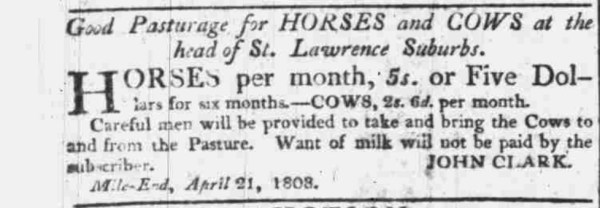
The first known reference to Mile End was dated April 21, 1808, when landowner John Clark placed a notice in the Gazette advertising Mile End Farm as providing “good pasture for horses and cows at the head of the Faubourg [suburb] Saint-Laurent.”

Screenshot

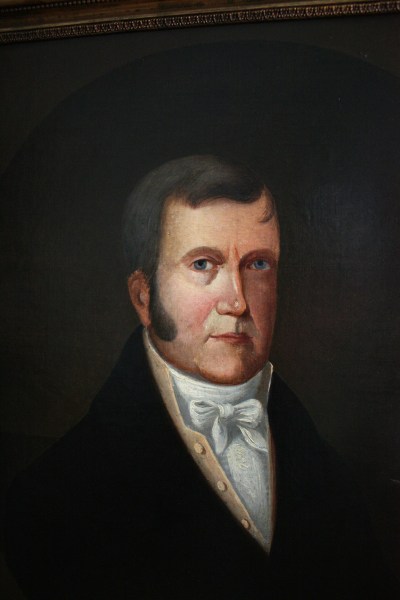
Clark (1767-1827), an English-born butcher, acquired the land he would call Mile End Farm in several transactions, including purchase agreements and leases, between 1804 and 1810.2 Like most farms in Quebec, it was long and narrow. At its greatest extent in 1810, it measured 2.5 kilometers from south to north, and between 400 and 550 meters wide. Clark was almost certainly the one who chose the name Mile End. The centre of his property was about a mile north of the small city of Montreal, and the area might have reminded him of another Mile End, a mile east of London, England. The name caught on and has been in use ever since.

John Clark, a butcher from Durham, England, settled in Montreal around 1797. Portrait in a private collection.

When Montreal was founded in 1642, Mile End was probably uninhabited. The ground was too rocky for settlements or agriculture, and few Indigenous artefacts have been found there. The northeastern region of the Island of Montreal was covered by a vast cedar forest. The heart of Mile End was also forested, but there, both cedar and ash trees were the dominant species. This forest was still intact when the Sulpician priests mapped the area in 1702, but as the city’s population grew — it stood at around 1,200 residents in 1700 – more and more trees were cut to provide firewood.   

By 1780, most trees had disappeared from the foot of the mountain, replaced by houses, farm buildings, hay fields and pastures. In the Mile End area, livestock pastures, vegetable crops, tanneries and quarries dominated the countryside, and orchards were planted in the mid-1800s.

In 1663, the Sulpician priests became the seigneurs, or feudal lords, of the entire island. In 1701, the Hôpital Général acquired an extensive piece of land from the Sulpicians in the future Mile End area, and the Grey Nuns took over the hospital and all its lands in 1747. In 1803, the nuns sold the piece of land that would become Mile End Farm to two masons, Jean-Baptiste Boutonne and Joseph Chevalier. They wanted to quarry its stone and sand for building materials.

The masons had to pay the Grey Nuns a rente constituée (annual interest), as well as yearly seigneurial dues to the Sulpicians. So when John Clark bought the property – the first part of his Mile End Farm — in 18044 and gave Boutonne and Chevalier the right to continue collecting building materials for seven years after the sale, they must have been relieved. Meanwhile, Clark found another use for the land, first advertising pasture for other peoples’ cows in 1808.

When the same ad for livestock pasturing at Mile End Farm appeared the following year, it was placed by Phineas Bagg (c.1751-1823) and his son Stanley Bagg (1788-1853), my four-times and three-times great-grandfathers. A farmer from western Massachusetts, Phineas had brought his family to Canada around 1795. Initially he worked as an innkeeper in LaPrairie, near Montreal, and then the family moved onto the island. In 1810, Phineas and Stanley signed a lease with John Clark.5 Paying an annual rent of 112 pounds, 10 shillings, they ran the Mile End Tavern and managed the farm for the next seven years before subletting to another innkeeper.

description below.

The lease described the property as having a two-storey house (which at some point must have been converted into the tavern), a barn, stable and outbuildings. The Baggs were required to sufficiently manure the pastures and arable land, to cultivate and to perform road maintenance and other required duties. They were permitted to cut wood for fencing and firewood, but they had to preserve the maple grove. They were also permitted to cut and remove stone.

No doubt the tavern brought them a good income since it was located at an important, if somewhat remote, intersection. Stanley must have attracted many additional customers after he built a racetrack nearby. In May 1811, he signed an agreement with the Jockey Club of Montreal, subletting a piece of land to the club and promising to build the track within five weeks. The club supervised the races. The track, partially on land leased from the Sisters of the Hôtel-Dieu, was about a mile in circumference and what is now Jeanne Mance Park, extending east to Saint-Laurent. It was most likely the first racetrack in Montreal.6

Another reference to Mile End appeared in the Gazette on August 4, 1815 when Stanley Bagg, Mile End Tavern, placed a notice offering a reward for information about a lost bay horse, about 10 years old, with a white face and some white about the feet.7

In 1819, Stanley married John Clark’s daughter, Mary Ann (John Clark was also my four-times great-grandfather). Their son, Stanley Clark Bagg (1820-1873), eventually inherited the Mile End Farm, as well as other properties Clark had owned nearby.

In the second half of the 19th century, Stanley Clark Bagg began subdividing and selling the properties he had inherited from his father and grandfather. He died in 1873 and the next generation of the family continued to sell building lots from the Stanley Clark Bagg Estate.

In 1891, they sold most of the Mile End Farm property to McCuaig and Mainwaring, a pair of promoters from Toronto who envisioned a high-end residential suburb they called Montreal Annex.8 The project got off to a slow start because basic services such as water, sewers and streetlights were nonexistent and a promised electric tramway did not materialize in time. A recession that started in 1893 put an end to their dreams. A few years later another group of investors, the Montreal Investment & Freehold Company, took over the property and the area developed as a mixture of duplexes, triplexes and commercial buildings.

Meanwhile, the Mile End Hotel continued to appear in city directories at the corner of Saint- Laurent and Mount Royal until 1900. The property was expropriated for road widening in 1902 and the building was demolished. A department store had replaced it by 1906.

Description of Map: The areas with a greyish tinge are the areas that John Clark held by lease rather than owning them; none of them ever came back to Clark-Bagg possession after the leases ended. The yellow areas are cutouts belonging to and reserved by other people, excluded from the rectangles describing the property leased to P & S Bagg in 1810. Mile End Farm was bounded by the modern Saint-Laurent Blvd. in the east, while the future Park Avenue was just to the west and Pine Ave. would have been the southern boundary. RHSJ refers to the Religieuses Hospitalières de Saint-Joseph de Montréal, a religious order dedicated to caring for the sick.

This article also appears in my personal family history blog, www.writinguptheancestors.ca.

See also:

Janice Hamilton, John Clark, 19th Century Real-Estate Visionary, Writing Up the Ancestors, May 22, 2019, https://www.writinguptheancestors.ca/2019/05/john-clark-19th-century-real-estate.html

Janice Hamilton, The Life and Times of Phineas Bagg, Writing Up the Ancestors, Oct. 17, 2018, https://www.writinguptheancestors.ca/2018/10/the-life-and-times-of-phineas-bagg.html

Janice Hamilton, The Life and Times of Stanley Bagg (1788-1853), Writing Up the Ancestors, Oct. 5, 2016, https://www.writinguptheancestors.ca/2016/10/the-life-and-times-of-stanley-bagg-1788.html

Notes and Sources

1.  Mount Royal Avenue is the continuation of Côte Sainte-Catherine Road, which traverses the northeast slope of Mount Royal and continues east of Saint-Laurent Boulevard. Saint- Laurent, now a busy commercial street, was at one time the only road leading north from city to the Rivière des Prairies, on the north shore of Montreal Island. Built by the Sulpician priests in 1717, Saint Laurent was initially known as Le grand chemin du Roy – the Great King’s Highway. Over the years it has been known by many names, English and French, including Chemin Saint-Laurent, St. Lawrence Street and “the Main”. Since 1905, its official name has been Boulevard Saint-Laurent.

2.  Yves Desjardins, Histoire du Mile End, Québec: Les Ēditions du Septentrion, 2017, p.  22.

3.  Island of Montreal property owners were required to pay dues to the Sulpicians every year until the seigneurial system was gradually abolished there, starting in 1840. The system was abolished in the rest of Quebec in a gradual process starting in 1854.

4.       Louis Chaboillez, n.p. no 6090, 30 May 1804. A reference to the purchase also appears in J.A. Labadie, n.p. no 16733, 7 June 1875. This was the inventory of Stanley Clark Bagg’s Estate. It includes the name of the seller, the date of the sale and the notary who prepared the deed. This part of Mile End Farm is item #264.

5.  Jonathan A. Gray, n.p. no 2874, 17 Oct. 1810.

6.  Justin Bur, Yves Desjardins, Jean-Claude Robert, Bernard Vallée, Joshua Wolfe, Dictionnaire historique du Plateau Mont-Royal (Montreal, Éditions Écosociété, 2017), p 107.

7.  Justin Bur, “À la recherche du cheval perdu de Stanley Bagg, et des origines du Mile End.” A la recherche du savoir: nouveaux échanges sur les collections du Musée McCord; Collecting Knowledge: New Dialogues on McCord Museum Collections. Joanne Burgess, Cynthia Cooper, Celine Widmer, Natasha Zwarich. Montreal: Éditions MultiMondes, 2015, p. 143.

8.  Justin Bur, Yves Desjardins, Jean-Claude Robert, Bernard Vallée, Joshua Wolfe, Dictionnaire historique du Plateau Mont-Royal (Montreal, Éditions Écosociété, 2017), p 271.

A Spontaneous Act of Kindness

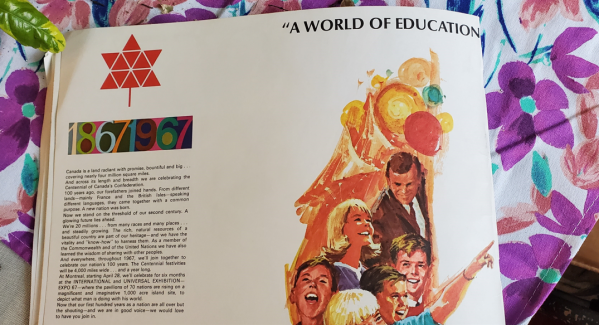
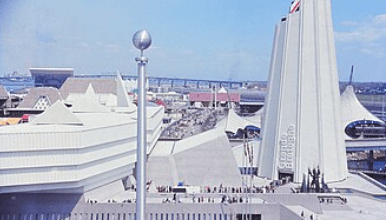
A World of Education, page from a pamphlet given out to school children in 1967 about Expo 67.

My mother, Mary-Marthe, would put herself out for people. At the check-out counter of the grocery store; on the bus; in the park my mother was not shy about helping out others. She sometimes forced spontaneous acts of kindness on complete strangers, often to my childish embarrassment.

This habit, I imagine, she picked up from her own mother, Maria, a pious French Canadian who married well in 1901 and was generous with food and home-remedies.

The story goes that in the 1920’s my mother’s Sherbrooke Street West grey stone had a mark on the gate that indicated to homeless men, or ‘tramps’ as they called them, that a hearty meal was in store for them should they knock at the back door.

I most vividly recall an incident that unfolded in the summer of 1967, the year of Expo 67, the World’s Fair, when I was a young adolescent and because of my prickly age extra prone to being embarrassed by my mother.

My family lived in Montreal and we all had ‘ passports’ so we could visit the nearby World’s Fair anytime we wanted.

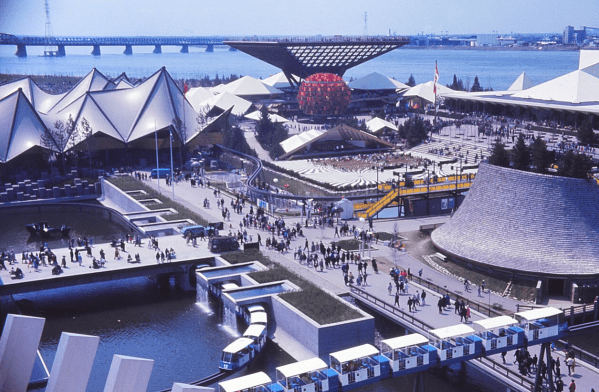
The Canadian section of Expo 67. The Western Provinces Pavilion, a forest, smelled so wonderful compared to smoggy city air!

I was 12 years old and I sometimes took the number 65 bus to those blissfully bright Expo isles alone, likely skipping school, and the bus stop was right under my 6th grade classroom window! I wasn’t too afraid to be found out. Didn’t my teacher say we’d learn more at Expo than at school?

Over that six month period from May to October 1967 I travelled the short bus and metro route to Expo 50 times, sometimes alone, sometimes with my brothers or other relations and sometimes with friends and their families. I recall that one mom was so afraid of losing her many tweenage charges in the swelling sea of thrill seekers she looped a long rope around our waists to keep us contained. How embarrassing!

I wandered to the Expo site in all weather with a packed lunch since I had no extra money to spend.3 I liked the wide open Canadian and Ontario pavilions the best. I’d eat my sandwich on the Katimavik watching the rusty monster emerge from the lake adjacent. I experienced their exhilarating movies1 over and over again. The five Expo theme pavilions were a hit with me, too. 4I mostly avoided the popular national pavilions: the American, Russian, Czech and British pavilions with their long long line ups.

The movie We are Young in the Cominco Pavilion another favourite haunt of mine in the summer of 67. The exhibits explored the five senses. See link below that includes info about The Eighth Day at the Christian Pavilion and all the other landmark films that prepared us well for the future of media.

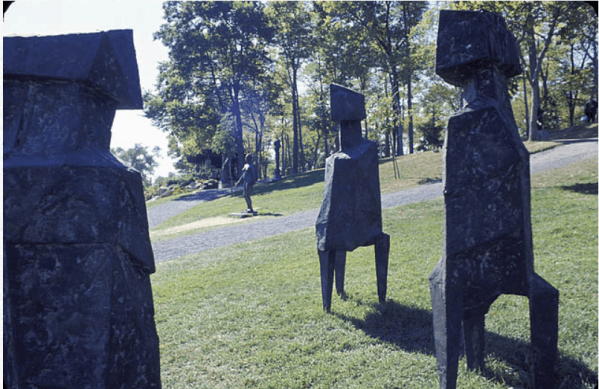
But I did like escaping to the sculpture garden behind the American pavilion. It was uncrowded, cool and peaceful in that place and all the avant-garde works of art, both life-like and abstract, were exciting to behold.2

One installation at the Sculpture Garden. The Watchers.Lynn Chadwick, UK 1960. No wonder I felt safe.

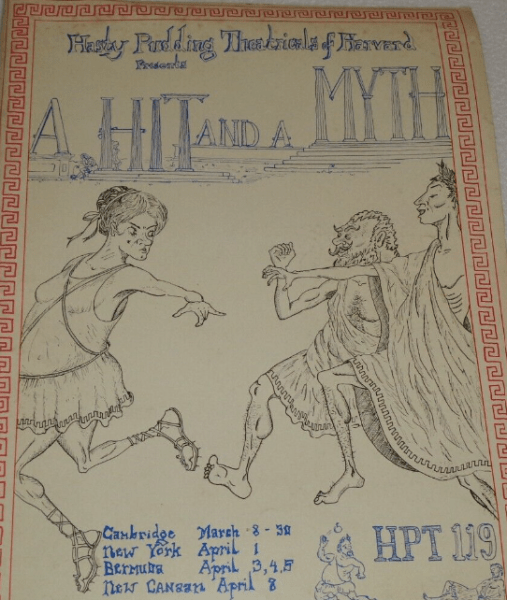
My older brother, a cutting-edge type, liked the Cuban pavilion for the vibes so we went there together, feeling slightly rebellious. He dragged me into the Christian pavilion one day and we saw a film with a monk setting himself on fire that depressed me for a days. And together we saw Harvard’s famous all-male Hasty Pudding troupe at an outdoor bandstand in a play called a Hit and a Myth that was quite bawdy. Although a good fit for my brother, it was bit mature (sic) for my tastes. I recall the energetic finale, Acalpulco, with a group of ‘grown men’ dressed like Carmen Miranda dancing in a conga line. Their unanchored brassieres kept riding up to their necks.

The list of songs inside this programme reveals that Acapulco was the penultimate song in the play, not the last. Characters in the play included Xerox and Tenintius and there were also Vestal Virgins. The Montreal Gazette said the play was written by the sons of Pulitzer Prize winning playwrights and would be of interest to anyone willing to get into the panty raid spirt. (I checked on Wikipedia: one writer, Timothy Crouse, became a journalist for Rolling Stone. The other, John Weidman, wrote for Sesame Street.)

Yes, I went alone to those glittering Expo Isles in the St. Lawrence, despite the fact that in the spring a policeman had visited our sixth grade classroom to tell us about the dangers lurking there. He said a girl could be drugged in a bathroom and then sold into white slavery. I’m guessing I never mentioned this to my father and mother. I wasn’t too worried being used to walking the big city streets on my own and not understanding the term white slavery – something to do with snow, I imagined. However, I did keep a look out for any suspicious Boris Badenof types around the Russian Pavilion.

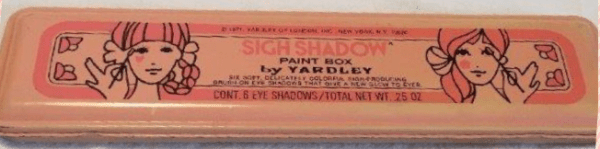
Yardley paintbox eye liner from the era. So obviously aimed at little girls like me. I still want one!

My father worked for Expo as a comptroller but I never visited the fair with him. He obviously was too busy. I did go with my mother, though, a few memorable times. On one occasion we saw Bobby Kennedy walk by surrounded by his team of FBI agents in dark glasses, and on another day we witnessed Haille Selassie, the Emperor of Ethiopia. He had a little dog following him. (I assume this wasn’t a coincidence. My mother wanted to see these famous figures.)

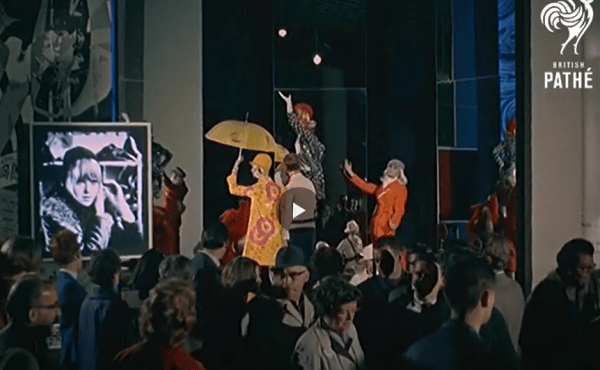
And on one very hot day my mom decided to visit the British pavilion. That place, more than any other, always had an especially long line up. This was the era of Swinging London, after all, and the pavilion included a MOD London exhibit with the Beatles (remember them?) and a Mini Minor Car. I was excited to go. I was a big fan of The Avengers with gorgeous Emma Peel karate-chopping Cold War baddies in her colourful Carnaby Street attire and of the Monkees TV show that featured Yardley commercials and “the London Look.”

The long line up at the British Pavilion. No shade. Wikipedia Commons.

My mom and I queued up realizing we probably had a very long time to wait. It was a hot day and in the line you couldn’t escape the sun. The person ahead of us was an ‘older’ woman with a young child – perhaps around 15 months old -who was not happy in the heat. The baby girl was kicking up a big fuss the whole time and would not be pacified, not in her stroller, not in her mother’s arms.

As was her way, my mother struck up a conversation with this woman.

She was British but this is where the similarity to Emma Peel or any other British ‘bird’ ended.

She was tall and thin, yes, but with wispy light brown hair and lots of stress lines around her eyes. Dowdy would be a good way to describe her attire. She was self-conscious about it, too. “I must look like the wreck of the Hesperus,” she said, combing back a rogue lock of hair with her hand.

This statement impressed me. Here was a smart British lady, just like my 6th grade teacher. And yes, in fact, this beleaguered mom was a teacher but in Toronto. She also had a 15 year old son who was off somewhere exploring the grounds – and she was divorced.

I started to feel sorry for her. She said she had driven to Montreal for just one day so her son could visit the Fair. Just one paltry day to see Expo, how sad! And all she wanted was to visit the pavilion of her homeland. Minutes, maybe hours ticked by and the long line inched forward. The little girl squirmed wildly in her mother’s arms, her shiny face getting redder and redder.

We were getting closer to the entrance and then my mother offered to do something very generous. She said WE would watch the baby for the woman in a shady area nearby so that she could visit the British pavilion in peace. (Our own visit would have to wait for another day.) And, what do you know, the woman took her up on the offer. I guess all that time in the line had made us seem safe and familiar to her.

The harried British mother passed through the turnstiles by herself and my mother and I and the baby found a big tree to sit under.

Detail of Mod Britain exhibit British Pathe video.

Then the lady returned and we said our goodbyes.

At Christmas she sent us a card with a long thank-you note written in impeccable teacher handwriting. (She had told us she didn’t have a phone. Too expensive.) I remember the note was on blue paper, maybe one of those aerograms popular in the day for overseas correspondence.

So, it seems, this overwhelmed mother did, indeed, appreciate my mother’s spontaneous act of kindness, as outrageous as it was – even for the 1960’s. I, myself, don’t recall being embarrassed at all.

  1. http://cinemaexpo67.ca/reimagining-cinema-film-at-expo-67/ https://www.nfb.ca/film/in_the_labyrinth

2. https://expo67.ncf.ca/expo_sculpture_index.html

3. ” Take a bag of ham sandwiches and a thermos of coffee to Expo- where there are 146 restaurants and snack bars, 46 food shops and 500 automatic vending machines to serve you,” says the opening line of the article “Easting Exotically and otherwise at Expo,” in the Star Weekly insert for February 11, 1967. The pic shows Indian, Japanese, Italian and Mexican chefs with their exotic fare: tacos, pizza, sushi and a meal with pilau and nan. (I think I ate all these things this past weekend.) A pic on the next page caption says :A snack bar in Expo terminology means glamorous dining, indeed. (So, no real cheap food at Expo.) Oddly, the advert in this article was for KLIK and Kam luncheon meat with a pic of little squares of this ‘meat’ on toothpicks on a pickle. How ironic.

4. Man the Explorer; Man the Producer; Man the Creator; Man the Provider. I recall Man and the Community had a revolving exhibit (Czech artist) with little wooden models of a man and a woman in bed and all their needs revolving around them on a belt. “The cause of all progress is laziness.” Reading a list of that place’s exhibits, it sounds amazing. I want to go back!

The Star Weekly insert wrote about the Man out of Control? exhibit in Man the Producer with it’s “maze of signs showing man besieged by the information explosion.” The article continues: “The question mark in the title is no accident. Will the devices of man swallow him up or will he remain in control?” Hmm. Why do I feel this question to be extremely timely?

The Other Side of the Street: a story inspired by Lovell’s Directory

Decarie between Isabella and Dupuis, June 1961. Archives de Montreal VM105-Y-3 545 001-010. My back porch is somewhere in there.

I spent my elementary school years living on Coolbrook, a one-way street in the Snowdon district of Montreal, adjacent busy Decarie.

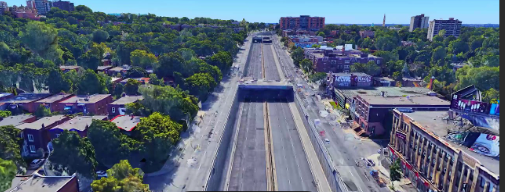
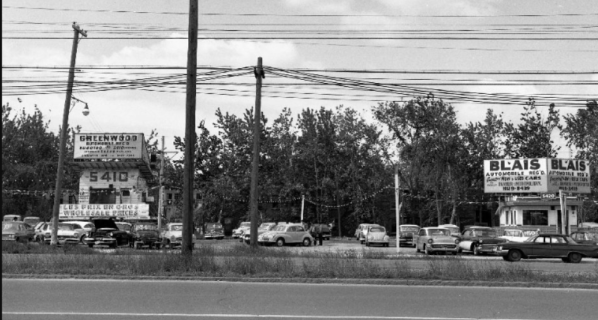
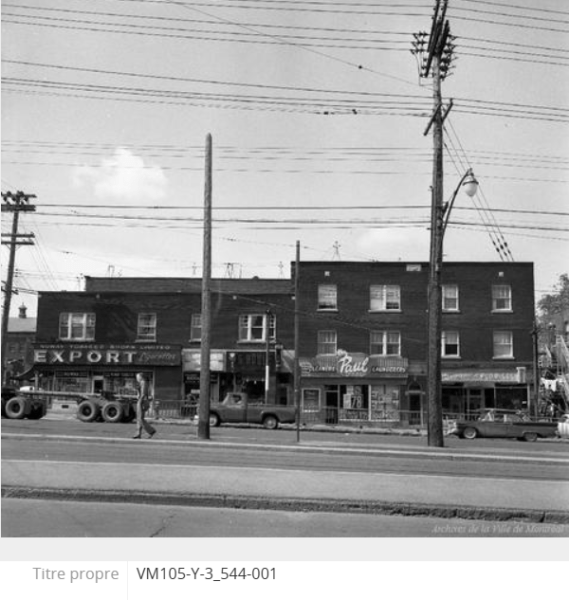
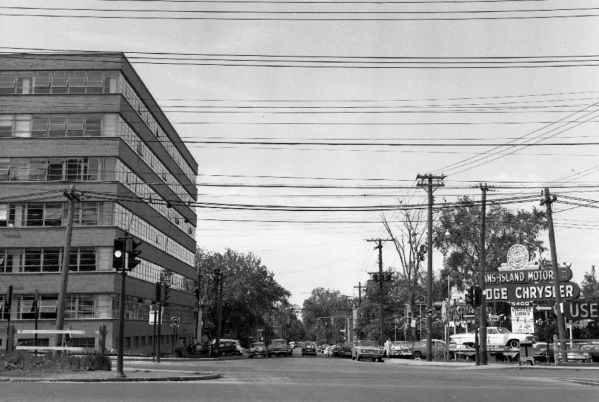
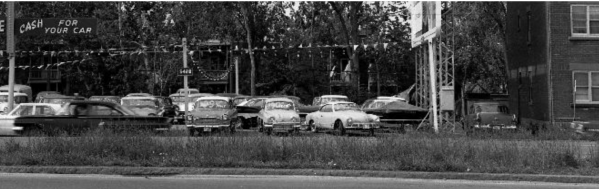
Before Decarie became “the trench” in time for Expo 67 it was a wide boulevard with a stretch of storefronts on the east side of my area including Young’s Vegetable Market and Green’s Pharmacy; and on the west side right behind my upper duplex apartment were a few used car lots as well as one empty lot where we children sometimes played. This lot, I remember, was strewn with dirty old toilet bowls and big baffling, almost supernatural chunks of quartz, but also sprinkled in between with enchanting pink hollyhocks and charming pussy willows. 1.

In those early days, I would cross Decarie at Isabella and skip down a few steps to the basement Decarie Handy Store to spend my 25 cent allowance on, usually, a MacIntosh Taffy or Cherry Blossom, ten cents each in those days. Any extra pennies would go to Lik-M-Aid, a sour powder in a paper tube.

My allowance didn’t permit me to buy the giant, perhaps healthier, Fruit and Nut bar I so craved. It cost 39 cents and I never thought to save up week to week.

The major commercial area in the neighbourhood was one and a half blocks south, up an incline on Queen Mary Road. There was a Woolworth’s on the corner of Coolbrook and Queen Mary with a lunch counter that featured enticing ads for banana splits for, yes, 39 cents. Again, too expensive for me although I imagine I could have always asked my Mom to buy the ingredients and make me one. She wasn’t cheap like my accountant Dad, who made us sign for our meagre allowance in a little booklet he kept for the purpose.

Nuway Tobacco Store with bit Export sign 1961, Montreal archives. There was a little hat shop tucked in beside it. An oddity in the 1960’s when hats were not in fashion especially among the young..

Every fall, we bought our school supplies at the Woolworth’s, sometimes a new pencil case. You could still get the old fashioned wooden ones with the sliding top or a newfangled plastic pouch with a zipper. I still get excited at the sight of an unsullied Hilroy scribbler.

The other stores of importance on Queen Mary was Black and Orange stationery shop, a dingy post-war style store but, still, all that potential in the pens and paper!

And the Zellers further up towards Cote des Neiges, also a bit of a dust bowl. Morgan’s Department store had a small shiny two story branch on Queen Mary, but that store was of no significance to me although my brother, fooling around with friends, once kicked in their showcase window.

And a little further up the street was the NDG library for boys and girls where I borrowed the horsey tome King of the Wind by Marguerite Henry over and over.

Yes, I remember the stores in my area with varying degrees of yearning, for sugar and for learning, but when it comes to the block of Coolbrook on which I lived, I only have half a memory of it.

That’s because I don’t recall one person, not one, who lived on the other side of the street. I suspect no children lived across the street in the 1960’s. Maybe whoever owned those duplexes refused to rent to families with children. And it was the baby boom era!

Corner Isabella and Decarie. Archives de Montreal. This was taken a few yards away to the right of the Decarie Handy Store.

Our duplex block of four homes, two lower, two upper, was one of a stretch of five or more owned by the same man, an unpretentious French Canadian, a Monsieur D. who dressed like a hobo. My mom also said he thought I was the loveliest little girl, so kudos to him. Monsieur D. was very cheap, it seems. He painted all the doors of his brown/red brick buildings dark brown and all the porches grey, casting a gloom over the entire block. He must have got a deal on paint, my mom said.1

Gibeau’s Orange Julep from other side of the trench. wikipedia commons
I lived smack in between two of Montreal’s most iconic structures, the Orange Julep
and the Snowden Theatre, below, in an otherwise dreary-looking neighbourhood.
I visited Orange Julep but once. The drink tasted sulphury to me.

It’s a condo today after lying in disrepair for ages. I saw the Lippizanner movie there.
Also maybe Sound of Music. I didn’t see many movies as a child.
Children were banned from theatres until 1962 in Quebec due to the Laurier Palace Fire of 1927

It didn’t help that in those days no one bothered to decorate their upper or lower balconies with pots of flowers except for the Italian man a half dozen doors down living in a gaudy new duplex (Lovell’s reveals he was a landscaper) and an unknown family in one of the few stand-alone houses on my street, up near Queen Mary Road, who had a very splashy flower garden in summer. One year it snowed in the middle of May and I recollect the sight of a lovely row of red tulips with a cushion of white on top as I passed this tiny cottage on my way to the Nuway Tobacco Store at the corner of Decarie and Queen Mary to buy my mom a carton of Du Maurier cigarettes.

Luckily, the trees along my stretch of street were tall and leafy and during the hot, humid Montreal summers the setting sun dappled the baking macadam with light. I could reach out over my balcony and touch a branch of my very own mystic maple. I do suspect the tree’s leaves protected me – a bit – from the ubiquitous 1960’s air pollution and the lead-laden fumes of the pink, turquoise and fire-engine red Corvairs, Thunderbirds and Mustang convertibles idling on the street below. These automobiles belonged to visitors as few families on our side of the street actually owned a car. Kids cost money, after all.

A glance at Lovell’s Directory on BANQ reveals to me the familiar surnames of families living around us. I recognize, too, the phone numbers, as I dialed many of them over and over during my childhood. The family names from across the street are new to me, of course. Mostly French, some English and one Finn. The breadwinner of the family is the only one listed on Lovell’s, but had any children lived there, French or English or Finnish, I would have seen them playing on the short sloping driveways or on the sidewalk or at least walking to school.

Yes, we kids played out on the street in those days, chanting to skipping games like“double dutch” on those short sloping driveways, bickering over the rules of hopscotch or “yoki” on the sidewalk. The boys sometimes played ball hockey right on the road.2

However, when it comes to the other side of the street, I have no recollection at all. Ain’t memory funny.

I recall not one incident, not one visual. Nothing has imprinted itself on my brain for life, such as when my neighbour’s German Shepherd got hit by a truck late at night and my friend’s mom sobbed loudly on the street and there was leftover blood and sawdust on the curb the next morning.

I don’t recall one bit of gossip about anyone on the other side of the street. On our side plenty: “Did you know the L family’s kids are ONLY fostered? Did you know that in the S family, the Mom makes more than the husband?” Did you hear that the W sons went with two girls they hardly knew on a car trip out West? Real shameful stuff it was!

I don’t even remember seeing anyone out shovelling the walk across the street in winter. And I stared at that side of the street for seven years from my tiny bedroom window. No one picking up garbage strewn around by a stray dog. No one leaving the house in the early morning, rubbers on feet, leather briefcase in hand, felt fedora on brylcreemed head to take the brown and yellow No. 65 bus to some downtown skyscaper like Place Ville Marie.

I have to smile: the 1966 Lovell’s reveals that there were quite a few vacant homes across the street from us. Is it possible that it was harder to rent that block on that side of Coolbrook because of us? Because there were so many boisterous, loud, unruly children (I count about fifteen) playing out on our small section of Coolbrook Street.

As in happens, in 1967, Expo year, while my British grandmother was visiting us from Malaya for the first and only time, my brother was playing ball hockey with a friend when he knocked over one of the Italian man’s pretty flower pots, red geraniums, I think, with a errant slap shot. Supposedly the man was enraged and ran out onto the street and hit my brother with a leather strap, the one and only genuinely violent act I ever heard of on our street- and, yes, it was on our side!

My grandmother, who herself had complained many times about the “shrill” Canadian children playing on the street, convinced my father to move out of the district and within months we were living in a smog-free ex-burb north of the city in a house with a huge yard with at least two weeping willows and more fir trees than I could count.

One broken porch ornament – and a rather Felliniesque incident – and the trajectory of my life took a dramatic turn, for better or for worse, who knows. For sure, my current Facebook friends would be totally different had my brother’s ball just skipped off the railing and missed that freakin’ flower pot! Life, just like hockey, can be a game of inches.

But, as someone who has lived in sleepy suburbs most of her life, I carry that time in the west end of the city deep inside of me, even if it’s only half a memory.

END

1. Our backyard area was especially ugly. It was expansive with a floor of gravel and dirt. Each family had a little yard, yes, with a grey fence about 15 feet by 25 feet, with grass. Our plot contained a giant tree, so no light, and nothing grew there despite my efforts at a garden. We neighbourhood girls would sling blankets over the fence and tie skipping ropes to the wires and play ‘horse.’

Right behind my backyard. Soon the apt at right would be domolished, I think, and that became the vacant lot

A newlywed couple moved in for a while and I recall one time watching from my second story back balcony as the young wife was chased off the porch by her husband who was holding a bucket of water. He caught up to her and swung the bucket and poured the it over her head. I could feel their euphoria. Oh, to be in love.

Beyond the yard was an over-grown alley way, my black cat, Kitty Kat’s, private jungle, where we once saw a pheasant that had flown down from the mountain, so said my mother, and beyond that alley the used car lot. The moms would let kids run wild while at play, as was the usual in the 1960’s, but they would dutifully call their children in for lunch from the backyard porches. One Mom had a bell.

Once I and a friend came upon a ‘hobo’ sleeping in one of the used cars behind our house. He had one leg and he said he was a war veteran. I stole a rather large chunk of left-over roast beef for him, from my house. When my mom wondered what had happened to her leftovers, I told her that I had given it to a stray dog – and she laughed. No fool I.

2. I recall once and only once a huge slimy Norway rat scuttling past us into the drainpipe a we played.. How did that huge thing fit in that tiny hole? A favourite game was yoki ( I thought Yogi) also called elastics or Chinese skipping, where we used a sewing elastic and manipulated it around our lower leg to rhymes. Classic skipping was popular, too, double dutch, etc. “My mother and your mother were hanging out the clothes. My mother gave your mother a punch in the nose. What colour was the blood.” This rhyme sticks in my head probably because my French Canadian mother wasn’t friends with any of the other mothers on the block. She had little in common with them, being French and also a working mother who played competitive bridge at the tony Boulevard Club.

There was a definite pecking order among the children playing on our section of the block in the form of arguments, fights, churlishness, and a lot of one-upmanship. I was a passive observer type, definitely at the lower end of the hierarchy. A good thing too: I recall the two alpha-girls in my group viciously fighting and literally pulling out handfuls of each other’s hair.

My brothers did play ON the road, classic road hockey which was safe on our quiet one-way street. One day a car honked at them and just as they were about to give the guy the finger they noticed it was John Ferguson, the legendary Canadiens enforcer. A rather dishevelled looking man whom we sometimes saw around was related to a playmate of mine. It was Doug Harvey, the Canadiens legend.

Pierre Lalonde, a young teen idol at the time, lived in the Italian man’s place for a few years in the 1960’s. He seemed shy – but he owned two flashy convertibles, both neon aqua and two motorcycles. (I worked in the same building as he did in the early 80’s – a TV station – and lived in the same town as him, in the 1990’s, often seeing him at the pool – but never once spoke to him. I did walk his dog as a child.)

Benjamin Workman, MD: Leading the Way

One spring day in 1819, a young man named Benjamin Workman stood on the dock at Belfast, Ireland, trying to decide where he should immigrate to in North America. He had relatives in the United States, but before he booked his passage, he wanted to check on the safety of the vessels that were scheduled to leave soon.

He noted that the captain of the New Orleans-bound ship appeared to be drunk, the mate of the ship going to New York swore profusely, and the crew of vessel going to Philadelphia ignored his questions, but the captain of the Sally, bound for Quebec, impressed him favourably, so that’s the ship he chose. He later noted that this had been a lucky choice since yellow fever was widespread in American port cities that year.1

Benjamin left Ireland on April 27 and arrived in Montreal a few weeks later. He was 25 years old and had 25 guineas (a coin worth one pound, one shilling) in his pocket.

This photo of Dr. Ben Workman appears in Christine Johnston’s book The Father of Canadian Psychiatry, Joseph Workman

His choice of Canada turned out to be a good decision: within 10 years, all of his eight younger siblings and both of their parents had followed him. The Workmans were all hard-working, ambitious and smart, and they took advantage of the opportunities available to them in their new homeland. Four of Ben’s brothers (Alexander, Joseph, William and Thomas) became prominent in business, medicine and politics. His only sister, Ann (1809-1882), married Irish-born Montreal hardware merchant Henry Mulholland and was my great-great-grandmother.

Benjamin’s parents were Joseph Workman (1759-1848) and Catherine Gowdey (1769-1872). Ben was born on Nov. 4, 17942 in the village of Ballymacash, County Antrim, near Lisburn, where the family lived in a small house near the top of a hill.  

Joesph was a teacher in Ballymacash, but he left teaching for a job as a manager for a local landowner, and as a deputy clerk of the peace for the area. Without its only teacher, the local school had to close, so young Ben started studying on his own, reading the Bible and geography books while his father helped him with arithmetic. When Ben was 11, Joseph apprenticed him to a linen weaver, but it soon became clear that Ben had no talent in that field. What he really wanted to do was study. Eventually, Ben went back to school, where he excelled in grammar and the classics. After he graduated, he found a teaching job in Belfast, then another position near Lisburn.   

Ben’s decision to leave Ireland was influenced by an event that took place in 1817. As he was eating his evening meal at his parents’ home, a dozen beggars came in the gate and asked for food and money. Perhaps realizing how widespread poverty was in Ireland, he began to think about going to North America.3

Montreal suited Ben well: other Irish and Scottish immigrants arrived there around the same time, and there were work opportunities for all. He immediately found a teaching job, but after that school’s owner disappeared with its funds, several parents who had noticed what a good teacher Ben was started a new school, with Ben as headmaster.

The Union School, as it was called, was unique. For one thing, girls were admitted, although they were taught separately by a female teacher. It was also successful. By the spring of 1820, it had 120 pupils, and it remained the largest English school in Canada for 20 years.4 Several of its graduates went on to have distinguished careers in business and politics. In 1824, Ben became the sole owner of the school, but he eventually turned over the responsibility of running it to his brother Alexander, who had come to Montreal in 1820.

In 1829, Benjamin switched careers and became a newspaper editor, partnering with a friend to purchase a weekly Montreal newspaper, the Canadian Courant. It had been founded in 1807 as the Canadian Courant and Montreal Advertiser. Ben published the newspaper until 1834, using it to promote his liberal religious views, social welfare issues, and the temperance movement. When the paper ceased publication, Ben blamed distillers, saying that their advertising had dried up because of his support for temperance.

Meanwhile, Ben experienced several tragedies in his personal life, as he was married twice and became a widower twice. He married Margaret Manson, a teacher at the Union School, in 1823. The couple had no children and Margaret died seven years later. He married Mary Ann Mills on October 14, 1838, in Franklin, Michigan, and the couple had three children: Mary Matilda, born in July 1840; a son, Joseph, who was born in November 1841 and died at age 10 months; and Annie, born in July 1843. Mary Ann died two months after Annie’s birth, and Ben’s mother, Catherine, looked after his two daughters.

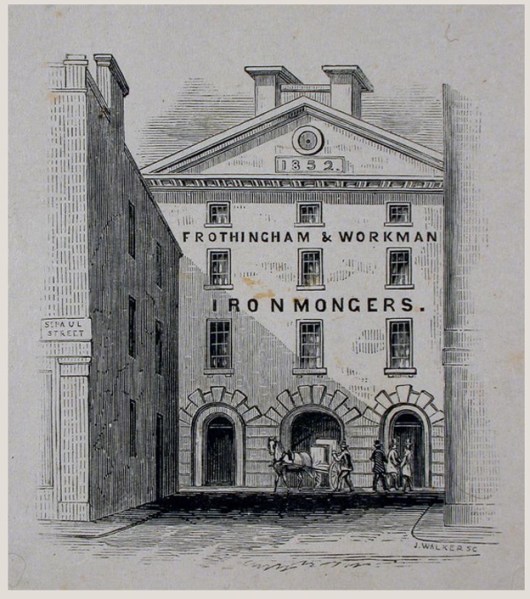
Soon after that, Ben took up his third career — as a druggist. For several years in the 1840s, Lovell’s city directory of Montreal listed “B. Workman & Co., chemists and druggists”, located at 172 St. Paul Street, corner Customs House Square.5 Meanwhile, he studied medicine at McGill University, graduating in 1853, at age 59. He was henceforth known as Benjamin Workman M.D., which helps differentiate him from several other Benjamins in the family.

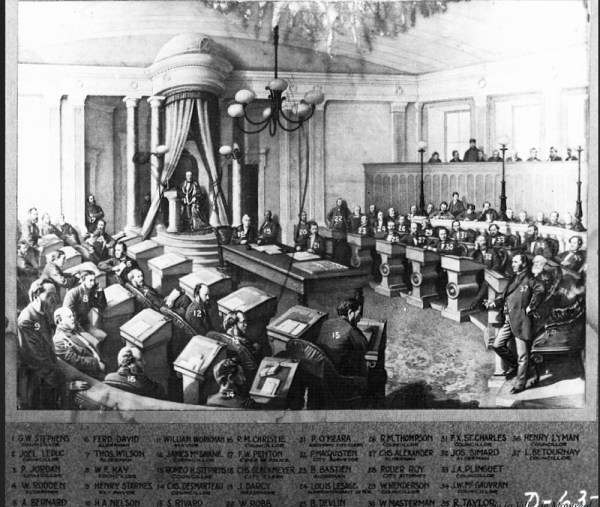
During these years as a pharmacist and doctor, Ben demonstrated compassion and generosity, often providing care to people who were too poor to pay. Then, in 1856, he reinvented himself again and moved to Toronto, where he assisted his brother Joseph run the Provincial Lunatic Asylum, the largest and most progressive psychiatric hospital in Canada at the time.

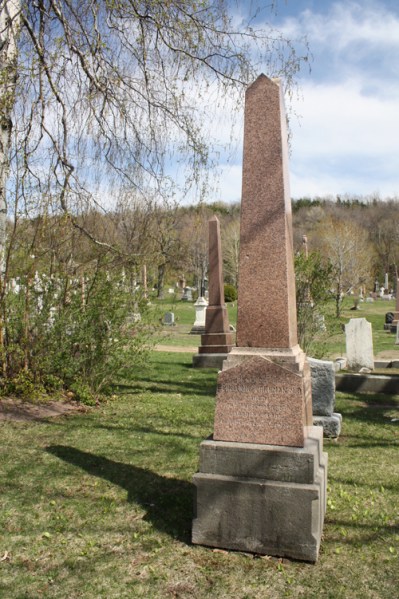
Benjamin is buried in Montreal’s Mount Royal Cemetery, near the Workman family plot. JH photo.

Benjamin Workman is probably best remembered as the founder of the Unitarian Congregation in Montreal.  In Ireland, the Workman family had attended the Non-Subscribing Presbyterian Church of Ireland in Dunmurry. Its members strongly believed in freedom of thought in religion.6

When Ben first arrived in Montreal, there were not enough Unitarians to organize a congregation, so he attended the St. Gabriel Street Presbyterian Church. When the city’s Unitarian congregation was permanently established in 1842, he played a key role.7

In 1855, Ben got into a disagreement with the congregation’s minister, Rev. John Cordner, a man he himself had recruited for the job. Benjamin argued that Cordner had excessive authority, and when the rest of the congregation sided with their minister, Ben withdrew from the church. Soon after, he moved to Toronto, joining the Unitarian congregation his brother Joseph had helped to found there. He got along well with the Toronto congregation’s members and their minister, and he ran the Sunday School there for many years.

Ben lived with his daughter Anne in Uxbridge Ontario at the end of his life, dying there on Sept. 26, 1878, several weeks short of his 84th birthday. He was buried a few days later next to the large Workman family plot at Montreal’s Mount Royal Cemetery.

This article is also posted on http://www.writinguptheancestors.ca.

See also:

Janice Hamilton, “Dr. Joseph Workman, Pioneer in the Treatment of Mental Illness” Writing Up the Ancestors, Oct 26, 2017, https://www.writinguptheancestors.ca/2017/10/dr-joseph-workman-mental-health-pioneer.html

Janice Hamilton, “Henry Mulholland, Hardware Merchant” Writing Up the Ancestors, March 17, 2016,  https://www.writinguptheancestors.ca/2016/03/henry-mulholland-montreal-hardware.html

Notes:

The children of Joseph and Catherine Workman were: Benjamin (1794-1878), Alexander (1798-1891), John (1803-1829), Joseph (1805-1894), William (1807-1878). Ann (1809-1882), Samuel (1811-1869), Thomas (1813-1889), Matthew Francis (1815-1839).

Benjamin kept a journal in which he recorded his memories of growing up in Ballymacash, and an account of the Workman family’s 200-year history in Ireland.  A large online database called A Family Orchard: Leaves from the Workman Tree, https://freepages.rootsweb.com/~database/misc/WORKMAN.htm, includes a family history going back to the 1600s, that was part of Ben’s journal. The late Calgary researcher Frederick Hunter prepared this site and database. 

Catherine Gowdey’s name has been spelled in various ways, including Gowdie and Gowdy.

Thank you to Christine Johnston, former archivist and historian of the First Unitarian Congregation of Toronto, and author of a biography of Ben’s brother Joseph.

Sources: 

1. Christine I. M. Johnston, The Father of Canadian Psychiatry: Joseph Workman, Victoria: The Ogden Press, 2000, p. 16.

2. A Family Orchard: Leaves from the Workman Tree, https://freepages.rootsweb.com/~database/misc/WORKMAN.htm, accessed Jan. 31, 2025.

3. The Digger, One Family’s Journey from Ballymacash to Canada, Lisburn.com, http://lisburn.com/history/digger/Digger-2011/digger-19-08-2011.html, accessed Jan. 31, 2024.

4. Nicholas Flood Davin, The Irishman in Canada, London: S. Low, Marston, 1877, p. 334, Internet Archive, https://archive.org/details/irishmanincanada00daviuoft/page/334/mode/2up, accessed Jan. 31, 2025.

5. Lovells Montreal Directory, 1849, p. 246, Bibliothèque et Archives nationales du Québec (BAnQ), https://numerique.banq.qc.ca/patrimoine/details/52327/3652392, accessed Jan. 31, 2024.

6. Christine Johnston, The Father of Canadian Psychiatry: Joseph Workman, p. 15.

7. Christine Johnston. “The Irish Connection: Benjamin and Joseph and Their Brothers and Their Coats of Many Colours,” CUUHS Meeting, May 1982, Paper #4, p. 2.

Enslaved by Poverty

Recently, I’ve been wondering about the white slave who successfully escaped after allegedly burning down New France’s third Hotel-Dieu hospital and 45 homes in what is now Old Montreal in 1735.

I can’t help feel sorry for the man who was brought to Canada as an indentured slave (engagé or trente-six mois due to the thirty-six month duration of his contract) primarily because he was young, healthy, strong enough to serve as a labourer and poor. In return for his work, he got room and board, clothing and a salary, but he had no rights beyond that. His employers could send him anywhere to do just about anything; and according to New France law he had little recourse.

A brief summary of his life appears online in the Canadian Mysteries series dedicated to the fire.

Originally from Butenne in Franche-Comté, Claude Thibault was found guilty of salt trafficking [illegal sale of salt]. Condemned to end his days in the king’s galleys, his sentence was commuted to a life in exile in Canada. He arrived in Québec with a dozen other salt traffickers, including Jacques Jalleteau, in September 1732.

On the night of April 10, he was seen at the site of the fire, but disappeared when Angélique was arrested the following day. Despite warrants issued for a wanted person throughout the colony, Thibault was never again seen.1

I imagine he used his acumen to create a new life under a new name, perhaps in the fur-trading industry. After all, as a faux-saunier (salt smuggler), he had to develop a lot of entrepreneurial skills. As someone who purchased salt in low-tax regions and sold it on the black market in high tax regions, he had to be skilled at finding clients and creating a distribution hub without being caught by the King’s agents.

The King’s decision to set up an unfair tax regime began in 1680, when he decided to pass a law varying the taxes (gabelle) on salt per region. Salt was an important commodity at the time, and controlling it was an important economic lever. In addition to using it to spice and cure food, people in France also needed enough salt to tan animal skins. In some regions, such as Brittany, people could buy one “minot” (about 37 litres) of salt for as little as 1 livre, while citizens of Main, Anjou and other “high gabelle” regions had to pay as much as 61 livres per minot. The law even forced them to buy a minimum quantity of salt every year, whether they needed it or not.

Smugglers thrived in the seeming injustice, but if they were caught, punishment was severe. They faced fines beginning at 300 livres and leading to jail time of anywhere from 10 days to three months. At first, only the most serious convicts were exiled to New France, but in 1730, Jean Frédéric Phélypeaux, the Comte de Maurepas, began insisting that convicted faux-sauniers should be sorted, with the most healthy or those with useful skills be sent overseas as enslaved labourers on three-year contracts. Eventually, the scheme ended in when King Louis XV of France removed Maurepas from his job in 1749.

Unfortunately, Thibault was caught when Maurepas’ scheme was fully underway, and he had few other ressources to avoid exile.

Alain Racineau, who has studied salt traffickers like Thibault at length, describes most of them as poor rural people, primarily day labourers and small merchants struggling to survive.

They were recruited from the poorest levels of society: casual agricultural labourers, petty artisans and traders, unemployed vagabonds. They frequently affirmed that they had taken up smuggling “pour gagner leurs vies.”2

Thibault’s life didn’t get any easier once he arrived in New France. His contract was purchased by fur-trader and merchant Francois Poulin de Francheville and his wife Thérèse de Couagne, who owned several slaves. After M. Francheville died in late 1733, the widow decided to sell Thibault’s girlfriend to a friend in Quebec City. Plans were established for her to be sent away in the spring of 1734, after the ice melted from the Saint Lawrence River.

On February 22, 1734, Thibault and his lover decided to run away, setting fire to her bed as a distraction. They had hoped to reach the English colonies, but bad weather stopped them. They got stuck in Châteauguay and were eventually captured by three militia captains.

Thibault was thrown into jail on March 5 for breaking his contract. He was released on April 9, just one day before the large fire that began in the Francheville home on St. Paul Street.

Thibault disappeared just before his girlfriend got arrested, was convicted and executed. On April 19, authorities set up a manhunt

…given that we are in no State at present to forward the description of the said Thibault with the present order, the Said Captains will take care to arrest and Interrogate all Young men who are unknown vagabonds coming from the direction of Montréal toward Québec and passing through their area, to ask of Them their names and surnames, who they are, where they come from, and where They are going; and upon failure by the said passers-by to provide adequate Information on their persons, And for the slightest doubt or suspicion regarding their responses, And in consideration of public safety, We expressly ordain that the said Captains have them arrested Immediately, and taken under sound and due guard to the gaols of This city;3

They never found him.

Two years later, authorities officially took him off the most wanted list.

1Beaugrand-Champagne, Denyse, Léon Robichaud, Dorothy W. Williams, Marquise Lepage, and Monique Dauphin. “Torture and Truth: Angélique and the Burning of Montreal,” Great Unsolved Mysteries in Canadian History Project, 2006, https://canadianmysteries.ca/sites/angelique/contexte/references/personnages/2229en.html

2Racineaux, Alain, ‘Du faux-saunage à la chouannerie, au sud-est de la Bretagne’, Mémoires de la Société d’histoire et d’archéologie de Bretagne, 1989.

3Archives nationales du Québec, Centre de Québec, Fonds des Ordonnances des intendants de la Nouvelle-France, E1, S1 P2622, Hocquart, Gilles, Ordinance given to the captains of the militia for the arrest of Claude Thibault, April 19, 1734, https://canadianmysteries.ca/sites/angelique/proces/rumeurcircule/1889en.html .

R. Stanley Bagg, Tory Politician

Robert Stanley Bagg (1848-1912), was a Montreal businessman, sportsman and life-long Tory. A newspaper report of his death noted, “He was a staunch Conservative both in and out of power, and some years ago was president of the Liberal-Conservative Club giving a great deal of his time to the work of organizing as well as well as to public discussion. He was well known amongst the French-Canadian people and spoke French almost as fluently as his mother tongue.”1

My great-grandfather’s interest in politics was not limited to reading about the issues of the day in the newspaper (The Gazette was a die-hard Conservative-leaning publication) or debating issues privately with his friends. Stanley became actively involved in the Liberal-Conservative Club after it was founded in 1895 as a rallying point for English and French-speaking Conservatives in Montreal. The club took a leading role in the Dominion (federal) election of 1896, and the Quebec campaign of 1897. No doubt to Stanley’s dismay, the Conservatives lost in both elections.

The Conservatives had been the party of Canada’s first prime minister, Sir John A. MacDonald, who is said to have been a personal friend of Stanley’s father, Stanley Clark Bagg (1820-1873). They were in power until 1896, when Sir Wilfrid Laurier’s Liberals defeated them, and Laurier remained prime minister for the next 15 years. One of the main differences between the two parties was that the Conservatives promoted loyalty to the British Empire, independence from the United States and protectionism in trade, while the Liberals were in favour of free trade.

Robert Stanley Bagg, portrait by Adam Sheriff Scott. Bagg family collection.

Stanley played a role in many party activities, especially after his retirement from the family real-estate business at the turn of the century. Trained as a lawyer, he frequently chaired public meetings, he served for several years in the early 1900s as president of the Liberal-Conservative Club, and he twice attempted to run for a seat in the House of Commons in Ottawa. The first time was during the Dominion election of 1896 in the St. Lawrence riding, east of Mount Royal. This was the area where Stanley’s ancestors had lived and owned property for almost a century. Stanley was the third candidate in the riding, and the nomination papers he submitted showed he had considerable support among both English and French-speaking party members. However, four days later, when it became apparent that the other Conservative candidate had broader support, Stanley withdrew his name.

In 1905, The Gazette anticipated that Mr. R. Stanley Bagg might run as an independent candidate for the provincial legislature vacancy in the St. Lawrence division caused by the death of the incumbent.2 The newspaper’s prediction was wrong, however, and he did not run. A few years later, in the federal election of 1908, Stanley did put his name in for the Conservative nomination for the St. Lawrence division. This time, Henry Archer Ekers, the outgoing mayor of Montreal, won the nomination by a narrow margin, and Stanley called on the meeting to make the choice unanimous.

Although he never did run for office, Stanley appears to have been a popular speaker at Conservative party functions, and the newspapers reported on his speeches on several occasions.

When he addressed a meeting during the 1897 provincial campaign, The Montreal Star summed up his remarks:

“Mr. R. Stanley Bagg was the last speaker. In a really eloquent and polished speech this gentleman drew a picture of the possibilities of the Province of Quebec under good government. Especially strong were his commendations of the Flynn educational programme, which would bestow that priceless boon of education upon the poor as well as upon the rich. This education would enable the growing generation to intelligently study the questions appertaining to the government of the province, and when the young people became enfranchised, such study would enable them to vote for honest government, for the party and platform that best represented the best interests of Quebec.“3

In January 1900, Stanley was president-elect of the Liberal Conservative Club and a general election was coming soon. In remarks to a meeting, he pledged to put forward the interests of the club, the Conservative party and the county, adding that the Conservative party was the “true patriotic party of Canada.”4

Later that year, during the Dominion election campaign, The Montreal Star quoted his remarks to a Tory campaign rally: “Never in the history of Canada has there been an election so important, so fraught with vital interest in the whole Dominion, as that in which the people of this country are now engaged. The relations between Canada and the Mother Country are, at the present time, peculiar. The South African (Boer) war afforded Canada an opportunity to demonstrate Canadian loyalty and Canadian valour, and today we have as a result an exceptional chance to secure favours from the Mother Country, which never before presented itself. The Imperial sentiment is strong throughout the Empire and the British people are disposed to accord to the colonies trade concessions the value of which to ourselves cannot be overestimated.

“There is but one way in which Canada can benefit from this opportunity, and that way lies through the return of the Conservative party to power. The Conservative party is pledged to use its best efforts to secure a mutual imperial preferential tariff …. The Conservative party stands for protection, for stability in the tariff, for patriotism and for progress.…”5

Eleven years later, Stanley again focused on the topic of reciprocity (free trade) with the U.S. In an hour-long address, he noted that, as someone who had taken part in a large number of election campaigns and given close and continuous study to public affairs, he had been invited to give his views on the great question now before the voters. He “emphatically urged that reciprocity be thrown out. He not only showed that the pact would be commercially injurious to Canada, but appealed to the patriotism of the electors, their spirt as Canadians and Britons. He reminded them, amidst ringing applause, how Sir John A. Macdonald had denounced the attempts of Liberal leaders to bring about unrestricted reciprocity in 1891 as ‘veiled treason’.”6

These accounts of Stanley’s speeches may seem old fashioned today, but I was pleased to discover them as they provided a window into my ancestor’s thoughts. He clearly identified as Canadian and British, although his ancestors also included Americans and Scots.

This story is also posted on http://www.writinguptheancestors.ca

See also:

Janice Hamilton, “Horses, Snowshoes and Family Life”, Writing Up the Ancestors, Sept 21, 2024, https://www.writinguptheancestors.ca/2024/09/horses-snowshoes-and-family-life.html

Janice Hamilton, “The Silver Spoon”, Writing Up the Ancestors, ”, June 12, 2024, https://www.writinguptheancestors.ca/2024/06/the-silver-spoon.html

Sources:

  1. “R. Stanley Bagg Died Yesterday,” The Gazette, (Montreal, Quebec), July 23, 1912, digital image, https://www.newspapers.com/image/419604976 accessed Aug. 4, 2024.
  • “St. Louis Division; Mr. Parizeau’s Supporters Enthusiastic.” The Montreal Daily Star (Montreal, Quebec), 10 May, 1897, p. 4, digital image, https://www.newspapers.com/image/740883625 accessed Oct. 1, 2024.

Sundays and the Great Depression

I used to hate Sundays. I had to go to Sunday school. I really didn’t understand why I had to attend because my parents just dropped me off. That’s right. They didn’t even go to church. And no one asked me if I wanted to go.

After they picked me up, things got worse. It was homework time until lunch. Of course, I could have done my homework on Friday night but Fridays were reserved for movies on the television and reading in bed with a flashlight until all hours.

And worst of all, some Sunday afternoons were for Visiting the Elderly Relatives. In my mind, my aunts and uncles were ancient. Plus my brother, being a boy and older than me, was apparently able to take care of himself, as he always seemed to be absent from these visits. So I would sit in the living rooms of my aunts and uncles, with no toys or any other amusements, and listen to the adults talk.

I now cherish the memories of these visits because they provided me with an appreciation of the social history of Montreal, as well as significant events such as the Depression and World War II.

The stories about the Depression are the ones that struck me the most. During the Depression, a quarter of Canada’s workforce was unemployed.1  My dad, Edward McHugh, was a young man out of work in Montreal and he joined his older brother and sister in Drummondville, to work for the Celanese. At the peak of the Depression, the Celanese employed 1,757 workers.2

None of the McHughs had cars in those days so they must have travelled back and forth to Drummondville by train. And Uncle Thomas McHugh married a local girl. I can just imagine the McHughs, from Verdun, arriving in Drummondville for the wedding. I doubt very many people spoke English in Drummondville at the time. The culture shock must have been intense.

My aunts and uncles, even into the 1960s, were thankful that they were able to have had some work during the Depression. Uncle Al Scott worked for the Northern Telecom for 40 years, although with reduced hours during the Depression. Luckily Uncle Frank McHugh worked for the Montreal Tramway Company so he was able to keep working during the Depression. He was a tram driver for tram number 24 that started in Montreal West and crossed the city on Sherbrooke Street. His job was safe.

Dad’s siblings loved to have a good time and the Depression did not stop them. My Aunt Elsie used to describe their card parties. There was only one bottle of scotch, some ginger ale, one can of salmon and one loaf of sliced white bread. My aunt was able to spread the salmon so thinly that she could make sandwiches out of the whole loaf of bread.

It was very clear to me that the Depression was a very frightening time in their lives. During this period, the future must have seemed bleak. Life was a struggle to make ends meet. But they made the most of it and persevered. Today I feel lucky to have listened and to remember their stories.

1 https://en.wikipedia.org/wiki/Great_Depression_in_Canada

2 http://www.patrimoine-culturel.gouv.qc.ca/rpcq/detail.do?methode=consulter&id=14311&type=pge#.WSNY7Gg1-Uk

The Silver Spoon

In this article I refer to Robert Stanley Bagg by his middle name since it was the name by which he was best known. In other articles I have referred to him as RSB to differentiate him from his father, Stanley Clark Bagg (SCB) and his grandfather, Stanley Bagg.

My great-grandfather Robert Stanley Clark Bagg, or R. Stanley Bagg (1848-1912), was born with the proverbial silver spoon in his mouth, however, working in the family real estate business was not what he really wanted to do in life. It wasn’t until after he retired that he was able to follow his true passion: politics.

I never heard any family stories about Stanley, perhaps because he died several years before my mother was born. It wasn’t until Montreal’s two major English-language newspapers were digitized a few years ago that I learned about his various interests and activities. In fact, his name appeared in Montreal newspapers frequently, especially after the late 1890s when he became active in the Conservative party.  

Portrait of Robert Stanley Bagg by Adam Sheriff Scott. Private collection.

Stanley was the second child of Montreal notary and land-owner Stanley Clark Bagg (1820-1873) and Philadelphia-born Catharine Mitcheson (1821-1914). The couple’s first child died before Stanley was born. Three younger sisters, Katharine, Amelia and Mary, were born in 1850, 1852 and 1854, and a fourth sister, Helen, arrived in 1861. Even as a child, Stanley must have been told that he would have a leadership role in the family, not only as the eldest, but also as the only male.

According to his obituary in the Montreal Gazette,1 Stanley studied law at McGill University and passed the bar in 1873. He then left Montreal for England, intending to further his studies, however, his father died unexpectedly in August of that year and Stanley came home. For a short time, he was in partnership with lawyer Donald Macmaster, sharing an office on St. James Street, in the old business heart of the city, but he gave up his legal practice to concentrate on the administration of his late father’s real estate. Nevertheless, throughout his life, Stanley identified himself as a lawyer or an advocate, a term used to refer to the practice of Quebec’s civil law.  

The job Stanley undertook as administrator of his father’s estate was not an easy one. Montreal was growing rapidly, with thousands of new immigrants arriving, manufacturing, railroads and industries expanding and construction of new residences ongoing. The farmland that comprised the vast S. C. Bagg Estate, mostly located on the west side of St. Laurent Boulevard in a corridor north of Sherbrooke Street, increased in value as the city grew. Sales, mainly of residential properties, became a profitable business.

This map shows the extent of the late Stanley Clark Bagg’s properties, shaded in beige, in 1875, when an inventory was made of his estate. These properties are overlaid over a modern map of the island of Montreal. At that time, the actual city of Montreal was south of Sherbrooke Street, extending down to the banks of the Saint Lawrence River. The eastern slope of Mount Royal is adjacent to the Mile End properties. Map created by Justin Bur, based on two open data sources: physical geography from CanVec, Natural Resources Canada and modern streets from Geobase, City of Montreal.

Stanley does not seem to have been interested in developing and promoting housing or commercial real estate projects himself, but he did decide which pieces of land to subdivide into lots and he supervised sales. The Estate also rented small residential and commercial buildings, and some of the land was sold to the city for civic projects such as parks.

He encountered many unexpected headaches over the years. He had to ask the provincial government to pass a special law in 1875 to override a provision in SCB’s will in order to make the lot prices competitive.2 There were misunderstandings in 1889-91 over which properties were part of the estate and which belonged to the five children. And sister Helen’s husband disappeared under mysterious circumstances in 1897, owing the family large sums of money.

Although Stanley was the main administrator of his father’s estate, several family members acted as advisors. His mother had a great deal of input, and sister Amelia kept track of some of the property sales. When a major decision had to be made, family members got together to discuss it, or if that was not possible, they communicated through letters.

Robert Stanley Bagg and Clara Smithers were married in 1882 at St. Martin’s Anglican Church, on what was then the corner of Saint Urban and Bagg Streets. Bagg Street was later renamed Prince Arthur and the current Bagg Street is located several blocks further north. St. Martin’s never acquired a spire and it was eventually demolished. Image source: St. Martin’s Church, Historical Sketch of St. Martin’s Church : 1874-1902, Montreal, Canada, 1902?; Canadiana, https://www.canadiana.ca/view/oocihm.85997  Accessed June 14, 2023.

When Stanley announced his retirement as of January, 1901, his mother arranged to hire someone to succeed him, and she wrote Stanley a thank-you letter.3 She described her husband’s unexpected death as a calamity for the family, especially for Stanley who was “so young and inexperienced in the ways of the world.”  She commended him for the “able, honourable and efficient manner” in which he had performed his arduous duties for 27 years. She added, “I am most anxious that you should have a complete rest from all the worry and anxiety that is unavoidably connected with the responsible position you have occupied for such a long time – and while personally I shall greatly miss you, I hope that your absence and a complete change will allow you to regain your usual health and strength.”

One activity Stanley found helped to restore his health was travel, especially ocean voyages.  Perhaps he got the travel bug when he was 20 and spent a year exploring the highlights of Europe with his parents, his aunt and his sisters.

In 1875, Stanley visited England again with his mother and one of his sisters, and he returned to Europe with his new wife, Clara Smithers, on their two-month-long honeymoon in the summer of 1882.

In 1891, he and Clara spent an extended period of time in England, taking along their two young daughters. That year’s Census of England showed Stanley, Clara, the children, a governess and a cook staying in a lodging house in St. George Hanover Square, in central London. Ten years later, after his retirement, Stanley returned to Europe, this time touring for eight months.

While real estate management, legal training and travel seem to have been family traditions, so was military service. Stanley’s father had served in the military, and his grandfather had been a major in the 1st Battalion Loyal Volunteers during the Rebellion of 1837. His great-grandfather Phineas Bagg had served during the American Revolution ((1775-1783) before immigrating to Canada.

In 1877, the Canada Gazette reported that R. Stanley Bagg, gentleman, began his military service as an ensign with the 5th Battalion, Royal Fusiliers, Montreal. When he retired in 1882, he retained the rank of captain from what had become the Royal Scots Fusiliers. Although his military career was relatively short, it appears to have been a success. The Montreal Star quoted the following article about Stanley that had appeared in the paper 30 years earlier:4

“There are few better-known figures in Montreal than Captain Stanley Bagg. He was an enthusiastic volunteer and belonged to the old 5th Royals before and after they had become a kilted regiment. At the time of the ship labourers’ riots in Quebec, when several regiments of Montreal were sent to restore order and liberate the regular garrison, who were practically prisoners in the Citadel, the 5th Royal Scots were marched up Mountain Hill and the honour of leading them was conferred by the colonel of the regiment on Captain Bagg owing to his height and commanding presence. Captain Bagg has always been an ardent supporter of and participant in athletic sports. A good rider and one of the old Dowell school of boxers, he kept himself in such first-class condition that he can stand almost any fatigue.”

I had read the letter written by Stanley’s mother about his retirement many years ago, and it had left me with an image of my great-grandfather as a tired and anxious man. This newspaper article made me realize that he had indeed once been a strong leader and an good athlete.

This article is also posted on http://www.writinguptheancestors.ca

Footnotes:

1. “R. Stanley Bagg Died Yesterday,” The Gazette, July 23, 1912, p. 4, accessed June 9, 2024.

2. “38 Vict. cap. XCIV, assented to 23 February 1875”, Statutes of the Province of Quebec passed in the thirty-eighth year of the reign of Her Majesty Queen Victoria, part 1, p. 474, https://books.google.ca, accessed June 9, 2024.

3. Catharine Mitcheson Bagg, Correspondence, P070/B6.4, Bagg Family Fonds, McCord Stewart Museum, https://collections.musee-mccord-stewart.ca/en/objects/details/176488; classification scheme; personal documents; correspondence. Accessed June 14, 2024.

4. “From the Star Files 30 Years Ago Today” The Montreal Star, Sept. 17, 1909, p. 10, www.newspapers.com, accessed June 9, 2024.

See also:

Janice Hamilton, “Bagg Family Dispute part 1: Stanley Clark Bagg’s Estate”, Writing Up the Ancestors, Dec. 13, 2023, https://www.writinguptheancestors.ca/2023/12/bagg-family-dispute-part-1-stanley-clark-baggs-estate.html

Janice Hamilton, “The Bagg Family Dispute part 2”, Writing Up the Ancestors, Feb. 14, 2024, https://www.writinguptheancestors.ca/2024/02/the-bagg-family-dispute-part-2.html

Janice Hamilton, “Helen Frances Bagg: A Happy Exile”, Writing Up the Ancestors, Jan. 6, 2016, https://www.writinguptheancestors.ca/2016/01/helen-frances-bagg-happy-exile.html

Janice Hamilton, “Continental Notes for Public Circulation”, Writing Up the Ancestors, April 8, 2020, https://www.writinguptheancestors.ca/2020/04/continental-notes-for-public-circulation.html

Janice Hamilton, “Aunt Amelia’s Ledger”, Writing Up the Ancestors, April 26, 2023, https://www.writinguptheancestors.ca/2023/04/aunt-amelias-ledger.html

Clara Smithers Weds R. Stanley Bagg, Writing Up the Ancestors, March 2, 2014, https://www.writinguptheancestors.ca/2014/03/clara-smithers-weds-r-stanley-bagg.html

Janice Hamilton, “The Life and Times of Stanley Bagg, 1788-1853”, Writing Up the Ancestors, Oct. 5, 2016, https://www.writinguptheancestors.ca/2016/10/the-life-and-times-of-stanley-bagg-1788.html

The Bagg Family Dispute, part 2

In collaboration with Justin Bur

When my great-great grandfather Stanley Clark Bagg died in 1873, his wife and five children inherited large tracts of farmland on the island of Montreal, land that they made a family business of selling.1 But misunderstandings over who owned what and how to keep track of the income created a lot of difficulties. 

Stanley Clark Bagg (I usually refer to him as SCB to differentiate him from his father, Stanley Bagg, and his son, Robert Stanley Bagg,) had inherited most of this property from his grandfather John Clark (1767-1827).2 But there were conditions attached to some of these bequests: Clark’s 1825 will stated that land that comprised the Durham House property, and land comprising Mile End Farm, should pass down through three generations of descendants before it could be sold. The legal term for this, in civil law, is a substitution. However, a change in the law, passed in 1866, limited substitutions to two generations.3 That meant that the generation of Robert Stanley Bagg and his sisters Katharine, Amelia, Mary and Helen were the last generation affected by the substitutions and they could do what they liked with these properties.

The substitution clause referring to Durham House was part of the 1819 marriage contract between SCB’s parents, in which John Clark gave that property to his daughter as a wedding present.4 (It is shown in dark green on the map below.)

Robert Stanley Bagg, # II-57308.1, 1880, Notman & Sandham, McCord-Stewart Museum; Bagg family collection.

When SCB died at age 53, none of his family members was ready to manage these properties. His only son, Robert Stanley Bagg, or RSB, (1848-1912) had recently graduated in law, but he had no experience in renting or selling properties. Furthermore, neither the notary who completed the inventory of SCB’s estate in 1875,5 nor SCB’s widow, nor his children were aware of the substitutions. The Durham House and Mile End Farm properties were treated as though they were no different than the other properties belonging to the late SCB’s estate.

The 22-acre Durham House property (lots 19–28 and 101–115, cadastre of the Saint-Laurent ward) was located north of Sherbrooke Street, on the west side of today’s Saint-Laurent Boulevard. SCB had subdivided part of it and sold lots from it as early as 1846. In 1889, RSB, who was an executor of his father’s estate, subdivided the Upper Garden of Durham House (lot 19, Saint-Laurent ward) and began to sell those lots. He signed the property documents as “R. Stanley Bagg for the estate,” and his mother, Catharine Mitcheson Bagg, also signed.

But the Durham House property actually belonged jointly to the five Bagg siblings. It was not part of SCB’s estate, and his widow could not inherit this land, sell lots from it or acquire income from it. Yet that is what she did: the name Dame Catharine Mitcheson, widow of Stanley Clark Bagg, appeared on five deeds of sale in 1889.  

It is not clear who discovered the error, but perhaps someone close to the Bagg family took a good look at the property documents and noticed these details. SCB’s middle daughter, Amelia Bagg, was to marry Joseph Mulholland the following year, and he worked as a real estate agent for the Stanley Clark Bagg Estate. Also, Joseph’s brother-in-law, John Murray Smith, was about to purchase several of the Durham House lots. Any one of these people could have discovered the marriage contract and John Clark’s will, which SCB had registered at the provincial land registry office.6

This map shows details of several of the late Stanley Clark Bagg’s properties in 1875, when an inventory was made of his estate. Durham House and its upper garden, as well as a small part of the Mile End Farm and SCB’s home, Fairmount Villa, are overlaid over a modern map of the island of Montreal. Mile End Lodge had been John Clark’s home. At that time, the densely populated part of Montreal was south of Sherbrooke Street. Mount Royal Park, opened in 1876, is on the left. Map created by Justin Bur, based on two open data sources: physical geography from CanVec, Natural Resources Canada and modern streets from Geobase, City of Montreal.

As soon as they became aware of the situation, the Bagg siblings tried to remedy it with a notarized document called a Ratification.7 It said that, as the actual owners, they ratified and approved the five sales made by their mother. A few weeks later, in January and April of 1890, the Bagg siblings sold five lots to John Murray Smith and four to James Baxter, and this time, the vendors named in the deeds were correct.

Next, Catharine and her five children took a step to sort out the income from lots from the Durham House property that SCB had sold in his lifetime. They did not involve a notary, but tried to look after the issue as a family, signing a document called an Indenture on May 12, 1890.8

The indenture stated that neither Catharine nor her children had known about the marriage contract until December, 1889. The Bagg children (by now all were adults) declared the love and affection they had for their mother and their desire to settle the matter amicably, and released her from all claims and demands. For her part, Catharine agreed to repay to her children the capital sums she had received from the sale of these properties. Because she had paid taxes and expenses on them, the children made no claim for the interest payments she had received.

Action Demanded

No doubt confident that everything had been resolved, RSB took his wife and two young daughters on an extended trip to England, leaving his mother and sisters to handle offers for land sales during his absence. After his return, however, the family dispute blew up once more, this time over the Mile End Farm property. Two of the married sisters, Katharine Sophia Mills and Mary Heloise Lindsay, hired a notary to represent their interests.

Notary Henry Fry sent a complaint on their behalf to the three living executors of SCB’s will — Catharine Mitcheson Bagg, Robert Stanley Bagg and notary J.E.O. Labadie – demanding immediate action. Dated July 22, 1891 and titled Signification and Demand,9   this document stated that the executors of SCB’s will were bound, upon his death, to deliver over the Durham House and Mile End Farm properties to his children, and to produce an account of the administration of these properties.

Catharine Mitcheson Bagg, #71147, 1883, William Notman & Son, McCord-Stewart Museum; Bagg family collection.

It stated that the executors “have wholly failed and neglected to render such account, but on the contrary, have, since the death of the said Stanley Clark Bagg, continued in possession of the said substituted property and have even sold and alienated portions thereof and have received the consideration money of such sales and have received and retained the entire revenues therefrom and that although they have been recently requested to render such account, the said executors have neglected and refused to do so.”

The executors had until August 10 to provide an account of the property belonging to the substitutions. They must have met this demand because no further complaints have turned up. Furthermore, the Bagg siblings seem to have found a better solution to their dilemma: they partitioned the Durham House property and sold a large chunk of the Mile End Farm.

In September 1891, the remaining unsold lots of the Durham House property were grouped into five batches, and the five siblings pulled numbers out of a hat to determine who got which ones.10 They could then sell these lots, or keep them, as they pleased.

Two months later, the five siblings sold 145 arpents of land, including most of the Mile End Farm and a section of the adjoining Black Gate Farm, to Clarence James McCuaig and Rienzi Athel Mainwaring,11 These Toronto land developers had plans to develop an exclusive housing development they called Montreal Annex in the area.12

As for keeping track of property sales, Amelia, the middle Bagg sibling who was now married to Joseph Mulholland, took on that responsibility. Starting in 1892, she kept a ledger in which she wrote down the dates, names of purchasers and prices paid for each of the lots that were part of the Mile End Farm and Durham House properties.13

This article is also posted on my personal family history blog, www.writinguptheancestors.ca

See also:

Janice Hamilton, “Bagg Family Dispute Part 1: Stanley Clark Bagg’s Estate”, Writing Up the Ancestors, Dec. 13, 2023, https://www.writinguptheancestors.ca/2023/12/bagg-family-dispute-part-1-stanley-clark-baggs-estate.html

Janice Hamilton, “Aunt Amelia’s Ledger” Writing Up the Ancestors, April 26, 2023,  https://www.writinguptheancestors.ca/2023/04/aunt-amelias-ledger.html

Janice Hamilton, “Stanley Clark Bagg’s Family”, Writing Up the Ancestors, Feb. 29, 2020,  https://www.writinguptheancestors.ca/2020/02/stanley-clark-baggs-family.html

Janice Hamilton, “My Great-Great Aunts, Montreal Real-Estate Developers”, Writing Up the Ancestors, October 11, 2017, https://www.writinguptheancestors.ca/2017/10/my-great-great-great-aunts-montreal.html

Janice Hamilton, “A Home Well Lived In”, Writing Up the Ancestors, Jan. 21, 2014, https://www.writinguptheancestors.ca/2014/01/a-home-well-lived-in.html

Notes:

The Indenture, the Deed of Ratification and several other documents mentioned in this article were donated to the archives of the McCord Stewart Museum in Montreal around 1975 by my cousin.

This article was written in collaboration with urban historian Justin Bur. Justin has done a great deal of historical research on the Mile End neighbourhood of Montreal (around Saint-Laurent Blvd. and Mount Royal Ave.) and is a longtime member of the Mile End Memories/Memoire du Mile-End community history group (http://memoire.mile-end.qc.ca/en/). He is one of the authors of Dictionnaire historique du Plateau Mont-Royal (Montreal, Éditions Écosociété, 2017), along with Yves Desjardins, Jean-Claude Robert, Bernard Vallée and Joshua Wolfe. His most recent article about the Bagg family is La famille Bagg et le Mile End, published in Bulletin de la Société d’histoire du Plateau-Mont-Royal, Vol. 18, no. 3, Automne 2023.

Sources:

  1. Stanley Clark Bagg will, J.A. Labadie, n.p. no 15635, 7 July 1866
  2. John Clark will, Henry Griffin, n.p. no 5989, 29 August 1825
  3. In 1866 the government of Lower Canada enacted the Civil Code. This was a compilation and revision of the civil law inherited from the French regime; article 932 of the code put a two-generation limit on substitutions.
  4. Marriage contract between Stanley Bagg and Mary Ann Clark, N.B. Doucet, n.p. no 6489, 5 August 1819
  5. Stanley Clark Bagg inventory, J.A. Labadie, n.p. no 16733, 7 June 1875
  6. John Clark’s will and the marriage contract between Stanley Bagg and Mary Ann Clark are still publicly available at the Registre foncier du Québec. John Clark’s will had been transcribed there in 1844 (Montréal ancien #4752). The marriage contract (Montréal Ouest #66032) was transcribed in 1872. SCB’s will was transcribed into the register (Montréal Ouest #74545) in 1873.
  7. Deed of Ratification, Adolphe Labadie, n.p. no 2063, December 12, 1889, register Montreal Est #25109, McCord Stewart Museum (P070/66,3) This notary was a son of notary J.E.O. Labadie, who was an executor of the will, and grandson of notary J.A. Labadie, who had handled SCB’s will and the inventory of his estate.
  8. Indenture, May 12, 1890, McCord Stewart Museum (P070/B6,3).
  9. Signification and Demand, Henry Fry, n.p. no. 2234, 22 July 1891, McCord Stewart Museum (P070/B6,3).
  10. Deed of Partition, John Fair, n.p no 3100, Sept. 10, 1891, register Montreal Est #29503, McCord Stewart Museum (P070/B8,4).
  11. Deed of Sale, William de Montmollin Marler, n.p. #17571, 20 November, 1891, register Hochelaga-Jacques-Cartier #40225
  12. Justin Bur, Yves Desjardins, Jean-Claude Robert, Bernard Vallée, Joshua Wolfe, Dictionnaire historique du Plateau Mont-Royal (Montreal, Éditions Écosociété, 2017), p 271.
  13. Amelia Josephine Bagg Mulholland, Grand livre, 1891-1927, McCord Museum, Fonds Bagg, P070/B07,1. https://collections.musee-mccord-stewart.ca/en/objects/293626/a-j-mulholland-ledger (accessed April 3, 2023)