Category Archives: Scotland

James’ Tragedy

Suicide is a tragedy that leaves a deep and lasting scar. On an April day in 1864, James Hunter, 45 years old, my second great-granduncle, decided to throw himself in front of a train. All the sadness of this event is illustrated in James’ father’s registration of the death described as “accidentally killed on Monkland Railway by the engine.”1 The newspaper article is more direct, “Hunter threw himself in front of the engine.”2 Understandably, James’ father probably rewrote history to get through his pain of registering such a sad event. He also possibly wanted to avoid further pain for the family as a result of a suicide in the family.

In 1864, sudden deaths would have usually be referred to the Procurator Fiscal, known in other jurisdictions as the public prosecutor. There is no entry on the registration of death to indicate that the Procurator Fiscal held an inquiry into James’ death. They may have deemed it not necessary, as it was obviously a suicide. While committing suicide was considered a crime in 19th century England and Wales, this was not the case in Scotland. Citizens were free to take their own life, but it was assumed they would be answerable to God. In England and Wales, suicide was decriminalised only in 1961 with the passing of the Suicide Act. Prior to this, anyone who attempted suicide could be imprisoned and if they were successful and died, their families could be prosecuted. 3

James was born around 1819 and possibly in a colliery. James, like his father, was a coalminer. When he committed suicide he left behind his wife, Elizabeth Pettigrew, 4 and seven children.5

At the time of his death, James lived in Coatbridge, a village in North Lanarkshire in Scotland. Coatbridge is about 8 km north of Glasgow. James lived in Brewsterford, an area of Coatbridge that was close to the Calder Iron Works. It is therefore no surprise that James chose to end his life within walking distance of his home.6 The train of the Monkland Railways was at a level crossing at the Calder Iron Works when the locomotive engineer spotted James. Sadly, it was too late for the engineer was unable to stop the train in time to prevent the tragedy.7

Map of Calder Iron Works, 1859, Scotland’s Brick and Tile Manufacturing Industry

Of course, no one can know why James committed suicide or at least there is no official record of why. The newspaper article indicates that he had been “dull and melancholy for some time past.” 8 We can guess that he was clinically depressed. His family and loved ones would have noticed but, unlike today, would have had no way to help him overcome his depression.

All suicides are a tragedy. It would have been catastrophic for Elizabeth and her seven children. Added to the shame and stigma of suicide, Elizabeth would have lost the breadwinner of the family. The older children were on their own by then but the four youngest ones were still in school.

  1. Scotland’s People, Statutory Registers of Death, 1864, Deaths in the District of Old Monkland in the County of Lanark, 21 April 1864, James Hunter, accessed 23 October 2025.
  2. The Herald Glasgow Edition, Strathclyde, Scotland, 26 April 1864, page 3, accessed 23 October 2025.
  3. Wikipedia, Suicide Act 1961, https://en.wikipedia.org/wiki/Suicide_Act_1961, accessed 28 May 2024.
  4. Scotland’s People, Old Parish Registers of Marriages, 1839, Airdrie or New Monkland, James Hunter and Elizabeth Pettigrew, accessed 7 November 2025.
  5. Ancestry, family trees, children not double checked.
  6. Map of Calder Iron Brickworks, Scotland’s Brick and Tile Manufacturing Industry, https://www.scottishbrickhistory.co.uk/calder-iron-brickworks-whifflet-coatbridge-north-lanarkshire/, accessed 1 December 2025.
  7. The Herald Glasgow Edition, Strathclyde, Scotland, 26 April 1864, page 3, accessed 23 October 2025.
  8. The Herald Glasgow Edition, Strathclyde, Scotland, 26 April 1864, page 3, accessed 23 October 2025.

The Cipher

When I say that my grandfather, Thomas McHugh, worked as a cipher, Bletchley Park, MI5, Russian spies immediately come to mind. He was neither a Russian spy nor did he work as a cipher during the war. His employer was the Bank of Montreal, and it was his first job when he came to Canada in 1912.

The decision to immigrate to Canada was not easy for Thomas. He was in his mid-30s and already had seven children, between the ages of one and fifteen. For over 40 years, the jute manufacturers of Dundee, Scotland, had been providing employment for his parents, aunts, uncles, siblings, wife, and for him. However, by the early 1900s, he was facing a precarious future for his children.

By that time, Dundee had suffered a serious decline in the textile industry and more significantly, the jute industry. Jute was imported from India; however, the mill owners realized that it would lower production costs to open mills in India to prepare the jute and import the finished product to Scotland. Once mills were established in India, the jute production in the mills in Dundee decreased substantially.1

So when Thomas arrived in Canada, a little ahead of his wife and his children, he was eager and prepared to do any job that he could. The Bank of Montreal had its headquarters in Montreal, Quebec. At the beginning of the 20th century, the bank had significant dealings with Great Britain and there were correspondence and banking instructions back and forth between Canada and Great Britain daily. These instructions were mainly sent by telegraph overnight.  Some of these instructions were confidential, and it was preferred that they remain so. Overnight instructions reduced the number of people who would have access to them. And the time difference between Montreal and the United Kingdom meant that the banks in London and Edinburgh were open for business while Montreal was still asleep.

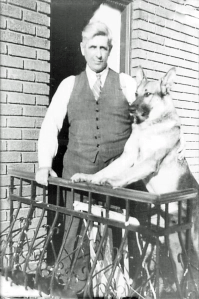
Thomas with Pal in Verdun

Even in those days, the banks were concerned about security, privacy and confidentiality. The banking instructions and transactions that were transmitted by telegraph were encrypted. It was the job of the cipher clerk to decipher them so that the bank staff could then ensure that the instructions were carried out as required.

To be a cipher clerk, one had to be reliable, meticulous and honest, and maintain the confidentiality of the bank’s business above all else. To decipher the information, the clerk used a cipher handbook and worked overnight, making it a difficult job for a man with a family.

So while my grandfather, the cipher, did not work in espionage, I still think that his first job in Canada was rather interesting.2

  1. Wikipedia web site, The History of Dundee, online<https://en.wikipedia.org/wiki/History_of_Dundee>, accessed February 19, 2017.
  2. McHugh, Edward. Personal knowledge. [Father of writer].

Gunner John Hunter, World War 1

When I discovered that my Great-Uncle, John Hunter died at the age of 20 in either France or Belgium in 1917 during World War I, I assumed that he had died in battle. He was a gunner, which mean that he either served the guns, handled ammunition, or drove the horses. My first thought was that this seemed like a particularly dangerous assignment.1 With further research, I discovered that it was almost inevitable that he would die.

John was assigned to the 87th Brigade of the Royal Field Artillery (RFA). He lived in Fife, Scotland and the RFA was actively recruiting there. In World War I, the minimum age was 19 to sign up, so John would only have seen a year of active fighting before his death. 2 He either enlisted voluntarily or was forced to as the Military Service Act was passed in 1916, requiring the conscription of unmarried and widowed men without any dependents.3

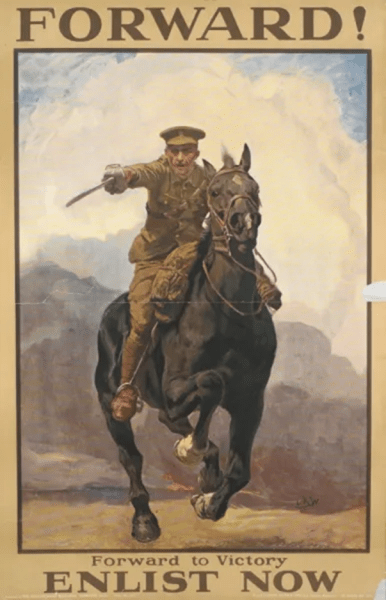
Courtesy War Museum, Recrutment Posters

The 87th Brigade was an infantry brigade formation of the British Army. By the time John would have joined the Brigade, it was serving on the Western Front.4 John would have likely participated in the Battle of the Somme and Passchendaele.

John was taken ill when he was in the theatre of war. He was sent to the Lord Derby War Hospital in Winwick, Borough of Warrington, Chesire, England. He was in a diabetic coma when he died on September 7, 1917, with my grandmother, just 16 years old at the time, at his side. Their mother had died in April 1917 and their father was also serving in World War I and was positioned in France at the time of his son’s death. My grandmother would have been summoned to his bedside and she would have had to make the journey from Lumphinnans, Scotland to Chesire, England by herself.5

Imagine the terror of being diagnosed with diabetes prior to 1921, the year insulin was discovered by a team of doctors, Charles Banting, Charles Best, and J.B. Collip and their supervisor, J.J.R. Macleod,  working at the University of Toronto.6 The symptoms would have included a terrible thirst, excessive urination, lethargy, and perhaps confusion. A urine analysis would have been done and a high glucose level would have confirmed diabetes but there was nothing to be done before the discovery of insulin except a strict dietary regime. We now know that diabetes can be triggered by trauma in someone with a genetic predisposition. There Is no doubt that the trauma of trench warfare would have had its toll on John.

When my grandson was diagnosed with diabetes when he was 16 months old, the doctors questioned whether type 1 diabetes was in the family. We could not think of any relative who had type 1 diabetes. We now know that we were wrong. My grandson will live a normal life with the help of a pump that provides insulin as he needs it. But John did not have a chance. He was living through traumatic circumstances, had a genetic predisposition, and life-saving insulin was not yet discovered. 

  1. Wikipedia, Gunner (rank), https://en.wikipedia.org/wiki/Gunner_(rank), accessed 17 June 2025
  2. War Museum, https://www.iwm.org.uk/history/voices-of-the-first-world-war-joining-up, accessed 17 June 2025
  3. War Museum, https://www.iwm.org.uk/learning/resources/first-world-war-recruitment-posters, accessed 18 June 2025.
  4. Wikipedia, 87th Brigade, https://en.wikipedia.org/wiki/87th_Brigade_(United_Kingdom)#:~:text=The%20brigade%20was%20assigned%20to,the%20rest%20of%20the%20war., accessed 17 June 2025.
  5. Death certificate, John Hynd Hunter, issued 22 April 2025, Grace Hunter, sister, was the informant.
  6. The Canadian Encyclopedia, The Discovery of Insulin, https://www.thecanadianencyclopedia.ca/en/article/the-discovery-of-insulin, accessed 18 june 2025

The Harvester Scheme and the Empire Settlement Act

Who would have thought that finding the immigration records of my grandparents would have led to me to learn about two British government initiatives designed to promote emigration to Canada in the 1920s?  I was browsing the Library and Archives Canada web site and found digitized records of Form 30 that recorded the entry of every immigrant between July 1921 and December 1924.1  I was thrilled to find the form that my grandfather, George Thomas Deakin, signed in August 1923, and the one that my grandmother, Grace Graham Hunter, signed in February 1924.

My grandfather’s form indicated that he came to Canada as part of the Harvester Scheme.  In 1923, Canada had a bumper wheat crop and North America could not provide the labour needed to harvest the crop.  Under the Harvester Scheme, the two major Canadian railway companies entered into an agreement with the British government to transport 12,000 workers out west where they would earn $4.00 per day plus board.  This was considered a successful scheme as 11,871 migrants came to Canada to work on the farms in Western Canada. The harvest was successfully completed and 80% of the harvesters stayed and were considered “successfully assimilated.”2

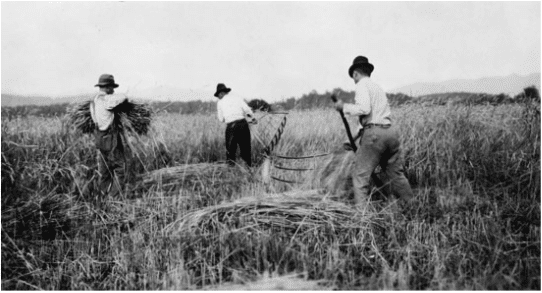
Source: The Farm Collector

Like the Harvester Scheme, The Empire Settlement Act was also an initiave to provide Canada with badly needed labour. It was passed by the British Parliament in 1922 and its purpose was to provide an incentive for migrants to settle in the colonies.  Canada badly needed farm labourers and domestic workers.  At that time, the Canadian government favoured immigrants from Great Britain as a means of ensuring the predominance of British values.  In the early 1920s, it was difficult for Canada to attract immigrants from Great Britain as Britain was enjoying a period of prosperity right after World War I.  Another reason was the prohibitive cost of transatlantic transportation.  Even passage in third class would have been expensive for a farm labourer or a domestic worker.3

My grandmother came to Canada to enter into domestic service as a cook and her destination in Montreal was the government hostel.  Hostels were located in major urban areas across Canada.  These hostels were partially funded by the provinces and immigrants from Great Britain were allowed free dormitory accommodation for 24 hours after their arrival.  Young ladies were looked after by the Superintendent of the hostel and referred to a church worker.  They were also referred to Employment Services of Canada who would find them employment.4

1 Library and Archives Canada:  http://www.collectionscanada.gc.ca, accessed March 2013.

2 Foster, John Elgin, 1983, The Developing West:  Essays on Canadian History in Honor of Lewis H. Thomas, University of Alberta, accessed March 2013.

http://www.pier21.ca/research/immigration-history/empire-settlement-act-1922, accessed March 2013.

4 Crawford, Ruth, 1924, “Canada’s Program for Assimilation”, The Rotarian, May 1924, p. 16, accessed March 2013

Mary’s Tragedy

“Of late she was somewhat weak in the mind.”

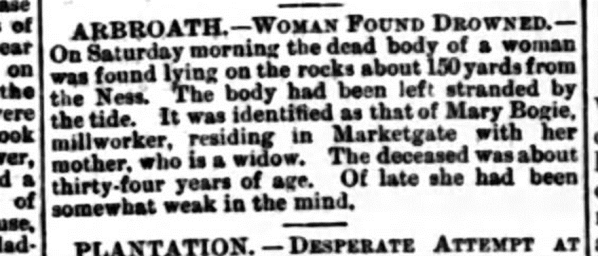
This sad sentence concludes the obituary of Mary Boggie who died by drowning on September 6, 1884 when she was just thirty-four years old.1 Her death was a suicide and this one sentence tries to explain why. Of course, no one will ever know why she jumped off a cliff into the cold and inhospitable waters of the North Sea. What we do know is that it was a desperate and definitive act.

Mary Boggie was Henry Boggie’s sister. Henry, my great-grandfather, was taken to court by my great-grandmother, Annie Orrock, in a paternity suit. He never lived with Annie and, as far as I know, did not participate in bringing up my grandmother, Elspeth Orrock. Mary and Henry were the only children of George Boggie and Elspeth Milne. The Boggie family lived all their lives in Arbroath, Scotland. Arbroath is a coastal town located on the North Sea, about 26 km northeast of Dundee and 72 km southwest of Aberdeen.2 In the 19th century, Arbroath experienced a rapid growth in population with an influx of workers needed for the expansion of the jute and sailcloth industry.3 George was a member of the merchant navy and would have been absent from home most of the time. Both Mary and Henry lived at home, with their mother, all of their adult lives.

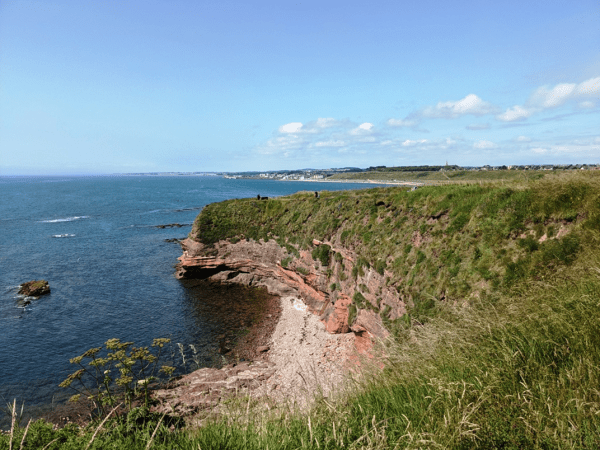
The registration of Mary’s death indicates that Henry was one of the “finders” of her body. The cause of death was “mental disturbance.”4 Who knows how long he and others were searching for her? She was found at the bottom of Whiting Ness, a cliff in Marketgate, Arbroath.

Part of the cliff face on Whiting Ness walk, James Herring, James Herring c10 Day Blog, Whiting Ness walk: The Needle’s E’e, The Deil’s Heid and Castle Gate, September 7, 2021

In 1884, sudden deaths in Scotland were referred to the Procurator Fiscal, known in other jurisdictions as the public prosecutor. The inquiry found that that the cause of Mary’s death was drowning and that she had committed suicide. The corrected entry notes that Mary had not been certified, meaning that she had never been certified as being mentally ill.5 The newspaper article implies that she was suffering from some mental affliction. And this is in accordance with the thinking at the time; that suicides were thought to be temporarily insane, thus being innocent of “self-murder.”6 Committing suicide was not considered a crime in Victorian and Edwardian Scotland. Citizens were free to take their own life, but it was assumed they would be answerable to God. This was not the case in England and Wales, where suicide was decriminalised only in 1961 with the passing of the Suicide Act. Prior to this, anyone who attempted suicide could be imprisoned and if they were successful and died, their families could be prosecuted. 7

No matter what the attitudes towards suicide at the time, Mary’s death was a tragedy. She could have been suffering from any number of mental or physical afflictions that would cause her to take her life. We can only imagine the anxiety and agony that Henry and Elspeth were feeling as people were desperately trying to find her. The trauma of finding her must have been almost more than Henry could bear. It would then be up to him to tell his mother. The suddenness and the violence of Mary’s death would have been a shock and difficult to understand. Henry and Elspeth were faced with an investigation and they would have had to deal with the press. Sadly, they may have had to deal with shame and the stigma of mental illness in the family.

  1. Obituary for Mary Boggie, Glasgow Daily Mail, 8 September 1884, newspapers.com, accessed 23 May 2024.
  2. Wikipedia, Arbroath, https://en.wikipedia.org/wiki/Arbroath, accessed 29 May 2024.
  3. Ibid.
  4. Scotland’s People, Registration of Deaths 1884, Mary Boggie, accessed 3 April 2024.
  5. Scotland’s People, Page 105, Register of Corrected Entries, Mary Boggie, signed by the Procurator Fiscal’s Office, 24 September 1884, accessed 3 April 2024.
  6. Shiels, Robert, The Investigation of Suicide in Victorian and Edwardian Scotland, Dundee Student Law Review, Vol. 5(1+2), No.4, https://sites.dundee.ac.uk/dundeestudentlawreview/wp-content/uploads/sites/102/2019/09/R-Shiels-No-4.pdf, accessed 27 May 2024.
  7. Wikipedia, Suicide Act 1961, https://en.wikipedia.org/wiki/Suicide_Act_1961, accessed 28 May 2024.

Who is Henry Boggie?

Henry Boggie is my great-grandfather, but he was never really part of the family.

My grandmother, Elspeth Mill Boggie Orrock was born in 1875 in Arbroath in County Angus, Scotland. Her mother, Annie Linn Orrock, registered the birth and gave Elspeth her surname Orrock but she also gave Elspeth the name Boggie. The registration notes that Elspeth was illegitimate as her parents were not married.1

In 1881, when Elspeth was 6 years old, Annie Linn, still residing at 32 East Mill Wynd where she had given birth to Elspeth, instituted a civil paternity suit against Henry Boggie in the Sheriff Court.  On 11 September 1882, a decree was issued by the Sheriff Court, stating that the birth registration be corrected to include Henry Boggie as Elspeth’s father.2

Paternity cases were usually attempts to make the father pay child support and we can assume that this is probably why Annie Linn sued Henry for paternity.3 There is no evidence that Henry and Annie every lived together.

The censuses show that Henry lived with his mother until at least 1891. He worked as a mason and remained in Arbroath his entire life. He died fairly young, at 53. The registration of his birth says that he was single.4 It is unlikely that he fathered any other children.

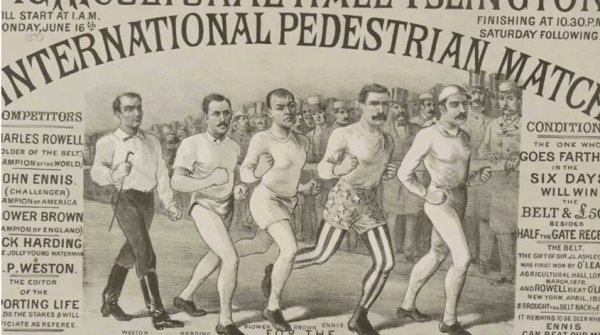
The records indicate that Henry led a quiet life, living in the same city all his life. However, Henry did practice an unusual sport, pedestrianism. In the 19th century, he would have been called a ped. At the time, pedestrianism was popular in Scotland and elsewhere. The six-day, 450-mile race usually began on a Sunday at 1:00 a.m. It started after midnight on Sunday because public amusements were prohibited on Sundays. The athletes walked for six days in a row, in a circle and had to complete the 450 miles. They could run, walk, or crawl. They ate, drank, and napped in little tents at the side. 5

Bloomberg, When Walking was a Spectator Sport, 7 August 2015

The walking matches were a spectator sport, with music and refreshments. It was like a fair. Gambling was also part of the attraction. There were lots of possibilities to place bets, such as the first pedestrian to drop out or the first to achieve a set number of miles. At the time, champagne was considered a stimulant. Some of the trainers (yes, they had trainers) would encourage the participants to drink copious amounts of it.6

Henry seems to have participated in several pedestrian tournaments. He was described as one of the “crack” walkers who participated in the Dundee tournament when he joined the Aberdeen Walking Match in December 1879. It took place in Cooke’s Circus, an equestrian establishment so we can assume that the participants walked around the equestrian arena. Prize money totalled £40 (about £6,000 today) and the winner won the champion belt of Scotland.7

On March 8, 1880, Henry competed in the Perth Grand Pedestrian Tournament. The thirty-three participants hailed from England and Scotland. The format of this tournament was that the men would walk or run between eleven o’clock in the morning and stop at eleven o’clock in the evening. First prize was £25 (about £3,800 today). Jostling, hindering another participant, or using bad language would result in disqualification.  Reserved seats were two shillings, second seats were one shilling, and third seats were a sixpence. A musical band was in attendance. Gambling was prohibited.8

The newspaper articles that list Henry’s participation in the Dundee, Perth, and Aberdeen tournaments are just a glimpse into this interesting sport. Not only did the participants travel to compete in these tournaments, the six-day races would have been quite exciting and exhilarating. There is no indication whether or not Henry ever won prize money, but still, he was a “crack” competitor.

  1. Scotland’s People, National Records of Scotland, Statutory Registers of Birth, 1875, District of Arbroath, County of Forfar, Elspeth Mill Boggie Orrock, retrieved 12 January 2018.
  2. Register of Corrected Entries for the District of Arbroath in the County of Forfar, dated 11 September 1882, directing that the defendant, Henry Boggie, Mason, should appear on the registration of birth of Elspeth Mill Boggie Orrock, in possession of author.
  3. Traces. Uncovering the Past, Tracing the Fathers of Illegitimate Children in Scottish Court Records, 3 December 2020, https://tracesmagazine.com.au/2020/12/tracing-the-fathers-of-illegitimate-children-in-scottish-court-records/, accessed 22 January 2024.
  4. Scotland’s People, National Records of Scotland, Statutory Registers of Death, 1905, District of Arbroath, County of Forfar, Henry Boggie, retrieved 22 January 2024.
  5. BBC, The Strange 19th century sport that was cooler than football, Zaria Gorvett, 28 July 2021, https://www.bbc.com/future/article/20210723-the-strange-19th-century-sport-that-was-cooler-than-football, accessed 22 January 2024.
  6. NPR,  In The 1870s And ’80s, Being A Pedestrian Was Anything But, 3 April 2014, accessed 23 January 2024.
  7. Aberdeen Press and Journal, 29 December 1879, page 4, accessed through British Newspapers on Findmypast, 23 January 2024.
  8. Dundee Courrier and Angus, 8 March 1880, page 1, accessed through British Newspapers on Findmypast, 23 January 2024.

Lunatic Asylums in Scotland

In the 1871 census in the United Kingdom, categories of disability were added to the census questions. These categories included the deaf and dumb, blind, imbecile or idiot, and lunatic.1 Imbecile, idiot, and lunatic are pejorative terms today but in the 19th century, they were medical terms used to indicate mental health conditions. Idiots and imbeciles had learning disabilities. Lunacy was a term used broadly to denote anyone with a mental illness.2

James Kinnear Orrock, my 2X great-uncle, was committed to the Dundee Royal Lunatic Asylum on December 9, 1888. Superintendent James Rorie declared that he was a pauper and that he was delusional.  James’ mother, Mary Watson, my 2X great-grandmother, requested that he be committed.4 Not unlike today, the police were involved. A constable declared that he had been violent and incoherent. It is obvious from the notice of admissions that James was experiencing psychotic episodes.

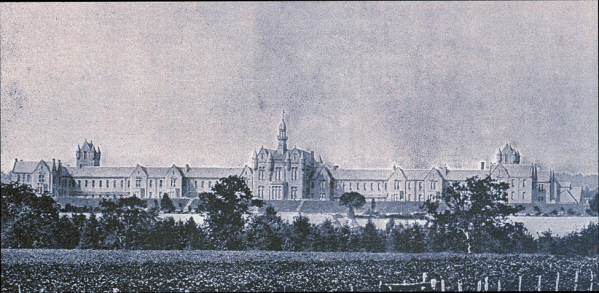
Westgreen Asylum, Liff, Dundee, Scotland in 1897, Westgreen Asylum, Liff, Dundee, Scotland in 1897

James was just 30 when he was admitted to the asylum. Sadly, he remained there until his death in 1930 when he was 72.5 It is distressing that he lived in this institution more than half his life. While little was known about mental illness at the time, the asylum offered the patients safety and hope. Specialist registrar Amy Macaskill states “What is clear is that they wanted to offer a degree of care and protection and containment for people who were causing difficulty at home and were in some level of distress.”6 The asylums cared for people who were depressed, anxious, delusional, as well as those suffering from other conditions such as epilepsy, alcoholism, and syphilis.7

The Dundee Royal Lunatic Asylum had separate quarters for men and women. The pauper wards for men each had a day room, with a number of single rooms with windows overlooking the airing court. The windows provided the only ventilation. The rooms were not heated but there were open fire places in the corridors. There were weaver shops in a separate building where some patients made packing cloth. Male patients also did stone breaking and some worked on the grounds. They were paid with tobacco and beer. There was a billiard room and dancing parties for the patients, attended by both men and women. A chaplain provided services on Sundays.8

When James was admitted, he was certified a pauper lunatic. This certification gave him access to psychiatric care, but it does not necessarily mean that he was a pauper. His admission records indicate that he was a seaman and he could have been gainfully employed. The Board of Governors of the asylums assessed each patient’s finances. If any financial assistance was required, then the patient was declared a pauper. If the patient or their family was assessed as being able to entirely finance their own care, they were classified as private patients. Private patients benefitted from better food, were able to wear their own clothes, and could be discharged if the person paying for their care wanted their discharge. Unfortunately, while a technical and legal label, the term “pauper lunatic” carried a stigma and deterred people from seeking help.9

We have come a long way in our care for those suffering from mental illness since the 19th century. The Lunacy (Scotland) Act 1857 formed mental health law in Scotland from 1857 until 1913. Its purpose was to provide official oversight of mental health institutions and to ensure that they were adequately funded.10

  1. Scotland’s People, Census Records, 1871 Census, https://www.nrscotland.gov.uk/research/guides/census-records/1871-census#1871%20instructions, accessed 1 November 2023.
  2. Historic England, Disability History Glossary, https://historicengland.org.uk/research/inclusive-heritage/disability-history/about-the-project/glossary/, accessed 1 November 2023
  3. Notice of Admissions, Royal Dundee Lunatic Asylum, Notice of Admissions, James Orrock, retrieved 22 March 2023
  4. James Rorie went on to write the History of the Dundee Royal Lunatic Asylum
  5. Scotland’s People, 1891, 1901, 1911, 1921 censuses, John Orrock, accessed 20 November 2023.
  6. BC News, Archives reveal life in Edinburgh and Inverness asylums, 7 January 2013, https://www.bbc.com/news/uk-scotland-20938462, accessed 21 November 2023.
  7. National Records of Scotland, From the NRS Archives, Servicemen in Scotland’s Asylums, 1918, 10 January 2019, https://blog.nrscotland.gov.uk/2019/01/10/from-the-nrs-archives-servicemen-in-scotlands-asylums-august-1918/, accessed 22 November 2023.
  8. Scottish Indexes, Institution Information – Dundee Royal Infirmary, https://www.scottishindexes.com/institutions/19.aspx, accessed 22 November 2023.
  9. Royal College of Psychiatrists, Pauper lunatics were not paupers, 23 February 2022, https://www.rcpsych.ac.uk/news-and-features/blogs/detail/history-archives-and-library-blog/2022/02/23/pauper-lunatics, accessed 21 November 2023.
  10. Wikipedia, Lunacy (Scotland) Act 1857, https://en.wikipedia.org/wiki/Lunacy_(Scotland)_Act_1857, accessed 22 November 2023.

The Trip of a Lifetime

My father, Edward McHugh, didn’t really talk about his family’s trip of a lifetime. After all, Dad wasn’t even born yet. But it must have been discussed by everyone when he was a boy. In 1911, the first member of the family, Mary Ann McHugh, moved from Dundee, Scotland to Montreal.

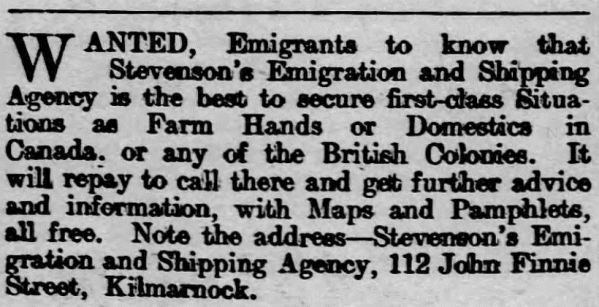
At the time, booking agents in the United Kingdom advertised and recruited potential immigrants to Canada. There was an acute need of domestic help and agricultural workers. Between 1890 and 1920, Canada experienced its third wave of immigration and its peak was between 1911 and 1913, just before World War I.1 The following type of advertisement was common in the newspapers.2

Booking agent advertisement

Maybe one of these advertisements gave the McHugh family the idea to emigrate to Canada. Or maybe Mary was ready for an adventure. She was just 21 when she disembarked from the SS Grampian that had left Glasgow on June 24, 1911 and arrived in Quebec City on July 9, 1911.  She would have had a medical exam when she arrived to ensure that she was in good health and did not have an infectious disease. Conditions for immigration to the colonies were well known in the United Kingdom. The February 11, 1911 edition of the Hamilton Observer, in its article, Canadian Notes, People Prohibited, details the reason some potential immigrants could expect to be refused by Canada. The article explains the booking agent’s liability for the immigrants that arrived in Canada for a period of three years following their arrival:

“The following classes of people are prohibited from landing … feeble minded, idiotic, insane, or who have been insane within five years, afflicted with any loathsome, contagious, or infectious disease; anyone who is a pauper, who is destitute, who is a professional beggar or vagrant.”3

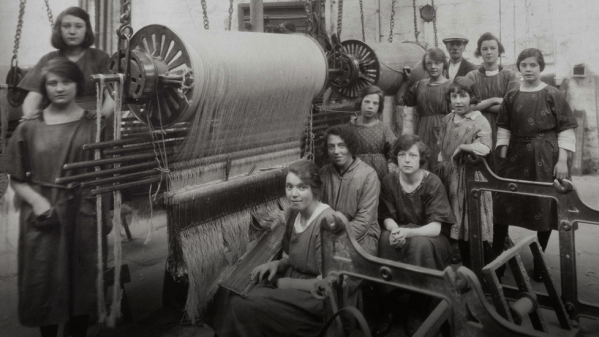
All of the members of the McHugh family worked in the jute mills in Dundee. The 1911 census indicates Mary was a jute weaver, which probably meant that she operated a jute weaving machine.4 She lived with her mother, Sarah Jane McLaughlin, and her brothers, Edward and Francis. They lived at 1 Tait Lane, Dundee. Her other brother, Thomas, my grandfather, lived with his wife and seven children at 9 Tait Lane.

The picture below shows the jute weaving machine.5

Mary must have been satisfied with her new life in Montreal, Quebec. Within a year, her mother and her two brothers, along with my grandfather, had followed her to Canada. Six months later, my grandmother, Elsie Orrock, and her seven children joined her husband, Thomas, in Montreal.

The McHughs lived close together in Dundee and they also lived close together in Verdun, Quebec. While I will never know for sure why they decided to emigrate, I can guess that they wanted a life that was not as hard as the one working in the jute mills. There are a few clues that this was not a spur of a moment decision but a planned family decision.

Mary left first and, if it did not suit her to live in Canada, she would have been able to easily return to Dundee. Her mother and brothers were still there. By the time her mother emigrated, along with her three sons, they arrived with $150 CAD, about $4,750 in today’s dollars. Browsing through the passenger lists, I can see that they had a lot more money than many of their fellow passengers. 6 They were not a rich family, so this amount of money would have taken some time to save up.

Coincidentally my grandfather joined the Freemasons in 1910 and achieved a Master Mason diploma and a Mark Mason diploma.7 By that time, he already had six children. He worked long hours in the jute mill, including Saturdays. Why would he join the masons when he was already a very busy man providing for his family, plus taking care of his widowed mother, and his siblings who still lived at home? There is no evidence that he ever joined the masons when he arrived in Canada. I believe that it is possible that he joined the masons to in case he needed the contacts to find employment. As he quickly found work, his busy family life prevented him from pursuing his membership in the masons.

Only one of my grandfather’s siblings stayed in Scotland, Sarah Jane McHugh. She was not living with the other McHughs at the time of the 1911 census. But she remained close to the family. Surprisingly, she travelled to Montreal to be a witness at her brother’s wedding at the Notre Dame Basilica in Montreal on May 8, 1913.8 That would have been quite a trip for Sarah Jane to make.

  1. Wikipedia, Immigration to Canada, https://en.wikipedia.org/wiki/Immigration_to_Canada, accessed 27 September 2023.
  2. Irvine Herald and Ayrshire Advertiser (Irvine, Strathclyde, Scotland) · 13 Oct 1911, accessed Newspapers.com, downloaded 24 August 2023.
  3. The Hamilton Advertiser (Hamilton, Strathclyde, Scotland) · 11 Feb 1911, accessed Newspapers.com, downloaded 24 August 2023.
  4. Scotland’s People, National Records of Scotland, 1911 Census, Sarah Jane McHugh, downloaded 23 June 2019.
  5. V&A Dundee Design Museum, Women’s Day tweet, 6 March 2020.
  6. Passengers lists for S.S. Grampian arriving in Port of Quebec, May 21, 1912, Library and Archives Canada, https://www.bac-lac.gc.ca/eng/discover/immigration/immigration-records/passenger-lists/passenger-lists-1865-1922/Pages/image.aspx?Image=e003578022&URLjpg=http%3a%2f%2fcentral.bac-lac.gc.ca%2f.item%2f%3fid%3de003578022%26op%3dimg%26app%3dpassengerlist&Ecopy=e003578022, accessed February 3, 2022.
  7. Thomas McHugh, registration of the Grand Lodge of Scotland, dated 25 August 1910.
  8. Registration of marriage of Francis McHugh and Helen Smith, 8 May 1913, downloaded 6 January 2022.

Romeo and Maid Marion: A Rom-com Romance

August 18, 1918

30 York Avenue, Westmount

My dearest sweetheart,

I cannot express in writing how pleased I was to hear your voice over the telephone a little while ago and was very sorry when I learned that due to the circumstances, you were not able to come home.

Dearest, I have never written you on this strain since I have known you and before I say what I have in mind, I beg of you to please try and understand it in the light that I mean it.

 For Marion, dear, I love you with all my heart and it is because of my affection for you that I try to pave the way a little. I honestly, would not intentionally hurt you Marion. 

Now sweetest, here it is: You know, Dear, that you have left me alone at different times for indefinite periods, but may I say that I have never yet found one month to be as long as this one. 

Really, it has seemed to me almost like years. I would a thousand times rather be left entirely alone than to be left again with the girls, as I cannot get them to  do anything which appears to me to be reasonable. I have come home on several occasions and the front and back doors were not locked. They will not close the windows and the house is almost like an oven. They forget to order food. The refrigerator is left open; the ice is melting as fast as you can put it in. Cawlice. Water is running all over the floor and things are lying about. I am sick and tired of the whole place.  

Take pity on me Darling before I go crazy and come home to me to look after and love me. *but under no circumstances take chances (with mother’s health).  Take it from me, God help the poor man that gets either one of them, if they don’t change. You can do more in five minutes than they can do together in a day.  You have forgotten more than they’ll ever know. God bless you Marion and may it be God’s will that he can spare you to me for many long happy years.

Lovingly,
Hughie

PS. Don’t fail to burn this when finished reading.

This rather amusing letter was sent under duress by my husband’s grandfather, Hugh Blair, to my husband’s grandmother, Marion Nicholson Blair in August 1918.

It seems Marion had taken her daughters, 12 month old Marion and three-year-old Margaret, from their home in Westmount, Quebec to visit her mother in Richmond, Quebec leaving her husband in the care of his sisters-in-law, Flora and Edith.

Hugh, clearly, is at his wit’s end. He is feeling neglected. Of course, his sisters-in-law have more important things to do. They have busy day jobs as teachers. WW1 is raging. Over and above their tiring day jobs, the women volunteer for the war effort. Many of their friends have lost brothers or sons at the Front. They can hardly feel sorry for Hugh.

My husband’s grandfather, Hugh Christian Blair, born in Three Rivers Quebec in 1882, was a man of many faces. He could be a big baby, no question, but he was also a suave charmer, a savvy businessman, a talented carpenter and metalworker, a fine fiddler, a hockey player and curler and, ugh, judging from an album I have filled with photos of dead foxes and such, an ardent hunter.

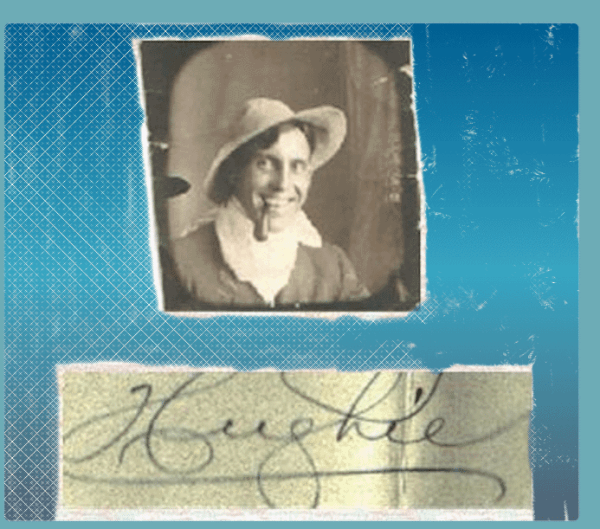
Hughie the joker with the stylish signature

He was the son of a prosperous Three River lumber baron and he worked in the family business.

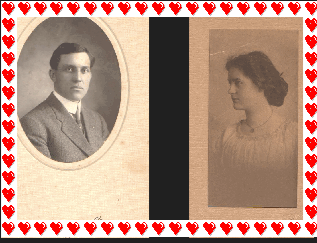
In 1912-13, Hugh was courting his future wife, Marion Nicholson, daughter of Norman Nicholson, a very respectable but down-on-his-luck businessman from Richmond, Quebec.

Letters I have reveal that their one year courtship, from May 1912 to October 1913, has all the earmarks of a modern rom-com movie with its many ups and downs and breakups and make-ups and misunderstandings.

Let me summarize the plot for you:)

In May 1912, in his mid thirties and with good prospects, Hugh Christian Blair is introduced by his landlady to Marion Nicholson, a teacher at Royal Arthur School in Little Burgundy. Hugh is instantly smitten by this attractive firebrand, but first he must give his current girlfriend, Jean, a Momma’s girl, the brush-off. “Of course, you must know that we were never engaged and as for any understanding it must have been entirely on your part as I myself was only thinking of you as a very kind friend.” 1

He pursues Marion with all of his energy, taking her out of her stuffy rooming house to church as well as to more exciting places like the Orpheum Vaudeville Theatre and Dominion Thrill Park.

Marion is secretive about her life but sisters Flora and Edith keep their mother Margaret up to date about the budding romance, cheekily referring to Hugh in their letters as “Romeo” or “Hugh Dear.”

At the end of the school year Marion organizes a party at her rooming house. She strategically invites Hugh as well as another male friend. Neither of them shows up. She is furious. So the romance stalls. Marion returns to Richmond for the summer months.

In August, 1912, Flora and Marion visit a kind doctor cousin, Henry Watters, in Boston who takes them to Norumbega Park and a Bosox game. Henry isn’t the marrying kind, but another Boston relative, a Mrs. Coy, is keen on having Marion marry her son, Chester. Hugh somehow senses this. He writes Marion two long-winded letters while she is in Boston.

“I notice by the advertisements that there will be quite a few nice plays out this fall in Montreal. So if I am here – and of course you also – and care to take them in, I will enjoy taking you along. Of course, I would not like to neglect our Old Standby at the Orpheum. But I suppose there is no use planning too far ahead as many changes can take place between now and then.” It looks like he’s hedging his bets, doesn’t it?

It’s September. School begins anew. Marion is totally fed up with her rooming house with its suffocating curfews, so she finds a large flat to live in with her sister Flora and two other teachers in Mile End.

This is quite the revolutionary feminist act. Mr. Blair is a frequent visitor, so says Flora in her letters. (How scandalous!) However, Chester, “A great Yankee” also comes to visit.

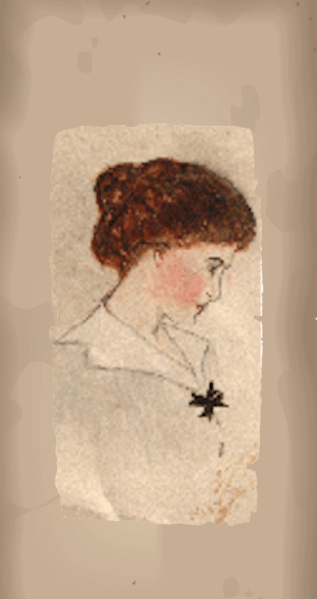
Marion drawn by a fellow teacher

In November, Marion writes her Mom: “Hugh is helping with the double windows. Sometimes I like him, sometimes I hate him, but I wouldn’t know what to do without him.” Now, doesn’t that sound promising!

But something happens at Christmas (likely a dispute with the dad, Norman) that once again pours cold water on the romance.

In a telling January 3, 1913 letter to Marion, Hugh acknowledges receipt of her Christmas gift of cuff links and in turn says that the teddy bear he sent her was probably lost in the mail or stolen. Hmmm.

In February, 1913, Edith tells her Mom she went out with Hugh and Marion and he was all suave charm, “not the Hugh you had at Christmas.” Things are definitely looking up.

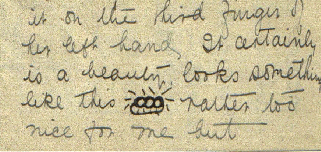
Sure enough in May 1913, Marion sends a letter to her mom with a drawing of her engagement ring.

A month later Hugh sends a very formal letter to Norman, her father, asking for Marion’s hand. Norman sends a letter to Marion saying “I can’t give my consent for I am dead broke.” 2. (Clearly giving consent is about money here.)

The men finally come to some arrangement but first Marion has to sign a miserly marriage contract that stipulates she gets nothing should the couple separate FOR ANY REASON. This is, likely, Hugh caving to his parents who do not approve of the marriage.

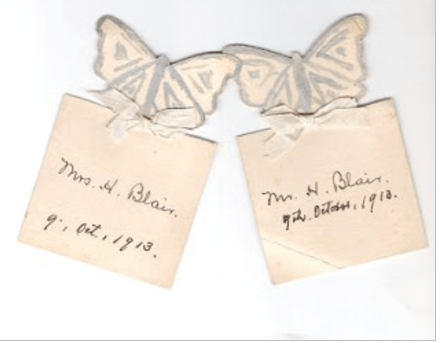
The couple weds in Richmond in October 1913. Hugh’s parents do not attend the wedding. Hugh leaves the family business to set off on his own.

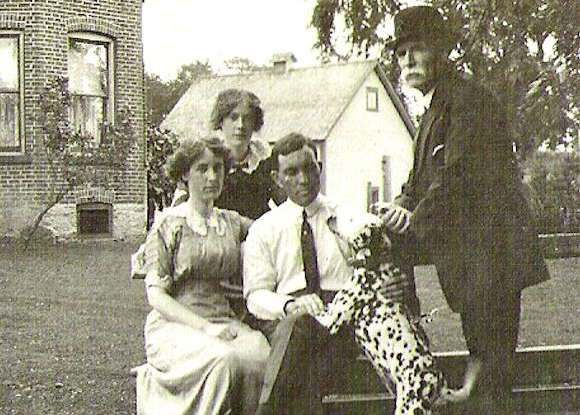
Edith, Flora Hugh, Floss and Norman Nicholson, I suspect on the wedding day.

Wedding on the cheap.

But a Great War breaks out and Hugh soon reconciles with his parents and returns to the family business. (They need him: production is ramping up. Canadian lumber is key to the war effort apparently.) Hugh and Marion, with a newborn daughter, move from NDG to a cottage 4 on York avenue in Westmount near Hugh’s Aunt and Uncle.

Marion invites Flora to come live with them (with Hugh’s approval):

“It seems rather foolish to me to have you alone at Mrs. Ellis’s when there is room here. It is not that I need you especially for anything, but that I would like to have you with us.”

Marion tells how Hugh and his uncle work on their Victory Garden:

“Hugh and Willie are making a garden. What success they will have I do not know. One thing may be sure, the beds are straight and square. I would prefer to have more in them myself.”

Marion describes how much Hugh’s mother rails against Conscription:

“Everyone here, that is the Aunts and Grandma B are terribly worked up about conscription. All they say would fill a book and some of the sayings I do not find very deep. I would like to tell them that they are not the only ones who have sons who will be called, or they may think that theirs are more to them.”

Letter from the Front. Flo’s friend, Ross Tucker. He survived, his brother Percy did not. Percey was killed just before Armistace. A sister died of the Spanish Flu. “That family is not the same,” says Edith in a letter.

And in July, 1918, just a couple of months before another scourge, the Spanish Flu, hits Quebec, Marion takes her two young daughters on a prolonged visit to her parents’ in Richmond and Hugh, left behind to swelter in the kitchen, has a meltdown. He writes her a long, plaintive letter he hopes his wife will burn after reading. Alas, she doesn’t burn the letter. BIG mistake!

Denouement.

Post war life is good for the Blairs. They have two more children, a girl and a boy, and spend a great deal of money, according to Edith. Marion’s father dies in 1921. Marion continues to regularly visit Richmond, a place her children come to cherish.

However, in 1926, Hugh contracts a liver disorder and passes away a year later – but not before signing away Marion’s rights to his portion of the family business on his deathbed – “as a temporary measure to facilitate business.” Marion Nicholson Blair is left with nothing to live on so she goes back to work as a teacher, wheeling and dealing to find sponsors for her children’s McGill education.

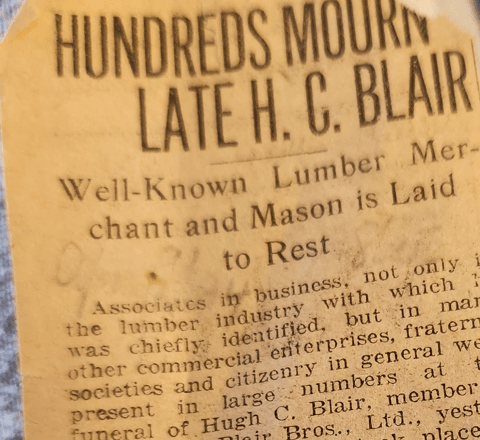
A last minute letter reveals that Hugh attempts to to purchase a burial plot in Melbourne Cemetery beside the Nicholson family plot. That doesn’t happen. Hugh Christian Blair is buried with his family on Mount Royal in Montreal. The funeral notice in the Gazette reveals it is packed with Masons but fails to mention Marion and her family as mourners.

Afterward:

So, here we have the plot for a classic rom-com romance, but a movie with no happily-ever-after. Iron-willed Marion just rolls up her sleeves and goes back to work, despite great pressure put on her to remarry for the sake of her children. Indeed, she once told her children that being a lone parent wasn’t so bad: “At least I can make all the decisions for my family myself.”

Marion becomes a master-teacher and rises up to lead the Provincial Association of Protestant Teachers, or PAPT, during WW2 where she fights for teachers’ pensions.

In 1947, Marion dies of a heart attack before she can earn her pension.3 She receives a front page obituary in the Montreal Gazette, a major newspaper. “With the loss of Marion Blair the province, indeed, the whole Dominion has suffered a serious loss.”

In the 1960’s, the PAPT is one of the highest achieving public boards in North America and no doubt Marion Nicholson Blair had a role in making that happen.

1. This was the usual language used in such situations. I believe there must be a legal component to it. Indeed, the last line of the letter asks her ‘reply and tell me you have forgiven me.’

2. Many people believe this traditional gesture is romantic but it was practical, all about money. In Britain at least adults have been able to marry without consent for many centuries. However, without a dowry, most men couldn’t marry.

3. Marion’s heart condition first flares up in the year Hugh is dying. Edith suggests Hugh is very demanding and Marion, with four children, is run ragged meeting his needs. Edith also says Hugh’s eyes are yellow as yolk. A tube between the liver and stomach fell apart. It is a condition easily fixed nowadays.

4. 30 York Avenue is still there, a two story cottage. It’s on Google Maps.

Great Uncle James Went to Reform School

James Orrock, my two-times great-grandfather, was a farm labourer in Scotland in the mid 1800s. Agricultural labourers did not work all their lives on one farm. It was common for farm servants, both men and women, to attend farm hiring fairs. They would then hire themselves out to the highest bidder.1

Hiring Fair

According to the 1851 census, James worked on a farm in the village of Marykirk, Kincardineshire.2 His wife-to-be, also a farm servant, worked on a different farm located in the same village. They married two years later. By then they had moved to Kirken, in County Angus.3 Mary and James went on to have seven children and it is no surprise that their children were born in different villages, as James would have moved from job to job, always as a farm servant. The various censuses indicate that James worked as a ploughman, farm servant, or agricultural labourer. His family followed him as he moved for work. In 1863, their daughter, Martha Linn died of small pox at the age of three.4 Two years later tragedy struck again when James died at the age of 33 from tuberculosis.5

When Mary became a widow, her situation would have been precarious. James had been sick for a long time and had been unable to work. Mary had to find a way to provide for her children. Farm servants were usually lodged at the farm where they worked. Families often had small dwellings, with a small yard, where they could have a garden and a henhouse.  With the death of James, Mary would have also lost her home. It is no surprise that she moved to Arbroath, perhaps in the hope of working in the jute and sailcloth mills. At the time of James’ death, demand for jute was high due to the American Civil War6 and work was available in the mills. Mary would soon learn that, while Arbroath provided employment, it also provided additional worries about her son, James.

The 1871 census shows Mary living with four of her six remaining children in Arbroath.7 Her eldest son, Alexander, 17, worked as a farm servant in a village about 10 km away, in Kirkden.8 Ann and Jemima, 16 and 14, would have been working. David and Jane were in school. But where was James, only 12 at the time?

I found James in the 1871 census listed as an inmate at the Mars Training Ship for Homeless and Destitute Boys, about 35 km away from his family.9 This ship was moored on the river Tay at Woodhaven Harbour, Wormit, Fife from 1869 to 1929.10

The HMS Mars was built in 1848 and saw military service in the Crimean War. Deemed surplus in 1869, it became a training ship with space for 400 boys with the objective to take destitute and homeless boys off the streets of Dundee, Edinburgh, and Glasgow and train them for service in the Royal Navy or the Merchant Marine at their discharge at age 16.11 

The Mars Training Ship was an initiative put forth by Lord Provost William Hay and members of the elite. Truancy and vagrancy were rife in the cities of Scotland, due to overcrowding, unemployment, and poverty. The inmates of the Mars were often picked up for truancy or for begging and were sent to the training ship for five years by magistrates. The boys were poor, orphans, beggars, or homeless or sometimes they had just fallen in with the wrong crowd.12

Mars Training Ship Institution 13

The move from farm life to a bigger urban centre would have been difficult for James. He was 12 when he shows up as an inmate in the Mars Training Ship and he was probably sent there at the age of 10 or 11. There is no way to know why he ended up there. We know that his family was poor. It is probable that he wandered the streets while his mother and two sisters worked long hours in the jute mills. He may have been a difficult child as he suffered from mental illness later on in life.14

The Mars Training School was an industrial school, as opposed to a reform school. The boys did not have a criminal record; however, in some ways they were prisoners. All of the boys were very poor and many of them were homeless. For those who did have homes, they were deliberately given very little opportunity to maintain connections with family and friends.15

Upon arrival on the ship, a medical officer examined the boys once they were stripped. The children then washed, put on their uniforms, and were assigned a number. From then on, they were only referred to by their number. Even the boys called each other by their numbers.16

The day on the Mars ship would begin early, at 5:30 a.m. The boys scrubbed the deck, had breakfast, and then said their prayers. In the morning they learned English, arithmetic, geography, and music. The afternoons were dedicated to practical skills such as shoe repairing, clothing and sail-making, woodworking, metalworking, tailoring and seamanship. The boys were attended by doctors and dentists and were well fed. There was less disease onboard than in the crowded and unsanitary cities of Dundee, Edinburgh, and Glasgow. To further reduce the chance of disease, the boys would make an annual trip to Elie, a coastal town, allowing a skeleton crew to fumigate and clean the ship. 17

James would have been discharged from the ship when he was 16. Records of his later life did, indeed, indicate that he worked as a seaman.18

  1. https://www.historyscotland.com/history/farm-servants-and-the-hiring-fairs/, accessed 15 March 2023. Picture of the engraving of a hiring fair courtesy of History Scotland website.
  2. National Records of Scotland, 1851 census, Parish of Marykirk, County of Kincardineshire, James Orrock, Scotland’s People, downloaded 27 March 2023.
  3. National Records of Scotland, Old Parish Registers, Church of Scotland marriages, Kirken, James Orrock and Mary Watson, Scotland’s People, downloaded 27 March 2018.
  4. National Records of Scotland, 1863 Deaths, Parish of Dunnichen, County of Forfar, Martha Linn Orrock, Scotland’s People, downloaded 8 March 2023.
  5. National Records of Scotland, 1865 Deaths, Parish of Dunnichen, County of Forfar, James Orrock, Scotland’s People, downloaded 9 April 2018.
  6. The Textile Industry of Arbroath since the Early 18th Century, Turner, W.H.K., The Abertay Historical Society, 1941, p.15
  7. National Records of Scotland, 1871 census, St. Vigeans, Arbroath, Mary Orrock (Watson), Scotland’s People, downloaded 16 March 2023.
  8. National Records of Scotland, 1871 census, Kirkden, Angus, Alexander Orrock, Scotland’s People, downloaded 23 March 2023.
  9. National Records of Scotland, 1871 census, Woodhaven, Forgan, Fife, 1871 census, James Orrock, Scotland’s People, downloaded 15 March 2023.
  10. Wikipedia, HMS Mars, https://en.wikipedia.org/wiki/HMS_Mars_(1848)#:~:text=HMS%20Mars%20was%20a%20two,July%201848%20at%20Chatham%20Dockyard.&text=She%20served%20as%20a%20supply,the%20River%20Tay%2C%20off%20Woodhaven, accessed 19 April 2023.
  11. The Mars Training Ship and Elie, Gordon Douglas, 13 January 2017, https://www.eliehistory.com/uncategorised/mars-training-ship-elie-gordon-douglas/, accessed 23 March 2023.
  12. Maritime Trail Dundee, Mars Training Ship, https://www.dundeemaritime.co.uk/Mars, accessed 23 March 2023.
  13. The Herald Scotland, From Mars to Dundee: The prison ship that shaped generations, Ron McKay, https://www.heraldscotland.com/news/17996129.mars-dundee-prison-ship-shaped-generations/, accessed 24 March 2023.
  14. General Registers of Admissions in Lunatic Asylums, 1888, James Orrock, downloaded 22 March 2023.
  15. Whyte, Christine, HMS Mars: An industrial school in the late 19th century, Scottish Journal of Residential Child Care, Volume 20.2, https://strathprints.strath.ac.uk/84204/1/Whyte_SJRCC_2021_HMS_Mars_an_industrial_school.pdf, accessed 11 April 2023.
  16. Ibid
  17. The Mars Training Ship and Elie, Gordon Douglas, 13 January 2017, https://www.eliehistory.com/uncategorised/mars-training-ship-elie-gordon-douglas/, accessed 24 March 2023
  18. National Records of Scotland, 1930 Deaths, Parish of Liff and Benvie, County of Angus, James Orrock, Scotland’s People, downloaded 8 March 2023.