
Category Archives: Verdun

Women Heroines at La Poudrière during WWI

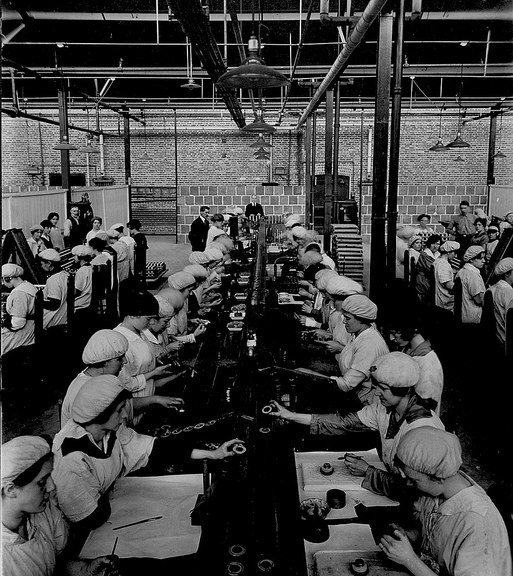
During World War I, 4,000 people, many of them women,  assembled eight million fuses in a building locally known as “La Poudrière.” Given that the job required mounting a detonator cap over a gunpowder relay charge and attaching a safety pin (read more about WWI fuses here), the job was risky and monotonous at the same time.

Who were these people? How can we honour their work?

Recently, while looking through the records of World War I soldiers, I realized that their records may offer us ways to discover our homefront heroines.  Several women moved to Verdun and lived within walking distance of the armament plant while their husbands or brothers served overseas.

Patrick Murray

When Ethel Henrietta Murray’s husband Patrick volunteered for the Canadian Over-Seas Expeditionary Force on Wednesday, April 12, 1916, the couple lived at 80 Anderson Street, in downtown Montreal.[1]

According to his military records, he died on October 29, 1917, driving with the 4th Brigade of the Canadian Field Artillery. She went by the first name Henrietta. Initially, she had moved to 1251 Wellington Street. Later, she lived at 956 Ethel Street.[2]

None of her addresses exist anymore, nor have I yet found any evidence explaining why she moved to Verdun. Based on her address and circumstances, however, I suspect that she—and three other women who lived nearby—worked at “la poudrière.”

La Poudrière

Locals call a building that currently houses 64 units for senior citizens “La Poudrière,” which means powder keg. The Canadien Slavowic Association (l’Association canadienne slave de Montréal) operates the space.

I haven’t yet looked into the records of the company to find out if there is a list of employees so that I can see if Ethel or Henrietta Murray appears on their rolls.

Other women I’d like to verify include Marjorie Victoria Stroude Luker, Ellen or Helen Elizabeth Winsper, and Mrs. John Sullivan. These three women also lived within walking distance of la poudrière between 1916 and 1919.

Military records include the addresses of these women because all of them received telegrams about loved ones being wounded or killed overseas.

Arthur Stroude

Marjorie’s husband Arthur was wounded in Italy on August 20, 1917, and then died of the flu in Belgium on December 2018. Although the couple lived in Point St. Charles when he signed up, her benefits were sent to her at 714 Ethel Street by the time he died.[3]

George Winsper

Ellen or Helen Elizabeth Winsper, the wife of George Winsper who died on November 7, 1917, had moved from Rosemont to 196 St. Charles Street in Pointe St. Charles by the time he died.[4]

William Wright

Two records mention the grief of Mrs. John Sullivan when Private William Wright, a steamfitter from Scotland, died in action at St. Julien on April 24, 1915. Neither have her first name. One document describes William, who was 21 when he died as the adopted child of Mr. and Mrs. John Sullivan. The one I think is correct mentions that she is his sister. Her address at the beginning of the war was 9 Farm Street, Point St. Charles, the same as his when he enlisted. His medals were sent to her at 431A Wellington St., Point St. Charles.[5]

If these women worked together, as is possible, they too risked their lives.

Employees with the British Munition Supply Company–which was created by The British Government under the auspices of The Imperial Munitions Board–faced the possibility of accidental explosions. Britain paid $175,000 in 1916 to construct a building that could contain shockwaves. It also included a saw-tooth roof to prevent sunlight from entering.[6]

British Munitions Limited

One description of their work comes from the biography of Sir Charles Gordon, who led the team that arranged for building construction.

The IMB had inherited from Sir Samuel Hughes’s Shell Committee orders for artillery shells worth more than $282 million, contracts with over 400 different factories, and supervision of the manufacture of tens of millions of shells and ancillary parts. Its most serious problem was acquiring time and graze, or percussion, fuses for the shells produced by its factories. There was no capacity to create and assemble these precision parts in Canada, and contracts with American companies had proved dismal failures.

The problem was given to Gordon to solve. He recommended that fuse manufacturing be done in Canada. The IMB set up its own factory in Verdun (Montreal) to make the delicate time fuses. Skilled workmen and supervisors were quickly brought over from Britain to train Canadian workers. British Munitions Limited, the IMB’s first “national factory,” was open for business by the spring of 1916. The last order from Britain, for 3,000,000 fuses, came in 1917 and the last fuses were shipped in May 1918. British Munitions was then converted by the IMB into a shell-manufacturing facility.[7]

Another source I read said that Dominion Textile Company purchased the site for its textile operations when the war ended in 1919. Two decades later, Defence Industries Limited revived the site for a shell factory during World War II, between 1940 and 1945. David Fennario’s book “Motherhouse” offers a good look at the women’s lives during this second wartime era.

[1] Attestation Paper, Library and Archives Canada, RG 150, #347740, Patrick Murray, a derivative copy of the original signed by Patrick.

[2] Address card, ibid.

[3] Attestation Paper and address card, Library and Archives Canada, RG 150, #1054006, Arthur Luker.

[4] Attestation Paper and address card, Library and Archives Canada, RG 150, #920146, George Winsper.

[5] Library and Archives Canada, RG 150, #26024, William Wright.

[6] “Usine à munitions pour retraités slaves” by Raphaël Dallaire Ferland,  ttps://www.ledevoir.com/societe/354100/usine-a-munitions-pour-retraites-slaves, accessed September 22, 2018.

[7] Biography – GORDON, SIR CHARLES BLAIR – Volume XVI (1931-1940) – Dictionary of Canadian Biography, http://www.biographi.ca/en/bio/gordon_charles_blair_16F.html, accessed September 22, 2018.
Sundays and the Great Depression

I used to hate Sundays. I had to go to Sunday school. I really didn’t understand why I had to attend because my parents just dropped me off. That’s right. They didn’t even go to church. And no one asked me if I wanted to go.

After they picked me up, things got worse. It was homework time until lunch. Of course, I could have done my homework on Friday night but Fridays were reserved for movies on the television and reading in bed with a flashlight until all hours.

And worst of all, some Sunday afternoons were for Visiting the Elderly Relatives. In my mind, my aunts and uncles were ancient. Plus my brother, being a boy and older than me, was apparently able to take care of himself, as he always seemed to be absent from these visits. So I would sit in the living rooms of my aunts and uncles, with no toys or any other amusements, and listen to the adults talk.

I now cherish the memories of these visits because they provided me with an appreciation of the social history of Montreal, as well as significant events such as the Depression and World War II.

The stories about the Depression are the ones that struck me the most. During the Depression, a quarter of Canada’s workforce was unemployed.1  My dad, Edward McHugh, was a young man out of work in Montreal and he joined his older brother and sister in Drummondville, to work for the Celanese. At the peak of the Depression, the Celanese employed 1,757 workers.2

None of the McHughs had cars in those days so they must have travelled back and forth to Drummondville by train. And Uncle Thomas McHugh married a local girl. I can just imagine the McHughs, from Verdun, arriving in Drummondville for the wedding. I doubt very many people spoke English in Drummondville at the time. The culture shock must have been intense.

My aunts and uncles, even into the 1960s, were thankful that they were able to have had some work during the Depression. Uncle Al Scott worked for the Northern Telecom for 40 years, although with reduced hours during the Depression. Luckily Uncle Frank McHugh worked for the Montreal Tramway Company so he was able to keep working during the Depression. He was a tram driver for tram number 24 that started in Montreal West and crossed the city on Sherbrooke Street. His job was safe.

Dad’s siblings loved to have a good time and the Depression did not stop them. My Aunt Elsie used to describe their card parties. There was only one bottle of scotch, some ginger ale, one can of salmon and one loaf of sliced white bread. My aunt was able to spread the salmon so thinly that she could make sandwiches out of the whole loaf of bread.

It was very clear to me that the Depression was a very frightening time in their lives. During this period, the future must have seemed bleak. Life was a struggle to make ends meet. But they made the most of it and persevered. Today I feel lucky to have listened and to remember their stories.

1 https://en.wikipedia.org/wiki/Great_Depression_in_Canada

2 http://www.patrimoine-culturel.gouv.qc.ca/rpcq/detail.do?methode=consulter&id=14311&type=pge#.WSNY7Gg1-Uk

The Trip of a Lifetime

My father, Edward McHugh, didn’t really talk about his family’s trip of a lifetime. After all, Dad wasn’t even born yet. But it must have been discussed by everyone when he was a boy. In 1911, the first member of the family, Mary Ann McHugh, moved from Dundee, Scotland to Montreal.

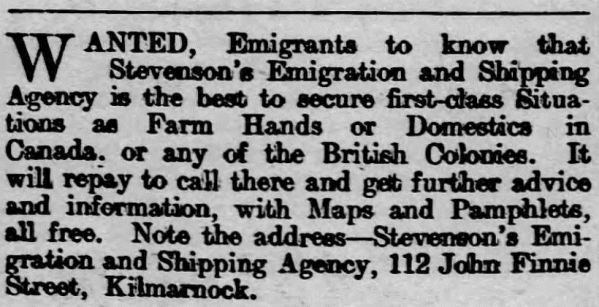
At the time, booking agents in the United Kingdom advertised and recruited potential immigrants to Canada. There was an acute need of domestic help and agricultural workers. Between 1890 and 1920, Canada experienced its third wave of immigration and its peak was between 1911 and 1913, just before World War I.1 The following type of advertisement was common in the newspapers.2

Booking agent advertisement

Maybe one of these advertisements gave the McHugh family the idea to emigrate to Canada. Or maybe Mary was ready for an adventure. She was just 21 when she disembarked from the SS Grampian that had left Glasgow on June 24, 1911 and arrived in Quebec City on July 9, 1911.  She would have had a medical exam when she arrived to ensure that she was in good health and did not have an infectious disease. Conditions for immigration to the colonies were well known in the United Kingdom. The February 11, 1911 edition of the Hamilton Observer, in its article, Canadian Notes, People Prohibited, details the reason some potential immigrants could expect to be refused by Canada. The article explains the booking agent’s liability for the immigrants that arrived in Canada for a period of three years following their arrival:

“The following classes of people are prohibited from landing … feeble minded, idiotic, insane, or who have been insane within five years, afflicted with any loathsome, contagious, or infectious disease; anyone who is a pauper, who is destitute, who is a professional beggar or vagrant.”3

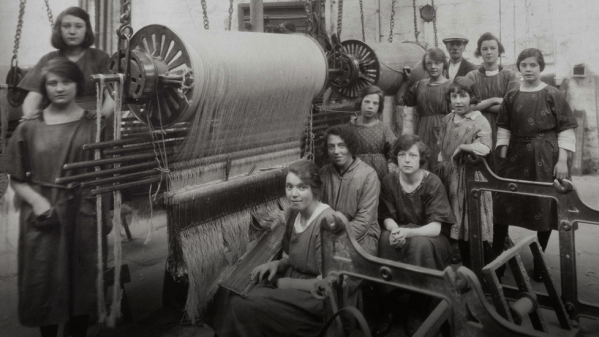
All of the members of the McHugh family worked in the jute mills in Dundee. The 1911 census indicates Mary was a jute weaver, which probably meant that she operated a jute weaving machine.4 She lived with her mother, Sarah Jane McLaughlin, and her brothers, Edward and Francis. They lived at 1 Tait Lane, Dundee. Her other brother, Thomas, my grandfather, lived with his wife and seven children at 9 Tait Lane.

The picture below shows the jute weaving machine.5

Mary must have been satisfied with her new life in Montreal, Quebec. Within a year, her mother and her two brothers, along with my grandfather, had followed her to Canada. Six months later, my grandmother, Elsie Orrock, and her seven children joined her husband, Thomas, in Montreal.

The McHughs lived close together in Dundee and they also lived close together in Verdun, Quebec. While I will never know for sure why they decided to emigrate, I can guess that they wanted a life that was not as hard as the one working in the jute mills. There are a few clues that this was not a spur of a moment decision but a planned family decision.

Mary left first and, if it did not suit her to live in Canada, she would have been able to easily return to Dundee. Her mother and brothers were still there. By the time her mother emigrated, along with her three sons, they arrived with $150 CAD, about $4,750 in today’s dollars. Browsing through the passenger lists, I can see that they had a lot more money than many of their fellow passengers. 6 They were not a rich family, so this amount of money would have taken some time to save up.

Coincidentally my grandfather joined the Freemasons in 1910 and achieved a Master Mason diploma and a Mark Mason diploma.7 By that time, he already had six children. He worked long hours in the jute mill, including Saturdays. Why would he join the masons when he was already a very busy man providing for his family, plus taking care of his widowed mother, and his siblings who still lived at home? There is no evidence that he ever joined the masons when he arrived in Canada. I believe that it is possible that he joined the masons to in case he needed the contacts to find employment. As he quickly found work, his busy family life prevented him from pursuing his membership in the masons.

Only one of my grandfather’s siblings stayed in Scotland, Sarah Jane McHugh. She was not living with the other McHughs at the time of the 1911 census. But she remained close to the family. Surprisingly, she travelled to Montreal to be a witness at her brother’s wedding at the Notre Dame Basilica in Montreal on May 8, 1913.8 That would have been quite a trip for Sarah Jane to make.

  1. Wikipedia, Immigration to Canada, https://en.wikipedia.org/wiki/Immigration_to_Canada, accessed 27 September 2023.
  2. Irvine Herald and Ayrshire Advertiser (Irvine, Strathclyde, Scotland) · 13 Oct 1911, accessed Newspapers.com, downloaded 24 August 2023.
  3. The Hamilton Advertiser (Hamilton, Strathclyde, Scotland) · 11 Feb 1911, accessed Newspapers.com, downloaded 24 August 2023.
  4. Scotland’s People, National Records of Scotland, 1911 Census, Sarah Jane McHugh, downloaded 23 June 2019.
  5. V&A Dundee Design Museum, Women’s Day tweet, 6 March 2020.
  6. Passengers lists for S.S. Grampian arriving in Port of Quebec, May 21, 1912, Library and Archives Canada, https://www.bac-lac.gc.ca/eng/discover/immigration/immigration-records/passenger-lists/passenger-lists-1865-1922/Pages/image.aspx?Image=e003578022&URLjpg=http%3a%2f%2fcentral.bac-lac.gc.ca%2f.item%2f%3fid%3de003578022%26op%3dimg%26app%3dpassengerlist&Ecopy=e003578022, accessed February 3, 2022.
  7. Thomas McHugh, registration of the Grand Lodge of Scotland, dated 25 August 1910.
  8. Registration of marriage of Francis McHugh and Helen Smith, 8 May 1913, downloaded 6 January 2022.