Hard Life, Beautiful View

The path my 2 times great grandmother Anne Nesfield took to work and marry in 1860 era. People in Sleights tended to stay put until the opening of the railroad in 1840.

My father, Peter, born Kuala Lumpur, Malaya in 1922 of hardscrabble North of England stock, always signed his name Peter N.F. Nixon Esq., something I found a wee bit pretentious. He was just a chartered accountant, after all. The F stood for Forster, the N for Nesfield.

I knew Forster was his mother’s surname. I didn’t know until very recently upon doing his genealogy that Nesfield was his father’s paternal grandmother’s name.

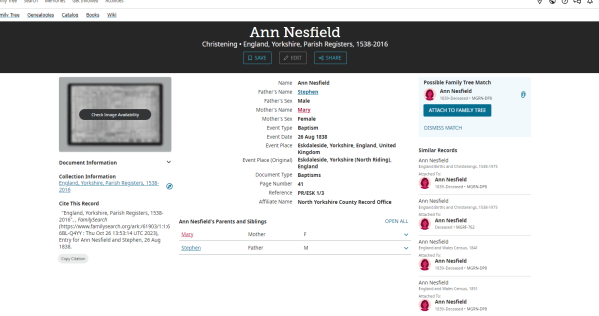
Ann Nesfield, my 2x GG was born in 1838A in Sleights near the lovely coastal town of Whitby at the North East corner of the North Yorkshire Moors to Stephen Nesfield of that place and Mary Jeferson of nearby Sneaton.

Stephen was a labourer. He and Mary were both illiterate as they signed their 1830 marriage certificate with an X.
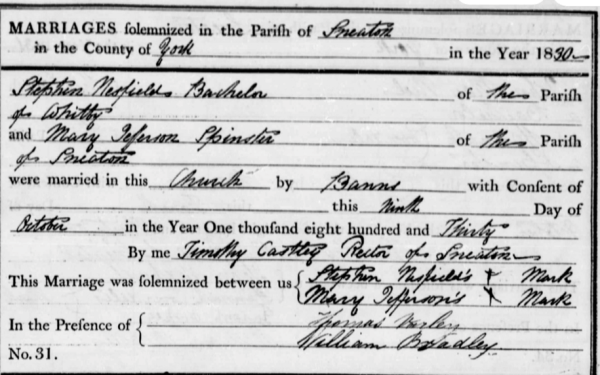
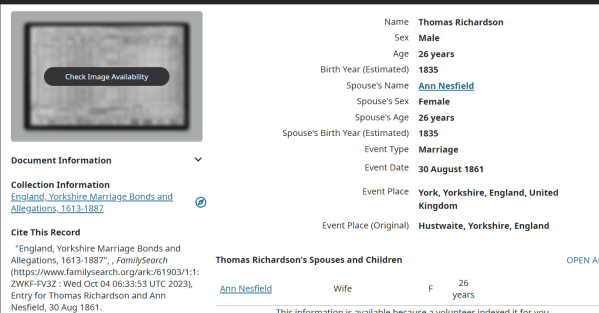
The August 30, 1861B marriage record for Thomas Richardson and Ann Nesfield has them wed in Husthwaite, 40 miles to the south west but still on the Moors. Thomas was from nearby Rievaulx, a small town of 229 people (10 farms and 26 cottages, one school house and no pub) famous then as now for its monastery ruins.

According to the 1861 UK Census, Ann had been working in Husthwaite as a cook at an estate/farm, Highthorne, belonging to one Nathaniel Thomas Lumley Hodgson, Esquire (sic) gentleman horse-breeder who had been a crony of Charles Darwin’s at Cambridge! 3Thomas according to the same Census is living in Rievaulx with an older sister.

Ann and Thomas Richardson go on to have ten children over twenty years with my father’s grandmother Mary-Ellen, 2nd born in 1862, destined to marry one Robert Nixon, a quarryman from the adjacent market town of Helmsley.1

Now, I imagine Ann Nesfield’s existence in rural England post-Industrial Revolution wasn’t that easy despite her initial skilled position as a cook for a small family at a Yorkshire Dales farm/estate. And who can know about her 1861 marriage to Thomas Richardson. Tailors and drapers, especially in small towns, were still solidly working class.

It is also possible Ann married right then out of necessity. It was announced in the 24th of August 1861 Yorkshire Gazette (just one week before Ann’s marriage) that Lumley-Hodgson Esq. was selling off some fine animals and leaving his farm for the winter ‘due to the health of his daughters.’

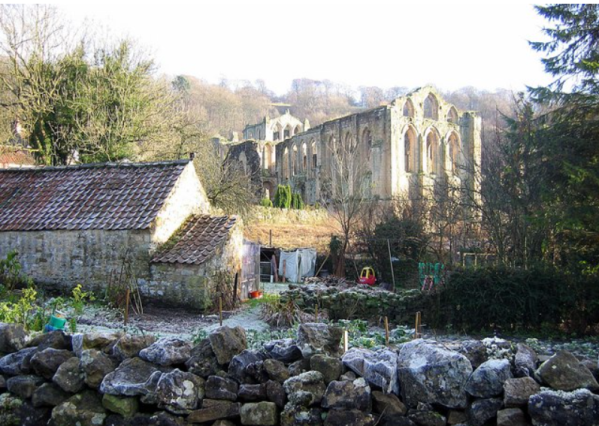
Abbot’s Well cottage on Google Earth with ruins behind. The oldest standing non-monastery building in Rievaulx, designated by the National Trust as Medieval, a period that ended in 1450.
The view from the garden. Roger Smith. Geograph Project Creative Commons

In the beginning, Thomas and Ann Richardson lived at the Richardson family abode, Abbot’s Well, a cozy-looking medieval cottage in Rievaulx, a town that started out as the inner court of one of the richest Cistercian Monasteries in England founded in 1132. The Monastery was destroyed by Henry VIII in 1532 at the very beginning of the infamous dissolution. New homes were then built with stone from the monastery, homes that were used to house various workers from the nearby Duncombe Park Estate of Lord Feversham.

The view from the little garden of Ann’s heritage house, by all accounts, was simply stupendous.

I discovered a 1830’s travelogue online that already describes the town of Rievaulx as ‘quaint’ and ‘picturesque’ and ‘historic,’ claiming the view from the ridge of the vale and ruins “offers a combination of beauties that must be seen to be enjoyed and once seen can never be forgotten.”2

A century later, in the 1930’s, a nephew of the 1st Lord Feversham of Duncombe Park in Helmsley was living at Abbot’s Well House (built 1906 and 30 meters away from the cottage) and Lady Beckett, the widow of the 2nd Lord Feversham, was offering tours of the cottage in benefit of local nurses “with the small garden providing an excellent prospect overlooking the monastery ruins.” Her tours continued well into the 1950’s.

And in May, 1984, the London Times remarked upon a recent sale of the modern Abbot’s Well House. “That a view is worth something is proved by the recent million pound plus sale of the modern Abbot’s Well with a two acre garden that has a view of the 12th century abbey and the Rye Valley beyond.”

I have to wonder, in the 1860’s, did Ann’s heart sing out every time she went out to hang the laundry with my great-grandmother, Mary-Ellen, at her feet? Or did she lament the leaky roof, drafty windows or the lack of bedrooms for her growing family? Was living beside these majestic monastery ruins a comfort to her or merely a haunting reminder of how things can fall apart?

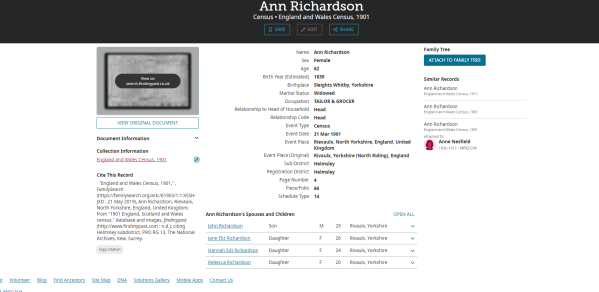
As it happens, the Richardsons did move out of Abbot’s Well sometimes after 1881 and before 1891, but they did stay in town. The 1891 UK Census has the family living at New Cottage in Rievaulx, with Thomas still a tailor and draper but also, now, a grocer. The 1901 CensusC has Ann a widow with four grown children still at home, one son working as a general labourer but three girls in their twenties performing “home duties.” Ann is now the tailor/grocer in the family. In 1911, one year before her death at 74, Ann is still at New Cottage, working as a grocer and living with her youngest daughter who is 30 and married.
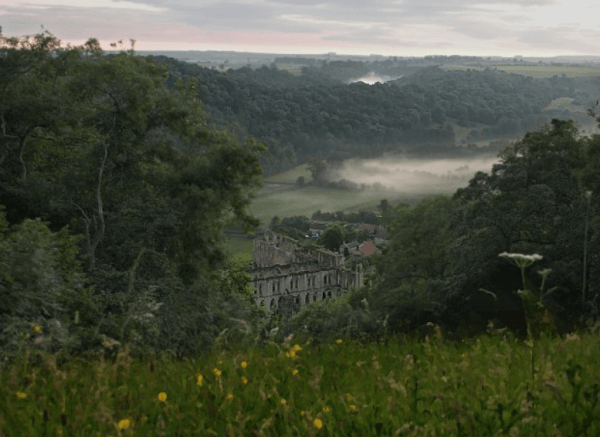
Recent Photo: Rievaulx Abbey and Rye Valley beyond from Rievaulx Terrace. Colin Grice. Geograph Project. Creative Commons.
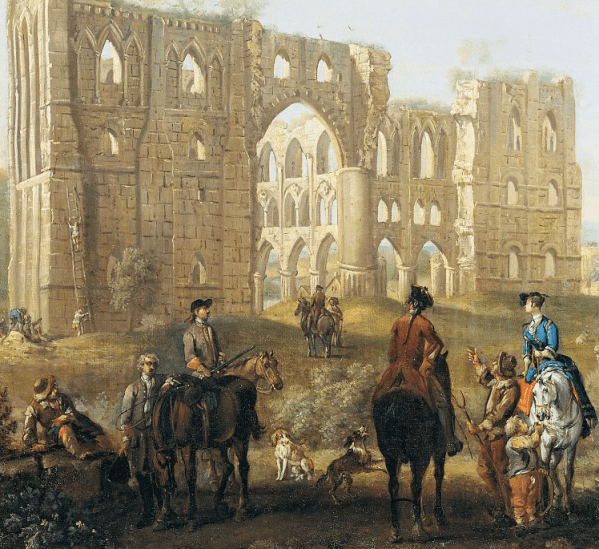
Duncombe Hunting Party. 1728. John Wooten. Yale Collection of British Art. Creative Commons . My ancestors would be the labourers in the background or the scruffy attendants:)

My father’s working-class ancestors lived in picturesque towns all along the route from Whitby to Helmsley; pretty places with colourful names like Goathland, Kirbymoorside and Ugglebarnby. Whitby, where Ann Nesfield lived her early years, is also a North of England beauty spot from what I see on YouTube with surrounding coastal villages as lovely as anything in Italy’s Cinque Terre.

So, although little of consequence about Ann Nesfield’s life can be gleaned from the genealogical record, one thing about the woman cannot be denied. She spent her entire existence surrounded by the breath-taking beauty of the North Yorkshire Moors. That, I think, has to have taken the edge off her own hard-scrabble existence.

Notes:

Thank you to the Ryedale Family History Group for all their kind and expert help and especially to Valerie Slater for helping me sort out the many Ann Nesfields in the Whitby area born circa 1838.

(Apparently, there’s a lot of mix up over these Anns in online family trees. I have to redo part of my tree, now! And it doesn’t help birth dates on the UK Census are only guesstimates 🙂

A walk around Rievaulx Terrace National Trust: https://www.bing.com/videos/riverview/relatedvideo?q=youtube+a+walk+around+rievaulx+terrace&mid=7CB260977EE2F240F3D27CB260977EE2F240F3D2&FORM=VIRE

  1. Robert Nixon Sr, my great grandfather, 1863-1937, who married Nesfield’s daughter, Mary Ellen Richardson, was a delver in the quarry in 1911 according to the UK Census, but he had other occupations. I know because I found his short obit from 1937 from the Yorkshire Post on the British Newspaper Archive database:

“Mr. Nixon was for man years foreman timber leader with messrs William Frank and Sons and with Mr Bentham King. Later worked for the Duncombe Park Estate, and during the war was put in charge of the felling of timber at Waterloo. He was a Sunday school superintendent and a local preacher in the Methodist circuit for over half a century.”

The 1921 census says Robert is working as head quarryman at Duncombe for the Trustees of the Earl of Feversham who was under age. The former Earl had died in 1915 in the war.*I wonder if the Nixons had an IN with the Earl? A Nixon and a Richardson were pallbearers at the Dowager Feversham’s 1889 funeral.

2. Ross, Stephanie. The Picturesque, an eighteenth century debate. Journal of Aesthetics and Art Criticism. 1967

Esquire: Modern British. Polite term as appendix to a surname of someone without any other title implying genteel birth. Earlier, for English gentry rank below a Knight.

3. Both Darwin and Lumley Hodgson were ‘admitted pensioners under Mr. Shaw 1827. at Christ’s College a Divinity School.” Apparently, nature studies and divinity studies were considered compatible back then, as in ‘all God’s creatures.” Both graduated in 1832, although Darwin completed his exams in 1831. The Darwin Archives of Cambridge contains a January 1831 letter where a friend is asking Darwin if Lumley Hodgson has passed. “I don’t see his name anywhere, I am almost afraid to ask.”
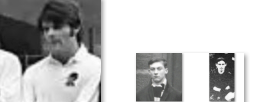
Nesfield Rugby genes. My father’s nephew 1973, Rugby for Cambridge and England. My father, co-captain, 1939 Rugby for St Bees School Cumberland. My grandfather, 1912 Rugby for Duncombe Park where he was a footman. Through DNA I discovered other Ann Nesfield descendants played rugby for Scotland.

CITATIONS

A: Ann Nesfield Baptism 1838 Family Search
2. Ann’s marriage to Thomas Richardson 1861 Family Search
C: 1901 Census. Ann at Home running the family business with her girls.

The Bagg Family Dispute, part 2

In collaboration with Justin Bur

When my great-great grandfather Stanley Clark Bagg died in 1873, his wife and five children inherited large tracts of farmland on the island of Montreal, land that they made a family business of selling.1 But misunderstandings over who owned what and how to keep track of the income created a lot of difficulties. 

Stanley Clark Bagg (I usually refer to him as SCB to differentiate him from his father, Stanley Bagg, and his son, Robert Stanley Bagg,) had inherited most of this property from his grandfather John Clark (1767-1827).2 But there were conditions attached to some of these bequests: Clark’s 1825 will stated that land that comprised the Durham House property, and land comprising Mile End Farm, should pass down through three generations of descendants before it could be sold. The legal term for this, in civil law, is a substitution. However, a change in the law, passed in 1866, limited substitutions to two generations.3 That meant that the generation of Robert Stanley Bagg and his sisters Katharine, Amelia, Mary and Helen were the last generation affected by the substitutions and they could do what they liked with these properties.

The substitution clause referring to Durham House was part of the 1819 marriage contract between SCB’s parents, in which John Clark gave that property to his daughter as a wedding present.4 (It is shown in dark green on the map below.)

Robert Stanley Bagg, # II-57308.1, 1880, Notman & Sandham, McCord-Stewart Museum; Bagg family collection.

When SCB died at age 53, none of his family members was ready to manage these properties. His only son, Robert Stanley Bagg, or RSB, (1848-1912) had recently graduated in law, but he had no experience in renting or selling properties. Furthermore, neither the notary who completed the inventory of SCB’s estate in 1875,5 nor SCB’s widow, nor his children were aware of the substitutions. The Durham House and Mile End Farm properties were treated as though they were no different than the other properties belonging to the late SCB’s estate.

The 22-acre Durham House property (lots 19–28 and 101–115, cadastre of the Saint-Laurent ward) was located north of Sherbrooke Street, on the west side of today’s Saint-Laurent Boulevard. SCB had subdivided part of it and sold lots from it as early as 1846. In 1889, RSB, who was an executor of his father’s estate, subdivided the Upper Garden of Durham House (lot 19, Saint-Laurent ward) and began to sell those lots. He signed the property documents as “R. Stanley Bagg for the estate,” and his mother, Catharine Mitcheson Bagg, also signed.

But the Durham House property actually belonged jointly to the five Bagg siblings. It was not part of SCB’s estate, and his widow could not inherit this land, sell lots from it or acquire income from it. Yet that is what she did: the name Dame Catharine Mitcheson, widow of Stanley Clark Bagg, appeared on five deeds of sale in 1889.  

It is not clear who discovered the error, but perhaps someone close to the Bagg family took a good look at the property documents and noticed these details. SCB’s middle daughter, Amelia Bagg, was to marry Joseph Mulholland the following year, and he worked as a real estate agent for the Stanley Clark Bagg Estate. Also, Joseph’s brother-in-law, John Murray Smith, was about to purchase several of the Durham House lots. Any one of these people could have discovered the marriage contract and John Clark’s will, which SCB had registered at the provincial land registry office.6

This map shows details of several of the late Stanley Clark Bagg’s properties in 1875, when an inventory was made of his estate. Durham House and its upper garden, as well as a small part of the Mile End Farm and SCB’s home, Fairmount Villa, are overlaid over a modern map of the island of Montreal. Mile End Lodge had been John Clark’s home. At that time, the densely populated part of Montreal was south of Sherbrooke Street. Mount Royal Park, opened in 1876, is on the left. Map created by Justin Bur, based on two open data sources: physical geography from CanVec, Natural Resources Canada and modern streets from Geobase, City of Montreal.

As soon as they became aware of the situation, the Bagg siblings tried to remedy it with a notarized document called a Ratification.7 It said that, as the actual owners, they ratified and approved the five sales made by their mother. A few weeks later, in January and April of 1890, the Bagg siblings sold five lots to John Murray Smith and four to James Baxter, and this time, the vendors named in the deeds were correct.

Next, Catharine and her five children took a step to sort out the income from lots from the Durham House property that SCB had sold in his lifetime. They did not involve a notary, but tried to look after the issue as a family, signing a document called an Indenture on May 12, 1890.8

The indenture stated that neither Catharine nor her children had known about the marriage contract until December, 1889. The Bagg children (by now all were adults) declared the love and affection they had for their mother and their desire to settle the matter amicably, and released her from all claims and demands. For her part, Catharine agreed to repay to her children the capital sums she had received from the sale of these properties. Because she had paid taxes and expenses on them, the children made no claim for the interest payments she had received.

Action Demanded

No doubt confident that everything had been resolved, RSB took his wife and two young daughters on an extended trip to England, leaving his mother and sisters to handle offers for land sales during his absence. After his return, however, the family dispute blew up once more, this time over the Mile End Farm property. Two of the married sisters, Katharine Sophia Mills and Mary Heloise Lindsay, hired a notary to represent their interests.

Notary Henry Fry sent a complaint on their behalf to the three living executors of SCB’s will — Catharine Mitcheson Bagg, Robert Stanley Bagg and notary J.E.O. Labadie – demanding immediate action. Dated July 22, 1891 and titled Signification and Demand,9   this document stated that the executors of SCB’s will were bound, upon his death, to deliver over the Durham House and Mile End Farm properties to his children, and to produce an account of the administration of these properties.

Catharine Mitcheson Bagg, #71147, 1883, William Notman & Son, McCord-Stewart Museum; Bagg family collection.

It stated that the executors “have wholly failed and neglected to render such account, but on the contrary, have, since the death of the said Stanley Clark Bagg, continued in possession of the said substituted property and have even sold and alienated portions thereof and have received the consideration money of such sales and have received and retained the entire revenues therefrom and that although they have been recently requested to render such account, the said executors have neglected and refused to do so.”

The executors had until August 10 to provide an account of the property belonging to the substitutions. They must have met this demand because no further complaints have turned up. Furthermore, the Bagg siblings seem to have found a better solution to their dilemma: they partitioned the Durham House property and sold a large chunk of the Mile End Farm.

In September 1891, the remaining unsold lots of the Durham House property were grouped into five batches, and the five siblings pulled numbers out of a hat to determine who got which ones.10 They could then sell these lots, or keep them, as they pleased.

Two months later, the five siblings sold 145 arpents of land, including most of the Mile End Farm and a section of the adjoining Black Gate Farm, to Clarence James McCuaig and Rienzi Athel Mainwaring,11 These Toronto land developers had plans to develop an exclusive housing development they called Montreal Annex in the area.12

As for keeping track of property sales, Amelia, the middle Bagg sibling who was now married to Joseph Mulholland, took on that responsibility. Starting in 1892, she kept a ledger in which she wrote down the dates, names of purchasers and prices paid for each of the lots that were part of the Mile End Farm and Durham House properties.13

This article is also posted on my personal family history blog, www.writinguptheancestors.ca

See also:

Janice Hamilton, “Bagg Family Dispute Part 1: Stanley Clark Bagg’s Estate”, Writing Up the Ancestors, Dec. 13, 2023, https://www.writinguptheancestors.ca/2023/12/bagg-family-dispute-part-1-stanley-clark-baggs-estate.html

Janice Hamilton, “Aunt Amelia’s Ledger” Writing Up the Ancestors, April 26, 2023,  https://www.writinguptheancestors.ca/2023/04/aunt-amelias-ledger.html

Janice Hamilton, “Stanley Clark Bagg’s Family”, Writing Up the Ancestors, Feb. 29, 2020,  https://www.writinguptheancestors.ca/2020/02/stanley-clark-baggs-family.html

Janice Hamilton, “My Great-Great Aunts, Montreal Real-Estate Developers”, Writing Up the Ancestors, October 11, 2017, https://www.writinguptheancestors.ca/2017/10/my-great-great-great-aunts-montreal.html

Janice Hamilton, “A Home Well Lived In”, Writing Up the Ancestors, Jan. 21, 2014, https://www.writinguptheancestors.ca/2014/01/a-home-well-lived-in.html

Notes:

The Indenture, the Deed of Ratification and several other documents mentioned in this article were donated to the archives of the McCord Stewart Museum in Montreal around 1975 by my cousin.

This article was written in collaboration with urban historian Justin Bur. Justin has done a great deal of historical research on the Mile End neighbourhood of Montreal (around Saint-Laurent Blvd. and Mount Royal Ave.) and is a longtime member of the Mile End Memories/Memoire du Mile-End community history group (http://memoire.mile-end.qc.ca/en/). He is one of the authors of Dictionnaire historique du Plateau Mont-Royal (Montreal, Éditions Écosociété, 2017), along with Yves Desjardins, Jean-Claude Robert, Bernard Vallée and Joshua Wolfe. His most recent article about the Bagg family is La famille Bagg et le Mile End, published in Bulletin de la Société d’histoire du Plateau-Mont-Royal, Vol. 18, no. 3, Automne 2023.

Sources:

  1. Stanley Clark Bagg will, J.A. Labadie, n.p. no 15635, 7 July 1866
  2. John Clark will, Henry Griffin, n.p. no 5989, 29 August 1825
  3. In 1866 the government of Lower Canada enacted the Civil Code. This was a compilation and revision of the civil law inherited from the French regime; article 932 of the code put a two-generation limit on substitutions.
  4. Marriage contract between Stanley Bagg and Mary Ann Clark, N.B. Doucet, n.p. no 6489, 5 August 1819
  5. Stanley Clark Bagg inventory, J.A. Labadie, n.p. no 16733, 7 June 1875
  6. John Clark’s will and the marriage contract between Stanley Bagg and Mary Ann Clark are still publicly available at the Registre foncier du Québec. John Clark’s will had been transcribed there in 1844 (Montréal ancien #4752). The marriage contract (Montréal Ouest #66032) was transcribed in 1872. SCB’s will was transcribed into the register (Montréal Ouest #74545) in 1873.
  7. Deed of Ratification, Adolphe Labadie, n.p. no 2063, December 12, 1889, register Montreal Est #25109, McCord Stewart Museum (P070/66,3) This notary was a son of notary J.E.O. Labadie, who was an executor of the will, and grandson of notary J.A. Labadie, who had handled SCB’s will and the inventory of his estate.
  8. Indenture, May 12, 1890, McCord Stewart Museum (P070/B6,3).
  9. Signification and Demand, Henry Fry, n.p. no. 2234, 22 July 1891, McCord Stewart Museum (P070/B6,3).
  10. Deed of Partition, John Fair, n.p no 3100, Sept. 10, 1891, register Montreal Est #29503, McCord Stewart Museum (P070/B8,4).
  11. Deed of Sale, William de Montmollin Marler, n.p. #17571, 20 November, 1891, register Hochelaga-Jacques-Cartier #40225
  12. Justin Bur, Yves Desjardins, Jean-Claude Robert, Bernard Vallée, Joshua Wolfe, Dictionnaire historique du Plateau Mont-Royal (Montreal, Éditions Écosociété, 2017), p 271.
  13. Amelia Josephine Bagg Mulholland, Grand livre, 1891-1927, McCord Museum, Fonds Bagg, P070/B07,1. https://collections.musee-mccord-stewart.ca/en/objects/293626/a-j-mulholland-ledger (accessed April 3, 2023)

Learning about the Acadian Diet

Some of the most interesting information about my ancestors comes from documents detailing what they ate.

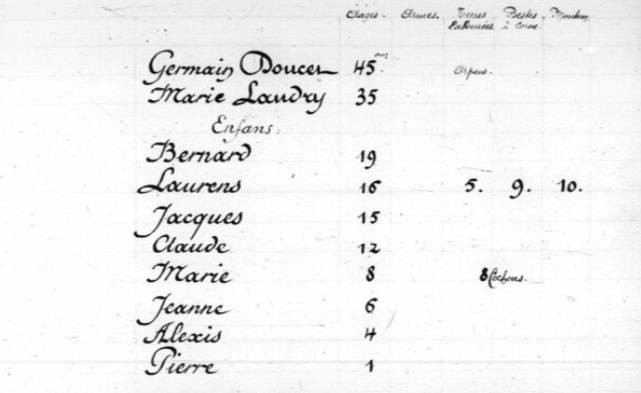
The 1686 Acadian Census, for example, shows my ancestor Alexis Doucet at four years old living in Port Royal with his parents and seven brothers and sisters on “5 arpents of cultivable land with 9 cattle, 10 sheep and eight pigs.”1

The census detailed our ancestors’ cattle and livestock along with the cultivated land because those elements were the primary elements of wealth in North America at that time. The settlers’ ability to nourish themselves determined whether they would be able to thrive, multiple, and permanently inhabit a place on behalf of whichever European colony to which they belonged.

Doucet’s family and their neighbours were ingenious at this task, as Caroline‐Isabelle Caron points out in her delightful booklet about Acadians in Canada.

Indeed, the Acadians set roots in the marshy salines left untouched by the First Nations, in the tidal flood plain which they proceed to dry and put into culture thanks to a complex system of dykes (levées) affixed with drying valves called aboiteaux. This technology was imported from France, probably from the Loudunais region where some early settlers originated. The vast network of dykes the Acadians created inside and beyond the marshlands before 1755, ensured the fertilization of vast meadows for the culture of wheat but also the growth of salt‐hay pastures, a particularly attractive source food for cattle. At this time, Acadian agriculture ranked among the most fertile in the world, boasting near constant, abundant crops.

A typical Acadian farm consisted of one house with one or two rooms on the first floor, a barn, outdoor latrines, a cellar, and a well. Dwellings were usually built up from the ground without foundation, the walls sided with whitewashed cob walls surmounted by a thatched roof. In addition to an enclosure to keep farm animals (chickens, sheep, pigs), the courtyard contained a fenced garden to grow legumes and root vegetables (carrots, turnips, radishes, but not potatoes), herbs (for both cooking and apothecary), and berries. The Acadians planted, among a vast array of fruit trees, the first apple trees the Annapolis valley is reputed for today.

Abundant food supply stimulated strong demographic growth. It is believed that between 1650 and 1755, the growth rate of the population increased annually by 4.5 percent. Birthrates alone explains this growth, the result of a near 100 percent marriage rate and very high fertility rates, as well as low mortality rates due to the quasi absence of epidemic diseases or famine, and easy access to arable land and drinking water. Despite tentative estimates, experts agree that the Acadian population grew from over 400 people in 1671 to more than 1400 in 1730, for a total of 10,000 to 18,000 people in 1755.2

By the way, the dykes made by Acadians like my ancestor, still exist today. The most successful examples allow only a third of the territory to be farmed, with the other two thirds dedicated to natural wetland rejuvenation and rough cover.3

These early settlers’ ingenuity at bringing old world technology to their new circumstances enabled them to cultivate land that wasn’t already being farmed by the First Nations communities already in the area. That fact meant that they weren’t seen as a threat by their First Nations neighbours and became friends and neighbours. Some of the French settlers fell in love with First Nations people, as Alexis’ grandmother had. According to recent DNA research, Germain’s last name “Doucet” is presumed to be an adopted name, because his father, Germain Doucet, definitely descended from First Nations.4

But that’s a tale for another day.

1Hebert, Tim , Transcription of the 1686 Acadian Census, at Port-Royal, Acadie 1686 Census Transcribed. The original census can be found at Acadian Census microfilm C-2572 of the National Archives of Canada “Acadie Recensements 1671 – 1752,” p 30.

2Caron, Caroline‐Isabelle. The Acadians. Immigration and Ethnicity in Canada 33, 2015. http://archive.org/details/the-acadians.

3Fundy Dykelands and Wildlife | Novascotia.Ca.” Accessed February 7, 2024. https://novascotia.ca/natr/wildlife/habitats/dykelands/.

4Estes, Roberta. “Germain Doucet and Haplogroup C3b.” DNAeXplained – Genetic Genealogy, September 18, 2012. https://dna-explained.com/2012/09/18/germain-doucet-and-haplogroup-c3b/.

BBC RADIO 4 – “This is the Shipping Forecast”

This piece of music is called “Sailing By” composed by Ronald Binge in 1963, and performed by the Alan Perry/William Gardner Orchestra, and is the version used by the BBC for its late-night early-morning shipping forecasts,

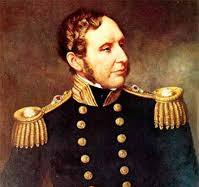
It signals the beginning of the Shipping Forecast, an important part of living on an island and it dates back over 150 years. The Shipping Forecast was established by Vice-Admiral Robert FitzRoy the first professional weather forecaster, and captain of the HMS Beagle, on which Charles Darwin sailed to South America. (1)

Vice-Admiral Robert FitzRoy.

Born 5 July 1805, Suffolk, England

Died 30 April 1865 Norwood, England.

In October 1859, the steam clipper Royal Charter was wrecked in a strong storm off Anglesey, Wales 450 people lost their lives. In response to this loss, FitzRoy introduced a warning service for shipping in February 1861, using telegraph communications.

Sadly, FitzRoy didn’t live to see his ideas become a permanent fixture of British life; he killed himself in 1865, in part because of his frustration at failing to set up a regular service. (2)

The shipping service was only discontinued during and following WW1 between 1914 and June 1921. During WW2, it was discontinued between 1939 and 1945.

The shipping forecast is heard by local fishermen all over the British Iles, Scotland Wales and further afield and Its tune is repetitive, assisting in its role of serving as a signal for sailors tuning in to be able to easily identify the radio station.

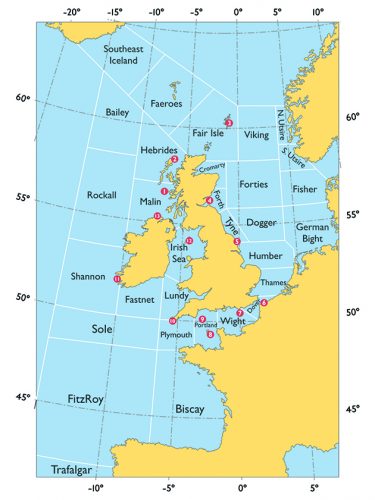
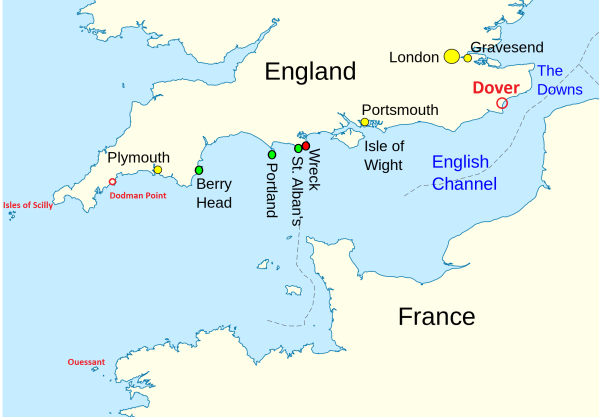
This delightful music above brings back happy memories for me, listening to the radio as a child in Plymouth Devon England, where I was born. “Dogger, Fisher, German Bight, North Utsire and South Utsire” – coastal regions near Norway – although I had no idea where these exotic names were, it was wonderful to imagine. 

Just look at some of the unusual names on the map, it was always a thrill to hear ‘Plymouth’ mentioned.

The sea areas match the forecast areas used by other North Sea countries, though some names differ. The Dutch KNMI and Norwegian counterpart, names the Forties “Fladen Ground”, while Météo-France uses “Pas-de-Calais” for Dover, “Antifer” for Wight “Casquests” for Portland and “Ouessant” or ‘Ushant” for my home town, Plymouth. Because of the unusual name for Plymouth, I also learned a fascinating piece of French history.

The Ouessant (or Ushant) is a breed of domestic sheep (Could that be a French insult?) from the island of Ouessant off the coast of Brittany but also the name of a French Submarine). Ushant is a French island at the southwestern end of the English Channel which marks the westernmost point of metropolitan France.  

It belongs to Brittany and in medieval times, Léon. In lower tiers of government, it is a commune in the Finistère department. It is the only place in Brittany, save for Brittany itself, with a separate name in English.

Even today, if I cannot sleep, I still listen to BBC Radio 4 in the early hours of the day and catch the Shipping Forecast as it lulls me to sleep.

Unfortunately, from this year, 2024, it is expected that the Shipping Forecast will no longer be broadcast on long wave (LW) due to the closure of the LW platform. This announcement was updated on the 4th of April 2023 due to the BBC amending their original announcement on the future of the LW Shipping Forecast. The LW broadcasts are expected to end in 2024, but a final decision has not yet been made. (4)

Listeners are reassured by the thought that, somewhere out at sea, British fishers are patiently waiting by their radios to find out whether there is a gale warning in Rockall or Cromarty. However, the slightly less romantic reality, according to Mike Cohen of the National Federation of Fishermen’s Organisations, is that his members have not needed Radio 4 for decades.

Modern fishers have far more accurate devices to warn them about the wind and rain: “Even the small 15-metre boats in Bridlington have satellite internet these days. I’ve had video calls from people in the middle of the sea.” (5)

Some interesting quotes below about the shipping forecast: 

“The Shipping Forecast is immensely popular with the British public; it attracts listeners in the hundreds of thousands daily – far more than actually require it.[18]

In 1995, a plan to move the late-night broadcast by 12 minutes triggered angry newspaper editorials and debates in the UK Parliament and was ultimately scrapped.[19]

Similar outcry greeted the Met Office’s decision to rename Finisterre to FitzRoy, but in that case, the decision was carried through.[20]

Peter Jefferson, who read the Forecast for 40 years until 2009, says that he received letters from listeners across the UK saying that the 0048 broadcast helped them get to sleep after a long day.[4]

The Controller of BBC Radio 4, Mark Damazer, attempted to explain its popularity: 

“It scans poetically. It’s got a rhythm of its own. It’s eccentric, it’s unique, it’s English. It’s slightly mysterious because nobody really knows where these places are. It takes you into a faraway place that you can’t really comprehend unless you’re one of these people bobbing up and down in the Channel.[18]

Zeb Soanes, a regular Shipping Forecast reader, described it thus:

“To the non-nautical, it is a nightly litany of the sea. It reinforces a sense of being islanders with a proud seafaring past. Whilst the listener is safely tucked-up in their bed, they can imagine small fishing-boats bobbing about at Plymouth or 170ft waves crashing against Rockall.[21]

….and many more here:

https://en.wikipedia.org/wiki/Shipping_Forecast

SOURCES

(1) https://en.wikipedia.org /wiki/Shipping_Forecast#Coastal_weather_stations_and_inshore_waters

(2) https://www.countrylife.co.uk/out-and-about/10-things-about-the-shipping-forecast-164341

(3) https://en.wikipedia.org/wiki/Ushant

(4) https://www.pbo.co.uk/news/no-more-shipping-forecast-on-lw-from-2024-75844

(5) https://www.theguardian.com/media/2022/jun/03/shipping-forecast-radio-4-long-wave-broadcast

Who is Henry Boggie?

Henry Boggie is my great-grandfather, but he was never really part of the family.

My grandmother, Elspeth Mill Boggie Orrock was born in 1875 in Arbroath in County Angus, Scotland. Her mother, Annie Linn Orrock, registered the birth and gave Elspeth her surname Orrock but she also gave Elspeth the name Boggie. The registration notes that Elspeth was illegitimate as her parents were not married.1

In 1881, when Elspeth was 6 years old, Annie Linn, still residing at 32 East Mill Wynd where she had given birth to Elspeth, instituted a civil paternity suit against Henry Boggie in the Sheriff Court.  On 11 September 1882, a decree was issued by the Sheriff Court, stating that the birth registration be corrected to include Henry Boggie as Elspeth’s father.2

Paternity cases were usually attempts to make the father pay child support and we can assume that this is probably why Annie Linn sued Henry for paternity.3 There is no evidence that Henry and Annie every lived together.

The censuses show that Henry lived with his mother until at least 1891. He worked as a mason and remained in Arbroath his entire life. He died fairly young, at 53. The registration of his birth says that he was single.4 It is unlikely that he fathered any other children.

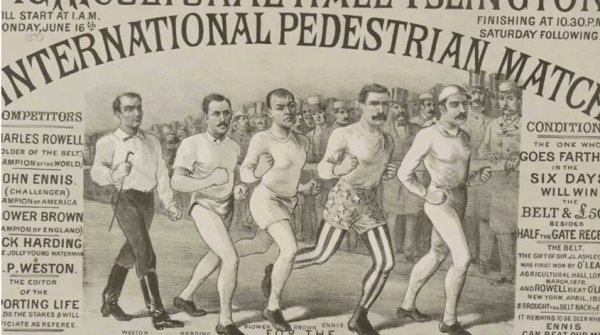
The records indicate that Henry led a quiet life, living in the same city all his life. However, Henry did practice an unusual sport, pedestrianism. In the 19th century, he would have been called a ped. At the time, pedestrianism was popular in Scotland and elsewhere. The six-day, 450-mile race usually began on a Sunday at 1:00 a.m. It started after midnight on Sunday because public amusements were prohibited on Sundays. The athletes walked for six days in a row, in a circle and had to complete the 450 miles. They could run, walk, or crawl. They ate, drank, and napped in little tents at the side. 5

Bloomberg, When Walking was a Spectator Sport, 7 August 2015

The walking matches were a spectator sport, with music and refreshments. It was like a fair. Gambling was also part of the attraction. There were lots of possibilities to place bets, such as the first pedestrian to drop out or the first to achieve a set number of miles. At the time, champagne was considered a stimulant. Some of the trainers (yes, they had trainers) would encourage the participants to drink copious amounts of it.6

Henry seems to have participated in several pedestrian tournaments. He was described as one of the “crack” walkers who participated in the Dundee tournament when he joined the Aberdeen Walking Match in December 1879. It took place in Cooke’s Circus, an equestrian establishment so we can assume that the participants walked around the equestrian arena. Prize money totalled £40 (about £6,000 today) and the winner won the champion belt of Scotland.7

On March 8, 1880, Henry competed in the Perth Grand Pedestrian Tournament. The thirty-three participants hailed from England and Scotland. The format of this tournament was that the men would walk or run between eleven o’clock in the morning and stop at eleven o’clock in the evening. First prize was £25 (about £3,800 today). Jostling, hindering another participant, or using bad language would result in disqualification.  Reserved seats were two shillings, second seats were one shilling, and third seats were a sixpence. A musical band was in attendance. Gambling was prohibited.8

The newspaper articles that list Henry’s participation in the Dundee, Perth, and Aberdeen tournaments are just a glimpse into this interesting sport. Not only did the participants travel to compete in these tournaments, the six-day races would have been quite exciting and exhilarating. There is no indication whether or not Henry ever won prize money, but still, he was a “crack” competitor.

  1. Scotland’s People, National Records of Scotland, Statutory Registers of Birth, 1875, District of Arbroath, County of Forfar, Elspeth Mill Boggie Orrock, retrieved 12 January 2018.
  2. Register of Corrected Entries for the District of Arbroath in the County of Forfar, dated 11 September 1882, directing that the defendant, Henry Boggie, Mason, should appear on the registration of birth of Elspeth Mill Boggie Orrock, in possession of author.
  3. Traces. Uncovering the Past, Tracing the Fathers of Illegitimate Children in Scottish Court Records, 3 December 2020, https://tracesmagazine.com.au/2020/12/tracing-the-fathers-of-illegitimate-children-in-scottish-court-records/, accessed 22 January 2024.
  4. Scotland’s People, National Records of Scotland, Statutory Registers of Death, 1905, District of Arbroath, County of Forfar, Henry Boggie, retrieved 22 January 2024.
  5. BBC, The Strange 19th century sport that was cooler than football, Zaria Gorvett, 28 July 2021, https://www.bbc.com/future/article/20210723-the-strange-19th-century-sport-that-was-cooler-than-football, accessed 22 January 2024.
  6. NPR,  In The 1870s And ’80s, Being A Pedestrian Was Anything But, 3 April 2014, accessed 23 January 2024.
  7. Aberdeen Press and Journal, 29 December 1879, page 4, accessed through British Newspapers on Findmypast, 23 January 2024.
  8. Dundee Courrier and Angus, 8 March 1880, page 1, accessed through British Newspapers on Findmypast, 23 January 2024.

Great-Grandfather Thomas Bevan

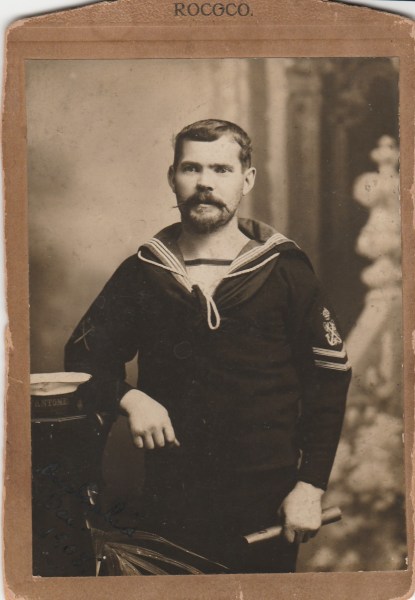
Thomas Bevan Royal Navy, Australia 1908

I was too young to know my maternal Great-Grandfather, Thomas Bevan. However, I do have some memories of him – mainly in his casket – in the front room of his house at number nine, Pellow Place Stoke, Plymouth Devon. The coffin stayed in the house for 7 days before the burial. My gran said I had to kiss him goodbye so that I would have pleasant memories of him and no nightmares!

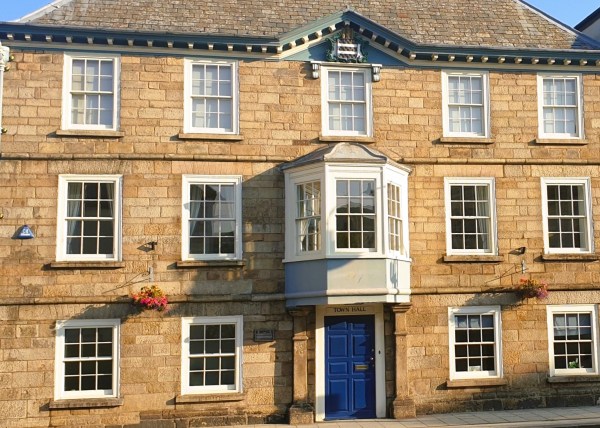
Thomas was born in the little ancient town of Okehampton in West Devon on the Northern edge of Dartmoor and had a population of less than 6,000 in 2011.

The name Okehampton means settlement or estate (tun) on the River Okement and was founded by the Saxons. The earliest written record of the settlement is from 980 AD. The early form of the name Okementone is recorded in the Domesday Book of 1086, and later in 1167 and 1275 as Okemento(a).

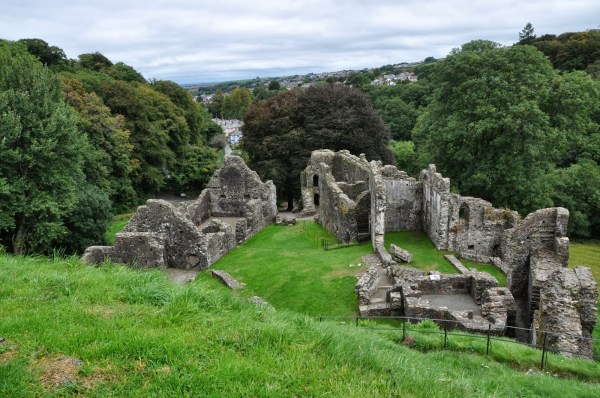
Like many towns in the West Country, Okehampton grew on the medieval wool trade. Notable buildings in the town include Okehampton Castle, now a ruin, established by the Norman Sheriff of Devon, Baldwin FitzGilbert. following a revolt in Devon against Norman rule.

The 17th-century Okehampton Town Hall.

My Granny used to pronounce it as “Okenton”. Apparently, as late as the 1930’s the older people of the district pronounced it “Okington” or “Okenton” I asked Granny why she said it that way, and she said that was how her Father pronounced it. (1)

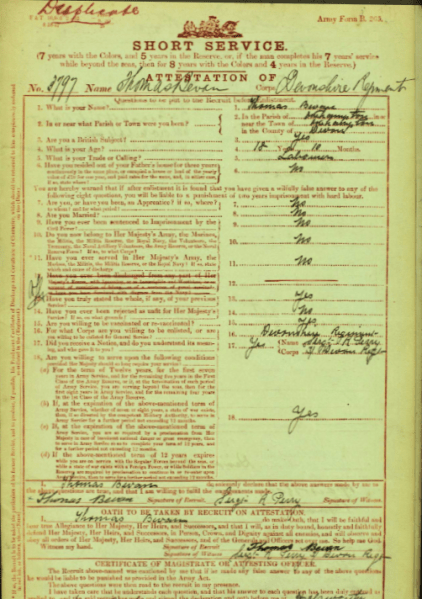
On the 18th of October, 1893, when Thomas was 18 years and 10 months old, he joined the Devonshire Regiment for ‘Short Service’.

The term “short service” refers to a type of enlistment in the British Army, introduced in 1870. It allowed soldiers to serve for a shorter time than the standard 12 years of service. Thomas served for eight years and then joined the Royal Navy at age 25.

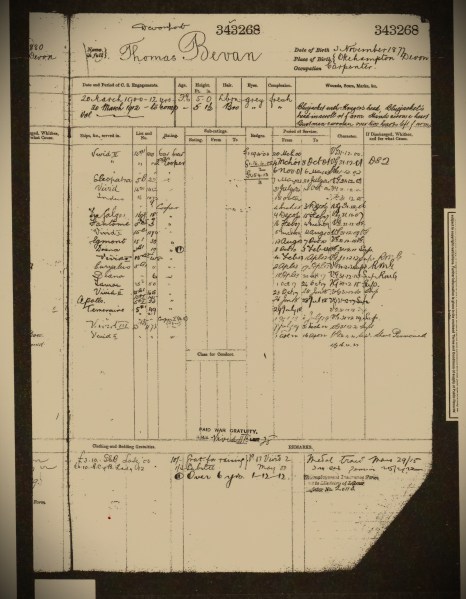
According to his records, when he joined the Royal Navy for a 12-year engagement on the 20th of March 1900, two years were added to his birth year. He was born in 1875 but his Royal Navy service Records show 1877.

Thomas became a Cooper and Master Carpenter on HMS Vivid II. This was a shore establishment, in the Devonport Dockyard in Plymouth, where I was born and lived. He may have learned of the rules regulations and history of the Royal Navy whilst there and probably picked up the basics of his trade too. According to his Service Record below, he served on many different ships and finished his service 12 years later, also on HMS Vivid III. (2)

Thomas Bevan’s Royal Navy Service Record

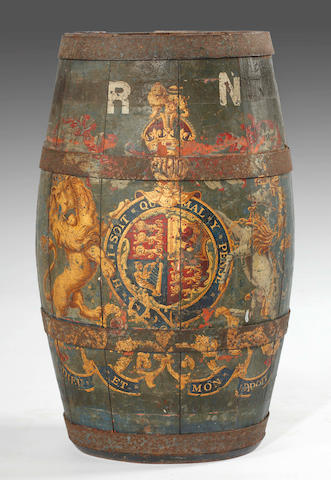
Granny told me that Thomas made and repaired wooden barrels, casks and other containers. The daily Rum ration for the Royal Navy, called the ‘tot’ for the crew was stored in a barrel such as Thomas would have made. The daily tot was abolished in 1970; I remember it made headlines in England. The reason was concerns that the intake of strong alcohol would lead to unsteady hands when working machinery.

A Scarce Royal Navy Rum Barrel made of English oak painted overall in blue faded to green on the front. Bound with four iron bands, the front was painted with post-1901 Royal Arms and R.N. and retained trace imprints of earlier bands.

Thomas lived with his wife, Lilian, their daughter Edith O’Bray (my Granny) and her husband Percival Victor (my Grandfather) in the early 1950’s in Plymouth at number nine Pellow Place Stoke. I lived with my parents five doors down from them at number four.

Although my Granny, Edith was born in 1900, her mother Lillian was single. Lillian’s father, a gardener named Thomas Symons, went to the Royal Navy to find the child’s father. Thomas had no idea he was a father as he was at sea for three years. When Thomas did arrive home on HMS Cleopatra in 1904 he married Lillian and the family went on to have six more children. Granny was already four years old then. The following link explains those circumstances.

https://genealogyensemble.com/2015/11/18/the-family-secret/

My Granny, his daughter, told me that her father tragically died in her house, whilst asleep in his chair. Everyone had gone shopping and when they arrived home, the house smelled of gas and Thomas was dead. Apparently, gas had leaked into the house, killing him. She told me he was a kind, quiet man.

The photo below of him at 71, was taken about one year before his unfortunate death on the 31st of May, 1947.

Great-Grandad Thomas Bevan

SOURCES

(1) https://en.wikipedia.org/wiki/Okehampton

(2) https://en.wikipedia.org/wiki/HMS_Vivid_(1891)

(3) https://en.wikipedia.org/wiki/Okehampton_Town_Hall

The Royal Navy in the year 1900 had several tradesmen who were responsible for the maintenance of the ships and their equipment. One such trade was that of a cooper. A cooper is someone who makes wooden, staved vessels, held together with wooden or metal hoops and possessing flat ends or heads. Examples of a cooper’s work include casks, barrels, buckets, tubs, butter churns, vats, hogsheads, firkins, tierces, rundlets, puncheons, pipes tuns butts, troughs pins and breakers. 

Bottles, Boats and Blocks

by Claire Lindell

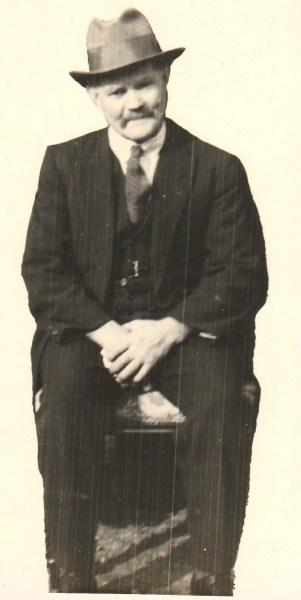
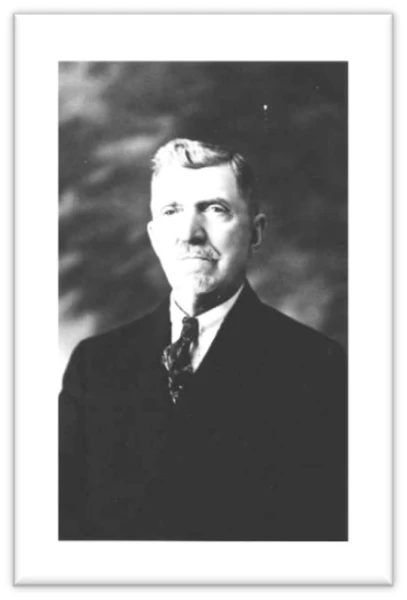
In the late nineteenth and early twentieth century, many enthusiastic young men with entrepreneurial spirits set out to make their fortunes. L.J Jodouin, my maternal; grandfather was among them. It was said that where there was a need he found a way to fulfill it. L.J.’s business ventures were a great success.

Louis Joseph Jodouin was born in 1861 in Montebello, Quebec, the third of five children of Joseph Jodouin and Leocadie Fortin. When he was a young man his family moved to Hull, Quebec where he was schooled by the Christian Brothers and attended college in nearby Ottawa.

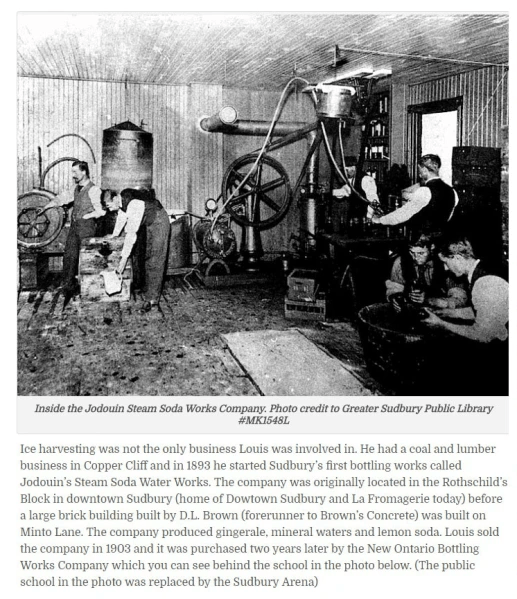
In 1891, at the age of twenty-seven, he went to Sudbury, Ontario where in nearby Copper Cliff prospectors found nickel and mines were being opened. It is there he started his first enterprise, L. J. Jodouin Bottling Works. With six employees he bottled and sold ginger ale, lemon soda, cream soda, and mineral water. Due to the influx of miners, the Sudbury area was a new and growing community, and L.J.’s business was profitable

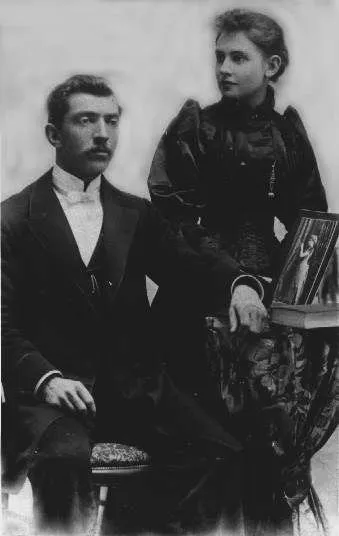
            Louis and Louisa

              1893

With financial security assured the young man decided it was time to seek a bride and start a family. Although the couple had the same grandfather and different grandmothers, they received dispensation and were married in Saint Columbkille Cathedral in Pembroke, Ontario in January of 1893. The young couple settled in Sudbury where they built their home and raised nine children, three boys and six girls.

In 1903 the bottling works were sold to the Taylor and Pringle Company of Owen Sound. His next venture was an ice business. He built a huge icehouse in the rear of his home along with a stable for the horses. At the time people had wooden iceboxes where the top section was lined with metal and large blocks of ice were placed within. Foods that needed to be kept cold were placed on shelves below. Ice was delivered regularly in the same manner as milk and bread from house to house by horse-drawn wagons and later years by truck.

Over the years Louis Joseph had many enterprises. He built a boathouse on Lake Ramsey, a large lake nearby. He rented boats and canoes. He ran a water taxi service and a huge gasoline-powered barge to transport large quantities of building and personal supplies for the people building cottages along the lake. The boat house was also used for storing huge blocks of ice during the winter months.  

The ice business was my grandfather’s lifelong enterprise and the most successful. A key to the success was the annual contracts with both railways. The Canadian Pacific and the Canadian National Railways. This arrangement continued until the mid-1940 when the trains acquired powered refrigeration.

My cousin Madelyn Percival described how Grandfather would spend his days.

  “In the winter months, Grandfather would often go out on Lake Ramsey to oversee the ice operations wearing his long raccoon coat and fur hat and fur mitts, but for the most part, he ran the business from a rocking chair near the dining room window overlooking the backyard where the horses were kept so he could see all the action!”

He was a good employer, and an active citizen, a town councilor, a school trustee, a voluntary fireman, and a member of the Board of Health. He played in the town band, sang in the church choir, and was an avid lacrosse player until he was hit in the head and lost his hearing.

“L.J. bought one of the first motor cars in Sudbury, although he could not drive because of his deafness. His eldest daughter, Alice Percival was the first woman driver in Sudbury and for many years she was his chauffeur.”

            In 1943 on the eve of his seventy-ninth birthday Grandpa Jodouin passed away. His son, Arthur, continued the ice business into the late 1950s and early 60s supplying the many cottagers in the area until electricity became available.

References:

  • Ancestry.com Quebec, Canada Viral and Church Records. Drouin Collection 1921-1968 database online.
  • Sudbury Star newspaper article., Author, Gary Peck. “The Not-so-distant Past, Jodouin Steam Soda Water Works.” October 2, 1981
  • Ancestry.com. Ontario, Canada, Catholic Church Records. Drouin Collection 1802-1967 database online.
  • Archives of Ontario, Toronto, Canada Registration of Marriage, 1869-1928 Series MS032:Reel 70 source ancestry.com and Genealogical Research Library( Brampton, Ontario, Canada Ontario Canada Marriages Ancestry.com Operations In.,2010.
  • Excerpts from an interview with the author and her cousin Madelyn Percival Smith , Louis Joseph’s granddaughter, Toronto Canada, August 2010.
  • Below is a video: cutting ice on Lake Ramsey

This biographical sketch of my maternal grandfather was first published in our book “Beads in a Necklace” published in 2017 by our Genealogy Ensemble group. It seems appropriate to include it in our ongoing blog.

Napoleon Bruneau – A Tragic End

Napoleon Bruneau

Napoleon Bruneau died tragically on a Sunday night in 1916. The La Presse newspaper reported the train accident at Delson Junction on the CPR line but no details were given. This was not far from his home in St-Constant, Quebec. Was he coming home or going to Montreal? What happened? Did he fall on the tracks? He was almost 72 years old so he should have known better than to get in front of a train!

He and his twin sister Mathilde were the 5th and 6th children of Barnabe Bruneau and Sophie Marie Prudhomme. He lived his whole life in St-Constant, south of Montreal. It seems he inherited the family farm after his parent’s deaths. 

Napoleon and his sister Sophie Bruneau

Descriptions of Napoleon included being a farmer, a Free Will Baptist, a veterinarian and a justice of the peace. He was appointed a justice of the peace in 1902 for the district of Montreal which included St-Constant. It is possible he studied to be a veterinarian and didn’t just learn as an apprentice. A school for veterinarians was established in Quebec in 1866 with one of his cousins, Orphyr Bruneau as one of the lecturers. In 1876 courses were also offered in French when the school was under the McGill University Department of Agriculture. The Veterinary school, later associated with The University of Montreal, moved to Oka in 1928 and to its present location in Saint-Hyacinthe in 1947.

One would think that a tall handsome man with many interests and a farm would easily find a wife, so I found it strange that he didn’t marry until he was 66. His brother, Reverand Ismael Bruneau performed the ceremony at his Protestant Church, L’Eglise St Jean Baptiste de Montreal. Napoleon’s wife Emilie Beauchamp was 42 at the time, so it isn’t surprising that they didn’t have children. Emilie was born in Grenville, Quebec, on the Ottawa River. She probably met Napoleon in Montreal where she lived with her parents and sister Lily. Emilie had an uncle who was a French Protestant minister so it is quite possible that they met through the church.

My great-grandfather, Ismael Bruneau was upset with Emilie after Napoleon died as he wrote in a letter to his son Sydney.

You know your Uncle Napoleon made me the heir of all his estate except for $500, which I must give after the death of his widow as follows; $300 to my sister Helene, $100 to my sister Virginie and $100 to my sister Elmire. But his widow has everything during her lifetime. As she is a great deal younger than I, it is almost probable that I shall never enjoy this myself. They say she is already neglecting the house which is going to ruin and according to the law she must maintain it in good condition as it was at the time of the death of her late husband.”

Unfortunately, Ismael didn’t enjoy any of his inheritance as he died two years after Napoleon. Emilie only died in 1951. I don’t know what happened to the property as she married Emilien Frechette in 1929 and he had his own house and farm. Emilien had been married to two other Bruneau women, Emilina Bruneau, Ismael’s sister and and Ida Girod Bruneau Ismael’s wife.

Napoleon was buried in Mount Royal Cemetery with his sister Helene, her husband Celestin Lachance and their daughter Antoinette and not with his twin Mathilde in the Baptist cemetery in Grand Ligne. Emilie isn’t buried with Napoleon or even with Emilien Frechette and his first two wives, rather her final resting place is with her parents in the Beauchamp Cemetery in Marelan in the Laurentians near Grenville.

I haven’t yet found answers to questions about his tragic end.

Notes:

Napoleon Bruneau Obituary: LaPresse January 16, 1916.

Napoleon Bruneau’s death determined to be accidental. The Montreal Gazette, Tuesday, January 25, 1916. Page 7.

when searching for information on the train accident I found another Napoleon Bruneau who was also killed by a train. This accident happened in Huntington, Pennsylvania in 1908. He was decapitated and horribly mangled.

Appointed Justice of the Peace: Montreal Star Monday, June 23, 1902. page 10. Accessed Newspapers.com March 20, 2023.

Letter from Ismael Bruneau to his son Sydney Bruneau. Quebec, February 21, 1917. A copy in the hands of the author.

Emilie Beauchamp burial https://www.findagrave.com/memorial/167478027/emily-esther-beauchamp

accessed November 25, 2023.

Orphyr Bruneau one of Napoleon’s first cousins the son of his father Barnabe’s brother Medard.

There are notarial documents, Quittances which are receipts where Napoleon gave most of his siblings 300 piastres each, beginning two years after his mother died. These dispersals occurred from 1894 to 1904. Some received less and I haven’t found the documents for his sisters Aglae and Sophie. His brother Selene had already died and had no heirs. I am unsure if these were money paid to his siblings because he received the farm.

Three hundred piastres were 300 dollars. This would be the equivalent of over $10,000 today. Quebec used the word piastres on official documents into the 20th century. Even later it was used as a slang equivalent to the English word buck.

Montreal and the Ville Marie Fire of 1734

Update: January 24, 2024

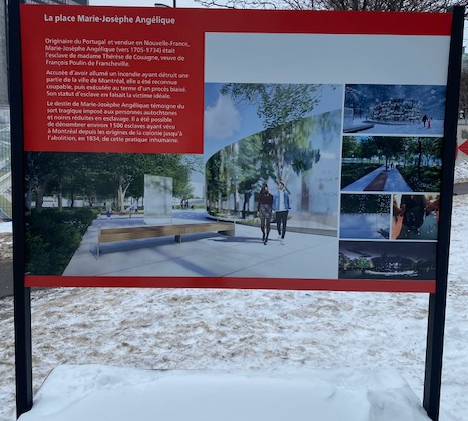
Since this story was originally published, the City of Montreal has added a poster next to Metro Champs de Mars to make it clear that Marie-Josèphe Angélique’s park will be within the Place de Montrealais!

Thanks to Annie for letting me know, and thanks for everyone who made sure that her story is not forgotten!

Original Story

For an hour on the first cold day of the year last month, I wandered around City Hall looking for the memorial park named after an enslaved woman whose torture led to her conviction for arson in 1734. She was then ridiculed, hanged, and her body was burned to ashes and thrown to the wind.

I couldn’t find it.

I’m not sure what happened from the time the park was created in 2012 to today, thirteen-and-a-half years later, but the one-time park still appears on Google Maps. In person, I couldn’t find anything to indicate where it might be.

According to various articles on the web, a green space just west of Champs de Mars métro station honours Marie-Josèphe Angélique’s memory. The official inauguration of the park took place on Aug. 23, International Day for the Remembrance of the Slave Trade and its Abolition, 2012.

As I walked through the area last month, the one-time park seemed to be encompassed in a massive construction site underway for Place des Montréalais, a new public space being created next to the Champ des Mars metro on Viger Street. The posters on site explaining the current project included nothing about Marie-Josèphe Angélique.

Despite being honoured with an award-winning film, a bronze plaque, lilies and a presentation by Governor General Michaelle Jean in 2006, and a public park created by the city of Montreal in 2012, she’s disappeared again.

Before this experience, I was already struggling to see Angélique as the symbol of freedom and resistance she serves for many, but I don’t want her to be forgotten. Did she set the fire or was she a convenient scapegoat? If she didn’t, who did? As I began exploring her story last month as part of a project for NANOWRIMO (the National Novel Writing Month), she served as a reminder of the kind of unnecessary suffering a biased political, policing and justice system can create. Despite the fact that she was a victim of slavery, hatred, spite, racism, class bullying and the worst that a mob could throw at her, her spirit remained strong and unrelenting.

Angélique proclaimed her innocence until the day she was tortured, throughout the court case, and through questioning. Despite that, three weeks after the fire, she was hanged, ridiculed publicly, then burned with her ashes tossed into the wind. Clearly, the authorities at the time wanted her punishment to be seen and remembered.

I read the details about Marie-Josèphe Angélique’s case on Torture and the Truth, a fabulous website set up in 2006 by multiple people, including one of my genealogical mentors, Denyse Beaugrand-Champagne and one of my historian mentors, Dorothy W. Williams. Both of these women have researched, written, spoken and taught many people about the history of Montreal and why studying it is so important.1

The site is one of thirteen different “historical cold cases” established for classrooms across Canada. It was created through the work of six writers, a photographer, an artist, and two translators collaborating with six funding agencies, seven production partners, and 15 archive and museum partners.

It is one of the best historical websites I’ve ever read. If you do nothing other than read through this site, you will get a good overview of the community, the victim arsonist, and life in early Montreal.

As I read about Angélique’s story, she sounded like just the kind of person anyone would like to get rid of. She was a woman who told people she would burn them alive in their homes. She said so to her owner for refusing to grant her freedom, to other slaves for making her work harder than she wanted and to others too. To anyone who slighted her, she threatened the worst thing she could think of. She would burn their homes down.

When 45 houses in her small community did in fact burn down, people blamed her. In retrospect, it may have been an accidental kitchen fire that caused the flames, but her words came back to haunt them all.

The fire began at 7 p.m. on a Saturday evening in spring, April 10, 1734. In only three hours, it destroyed 45 homes and businesses on Rue Saint Paul. Even the Hôtel-Dieu hospital and convent, where people initially took shelter, burned to the ground. Hundreds of people were left in the cold; supplies from many merchants burned, never to be seen again.

Plus, who knows how many caches of fur got wiped out. At that time, Montreal was the centre of the fur trade, more than half of which was illegal trading with the Dutch and English communities in Albany, Boston and other communities to the south. According to a 1942 thesis by Alice Jean Elizabeth Lunn, furs were stored in the backs of shops and even buried just beyond the Montreal wall, which was still under construction at that time, in order to be shipped without being seen by New France authorities. A lot of money went up in smoke that day.2

Everyone in Montreal knew about the fire, given that all the church bells throughout the city began ringing when it started and continued until it was over and people were safe again. Although stone buildings existed at the time, most of the buildings were made of wood; fire could destroy them all.

I had ancestors who lived in Montreal then, the Hurtubise clan on my father’s mothers side. One of them, Jean Hurtubise, the grandson of Étiennette Alton and Marin Hurtubese, was thirty-nine years old, ten years older than Angélique when the fire took place. He and his wife Marie-Jeanne (Marie-Anne ou Marianne) Tessereau had been married for seven years in 1734.

Jean was born in Ville Marie and lived in Montreal for his entire lifetime, so he and his family would have experienced the fire, at least from a distance. They certainly would have seen the ordinance compelling witnesses to appear, given that “it was posted and cried out everywhere in the city and its suburbs.”

Jean and his family farmed a 3×20 arpent property they bought three years earlier from Raphael Beauvais and Elisabeth Turpin on Rue Côte Saint-Antoine.”3 The property was in a part of Montreal that was considered the countryside at that time. Their home was then one of four wood houses on Côte Saint-Antoine in 1731.4

Given that the area was still very rural, and on a major hill, I can’t help but wonder. Did they see the smoke rising into the sky as the hospitals and 45 other buildings in Ville Marie were destroyed?

They certainly had strong links to Ville Marie, particularly the hospital. His grandmother, Etionnette Alton, had died there in her 84th year twelve years earlier. They couldn’t have helped wondering what would happen to others like her, being treated in the hospital that the fire destroyed. Were they among the crowd clamouring for revenge? Did they go to Ville Marie to see Angelique hanged? Did they watch her corpse burning? Did they see her ashes spread into the wind? Did they care at all?

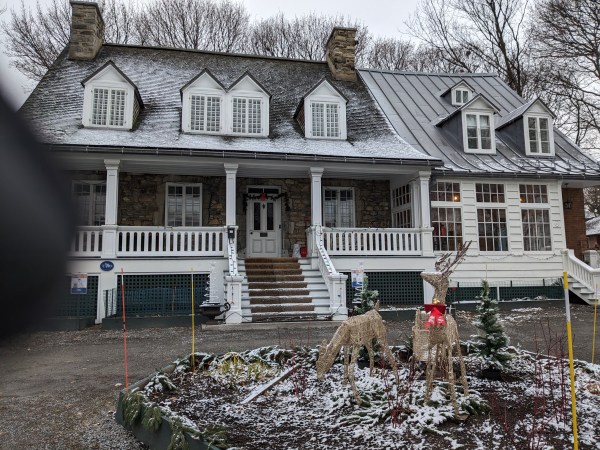
I can’t help but imagine that the controversial hanging effected all 2000 people who lived on the island that year. Five years after Angélique’s death, Jean built Hurtubise House, a storey-and-a-half fieldstone structure on land originally rented by his father in 1699 on Mount Royal. The family built the gabled home out of stone to protect themselves from fire, as required by a law passed the summer after Angelique’s death. You can still visit the home today.5

Sources

1 Beaugrand-Champagne, Denyse, Léon Robichaud, Dorothy W. Williams, Marquise Lepage, and Monique Dauphin, “Torture and Truth: Angélique and the Burning of Montreal,” the Great Unsolved Mysteries in Canadian History Project, 2006, https://www.canadianmysteries.ca/sites/angelique/accueil/indexen.html.

2 Lunn, A. J. E. Economic Development in New France, 1713-1760. McGill University, 1942, https://books.google.ca/books?id=rtcxvwEACAAJ.

3 Roy, Pierre-Georges,, Inventaire des greffes des notaires du Régime français, Québec, R. Lefebvre, Éditeur officiel du Québec, 1942, 28 vol. ; 25-27 cm, Collections de BAnQ.

4 MacKinnon, J. S. The Settlement and Rural Domestic Architecture of Côte Saint-Antoine, 1675-1874. Université de Montréal, 2004. https://books.google.ca/books?id=IEJ4zQEACAAJ.

5 https://hcq-chq.org/the-hurtubise-house/

Working together to help genealogists discover their ancestors