Many French Canadians left the farms of Quebec and migrated to the mills of New England in the mid 1800s. Some worked and then returned home while other like Dolphis Bruneau settled in the United States.
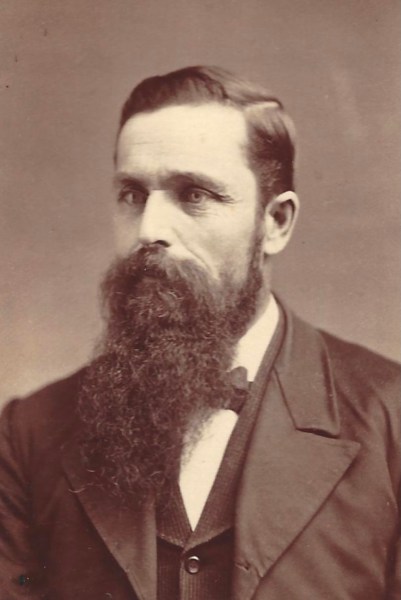
Dolphis was the eldest son of Barnabé Bruneau (1807-1880) and Sophie Marie Prud’homme (1812-1892) my great great grandparents. One would think he would inherit the family farm in Saint Constant, Quebec but he had moved to North Adams, Massachusetts, long before his father’s death.
North Adams, a mill town in Berkshire County, grew at the convergence of two branches of the Hoosic River, which gave the town excellent water power for the developing industries. Dolphis arrived there 1864, at the end of the Civil War. He first lived in a rooming house and worked as an operative, presumably in a mill. At the same time, his younger brothers, Aimé and possibly Napoleon also lived and worked there.
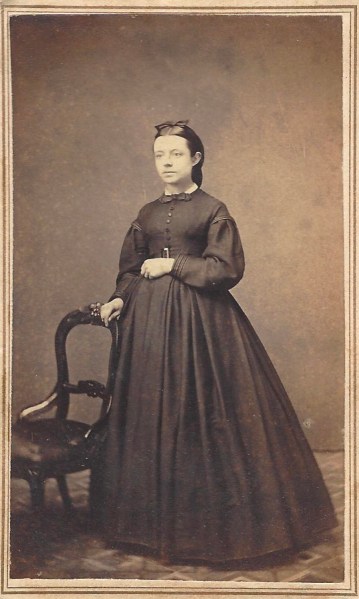
He married Nellie Saunders the daughter of an Irish immigrant Thomas Saunders. She worked in a shoe factory. They started a family with Maude born in 1871 and another daughter Nellie three years later. Tragically, his wife died during that childbirth so Dolphis was left to raise his two daughters alone. He must have had help from Nellie’s family, as he didn’t move back to Quebec like his brother Napoleon and applied for his United States Naturalization Petition in 1895.
Dolphis’ wife Nellie Saunders
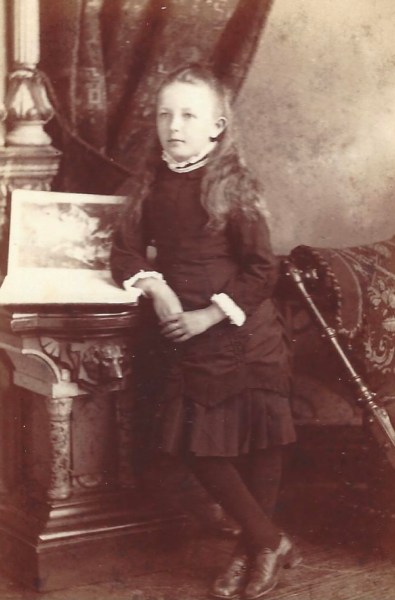
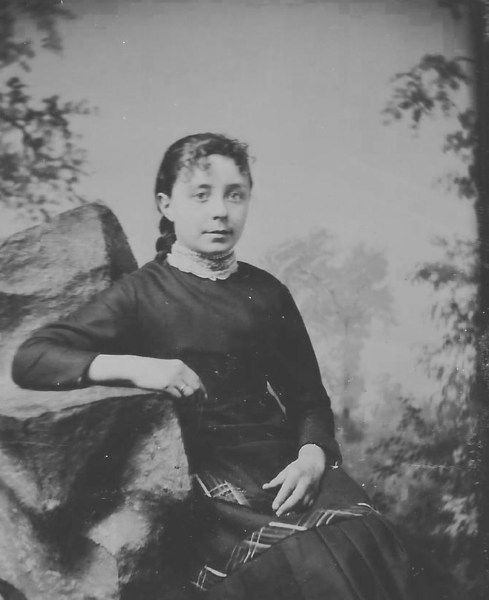
Dolphis continued his quiet life in North Adams. He worked as a carpenter possibly not at a mill but for for a cabinet maker. He kept in contact with his family in Quebec. Some pictures of his growing girls were taken in Montreal so they certainly went north to visit. He didn’t move much as his address, a rental property, is listed as 15 N Holden St for most of his life. His daughters continued to live with him. Maud seems to have kept house and Nellie worked as a bookkeeper.
Nellie BureauMaude Bruneau
Dolphis remarried eleven years after his wife died to a widow, Ester Mary Halse Tingue. Information about his second wife is scant and rather confusing. Ester received a Civil War pension from her first husband and so had some income. The census and city directories show them living apart although listed as married. He lived with his daughters and she lived with her daughter Emma Tingue. Dolphis died in 1909 and Ester in 1924. In her obituary she is refered to as Mrs. Ester T. Bruneau, living at 108 Quincey Street and survived only by Emma. “Her death will bring deep sorrow to her many acquaintances,” it said. Dolphis and Ester were buried in different cemeteries.
The year after her father’s death, Nellie married Arthur Henwood. They moved in with her sister Maud at 15 N Holdon Street. Nellie and Arthur never had any children. Arthur kept a steady job working for James Hunter Machinery as a machinist. His draft registration cards for both WWI and WWII showed him working at the same company. Nellie continued to work as a bookkeeper and Maude continued to keep house. Both sisters had a close involvement with the First Baptist Church.
Maude never married and after her sister’s death in 1939, she and her brother-in-law continued to live together for the next twenty plus years, still at 15 N Holden Street. Arthur died in 1960 and Maude then moved to the Sweet Brook Nursing Home in Williamstown, Massachusetts where she died two years later. Maude’s death ended the Bruneau line in North Adams although most of the family are buried in Maple Street Cemetery.
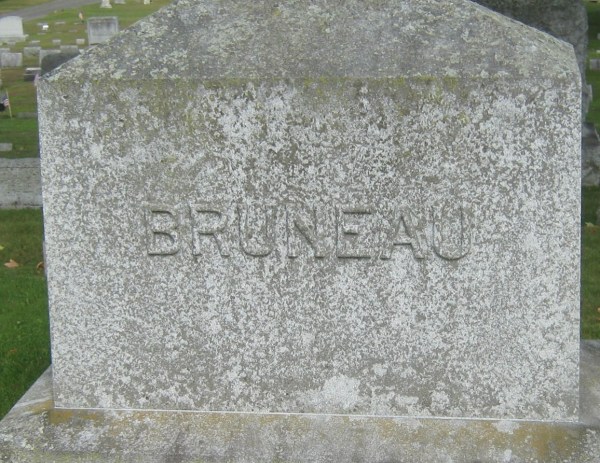
Bruneau Family Tombstone North Adams, MA
Notes:
Dolphis BruneauMassachusetts, U.S., Death Records, 1841-1915 [database on-line]. Provo, UT, USA: Ancestry.com Operations, Inc., 2013. Original data:Massachusetts Vital Records, 1840–1911. New England Historic Genealogical Society, Boston, Massachusetts.Massachusetts Vital Records, 1911–1915. New England Historic Genealogical Society, Boston, Massachusetts. Accesses March 15, 2022.
Dolphis Bruneau – Massachusetts, U.S., State and Federal Naturalization Records, 1798-1950 [database on-line] NAI Number: 4752894; Record Group Title: Records of the Immigration and Naturalization Service, 1787-2004; Record Group Number: R G 85. Provo, UT, USA: Ancestry.com Operations, Inc., 2011. Accessed Mar 12, 2022.
Nellie Bruneau Henwood Obituary.The North Adams Transcript (North Adams, Massachusetts) December 27,1939, Page 3. Accessed on Newspapers.com Mar 27, 2022.
Maude L Bruneau Obituary. North Adams Transcript (North Adams, Massachusetts) March 17, 1962, Page 3. Accessed on Newspapers.com Mar 23, 2022.
Mrs Ester T Bruneau Obituary. North Adams Transcript (North Adams, Massachusetts) Dec 19, 1924, page 14. Accessed on Newspapers.com Mar 30, 2022.
1900 Census: North Adams Ward 3, Berkshire, Massachusetts;Roll:632;Page:7;Enumeration District:0051;FHL microfilm:1240632Ancestry.com.1900 United States Federal Census[database on-line]. Provo, UT, USA: Ancestry.com Operations Inc, 2004. Original data: United States of America, Bureau of the Census. Twelfth Census of the United States, 1900. Washington, D.C.: National Archives and Records Administration, 1900. T623, 1854 rolls. Accessed Mar 2, 2022.
Arthur Henwood: Draft Card H. Registration State:Massachusetts; Registration County: Berkshire Source Information Ancestry.com. U.S., World War I Draft Registration Cards, 1917-1918.Imaged from Family History Library microfilm M1509, 4,582 rolls. Provo, UT, USA: Ancestry.com Operations Inc, 2005. Accessed April 5, 2022.
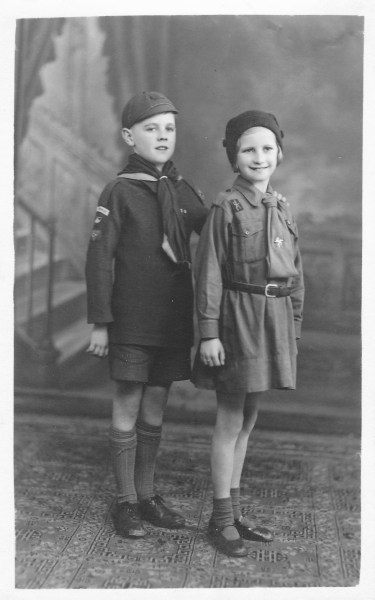
My Mum and her brother, Kenny c. 1932 my Mum would have been about 9 and Kenny 11 years old.
Two years into Uncle Ken’s apprenticeship, his life takes another turn…
A few days before Christmas, a neighbour visited Granny and saw her putting Holly branches around the fireplace and remarked “You should not put up Holly, it means a death in the family’ Gran chose to ignore this ‘old wives tale’
The United Kingdom declared war on Germany on the 3rd of September 1939, after Germany invaded Poland. France also declared war on Germany later the same day. The state of war was announced to the British public in an 11 am radio broadcast by Prime Minister Neville Chamberlain. (1)
Most of the country was in shock. Kenny as my grandparents always called him, was 17 years old that July 31st, and I have no doubt that he would have signed up as soon as he was 18 years old.
On about the 20th of December, Kenny complained of a tummy ache, so he stayed home from work. The pain got progressively worse, so the family doctor was called in. This was before the National Health Service was formed in 1948, so all house calls were to be paid in cash.
Because Kenny was feeling so poorly, Granny put a stool next to his bed, piled it up with books and put his food and drink on it, so it was eye level and easy to reach.
When the doctor arrived he examined Kenny and said it was nothing just an upset tummy. My Mum also had the same stomach pains so the doctor thought it was this. Days later, he worsened and the doctor was called in again.
By this time, my gramps was very worried and asked for him to be taken to the hospital as the pain was getting worse, but the doctor refused to admit him saying” With all those books piled up next to him, he can’t be that ill’
The next day, 23rd December and again, Gramps called the doctor in. This time he examined my Mum and left some mixture for her to take. Mum told me, that she refused to take it, because he had a strong foreign accent, and she was certain he was a ‘spy’ and the mixture was poison! Kenny worsened on the 23rd of December.
My mum remembers her parents and neighbours at his bedside, whispering ‘Is he still breathing?” Get a mirror and hold it up to his mouth’ Mum was in the bedroom next door worrying and in pain herself. Kenny died that evening. He was 17 years old.
Once again, the doctor was called and Gran and Gramps made him examine Mum at the same time. She was admitted to the hospital immediately with the same symptoms as Kenny had.
She had appendicitis and was operated on that day, and she recovered. Kenny meanwhile was autopsied. They discovered he had peritonitis. A ruptured appendix spreads infection throughout the abdomen. it requires immediate surgery to remove the appendix and clean the abdominal cavity or death occurs.
Mum was lucky her appendix had not yet burst. Kenny was not. My Granny and Gramps were so upset they tried to sue the doctor. I read Gramps’ diary of these events leading up to Uncle Ken’s death and wept.
My Gramps was not successful in suing the doctor although he tried very hard. Granny told me of her visiting the cemetery after Kenny’s burial and sitting on his gravesite and weeping, every day.
Plymouth was one of the most heavily bombed British cities during World War Two. The first bombs fell on the city on 6 July 1940, with the heaviest period of bombing occurring in March and April 1941. (2)
Many years later when she related this sad family history to me, we were at the cemetery visiting Uncle Ken’s grave. I noticed a large chip in the granite headstone and pointed it out to Granny. ‘Oh, yes” she replied, “I remember that!” She continued, “One day when I was visiting the cemetery, sitting on the edge of the grave, when the air raid sirens went off. I just carried on weeping and shouting to the sky ‘Take me now! I don’t care!” when a large piece of shrapnel hit the side of the headstone!
I asked her if she was afraid but she said ‘Not in the least!” and told me, that she continued to sit there and cry and shout, all whilst the air raid roared and blazed around her. I think this was her expressing her grief in a most dramatic but cathartic way, and was probably a good thing to do.
Grief can drastically alter a person’s attitude to life and I know families who lose a child never really recover from the shock.My grandparents, whilst not always talking about Kenny, did answer my questions and let me look through all his sketches and drawings they had.
My Mum was affected by her brothers’ death. Her parents were strict she said, timing her outings and expecting her home at a certain time, if she was spotted talking to boys she was called into the house.
She was constantly “kept an eye on” not allowed much freedom, or chance to meet people, and consequently, married far too young and too fast. However, I believe that they were afraid that they would lose her too, especially during the war years with constant bombs and air raids.
When her brother died and Mum’s infant son, my baby brother Christopher, died at three days old and she thought they were ‘cursed’ I must admit when my own son was born, the thought did cross my mind that the boys of the family did not live for long….. but I quickly quelled that thought! (3)
Today, my two ‘boys’ are healthy happy men and I am grateful.
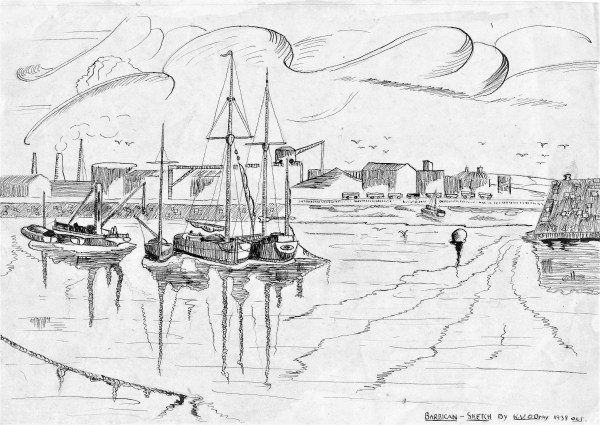
October 1938. A sketch by Uncle Kenny of the Barbican where the Pilgrim Fathers sailed for America on the 16th September 1620
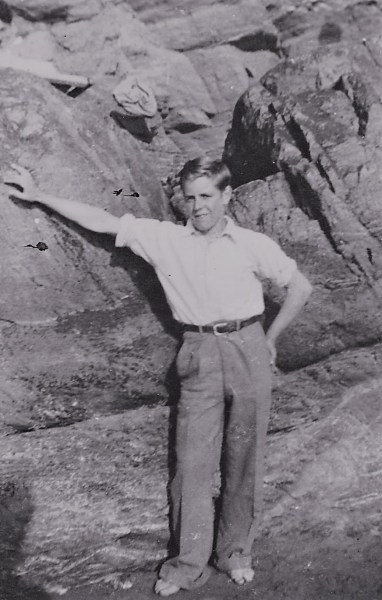
August 1939, This was taken four months before Uncle Kenny died. He is 17 years old, and it was taken at the Whitsands Beach, near Plymouth Devon.
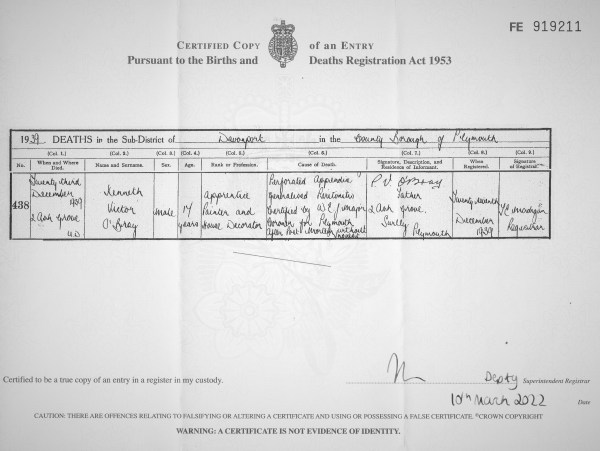
The above photo was the one that I always remember, it is hung on the wall when I lived with my grandparents and is still there today. Below is Kenny’s Death certificate. The cause of death reads: “Perforated appendix generalised peritonitis Certified by W. E. J. Major Coroner for Plymouth after post mortem without inquest”. Because there was no inquest, I believe this is why my grandparents decided to try and sue the doctor. There should have been an inquest, so they could express their outrage, grief and sorrow at the behaviour of the doctor.
A few days ago I received an email from HM Coroner’s Office in Plymouth Devon. I had inquired about obtaining the Post Mortem report.
OFFICIAL: SENSITIVE
Good Afternoon
Thank you for your email and for updating the information provided.
I have made enquiries with our archivists and unfortunately, they do not hold any Post Mortems reports for 1939. Unfortunately, we are unable to assist with your enquiry any further.
Kind regards
Debbie, HM Coroners Office1 Derriford Park, Derriford Business Park Plymouth PL6 5QZ
I had hoped to obtain them to add to this story. It was not to be. Perhaps, in the future, I may be luckier. I am sure they are held, just not digitized yet.
A Brief Note on Holly Beliefs in the West Country of Devon, England.
“It was always considered terribly unlucky to bring holly into the house before Christmas Eve and even more so to leave it in the home after Candlemas Eve (1st February)“.
The McHugh brothers were just in their early twenties when they left County Sligo, Ireland to try their luck in Dundee, Scotland.1 When John and Edward McHugh arrived in Dundee, they had lodgings on Scourin Burn. Edward was a tinsmith and John, my 2X great-grandfather, was a sailcloth weaver. 2 A burn is a watercourse and the name Scourin Burn, or ‘cleansing burn’ probably referred to the process of scouring (textile term for cleaning the yarn) the yarn before dyeing as the nearby jute factories used the burn for this purpose. Scourin Burn no longer exists in modern Dundee and is now called Brook Street.3
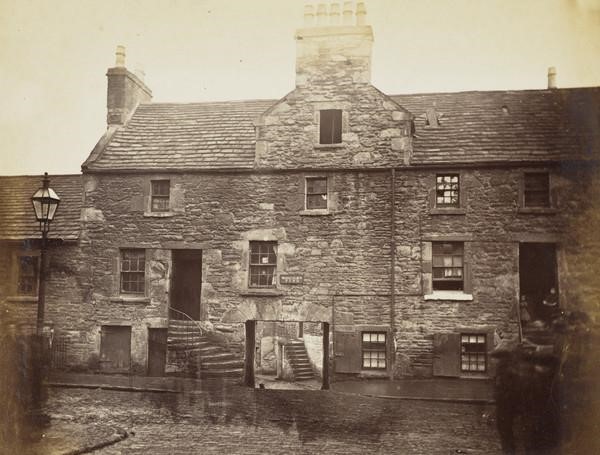
Malcolm’s Pend, from the Scouringburn, Dundee, Photograph James Valentine (1815-1879), created 1877, Courtesy Scottish National Portrait Gallery, no copyright infringement intended
The McHugh brothers were part of a wave of Irish immigrants to Dundee, a city with a thriving jute industry, which had earned the nickname “Juteopolis.” By 1850 there were 47 spinning mills and eight power-loom factories employing some 11,000 people, as well as 4,000 handlooms. Linen goods, especially canvas, were exported to the Mediterranean, Australia, America, and the West Indies.4 Jute was a versatile fabric and used for everything, including the ropes made by the British Navy, sacking, tents, gun covers, sand bags, and horse blankets.5
Work in the mills was grim with the workday lasting twelve hours, from 6:00 a.m. to 6 p.m., with additional shifts on Saturday. It was not unusual for workers to bring sacks home to sew at night. 6 Three quarters of the workers were women and children, who could be employed at cheaper rates than the men. Injuries and accidents were commonplace. Dust would be everywhere and the machinery produced heat, grease and oil fumes, leading to a condition that was known as “mill fever.” The constant noise of the machinery led to many workers going deaf. 7 The booming jute industry provided plenty of work, but there was a shortage of housing due to the large influx immigrants. Wages remained low. Overcrowding meant that many migrants boarded with other families in cramped rooms.8
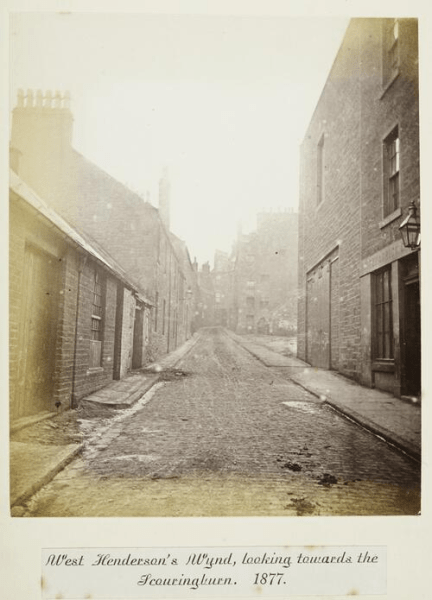
John settled in Dundee and married Mary Garrick, also from Ireland, in 1845. They both worked in the jute factories. It is no surprise that John and Mary raised their family close to the jute mills. In 1861 they still lived very close to Scourin Burn, in Henderson’s Wynd.9
West Henderson’s Wynd, looking towards the Scouringburn [Dundee]. 1877, James Valentine Photographic Collection, Courtesy of the University of St Andrews Libraries and Museums, ID: VGA-122-40a
John and his family lived in tenement housing all their lives. Tenement housing was hastily built to accommodate the rapid growth of the city due to the influx of workers. The construction quality was poor and the living spaces were small. It was not uncommon for families to share flats. As it was not profitable for landlords to build brand new affordable housing for the workers, pre-existing tenements were subdivided into smaller rooms, making living space even more crowded.10
“In 1861 with 91,664 inhabitants Dundee had only five WCs, and three of them were in hotels. All water in the city was drawn from wells of which the chief, the Lady Well, was heavily polluted by the slaughterhouse. Of the total housing stock of Scotland 1% had no windows, which meant that 8,000 families were without access to natural light. “11
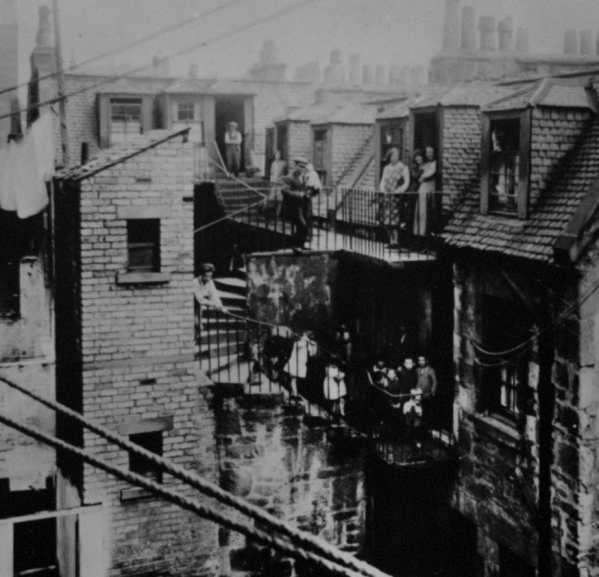
Tour Scotland website, no copyright infringement intended
In the photograph of the tenement above, people are gathered on the outside staircase and the platforms or “platties.” Outside staircases were a way of saving space inside the building. In the photo, you can see how tiny each of the flats are.
In the 1800s, several cholera epidemics swept Dundee. Poor sanitary conditions were a direct cause of these epidemics. Dundee was a crowded and smelly city and, as in the above photograph, toilets were outside the flats and shared by many families living in the same tenement block. There were very few public facilities available for bathing. Disease was everywhere and it was believed that foul smells carried the disease. Inadequate sewerage and drainage facilities, and poor water supplies contributed to the increasing unsanitary conditions in Dundee and with its rapidly growing population.12
By the early 20th century, housing in Dundee continued to be problematic. Even though houses without windows had disappeared by 1881, overcrowding continued to be a problem. The 1911 census reveals that 72% of Dundonians lived in crowded conditions, in a one or two roomed home. Only 32% of the population of London lived in a one or two roomed home.13 In 1911, my grandparents had seven children and were living in a two roomed flat in Dundee.
My McHugh ancestors lived in Dundee about 72 years, from around 1840 to 1912. During their time in Dundee, every member of the family worked in the jute factories. In 1912, they emigrated to Canada and found jobs in other industries.
Death of brother Thomas McHugh in Sligo, Ireland, 1871. Deduced from Ancestry public member tree. To date, this cannot be confirmed.
1841 Census, Scotland, Scotland’s People, entry for John McHugh, National Records of Scotland, referenced January 2, 2021.
In 1984, at the age of 35, Harold Rosenberg discovered he had been adopted. Fourteen years later, he found out who his birth mother was – or so he thought. Today, he is still searching for his roots.
His adoptive parents never told him he was not their natural child, and both were already deceased when he learned the truth. His cousin Dinah, who was almost a generation older than him, could only recall that a Mrs. Baker, a matchmaker in Montreal’s large Jewish community, had done Harold’s adoptive father a favour and found the baby. The Rosenbergs had paid Mrs. Baker $1800 to make the arrangements.
Harold Rosenberg, age 8, in 1957.
Harold, who is my husband, tried to find out more, but there were no official records of his adoption and even the record of his birth kept by the synagogue was fake. He followed many false leads and ran into brick walls everywhere he turned.
In 1998, he opened The Gazette to see a front-page article about a group of women who had gathered in Montreal to search for their roots. All had been adopted into Jewish families, most eventually discovered that their birth mothers had been Catholic.
The article described a black-market baby ring that operated in Montreal in the late 1940s and early 1950s, trafficking about 1,000 babies to adoptive parents in Canada and the United States. A small group of doctors, lawyers and various intermediaries arranged these adoptions for childless Jewish couples who could not find babies through regular adoption channels. At the time, it was illegal in Quebec to adopt a child from another religion, and, while there were no Jewish babies available, there were lots of Catholic ones. Most of these babies were delivered at a handful of private maternity clinics in Montreal. The money went to the doctors and the people who arranged the adoptions, or who turned a blind eye to the transfer of small bundles. The mothers were not paid, but they were able to stay for free at the clinics during their last weeks of pregnancy, and they did not have to worry about medical costs.
When the ring was busted in 1954, The Gazette reported, several lawyers and a woman named Rachel Baker were arrested. Suddenly, Harold realized that Mrs. Baker did not just find a baby for his parents, she arranged for many under-the-table adoptions.
Years later, his cousin Moe told Harold that he had seen a tiny hospital bracelet with the name “baby Boyko” in the Rosenbergs’ safe deposit box, and he recalled that a girl named Mary Boyko had lived in his neighbourhood. Harold checked a list that a volunteer researcher had made of single mothers who gave birth in the late 1940s, and there was the name: Mary Boyko. She must have been his birth mother!
Harold asked a friend, a retired police detective, to look for her. It was a challenge because Mary had married someone named Tremblay, and Tremblay is one of the most common family names in Quebec. Nevertheless, three days later, the friend phoned to say that he had found her. Unfortunately, she was deceased, but he had tracked down her husband and her son. They said they had been looking for Mary’s baby for years, and they couldn’t wait to meet him.
Harold became good friends with his new-found half-brother, Sonny Tremblay. All the pieces seemed to fit, except for a few minor details. Meanwhile, he became an unofficial spokesperson for black market babies, participating in television documentaries in English and in French, and being interviewed for newspaper and magazine articles. He hoped to help other adoptees, as well as their birth mothers, learn the truth.
Harold in 2022
In 2020, our sons persuaded Harold to try to find his birth father. He did a DNA test, and he asked Sonny to do one also. Everyone was shocked when the results came back – they were not related! Just to be sure, Sonny’s cousin also took a DNA test, and it confirmed that the cousin is related to Sonny, but not to Harold. He then hired genetic genealogist Mary Eberle, of DNA Hunters, to help him make sense of his DNA results. He had many matches, but no one closer than a third or fourth cousin. Clearly, Harold is of Eastern European descent, and his birth father was probably Ukrainian. Many of his matches on his father’s side live around Cleveland, Ohio, an area where many Eastern Europeans settled.
Recently, he made a big break-through and got in touch with Lynne, a woman in Cleveland with whom he shares a whopping eight percent of his DNA. She is probably a first or second cousin and has been delighted to help out. Harold is still not sure who his birth father was, but at least he now has a genuine, close genetic cousin.
As for the identity of his birth mother, that remains a mystery. Was Harold really born at a Montreal hospital, as his cousin told him? And what should he now make of the story of the baby bracelet and the name Boyko? Hopefully, he will find out some day soon.
CTV News Montreal, “Special Report: Black Market Baby”, Dec 18, 2017, https://montreal.ctvnews.ca/video?clipId=318300 This interview was done when Harold mistakenly believed that Mary Boyko was his birth mother. I have included it here anyway because it includes more background on the black-market baby ring.
From pastry dough based on 3 cups flour, roll out four 10” rounds. Place on baking sheet, or backs of 9” cake tins. Fold under 1/2 inch around edges. Flute. Prick well. Bake in hot oven 475 degrees….
It’s been over 50 years since I’ve typed the above words in that exact order from a recipe for a gunky (but delish) 60’s confection, 51 years to be exact. Now, I’m doing it again, as an exercise in memory.
In 1971, when I was in 10th grade at high school, I helped my mother type out her favourite recipes onto file cards, many of which I still have – and treasure – today.
I found them again in 2009, in a hidden drawer in a Chinese cabinet, shortly before my mother’s passing.
My mother, a bilingual legal secretary, could type up a storm in both English and French and I was just learning to type, but she left me to perform the honours for some reason, hence all the typos and misspellings. 3 ripe bababas, lemong, seperate the eggs.
Today, half a century later, as I meditate on these yellowed, oil-stained recipe cards and their deeper meaning, I realize that this may well have been the only sustained project my Mother and I ever worked on together.
My mother was a doer, not a teacher and her only creative outlet (outside of coordinating her work outfits) came in the kitchen and at the bridge table. She didn’t have much patience, any patience for that matter, so she commandeered the kitchen using me only to convert fractions as she doubled and tripled the recipes and to sift the mountains of flour for her classic cakes. I sometimes helped her stir the various batters with our little yellow Mixmaster with the motor that smelled of burning plastic as it heroically whizzed away. For this reason I still can’t make a pie crust – even after watching my mother ply so many apple pies right in front of me, but who bakes any more, anyway?
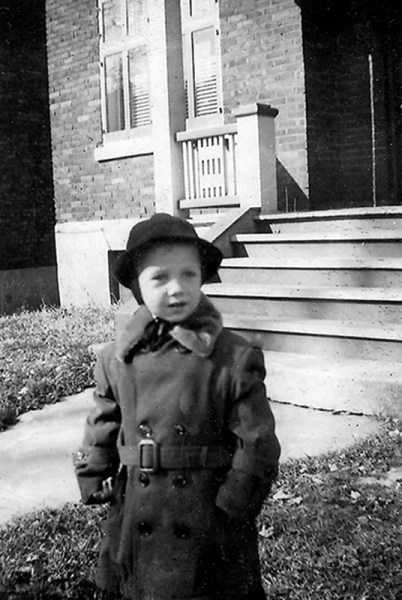
My Aunt Flo, me and my brother and my mother at Old Orchard Beach 1962 ish. My nickname was “Stringbean” or “SkinnyHymer” so all that Cafe Bavarian (my fave dessert from the inside of a Carnation Milk label) didn’t hurt me.
My mother , Marie-Marthe Crepeau Nixon was a terrific cook, at least that is how I remember it.
But reading the recipes on these battle-scarred cards I realize these are mostly very simple back- of -the -magazine recipes, using products advertised within the pages like Fry’s Chocolate or Hunt’s tomato sauce and in the case of the above 4 Decker trifle-style dessert, Delmonte fruit cocktail.
I also realize, now, fifty years later, that I didn’t like some of these recipes. The chicken mole was too authentic using unsweetened chocolate. The tokay grape aspic or gelatin mould, so trendy at mid-century, well, what can I say. Yuk.
I sort of liked the hot tomales, except the sauce was too hot for my immature taste buds. All that tobasco.
But most of these recipes I remember as rib-tickling: a simple lasagna (you could use “real” swiss instead of mozzarella) that only had one herb, rosemary. It called for two teaspoons of olive oil, but I suspect my mother used Mazola. The beef stroganoff (another 60’s favourite) called for one cup of white wine. My parents never had wine in the house, so I doubt my mom added that ingredient.
My mother’s go-to meals are not on the cards I still have: her fabulous Italian spaghetti that when cooled had at least an inch of fat on top and her equally hearty chili con carne, from which I would pick out all the mushrooms before it hit the table. (She fried the hamburger first for the chili. She put the raw beef into the simmering sauce for the spaghetti.) Her southern fried chicken put the Colonel to shame. It attracted the neighbourhood kids to many a picnic on our back porch.
I even adored her calf’s liver and onions, ‘as delicious as steak’ she said, and it was.
My mother’s only heirloom recipe in her writing for turkey stuffy from her mom. A real cholesterol bomb. One pound of sausage meat and 1/2 pound of butter.
Yes, I remember my mother for being a fabulous cook, despite the fact she obviously didn’t come to her marriage at 30 armed with years of experience and a file folder filled with secret family recipes. She looked to Redbook and Ladies Home Journal for ideas, just like many other new ‘housewives’ of the era.
My mother was born in 1921, to middle-aged parents who, by that time, were very well off. She went to a fancy boarding school nearby, learning Greek and Latin but probably not domestic science. I doubt she lifted a finger when at home.
Her unschooled older sisters who who had known leaner times were the ones who helped out at home. In her twenties, my mother lived with her widowed mom (famous for her fatty tortiere and savory baked beans) and two sisters on Oxford in the Notre Dame de Grace section of Montreal, one of whom, Cecile, is listed as ‘housekeeper’ on the Voting Register. My mother was working as a ‘stenographer’ for a movie distribution company down the street, RKO, so she likely helped support the family.
Yes, my mother was a great cook (I seem to remember) but one lousy home economist, but what could you expect from a “daddy’s girl” who, by her own admission, was always exceeding her allowance at boarding school.
If there was a more expensive way of making something, my mother would find it. She would buy Kraft dinner for the macaroni and discard the little aluminum packets of processed cheese product, adding her own fresh cheeses and herbs and spices. The metallic packets piled up 40 high in our pantry.
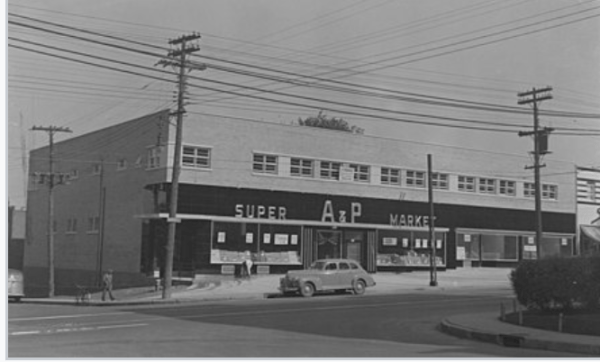
The A and P on Queen Mary and Earnscliffe, Snowdon. BANQ. In 1960 there was a bowling alley over top. My mother loved to bowl but I don’t remember every going there.
I recall 1964, when we would go grocery shopping at the A& P on Queen Mary at Earnscliffe. It was an old-fashioned (see dingy) store, opened 22 years before, with wooden floors covered in sawdust to soak up the slimy spillages; the pleasant aroma of their famed Eight O’clock coffee; grey display counters filled with 1960’s staple vegetables, like iceberg lettuce and broccoli, (my mom would soak broccoli and cauliflower in salt water to get any bugs out) big baskets of juicy peaches, but only for a few weeks in late summer, and all the 20th century commercial brands that made America great.
My mother would fill to heaping two shopping carts with food. The cashier would often ask, “Are those BOTH yours?” I seem to recall the bill coming to a whopping 60 dollars. We were only a family of five. 1
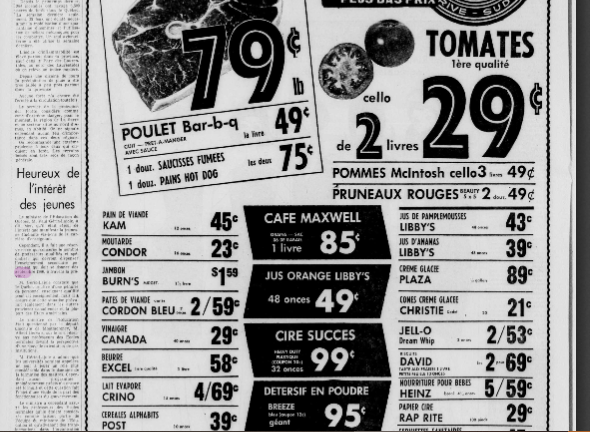
Prices in 1962 in Quebec City from Le Soleil newspaper BANQ. My mother’s coffee was instant Maxwell House with Carnation Milk. I made a bazillion cups for her.
What made my mother’s food so tasty and so memorable? Was it the simple ingredients? Was it the fact that she never overcooked the high quality meats she purchased from Queen Mary Provisions, a specialty store? Was it the Hollandaise or white sauce that always topped the lightly steamed veggies we ate?
Maybe her meals were so satisfying because she had no fear of cholesterol and didn’t skimp on the seasoning and, truth be told, didn’t hesitate to add cascades of Accent to any soup or stew.
Or maybe, there’s another reason. Maybe her meals are so memorable because cooking for her family was the only positive way my mother, who was bright as hell, frustrated with her domestic life, and bipolar, expressed her love for us. Oh, yea. That last one. That’s clearly the reason I treasure these scruffy little yellow recipe cards from over 50 years ago.
I did the research and according to Statistics Canada historical 60 dollars every two weeks was the average amount spent by families every two weeks in Canadian cities.
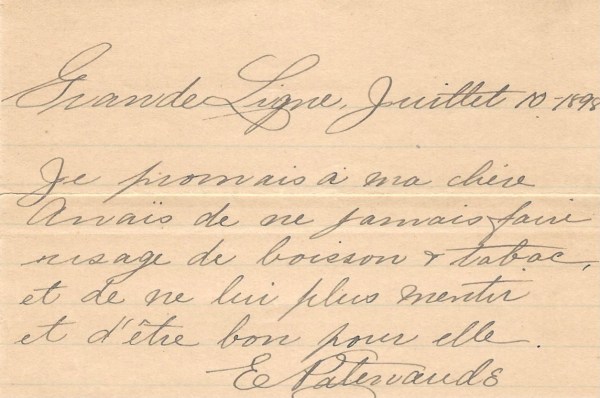
I promise to my dear Anais never to use alcohol or tobacco
and not to lie to her anymore and to be good to her.
E Patenaude”
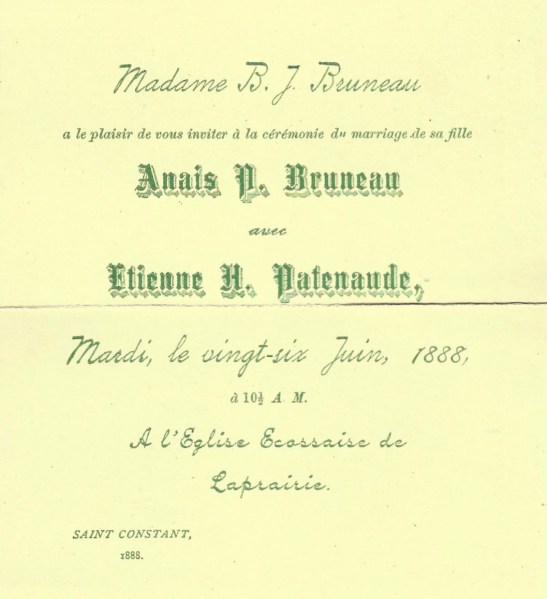
This note found in a box of Bruneau family pictures, along with an invitation to Anais Bruneau and Etienne Patenaude’s wedding made me wonder. At first I thought it was a promise made before they married but then realized the date was ten years later. What had Etienne done?
Anais, the sister of my great grandfather Ismael Bruneau was the youngest of 13 children of my two times great grandparents, Barnabé Bruneau and Sophie Marie Prud’homme. She appeared to be my great grandfather Ismael’s favourite and only three years his junior. He wrote many letters to Anais and some survived but none of her replies. He traveled for his studies and his ministry while she remained close to home in Saint Constant helping their parents. When Ismael was ministering in Kankakee, Illinois, he wrote that he wanted her to meet his beautiful soon-to-be wife. He asked her to come and visit and said that he would find her a tall strong farmer for a husband. As far as I know, Anais never visited and she found her own husband.
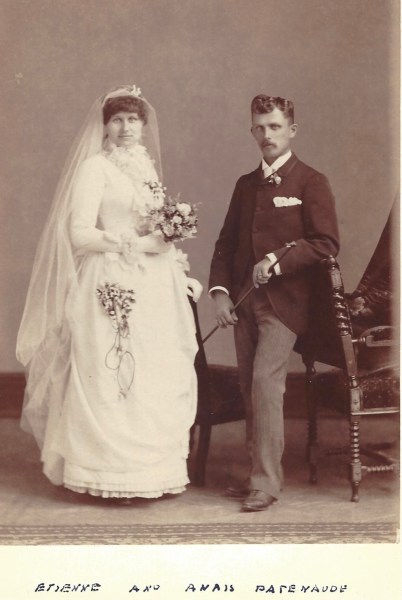
Anais married Etienne Hilaire Patenaude on a Thursday at ten and a half in the morning in L’Eglise Ecossaise in Laprarie, Quebec. I thought it was a strange day and time for a wedding but Anais dressed the part of a bride in a fancy white dress and veil with a bouquet of flowers as their wedding photograph shows. She was 33 and Etienne only 27.
They seemed to live a quiet life on a farm south of Montreal. They had no children. Her mother lived with them for a time after their marriage and most likely until her death. Anais was the good daughter and following her brother’s instructions, continued to look after her mother after her father died. Although Anais had seven sisters only she remained near St-Constant.
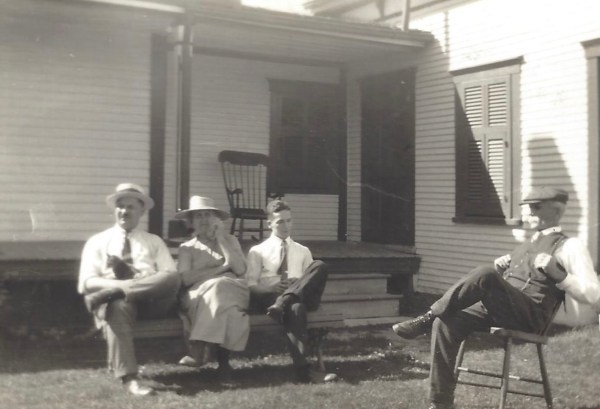
Nephews Edgar & Gerald Bruneau with Anais & Etienne in Grande Ligne
Etienne died in 1931 and Anais a year later at 77 years old. They are both buried in the cemetery at St Blaise Baptist Church in Grande Ligne showing they led a religious life. This church was associated with the Feller Institute, founded by Henrietta Feller a Swiss missionary who came to convert the native population but had greater success with the French Catholics. Madame Feller and her partner Louis Roussy were responsible for the conversion of Anais’ parents. Etienne’s parents were also Baptists.
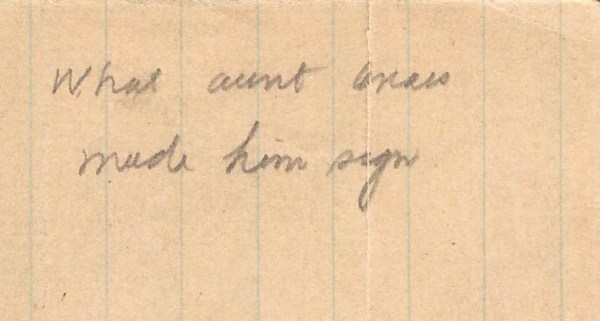
What did Etienne do to have him write this promise? They were both French Baptists and involved in the Mission at Grande Ligne where sobriety would be expected. Did he go off and drink, smoke and lie about it? Who saved this paper and how did it come to me? On the back is written, “What Aunt Anais made him sign.” So, according to family lore, it wasn’t his choice to make this declaration.
Notes:
Note by Etienne Patenaude translated by author.
Ancestry.com. 1921 Census of Canada[database on-line]. Provo, UT, USA: Ancestry.com Operations Inc, 2013. Original data:Library and Archives Canada. Sixth Census of Canada, 1921. Ottawa, Ontario, Canada: Library and Archives Canada, 2013. Series RG31. Statistics Canada Fonds.Images are reproduced with the permission of Library and Archives Canada.
Ancestry.com. 1901 Census of Canada[database on-line]. Lehi, UT, USA: Ancestry.com Operations Inc, 2006. Original data:Library and Archives Canada. Census of Canada, 1901. Ottawa, Ontario, Canada: Library and Archives Canada, 2004. http://www.bac-lac.gc.ca/eng/census/1901/Pages/about-census.aspxl. Series RG31-C-1. Statistics Canada Fonds. Microfilm reels: T-6428 to T-6556.Images are reproduced with the permission of Library and Archives Canada.
Ancestry.com. 1891 Census of Canada[database on-line]. Provo, UT, USA: Ancestry.com Operations Inc, 2008. Original data:Library and Archives Canada. Census of Canada, 1891. Ottawa, Ontario, Canada: Library and Archives Canada, 2009. http://www.bac-lac.gc.ca/eng/census/1891/Pages/about-census.aspx. Series RG31-C-1. Statistics Canada Fonds. Microfilm reels: T-6290 to T-6427.
Ancestry.com. Quebec, Canada, Vital and Church Records (Drouin Collection), 1621-1968 [database on-line]. Lehi, UT, USA: Ancestry.com Operations, Inc., 2008. Original data:Gabriel Drouin, comp. Drouin Collection. Montreal, Quebec, Canada: Institut Généalogique Drouin.
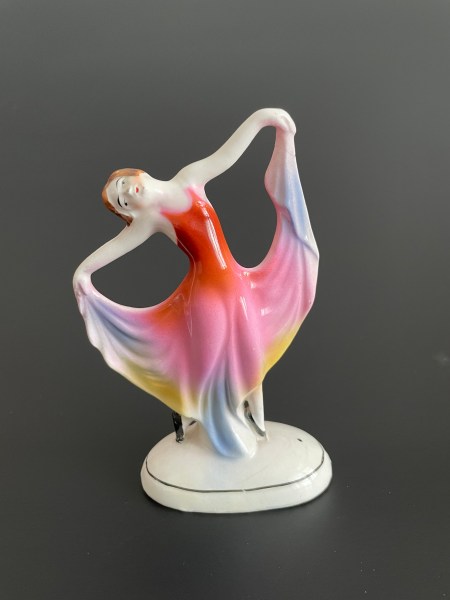
Noun: ornament; plural noun: ornaments A thing used to make something look more attractive but usually has no practical purpose, especially a small object such as a figurine Noun: figurine, plural noun: figurines statuette, especially one of a human form. The photo above is the ornament.
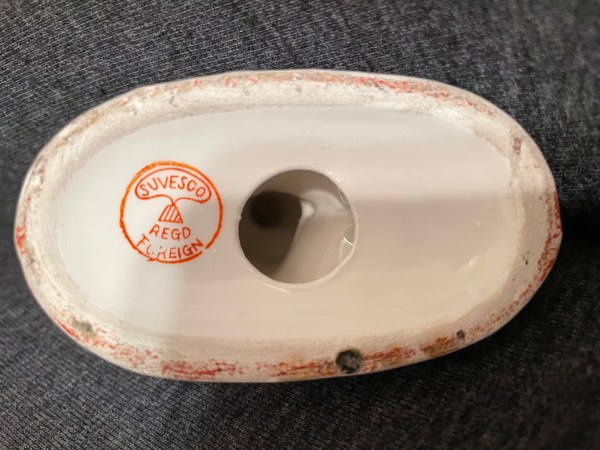
The underside is printed “Suvesco Foreign”
Granny always called it Ken’s ‘ornament’ so, for the purpose of this story, ornament it is.
Further searching tells me it was made in Japan in the 1930s and is in the style of ‘Art Deco’ (1)
When I lived with Granny and Gramps in the late 1950s there was not much colour around her house or indeed anywhere. We were still rebuilding our city after WW2 and things were still rather bleak.
However, I do remember in Granny and Gramps’ bedroom, on the shelf above the fireplace, a small lady holding out her colourful skirts, with her head on the side, she was the only bit of colour in the house. I often admired the pretty pastel colours and ‘the ladies’ pose.
Many years later, when I was visiting Granny, she must have been in her late 90’s, she took it from her cabinet and gave it to me! She said, that she knew how much I had admired it whilst I lived with her and she knew I would appreciate it. She was right! I was thrilled!
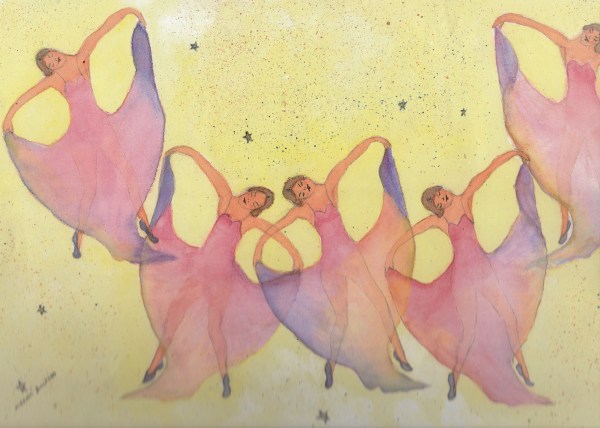
As I grew older, I kept Granny’s ornament in my cabinet and I admired the pose and colours. Much later in life, when I was taking art courses, I painted it and called it ‘Dancing Lady’
Dancing Lady
Living with Granny and Gramps, I one day asked if the lady was old, and where and how Granny got it, she was silent for a moment, and then told me the story.
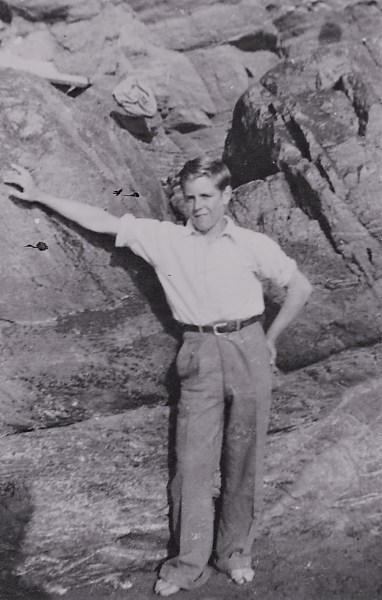
Her eldest son, Kenneth, had bought it for her with money from his very first job. I knew who Ken was, he was my Uncle the older brother by two years, of my mother. I had always seen his photo on the wall in their house, at the bottom of the stairs, a dark-haired young man, looking similar to Gramps in his first – so Gran told me – pair of long trousers! At the beach, barefoot and leaning against a cliff in shirtsleeves.
Uncle Ken about 16 years
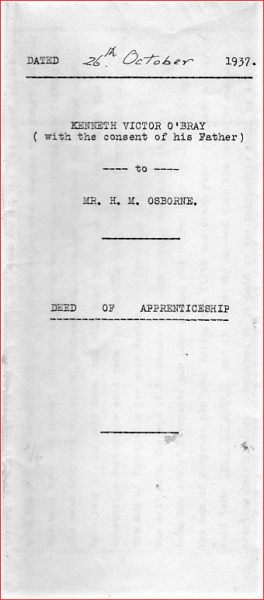
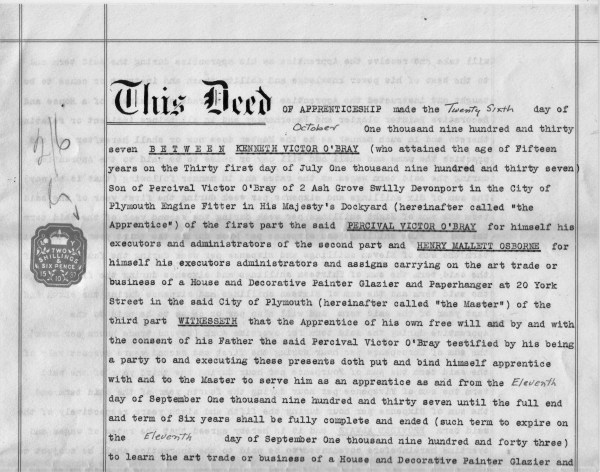
Uncle Ken was apprenticed to Mr Henry Mallett Osborne on the 27th of October, 1937, from the age of 15 years until he was 21 years. He was to “Carry on the art trade of business of a House and Decorative Painter Glazier and Paperhanger at 20 York Street City of Plymouth”
I know this because I have Uncle Ken’s Deed.
Gran told me he was so excited and the business of “THIS DEED” gave him a feeling of being, at last, a grownup.
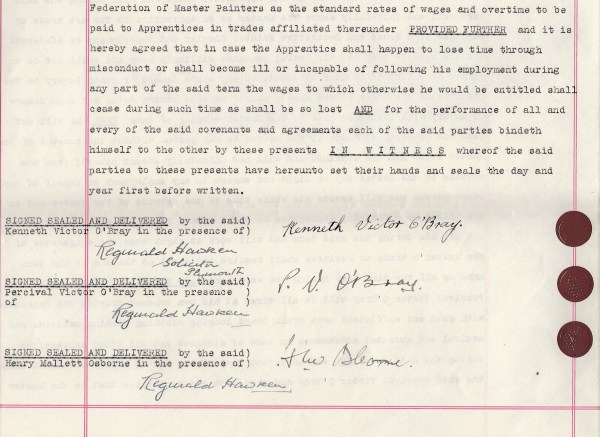
The Deed was large and cannot be shown in full here, as the document measures 41cm in length (16 inches) and 27cm in width (101/2 inches). However, I can show the top of the Deed and the bottom with the signatures of Gramps, his son, Uncle Ken and the ‘Master’ Mr Osborne.
Frontpage of the Deed
First Page of the Deed.
Included in the ‘Deed’ are these words…… “he will faithfully serve ‘The Master’ until the full end and term of six years shall be fully complete and ended. (Such term to expire on the 11 September 1943)
Who could have known, that full out war and destruction would have been wreaking havoc all over the world for four years by then? The United Kingdom had declared war on Germany on the 3rd of September, 1939, two days after Germany invaded Poland.
One interesting note in the Deed was Kenneth’s salary which says:
……the Master does now or shall hereafter use and practice the same and shall and will pay or cause to be paid to the Apprentice during the said same wages at the rates and in manner following (that is to say) the sum of six shillings and sixpence per week during the first year of the said term and sum of eight shillings per week during the second year of the said term the sum of nine shillings and sixpence per week during the third year of the said term the sum of Eleven shillings and sixpence per week during the fourth year of the said term the sum of Thirteen shillings and sixpence during the fifth year of the said term and the sum of Sixteen shillings and sixpence during the sixth and last year of the said term”
The last and Signature Page
So, with the handsome salary of six shillings and sixpence, (worth approximately $2.50 in today’s Canadian dollars) during the first year of his apprenticeship, he bought Granny the lovely little lady.
Granny said that Kenneth was keen to learn the signwriting part of the Apprenticeship as he was quite a good artist. Granny kept all his paintings sketches and drawings between two large pieces of cardboard. I often got them out and looked at them. I could spend hours looking at his art.
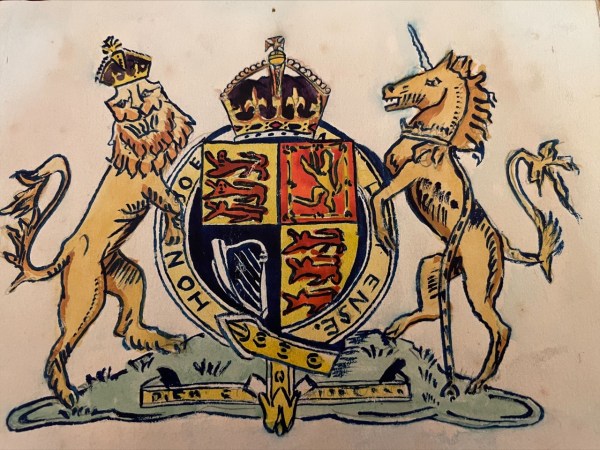
Whilst I was still at school, I had to do a project on the City of Plymouth History. Granny let me have the Royal Coat of Arms, painted by Uncle Ken to put on the front of my project book, I was thrilled and still have the project book and Uncle Ken’s painting on the front.
Uncle Ken’s painting of the Royal Coat of Arms – not finished.
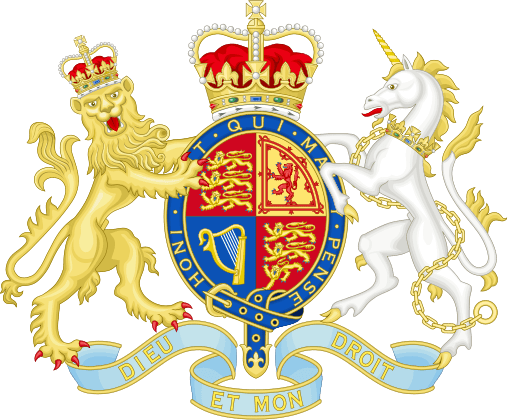
The picture below is the present Royal Coat of Arms, with the crown of Queen Elizabeth II.
The motto at the base reads: ‘Dieu et mon Droit’ (‘God and my Right’) and the shield bears the motto Hon soit qui mal y pense (‘Evil to him who evil thinks’ (2)
Two years into Uncle Ken’s apprenticeship, his life takes another turn which will be told in Granny’s Ornament Part Two.
(1) When did Art Deco start and end?
Art deco (c. 1908 to 1935) Art deco began in Europe, particularly Paris, in the early years of the 20th century, but didn’t really take hold until after World War I. It reigned until the outbreak of World War II
Of course, Art Deco covered a great many items including homes, buildings, clothing, home furnishings and sculptures.
If you Google ‘Art Deco Ladies’ many of the ladies are in similar positions and colours. Some just marked ‘foreign’ and some made in Germany and Austria.
I have no idea of value, but to me it is priceless and I hope when I have shuffled off this mortal coil, one of my sons or grandchildren will treasure it too.
(2) This symbolises the Order of the Garter, an ancient order of knighthood of which the Queen is Sovereign. Uncle Ken’s painting shows the crown of the then-King George V
We all know time flies but have you ever thought of your life in chunks of five or ten years at a time?
Census records are a vital resource for family historians researching their ancestors. They provide a snapshot of each household on a particular day over the years. Here is the snapshot of my life on census years.
1961
POP: 18,238,247-Prime Minister: John Diefenbaker(Conservative)
In the News: CUSO was formed and the CFCF (Canada’s First Canada’s Finest) Television Network began broadcasting.
Favourite song : Ben E. King’s “Stand by Me”.
Travels included the family summer cottage in Knowlton (Eastern Townships).
My mother died of cancer leaving my father with four children under the age of 12. I was only four years old. We all lived in the house my father built ten years earlier in Montreal (Quebec). My father ran his own engineering company.
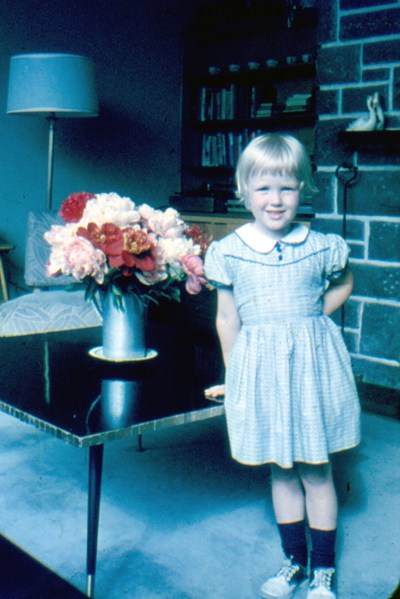
Four-year old me – 1961
1971
POP: 21,568,311-Prime Minister: Pierre Trudeau (Liberal)
In the News: FLQ terrorized Montreal. Pierre Laporte and James Cross are kidnapped. Trudeau invoked the War Measures Act. Frankie Vallie and the Four Seasons are a hit.
Favourite song: Led Zeppelin’s “Stairway to Heaven”.
Travels included winning a trip for two to Paris accompanied by my father and meeting up with my older sister living in England at the time and the Knowlton summer cottage.
I still lived in the same house…blessed with a stepmother (1964) and three more sisters. My youngest half- sister was born in June which gave me a focus to my 14 year-old angst-filled life. As a high school student in 1971, classes were regularly interrupted by bomb scares and evacuations to a shelter across the street. I regularly ran by mailboxes on my way to school “just in case”. I played badminton in the winter and, in the summer, tennis as well as horseback riding just like my older sister… never admitting that the beasts actually terrified me!
(Note: After 1971, the Canadian Census was taken every five years instead of ten.)
Riding “Sugarfoot” at the Knowlton Pony Club – 1971
1976
POP: 22,922,604 – Prime Minister: Pierre Trudeau (Liberal)
In the News: The Parti Quebecois won a provincial majority and Bill 101 (the french language law) was being finalized. Montreal hosted the Summer Olympics.
Favourite song: ABBA’s “Dancing Queen”.
Travels included a family trip to Kennebunk (Maine) beach and the Knowlton summer cottage.
All grown up at 19 years old, I worked at my first real job as a bank teller and moved out of the family home into my first apartment. By the end of the year, I had changed my mind and quit my job, moved back to the family home (with a cat) and signed up for courses at CEGEP (a Quebec college). Maybe I wasn’t quite finished growing up after all!
L to R – Me, my father, my three half-sisters, my Stepmother and my brother – 1976
1981
POP: 24,343,181 -Prime Minister: Pierre Trudeau (Liberal)
In the News: All-time high prime interest rate of 22.75% and Rene Levesque’s Parti-Quebecois was re-elected after the failed Referendum.
Favourite song: The Pointer Sisters’ “Slow Hand”.
Travels included Barbados and weekends of golf in Magog (Eastern Townships).
My fourth attempt of moving out of my father’s house finally succeeded. As an adult of 24 years, my legal secretarial training in Ottawa landed me a job in NDG (west end of Montreal) near my new apartment. However, my interest in investments prompted me to take the Canadian Securities Course where I met a boy and, by the end of the year, I was engaged to be married.
1986
POP: 25,309,331 – Prime Minister: Brian Mulroney (Conservative)
In the News: The Canadian dollar hit an all-time low of USD70.2 and Jean Drapeau (responsible for the Metro, Expo 67 and Place des Arts) resigned as Mayor of Montreal.
Favourite song: Chris deBurgh’s “Lady in Red”.
Travels included Vancouver (British Columbia) and weekends in Magog (Eastern Townships).
My husband, our one-year daughter and I moved back to Quebec from Morrisburg (Ontario), where we operated a ten unit motel for a year until we quickly realized we were losing money. Real estate prices had increased so much in the one year since we left Dorval that we had to buy in a suburb further west of Montreal (Ile Perrot). Moving “home” was no longer an option once married and 29 years old!
Mother and daughter – 1986
1991
POP: 27,296,859 – Prime Minister: Brian Mulroney (Conservative)
In the News: The GST tax came into effect and Canadian forces participated in the Persian Gulf War.
Favourite song: Cher’s “It’s in his kiss”.
Travels included Vancouver and Victoria (British Columbia).
Now divorced and living with my six-year daughter in Magog (Eastern Townships) after closing our used bookstore since we were losing money…again. True to my flip-flop nature, I enrolled to study business at Bishop’s University as a 34-year old mature student. My daughter and I attended our respective schools and enjoyed a less expensive country life filled with seasonal sports and blessed with a group of supportive friends.
1996
POP: 28,846,761 – Prime Minister: Jean Chretien (Liberal)
In the News: Mr. Dressup’s last children’s show. Lucien Bouchard replaced Jacques Parizeau after the second lost Quebec referendum. Severe flooding of the Saguenay River (east of Montreal).
Favourite song: Sarah McLachlan’s “I will remember you”.
Travels included Glacier Park (Montana), San Francisco and Carmel (California), Los Cabos (Mexico) as well as cottage time at the lake.
My father died (1995). After five years of study, I graduated from university at 39 years old. My daughter and I moved back to Montreal (Quebec) to start my new career but mostly to crowd into an apartment with my boyfriend of three years and his two teenage children. We married two years later.
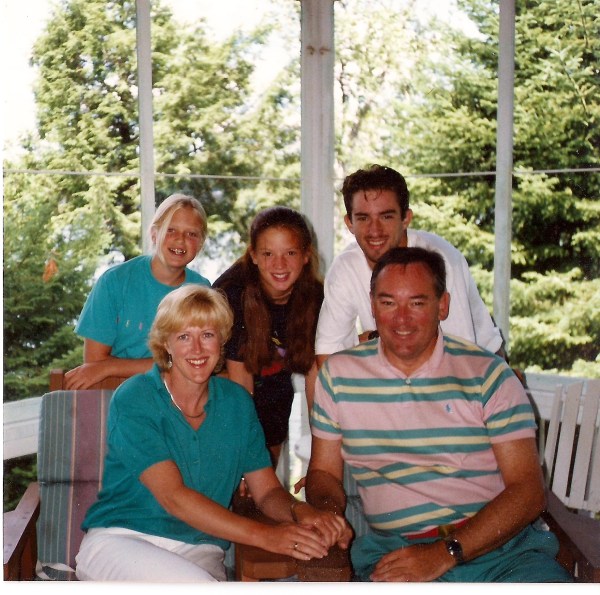
Cottage time at the lake as a family – 1996
2001
POP: 30,007,094 – Prime Minister: Jean Chretien (Liberal)
In the News: 9/11 terrorist attacks on the US and Canadian Astronaut Chris Hadfield’s space walk.
Favourite song: Westlife’s “Uptown Girl”.
Travels included Porto (Portugal) and an Alaskan cruise as well as cottage time at the lake.
My business degree enabled me to work full time while juggling my busy new family life but we still found time to travel. The events of 9/11 shook up the world, affecting the travel industry especially, so my husband took the early retirement package “offered” by Air Canada. So at the age of 44, I found myself with my new husband retired, my daughter finishing high school and a roomier apartment as the other two children were away at school in the United States.
2006
POP: 31,612,897-Prime Minister: Stephen Harper (Conservative)
In the News: Dawson College shooting, the fatal collapse of a Laval overpass (a suburb north of Montreal), the Québécois ethnic group officially recognized as a nation within Canada.
Favourite song: John Mayer’s “Waiting on the world to change”.
Travels included Lisbon (Portugal) and a Hawaiian cruise as well as cottage time at the lake.
The only one left in our “nest” was my daughter who attended McGill locally. We continued to enjoy travelling (on Air Canada passes) while I was still working at age 49 and my husband enjoyed his early retirement.
One of several cruises enjoyed with my husband
2011
POP: 33,476,688-Prime Minister: Stephen Harper (Conservative)
In the News: Extreme weather conditions with a winter storm in the Maritimes, a cold snap in Quebec, the Richelieu River overflowing its banks and Wild Fires in the West.
Favourite song: Adele’s “Someone like you”.
Travels included a Hawaiian cruise, England to meet our second grandchild, Halifax (Nova Scotia), Los Angeles (California) and Seattle (Washington) as well as cottage time at the lake.
My husband and I are very comfortable in our new house (2007) that we bought after all the children left home! The unfinished basement made a fabulous art studio that I enjoyed now that I was semi-retired. As a 54- year old grandmother of two, I had the time, love and energy to share with them…but sadly they lived in England.
Cottage time at the lake with the grandkids – 2012
2016
POP: 35,151,728 – Prime Minister: Justin Trudeau (Liberal)
In the News: Final concert of Canadian band Tragically Hip, Wild Fires evacuate Fort McMurray (Alberta).
Favourite song: Ed Sheeran’s “Photograph”.
Travels included a Carribean cruise, a visit with the grandkids in England, a trip down my husband’s memory lane in Winnipeg (Manitoba) and cottage time at the lake.
My daughter married and lives only ten minutes away. Fully retired from office life at the age of 59, I enjoyed an active membership in two art associations. And, as one of nine writers in my genealogy group, my monthly creative writings were due regularly. I volunteered any spare time with the “stitch and bitch” group at my church.
Trip to England to visit the grandkids and the Disraeli House – 2016
2021
POP: 38,246,108 – Prime Minister: Justin Trudeau (Liberal)
In the News: Covid, Vaccinations, Closed Canada-US border and Canadian Indian residential schools gravesites.
Favourite song: All the Golden Oldies!
Travels were restricted to cottage time at the lake… which helped keep me sane.
The strange year flew by with very little in the way of normalcy. We kept safe in our house, wore masks in public, washed our hands frequently, only shopped when necessary and maintained our distance from others. At 64 years, staying fit and healthy had never been more important. The deck at the back of our house provided numerous opportunities for outdoor entertaining of family, friends and neighbours between May and September.
I wonder what my life will look like for the 2026 Census?
Perhaps someday my “great-greats” will find this story helpful and some of their research on my life will already be done!












 Genealogy Ensemble