Dad, The Old Bailey, and Me

Recently, I was in the Montreal Courthouse accompanying a friend selected for Jury duty.

It was a four-hour wait so I had time to drink my coffee, look around and daydream. I watched as many lawyers dressed in black robes rushed in to buy coffee and dash out again. Others sat casually with clients over legal documents and I could tell they were lawyers only by their stiff white collars.

As I sat there, a distinct memory came back to me from my last courtroom visit to the Old Bailey in London, England when I was 13.

After my parents’ divorce when I was seven, I infrequently saw my Dad, but in 1958 he took me on a holiday to the capital. My dad was tall and dark and a very quiet, introspective man. I was a chatty individual but, somehow, we had a meaningful time together. At the end of our holiday, he bought me presents to take home, for my mum and sisters. He never told me he loved me, but I have a lovely memory of a man I never really understood or got to know and I like to think this was how he showed his love.

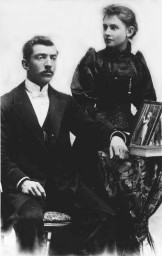
Me and Dad in London, 1958

It was a wonderful holiday, just the two of us. We visited The London Palladium Theatre and saw a show; we shopped on Oxford Street; we went to the London Zoo and Trafalgar Square where I fed the pigeons and had my portrait drawn in pencil by a street vendor, we even ventured to Soho, a notorious part of London frequented by prostitutes, drug dealers and ‘Teddy Boys. ‘So exciting’!

The Old Bailey was built in 1673, it’s predecessor, the medieval version had been destroyed in the Great Fire of London in 1666. During the Blitz of World War II, it was bombed and severely damaged. In the early 1950s, it was reconstructed and, in 1952, the restored interior of the Grand Hall of the Central Criminal Court was once again opened by the Lord Mayor of London.  This was the Old Bailey we visited. Although the Old Bailey courthouse was rebuilt several times between 1674 and 1913, the basic design of the courtrooms remained the same. [1]

I remember the entrance to that grand hall. It was like a palace, huge and so beautiful.

The Grand Hall Inside The Old Bailey, the design mirrors the nearby dome of St Paul’s Cathedral

My Dad and I sat in the visitors’ gallery to watch a trial. I have no recollection of the details of the trial. I was too busy looking around at the wood-panelled walls, the prisoner, the solicitors, the policemen and, of course, the judge. He was dressed in a red robe and a horse-hair wig and sat slightly raised on a dais so he could gaze down upon the proceedings.

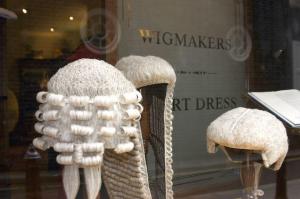
The ‘accused’ or ‘prisoner’ as they referred to him stood at the ‘bar’ or ‘dock’ with his Solicitors and Barristers (as lawyers are called in England). These 1950’s British lawyers were attired in flowing black robes like the 2018 Montreal lawyers, but with stiff-winged collars with two bands of linen in the front of the neck.  They also wore wigs. And what wigs!

Type of Wigs Worn In Court

Some were white, signalling that a lawyer had just started out in his chosen profession; others were yellow with age, signalling more experienced lawyers. To me, all of the lawyers in the courtroom looked stern and forbidding.

Proceedings moved very slowly with no drama. After a few hours, I got bored and Dad and I left for lunch.  But still, what a memory! And how very different was the Old Bailey courtroom compared to the modern Montreal Courthouse where informality seems to be the rule.

[1]  https://www.oldbaileyonline.org/static/The-old-bailey.jsp

NOTES:

A court is held at the Old Bailey eight times a year for the trial of prisoners for crimes committed within the city of London and the county of Middlesex. The crimes tried in this court are high and petty treason, murder, felony, forgery, petty larceny, burglary, etc.

This link below shows Court Cases being heard today, at the Old Bailey.

https://old-bailey.com/old-bailey-cases-of-interest/

When I visited the Old Bailey, everyone was attired in wigs but that is now changing in England. For non-criminal cases, lawyers and judges will cease wearing wigs and I cannot help but feel sad that yet another centuries-old custom has gone.

Here is a 2 -minute read on the subject.  https://www.reuters.com/article/us-britain-wigs/wigs-off-as-britain-ends-courtroom-tradition-idUSL1287872820070713

Unfortunately, now strict security measures make it impossible for visitors to go into the main body of the building. However, the clip below, shows the Lord Mayor of London opening the newly restored Old Bailey in 1952. This was the hall I entered in 1958 with my Dad.


Genealogy Standards

For years, I found the differences between primary and secondary sources confusing. Add the fact that you can have original and derivative versions of both and that either can be negative or positive proof and it all sounds like mumble jumble to someone who isn’t used to them all. Luckily, the glossary within the Board for Certification of Genealogists “Geneology Standards” manual makes all the important distinctions very clear.

For example, on page 72, the glossary defines “primary information” as:

A report of an event or circumstance by an eyewitness or participant; the opposite of secondary information.

This is just one of many confusing nonfiction research terms that are clearly defined in very simple language. The chapters within this pithy guide cover how to plan and research a story. It also shows how to properly cite sources. Several pointers throughout the guide clarify some of the most challenging nonfiction research challenges.

If you want to document, research and write stories about ancestors’ experiences, the guide is a must-have. In my opinion, it’s equally useful for any obsessive nonfiction researcher and writer who wants to communicate carefully and accurately.

Board for Certification of Genealogists Genealogy Standards. Edited by Thomas W. Jones. Washington: Turner Publishing Company, 2014. ISBN 978-1-630-26018-7


Sad death

One of the first Canadian women who enlisted into the Royal Canadian Air Force committed suicide less than a year later.

Ten days after her 29th birthday, Hazel Winnifred Webb Seymour left a steady job with the Bell Telephone Company of Canada to enlist in the Canadian Women’s Auxiliary Air Force. The unit operated under the motto: “we serve that men may fly.”

Ten months later, she swallowed three bottles of cleansers (iodine, cresol and carbolic acid) while in the hospital for hysteria. She died on September 10, 1942.

When she joined the Royal Canadian Air Force (RCAF), Webb Seymour seemed like the perfect candidate. She was healthy, high-school educated, the right age and height, and well-trained in administrative duties. She was married, and had been for seven years, but the couple had no children as he was deployed overseas.

Her early days in the Air Force reinforced her aptitude for the job. One test resulted in the comment:

“One of the best on the course – always cheerful and will make a wonderfully reliable and good N.C.O. Suitable for a difficult station.”

An “assessment of character” completed in March 1942 also contained high praise: “industrious, capable, willing worker,” “highly resourceful,” and “merits accelerated promotion.”

Four months later, Seymour was admitted to the Station Hospital with something so serious, she stayed for eight days. From then on, she went in and out of hospitals, both civilian and military, until her suicide.

During an inquest about her death, Flight Lieutenant Allan Campbell Blair described what happened in the final three days of her life.

“It was considered that before she should be discharged on the grounds of this nervous disorder that it would be worthwhile to give her another chance and to this end was admitted to Station Hospital again to be kept under observation and the be employed doing small jobs about the hospital which was thought might be of benefit to her. She was apparently responding and there was, in my opinion, no need to restrict her freedom about the hospital. There was no evidence or intentions from her that she was planning self destruction. On September 10, at 1205 hours as Dr. Williams and myself were leaving the hospital we encountered her in the hall holding an iodine soaked stained towel to her mouth and she stated that she had just drunk three bottles of poison….”[1]

After she died, her mother wrote to the military needing help.

“The funeral refund has not been sent to me and I really need that amount to help with my winters’ coal, if I can get any.”[2]

Despite those pleas, the only cheque to the family reimbursed $154.16 they paid for Webb Seymour’s funeral.


Note: This story is a mini-version of a chapter in Tracey’s upcoming book: Steady Hands, Brave Heart: World War II’s effect on Canada.

[1] Seymour, Hazel Winnifred; Library and Archives Canada, RG-24, volume 28621, testimony, Allan Campbell Blair, C3966.

[2] Seymour, Hazel Winnifred; Library and Archives Canada, RG-24, volume 28621, letter, Pearl Web, August 28, 1943.

Enjoying the Story of Westmount

I began looking for traces of the Huguenots that my grandmother always told me were in the family. First, I looked for anyone born in Blois, Orléans, Paris, Rouen or Tours France sometime after the Affair of the Placards. These are the towns in which people posted signs questioning Catholic dogma overnight on October 17, 1534. The incident set off the reformation and eventually led to hangings and mass migration of Protestants out of France.

Unfortunately, my genealogical records don’t extend far into France during the 1500s, so that research will be for another day.

My journey through the Hurtubise side of my family, however, led me upon a wonderful history of Westmount called A View of Their Own: The Story of Westmount, written by Aline Gubbay in 1998. The little guide introduced me to several early maps of Montreal I hadn’t seen before, Montreal’s Mohawk name “”Kawanote Teiontiakon” and a hint about how some of my distant ancestors lived. Gubbay describes the geology of Montreal in a way that allows you to really imagine how things used to be.

The western part of the island was distinguished by a little mountain Westmount — some 600 feet high, formed by an outcropping of a larger rise, Mount Royal. Iroquoians had discovered that the slope of the little mountain, facing south-east, was sheltered from the strongest northern winds, a factor which, together with abundant water from the mountain springs, made for a richly fertile soil where they could cultivate their traditional crops of beans and corn. (p 11)

My ancestors get a small mention on page 15:

One by one the families arrived, settling along the Indian trail now given the name of Côte St. Antoine. They included names such as Des Carries (sic), Prud’homme, Leduc, Pierre et Jean Hurtubise, and St. Germain.

(Fascinating how Gubbay missed the French word “et” in her paragraph, something I frequently do in my texts. Bilingualism can be quite troubling sometimes.)

She continues:

Most of the men were artisans, recruited from towns of northern France for their skills as stonemasons, millers, brewers, but they soon acquired the new skills necessary to clear and cultivate the land. In winter, after the land had been cleared, the trunks of the trees were gathered, carried down to the water and lashed together on the rim of a frozen lake, Lac St. Pierre. When the ice melted in the spring the lumber was floated through a short inlet to the St. Lawrence River and rafted along the shore for sale at Ville Marie, now renamed Montreal.

If you have Clarks, Dawsons, Dionnes, Elgins, Enslies, Hays, Hendersons, Lighthalls, Mackays, Monks, Murrays, Newnhams, Ohmans, Parés, Shearers, Smithers or Timmins in your family, you’ll find gems about their lives in this book. If you appreciate reading about the Town of Westmount, the borough of NDG or Montreal history, this is definitely a story you’ll want to discover.

At only 151 pages, A View of their Own: The Story of Westmount is a quick and easy read. Gubbays smooth writing style and her use of many anecdotes make it entertaining as well. I highly recommend it.

Granny Jodouin and Her Baby Grand

In her book entitledLa Fille de Georges’, Laurette Jodouin Talbot, Louisa Jodouin’s niece wrote “Tante Louise was always well turned out, with the tact and distinction of a queen, but endowed with a profound sensitivity. She inspired in me a great respect and I learned from her, the art of remaining a lady at all times.”.

Maria Louisa Seraphina Fortin, my maternal grandmother was the daughter of Francois Evariste Fortin, a merchant. At one time he was the Mayor of Pembroke, Ontario, where she was born in the winter of 1874 at the end of February, some say, the coldest month of winter.

At a young age Louisa learned to play the piano and soon became an accomplished pianist. It was a passion that brought her great joy and satisfaction throughout her lifetime.

When Louisa was eighteen, she married her cousin Louis Joseph Jodouin. They both had the same grandfather, Moyse Hypolite Fortin. He had two wives. Henriette Bertrand, his first wife was Louis Joseph Jodouin’s mother. She passed away at the tender age of twenty-five. Moyse remarried Emilie Thomas dite Tranchemontage, Louisa’s mother. Before the cousins were able to marry, the Vicar Apostolate of the Diocese of Pontiac granted them the required consanguinity dispensation.1

Louis and Louisa were married in the Saint Columbkille Cathedral in Pembroke on the 9th of January 1893. They moved to Sudbury, Ontario, where Louis Joseph had already established a bottling company.

The new community had recently been incorporated and was booming. In 1883, during the construction of the Canadian Pacific Railway, nickel-copper ore had been discovered  near Sudbury. Prospectors and miners came flocking to the district and soon staked their claims with high hopes.

Louis’ bottling company sold ginger ale, soda water and mineral water. It was a successful enterprise. After several years the bottling company was sold. A new company, L.J. Jodouin Ice Company was formed, and it became a thriving business for L. J. (as grandfather was known). He had an ongoing contract with the CPRailway to provide ice for the trains. The trains stopped in Sudbury where they were furnished with fresh ice for the next leg of their journey out west. This long-standing contract lasted till refrigeration became available on trains, some time in the mid forties.

Meanwhile, Louise was settling in as a homemaker. The couple were blessed with nine healthy children, six girls and three boys. They also raised a grandson, Frankie. His mother, Delia  had died of septicemia when he was an infant.

Louisa led a very sheltered life. Louis did all the grocery shopping and he paid the bills. Louisa had no idea what anything cost. She had an allowance that she could spend as she chose.

After her death it was revealed that over the years she bought First Communion dresses for little girls whose parents could not afford them. During the Depression, daughters of friends coming from out of town to find work were taken in to their large home on Elm Street. They were treated as one of the family until they were able to establish themselves. Wedding receptions were hosted in their home for young brides who had no family, the same way they did for their own daughters. She also paid the expenses allowing her granddaughter to continue her education after her parents were separated. All these acts of kindness went unnoticed. Perhaps one of the reasons her niece Louise who wrote about her, and knew of her generosity. More than likely Granny was there for her when she moved from Temiskamang to Sudbury as a young bride.

After Louis passed away in 1944, the family homestead was sold. The property was developed, a Canadian Tire Store was built on the site which was then considered prime land.  Louisa had a small bungalow built not far from the original ice warehouse on Lake Ramsey. She spent her last years living with her spinster daughter, Adele. It was here that she was able to fullfill a lifelong dream of having a baby grand piano in her home! The ‘Baby Grand’ had a place of honour in her bright sunny living room.

During the summer of 1948 my Mother drove four of us, Ruth, John, Paul and I to Sudbury for a visit. I have vivid memories of my grandmother, Granny Jodouin, ever a lady, playing her ‘Baby Grand.’ She sure could tickle those ivories. It seems her fingers remained nimble throughout her life.

Upon leaving Sudbury and heading for the long drive home to Asbestos there was a touching moment, as she began playing “Say Au Revoir, But Not Goodbye”. It is a moment that will be forever etched in my memory.

Two years later, on the 11th of May 1950 she died of a stroke, at the age of seventy-six. She is buried beside Louis in the LaSalle Cemetery in Sudbury. A place I have visited over the years.  Both my parents are there beside my grandparents, near the huge  granite Jodouin cross that once stood so prominently. Over time the ground could not support the cross and we  laid it to rest due to ground changes and heaving. It is also to be my final resting place.

P427_AUX_162_256

Louis Joseph and Louisa Jodouin 1893

granalt

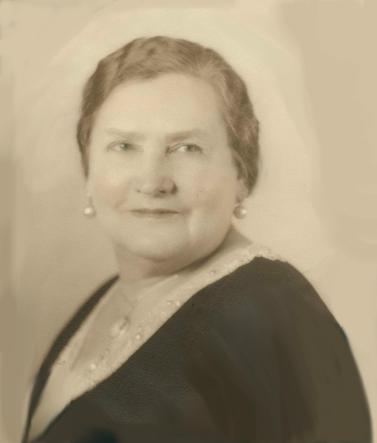
Marie Louisa Seraphina Fortin (Jodouin) – “Granny”

*************

You may want to visit the following family related  stories at http://www.genealogyensemble.com

A Pembroke Pioneer – Francois Evariste Fortin Louisa’s Father

Dad’s Favourite Christmas Story – Little Frankie


Family Diaspora

Since time immemorial parents have lost children to the far flung reaches of the globe. They left home to serve their country, to preach the Word, to better their own lives or to simply seek adventure.

Today, advances in transportation and modern technology allow families to keep in close touch no matter how far apart they find themselves. Not so in the time of my great grandfather. When five of his seven sons left Scotland at the turn of the twentieth century he knew he would likely never see them again.

My great grandparents, David Angus (1842-1929) and Ann Rankine, had themselves left their families to seek employment elsewhere. David was a shoemaker. They settled in the Glasgow district of Partick a short day’s journey from their home village of Kincardine. Of the nine children born to them in Partick only two were girls, the younger dying in infancy.

By the end of the nineteenth century Glasgow had become a heavy industry and shipbuilding center. The influx of workers into many Scottish cities was so rapid that housing, city planning and provisions for health care couldn’t keep up. This unplanned growth created squalor and over-crowding on a massive scale. Two-thirds of Scots were living in one- or two-roomed houses compared with only 7 per cent in England. Poverty was widespread, wages were low in comparison with other parts of the UK and infant mortality rates were alarmingly high. (1)

Two of David’s sons, David and Ebenezer, escaped this desperate social situation when they immigrated to Australia, David to Melbourne and Ebenezer to Sydney. They both raised families the descendants of which live in Australia today. Both brothers are buried in Australia

Thomas settled in Malaysia as a missionary. He was likely inspired, as were many others at the time, by the legendary African exploits of David Livingston from nearby Blantyre (2). Although the family lived in Kuala Lumpur, Thomas sent his daughters, Kathleen, Joan and Margery, to a missionary boarding school in southern India, the same school I attended years later when my own father worked in East Pakistan. Typically missionaries went on furlough every five years so Thomas may have seen his homeland again.

Andrew did not stray far from home. He lived and died in East Bourne, England and we can presume he returned to Scotland frequently.

My grandfather James (1879-1964) immigrated to Canada and settled in Quebec City. It was many years after his father had died before he was able to return home. He took his Canadian “bride” to Glasgow for their fiftieth wedding anniversary. His only sister Rachel, with whom he had faithfully corresponded over the years, suffered from dementia at the time of their visit and hid from him. A sad ending to their long distance relationship.

The two sons who remained in Scotland, John and William, died in middle age. It was Rachel who cared for their widowed father in the last years of his life. My father and his two brothers spent time with their aunt at her home in Steppes when they were stationed in England during World War II. Their visits were too late for their grandfather.

Today there are more people of Scottish descent living in countries around the world than there are Scots in Scotland. My family is part of this diaspora.

  1. http://www.educationscotland.gov.uk/Images/MigrationandEmpire1830- 1939_tcm4-571546.doc
  2. http://protestantism.enacademic.com/389/Livingstone,_David


My Brothers’ Keeper

I am quite small, hiding under the table in a kitchen filled with big people all talking but not loudly, a hushed kind of murmuring. They are drinking tea and eating. The room is warm.

Scottie, my Gran’s Highland Terrier is with me under the table, he is a black dog which seems appropriate seeing as everyone in the room seems to be wearing black too.

The radio plays quietly in the background. Scottie and I are happy to be left alone underneath the table, but I am soon to be called and told to come out. I don’t want to come out, I was comfortable there.

I am helped up onto a chair to peer into a small white box. The first thing to catch my eye, is the white satin, lining the box. Then I notice the small doll wrapped in a silken shroud, from neck to foot. I am handed a red rose and told to put it on his chest. Someone says, ‘Now kiss your brother goodbye’ so I lean in, and kiss his cold forehead then scramble down from the table to crawl underneath again to play with Scottie.

I recall that all the curtains in the house were drawn, night and day, a big black wreath was on the front door and all the mirrors were covered, and everyone in the house wearing black armbands. Hushed conversations which abruptly end when I come into the room.

I am three years old, soon to be four on 20th of November 1948 and this is the occasion of the death of my baby brother born on 18th October 1948 and dying on 21 October, 1948.

Years later I learn that he died whilst nursing in my mothers’ arms on his third day of life. Christopher’s birth, as was the custom in those days, was at home, whilst I stayed with my grandparents, who lived five doors away in the same street. Many years later I learn that my mother, whilst she was in her ‘confinement’ watched my ‘blond bubble-curled head bob past her window every day’.  then, Mum,  tearfully telling me how one minute Christopher was nursing then he stiffened, and started to turn blue and went limp and in layman terms, she said: “He was born with only half a heart”.

Now in middle age, I think of him often. How he would have turned out, what kind of student he would have been, would we have been close friends? Indeed would my parents have ever divorced if he had lived, as death either makes or breaks a family.

For the past 30 years, I have been doing family genealogy so recently I sent off for his birth and death certificates, as his birth and death was something I wanted to know about in more detail.

As soon as the birth and death certificates arrive, hands trembling I open them and try to read the certificates, but memories flood back of the day of his funeral, with such clarity I am dizzy for a second. Seeing the certificates, brought back the memories and some more tears. 

I have no photos of Christopher but then, handling the certificates, I remember that day of his funeral with vivid clarity, and how black his hair was – our fathers’ Cornish heritage – but those memories are so vivid only because I now have his birth and death certificates in my hands

I start to read the two documents, His birth first, but then tears make me stop. Now a mother of two boys myself, I cannot imagine what my mother went through on those three days. I pull my self together and try again. I read the official account of his too-short life and the reason for his death: ”Congenitally abnormal heart. Heart consisted of two chambers a common auricle and a common ventricle” and then the memory of my mother, telling me he was born with ‘half a heart’ and realising that it was surprisingly accurate.

I hurry to write down what I remember of his death, that day in Granny’s kitchen and the memories flow.

Of his birth, I have no memory; however, I would like my future descendant’s to know a little about my brother and to remember him as I did on the day his Birth and Death Certificates arrived for me to read. How the memories I had of his funeral, events still so clear over 72 years ago.


Christopher’s Birth Certificate 1949

Christopher’s Death Certificate 1949

Once again, I am reminded of how handling documents, photos and memorabilia of a family is so important in our lives, especially when we are documenting our family histories.

I wonder how our future descendants will manage now most information is digitized? I believe like most of my genealogical friends, that we will keep our memorabilia in paper form to bring back memories like mine, which were so vivid and clear.


Montreal West Writes

Writing Your Family History

Got a family story that you are itching to write? Presenters Janice Hamilton and Mary Sutherland are two of nine Montreal-area genealogists who write about their ancestors and publish their stories on the family history blog Genealogy Ensemble, and in a new book called Beads in a Necklace: Family Stories from Genealogy Ensemble. Their presentation will inspire you to write about your own family and provide tips to help you start writing and publishing your stories.

Tuesday  January 16, 2018  7:00pm

Montreal West Public Library,  45 Westminster S,  514-481-7441

Note: if you can’t make this event, Janice and Mary will do the same presentation at the Benny Library in NDG on Feb. 28. Meanwhile, Tracey, Barb and Claire will be talking about writing family history at the British Isles Family History Society of Greater Ottawa on Feb. 10, and other presentations are planned for Montreal and the West Island area.


Happy on the farm

When my aunt turned ninety-six a few years ago, I prepared a short bio of her life, including photos of the farm where she grew up, baptism`s, confirmations and a wonderful photo of four people working in a farm yard.

Handwriting on the photo says “maman a l’age de 20 ans” and “papa” to identify my great grandmother, Marie-Berthe Charette and my great grandfather,  with her two sisters “tante Eva” and “tante Ida.”

They are all on their knees, looking at the photographer. Jean is staring towards Marie-Berthe, who was also called Martha, with an extremely happy look on his face.

The shot is the only happy photo I have of the couple. In every other shot, they look solemn or downright miserable.

Martha was born on October 3, 1889, so if the note about her age is correct, the photo would have have been taken in 1909 or 1910, five years prior to their marriage. There’s no indication where the photo was taken. It could have been his parents’ farm, her parents’ farm, or given that they are also in the shot, perhaps even the farm where his brother Gustave and her sister Ida moved after they were married.[1]

Both Charette farms were in Clarence Creek, where their families had lived since at least 1891. His family farm was located in Sarsfield, a town right next door near the current Ottawa, Ontario.

The first Hurtubese/Charette couple was already married by the time of the happy photo in my grandmother’s photo album. Later, it would be Jean-Baptiste and Martha’s turn, then his younger brother Francois and her younger sister Dora.

All three couples would eventually follow middle Charette son Ernest, who began farming in Alberta.

My cousin says his mother used to talk about a horse and buggy ride after their family lost a farm due to a train expropriation. My aunt spoke to him about remembering her mom’s tears. I don’t know whether that trip precipitated their move to Alberta or took place afterwards.

All I know for sure is that after this photo was taken, the couple had two little girls, Donna and Marguerite. Then, sometime after their second daughters’ birth in 1917 and the 1921 Canadian Census, they bought a farm with a three-bedroom wooden house on it in Bow River, Alberta.[2]

After that, their life took a turn for the worse, and they lost everything. The dust bowl, the Depression, locusts…take your pick, they saw it all.

By 1941, the family was renting part of a house in Edmonton. He did odd jobs to get through the war years and beyond. They remained in Edmonton until her death in 1957 and his in 1959.

————————-

[1] Data from the 1911 Census of Canada, Enumeration District 21, Cumberland Township, Russell, Ontario, Sarsfield Village, Léonard Village, Bear Brook Village, page 7, line 48.

[2] Data from the 1921 Census of Canada, Enumeration District 2, Bow River, Alberta, section 7, township 22, range 21, Meridian 4, page 6, line 28.

A Contrast in Character

DrHenry

Dr. Henry Portrait.

He looks like one of the clan in the snapshot, with a trim athletic body, a handsome, rugged face, full-lips, sturdy chin, prominent brow over deep set eyes. He is confident in his posture as well as a snappy dresser.

He is Dr. Henry Watters of Kingsbury, Quebec and Newton, Massachusetts, first cousin to my husband’s grandmother, Marion Nicholson, the son of her Aunt Christina on her father, Norman’s, side.

That also makes him first cousin to Herbert Nicholson, Marion’s older brother.  And although the two young men resembled each other in build and facial features, they could not have been less alike!

Dr. Henry , by all accounts, was a near-perfect man, a  high-achiever, a man who rose to the top of his profession at the Newton Hospital near Boston, but who remained devoted to family (and that includes his cousins) throughout his life.

Despite his busy vocation, he corresponded with all of his extended family, regularly, with letters than demonstrated uncommon empathy. When writing his youngest cousin, Flora, who apparently had complained of boy troubles in her letter, “I don’t have much experience in these matters, but I can only say, if he doesn’t want you, he isn’t worthy of you.”

Herb, well, what can I say?  As the only son of Norman and Margaret Nicholson of Richmond, Quebec, great things were expected of him. A whopping FIVE dollars was put aside at his birth in 1885 to start a bank account for his future medical career. But, upon graduation from St Francis College in 1905, he went to work as a clerk at the Eastern Townships Bank.

A ladies man and/or a gambler, Herbert immediately got into debt, borrowing money off all of his relations, until, in 1910,  he got into such a desperate situation that he filched 60 dollars from the till at work.

Herbert didn’t go to jail: The Nicholsons were too well connected for that, but even Norman’s patron, E.W. Tobin, the Liberal MP for Richmond, Wolfe, couldn’t help Herbert’s cause.

  Herbert was forced to skulk out West. His already cash-strapped dad had to come up with the huge sum of 500 dollars to help pay his sons debts and travel expenses.

Herbert was a teeny bit ashamed. “Don’t tell anyone where I am,” he wrote to his parents from Saskatchewan, where he was staying with Norman’s former partner in the hemlock bark business.

Out West, Herbert worked in a series of jobs in, yes, banking, then insurance, and then with a the farm equipment company, Massey-Harris.

At one point he devised a scheme to dupe immigrant farmers out of their hard-earned cash.

“I also made a 100 dollars yesterday in the shape of a man’s note due in a year’s time. I sold a threshing outfit that I repossessed from a party that could not pay for it.  For 3300 and as there was only 3000 against the rig to the company; I am 300 dollars to the good.  In doing this I had to divide up with two others who assisted me and knew what I was doing so we get 100 each.  Have to keep these things quiet, of course.”


Herbletterhead

Herb’s letterhead from 1911-12 illustrating his roving ways

His other letters home were full of complaints about his workload, the freezing cold weather, etc. – and no shortage of insights into how capitalism works. “You have to already be rich to get rich out here,” he said.

Later, Herbert settled down in ‘real estate’ in Vancouver, got married twice to wealthy women, and then moved on to California.  He died in 1967, childless.

Beside his name in the Nicholson family genealogy it says “Successful Banker.” sic.

Dr. Henry ,whose dad, Alexander Watters,  was a Kingsbury, Quebec farmer, never married.  Henry employed his younger sisters, Christina then Anna, as his housekeeper in his comfortable clapboard Colonial in Newton, Massachusetts.

Henry may not have been a ladies man in the usual sense of the word, but he certainly had a way with the young ladies in his family. In the 1910 period, he indulged the Nicholson women no end with trips to Wellesley College in his flashy Stanley Steamer, with sea-bathing at Nantucket, box seats at Red Sox games, theatre plays, and dinners at the posh Windsor Hotel in Montreal, when at home visiting.

His younger sister, May, got new shirtwaist suits and fancy hats from him as gifts on a regular basis. Henry once used his  vacation time to drive his Aunt Margaret up and down the E.T to visit old friends.

And much to his Uncle Norman’s admiration, he paid his own father, Alexander, a trip “home” to the Old Country in 1911. “Not many sons would do that,” wrote an envious Norman to his wife.

Unlike Herbert, who found nothing good to say about any of his employers, the banks, the railway or insurance,  Dr. Henry never complained about work as a doctor and surgeon in his letters to family, even when suffering from a fatal disease at a relatively young age.

From his obituary in the New England Journal of Medicine: “When stricken with what he knew meant the shortening of his days and the limiting of his activities, he carried on cheerfully and uncomplainingly. He was the friend as well as the associate of those  with whom he worked, the friend and the physician of his patients.

Dr. Henry died 1937 and is buried at home, of course, in the clan cemetery in Melbourne, Quebec.  Herbert died in 1967 and is buried somewhere in a Long Beach cemetery. His last visit home to Richmond was in the 1920’s.

Herbnicholson1910

 Herbert Nicholson 1910ish

The information comes from the Nicholson Family letters of the 1910 period. The Watters clan of Kingsbury, Quebec is written down as Waters on the 1911 Canadian Census. Henry had a younger brother, William, who died in 1910. A photo on Ancestry claims this 21 year old William is an MD too. He must have been a recently graduated one, or still a student.

I have a short obit cut out left by the Nicholsons. It says the family is shocked at William’s death in Montreal, but nothing  else. A man could catch a cold and die in a day in those days, but this very short obit suggests something else more nefarious.

Below: 1911 census showing Herbert Nicholson living in a boarding house in Qu’Appelle Saskatchewan, with two recent immigrants, one from Germany, one of Scotland (a bartender, no less) and a female (!!!) stenographer. His temperance-minded parents would have passed out, had they known. 


quappelle

*This post was originally published on Writing Montreal, my blog.

Working together to help genealogists discover their ancestors