Benjamin Workman, MD: Leading the Way

One spring day in 1819, a young man named Benjamin Workman stood on the dock at Belfast, Ireland, trying to decide where he should immigrate to in North America. He had relatives in the United States, but before he booked his passage, he wanted to check on the safety of the vessels that were scheduled to leave soon.

He noted that the captain of the New Orleans-bound ship appeared to be drunk, the mate of the ship going to New York swore profusely, and the crew of vessel going to Philadelphia ignored his questions, but the captain of the Sally, bound for Quebec, impressed him favourably, so that’s the ship he chose. He later noted that this had been a lucky choice since yellow fever was widespread in American port cities that year.1

Benjamin left Ireland on April 27 and arrived in Montreal a few weeks later. He was 25 years old and had 25 guineas (a coin worth one pound, one shilling) in his pocket.

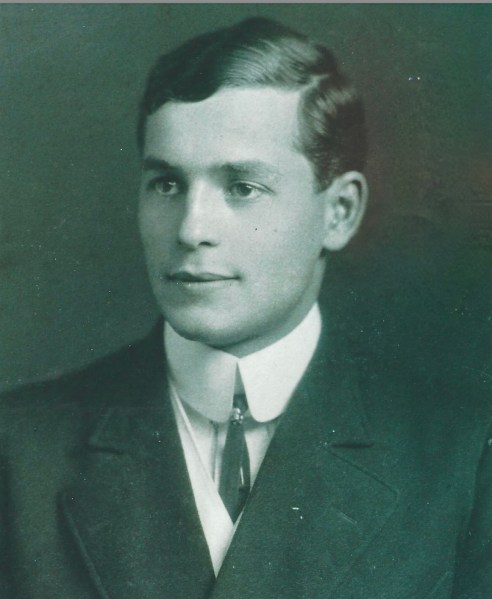
This photo of Dr. Ben Workman appears in Christine Johnston’s book The Father of Canadian Psychiatry, Joseph Workman

His choice of Canada turned out to be a good decision: within 10 years, all of his eight younger siblings and both of their parents had followed him. The Workmans were all hard-working, ambitious and smart, and they took advantage of the opportunities available to them in their new homeland. Four of Ben’s brothers (Alexander, Joseph, William and Thomas) became prominent in business, medicine and politics. His only sister, Ann (1809-1882), married Irish-born Montreal hardware merchant Henry Mulholland and was my great-great-grandmother.

Benjamin’s parents were Joseph Workman (1759-1848) and Catherine Gowdey (1769-1872). Ben was born on Nov. 4, 17942 in the village of Ballymacash, County Antrim, near Lisburn, where the family lived in a small house near the top of a hill.  

Joesph was a teacher in Ballymacash, but he left teaching for a job as a manager for a local landowner, and as a deputy clerk of the peace for the area. Without its only teacher, the local school had to close, so young Ben started studying on his own, reading the Bible and geography books while his father helped him with arithmetic. When Ben was 11, Joseph apprenticed him to a linen weaver, but it soon became clear that Ben had no talent in that field. What he really wanted to do was study. Eventually, Ben went back to school, where he excelled in grammar and the classics. After he graduated, he found a teaching job in Belfast, then another position near Lisburn.   

Ben’s decision to leave Ireland was influenced by an event that took place in 1817. As he was eating his evening meal at his parents’ home, a dozen beggars came in the gate and asked for food and money. Perhaps realizing how widespread poverty was in Ireland, he began to think about going to North America.3

Montreal suited Ben well: other Irish and Scottish immigrants arrived there around the same time, and there were work opportunities for all. He immediately found a teaching job, but after that school’s owner disappeared with its funds, several parents who had noticed what a good teacher Ben was started a new school, with Ben as headmaster.

The Union School, as it was called, was unique. For one thing, girls were admitted, although they were taught separately by a female teacher. It was also successful. By the spring of 1820, it had 120 pupils, and it remained the largest English school in Canada for 20 years.4 Several of its graduates went on to have distinguished careers in business and politics. In 1824, Ben became the sole owner of the school, but he eventually turned over the responsibility of running it to his brother Alexander, who had come to Montreal in 1820.

In 1829, Benjamin switched careers and became a newspaper editor, partnering with a friend to purchase a weekly Montreal newspaper, the Canadian Courant. It had been founded in 1807 as the Canadian Courant and Montreal Advertiser. Ben published the newspaper until 1834, using it to promote his liberal religious views, social welfare issues, and the temperance movement. When the paper ceased publication, Ben blamed distillers, saying that their advertising had dried up because of his support for temperance.

Meanwhile, Ben experienced several tragedies in his personal life, as he was married twice and became a widower twice. He married Margaret Manson, a teacher at the Union School, in 1823. The couple had no children and Margaret died seven years later. He married Mary Ann Mills on October 14, 1838, in Franklin, Michigan, and the couple had three children: Mary Matilda, born in July 1840; a son, Joseph, who was born in November 1841 and died at age 10 months; and Annie, born in July 1843. Mary Ann died two months after Annie’s birth, and Ben’s mother, Catherine, looked after his two daughters.

Soon after that, Ben took up his third career — as a druggist. For several years in the 1840s, Lovell’s city directory of Montreal listed “B. Workman & Co., chemists and druggists”, located at 172 St. Paul Street, corner Customs House Square.5 Meanwhile, he studied medicine at McGill University, graduating in 1853, at age 59. He was henceforth known as Benjamin Workman M.D., which helps differentiate him from several other Benjamins in the family.

During these years as a pharmacist and doctor, Ben demonstrated compassion and generosity, often providing care to people who were too poor to pay. Then, in 1856, he reinvented himself again and moved to Toronto, where he assisted his brother Joseph run the Provincial Lunatic Asylum, the largest and most progressive psychiatric hospital in Canada at the time.
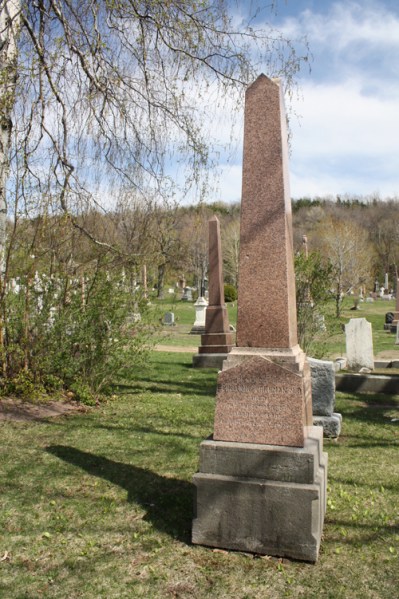
Benjamin is buried in Montreal’s Mount Royal Cemetery, near the Workman family plot. JH photo.

Benjamin Workman is probably best remembered as the founder of the Unitarian Congregation in Montreal.  In Ireland, the Workman family had attended the Non-Subscribing Presbyterian Church of Ireland in Dunmurry. Its members strongly believed in freedom of thought in religion.6

When Ben first arrived in Montreal, there were not enough Unitarians to organize a congregation, so he attended the St. Gabriel Street Presbyterian Church. When the city’s Unitarian congregation was permanently established in 1842, he played a key role.7

In 1855, Ben got into a disagreement with the congregation’s minister, Rev. John Cordner, a man he himself had recruited for the job. Benjamin argued that Cordner had excessive authority, and when the rest of the congregation sided with their minister, Ben withdrew from the church. Soon after, he moved to Toronto, joining the Unitarian congregation his brother Joseph had helped to found there. He got along well with the Toronto congregation’s members and their minister, and he ran the Sunday School there for many years.

Ben lived with his daughter Anne in Uxbridge Ontario at the end of his life, dying there on Sept. 26, 1878, several weeks short of his 84th birthday. He was buried a few days later next to the large Workman family plot at Montreal’s Mount Royal Cemetery.

This article is also posted on http://www.writinguptheancestors.ca.

See also:

Janice Hamilton, “Dr. Joseph Workman, Pioneer in the Treatment of Mental Illness” Writing Up the Ancestors, Oct 26, 2017, https://www.writinguptheancestors.ca/2017/10/dr-joseph-workman-mental-health-pioneer.html

Janice Hamilton, “Henry Mulholland, Hardware Merchant” Writing Up the Ancestors, March 17, 2016,  https://www.writinguptheancestors.ca/2016/03/henry-mulholland-montreal-hardware.html

Notes:

The children of Joseph and Catherine Workman were: Benjamin (1794-1878), Alexander (1798-1891), John (1803-1829), Joseph (1805-1894), William (1807-1878). Ann (1809-1882), Samuel (1811-1869), Thomas (1813-1889), Matthew Francis (1815-1839).

Benjamin kept a journal in which he recorded his memories of growing up in Ballymacash, and an account of the Workman family’s 200-year history in Ireland.  A large online database called A Family Orchard: Leaves from the Workman Tree, https://freepages.rootsweb.com/~database/misc/WORKMAN.htm, includes a family history going back to the 1600s, that was part of Ben’s journal. The late Calgary researcher Frederick Hunter prepared this site and database. 

Catherine Gowdey’s name has been spelled in various ways, including Gowdie and Gowdy.

Thank you to Christine Johnston, former archivist and historian of the First Unitarian Congregation of Toronto, and author of a biography of Ben’s brother Joseph.

Sources: 

1. Christine I. M. Johnston, The Father of Canadian Psychiatry: Joseph Workman, Victoria: The Ogden Press, 2000, p. 16.

2. A Family Orchard: Leaves from the Workman Tree, https://freepages.rootsweb.com/~database/misc/WORKMAN.htm, accessed Jan. 31, 2025.

3. The Digger, One Family’s Journey from Ballymacash to Canada, Lisburn.com, http://lisburn.com/history/digger/Digger-2011/digger-19-08-2011.html, accessed Jan. 31, 2024.

4. Nicholas Flood Davin, The Irishman in Canada, London: S. Low, Marston, 1877, p. 334, Internet Archive, https://archive.org/details/irishmanincanada00daviuoft/page/334/mode/2up, accessed Jan. 31, 2025.

5. Lovells Montreal Directory, 1849, p. 246, Bibliothèque et Archives nationales du Québec (BAnQ), https://numerique.banq.qc.ca/patrimoine/details/52327/3652392, accessed Jan. 31, 2024.

6. Christine Johnston, The Father of Canadian Psychiatry: Joseph Workman, p. 15.

7. Christine Johnston. “The Irish Connection: Benjamin and Joseph and Their Brothers and Their Coats of Many Colours,” CUUHS Meeting, May 1982, Paper #4, p. 2.
Is There a Doctor in the House?

Ismael Edgard Bruneau

As far as I can tell, Ismael Edgard Bruneau (1887 – 1967), my great uncle, was the first doctor in our family and maybe still the only doctor. His father wanted him to follow in his footsteps and become a minister, so when Edgar entered McGill in 1907, he registered for an Arts degree. During his university years, he decided he would rather be a doctor. He finished his Arts degree in 1910 while concurrently studying medicine and received that degree in 1912.

Edgar, as he became known, was the first of ten children of Ismael Bruneau and Ida Girod, my great-grandparents. He was born in Green Bay, Wisconsin, where his father served as a French Presbyterian minister. The family moved to Holyoke, Massachusetts, Quebec City and Montreal, where he did most of his schooling.

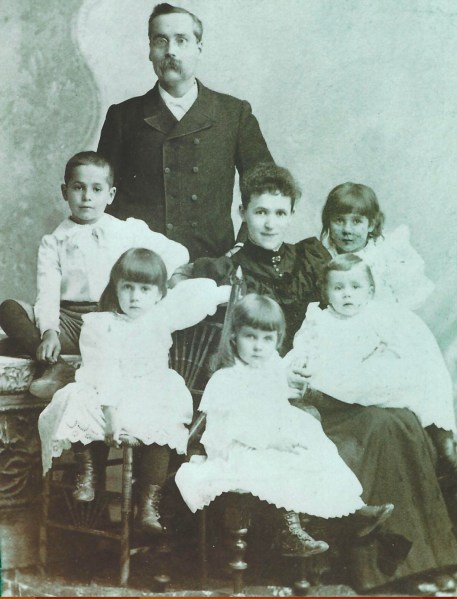
Ismael & Ida Bruneau with children Edgar top left, Hermonie, Helevetia, Sydney and Beatrice

He interned in Montreal and Ottawa and then practiced for a short time in Swift Current, Saskatchewan.

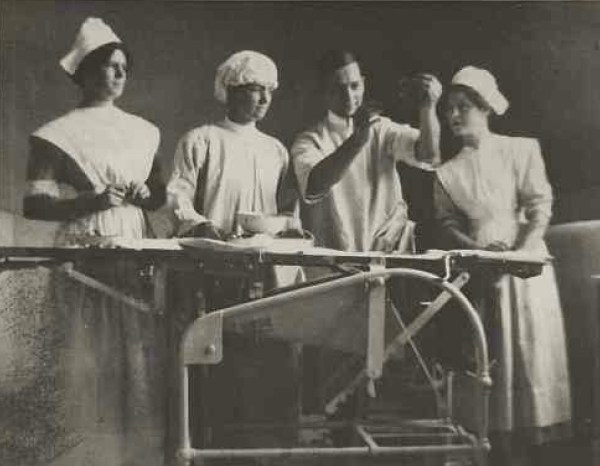
Dr Edgar Bruneau demonstrating techniques

When WWI began, he joined up with friends from McGill in the McGill Machine Gunners unit and was sent overseas in 1915. His father was unhappy with his decision to be a regular soldier and thought he should at least use his medical degree. Soon after arriving in England, he transferred to the Royal Army Medical Corp as a first lieutenant. This certainly didn’t keep him safe, as he served in France and Italy, being wounded twice and also severely gassed. Captain Bruneau was sent home to Canada in mid-1918. While in England, he visited with his Uncle Ernest Girod and became engaged to his cousin Marie but that relationship was over before he sailed home.

Edgar opened an office in Montreal as a general practitioner where he stayed his whole career. He lived on Park Avenue and had an office in his house with reception rooms on the ground floor and living space on the upper floor.

He also volunteered at the Montreal Dispensary through the 1920s. This clinic, established in 1850, gave health care to the poor. It was in downtown Montreal on St. Antoine Street, run by volunteer doctors and supported solely by donations. In the late 1920s, the Dispensary had financial difficulties and nearly closed but survived when it received a bequest of $10,000.

In the late thirties, Edgar suffered from a tubular disease in which the kidneys were damaged by lack of oxygen and blood flow, and so, for three years, he had to give up his practice. He was a much-loved doctor, as his patients visited him whether or not they needed care.

Edgar married Marie Eveline Lemoine in 1923. Before their marriage, they were in a car accident. He was driving on a street with streetcars when the traffic policeman gave him the signal to proceed. Unfortunately, the way was not clear and the car was hit by a streetcar. Eveline was thrown against the windshield, badly cut and she lost vision in one eye. Edgar felt responsible for her, so they married. Still, the marriage lasted 31 years until her death in 1954. Edgar was very social and attended all family gatherings but Eveline never did..

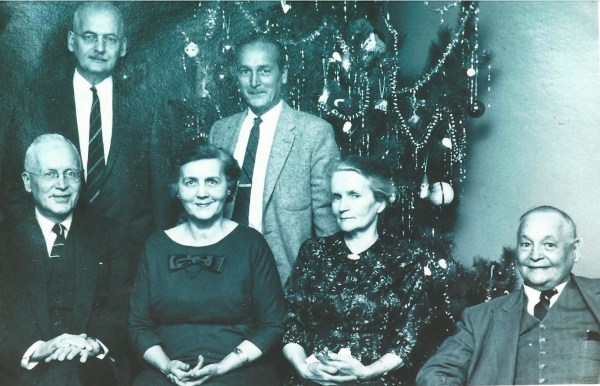
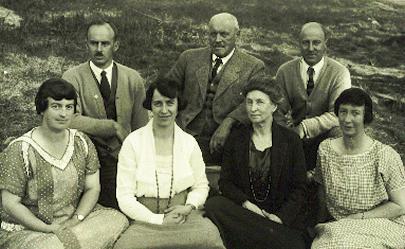
Six of the Bruneau children; Back row, Herbert & Gerald. Front row, Sydney, Edmee, Helvetia & Edgar ~1960.

One night, in the late 1950s, Edgar fell, going downstairs to his basement to fix the furnace. He broke his leg and wasn’t discovered until his housekeeper arrived in the morning. His brother Herbert wrote that when he was found, his leg was black and although the doctors saved it at that time, it resulted in gangrene. Edgar, like most of his siblings, had developed type II diabetes, which resulted in poor circulation in his legs. He first had his toes removed, then later, after many operations, most of his leg was amputated.

Edgar spent his final years at the St Anne’s Veteran’s Hospital in St Anne de Bellevue, Quebec. My sister said she never wanted to visit him as one of us told her he hung his leg in a stocking on his door at Christmas. Edgar is buried in Montreal’s Mount Royal Cemetery alongside his wife

Notes:

Recollections by Victor Herbert Bruneau , May 19, 1976.

Edgar was a keen fisherman.

He joined the Masonic Order and became a Shriner.

He was very musical; played the organ for his father’s services from the age of ten and he could play any tune he heard on the piano. He was popular with his comrades during the war and a good host afterwards.

I have no pictures of Evelyn. Edgar went to all the family functions and was very social but never Evelyn. She did play bridge and was mentioned in the newspaper as an attende at Karnac bridges put on by the Shriners.

All in the Family: The Butchers of Montreal

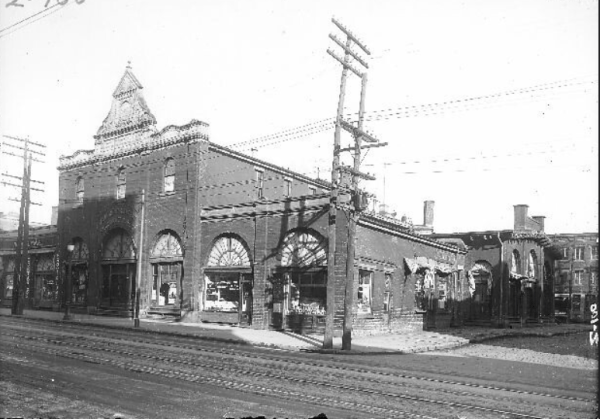
Marche St Laurent. Flicker Public domain

Every country has a foundation myth and so, too, have some families.

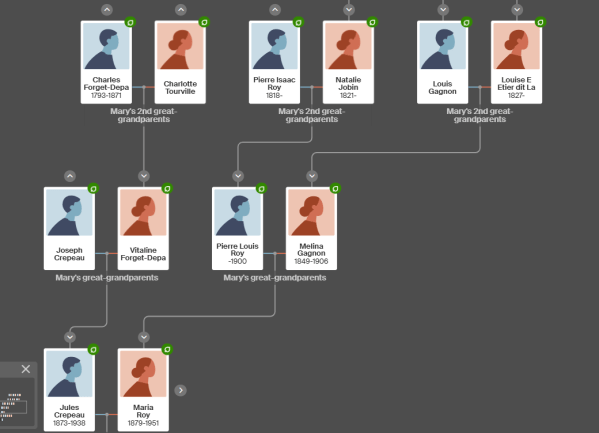
My mother’s family foundation myth was that her mother, Maria Gagnon Roy, was the daughter of a ‘master butcher’ and that she brought an enormous dowry of 40,000 dollars to her 1901 marriage to Jules Crepeau, a hardworking and ambitious 27 year old clerk at Montreal City Hall.

“Jules started out sweeping the floors at City Hall at eight years old,” my mom often said with a tear in her eye but according to his file there his first official post was in 1888 at 15 years old as messenger boy in the Health Department.*

My mother put so much store in this family myth that she even attributed her 5 foot 8 and a half inch height (tall for a French Canadian) to the fact she came from butchers. All that good steak they ate!

Left to right, Aunt Flo, my mom Marthe, Maria and Jules 1927ish.


The Father-in-Law: Maria’s Dad

My great-grandfather, Louis Roy, (circa 1843 to 1900) was the son of Pierre Isaac Roy and Natalie Jobin of Montreal and he worked as a butcher from 1860 to 1900. He came from a long line of butchers. In 1865 Louis Roy married Melina Gagnon, whose mother, Eleanore Ethier dit Lamalice,1 came from butchers as well.

At first Louis worked alone at St. Laurent Market and then from 1881 to 1896 he partnered with a J. Lamalice, likely his cousin. Roy et Lamalice had two stalls, 16 and 17, at that market in the south central part of the city near what is now Chinatown. Their partnership was dissolved in 1896 when Louis’s son, also Louis, entered the profession.

Louis Gagnon was a mason, all other men on Maria’s side were butchers.

L. Roy and J. Lamalice paid a good sum of money, perhaps 200 dollars a year a piece,2 to have these two stalls at St. Laurent Market.

According to a University of Laval thesis,4 butchers in Montreal were politically influential. Public markets were designed around their needs, in large part because of the slew of health regulations around the slaughter and sale of meat. Retail butchers also profited greatly at these public markets, more so than their private counterparts, sometimes only having to work 2 or 3 days a week to pay the bills.

Louis Roy and his ‘small’ French Canadian family, wife Melina, son Louis and daughters Eugenie and Maria, lived at various addresses early on, then moved to 357 Amherst around 1880 and then in 1890 to 515 Amherst, a brand new ‘small cottage.’

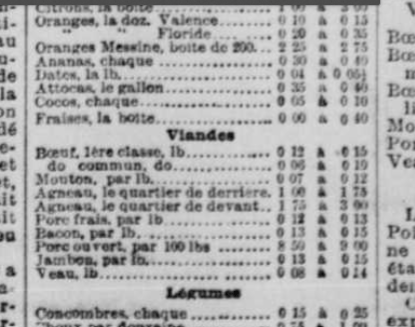
Price of meat Bonsecours Market, 1893


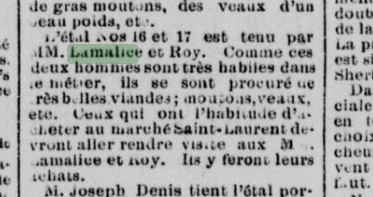
L. Roy et J Lamalice advertised regularly in all the Montreal papers, usually a little blurb like this.

Roy and Lamalice are very capable with very nice mutton, veal etc. Other ads focused on how beautifully the stall was decorated. (Clearly ladies did the shopping.)


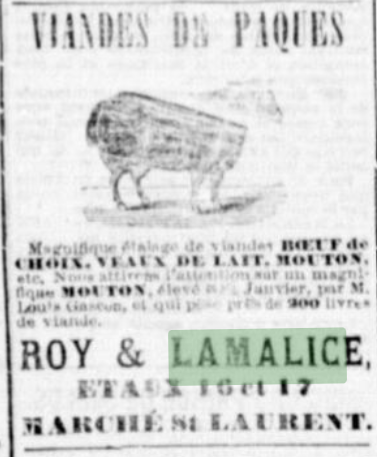
They sometimes put in bigger ads

Choice beef, milk fed veal and mutton for Easter.


And they gave to charity, as well, Notre Dame Hospital and the Public Welfare are two examples I discovered.

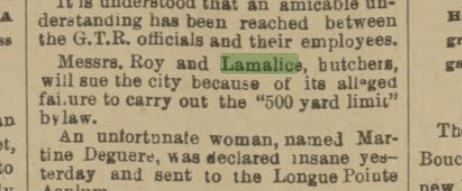
It may be significant that in 1891 Roy et Lamalice brought the City of Montreal to court. They complained that the City wasn’t doing enough to keep private butchers the mandated 500 yards away from the public markets.

They pay a license fee for a stall of 200 dollars, say Roy and Lamalice, as reported in Le Minerve.

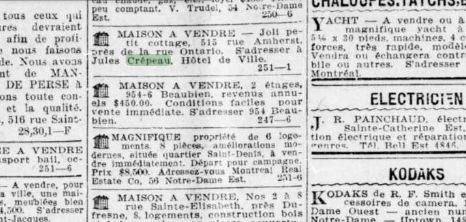
I have to wonder if this is where Louis Roy, master butcher, first met – or maybe locked horns with – the City Hall up-and-comer Jules Crepeau, messenger boy in the Health Department – but a boy gifted with a superb memory for regulations and by-laws.3


In 1896, Jules Crepeau, Second Assistant City Clerk, was assigned the post of Secretary of Public Markets, a suitable promotion considering his Health Department roots.

In 1900, a year before his marriage to Maria Roy, he would be involved in his first scandal at City Hall, one that involved butchers. Men in that trade claimed that aldermen were illegally charging them 50 dollars to have their stalls moved at the prestigious Bonsecours Market. Jules testified in Court and denied knowing anything about it.


In 1900/1901, the newly widowed Melina Roy rented out her Amherst house (yes, to a butcher) and moved to Notre Dame street to live with her married daughter, Eugenie, her husband Jacques (James) Deslauriers (son of a butcher who was deceased). She brought her young adult children Maria and Louis along. The Census man came around while she was there.

The 1901 census has my grandmother Maria and her brother Louis erroneously listed under Deslauriers. Laura Lacombe is an orphaned cousin. She would live with Maria and Jules until her death in 1921, just a few months before my Mom’s birth.


The Marriage of Jules and Maria

After my grandparents Maria and Jules got married on July 1, 1901, widow Melina and her grown up son Louis moved back into 515 Amherst with the newlyweds.

In late 1901, Jules applied for a permit to build a three story brick building worth 3,000 dollars at 513 Amherst next door and the next year he would rent it out to three different families.

Maria would very soon give birth to my Uncle Louis. (Louis was baptized exactly nine months after the wedding.) My Aunt Alice would arrive a year after that and in 1905 the Crepeau family would move to St. Hubert Street near Marie-Anne.

Melina Roy and her son Louis, Melina’s orphaned niece Laura, and possibly the Deslauriers would stay at 515 Amherst for a year until Melina’s death in 1906 upon which time Jules would sell the ‘small cottage.’


The Dowry

A notarial record reveal there was, indeed, a 1901 marriage contract for Jules and Maria from June 27, a few days before the marriage, but of course there are no details so no proof of a 40,000 dollar dowry.

It does look like Jules came into some money early in his marriage. He builds that brick triplex and then moves in 1905 to what is still a very tony area with tall elegant stone townhouses.

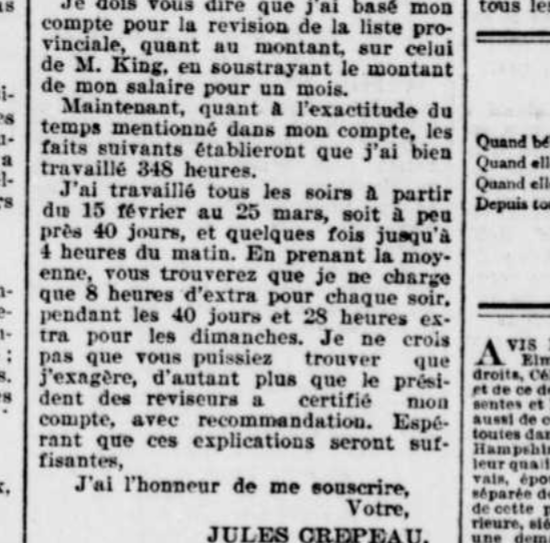
Before his marriage, Jules was making around 700 dollars a year at City Hall, a middling/good salary for a family man although at one point he asked for 248 dollars in overtime because “over a forty day period I worked 348 hours until four in the morning and on Sundays.”*

Still, a 40,000 dollar diary for Maria’s marriage seems highly unlikely. (That’s 1,500,000 in today’s money.)

I am doubly skeptical about the big dowry because I did not find any contract listing for the 1897 marriage of Maria’s older sister, Eugenie, to Jacques (James) Deslauriers, merchant. This suggests Eugenie received no formal dowry.

Why the second daughter and not the first?

Also, If Louis Roy, successful master butcher, left behind a large estate why did Melina Roy rent out her modest Amherst home after he died and move in with her daughter Eugenie and the husband. To help with the grandchildren?

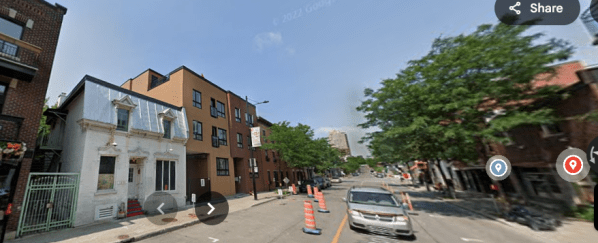
A modest street in 1900, Amherst today is called Attikan. The only remnant of an early era is this little ‘French Canadian” cottage on the corner where everyone lived in 1901.


Lovell’s Directory to the Rescue.

When I first looked for Jules and Maria on the 1901 automated census I found neither one. Maria was erroneously listed under Deslauriers and Jules wasn’t there.

So, it took me years, but eventually I consulted Lovell’s to discover that prior to his marriage Jules was living on Mentana Street in the Le Plateau Mont Royale with his widowed mother, Vitaline Forget Despaties Crepeau, and his three brothers, the older Isadore and the younger Roderick and Paul.

Isadore in that era is already working in insurance – as he would for the rest of his life. In 1898 Roderick is listed as a plumber, then a year later as a butcher. His brother Paul makes the Lovell’s listing in 1899 and is listed as a butcher working at “R. Crepeau and Freres.”

It’s all very suspicious because the highly regulated butcher trade wasn’t something you could jump in and out of. I suspect older brother Jules, son of a mere house painter, pulled some strings to get his younger brothers a short cut into that lucrative trade. (Neither man would remain a butcher for long.) If my grandmother’s family tree proves anything, it’s that the butchers of Montreal liked to keep it in the family!

So, I still have no concrete proof but it would not surprise me if my grandmother Maria’s dowry, whatever the true amount, was provided by a group of butchers (perhaps all members of her extended family) in return for Jules’ support at Montreal City Hall.

Prior to his marriage to my grandmother, Maria Roy, as I said, Jules had had plenty of chance to interact with these ‘politically influential’ tradesmen.

Anyway, that was simply business as usual in those days.

  1. Eleanore Ethier dit Lamalice was also a distant relation of Jules Crepeau through the Ethier line of Lachenai Seigneury. See my Why My Grandfather had a lot of Gaul on this site.
  2. This is the sum that Louis Roy cites in his 1896 complaint as reported in the French papers. It’s called a license of 200 dollars to have a stall at St Laurent Market. In the 1920’s the sum is just 50 dollars a stall, I discovered in another online item but by then the butchers are paying hefty income taxes, so they mention how high this income tax is in their complaints.
  3. Le Devoir says Jules’ mind was like a bank vault holding within all the city by-laws. This was in his 1938 obituary.
  4. YVES BERGERON:LES ANCIENNES HALLES ET PLACES DE MARCHÉ AU QUÉBEC :ÉTUDE D’ETHNOLOGIE APPLIQUÉE. University of Laval Thesis Canadian Thesis portal

5. Newsy items courtesy of BANQ newspaper archive.

The Gaspé Peninsula

The Province of Quebec is breathtakingly beautiful.  I have been all over the province and I am constantly amazed.

One of my favourite trips was when, in 1982, after we had moved into our first house, we decided to leave all the angst of being a first-time home owner at a young age and go on a road trip. We decided to visit the Gaspé Peninsula. We simply loved our trip. The countryside was stunning and the Gaspésians showed us a warm welcome.

Courtesy Tripadvisor

Did your ancestors settle or live on the Gaspé Peninsula? The first European to arrive in the Gaspé was Jacques Cartier when he landed in Gaspé Bay in 1534 to plant a cross and claim the land for the King of France. The Iroquois occupied the area. It is believed that the name Gaspé derives from a Micmac word meaning “land’s end.” 1

When the Gaspé belonged to New France, there were only about 400 fishermen living there. Harvests were plentiful and the coastal high winds were excellent for drying cod. However, James Wolf and his forces attacked the residents in 1758, destroying their homes and possessions and sending them back to France.2

Still, some Gaspesians managed to hide from the authorities and remained on the peninsula until 1763 when it became a British territory. They were joined by Acadians who fled from the British who had implemented a compulsory deportation order for all Acadians in Nova Scotia. In 1784, a significant number of Loyalists, fleeing the American Revolution, settled on the Gaspé Peninsula.3

If your ancestors came from the Gaspé, here are some sites that can help you with your research:

The Quebec Genealogy eSociety has extensive links and resources (requires a membership). Some of the resources include births, marriages, deaths and some census records, and newspapers: https://genquebec.com/en

GoGaspé is a site devoted to the Gaspé Peninsula with a tab that directs you to history and genealogy links and resources. Local Gaspesian genealogists and historians have contributed to this site: https://gogaspe.com/

Jacques Gagné’s compilation about the Channel Islanders on this blog: https://genealogyensemble.com/2016/08/21/the-channel-islanders-of-eastern-quebec/

Jacques Gagné’s tips on researching your Gaspé ancestors on this blog:https://genealogyensemble.com/2019/01/20/tips-on-researching-gaspe-ancestors/

Musée de la Gaspésie: https://museedelagaspesie.ca/en/index.php

Sources for information about settlement of the Gaspé Peninsula.

  1. The Canadian Encyclopedia, Lee, David, 7 February 2006, https://www.thecanadianencyclopedia.ca/en/article/gaspe-peninsula#:~:text=In%201784%20about%20400%20English,dependence%20on%20the%20fishing%20industry, accessed 11 February 2025
  2. The Canadian Encyclopedia, Lee, David, 7 February 2006, https://www.thecanadianencyclopedia.ca/en/article/gaspe-peninsula#:~:text=In%201784%20about%20400%20English,dependence%20on%20the%20fishing%20industry, accessed 12 February 2012
  3. The Canadian Encyclopedia, Lee, David, 7 February 2006, https://www.thecanadianencyclopedia.ca/en/article/gaspe-peninsula#:~:text=In%201784%20about%20400%20English,dependence%20on%20the%20fishing%20industry, accessed 12 February 2012

Uncle Bill and His Five Daughters

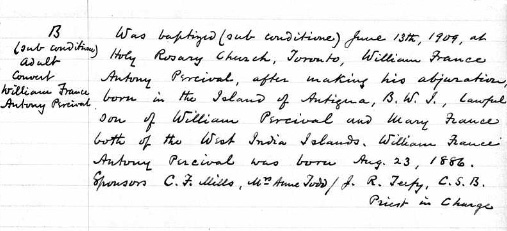
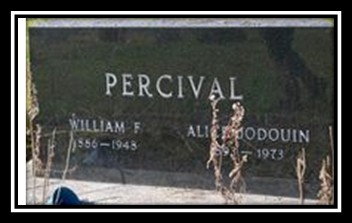
On August 23rd, 1886 in St. John’s, Antigua, British West Indies Mary France, the wife of William Percival gave birth to a son, William France Anthony Percival, my Uncle Bill.

Little is known about his early years in Antigua. At the age of eighteen in 1904 he immigrated to Canada. Records indicate that on the 13th of June 1909 at the age of 23 he converted to Catholicism and was baptised at the Holy Rosary Parish in Toronto.

Baptismal Record

In 1914 Bill settled in Sudbury, Ontario and began working as a dispatcher and later became the Assistant Chief Clerk for Canadian Pacific Railway. A job he held for 33 years.

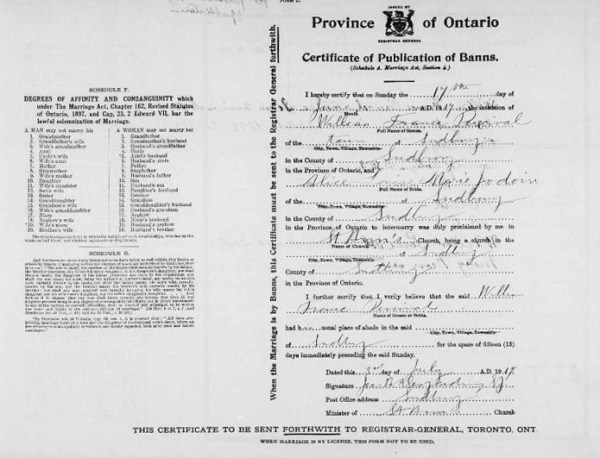
Bill began courting Alice Jodouin, the daughter of Louis and Louisa Jodouin.  Before long the customary banns announcing the upcoming marriage of the young couple were published. Banns are a notice read out on three successive Sundays in a parish church, announcing an intended marriage and giving the opportunity for objections.

The banns

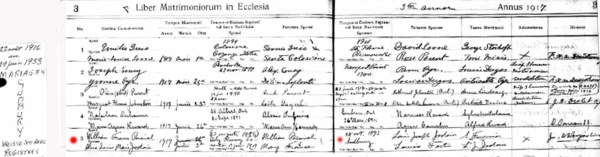
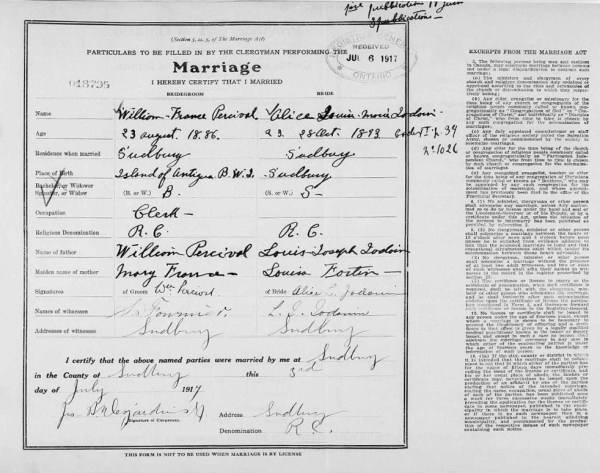
Uncle Bill and Aunt Alice were married on the 3rd of July 1917 in Saint Anne Church, the French Parish in Sudbury.

The church record of the marriage

The officiating Priest

The 1921 Canadian Census shows Uncle, Aunt Alice and their first daughter, Mary.was born in 1919.Later in 1921, Madge was born, followed by Frederica (Freddie)  in 1923, then Natalie in 1925 and Willena (Billye) in 1927.

After raising 5 daughters they were hoping for a son. In 1934 Aunt Alice was expecting another child. Would it be a boy? The family would be complete with the son they had always wanted and a little brother for all the girls

Alas! It was not meant to be. John Allan was stillborn. This tragedy, the loss of a son caused many heartaches for the family.

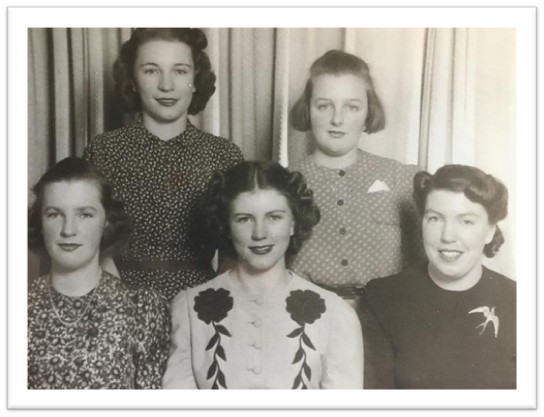
The Percival Sisters
Back row: Freddie and Billye
Front Row: Natalie, Madge and Mary

I never knew Uncle Bill, however, he enjoyed quiet moments sailing on Lake Ramsey, according to my older brother Karl, who had the good fortune of knowing him. At the time I was too young and our family moved from Sudbury to the rolling hills of the Eastern Townships in Quebec. I do not remember Uncle Bill.

Shortly after retiring Uncle Bill passed away on December 8th, 1948 at the age of 62.
Aunt Alice surrounded by her many grandchildren.
Aunt Alice lived another 25 years after Uncle Bill’s passing and continued as the church organist. She died in 1973  and is resting beside him  in the LaSalle Catholic Cemetery in Sudbury, Ontario

Over the years I  have visited many relatives in Sudbury and have fond memories.

Sources:

Familysearch.org

Personal photo collection of the author

Part Two of Remembering Great-Grand Uncle Arthur Symons – The Price of Survival

This is part two of my Great-Grand Uncle Arthur Symons’s experiences in WWI. Arthur emigrated to Canada in 1901, arriving in Halifax, Nova Scotia, on the SS Soman. (1)

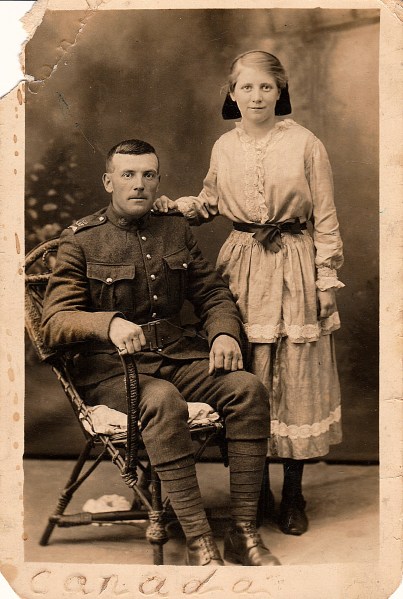
When WWI broke out, Uncle Arthur enlisted in the 56th Battalion Canadian Over-Seas Expeditionary Force in 1915 in Calgary. He was then shipped back home to the UK to train. While there, he visited his sister Lilian and her daughter Edith, my Grandmother.

Arthur Symons with Edith Bevan his niece, my Granny.

Granny was 15 years old.

At Salisbury, Wiltshire, England, the Canadians trained for four months, most of it in terrible mud, as England experienced one of its wettest winters in decades. While most troops stood up well to the awful conditions, Canadian equipment did not. Much of it was soon discarded in favour of British types. The Canadians learned basic soldiering in England after a hasty mobilization and a difficult, uncomfortable winter. Their real training would come at the front.

After training, Arthur was sent to France and later Belgium. At the Third Battle of Ypres, better known as Passchendaele, the troops fought there from July to November 1917. Both sides suffered appalling conditions and heavy casualties. “The name Passchendaele has become synonymous with mud, blood and futility”. Arthur was wounded in 1917 at Passchendaele. (2)

The Government of Canada Library and Archives search had Arthur’s Attestation Papers and detailed medical treatments at “No. 4 General Hospital Dannes Camiers” (2) among many other hospital visits.

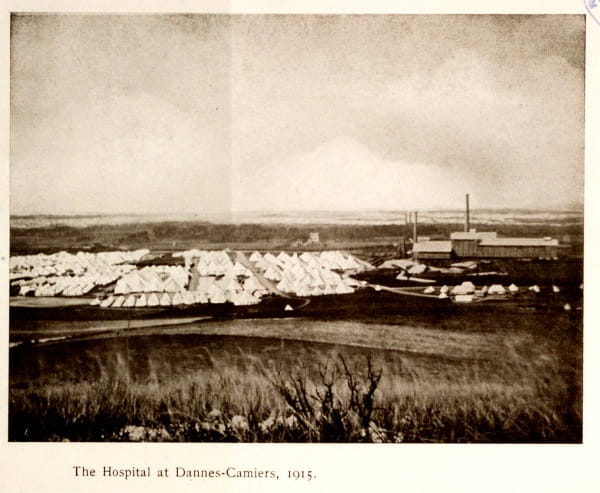
Searching for Dannes Camiers Hospital, led me to the Royal College of Surgeons of England and the following information. (2)

Shortly after the war broke out, McGill University organised the ‘No. 3 Canadian General Hospital’ to serve in France. The hospital was established at Dannes Camiers in the Pas-de-Calais area on 19th June 1915 under canvas. A staff of 35 Officers, 73 Nursing Sisters and 190 rank and file. Life under canvas that cold wet November was tough, with deep mud, storms, frost and collapsing tents. The conditions so undermined the health of one Lieutenant Colonel Yates that he was invalided to England where he died the following year.

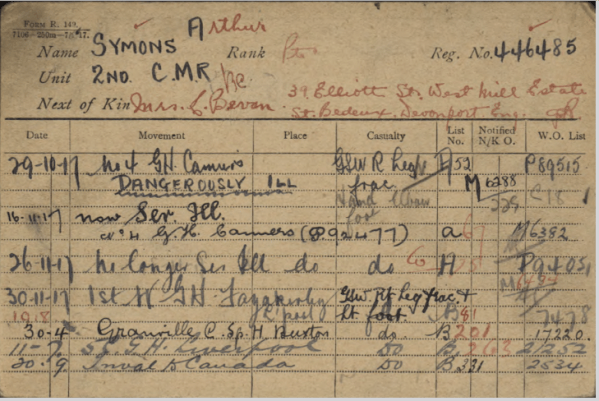
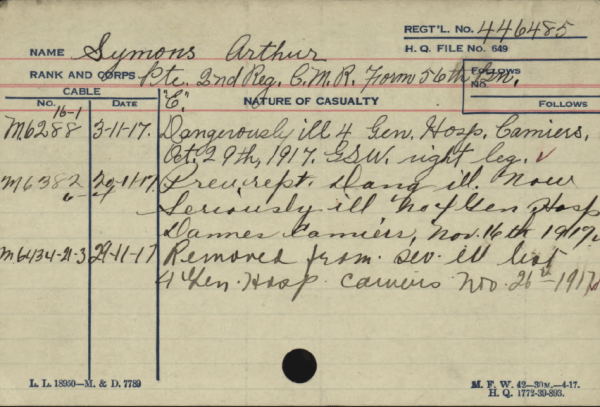
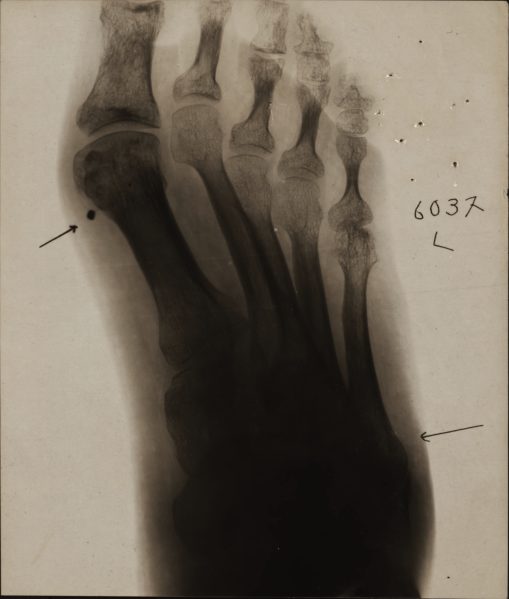
Arthur’s admission to the Dannes Camiers Hospital was on the 29th of October 1917. The first line of his medical records states he is ‘Dangerously ill’ with GSW (gunshot wounds) R. Leg fracture and left foot.

By the 16th of November, Arthur is now ‘seriously ill’ There follows 99 pages – starting with his Attestation Paper – then very detailed treatments and x-rays from various hospitals in France, England and Alberta, Canada. It makes for fascinating reading.

Three pages from Arthur’s 99 pages of hospital notes and X-rays.

On the 30 of November 1917, Arthur was transferred to the 1st West General Hospital Fazakerly, Liverpool England. After 5 months of treatment, Arthur was again moved to the Canadian Special Hospital Buxton, Derbyshire, England.

NOTE: Amongst the patients at Buxton, was Frederick G Banting, who would return to Canada after the war to continue research into diabetes and the use of insulin in its treatment, for which he was awarded the Nobel prize. (3)

His last transfer was on July 11, 1918, to the 5th Canadian General Kirkdale, Liverpool, England.

Eventually, on the 20th of September, 1918, Arthur was Invalided to Canada. He was sent to the Ogden military convalescent hospital in Calgary, Alberta. A short visit to the Calgary General Hospital, then back to Ogden.

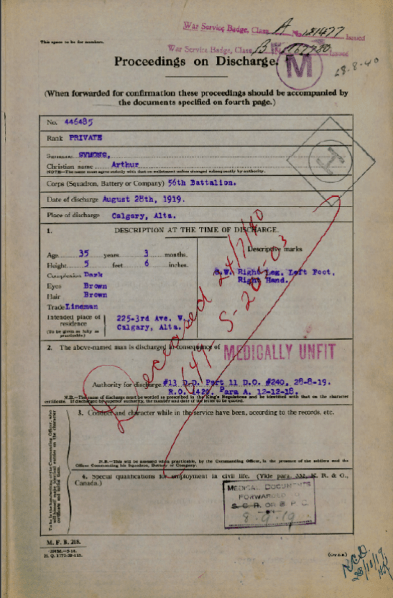
Finally, after nearly 2 years at 5 different hospitals, Arthur was sent to the Banff Rest Camp, and discharged on August 28, 1919, medically unfit for further service. He was 35 years old.

Arthur went on to marry and have two children and was employed in the Civil Service

This rather poignant note dashed across his discharge papers state ‘Deceased 24/7/40’

Excerpt from The Calgary Herald, July 26, 1940, page 2
Arthur Symons, 54, of 2409 Centre Street South, died in hospital here Wednesday afternoon. Born in Leicester, England, he came to Calgary 32 years ago and was employed in the civil service for 17 years. He is survived by his wife, Catherine, one son, Arthur, and one daughter, Dorothy.
Alberta Death Reg. #1940-08-201498

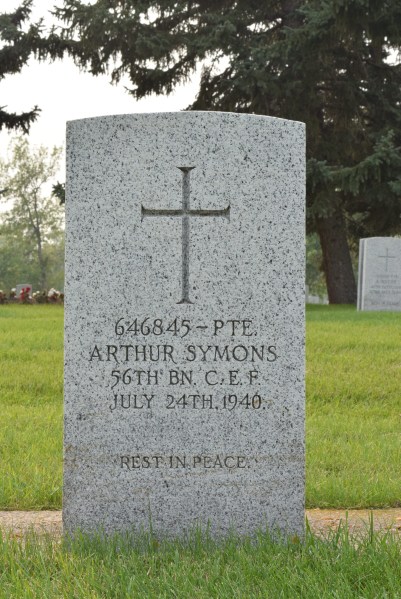
Great-Grand Uncle Arthur Symons is buried in Burnsland Cemetary, Calgary Alberta, Canada. (Photo credit Ron Reine)

RIP Uncle Arthur.

Part 1 of Great-Grand-Uncle Arthur’s experiences in WW1:

(1) https://genealogyensemble.com/2024/11/11/remembering-great-grand-uncle/

(2) https://www.rcseng.ac.uk/library-and-publications/library/blog/we-will-remember-them-no-3-canadian-general-hospital/

(3) https://buxtonmuseumandartgallery.wordpress.com/2019/12/13/canadian-red-cross-special-hospital-buxton-1915-1919/

(4) Dr. Frederick Banting

Not Just A Kingston Girl

My great-grandparents, Harriet Eva Gould and William Gardiner (WG) Anglin shared 48 years of marriage together, and their lives exemplify the saying “Behind every great man is a great woman.” In many cases, when we look into our family history, finding information about our female ancestors can be tough. After they marry, their maiden names are often forgotten, their careers aren’t recorded, and their lives tend to be defined by their roles as wives, mothers and community participants. Such was the case for Harriet too, as is clear from her obituary.

Mrs. Harriet Anglin – there passed away at her home on 52 Earl Street, on Saturday evening, Mrs. Anglin wife of Dr. W.G. Anglin, deceased, who was before her marriage Harriet Eva Gould, had lived in Kingston since her girlhood days. For the past year and a half, she had been ill. Mrs. Anglin who was of retiring nature, was most widely known through her membership in Sydenham Street United Church.

Surviving her are two sons, Douglas Anglin of Anglin-Norcross Construction Company, Montreal, and Wendling Anglin of the Johnston and Ward firm, Montreal; also three daughters Mrs. McLaren Ewert of Moosejaw, Sask.; Mrs. R. M. Horsey of Montreal and Miss Mary Anglin, secretary to the Principal of Queen’s University; also one sister, Mrs. John Hunter of Goderich and three brothers, George, Harry and William Gould. Ten grandchildren also survive.

Prior to meeting each other, Harriet and WG gained experiences that would serve them well when they married.

Harriet Joins Kingston Society

For the first decade of her life, Harriet grew up as the eldest child of William Gould and Mary Wartman in Ancaster, Ontario. When she was about 11 years old, according to the 1871 census, her parents sent her to Kingston, Ontario, to live with her mother’s sister Susanna, who was married to a wealthy businessman named James Richardson. It’s not clear why they made this decision, but it’s believed that the Gould family couldn’t support all their children. At the same time, Aunt Susanna, who had only sons, longed for a daughter. 

The arrangement worked well for everyone: Harriet was raised in a comfortable home and Aunt Susanna got the daughter she always wanted. While living with her aunt, Harriet received a good education and was introduced to Kingston society. She became known for her connections to the prominent Richardson family and her Loyalist heritage through her mother’s side. This social standing would play a part in her future, especially when she married.

William Gardiner (WG) Becomes a Surgeon

Before their marriage in 1886, WG went to Edinburgh, Scotland, where he learned new surgical techniques from Dr. James Lister, a pioneer in antiseptic surgery. After his return and marriage to Harriet, WG was invited to teach at Queen’s Women’s Medical College. Surgeon and Mentalist

Career and Family Life

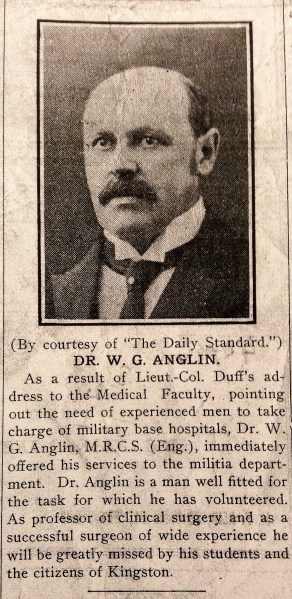
WG’s skill and dedication quickly earned him a spot on the prestigious faculty at Queen’s University. By 1887, he was appointed as a Professor of Pathology and head of the Clinical Surgery department. He shared the groundbreaking techniques he had learned in Edinburgh with his students, shaping the future of surgery in Canada. 

He and Harriet had their first daughter, Mary (1888-1979), that same year. In the following years came Susan (1889–1982), Douglas (1890–1955), Wendling (1892–1955) The Stock Broker, and Ruth (1895–1976). It’s believed that Mary and Susan were named after Harriet’s Aunt Susanna.

1923 – Douglas, WG, Wendling, Susan, Ruth, Harriet, Mary

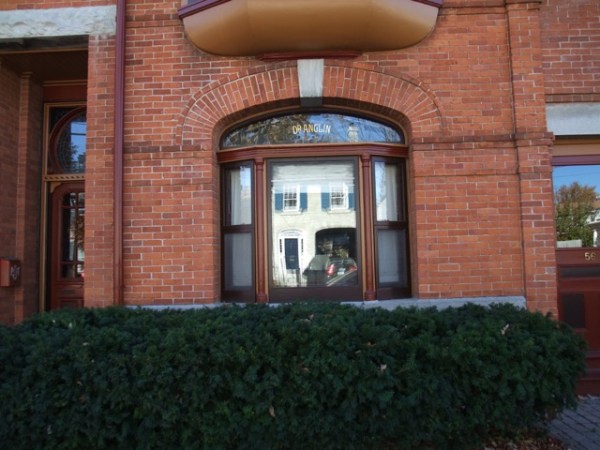
Throughout these years, W.G. ran a private medical practice from their home on Earl Street, which allowed him to spend time with the family. His name was even etched in stained glass in the window of their office building.

52 Earl Street with “Dr. Anglin” etched in top glass


Going to War

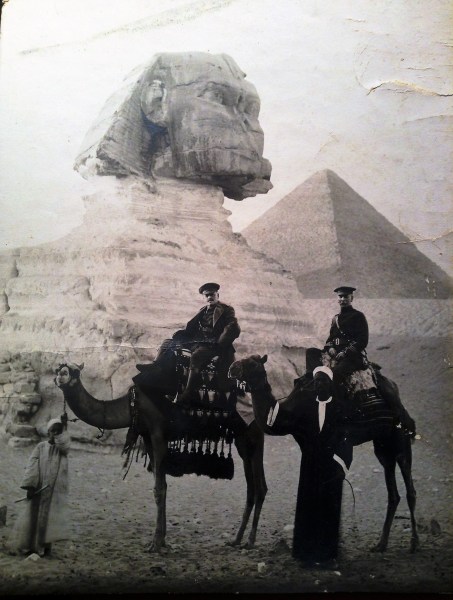
In 1915, WG left his teaching job and volunteered to go to Cairo, Egypt, with the Queen’s Stationary Hospital at 59 years old, in response to a plea from Lieutenant Colonel H.R. Duff, who needed someone with “experience and wisdom.” He caught Malta Fever and had to return to Canada a year later. Although he recovered a bit, the illness affected his health for the rest of his life. Duff, however, died of pneumonia in Cairo.

1915 – Cairo, Egypt, WG on the left camel

Community Leaders

After the war, WG continued working in medicine on a limited basis and served as an examiner for the Canadian Pension Board. He also worked at Kingston Penitentiary, where he introduced medical and administrative improvements and treated the inmates with dignity until he retired in 1928. 

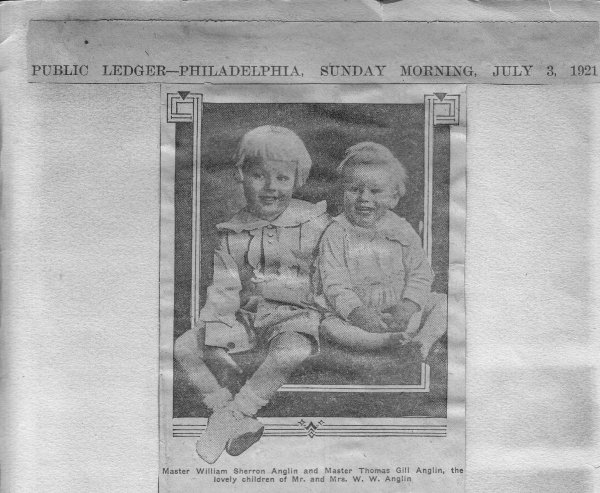
Harriet remained dedicated to her children, their families and her church. As a proud grandmother, she tucked a newspaper clipping of a photo of my father and his brother into a random book where it slipped out 90 years later into the hands of a distant cousin who then made contact with me!

1921 newspaper clipping of my Uncle Bill and my father Tom Social Media – Then and Now

In their later years, Harriet and WG were well-respected members of their Kingston community until he died in 1934. She died only two years later and they are now buried together in the Anglin plot at Cataraqui Cemetery.

Mulholland Bros. Hardware Merchants

In 1878, two brothers from Montreal opened a hardware store in Winnipeg, Manitoba. The Prairie city, known as the “gateway to the west,” was growing rapidly, and for several years the store appears to have been profitable, however, it went bankrupt in 1889. After that, the brothers’ lives took very different paths.

Mulholland Bros. Hardware Merchants was owned by Joseph Mulholland (1840-1897) and his younger brother Henry (1850-1934). Hardware must have been an easy choice for them since their father and several of their uncles had been very successful in the hardware business.  

Their father, Henry Mulholland (1809-1887), was born in Lisburn,1 near Belfast in the north of Ireland, and immigrated to Montreal as a young man. He soon found employment with a wholesale and retail hardware firm owned by Benjamin Brewster. By 1851 he was a partner in the Brewster and Mulholland hardware company. He later went into partnership with a member of the extended Workman family, Joel C. Baker. The hardware firm of Mulholland and Baker was in business from 1859 to 1879.

Henry Mulholland senior married Ann Workman (1809-1882) in Montreal in 1834. The Workman family had also come from the Lisburn area. Four of Ann’s brothers were in the hardware business, including William Workman (1807-1878) and Thomas Workman (1813-1889),who were partners in the firm of Frothingham and Workman, reputed to be the largest wholesale hardware company in Canada. The country’s population was growing, and hardware and building materials were in great demand.  

Henry and Ann Mulholland had several children who died very young, but two daughters (Ann and Jane) and three sons (Joseph, Henry and Benjamin) lived to adulthood. Both daughters remained in Montreal. Ann married Dr. George Henry Wilkins, while Jane and her husband, banker John Murray Smith, were my great-grandparents. Son Benjamin died of tuberculosis in Toronto in 1882.

The 1870 Canadian census found Joseph, 29, and Henry, 19, living in Montreal with their parents. Joseph was identified as a merchant, probably employed by his father’s firm. According to one newspaper account, he lived in Guelph, Ontario for a time prior to going to Winnipeg.2 Henry also worked for the family-owned hardware companies at the beginning of his career. Then, in 1878, Joseph and Henry headed to Manitoba. Many families were doing the same thing, attracted by the vast expanses of prairie farmland

The city of Winnipeg, incorporated in 1873, was a service center for the surrounding grain farms and, about a decade later, it became an important stop on the newly built Canadian Pacific Railway. The first CPR train steamed into the city in 1886. Optimists envisioned Winnipeg as a future “Chicago of the North”. In 1873, the city had a population of about 1900 people; that had risen to 8000 by 1881 and 42,000 in 1901.

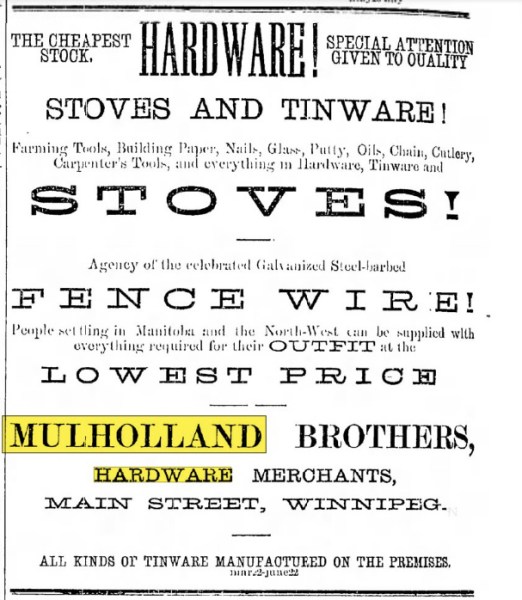
When Joseph and Henry opened their Winnipeg store in 1878, it faced stiff competition, and the large newspaper advertisement announcing the opening of Mulholland Bros. ran alongside ads from several other hardware stores. Over the next few years, the newcomers focused on basic items like fencing wire and wood stoves.

The store advertised regularly in the local newspapers. source: Manitoba Free Press, p. 4, May 26, 1880, Newspapers.com

Running a business with a sibling had its challenges. In a letter to his father in 1884, Henry must have mentioned that he and Joseph did not see eye to eye on a bookkeeping entry. Henry senior replied, “Joseph is a good-hearted, generous fellow, and I trust that you and he will get on cordially together, as it will be for your natural interest to continue the business without any wrangling and refer any differences of opinion between you and him to your Uncle Thomas [Workman] and me who have had long experience in co-partnership businesses and in keeping accounts between the copartners.”3

Henry senior continued to offer sensible advice and encouragement: “I am glad to hear that you are making no bad debts and that you have no large accounts due to you in the books and that your stock is well selected and next to this never be tempted to offer any customer to increase his indebtedness by selling him more goods on credit in hope of obtaining payment of a past due debt.”

It appears that Joseph was the more outgoing sibling. His name appeared frequently in Winnipeg newspapers as he was involved with the Board of Trade. He was for a time president of the Winnipeg Liberal-Conservative Association, and he was briefly a candidate for mayor of Winnipeg, but withdrew his name. Several newspaper clippings following his death described him as a very likeable fellow. 

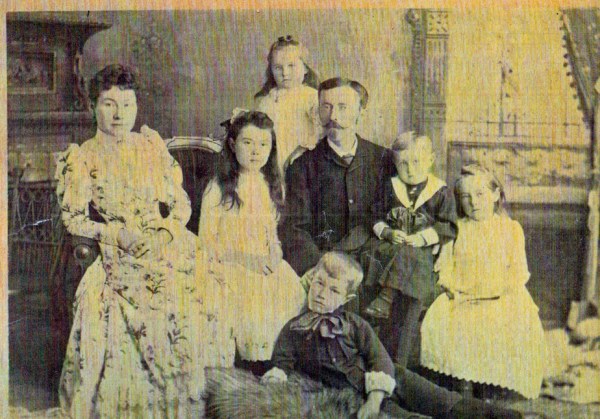
Meanwhile, Henry’s name never appeared in the newspapers, so perhaps he was the quiet one, busy running the store. It is also possible he was distracted by family obligations. Henry was married to Ontario-born Christina Maria Shore and the couple had six children.

Henry and Christina Mulholland and five of their six children. source: Mulholland family collection.

On June 25, 1885, Mulholland Bros. ran an ad in the Manitoba Daily Free Press listing the many new items they had in stock, including blacksmith and livery stable supplies as well as articles for barbers, butchers, hunters and gardeners. They also carried bird cages and ivory-handled table knives.

Few of Winnipeg’s citizens were wealthy, the local economy was dependent on a good grain harvest, and shipping costs to Winnipeg were high. The business may have over-extended its inventory. In February 1889, a bankruptcy sale notice for Mulholland Bros. appeared in the paper, listing egg boilers and dog collars among the many items to be disposed of.4

Joseph returned to Montreal and, in 1890, he married Amelia Bagg (1852-1943). Amelia had inherited Montreal real estate from her father, Stanley Clark Bagg, and she was an independently wealthy woman. She was generous to family members in need, and in return, she was loved and respected by members of both the Bagg and Mulholland families. For Joseph, marriage to Amelia not only brought companionship, it also brought him a job in the Bagg family business as a real estate agent.

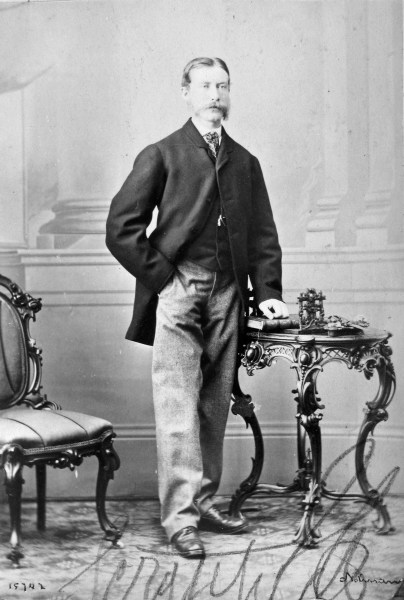
Joseph Mulholland, Montreal, QC, 1865, source: William Notman, I-1757421, McCord Stewart Museum

His good fortune did not last long, however. Joseph died of heart failure brought on by extreme heat in Montreal on July 15, 1897.5

As for Henry, after the Winnipeg store failed, he remained in Manitoba for a time — the family was still there in 1891 when the census was taken — but they eventually moved to Toronto, where Henry continued to work as a hardware merchant. After his death, his youngest son, Toronto lawyer Joseph Nelson Mulholland, commented that Henry had never regained his stride following the bankruptcy.6 When Henry died in Toronto in 1934, at age 84, his obituary did not mention the Winnipeg venture.7

A special thank you to a distant cousin who reached out to me recently with a question about his ancestor Henry Mulholland. Until then, I had never heard about Henry and had no idea Joseph had run a hardware store in Winnipeg.

This article is also posted on my personal family history blog, http://www.writinguptheancestors.ca

See also:

Janice Hamilton, “Henry Mulholland, Montreal Hardware Merchant”, Writing Up the Ancestors, March 17, 2016, https://www.writinguptheancestors.ca/2016/03/henry-mulholland-montreal-hardware.html

Janice Hamilton,  “The Life and Times of Great-Aunt Amelia”,  Writing Up the Ancestors, June 21, 2023, https://www.writinguptheancestors.ca/2023/06/the-life-and-times-of-great-aunt-amelia.html

Janice Hamilton, “The World of Mrs. Murray Smith”,  Writing Up the Ancestors, Feb.24, 2016, https://www.writinguptheancestors.ca/2016/02/the-small-world-of-mrs-murray-smith.html

Sources

  1. “The Late Mr. Mulholland”, The Montreal Star, Feb. 19, 1887, p. 8, Newspapers.com, https://www.newspapers.com/image/740882983/?match=1&terms=Henry%20Mulholland
  • 3. Letter from Henry Mulholland sr. to Henry Mulholland jr., Dec. 8, 1884, Mulholland family collection.
  • 5. “Late J. Mulholland. a man who was cordially liked by many friends in this city”, The Winnipeg Tribune, July 10, 1897, p. 5, Newspapers.com,
  • 6. Letter from Nelson Mulholland to Fred Murray Smith, June 22, 1943, Mulholland family collection.

7. “Henry Mulholland Dies in Toronto”, Montreal Daily Star, Nov. 12, 1934, p. 17, Newspapers.com, https://www.newspapers.com/image/741983911/?match=1&terms=Henry%20Mulholland

A Little About Helene Bruneau

Helene in New York City

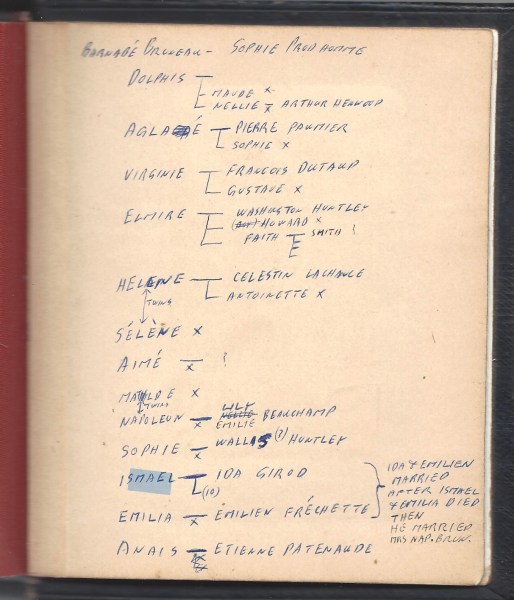
I have written stories about twelve of Barnabé Bruneau and Marie Sophie Prudhomme’s thirteen children. That just leaves Helene (1849 -1929). Helene was child number nine or perhaps number ten. I just realized that she and Selene Joseph were the second set of twins in the family. They were born on December 20, 1849.

I haven’t found much information about Helene other than she appeared to be a devoted wife and mother. She married at twenty-six but before, had spent some time in New York City as photographs can attest. Was she also a French teacher or governess like her sisters?

Sophie, Helene and Matilde Bruneau, New York City

Helene married Célestin Pépin dit Lachance ( known as Lachance). He was born in Joliette (1847-1915) to Celestin Lachance and Elisabeth Payette. His parents converted to Protestantism in 1852 when he was a young child. He attended the l’Institute Evangelique Francais de Pointe-aux-Trembles. After he graduated, he became a Colporteur for two years for the French Canadian Missionary Society. He had aspirations of becoming a minister

Celestin & Helene Lachance

In 19th century America, the word colporteur (the borrowing of a French word meaning “peddler”) came to be used for door-to-door peddlers of religious books and tracts and is still used today. The Missionary Society trained the colporteurs and future pastors as there wasn’t a French Protestant seminary. Celestin abandoned his studies in 1867, possibly because he had tuberculosis and his doctor recommended he only work outside in the fresh air. If he did have TB, the fresh air did him good as he lived almost another 50 years. He worked all over Quebec in the logging and forestry industry. Helene accompanied him everywhere during their marriage.

Helene & Celestin Lachance and Helen’s sister Anais

Although he gave up missionary work he remained a religious Presbyterian the rest of his life. He read the Bible every morning and night. During his last illness, he read the whole Bible twice in nine months. 

Helene was originally a Baptist as her parents also converted to Protestantism when she was a child. She is later recorded as being a Presbyterian.

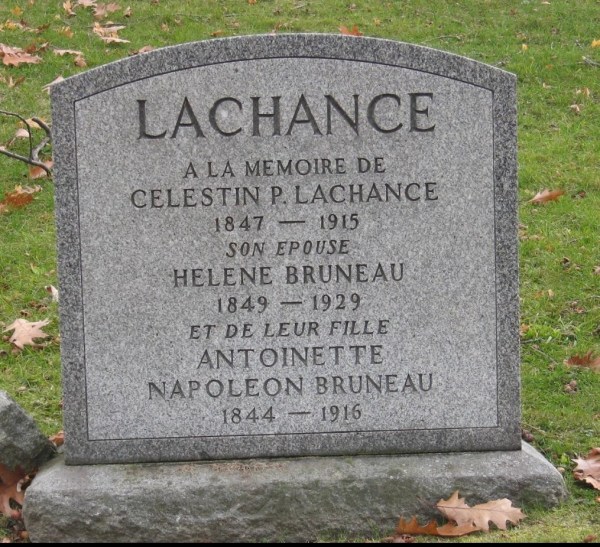
Celestin and Helene had only one daughter, Helene Marie Antoinette (1876 – 1916). This curly-haired child grew up but never married. She attended Royal Arthur School in Montreal. Antoinette attended English schools because the family was Protestant, so she couldn’t attend French Catholic schools. In 1892, she won the prize in French for second intermediate girls, besting Nellie Wilson, who won the awards for most of the other subjects. She didn’t have Antoinette’s advantage of a French background. At the closing of the ceremony, the commissioner said, “It was well to be clever but still better to be good.” Antoinette died at only forty years of age. She lived with her parents her whole life and never seemed to have an occupation.

Antoinette Lachance

After Celestin and Antoinette died, Helene lived in Verdun, Quebec until her death, on June 4, 1929. The family is buried in Mont-Royal cemetery in Montreal along with Helene’s brother Napoleon.

Mount Royal Cemetery Montreal

Notes:

In the back of the little photo album in a list of the children, it actually said twins, which had never registered with me. 

Back page of photo album

1871 Census: Celestin was 22 and living with his parents and sibling in St Charles Borromée, Joliette, Quebec. Year: 1871; Census Place: St Charles Borromée, Joliette, Quebec; Roll: C-10036; Page: 15

Helene and Celestin were married in 1875 and recorded as French Evangelicals.

Antoinette was born in October 2, 1876 and baptized at 9 years old in 1885.

According to Find a Grave: her full name was Helene Marie Antoinette Lachance born in St Constant Quebec.Ancestry.com. Canada, Find a Grave® Index, 1600s-Current [database on-line]. Lehi, UT, USA: Ancestry.com Operations, Inc., 2012.Original data: Find a Grave. Find a Grave®. http://www.findagrave.com/cgi-bin/fg.cgi accessed August 28, 2024.

1891 Census: The Lachances were living in Ste. Conegonde Hochelaga, Quebec. Celestin was a Commis au Bois, a wood clerk, Helene was a wife and both members of the Free Church. 

Year: 1891: Census Place: Ste Cunégonde Town, Hochelaga, Quebec, Canada; Roll: T-6396; Family No: 227Ancestry.com. 1891 Census of Canada [database on-line]. Lehi, UT, USA: Ancestry.com Operations Inc, 2008. Aug 28, 2024.

1901 Census: Celestine, Helene and Antoinettte (Marie-A ) were living in Ottawa, where Celestin was listed as a foreman and Antoinette, had no occupation. Year: 1901; Census Place: Ottawa (City/Cité) Dalhousie (Ward/Quartier), Ottawa (City/Cité), Ontario; Page: 19; Family No:189 Source InformationAncestry.com. 1901 Census of Canada [database on-line]. Lehi, UT, USA: Ancestry.com Operations Inc, 2006. Aug 28, 2024.

Montreal Star: Royal Arthur Closing Exercises, June 22, 1892 Wednesday, pg. 3. Newspapers.com accessed Sept 9, 2024.

Le Devoir: Celestin Lachance obituary, March 26, 1915 pg 2. Newspapers.com accessed September 9, 2024

Montreal Star Obituary: Helene Lachance, June 6, 1929 page 11. Accessed Oct 22, 2024.

Jean-Louis Lalonde: Lachance, Celestin (1849-1915) SHPFQ Societe d’Histoire du Protestantisme Franco-Quebecois. Octobre 12, 2020.

All the photographs are family photos in the hands of the author.

The Spiritualist Prime Minister: a book review

It has been 150 years since William Lyon Mackenzie King (1874-1950), Canada’s longest serving prime minister, was born in what is now Kitchener, Ontario. The anniversary of his birth passed with little fanfare, possibly because of King’s reputation as “weird Willie.” A new book called The Spiritualist Prime Minister: Volume I, William Lyon Mackenzie King and the New Revelation, by Anton Wagner, reveals what was weird about him.

Born Dec. 17, 1874, King was the grandson of William Lyon Mackenzie (1795-1861), leader of the failed Rebellion of 1837 in Upper Canada. King’s mother, Isabel, was his daughter. King grew up in Ontario with his parents and three siblings in what has been described as a happy family. He obtained several degrees from the University of Toronto and graduate degrees from Harvard University. In 1900, he was appointed Deputy Minister of Labour in Wilfred Laurier’s federal Liberal government. He was elected as a member of Parliament for the first time in 1908 and was appointed to cabinet a year later, but lost his seat in 1911 when the Liberals were defeated. He became leader of the Liberal Party in 1919, following Laurier’s death.

Over the next 21 years, he was prime minister for three stretches: 1921 to 1926, 1926 to 1930, and 1935 to 1948. During this time Canada went from having a primarily agricultural economy to becoming industrialized. King was prime minister during the difficult years of the Depression in the 1930s, and during the World War II.

Although he is said to have been a boring public speaker, King succeeded in keeping the country united through these tumultuous times. Today, many historians acknowledge him as Canada’s greatest prime minister. But King had interests and beliefs that the public did not know about. It is these activities, not his political accomplishments, that are the focus of Wagner’s book.

Raised a Presbyterian, King was a deeply religious man, but in addition to his Christian beliefs, he became a spiritualist: he was convinced of the continuity of life after death, and in the existence of a spiritual world that interacted with and guided him in the material world.

Such beliefs were not uncommon at that time. Many people had lost loved ones in World War I and in the great flu epidemic of 1918, and sought to communicate with them on the other side. While it may have been acceptable for ordinary people to try to contact deceased loved ones, it was another thing for the prime minister to do so. Meanwhile, Wagner writes, King was convinced he was “an agent of God, working out His will ‘on Earth as it is in Heaven.’”

Some people have suggested that King was on the brink of insanity. Wagner speculates he may have been suffering from prolonged grief disorder. King was unmarried and had few close friends. Both his parents and two of his siblings had died by 1922, and he was undoubtedly lonely. He was particularly attached to his mother, believing that she was “pure and holy and Christ-like” and was watching over him. A large portrait of her hung in his Ottawa study, and she regularly appeared to him in dream visions. 

Around 1917, King began consulting a fortune teller, having his horoscope read and consulting phrenologists, numerologists and palm readers. He participated in a séance for the first time in 1932 with the medium Etta Wriedt, and from then on took part in dozens of seances in the United States, England and Canada. At home, he began to act as a medium himself and, along with his “spiritual companion”, the married Joan Patteson, had regular table rapping conversations with spiritual entities over “the little table.”

King also met and corresponded with my grandparents, psychical researchers Dr. T.G. Hamilton and his wife, Lillian, of Winnipeg. It was because of this connection that I was asked to review Wagner’s book.

A few people knew about these activities, but they were not public knowledge. King kept a diary in which he recorded his daily activities, including his occult beliefs and practices. He intended these diaries to become the basis of his memoirs, but he died before he got a chance to write them. After he died, the instructions he left concerning the diaries were unclear. Some of his executors wanted to burn them in order to preserve King’s reputation but, in the end, they were not destroyed. In fact, they were eventually transcribed, with some omissions, and the 30,000-page typed copy is available online from Library and Archives Canada.

One of the first historians to write about King’s inner life was C.P. Stacey. In A Very Double Life: the Private world of Mackenzie King, published in 1976, Stacey wrote that King often frequented prostitutes. This information, as well as revelations about King’s spiritualist beliefs, led to his reputation as being weird. But until Wagner’s book was published in 2024, those occult activities had not been studied in depth. Volume I is an exploration of King’s life as a spiritualist, while Volume II takes a closer look at the many mediums he interacted with.  I have not read volume II.

Wagner is not an expert on Canadian political history. He has doctorates in drama and theatre, and has produced documentary films on arts and culture. He did, however, do extensive research for this book, not only from the primary sources of King’s diaries and letters; volume I includes a 15-page bibliography.

Volume I includes several examples of how King’s occult beliefs impacted his political decisions. Early in his political career, King consulted a fortune teller before choosing an auspicious date for an election – and he was disappointed when the prediction proved wrong. In 1937, King’s belief that he was part of a divine plan to save the world from war took him to Germany, where he badly misjudged Hitler and his intentions. And at the end of the war, King asked for advice from the recently deceased Franklin Delano Roosevelt regarding a spy scandal and what he should reveal to the Soviet Union about the development of the atom bomb.

Unfortunately, interesting as the topic is, I found the text hard to follow. So many people and events were included that the contents might have benefitted from better organization and an index, although a chronology at the end of volume I does help.

The Spiritualist Prime Minister, by Anton Wagner, PhD, is published by White Crow Books in association with the Survival Research Institute of Canada.

This article also appears on my personal family history blog, http://www.writinguptheancestors.ca.

Working together to help genealogists discover their ancestors