Recently, for a minor medical reason, I was referred to Hôpital Sacré Coeur de Montréal, located in the Ahuntsic/Cartierville neighbourhood, North of Montréal. Instead of using the major highway, we decided to travel via Gouin Boulevard. Motoring along a pleasant country road, filled with all manner of houses, trees, flowers and bushes, it was a very enjoyable route.
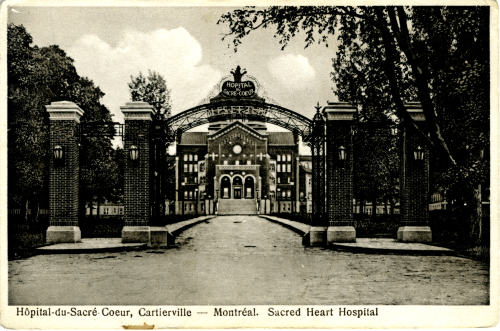
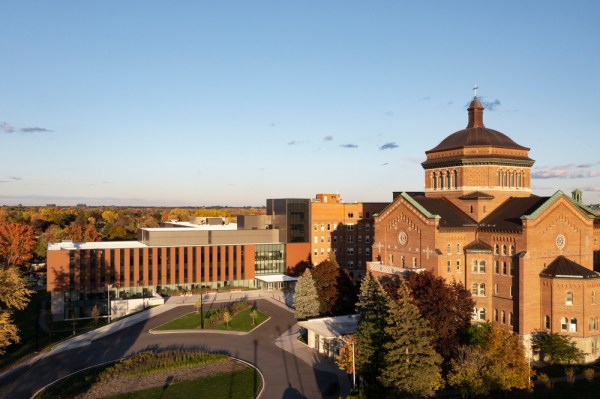
The reason I wanted to write about this hospital I had never seen before was because when we arrived and I saw the majestic gateway that led up to the main entrance, I thought at first the building may have once been a cathedral.
Although the photo below was taken C. 1940, it looks exactly the same today.
Publisher: Novelty Manufacturing and Art Co. Ltd., Montreal
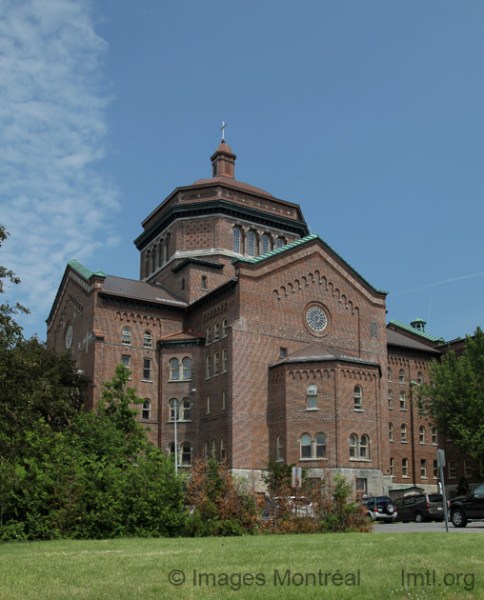
It intrigued me so much that I wanted to learn about the history of this striking building. As we approached the parking lot, I could see the huge cross on the top of the building. The original stonework, which was masterly, really stood out to me.
Picture Alexis Hamel
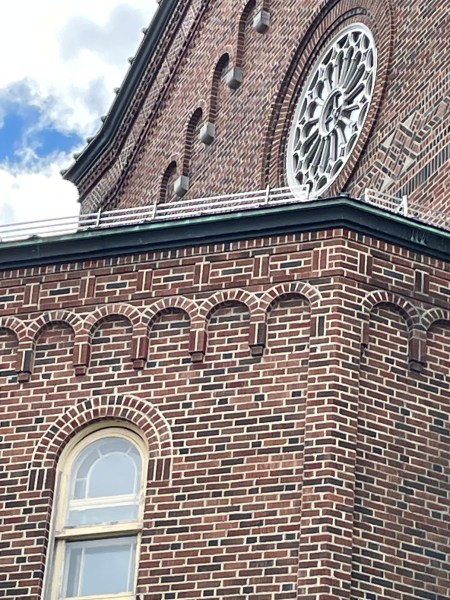
The original stonework would reflect the architectural styles popular in the late 19th and early 20th centuries, potentially incorporating elements of the Victorian or Beaux-Arts styles common for public buildings of that era.
Picture Marian Bulford
Excited to begin researching, I found a lot of interesting information. For instance, did you know that the institution was originally founded on June 1, 1898, the day of the Feast of the Sacred Heart, by a small group of women located in a building in downtown Montréal? (1)
They named it the Hôpital du Sacré-Cœur de Montréal, and the women cared for a dozen ill individuals, deemed the ‘incurables’. An unfortunate name, but cancer and patients with serious diseases were incurable then. By 1902, support care was provided by the Sisters of Providence.
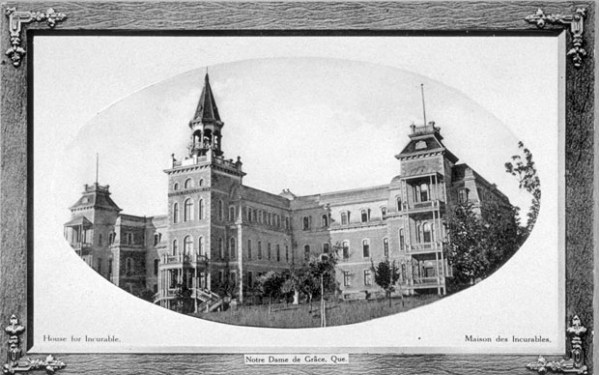
In 1900, the hospital moved to a larger building on Décarie Boulevard in Notre-Dame-de-Grâce (NDG). and was known as the Hôpital des Incurables.
Hôpital des Incurables.
This building was destroyed by fire in March 1923, and in 1926, a new building was built on Gouin Boulevard in Cartierville, where it still stands today. With the new building, the administration reverted to using the original name, Hôpital du Sacré-Cœur de Montréal.
Initially, it specialised in the treatment of tuberculosis. This was soon followed by the development of orthopaedic surgery (Dr. Édouard Samson, 1931) and thoracic surgery (Dr. Norman Bethune, 1933). In 1973, the Hospital became a tertiary care trauma centre for Western Quebec, together with the Institut Albert-Prévost, to provide psychiatric care and was affiliated with the University of Montreal as a research and teaching centre.(2)
In 2022, an expansion by Provencher_Roy and Yelle Maillé was completed, adding 16,252 square meters, which complements this heritage structure. (4)
Although a visit to a hospital is sometimes an anxious experience, the building and staff at Hôpital du Sacré-Cœur de Montréal were most helpful and attentive. Young volunteers are situated on each floor, ready to give directions to various parts of this now vast hospital.
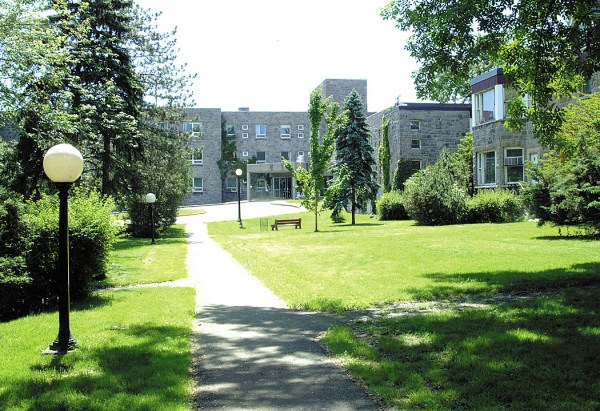
Along Gouin Boulevard, we passed the affiliated Institut Albert-Prévost, set in a pleasant park-like area, before reaching the Hôpital du Sacré-Cœur de Montréal.
Entrance to the Institut Albert-Prévost
Before becoming a hospital, Albert-Prévost may have changed names from sanatorium to pavilion, but never its vocation: it has been treating mental health problems for over 100 years. This influence is due as much to the teaching it provides as to the care it gives.
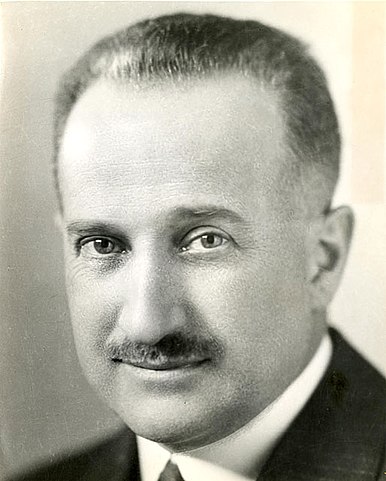
Who was Albert Prévost?
Albert Prévost
He was a Quebec neurologist and forensic physician, born in 1881 and died in 1926. He was the first holder of the chair of neurology at the Université Laval in Montreal and the founder of the institute that bears his name. (5)
This is part two of my Great-Grand Uncle Arthur Symons’s experiences in WWI. Arthur emigrated to Canada in 1901, arriving in Halifax, Nova Scotia, on the SS Soman. (1)
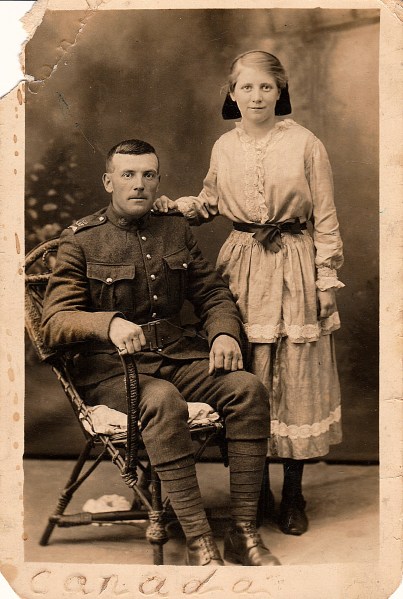
When WWI broke out, Uncle Arthur enlisted in the 56th Battalion Canadian Over-Seas Expeditionary Force in 1915 in Calgary. He was then shipped back home to the UK to train. While there, he visited his sister Lilian and her daughter Edith, my Grandmother.
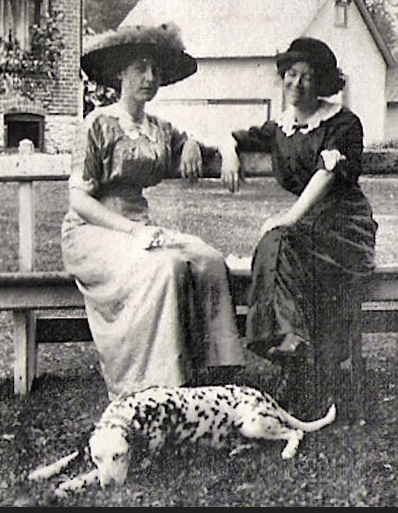
Arthur Symons with Edith Bevan his niece, my Granny.
Granny was 15 years old.
At Salisbury, Wiltshire, England, the Canadians trained for four months, most of it in terrible mud, as England experienced one of its wettest winters in decades. While most troops stood up well to the awful conditions, Canadian equipment did not. Much of it was soon discarded in favour of British types. The Canadians learned basic soldiering in England after a hasty mobilization and a difficult, uncomfortable winter. Their real training would come at the front.
After training, Arthur was sent to France and later Belgium. At the Third Battle of Ypres, better known as Passchendaele, the troops fought there from July to November 1917. Both sides suffered appalling conditions and heavy casualties. “The name Passchendaele has become synonymous with mud, blood and futility”. Arthur was wounded in 1917 at Passchendaele. (2)
The Government of Canada Library and Archives search had Arthur’s Attestation Papers and detailed medical treatments at “No. 4 General Hospital Dannes Camiers” (2) among many other hospital visits.
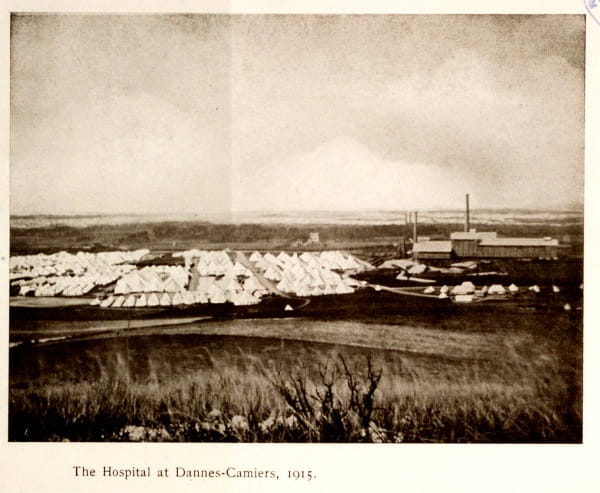
Searching for Dannes Camiers Hospital, led me to the Royal College of Surgeons of England and the following information. (2)
Shortly after the war broke out, McGill University organised the ‘No. 3 Canadian General Hospital’ to serve in France. The hospital was established at Dannes Camiers in the Pas-de-Calais area on 19th June 1915 under canvas. A staff of 35 Officers, 73 Nursing Sisters and 190 rank and file. Life under canvas that cold wet November was tough, with deep mud, storms, frost and collapsing tents. The conditions so undermined the health of one Lieutenant Colonel Yates that he was invalided to England where he died the following year.
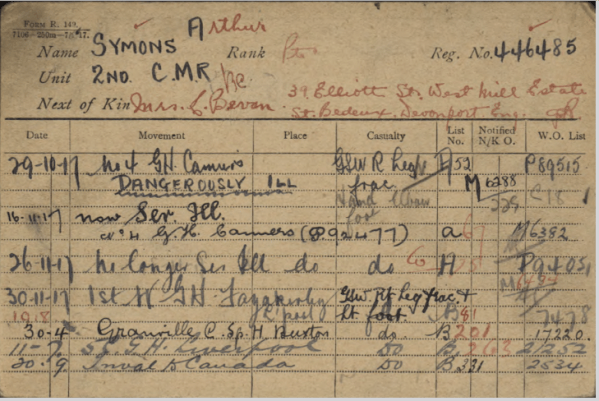
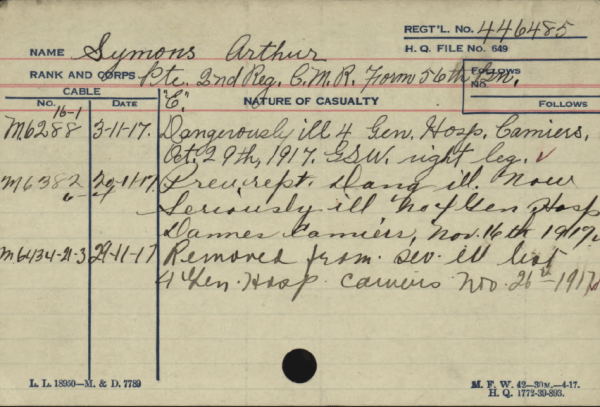
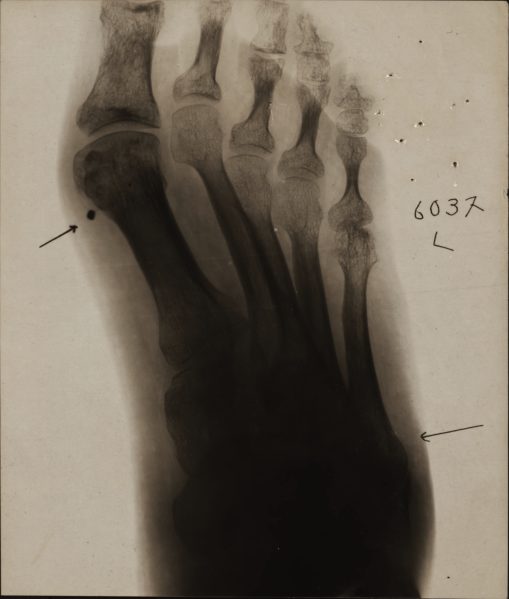
Arthur’s admission to the Dannes Camiers Hospital was on the 29th of October 1917. The first line of his medical records states he is ‘Dangerously ill’ with GSW (gunshot wounds) R. Leg fracture and left foot.
By the 16th of November, Arthur is now ‘seriously ill’ There follows 99 pages – starting with his Attestation Paper – then very detailed treatments and x-rays from various hospitals in France, England and Alberta, Canada. It makes for fascinating reading.
Three pages from Arthur’s 99 pages of hospital notes and X-rays.
On the 30 of November 1917, Arthur was transferred to the 1st West General Hospital Fazakerly, Liverpool England. After 5 months of treatment, Arthur was again moved to the Canadian Special Hospital Buxton, Derbyshire, England.
NOTE: Amongst the patients at Buxton, was Frederick G Banting, who would return to Canada after the war to continue research into diabetes and the use of insulin in its treatment, for which he was awarded the Nobel prize.(3)
His last transfer was on July 11, 1918, to the 5th Canadian General Kirkdale, Liverpool, England.
Eventually, on the 20th of September, 1918, Arthur was Invalided to Canada. He was sent to the Ogden military convalescent hospital in Calgary, Alberta. A short visit to the Calgary General Hospital, then back to Ogden.
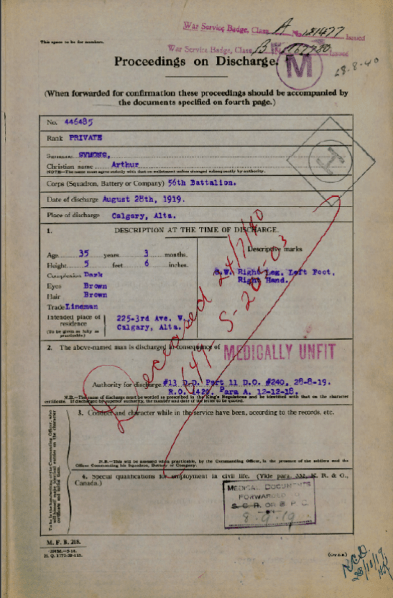
Finally, after nearly 2 years at 5 different hospitals, Arthur was sent to the Banff Rest Camp, and discharged on August 28, 1919, medically unfit for further service. He was 35 years old.
Arthur went on to marry and have two children and was employed in the Civil Service
This rather poignant note dashed across his discharge papers state ‘Deceased 24/7/40’
Excerpt from The Calgary Herald, July 26, 1940, page 2 Arthur Symons, 54, of 2409 Centre Street South, died in hospital here Wednesday afternoon. Born in Leicester, England, he came to Calgary 32 years ago and was employed in the civil service for 17 years. He is survived by his wife, Catherine, one son, Arthur, and one daughter, Dorothy.Alberta Death Reg. #1940-08-201498
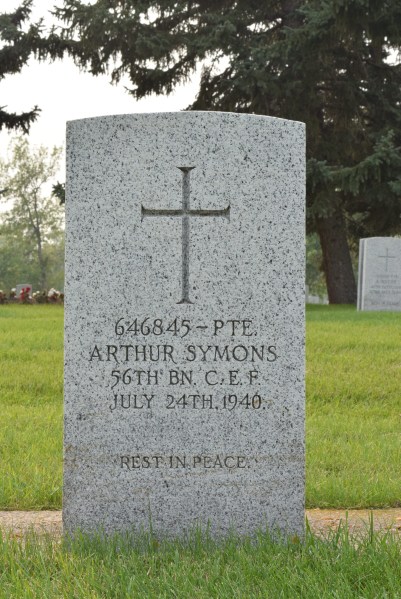
Great-Grand Uncle Arthur Symons is buried in Burnsland Cemetary, Calgary Alberta, Canada. (Photo credit Ron Reine)
RIP Uncle Arthur.
Part 1 of Great-Grand-Uncle Arthur’s experiences in WW1:
On September 26, 1912, a tall, slim, beautiful and well-dressed young woman stepped off the train at Viger Station in Montreal to be met, well, by no one.
There was a group of local reporters on the platform but they were waiting for someone else to arrive, someone far less fetching, as it were.
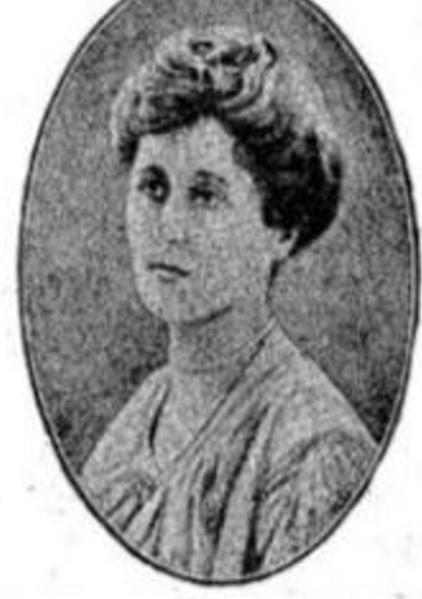
The journalists were expecting Barbara Wylie, a British suffragette. Wylie was one of Mrs. Pankhurst’s radical troops and British suffragettes were mostly manly, weren’t they?
Barbara Wylie 1912.
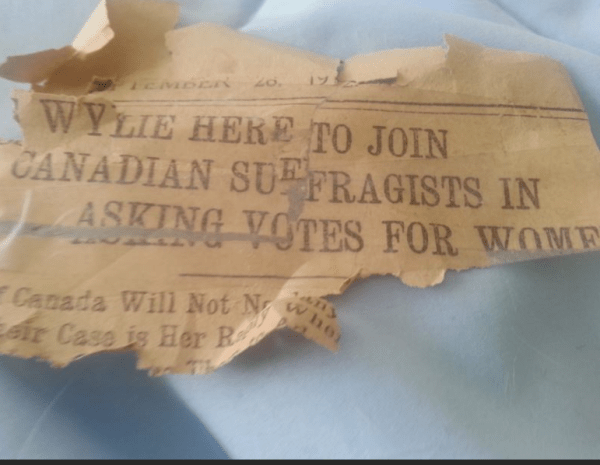
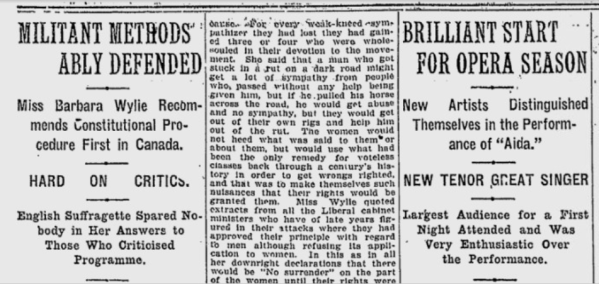
When the reporters realized that this stylish beauty was, indeed, Miss Wylie it caused quite a commotion according to a newspaper article in the Montreal Witness clipped by my husband’s great aunt Edith Nicholson.
The reporters immediately raced over and encircled the lovely lady.
Barbara Wylie did not disappoint on the radical front. The Scottish firebrand brashly answered questions about her reason for coming to Canada and glibly defended a British suffragette who recently had thrown a hatchet at British Prime Minister Asquith. “Had it hit the mark, it might have knocked some sense into him.”
Whoa!
Remnant of the Montreal Witness clipping.
When I first found the Witness newspaper report among Edith’s massive stash of yellowed newspaper clippings on the suffrage movement, it did not make an impression on me. I had heard of the British suffragettes, for sure. Who hadn’t? But, the name of Barbara Wylie meant nothing.
And I knew zilch about how, around 1910, some of Emmeline Pankhurst’s troops visited Montreal to try and convince “inert”1 Canadian suffragists that not-so-peaceful protest was actually the way to go.
Lets’ face it: there was nothing about Canadian women suffrage in my 1968 high school history book.
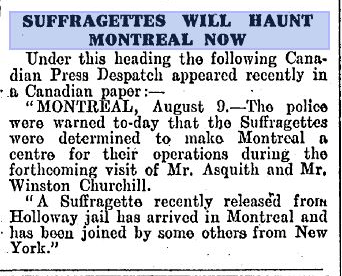
Haunt. Hmmm. Interesting choice of verb. Suffragettes were technically banned from coming to Canada. So the two suffragettes who did come,Caroline Kenney and Barbara Wylie, had Canadian relations and came on family visits.
Miss Barbara Wylie was head of the Edinburgh Chapter of Mrs. Pankhurst’s Women’s Social and Political Union. She came to Canada in 1912 on a year-long country-wide tour, but her loose-cannon ways did not get her far.
In Montreal, on November 4, 1912, Wylie climbed the speaker’s platform at the YMCA as a guest of the Montreal Local Council of Women. News reports say she was wearing a pretty powder blue silk dress, but her rhetoric was of the red-hot variety.2 “Why speak of men as brave and women as pure? Would it not be better to bring the idea into society that men can be pure and women brave?”
The meeting had to be adjourned early when a fist fight nearly broke out – between two men.
Edith Nicholson, 27, didn’t attend Wylie’s rowdy Montreal speech. A family letter reveals Edie returned home from Montreal to Richmond, Quebec on November 2. But the Montreal Witness clipping isn’t the only document I have that suggests Edie, an over-worked, under-paid teacher at Ecole Methodiste Westmount, was all for the “hysterical” window-smashing suffragettes.
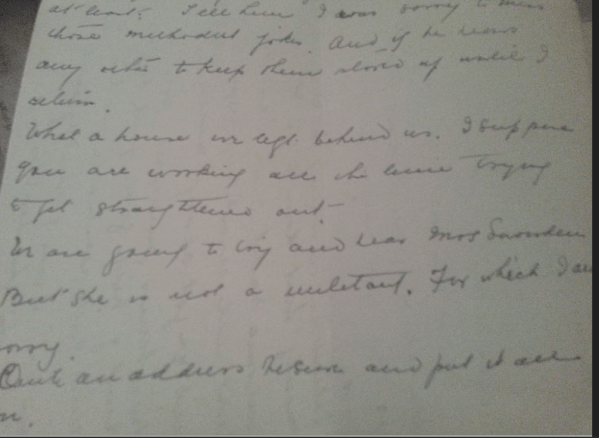
“So sorry” Mrs. Snowden was NOT a militant. May 1913 letter to Mom
On May 2, 1913, Edie is in Montreal with her two sisters, Marion and Flo, and she writes this in a letter home to her mom, Margaret: “We are going to hear Mrs. Snowden speak. But she is not a militant for which I am very sorry.”
This sentence, too, I might well have over-looked had it not been for that Wylie newsclipping because that fragile disintegrating memento prompted me to conduct more in-depth research on the messy, all-but-forgotten Montreal suffrage movement.
The first British suffragist brought in by the Montreal Council of Women was Mrs. Ethel Snowden, in 1909. Snowden was the young wife of a British Labour M.P. She spoke at Stevenson Hall.
Described in one report as “a daughter of the gods, divinely fair,” Snowden’s oratorical skills also impressed that day. She condemned the British militants, who were just beginning their ‘deeds, not words” path, saying “Mrs. Pankhurst has unleashed a Frankenstein monster.”
The Council soon passed an ambiguous resolution somewhat in favour of women suffrage.
Montreal Gazette places suffragette news beside opera news. You can make what you want of that.
Emmeline Pankhurst, herself, visited Montreal in December, 1911. She was brought in by Council President, Miss Carrie Derick (a closeted suffragette sympathizer) “so that women could hear the other side of the suffrage story.”
In her speech at Windsor Hall, the famed feminist, looking tired and frail, stated her case with eloquence but she made sure to avoid provocative language.
So afraid were Montrealers of Mrs. Pankhurst (whose troops back home were angry at Asquith over a broken promise) that the Council had to give away 200 tickets at the last minute and only broke even on the night. Mrs. Pankhurst’s fee was considerable too. After all, she was on the tour to raise money for lawyers.
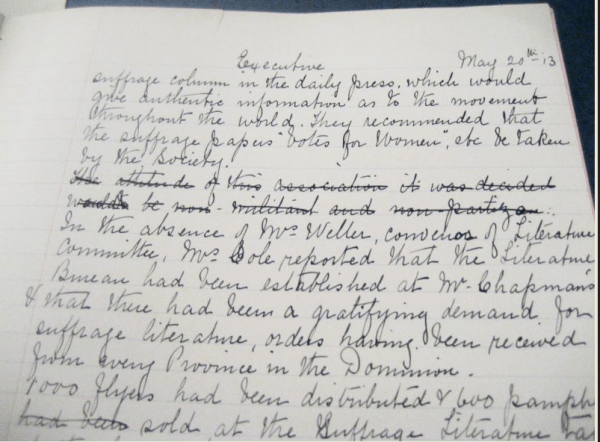
Minutes of MLCW launching Montreal Suffrage Associationat at the time of Mrs. Snowden’s second visit. Someone has crossed out the line where it says the organization is non-militant.(“Not relevant” Professor Derick said in the press.) They also intend to subscribe to WSPU Votes for Women Magazine and make money selling brochures. BANQ archives.
May, 1913 saw Mrs. Snowden’s second visit to Montreal. This time she spoke at St. James Methodist Church.
In the spring of 1913, Mrs. Pankhurst’s militants in England were in full battle mode, setting fire to post boxes, hunger-striking in prison and playing ‘cat and mouse’ with the police.
Mrs. Snowden calmed the fears of Montrealers in the audience, telling them not to worry, women wouldn’t suddenly want to run for Parliament with the vote (sic). “All men care about is money, but women care about the home, children and humanity,” she proclaimed. The vote for women, it seems, was all about saving babies.
This is exactly what the majority of women in the Montreal suffrage movement wanted to hear. These ladies were mostly well-off middle-aged matrons or unmarried teachers of a certain age. They were maternal suffragists, not equal-rights suffragettes, and they had worked very hard to keep any young, excitable unmarried women (even of their own class) out of the local movement.
These matrons did not like what they saw coming out of the UK or the U.S: the spontaneous marches in sundry small towns; the highly-publicized cross-country tramps; the gigantic uber-organized parades in major cities, including one with10,000 people that swept down 5th Avenue in New York led by a young suffragette goddess on horseback. They were especially afraid for/of their own daughters: A lengthy editorial in the Montreal Gazette described women’s colleges like McGill’s Royal Victoria College as”suffragette factories” churning out de-sexed females.
So, in March, 1913, they started up the Montreal Suffrage Association, an elite organization with a mandate to provide a ‘quiet and peaceful education of the people’ led reluctantly by, who else, Miss Carrie Derick – with a membership by invitation only.4
Ethel Snowden ended her 1913 speech by calling Mrs. Pankhurst’s troops “cavemen” giving the reporters their headline for the next day.
If Great Aunt Edie was in attendance that night in the large landmark Gothic Revival church on Ste. Catherine Street in Montreal, and I have no proof one way or another, she must have been mightily dismayed.
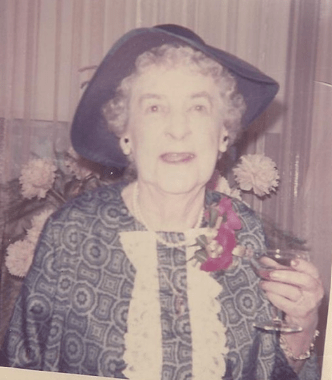
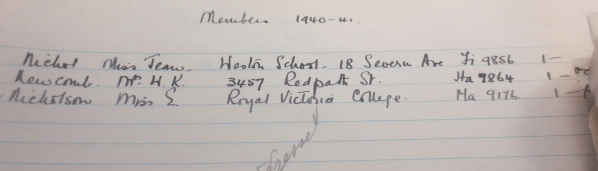
Great Aunt Edie 1971 toasting her niece’s marriage. In the 1920’s, she stepped out with Miss Carrie Derick according to a letter. They were both at McGill. Edith’s name on membership list for Therese Casgrain’s provincial suffrage association, The League of Women’s Rights in 1940-41. Edie was by then respectable, working at Royal Victoria College, McGill as Assistant to the Warden. Of course, back in 1913, Edie wasn’t listed as a member of the Montreal Suffrage Association, but that doesn’t mean she didn’t join the more inclusive and militant-minded Montreal Suffrage League started up by Caroline Kenney, another British suffragette. But, soon War broke out and everything kind of fell apart, but that’s a whole other story.
Originally published in Beads in A Necklace, Genealogy Ensemble’s compilation of family stories.
Furies Cross the Mersey is my story about the British Suffragette Invasion of 1912 from 3 different points of view. This era was a study in Media Literacy, that’s for sure. Journalists broke every rule of their trade covering the ladies of the suffrage movement. (For example: Were young suffragette sympathizers ‘manly and desexed’ or ‘excitable and hormonal?) Suffragists and Suffragettes wanted to take away men’s alcohol (overt)and their right to have sex before marriage with prostitutes (tacit). “Why can’t men be pure.” Mrs. Pankhurst, a doctor’s wife, was upset at the fact so many virginal women contracted veneral disease as a wedding present.(Hence the law requiring blood tests before marriage.). Also, many of her husband’s patients in the north of England arrived at his surgery pregnant by incest.
Margaret Votes published on this website. (How did Margaret Nicholson feel about voting for the first time in 1920? Very happy! Her neighbours not so much:) ) Most Canadian women won the right to vote in 1918. (Some with men in the military, earlier, in 1917) Quebec women in their province only in 1940.
“Inert” was the word used by Carrie Derick to describe the Canadian Suffrage Movement in 1912.
The British suffragettes, many of them young, were careful to dress well, knowing that it is easy to diss a woman on her appearance. This lead to news reports on the various marches in the UK and US sounding like fashion news.
The Montreal Local Council of Women launched the MSA in 1913, despite the fact this was not their mandate. They were supposed to be an umbrella for the various women’s organizations that had sprung up from the grass roots. I believe they launched the MSA because some other British Suffragettes, namely Caroline Kenney, sister of Annie Kenney, Emmeline Pankhurst’s working class lieutenant, were trying to start up a militant group (open to all) and even planning a march to Ottawa in the style of Rosalie Jones’s tramp. I know this because the Ottawa press covered their story, not the Montreal press. Another Kenney sister, Nell, had moved to Montreal (Verdun) with her journalist husband, Frank Randall Scott, in 1910, after he had swept her away to safety during a police action at a UK rally with Sir Winston Churchill, then the Home Secretary! His fonds are in the McCord Museum and include photographs of all the Kenney women – as well as the Royal Princes who came to visit in 1924. If you want to read more of their story read Furies Cross the Mersey, my book.
4. Carrie Derick is, famously, Canada’s first female university professor. A few other McGill professors were brought onto the Board of the Montreal Suffrage Association as well as some clergymen. The clergymen in particular hated – and feared – Mrs. Pankhurst. Many women on the Board secretly supported her, especially a Mrs. Weller, wife of a prosperous Westmount business man (electrical systems) who had made it a point to study the question in detail. She had invited Barbara Wylie into her home and she had visited the Suffragettes in England and had even given a speech about her visit.
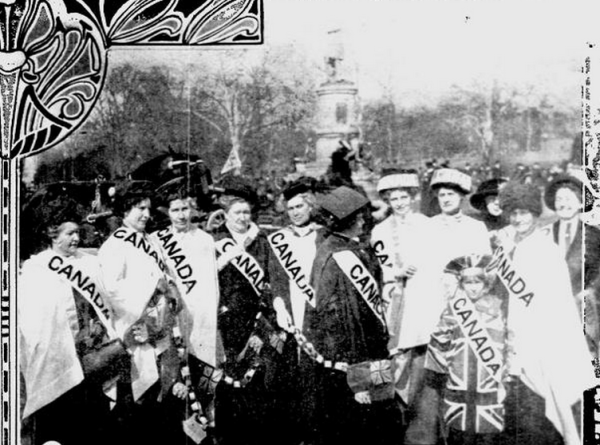
The Canadian Contingent at the 1913 Suffrage Parade in New York City. Older matrons all with ‘token’ child, the niece of Flora Macdonald Denison. From the Toronto Sun.
Some of the most interesting information about my ancestors comes from documents detailing what they ate.
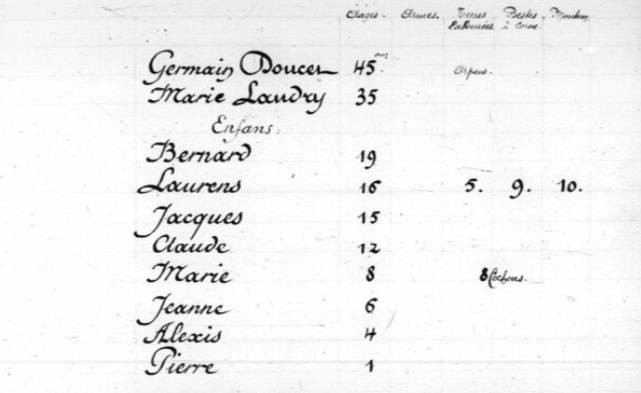
The 1686 Acadian Census, for example, shows my ancestor Alexis Doucet at four years old living in Port Royal with his parents and seven brothers and sisters on “5 arpents of cultivable land with 9 cattle, 10 sheep and eight pigs.”1
The census detailed our ancestors’ cattle and livestock along with the cultivated land because those elements were the primary elements of wealth in North America at that time. The settlers’ ability to nourish themselves determined whether they would be able to thrive, multiple, and permanently inhabit a place on behalf of whichever European colony to which they belonged.
Doucet’s family and their neighbours were ingenious at this task, as Caroline‐Isabelle Caron points out in her delightful booklet about Acadians in Canada.
Indeed, the Acadians set roots in the marshy salines left untouched by the First Nations, in the tidal flood plain which they proceed to dry and put into culture thanks to a complex system of dykes (levées) affixed with drying valves called aboiteaux. This technology was imported from France, probably from the Loudunais region where some early settlers originated. The vast network of dykes the Acadians created inside and beyond the marshlands before 1755, ensured the fertilization of vast meadows for the culture of wheat but also the growth of salt‐hay pastures, a particularly attractive source food for cattle. At this time, Acadian agriculture ranked among the most fertile in the world, boasting near constant, abundant crops.
A typical Acadian farm consisted of one house with one or two rooms on the first floor, a barn, outdoor latrines, a cellar, and a well. Dwellings were usually built up from the ground without foundation, the walls sided with whitewashed cob walls surmounted by a thatched roof. In addition to an enclosure to keep farm animals (chickens, sheep, pigs), the courtyard contained a fenced garden to grow legumes and root vegetables (carrots, turnips, radishes, but not potatoes), herbs (for both cooking and apothecary), and berries. The Acadians planted, among a vast array of fruit trees, the first apple trees the Annapolis valley is reputed for today.
Abundant food supply stimulated strong demographic growth. It is believed that between 1650 and 1755, the growth rate of the population increased annually by 4.5 percent. Birthrates alone explains this growth, the result of a near 100 percent marriage rate and very high fertility rates, as well as low mortality rates due to the quasi absence of epidemic diseases or famine, and easy access to arable land and drinking water. Despite tentative estimates, experts agree that the Acadian population grew from over 400 people in 1671 to more than 1400 in 1730, for a total of 10,000 to 18,000 people in 1755.2
By the way, the dykes made by Acadians like my ancestor, still exist today. The most successful examples allow only a third of the territory to be farmed, with the other two thirds dedicated to natural wetland rejuvenation and rough cover.3
These early settlers’ ingenuity at bringing old world technology to their new circumstances enabled them to cultivate land that wasn’t already being farmed by the First Nations communities already in the area. That fact meant that they weren’t seen as a threat by their First Nations neighbours and became friends and neighbours. Some of the French settlers fell in love with First Nations people, as Alexis’ grandmother had. According to recent DNA research, Germain’s last name “Doucet” is presumed to be an adopted name, because his father, Germain Doucet, definitely descended from First Nations.4
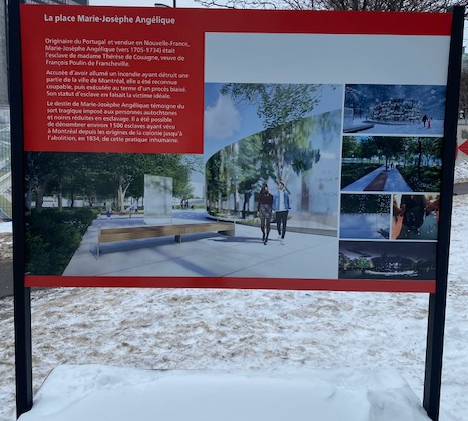
Since this story was originally published, the City of Montreal has added a poster next to Metro Champs de Mars to make it clear that Marie-Josèphe Angélique’s park will be within the Place de Montrealais!
Thanks to Annie for letting me know, and thanks for everyone who made sure that her story is not forgotten!
Original Story
For an hour on the first cold day of the year last month, I wandered around City Hall looking for the memorial park named after an enslaved woman whose torture led to her conviction for arson in 1734. She was then ridiculed, hanged, and her body was burned to ashes and thrown to the wind.
I couldn’t find it.
I’m not sure what happened from the time the park was created in 2012 to today, thirteen-and-a-half years later, but the one-time park still appears on Google Maps. In person, I couldn’t find anything to indicate where it might be.
According to various articles on the web, a green space just west of Champs de Mars métro station honours Marie-Josèphe Angélique’s memory. The official inauguration of the park took place on Aug. 23, International Day for the Remembrance of the Slave Trade and its Abolition, 2012.
As I walked through the area last month, the one-time park seemed to be encompassed in a massive construction site underway for Place des Montréalais, a new public space being created next to the Champ des Mars metro on Viger Street. The posters on site explaining the current project included nothing about Marie-Josèphe Angélique.
Despite being honoured with an award-winning film, a bronze plaque, lilies and a presentation by Governor General Michaelle Jean in 2006, and a public park created by the city of Montreal in 2012, she’s disappeared again.
Before this experience, I was already struggling to see Angélique as the symbol of freedom and resistance she serves for many, but I don’t want her to be forgotten. Did she set the fire or was she a convenient scapegoat? If she didn’t, who did? As I began exploring her story last month as part of a project for NANOWRIMO (the National Novel Writing Month), she served as a reminder of the kind of unnecessary suffering a biased political, policing and justice system can create. Despite the fact that she was a victim of slavery, hatred, spite, racism, class bullying and the worst that a mob could throw at her, her spirit remained strong and unrelenting.
Angélique proclaimed her innocence until the day she was tortured, throughout the court case, and through questioning. Despite that, three weeks after the fire, she was hanged, ridiculed publicly, then burned with her ashes tossed into the wind. Clearly, the authorities at the time wanted her punishment to be seen and remembered.
I read the details about Marie-Josèphe Angélique’s case on Torture and the Truth, a fabulous website set up in 2006 by multiple people, including one of my genealogical mentors, Denyse Beaugrand-Champagne and one of my historian mentors, Dorothy W. Williams. Both of these women have researched, written, spoken and taught many people about the history of Montreal and why studying it is so important.1
The site is one of thirteen different “historical cold cases” established for classrooms across Canada. It was created through the work of six writers, a photographer, an artist, and two translators collaborating with six funding agencies, seven production partners, and 15 archive and museum partners.
It is one of the best historical websites I’ve ever read. If you do nothing other than read through this site, you will get a good overview of the community, the victim arsonist, and life in early Montreal.
As I read about Angélique’s story, she sounded like just the kind of person anyone would like to get rid of. She was a woman who told people she would burn them alive in their homes. She said so to her owner for refusing to grant her freedom, to other slaves for making her work harder than she wanted and to others too. To anyone who slighted her, she threatened the worst thing she could think of. She would burn their homes down.
When 45 houses in her small community did in fact burn down, people blamed her. In retrospect, it may have been an accidental kitchen fire that caused the flames, but her words came back to haunt them all.
The fire began at 7 p.m. on a Saturday evening in spring, April 10, 1734. In only three hours, it destroyed 45 homes and businesses on Rue Saint Paul. Even the Hôtel-Dieu hospital and convent, where people initially took shelter, burned to the ground. Hundreds of people were left in the cold; supplies from many merchants burned, never to be seen again.
Plus, who knows how many caches of fur got wiped out. At that time, Montreal was the centre of the fur trade, more than half of which was illegal trading with the Dutch and English communities in Albany, Boston and other communities to the south. According to a 1942 thesis by Alice Jean Elizabeth Lunn, furs were stored in the backs of shops and even buried just beyond the Montreal wall, which was still under construction at that time, in order to be shipped without being seen by New France authorities. A lot of money went up in smoke that day.2
Everyone in Montreal knew about the fire, given that all the church bells throughout the city began ringing when it started and continued until it was over and people were safe again. Although stone buildings existed at the time, most of the buildings were made of wood; fire could destroy them all.
I had ancestors who lived in Montreal then, the Hurtubise clan on my father’s mothers side. One of them, Jean Hurtubise, the grandson of Étiennette Alton and Marin Hurtubese, was thirty-nine years old, ten years older than Angélique when the fire took place. He and his wife Marie-Jeanne (Marie-Anne ou Marianne) Tessereau had been married for seven years in 1734.
Jean was born in Ville Marie and lived in Montreal for his entire lifetime, so he and his family would have experienced the fire, at least from a distance. They certainly would have seen the ordinance compelling witnesses to appear, given that “it was posted and cried out everywhere in the city and its suburbs.”
Jean and his family farmed a 3×20 arpent property they bought three years earlier from Raphael Beauvais and Elisabeth Turpin on Rue Côte Saint-Antoine.”3 The property was in a part of Montreal that was considered the countryside at that time. Their home was then one of four wood houses on Côte Saint-Antoine in 1731.4
Given that the area was still very rural, and on a major hill, I can’t help but wonder. Did they see the smoke rising into the sky as the hospitals and 45 other buildings in Ville Marie were destroyed?
They certainly had strong links to Ville Marie, particularly the hospital. His grandmother, Etionnette Alton, had died there in her 84th year twelve years earlier. They couldn’t have helped wondering what would happen to others like her, being treated in the hospital that the fire destroyed. Were they among the crowd clamouring for revenge? Did they go to Ville Marie to see Angelique hanged? Did they watch her corpse burning? Did they see her ashes spread into the wind? Did they care at all?
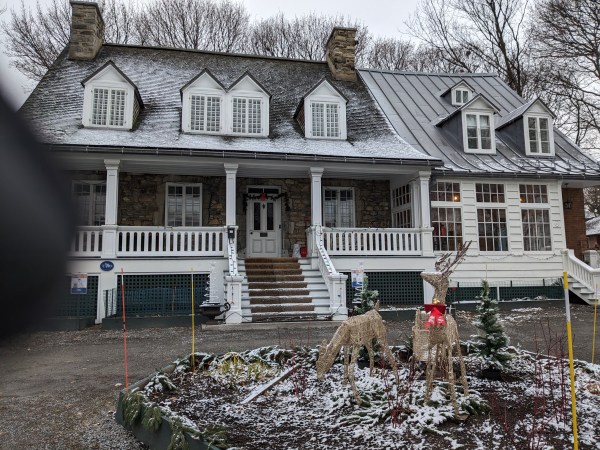
I can’t help but imagine that the controversial hanging effected all 2000 people who lived on the island that year. Five years after Angélique’s death, Jean built Hurtubise House, a storey-and-a-half fieldstone structure on land originally rented by his father in 1699 on Mount Royal. The family built the gabled home out of stone to protect themselves from fire, as required by a law passed the summer after Angelique’s death. You can still visit the home today.5
Sources
1 Beaugrand-Champagne, Denyse, Léon Robichaud, Dorothy W. Williams, Marquise Lepage, and Monique Dauphin, “Torture and Truth: Angélique and the Burning of Montreal,” the Great Unsolved Mysteries in Canadian History Project, 2006, https://www.canadianmysteries.ca/sites/angelique/accueil/indexen.html.
3 Roy, Pierre-Georges,, Inventaire des greffes des notaires du Régime français, Québec, R. Lefebvre, Éditeur officiel du Québec, 1942, 28 vol. ; 25-27 cm, Collections de BAnQ.
My family history includes, like most peoples’ history, twists and turns and coincidences that sometimes defy belief. In the 1970s, my family and I were living in Geneva, Switzerland, when we had a visit from the ‘Mormons’ doing their proselytizing door to door. Because we were in a non-English speaking environment and they were from the USA, we invited them in. Over the course of a few months, we became great friends and we decided to explore the church’s history with them.
One day, whilst talking to them, they mentioned Salt Lake City as the ‘Zion’ of the church, and how the early Pioneers had left their homes and families to trek across the US to get to Salt Lake City, Utah. That name Salt Lake City brought back a memory. When I was 11 years old, I lived with my Grandparents for a few years and my Grandfather used to ask me to go to the post office to post his letter to a Salt Lake City address. I remember it so well because in the 1950s Air Mail letters were treated differently from normal mail, and I had to have this important missive weighed and stamped before it could be posted, so it made quite an impression. I remember thinking ‘where was Salt Lake City, and why and who was my Grandfather writing to? Of course, by the time I arrived home again, the questions were forgotten.
Now, years later in the 1970’s the question arose again, so I called my Grandfather Percival Victor O’Bray (The English branch spells it with an apostrophe unlike the USA branch which spells it without) and asked him about the letters and to whom he had been writing.
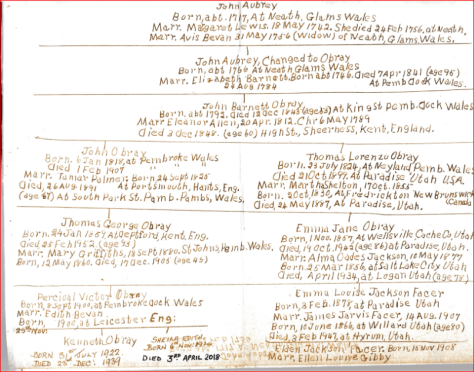
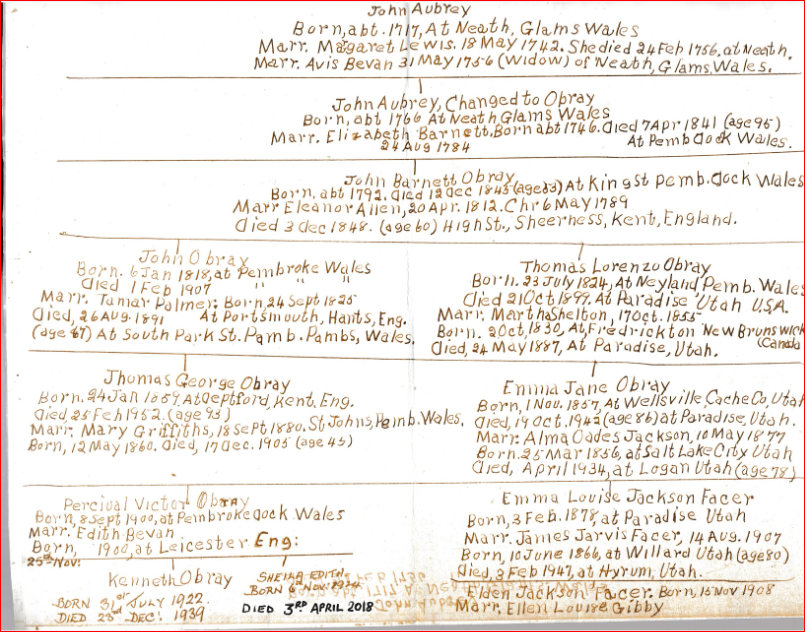
He replied ‘Well, you know the Americans, they are always doing their genealogy and one day, I received this letter from a lady, telling me I was related to her, I was a distant third cousin’ I questioned him further and he said they had corresponded for a number of years, and at one point, she had sent him a ‘Family Tree’ all handwritten then, of course, and started in 1717 to my grandfather’s day. I was very excited by this and asked him, if, when we next came home could I see the ‘Family Tree and read the letters. He replied that I could have the letters and the Family Tree, he had no further use for them, and he would post them to me.
The Family Tree was sent to my Gramps by his third cousin Ellen Louise Gibby Facer in Utah in the early 1950s.
Starting Family Genealogy
I think that started my interest in genealogy and research. The next time I went ‘home’ I questioned my grandparents and family at length, recorded their voices and wrote out the names and birth dates of the family. My Grandparents – who threw nothing out – gave me some marvellous 1800s photos of family members. On the back, I wrote who these people were, most important because shortly after that, we moved to Canada, and genealogy was put on the back burner in a box, for a number of years.
32 years later a renewed interest came when we met some UK friends again, and members of the Church of Latter Day Saints or Mormons. We talked about genealogy, but with young families and busy lives, that was all we did, talked about it, but, never really did any more research. About 8 years ago, we decided the time had come, and we met and researched together. Our friends invited us to their church’s “Centre of Family History” in LaSalle, Quebec, Canada to do some real research with them.
Finding Family Skeletons
I found the Family History Centre a wonderful place. Free to anyone at certain times it has most of the current genealogy websites online open for free. Books, microfiche and copies of records can be researched, with help from church members if needed. It was a quiet peaceful place and we got to spend some time with friends, have lunch and do some family history together. Our friends were a great help, as the Church recommends that its members do family history so they are very experienced. I recalled all the information I had amassed in the 1970s and had no idea how to put it all together. Now I had a chance to do that. I was pleased with how I had named all the photos as it was a wonderful tool to enable me to search online for family members.
I decided to start with the mysterious ‘Family Tree’ from the USA. It was so exciting to be able to put in full names, birth dates and areas to search. I was grateful to the previous Missionaries who advised us to label and date all information as we received it. A really great tip!
My Grandfather was born in Pembroke Dock, Wales and his Great-Grandfather had, as was usual, a large family. Two of those sons, my Grandfathers’ Uncles, Thomas and Samuel OBray became Mormons and left Wales for ‘Zion’ Salt Lake City in 1854.
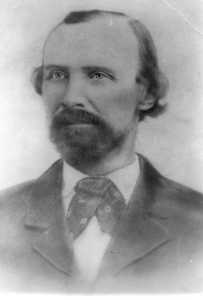
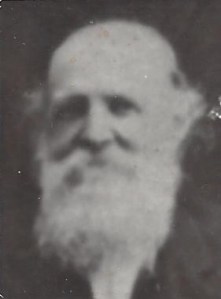
This photo, which appears all over FamilySearch.org, was included in letters to my Gramps from his third cousin in Utah.
Samuel William OBray
(Portrait found on Familysearch.org)
That was a surprise for me, considering the friends and interest I have had in the church over the years, a case of my Great Uncles having “been there, done that’ so I was able to trace their long and arduous journey across the plains to Utah through Mormon church records. Our friends were very excited for us, as this was a great honour in the history of the church, to have family that had made the arduous and terrible trip to reach their ‘Zion’.
Further Research
Through the Welsh Mormon History page, on FamilySearch.org I found that Thomas, was born in Wales in 1824 and he joined the Mormon church when he was 13 years old. Eight years later, he began to preach the gospel in England then Italy, France and Germany. Later, he went to Norway and Denmark. In Malta, he raised up a church branch. In 1854 Thomas emigrated to the US. The ship stopped in New Brunswick, Canada and picked up another family. Thomas joined that family and met Louisa. They continued the journey on their way to St. Louis Missouri to pick up supplies, wagons, food, and animals for the three-month journey across the plains of the United States.
In June at Fort Leavenworth, Kansas Thomas and Louisa were married. During that journey, with her brother Albert and her sister Martha, Louisa died of cholera and was buried en route to Salt Lake City on the plains, in an unmarked grave, a bride of three weeks. Thomas continued on with the family and arrived in Salt Lake City in September 1854.
A Few Surprises
In October 1854, Thomas married Louisa’s sister, Martha. Five children were born to Thomas and Martha. In 1857 Thomas married Carolyn and had 9 children with her. In 1864 Thomas married Ruth and they had 14 children together. The women and children, according to Censuses of the time, lived together in separate houses and were called ‘Housekeepers” Thomas lived with Martha and their children.
Altogether Thomas had 28 children and yes, my Great Grand Uncle had ‘plural marriages’! At that time, it was a tenet of the Church. Martha died in 1887 and a year after her death Thomas was sentenced to the Utah penitentiary for 11 months for ‘Unlawful cohabitation. He was sentenced a second time a year later and served from April to August 1890.
Following a revelation to the church Prophet, the practice of plural marriage was instituted among Church members in the early 1840s however; from the 1860s to the 1880s, the United States government passed laws to make this religious practice illegal. These laws were eventually upheld by the U.S. Supreme Court. At that time, the President of the church, Wilford Woodruff issued a Manifesto, which was accepted by the Church as authoritative and binding on October 6, 1890. This led to the end of the practice of plural marriage in the Church.
Decedents Of The Family
My Great Grand Uncle was asked by the church to explore further land outside of Salt Lake City and to build other settlements, and so he moved his families to ‘Cache’ (secret) County and founded a small place called “Paradise’ just outside of Salt Lake City. Thomas homesteaded the site where the church farm is now located.
In 2014, I visited this small town. It was full of my ancestors. Even the local cafe knew the name of my Grandfather and his Uncles. The Paradise Cemetery was a beautiful place, calm and serene and I found my Uncles and their families. It may sound strange, but I ‘introduced’ myself to them, and told them of their ancestor who wrote to my Grandfather, all those years ago, and how I now ended up here, in Paradise. I hope to go back again one day.
The cemetery contained all of the family who were ‘Pioneers’ and had crossed the plains to get to ‘Zion’ It was very moving to see my two Grand Uncles with special plates affixed to their memorial stones to indicate that they were original Pioneers. Great Grand Uncle Thomas died in Paradise, Utah on 21st October 1899 and Great Grand Uncle Samuel died in Paradise, Utah on 5th June 1910.
Meanwhile, I continue my research and find surprises every day. I would love to contact any members of Ellen Louise Gibby Facer’s family. She, who wrote to my Gramps, all those years ago! I still have her letters and Christmas cards.
In 1734, a huge fire destroyed part of Montreal. Marie-Joseph Angélique, a black slave, was accused on setting the fire deliberately as she tried to escape from her owner. She was arrested and found guilty, then she was tortured and hanged and her body was burned.
Angélique was one of many slaves, some black, others Indigenous, in New France. Slavery was legal in Canada for more than 200 years. The Slavery Abolition Act brought an end to chattel slavery throughout the British Empire, coming into effect on August 1, 1834 in Britain, Canada, and several other colonies.
The attached PDF Slavery in New France is a 23-page research guide to the topic of slavery in New France in the 17th and 18th centuries. It contains the following contents:
Page 2 A link to a complete online copy of the book L’Esclavage au Canadafrançais – 17e et 18e siècles” (in French) Author: Marcel Trudel – 474 pages Publisher- Les Presses Universitaires Laval, Quebec, Canada 1960
Pages 3-17 A List of authors who have written about slavery in Canada
My family history includes, like most peoples’ history, twists and turns and coincidences that sometimes defy belief. In the 1970s, my family and I were living in Geneva, Switzerland, when we had a visit from the ‘Mormons’ doing their proselytizing door to door. Because we were in a non-English speaking environment and they were from the USA, we invited them in. Over the course of a few months, we became great friends and we decided to explore the church’s history with them.
One day, whilst talking to them, they mentioned Salt Lake City as the ‘Zion’ of the church, and how the early Pioneers who had left their homes and families to trek across the US to get to Salt Lake City, Utah. That name Salt Lake City brought back a memory. When I was 11 years old, I lived with my Grandparents for a few years and my Grandfather used to ask me to go to the post office to post his letter to a Salt Lake City address. I remember it so well because in the 1950s Air Mail letters were treated differently from normal mail, and I had to have this important missive weighed and stamped before it could be posted, so it made quite an impression. I remember thinking ‘where was Salt Lake City, and why and who was my Grandfather writing too? Of course, by the time I arrived home again, the questions were forgotten.
Now, years later in the 1970’s the question arose again, so I called my Grandfather Percival Victor O’Bray (The English branch spell it with an apostrophe unlike the USA branch who spell it without) and asked him about the letters and to whom he had been writing.
He replied that ‘Well, you know the Americans, they are always doing their genealogy and one day, I received this letter from a lady, telling me I was related to her, I was a distant third cousin’ I questioned him further and he said they had corresponded for a number of years, and at one point, she had sent him a ‘Family Tree’ all handwritten then, of course and started in 1717 to my grandfather’s day. I was very excited by this and asked him, if, when we next came home could I see the ‘Family Tree and read the letters. He replied that I could have the letters and the Family Tree, he had no further use for them, and he would post them to me.
The Family Tree sent to my Gramps by his third cousin Ellen Louise Gibby Facer in Utah in the early 1950s.
Starting Family Genealogy
I think that started my interest in genealogy and research. The next time I went ‘home’ I questioned my grandparents and family at length, recorded their voices and wrote out the names and birth dates of the family. My Grandparents – who threw nothing out – gave me some marvellous 1800’s photos of family members. On the back, I wrote who these people were, most important because shortly after that, we moved to Canada, and genealogy was put on the back burner in a box, for a number of years.
32 years later a renewed interest came when we met some UK friends again, and members of the Church of Latter- Day-Saint or Mormons. We talked about genealogy, but with young families and busy lives, that was all we did, talked about it, but, never really did any more research. About 8 years ago, we decided the time had come, and we met and researched together. Our friends invited us to their church’s’ “Centre of Family History” in LaSalle, Quebec, Canada to do some real research with them.
Finding Family Skeletons
I found the Family History Centre a wonderful place. Free to anyone at certain times it has most of the current genealogy web sites online open for free. Books, microfiche and copies of records can be researched, with help from church members if needed. It was a quiet peaceful place and we got to spend some time with friends, have lunch and do some family history together. Our friends were a great help, as the Church recommends that its members do family history so they are very experienced. I recalled all the information I had amassed in the 1970s and had no idea how to put it all together. Now I had a chance to do that. I was pleased with how I had named all the photos as it was a wonderful tool to enable me to search online for family members.
I decided to start with the mysterious ‘Family Tree’ from the USA. It was so exciting to be able to put in full names, birth dates and areas to search. I was grateful to the previous Missionaries that advised us to label and date all information as we received it. A really great tip!
My Grandfather was born in Pembroke Dock, Wales and his Great-Grandfather had, as was usual, a large family. Two of those sons, my Grandfathers’ Uncles, Thomas and Samuel OBray became Mormons and left Wales for ‘Zion’ Salt Lake City in 1854.
This photo, which appears all over FamilySearch.org, was included in letters to my Gramps from his third cousin in Utah.
Samuel William OBray
(Portrait found on Familysearch.org)
That was a surprise for me, considering the friends and interest I have had in the church over the years, a case of my Great Uncles having “been there, done that’ so I was able to trace their long and arduous journey across the plains to Utah through Mormon church records. Our friends were very excited for us, as this was a great honour in the history of the church, to have family that had made the arduous and terrible trip to reach their ‘Zion’.
Further Research
Through the Welsh Mormon History page, on FamilySearch.org I found that Thomas, was born in Wales in 1824 and he joined the Mormon church when he was 13 years old. Eight years later, he began to preach the gospel in England then Italy, France and Germany. Later, he went to Norway and Denmark. In Malta, he raised up a church branch. In 1854 Thomas emigrated to the US. The ship stopped in New Brunswick, Canada and picked up another family. Thomas joined that family and met Louisa. They continued the journey on their way to St. Louis Missouri to pick up supplies, wagons, food, and animals for the three-month journey across the plains of the United States.
In June at Fort Leavenworth, Kansas Thomas and Louisa were married. During that journey, with her brother Albert and her sister Martha, Louisa died of cholera and was buried en route to Salt Lake City on the plains, in an unmarked grave, a bride of three weeks. Thomas continued on with the family and arrived in Salt Lake City in September 1854.
A Few Surprises
In October 1854, Thomas married Louisa’s sister, Martha. Five children were born to Thomas and Martha. In 1857 Thomas married Carolyn and had 9 children with her. In 1864 Thomas married Ruth and they had 14 children together. The women and children, according to Censuses of the time, lived together in separate houses and were called ‘Housekeepers” Thomas lived with Martha and their children.
Altogether Thomas had 28 children and yes, my Great Grand Uncle had ‘plural marriages’! At that time, it was a tenet of the Church. Martha died in 1887 and a year after her death Thomas was sentenced to the Utah penitentiary for 11 months for ‘Unlawful cohabitation. He was sentenced a second time a year later, and served from April to August 1890.
Following a revelation to the church Prophet, the practice of plural marriage was instituted among Church members in the early 1840s however; from the 1860s to the 1880s, the United States government passed laws to make this religious practice illegal. These laws were eventually upheld by the U.S. Supreme Court. At that time, the President of the church, Wilford Woodruff issued a Manifesto, which was accepted by the Church as authoritative and binding on October 6, 1890. This led to the end of the practice of plural marriage in the Church.
Decedents Of The Family
My Great Grand Uncle was asked by the church to explore further land outside of Salt Lake City and to build other settlements, and so he moved his families to ‘Cache’ (secret) County and founded a small place called “Paradise’ just outside of Salt Lake City. Thomas homesteaded the site where the church farm is now located.
In 2014, I visited this small town. It was full of my ancestors. Even the local cafe knew the name of my Grandfather and his Uncles. The Paradise Cemetery was a beautiful place, calm and serene and I found my Uncles and their families. It may sound strange, but I ‘introduced’ myself to them, and told them of their ancestor who wrote to my Grandfather, all those years ago, and how I now ended up here, in Paradise. I hope to go back again one day.
The cemetery contained all of the family who were ‘Pioneers’ and had crossed the plains to get to ‘Zion’ It was very moving to see my two Grand Uncles with special plates affixed to their memorial stones to indicate that they were original Pioneers. Great Grand Uncle Thomas died in Paradise, Utah on 21st October 1899 and Great Grand Uncle Samuel died in Paradise, Utah on 5th June 1910.
Meanwhile, I continue my researching and find surprises every day. I would love to contact any members of Ellen Louise Gibby Facer’s family. She, who wrote to my Gramps, all those years ago! I still have her letters and Christmas cards.
The Trail of the Huguenots in Europe, the United States, South Africa and Canada
Author: G. Elmore Reaman
QFHS #UEL-REF HG 010.01 R4 1972
Total pages: 318
From page 137 to page 205, this section of the book address the Protestant families in Nouvelle France (New France)
Being a book owned by the United Empire Loyalist’ Association of Canada, it cannot be taken out of the library.
The following is an excerpt from this superb book by G. Elmore Reaman.
It is a generally accepted point of view in Canada that Frenchmen have always been Roman Catholics and that Protestantism has had little or no reliationship with France. It has been further accepted that there was no connection between Protestant French and the exploration of Canada by the French. A careful study of both of these points of view will show that they are untenable. It may come as a surprise to learn that historians of this period state on good authority that, if it hadn’t been for the business enterprise of Huguenots in France and their desire to found a colony where they could remain loyal to the King of France and yet enjoy freedom of worship, it is doubtful if there would be many French in Canada today. Furthermore, it is quite possible that had the French allowed Huguenots to migrate to Canada in the seventeenth century, England would have stood a slim chance of conquering Canada.
Such information does exist in authentic sources, but few persons in Europe or America—and that includes Canada—have any knowledge of it. French Roman Catholics have naturally advanced their point of view and Protestants have never thought it worth while to investigate it. Huguenot Societies in France, England, and the United States are not aware that from 1534 until 1633 Canada was practically Huguenot controlled nor do they know that many of the earliest settlers in Upper Canada (Ontario) were descendants of émigrés from France, some of whom first went to the British Isles, then to the United States, and finally to Ontario.
G. Elmore Reaman
G. Elmore Reaman (1889-1969) was born in Concord, Ontario, he received his education at the University of Toronto, McMaster University, Queen’s University, Cornell University.
Dr. Reaman’s materials are found at the University of Waterloo Archives.

![Handcart Pioneers Postcard pg. 1 - 1939_thumb[1]](https://genealogyensemble.com/wp-content/uploads/2014/09/handcart-pioneers-postcard-pg-1-1939_thumb1.jpg)
![Handcart Pioneers Postcard pg. 2 - 1939_thumb[2]](https://genealogyensemble.com/wp-content/uploads/2014/09/handcart-pioneers-postcard-pg-2-1939_thumb2.jpg)
 Genealogy Ensemble