Tag Archives: Church of Jesus Christ of Latter-day Saints

The Master Shipwright: The Life and Death of John O’Bray Senior

Thursday, December 11, 1845, a biting easterly wind that had held Pembrokeshire, Wales, in an arctic grip for days as John O’Bray Senior, my third Great Grandfather, stepped out of his home at 14, Queen Street, East, bundled up against sub-zero temperatures, and the aftermath of a major snowstorm.
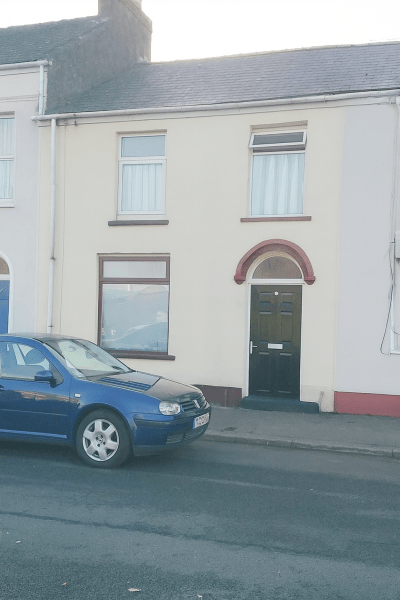
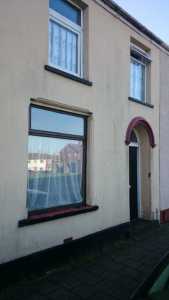
14, Queen Street, East Pennar, Wales, circa 2021

A thick layer of dry, powdery snow covered the ground—a rare sight for Wales that would linger for over a week due to the sustained freeze. (1)

John was an “old servant” of the Pembroke Royal Dockyard (the Paterchurch site). At 53, he was a master shipwright who had walked these paths since he was a twelve-year-old boy. He lived in Pennar, a district on a headland perfectly situated for dockyard workers. Pennar was one of the first residential areas to expand alongside the dockyard’s rapid 19th-century development.
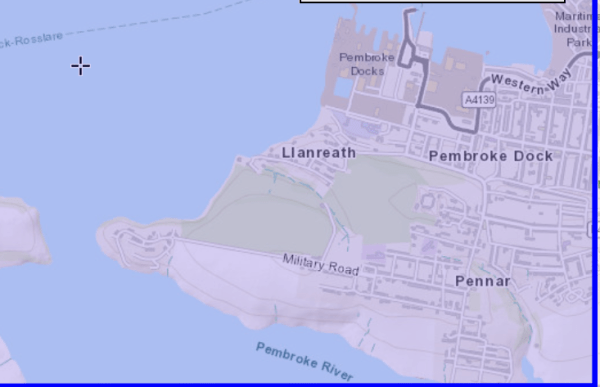
Map of Pennar and Pembroke Docks

A Lifetime of Service

Records from Richard Rose’s “Pembroke People” provide a clear timeline of John’s long career:

  • June 24, 1805: John entered as a shipwright boy at Milford, aged 13. He was paid 2 shillings a day.
  • July 1812: He became a full shipwright at age 21, earning 3 shillings and 4 pence a day.
  • April 20, 1812: Just before his promotion, he married Eleanor (Elinor) Allen. Together, they raised ten children.
  • A Lineage of Craft: John was part of a multi-generational dynasty. This trade—from shipwrights to boilermakers—continued for over 150 years, ending with my grandfather, Percival Victor O’Bray. They were the “naval backbone” of Britain from the Napoleonic era through the World Wars.

The Fatal Morning

On that freezing morning, 1845, John was working on the ‘slips’—the massive, sloping masonry platforms used to build and launch ships. At Pembroke, these were not open to the elements but were covered by enormous, echoing iron and timber roofs. Despite the roof, the dry powdery snow would have drifted through the open ends of the slips, and the east wind would have whistled through the scaffolding, coating the wooden planks in a treacherous glaze of frost.

For a significant vessel, the slip might rise 6-12 meters (20-40 feet) or more from the low water mark to the top of the slip’s working area, with the slope extending a considerable distance into the harbour (2)

The Accident

As John crossed a stage surrounding a ship’s hull, a common but deadly scaffolding error occurred. A plank had been “short planked”—it did not have a sufficient overlap on its support. As John stepped past the pivot point, the plank acted like a seesaw, tilting upward and sending him plummeting to the stone floor below.

The Carmarthen Journal (December 19, 1845) reported the tragedy:

An efficient and industrious shipwright, named John Obrey, (sic) belonging to Her Majesty’s Dock Yard at Pembroke, fell from a considerable height into one of the building slips, and was killed on Thursday last.

To mark the esteem in which he was held by the authorities of that establishment, the Chapel bell of the Arsenal was tolled during the funeral. * It appears a plank forming one of the stages aroundthe ship’s side had not sufficient hold of the support on which it rested, and the weight tilting it up, he was precipitated into the slip, and falling on his head.***

His skull was so fractured that his brain actually protruded. His wife will, no doubt, have a pension, though the amount must necessarily be small”

* The Chapel Bell of the Arsenal tolling is a significant detail. It shows that John was not just a nameless labourer; he was a respected member of a tight-knit community. The “Arsenal” refers to the fortified nature of the Pembroke Dockyard, which was protected by a series of Martello towers and barracks to defend the valuable ships under construction. (3)

** The Pension The Carmarthen Journal’s mention of a pension for his wife, Elinor, is noteworthy. While “small,” the fact that a pension was even discussed suggests John’s “old servant” status (his 40+ years of service since 1803) granted his family a level of consideration not always afforded to Victorian labourers.

*** The Hazard of Short Planking. The description of the plank not having “sufficient hold of the support” suggests a common but deadly scaffolding error. In the rush of a busy dockyard, a plank that didn’t overlap its support sufficiently could become a “seesaw” the moment a worker stepped past the pivot point.

Also reporting was The Pembrokeshire Herald and General Advertiser, 19th December, 1845, Page 3

A fatal accident befell one of the workmen in Pembroke Royal Dockyard last Thursday. On crossing a stage, he stepped on a plank which gave way under him, and falling into the slip upon his head, was killed on the spot. His brains were actually seen oozing through the skull. His name was O’Bray – an old servant and an active mechanic”

Those phrases, ‘brains actually protruded’, are graphic, but show the brutality of industrial work in the 19th century. The contrast between the “industrious shipwright” described in the newspapers and the brutal nature of his accident highlights the high stakes of Victorian maritime labour.

Faith and Final Rest

At the time of his death, John served as a clerk for his local church. Interestingly, he had converted to the Church of Jesus Christ of Latter-day Saints, though he passed away before he could be formally baptised.

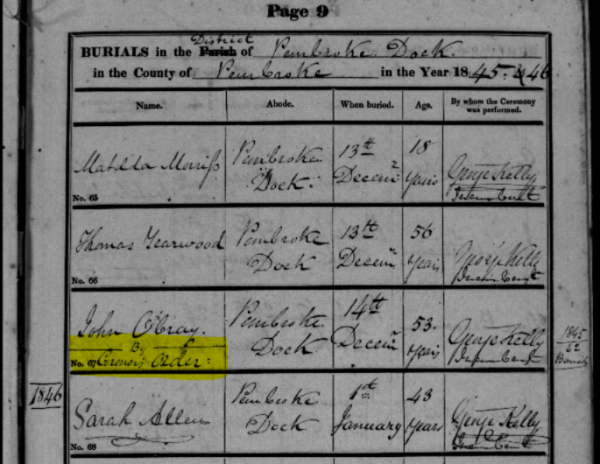
His wife’s family had roots in early Methodism in Milford and Pater, showing a family history of deep religious conviction. John O’Bray, Senior, was buried by Coroner’s Order at Saint Mary’s Churchyard in Pembroke.
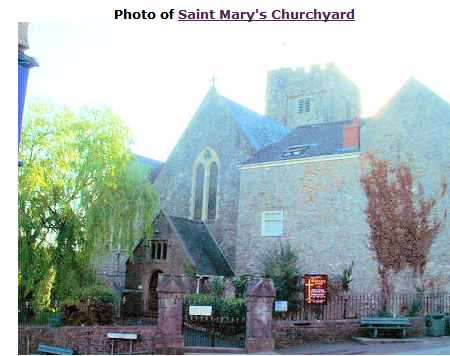
John was buried by a coroner’s order
Sources

These historical weather records below detail the cold temperatures and snow cover experienced in Milford Haven during December 1845

  1. Central England Temperature (CET) records and regional logs for the winter of 1845–46. Met Office Historical Weather Records / “The Climate of Pembrokeshire.”
  1. https://www.ice.org.uk/what-is-civil-engineering/infrastructure-projects/pembroke-dockyard#:~:text=Did%20you%20know%20%E2%80%A6%20*%20Pembroke%20Dockyard,first%20iron%20roofs%20to%20shipbuilding%20slips%20(1845).
  2. https://en.wikipedia.org/wiki/Royal_Navy_Dockyard

Notes:

Recorded here at https://www.cnrs-scrn.org/northern_mariner/vol03/tnm_3_1_1-43.pdf, is a historical fatality, which could be a mention of John O’Bray’s death:

Documentary evidence from the era records instances where planks forming these stages gave way, precipitating shipwrights into the slip. One such record describes a worker falling headfirst from a stage, resulting in a fatal skull fracture upon hitting the stone floor”


Doc Penfro, Wales and the O’Bray Family Name Part 2

In part one, (https://genealogyensemble.com/2023/01/06/doc-penfro-wales-and-the-obray-family-name-part-1/) I wrote about John Barnett O’Bray my third great-grandfather who was born in Rhosmarket and lived in Doc Penfo – The Welsh name for Pembroke Dock – and his family name, the spelling of which had changed so many times over the centuries.

Part two is about third great-grandad John’s life and work in Pembroke Dock.

The town of Milford was founded in 1793 a year after John Barnett O’Bray was born in 1792. He was apprenticed in 1805 at Milford as a shipwright boy.

Sir William Hamilton obtained an Act of Parliament in 1790 to establish the port at Milford. It takes its name from the natural harbour of Milford Haven, which was used for several hundred years as a staging point on sea journeys to Ireland and as a shelter by Vikings. (1)

By 1810, Third Great-Grandad earned 2 shillings a day, and when he was 21 years old in 1812, he became a shipwright and married Eleanor Allen, whose family were also shipwrights and lived in Pembroke Dock.

In 1823, John Barnett O’Bray took a 60-year lease of one of the Club Houses recently built in the High Street at a rent of One Pound, Ten Shillings a year. His years’ wages in 1828 were 87 pounds, 19 shillings and one penny. Such a tiny percentage of his salary for the lease compared to today!

Over 25 years, John and Eleanor had ten children. Their first child, William died at age four, Maria, was born in 1814, George in 1815, and John in 1818, and became a shipwright. Elizabeth was next in 1820, Thomas in 1821, Robert in 1824 who became a joiner’s apprentice, Samuel in 1828, and Eleanor in 1834. For some reason, although very common, partly because of the high mortality rate, the last child born in 1836 was named Thomas William however, he died at age eight in 1844.

Why would they name the youngest last child after his two siblings? Perhaps in memory of them especially after the first-born Thomas, left Wales for the other side of the world, so perhaps this would be a kind of memorial to both sons? Some family mysteries we will never know.

Five family members left Wales for various parts of the United States. I know that Thomas and Samuel were baptised as members of The Church of Jesus Christ of Latter-Day Saints – or Mormons. The other family members, Maria, George, and John did live and die in various parts of the USA and I believe they too, were baptised as Mormons. (2)

John Barnett my third Great Grandfather, suffered a grisly death at the age of 54 years.

An Unfortunate and Fatal AccidentCarmarthen Journal Article 19 Dec 1845

“An Unfortunate and Fatal Accident – An efficient and industrious shipwright, named John Obrey, belonging to Her Majesty’s Dock Yard at Pembroke, fell from a considerable height into one of the building slips and was killed on Thursday last. To mark the esteem in which he was held by the establishment authorities, the Chapel bell of the Arsenal was tolled during the funeral.

It appears a plank forming one of the stages around the ship’s side had not sufficient hold of the support on which it rested, and the weight tilting it up, he was precipitated into the slip, and falling on his head, his skull so fractured that his brains actually protruded. His wife will, no doubt, have a pension, though the amount must necessarily be small.” (2)

I went to Pembroke Dock, West Wales In September 2019 to visit my dear friend, Michelle, who kindly drove me around the areas in West Wales, where she lives, in Aberdare. She took me to Pembroke Castle where the Tudor Dynasty started with the birth of King Henry VII. Next door to the castle entrance was a shop called ‘The Hall of Names’ with a database of most names in the world and, for a price, they will research and print out the name, and its origins. (3)

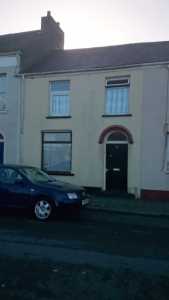
Michelle also drove me to 14 Queen Street East, where third great-grandfather John Barnett O’Bray lived in 1841 with his family. The street and number 14, one of a row of houses, are still there but have probably changed a great deal since!

It certainly was a strange experience standing in front of the well-maintained pretty house that my ancestors had once lived in with their many children.

14 Queen Street East – A typical terraced two-up (two bedrooms) and two-down (kitchen and sitting room) house.

According to the 1841 Census, only five of the children, now all in their teens, still lived there but a tight squeeze for seven people. However, I am sure they were happy to have such a pleasant home.

Through research, I believe that third-great grandad John Barnett was also a member of the Church of Jesus Christ of Latter-Day Saints (The Mormons), but died before he was baptised.

SOURCES

1.https://en.wikipedia.org/wiki/Milford_Haven

2. https://pembrokecastle.co.uk/

3. Carmarthen Journal Article

NOTE:

Richard Rose wrote a fascinating book called ‘Pembroke People’ and is described on the flyleaf, as probably the fullest account that was ever written about life in an early 19th-century community. Flipping through this wonderful book, that seems to be true. I found my Great-grandfather’s family listed there and other family members too.

Every possible trade in shipbuilding, mariner,  and associated trades were listed, from accountants to wine and spirit merchants even including the local prostitutes and illegitimate children! And yes, I did look to see if any of my family were listed there, but none were.

“My Family History” which includes Thomas and Samuels’ stories can be found here:

https://wordpress.com/post/genealogyensemble.com/610

And you can read Samuel’s story here:  

https://genealogyensemble.com/2016/08/17/mormon-history/

Land Of My Fathers…

Well, the land of my Grandfathers and Greats that is, all the way back to the 1400s.

My maternal Gramps was an O’Bray born, like all his forebears, in West Wales. Pembroke Dock, to be exact.  Welsh is still spoken widely in West Wales and the Welsh name for this area is Doc Penfro, it was originally named Paterchurch and was a small fishing village. Pembroke Dock Town expanded rapidly following the construction of the Royal Navy Dockyard in 1814.

There is some speculation about the original name of my fourth great-grandfather, John Barnett O’Bray born in 1792. About this time, the family name was Aubrey but in that century it changed to O’Bray and/or O’Brey. Our ancestors in the Mormon Church in Salt Lake City, Utah, spell it without the apostrophe – OBray whereas my Grandfather spells it O’Bray.

This September 2019 I went to Pembroke Dock, West Wales and visited Pembroke Castle where the Tudor Dynasty started with the birth of King Henry VII. Next door to the castle entrance was a shop called ‘The Hall of Names’ with a database of most names in the world and, for a price, they will research and print out the name, and its origins. [1]

They looked up the name Aubrey for me, and all the variations which are characteristic of Norman. Old and Middle English lack definite spelling rules, and then Norman French was added to the linguistic stew, with finally, medieval scribes who wrote names as they sounded, so no wonder I have such a problem. So, I am still none the wiser as to why the change – this is MY brick wall! [1]

I also went to 14 Queen Street East, where third great-grandfather John Barnett O’Bray lived in 1841 with his family. The street and number 14, one of a row of houses, are still there but have probably changed a great deal since!

14 Queen Street Pembroke Dock.jpg 2

14 Queen Street Pembroke Dock

In the year 1841, our O’Bray/O’Brey family is mentioned in a book called “Pembroke People” by Richard Rose under ‘shipwrights’ but even in this short piece in the book, there are three different spellings of his name!

The heading reads that he was “John Barnett O’Bray or OBrey” A further note in the book mentions a William Aubrey buried at St. Mary’s on 27th September 1817 aged four and the author assumes “He was probably another child of this family” If so, why was he called Aubrey and the rest of the family O’Bray/Obrey? Right at the end yet another mystery as the author states that when John Barnett O’Bray was buried, also in the register was ‘An Elizabeth Oberry. Buried on 11th April 1841 aged 93.

John Barnett O’Bray was apprenticed in 1805 at Milford as a shipwright boy. He was earning 2 shillings a day in 1810 and when he was 21 years old in 1812 he became a shipwright and married Eleanor Allen, who’s family also appear as shipwrights in the book.

Their ten children, aged from two years to the eldest aged 25 years include in order of birth, William who died at age four, Maria, born in 1814, George 1815, John 1818, Elizabeth 1820, *Thomas 1821, Robert 1824, *Samuel 1828, Eleanor 1834 and Thomas 1836, who died at age eight.

** Thomas Lorenzo and Samuel William, were baptised into the Church of Latter-Day Saints – the Mormons –  and left West Wales to trek across the plains in 1851 to Salt Lake City, Utah. Two other family members, Maria and George also became Mormon and went to Utah later.

In 1823, John Barnett O’Bray took a 60-year lease of one of the Club Houses recently built in the High Street at a rent of One Pound, Ten Shillings a year. His years’ wages in 1828 were 87 pounds, 19 shillings and one penny.

John Barnett my third Great Grandfather suffered a grisly death.

An Unfortunate and Fatal Accident
Carmarthen Journal Article – 19 Dec 1845

“An Unfortunate and Fatal Accident – An efficient and industrious shipwright, named John Obrey, belonging to Her Majesty’s Dock Yard at Pembroke, fell from a considerable height into one of the building slips and was killed on Thursday last. To mark the esteem in which he was held by the authorities of that establishment the Chapel bell of the Arsenal was tolled during the funeral.

It appears a plank forming one of the stages around the ship’s side had not sufficient hold of the support on which it rested, and the weight tilting it up, he was precipitated into the slip, and falling on his head, his skull so fractured that his brains actually protruded. His wife will, no doubt, have a pension, though the amount must necessarily be small.” [3]

Through research, I believe that John Barnett was also a member of the Church of Jesus Christ of Latter-Day Saints (The Mormons), but died before he was baptised.

SOURCES

1. https://pembrokecastle.co.uk/eat-shop-discover/hall-of-names

Richard Rose wrote a fascinating book called ‘Pembroke People’ and is described on the flyleaf, as probably the fullest account was ever written about life in an early 19th-century community. Flipping through this wonderful book, that seems to be true. Every possible trade in shipbuilding, mariner,  and associated trades were listed, from accountants to wine and spirit merchants even including the local prostitutes and illegitimate children! And yes, I did look to see if any of my family were listed there, but none were. [2]

[3] Carmarthen Journal Article

“My Family History” which includes Thomas and Samuels’ stories can be read here:

https://wordpress.com/post/genealogyensemble.com/610

And you can read Samuel’s story here:   https://genealogyensemble.com/2016/08/17/mormon-history/

Buried In Woollen

‘Buried in Woollen’ What an odd sentence!

So I thought, whilst indexing very old, late 17th century documents for the church of Jesus Christ of  Latter Day Saints. I was indexing English burials and once started on the list, nearly every name was also accompanied by an affidavit stating that the person was  ‘Buried in Woollen’

It seemed to be very important to state this on the burial affidavits. I wondered about this unusual practice and decided to find out.

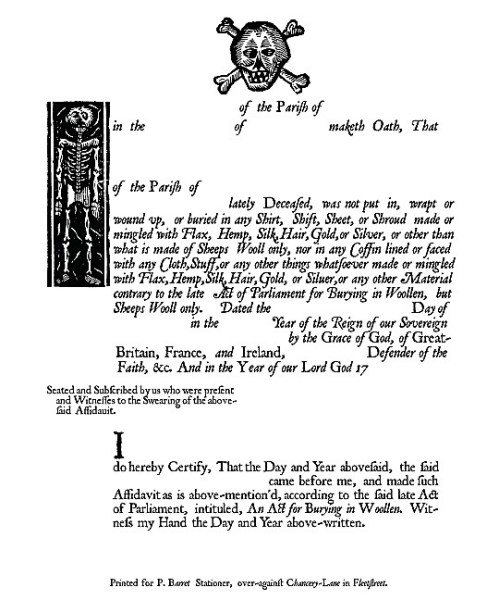
The museum in Hungerford, Berkshire England shows an affidavit similar to the one I was indexing.

I have written it out as it states on the affidavit.  Note that the letter ‘F” reads as an ‘S” in Old English.
It says:

Name of deceased……….of the Parifh of………….maketh Oath that…………………of the Parifh of lately deceased, was not put in, wrapt or wound up, or buried in any Shirt, Shift Sheet or Shroud made or mingled with Flax, Hemp, Silk, Hair God or Silver, or other than what is made of Sheeps. Wooll only nor in any Coffin lined or face with any Cloth, Stuff, or any other things whatforever made or mingled with Flax, Hemp, Silk, Hair, Godld or Silver or any other Material contrary to the late Act of Parliament for ‘Burying in Woollen, but Sheeps Wooll only.    Dated the…………..Day of….. in the………….Year of the Reign of our Sovereign By the Grace of God, of Great Britain, France and Ireland,               Defender of the Faith, etc. And in the Year of our Lord God 17……..Seated and Subfcribed by us who were prefent and Witnesses to the Swearing of the above faid Affidavit.

I do hereby Certify That the Day and Year abovefaid, the faid Affidavit as is above mention’d according to the faid late act Act of Parliament intituled, An Act for Burying in Woollen. Witnefs my Hand the Day and Year above-written.

(Printed for P. Barret Stationer, over-againsf Chancery-Land in Fleetfreet). [1]

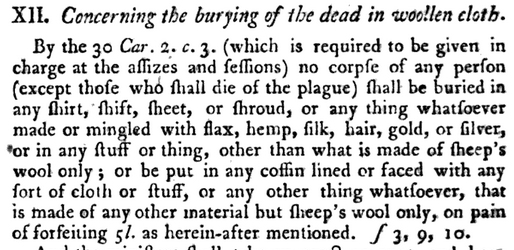
Only those with the plague or who were destitute escaped this law. So much for the rules of burying in woollen. But why?

Between 1665 and the turn of the century, wool became a national symbol of importance in England,  but new materials and foreign imports were coming into the country and the industry was under threat as linen, silk, and satin were readily available and the need for woollen dropped away. Workers who specialised in silks, satins, and linens flocked into the country and the need for wool waned.

Most of the wealthy depended on wool for their lifestyles, and some of these wealthy sat in Parliament, Members whose constituencies depended on the woollen industry, and was an essential part of their fortunes. These Members depended on rents paid by tenants who worked in the woollen trade, and so they changed the laws.

Most people were buried in linen shrouds. It was the custom and older than Christianity itself, but it also benefited England’s greatest rival across the Channel, the French, who provided most of all England’s linen. So, to stymie the French and preserve the woollen trade in England, Parliament developed the law of burying in Woollen only.

The first Act was passed in 1666 and the second, and rather more famous, in 1678 repealing the first  Its aims were “for the lessening the importation of linen from beyond the seas, and the encouragement of the woollen and paper manufacturer of the kingdom.” [2]

Below is an extract from the Act.

For more of the legislation see The Justice of the Peace, and Parish Officer, Volume 5, 1814 on Google Books

The Act was not without its protesters as a more wealthy set wanted to be buried in their finery, not woollen.

“At first nothing could be more shocking,” wrote philosopher Bernard Mandeville, “to Thousands of People than that they were to be Buried in Woollen.”

“Our Savior was buried in Linnen,” protested Edward Waller, the representative for Hastings. “‘Tis a thing against the Customs of Nations and I am against it.”

Henry Coventry, Secretary of State for the Southern Department, was harsher, suggesting that “men of the Romish Religion” (Romish belonging or related to, Rome as Catholics) prefer woollen burials to linen. “I fear this Bill may taste of Popery,” he sneered.

Citizens were fined five pounds if they did not obey the law but many would pay the fine rather than be ‘seen dead in wool’  In 1678 this was an enormous sum of money about $1,000 in today’s money. [3]

The Act was repealed in 1814, although long before then it had been largely ignored.

Sources:

[1] www.hungerfordvirtualmuseum.co.uk/index.php/10-themes/961-buried-in-woollen

[2] http://www.historyhouse.co.uk/articles/buried_in_wool.html

[3] https://www.atlasobscura.com/articles/england-wool-burial-shrouds

[4] Eric W. Nye, Pounds Sterling to Dollars: Historical Conversion of Currency, accessed Monday, March 25, 2019, http://www.uwyo.edu/numimage/currency.htm.


RootsTech Happens Next Weekend

FamilySearch.org, the genealogy website hosted by the Church of Jesus Christ of Latter-day Saints and the Federation of Genealogical Societies (FGS) are teaming up to host RootsTech, a two-day educational extravaganza next weekend, from Thursday February 11 until Sunday, February 14.

I’m so disappointed not to be going to Salt Lake City, Utah to attend in person, but at least I’ll be able to attend virtually, via a multitude of seminars that will be live-streamed via the website.

According to the RootsTech Facebook page, the sessions that will be live streamed in Eastern Standard Time are:

Thursday

10:30 a.m. Keynote speakers
1:00 p.m. The Future of Genealogy – panel
3:45 p.m. Tell it Again – Kim Weitkamp
5:00 p.m. The Genealogists Gadget Bag – Jill Ball and panel
6:15 p.m. Finding the Obscure and Elusive…- James Tanner

Friday

10:30 a.m. Keynote speakers
11:45 a.m. Researching Ancestors Online – Laura Prescott
1:00 p.m. FamilySearch Family Tree – Ron Tanner
3:45 p.m. Google Search…and Beyond – Dave Barney
5:00 p.m. From Paper Piles to Digital Files – Valerie Elkins

Saturday

10:30 a.m. Keynote speakers
11:45 a.m. Using Technology to Solve Research… – Karen Clifford
1:000 p.m. Digital Storytelling: More than Bullet Points – Denise Olson

Family history fairs around the world will also stream some of the sessions. Check the website to see if there’s one near you.

After watching as many of these as I can, I’ll be trying to figure out how to attend next year’s RootsTech. It will take place February 3–6, 2016, again at the Salt Palace Convention Center in Salt Lake City, Utah.