Tag Archives: Crepeau

Peacocks and Cherubim: My Mysterious Aunt Cecile

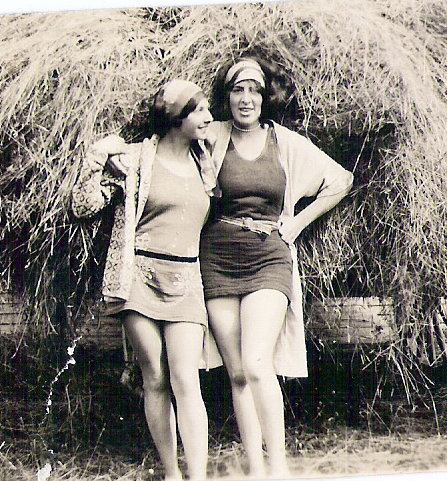
My Aunts Flo and Cecile, circa 1930, in what I assume are bathing suits maybe at Old Orchard Beach Maine where the family vacationed.

It was 1962 or so and my mom, twin brother and I had taken a bus from Old Orchard Beach to Ogunquit, Maine to visit my Aunt Cecile, who was on vacation at the same time as us.

As my brother and I crawled over the jagged and slippery shoreline in front of her hotel we openly wondered why anyone in their right mind would want to vacation in this spot. It was all rocks!

Well, much time has passed and my husband and I love to spend time at picturesque Perkin’s Cove on our short trips to Maine in the spring or fall.

On one such weekend visit, I recall the owners of our b-n-b telling us about pre-WWII Ogunquit: it had once been a bohemian artist’s colony with open air classes and nude models posing on the Marginal Way.

An artist’s colony! Now that explains it. My Aunt Cecile was an artist and a good one at that – but a bohemian, never! I remember her only as sober and serious – and seriously pious. Children were a foreign country to her and her main ambition with regards to me was to convert me to Roman Catholicism.

Marie-Catherine Cecile Crepeau was born in Montreal 1909 to Jules Crepeau and Maria Roy, my grandparents. She had an older brother and sister, Louis and Alice and in 1914 or so another girl her age, Florida, was plucked off the scruffy streets of south central Montreal and brought into the family fold. My mother would appear much later in 1921.

Cecile contracted scarlet fever as a child and suffered severe heart damage. According to her sisters, she was ‘babied’ for most of her childhood, not asked to do very much.

So, it seems she learned to paint.

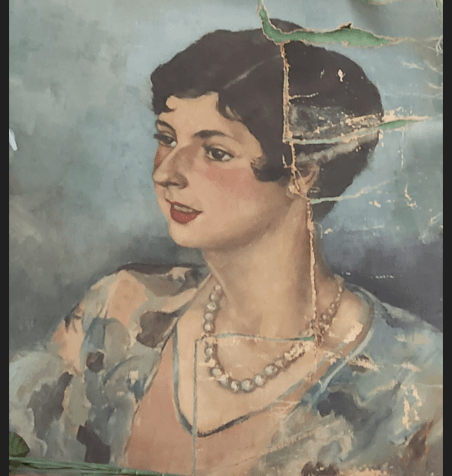
This battered canvas of young Flo is the only one of Cecile’s that I own. It was painted in 1927 when both Cecile and Flo were 18. It is pretty accomplished for so young an artist, I think.

Indeed, in a few years later Cecile would be accepted into the Beaux-Arts in Montreal (perhaps using this portrait in a portfolio) and she would win the first prize for oil painting (considered very much a male domain) in 1937.

I have the medal somewhere and I found this tidbit from a tabloid called “L’illustre” describing the 1937 Beaux-Art exhibition: “Although the Hall of Paintings has little that is very striking, Therese Boucher’s “Reclining Man’ is vigorously treated. Among the angels, Cecile Crepeau’s is most alluring, in large part because of the curious golden tonality of the ensemble. Her study of a face, placed to the right of the entrance, has life and sincerity, despite some weaknesses. Her blue vase beside a pewter bowl also merits a mention. The female nudes are unimpressive.”

The angel picture I remember well. It loomed over Cecile’s living room and, yes, it was very golden. Another tall tall wall hanging I remember was an oil painting of a statue of St John the Baptist holding his own very hairy head.

I don’t recall the still life mentioned in the newspaper article, but I wish she had put some pretty vases behind Aunt Flo in my painting. It seems unfinished somehow.
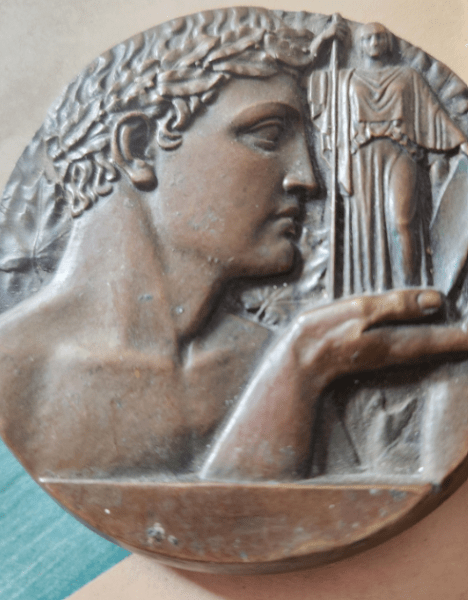
The gorgeous and heavy ‘gold’ medal. I wish

My aunt was ‘a perfectionist’ (who suffered migraines for it) said my mother, which might account for why she created so few completed canvases..

Again, according to my mother, a teacher at the Beaux-Arts told her she had the technique but to be a superior artist but she had to ‘live a little.” (I wonder if the teacher was hitting on her.)

In the 1940’s, Cecile is listed in Lovell’s Directory as “housekeeper’ at my widowed grandmother’s Oxford Avenue flat. My mother is working as a stenographer at RKO Motion Pictures just down the street and my Aunt Flo as a greeter at Henry Morgan’s department store downtown. They are providing the financial support. My grandfather, former Director of City Services, had died under mysterious circumstances in 1938.

My brother and aunts in Cecile’s garden on Beaconsfield Avenue. It was lined with statuesque poplars and showcased an ornate wrought iron and marble birdbath! 1956 or so.

In 1951 my grandmother passed away. My mother had already married and moved a short distance way. Flo, too, would soon marry, leaving Cecile to figure out what to do with the rest of her life.

The story goes Cecile tried to became a nun but was turned down ‘due to her bad heart.’ Instead, she married a friend’s father, Amedee Buteau, a retired professor almost 30 years her senior. 1They would take a lower duplex apartment in NDG, filling it with my grandparents’ elegant furnishings. It was a marriage of convenience, no doubt, but it worked.

In the 1960’s, I just loved visiting Cecile’s home. Unlike our dingy and unadorned upper duplex apartment not far away, Cecile’s home was spic-n-span, every surface polished to a high sheen. There was no TV blaring Bonanza or Star Trek, just a giant grandfather clock solemnly marking each quarter hour with a click and a ping. The place felt like a museum with all the curio cabinets filled with so many intriguing things.
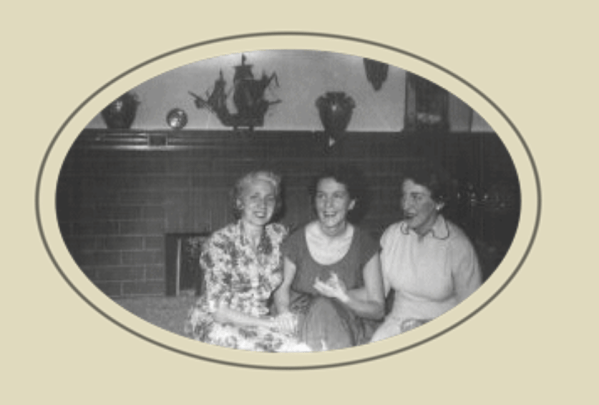
1955, My mom with her sisters.

And mixed in with the fin-de-siecle family treasures were her many multi-media artworks: sculptures, ceramics, watercolours. There were quite a few confusing (to me) religious subjects like bleeding hearts but also some adorable cherubim and many nature studies especially of flowers, birds and butterflies. Indeed, Cecile painted an immense peacock in full display on a wooden blind on the wall behind her bed. The tension between Eros and Thanatos in her beautiful Beaconsfield Avenue abode was quite evident to me, even as a child.

My mother had a very choppy relationship with her sister Cecile so even though we lived but a short bus ride away we didn’t visit her that often. – and I don’t recall her ever visiting us. Cecile’s hair went from red to grey between 1960’s visits I recall.

On at least one occasion I was sent on a sleepover. My aunt was awkward with me and I was determined not to like her, probably picking up on my mom’s vibes. It didn’t help that Cecile brought me to a scary Latin mass at Notre Dame Cathedral, pinning a silly handkerchief to the top of my head. Unfortunately, she did no art with me. Too messy I guess. Too bad as she was a wizard with pastels.

Cecile passed away in 1974 a year or two before her aged spouse. She was 65. My mother sobbed with grief at her passing. “You were always fighting with her,” I recall saying to my mom. “So why are you crying so much?” How naive of me.

All of the family heirlooms fell into the hands of ‘strangers’ upsetting my mother, but one lost canvas pained her in particular. “It was Cecile’s best painting,” she said, “of Alice putting a flower in Florida’s hair before a dance.”

Classic! I can hardly blame my mother for coveting that particular oil painting, one that involved all of her sisters: I wonder who owns it now.

  1. Mon Oncle Amedee was so comically vague in his dotage, seated in his armchair snoozing away with an upside down Le Devoir newspaper folded onto his lap, we children assumed he was expert in some airy-fairy field like ancient philosophy. But, no, quite the opposite. A short search on the Web reveals that in the 1920’s Amadee was a civil engineer, Dean of a Technical College and expert in technical education giving lectures, meeting with policy makers, even writing a book.
Laura Lacombe, Who Were You?

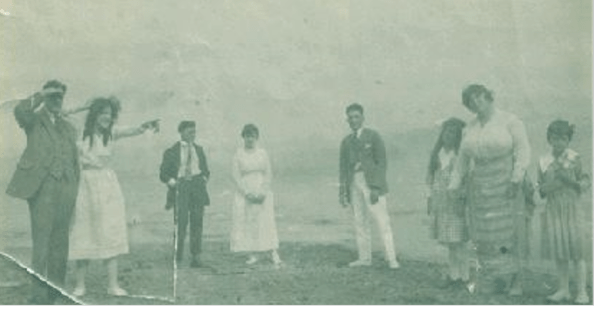
Perhaps the only picture of my mother’s cousin, Laura Lacombe, fourth from left in a Crepeau family picture circa 1914.

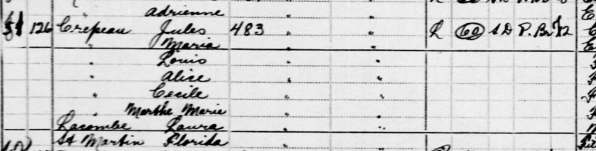
Genealogy is a gift that keeps on giving. A few years ago, when the 1921 Canadian census came online, I anxiously consulted it to see a Crepeau listing for my mother (4 months old), my uncle Louis, my aunts Alice and Cecile (20 and 17) and my 15 year old Aunt Flo, listed as adopted under the name Florida St-Martin.

Bingo! That’s what I had been waiting to see for 10 years!

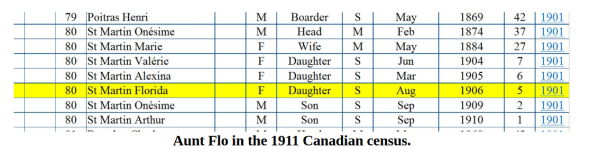
In the 1911 census, my Aunt Flo is listed with her birth family, the St-Martins but I wasn’t 100 percent sure the listing was hers. (I had only a vague recollection of her birth family’s name. The family name St-Martin had come to me in a light-bulb moment in the middle of the night!) So this 1921 listing confirmed my subconscious’ powers. I suddenly felt very smart.

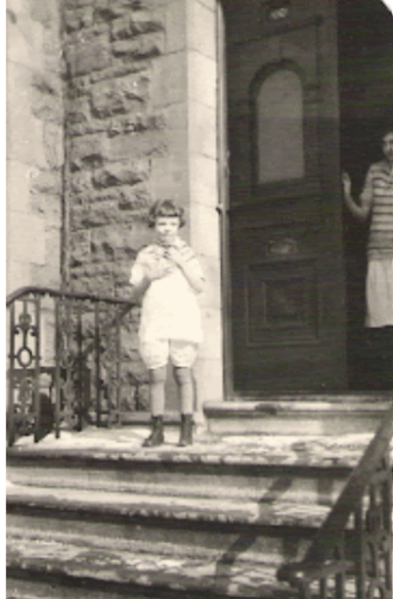
Aunt Flo peeking out at my mother in around 1925.

But, I also noticed another name in the Crepeau household on the 1921 census, Laura Lacombe, niece, born 1892. I had never heard this name before, so I took another peek at the 1911 census. Laura Lacombe is listed there, too. I had missed it.

Now I was really confused. (I suddenly didn’t feel so smart.) I rationalized that I might have missed Laura ten years earlier when the 1911 census came online because the Crepeau family listing is at the bottom of one page and Laura’s name comes up on the top of the next. Or maybe I did notice Laura’s presence on the census and just assumed she was one of the many young girls brought in over the years to help my grandmother, Maria, keep house.

Whatever the reason, it did not take long before I figured out who this Laura Lacombe was. She was the daughter of my grandmother’s sister Melina Roy Lacombe who had died in the mid 1890’s leaving behind two young children, Raoul and Laura.

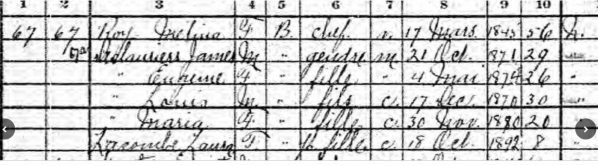
On the 1901 census Laura is living with her grandmother (my great-grandmother) Melina Gagnon Roy and my grandmother, Maria; also Maria’s brother Louis and sister Eugenie who is married to a James Deslaurier. Maria and Louis are mistakenly listed under Deslauriers. (For this reason, I had a lot of trouble finding Maria on the 1901 census at first. ) Melina Gagnon Roy is listed as chef or head of the household.

So, when Maria, my grandmother, got married later in 1901 to the ambitious Jules Crepeau, she took in the twelve-years-younger Laura. Or maybe Laura moved in with them in 1906, after the death of the grandmother.

Now, the real question begs: how come I never heard about Laura before? Was she for some reason a family secret?

Over the decades, I never heard my Aunt Flo or my own mother speak of this cousin – and they both liked to talk about the Crepeau family in the early days.

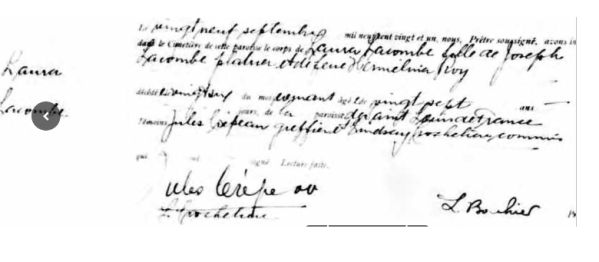
The answer might lie in another document I found: Laura’s death certificate. You see, she died only a few months after the 1921 Census man came around – and a few months more after my mother’s birth. My grandfather, Jules Crepeau, signed her death certificate. No reason for the death is given, which makes it all very sketchy. (I’m not embarrassed to say, I looked for the name “Lacombe” among my many French Canadian DNA cousins on Ancestry. The name hardly appears at all. Phew!)

Still, I have to ask. Why the silence surrounding Laura’s life. A real mystery, it is.

When History and Genealogy Come Together

Genealogy is usually of little interest to children probably because their parents already seem from the Dark Ages and their grandparents from the times when Tyrannosaurus Rex tramped the planet.

It was the same thing for me way back in the 1960’s – except for the one day when I was about twelve years old. My mother came home all excited with some important news passed on to her by a cousin who had researched the Crepeau family tree.

My mom’s father, Jules Crepeau of Montreal, was descended from one Abraham Martin dit L’Ecossais, a pioneering (boat) pilot and land-owner in New France. My French Canadian mom found this fact highly entertaining. “I am descended from a Scotsman,” she told me, laughing. “What a joke.”

I remember this episode only because of another part of the story. Apparently, this Abraham Martin fellow owned the Plains of Abraham. THOSE Plains of Abraham. Now that I could sink my tweenage incisors into.

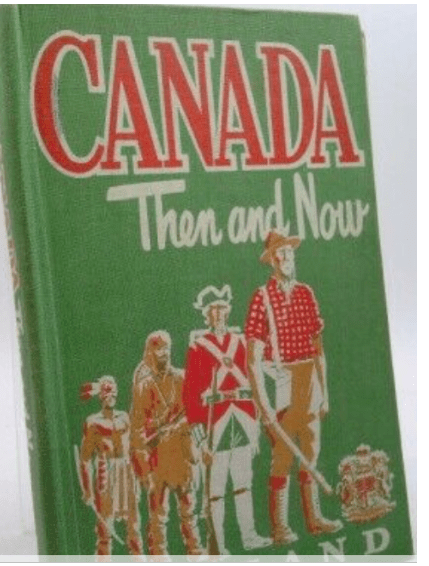
You see, I was learning about Canadian history in school. Our text was Canada Then and Now, a bright green text with a very iconographic cover pic.

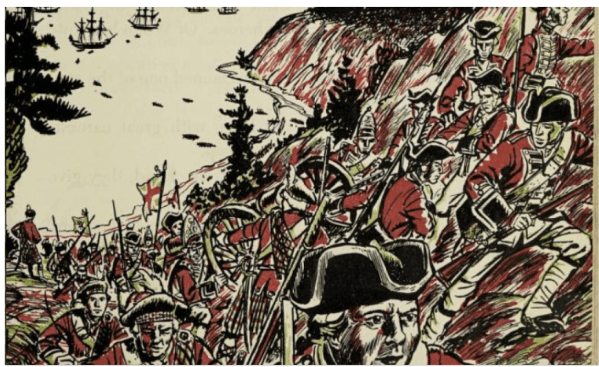
From this textbook, I was learning for the first time how the French and British were always at war with each other, way back then, in Europe and in North America. In North America, the fought over control of the lucrative fur trade and, apparently, it all came to a head one morning on the 1th of September, 1759 when a British general named Samuel Wolfe, after being rebuffed a few times by the superior French forces, led a cagey attack on the French General named Louis Joseph Marquis de Montcalm on the cliffs of Quebec City, cutting off his supplies and defeating his superior forces. This was all part of something called The Seven Years War.

All night long kept quietly landing the men on Wolfe’s cove. By morning, 5000 British soldiers were drawn up ready on the Plains of Abraham. The French had avoided battle, believing they were safe because they had more men than the British and plenty of supplies. They knew the British wold have to withdraw before freeze up. But now tht the British had landed above the town and cut off supplies from Quebec. The time had come for battle.

The textbook instructed us Canadian children, in subtle terms, to take no especial pride in this seminal event:

Wolfe and Montcalm were great generals and gallant men. Today, on the Plains outside of Quebec, a monument stands to honor them both. Wolfe’s name is on one side, Montcalm’s on the other. There is a Latin inscription that says, “Valour gave them a common death. History a common fame and posterity a common memorial.”

Illustration from Canada Then and Now. Storming the Plains of Abraham

Today, I am much older and predictably I am into genealogy. I have written many many family stories from both sides of my tree.

My mother’s French Canadian side was easy-peasy to patch together thanks to all those fabulous Catholic church records on Drouin available. And yes, if the Mons Origins website information is correct, my mom was indeed descended from this Abraham Martin.

Should I write about this pioneer ancestor? I have long wondered.

Truth be told, I would very much like to puzzle out the story of my earlier French Canadian ancestors, as Tracey Arial and Claire Lindle have done so brilliantly on this blog. I’d like to discover exciting new tidbits of information about my ancestors to add to the historical record (perhaps using some of the stellar resources catalogued on Genealogy Ensemble by Jacques Gagne) but it all seems so difficult, so labour intensive and so hard on the eyes.

In the past, I have explored the lives of Les Filles de Roi – because I am particularly interested in the lives of women ancestors – only to find there doesn’t exist much detailed information about these pioneering females from Normandy and Ile de Paris. It seems no one bothered to document the day-to-day lives or unique personal stories of these ‘mothers of millions’ back then– either in Europe or New France.

When it comes to this Abraham Martin dit L’Ecossais character, it would be a real waste of time to try to find a new angle or to write something fresh about him. There are already reams and reams (or pixels and pixels) of information written about him. It appears that Abraham Martin dit L’Ecossais is one of the most famous French Canadian pioneers and a father to millions of North Americans, including Madonna and Justin Bieber – and, ah, little ole me.

Long story short: He married Marguerite Langlois. Had 14 children. I am descended through Vitaline Forget-Despatie, my mother’s father’s mother.

The kicker to this non-story of mine: Abraham wasn’t necessarily Scottish. He could have invented the epithet to avoid criminal prosecution or he was a war deserter. His name might have generated from the fact that he had visited Scotland many times in his youth.*1

Now, lately I have dug out one very interesting fact about my mom’s French Canadian ancestors on her dad’s side, one she didn’t know about. My mother always told me that the name Crepeau meant “curly haired one.” She had very very curly hair herself, as did her father. I have no idea how long she had known this fact or who originally informed her.

If that same cousin, back in 1967, had provided her with a paper genealogy, my mother would have noticed that the original Crepeaus, going back six to eight generations, were Crespeaus, from Poitou Charent. I have recently learned that the name Crespeau almost certainly came from Crespo, a very Spanish name – and not only that a Sephardic Jewish name.

I found this tidbit on sephardim.com:

“The name Crespo has been identified by the Holy Office of the Church of Spain as a Sephardic Jewish surname.”

How fascinating.

So, it seems, even genealogically-timid I can dig out an interesting fact or two about a distant French Canadian ancestor. Maybe I should keep trying.

1. Even if Abraham Martin wasn’t born to the Tartan, he likely had English, Scottish and even Viking dna. Normandy, Normans, North men, Norsemen. Ancestry gives most of my many many French Canadian cousins a little bit of Norwegian ethnicity. I have a very vague 0-8 percent.

Wouldn’t it be funny if my mom were related to Eric the Red, chronicled in the second chapter of Canadian Then and Now, after the first chapter on “Indians” and “Eskimos.”

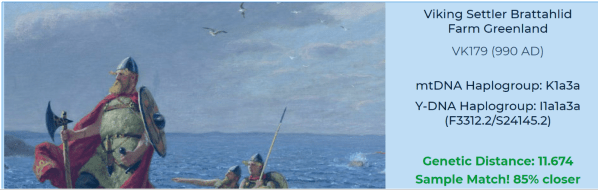
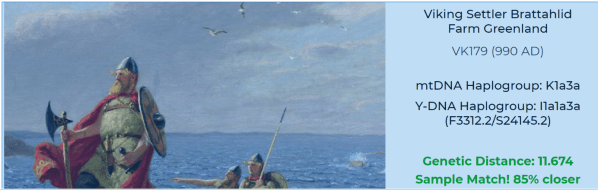
If you believe mytrueancestry.com, my husband, whose Mom comes from Isle of Lewis Scots, apparently is connected genetically to Eric’s clan. How very romantic! If I didn’t love him before, I’d have to love him now!

2. I checked the Y dna lists online at Family Tree and someone is trying to see if French Canadians have Semitic genes. There are very few members. On a regular French from France Y dna site I can see that some French Canadians have J M172, an Anatolian line, often thought of as the Greek Diaspora. Cote and Leger are the names that crop up. There are no Crespos, Crespeau’s or Crepeaus.