
Tag Archives: family

Transportation carries people west

It constantly amazes me how technology can influence where people live.

When I was examining the lives of my great great grandparents and their predecessors on my fathers’ side for instance, I noticed that their moves usually followed easier travelling circumstances.

In 1815, for example, a small settlement known as Bear Brook arose along the border of a small creek by the same name. The area is now in Russell County. Initially, settlers from Montreal used the waterway to get there. By 1820, a new road from Montreal replaced it to link then-Bytown (Ottawa) through Cumberland, Clarence Point, Plantagenet Mills, L’Orignal and Hawkesbury.

My great great great grandparents were among many French-Canadian families from Lower Canada who travelled along the new road to settle in the area in 1854 to farm.

There must have been some Irish among them too, because part of the community was renamed Sarsfield twenty years later to honour Irish hero Patrick Sarsfield.

By then, loggers used the old creek and to float timber to mills in Carlsbad Springs. They were still doing so when Gustave Hurtubise was born in Sarsfield in 1884. Gustave, the elder brother of my great great grandfather was the first child from our family born in the town. Two years later, our cousin Sévère D’Aoust built the Roman Catholic Church in the village where my great grandfather Jean-Baptist would be christened. That same year, the community lobbied for a local stop along J.R. Booth’s Railway line in 1886. They built a small building to entice Booth.

Jean-Baptist Hurtubise arrived in Sarsfield on February 16, 1889. His future wife, Marie-Berthe (known as Martha) Gourdine, was born in a neighbouring town, Clarence Creek, October 3 the same year.

The year the youngsters turned eight, the Old Montreal Road got paved and engineers constructed the Canadian Northern Railroad through Cumberland to Hawkesbury.

They were only 16 years old when the two got married in Clarence Creek on January 7, 1915

My grandmother, Anne Marguerite Hurtubise was born in the same town the following November. Her sister Donna came a year and a half later.

The family left Sarsfield and moved to Cluny, Bow River, Alberta, sometime between Donna’s birth in 1917 and the 1921 Canadian Census. By this time, the train was established across the country, so they and others took it to go west.

For some great shots of various buildings in the town from that period, refer to the images on http://www.prairie-towns.com/cluny-images.html.

Somehow, the couple got land and a home. In 1921, the Census reported that 31-year-old Jean owned a farm with a three-bedroom wooden house on it.1 It was located in section 7, township 22, range 21, Meridian 4. His wife Martha and the two girls didn’t work.

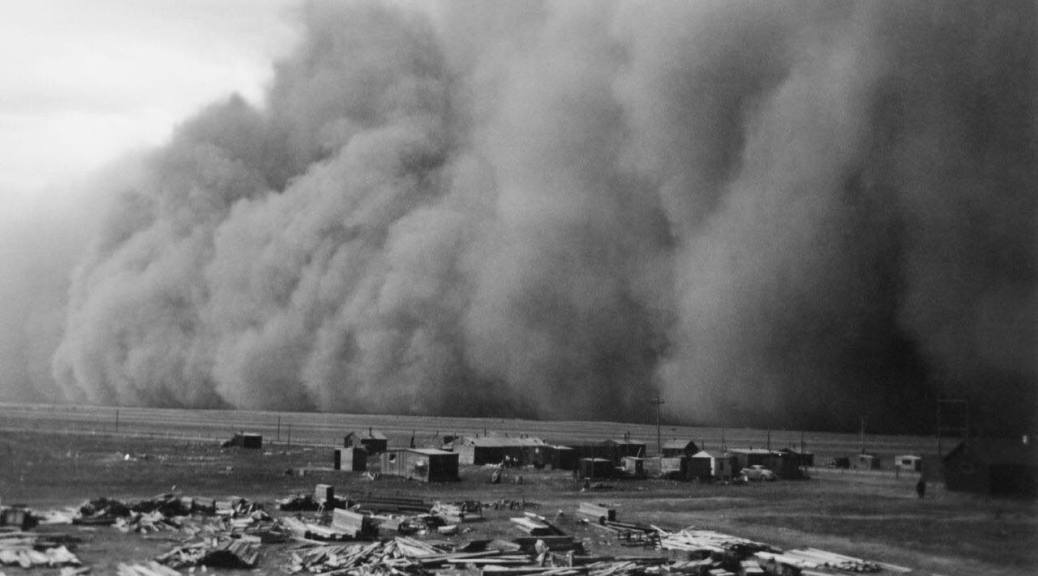
Unfortunately, they arrived just in time for five successive droughts that we now know as the Prairie Dry Belt Disaster.

In 1931 and 1932 they suffered from the dustbowl, when top soil was so dry that it blew into homes.

Then the locusts came in 1933.

I grew up listening to stories about those times, but got a better understanding of what they faced when looking at the photos on a University of Saskatchewan website https://drc.usask.ca/projects/climate/.

My great great grandparents were among 750,000 farmers who had to abandon their farms between 1930 and 1935.

By 1938, the family had moved to Edmonton and my grandfather and his wife had to depend on the incomes from their daughters’ jobs, my grandmother as a nurse and her sister as a clerk, to survive.
1Data from the 1921 Census of Canada, Enumeration District 2, Bow River, Alberta, section 7, township 22, range 21, Meridian 4, page 6, line 28.
Sundays and the Great Depression

I used to hate Sundays. I had to go to Sunday school. I really didn’t understand why I had to attend because my parents just dropped me off. That’s right. They didn’t even go to church. And no one asked me if I wanted to go.

After they picked me up, things got worse. It was homework time until lunch. Of course, I could have done my homework on Friday night but Fridays were reserved for movies on the television and reading in bed with a flashlight until all hours.

And worst of all, some Sunday afternoons were for Visiting the Elderly Relatives. In my mind, my aunts and uncles were ancient. Plus my brother, being a boy and older than me, was apparently able to take care of himself, as he always seemed to be absent from these visits. So I would sit in the living rooms of my aunts and uncles, with no toys or any other amusements, and listen to the adults talk.

I now cherish the memories of these visits because they provided me with an appreciation of the social history of Montreal, as well as significant events such as the Depression and World War II.

The stories about the Depression are the ones that struck me the most. During the Depression, a quarter of Canada’s workforce was unemployed.1  My dad, Edward McHugh, was a young man out of work in Montreal and he joined his older brother and sister in Drummondville, to work for the Celanese. At the peak of the Depression, the Celanese employed 1,757 workers.2

None of the McHughs had cars in those days so they must have travelled back and forth to Drummondville by train. And Uncle Thomas McHugh married a local girl. I can just imagine the McHughs, from Verdun, arriving in Drummondville for the wedding. I doubt very many people spoke English in Drummondville at the time. The culture shock must have been intense.

My aunts and uncles, even into the 1960s, were thankful that they were able to have had some work during the Depression. Uncle Al Scott worked for the Northern Telecom for 40 years, although with reduced hours during the Depression. Luckily Uncle Frank McHugh worked for the Montreal Tramway Company so he was able to keep working during the Depression. He was a tram driver for tram number 24 that started in Montreal West and crossed the city on Sherbrooke Street. His job was safe.

Dad’s siblings loved to have a good time and the Depression did not stop them. My Aunt Elsie used to describe their card parties. There was only one bottle of scotch, some ginger ale, one can of salmon and one loaf of sliced white bread. My aunt was able to spread the salmon so thinly that she could make sandwiches out of the whole loaf of bread.

It was very clear to me that the Depression was a very frightening time in their lives. During this period, the future must have seemed bleak. Life was a struggle to make ends meet. But they made the most of it and persevered. Today I feel lucky to have listened and to remember their stories.

1 https://en.wikipedia.org/wiki/Great_Depression_in_Canada

2 http://www.patrimoine-culturel.gouv.qc.ca/rpcq/detail.do?methode=consulter&id=14311&type=pge#.WSNY7Gg1-Uk

A Moody Chef

My Uncle was born second to the eldest daughter in a family of 11 in Cornwall, England.

My Dad never spoke of him, and I had no idea of his existence until I started to research the family tree, adding the family and my unknown Uncle.

Who was he? All I had was the fact he was born in 1909.

My parents divorced when I was seven years old, and I had no contact with Dad’s side of the family after that event. However, my cousins, whom I met about eight years ago, were none the wiser although cousin Diane did speak of a family argument and the eldest son leaving the family home never to return or to be heard of again. EVER!

It was still a shocking event in the family.

What that argument was about I will never know. Many of the other children were not even born when he left. Nobody seems to have any photographs of him, either.

After researching a few sites, I found out he was married at 21.  I cannot find any children yet, but Uncle  died on the 13th of June, 1940 at age 30.

I was shocked to find he had died so young. Immediately, because it was the beginning of WW2 in England, I assumed he died in the Blitz, as so many in that area of London had, and his death certificate states he died in Pimlico which I knew was, like many other areas of London, badly bombed.

When I retired, I took the time to find out the reason he died so young. I decided to purchase his death certificate. When it arrived, it stated he had died of coal gas poisoning.

Thinking again of the war my first thought was he had died of gas poisoning. How awful! Then common sense prevailed. Of course not! Gas poisoning only happened in WWI, so I took a few deep breaths, and re-read the death verdict.

‘Coal Gas Poisoning; Did kill himself while of unsound mind’  Certificate received from WB Purchase Coroner for the County of London. Inquest held 17th June 1940.

Ah, so he had actually gassed himself poor Uncle! What on earth made him do it?

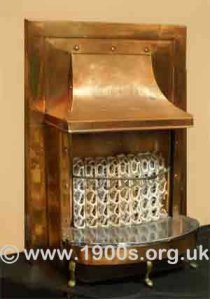
Gas was and still is, a common source of heat in England. Most homes including ours had gas fires. The gas then was coal gas, a very dangerous substance. You turned the tap on let the gas flow, and then lit it whereupon there was a loud POP! My Mum was always nervous about lighting it.

You had to be very careful that the fire, when the gas ran out, was turned off before you ‘fed’ the gas meter with shillings to re-establish the gas flow. Otherwise, you had odourless colourless gas flowing into your home and not realising it. Once a month the ‘gas man’ would arrive open and empty the meter and count the coins at the kitchen table. Depending on the amount of gas used, we would usually get a rebate of coins which were then fed back into the gas meter.

Photo Credit: Pat Cryer, with permission and thanks.

Committing suicide with a gas fire was easy, you just turned it on and did not light it. People accidentally died after forgetting to turn the tap of the gas flow off and feeding the meter, thus gassing themselves. Later in the 1950s a safety tap was added.

Because Uncle’s death was unusual a post mortem had to be conducted.

I reasoned that if he committed suicide, then there was a coroner’s report, which would be reported in a local newspaper. After hours of researching the newspapers of the area, I found what I was looking for.

Because this site is a subscription site, I only had access to this page and the text, so I had to re-write the copy [1]

A MOODY CHEF

A Pimlico Tragedy

The Westminster coroner (Mr. Purchase) held an inquiry at the Horseferry Road.

Coroner’s Court Monday into the death of […..]  (30) a chef, 79 Cambridge-street, Pimlico, who was found gassed there.

On Thursday morning. William McColl, 8 Rugby-street said he was a friend of the deceased. “He was in good health,” said witness. ‘and was in work. He was very moody.

Whenever I asked him what was the matter he would say’ Don’t take any take notice of me. I am a funny guy’

He had never said that would take his life and did not look the sort who might. He was in no trouble of any kind.

Faustina Alvarez. 79 Cambridge-street Pimlico said deceased had lodged there for three months.

On Wednesday night last week, he put threepence in the gas. The next morning witness’s wife got worried about him and witness went upstairs and knocked at the deceased’s door. There was no answer.

On opening the door witness saw deceased lying the floor by the gas ring.

PC. Elliott, 4138. who was called, said he saw the deceased lying on the floor with his head resting on a gas ring. He was dead.

The gas tap was turned on, but the supply had been exhausted. Dr. M. Hains, who made a postmortem examination, said the death was due to asphyxiation from coal gas poisoning.

Herbert Rehm. chairman of Rhem Brothers.Ltd., said the firm had eight licensed restaurants in London, […]  was employed at a branch at Buckingham Palace-road.

He was a very efficient employee, but very moody. The coroner said it seemed that in one of his moods, the deceased took his life. He recorded a verdict that the deceased took his life whilst of unsound mind.

When I was told by my cousin Diane, that the family never heard from him again after the death certificate arrived, I let them know of the circumstances of his death and we realised the reason nobody in the family had ever heard from him again. We cousins were sad for him.

‘Depression’ was not a word used in those days but obviously, that is what he suffered from.

One day, I hope to find if there were any children and so, like any genealogist who hits a brick wall, I keep searching.

Sources:

[1] Whether you are a researcher, historian or you simply want to know more about Britain’s history, take this opportunity to search The British Newspaper Archive – a vast treasure trove of historical newspapers from your own home.

Source: A Moody Chef | Chelsea News and General Advertiser | Friday 21 June 1940 | British Newspaper Archive

(2) Gas Meter Photographed in Blaise Castle Museum  https://www.1900s.org.uk/1940s50s-heating-gas.htm

With many thanks to Pat Cryer, whose website https://www.1900s.org.uk is a valuable source of information on the social life of wartime Britain. Pat allowed her photo of an old gas fire, similar to the one in the story, to be used. Thank you, Pat.