Tag Archives: Farmer

Her Name was Aglae

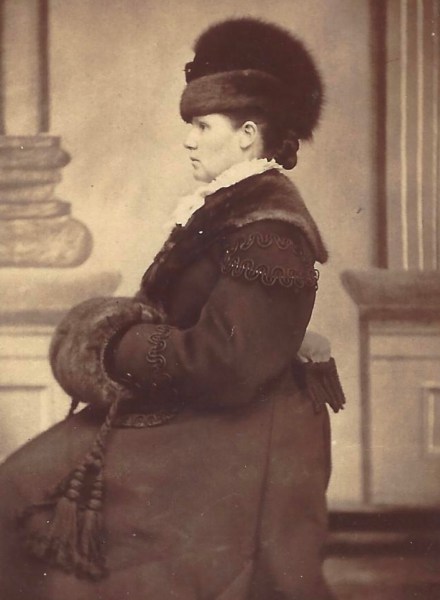
Aglae Bruneau Paumier

What is in a name? Aglae Bruneau (1837 – 1906) was the oldest of 13 children in my great-grandfather’s family. How did her parents Barnabe Bruneau and Sophie Marie Prud’homme come up with that name? Aglae is a name of Greek origin meaning splendour, brilliance and the shining one. She was one of Zeus’s three daughters, with her sisters Euphrosyne and Thalia known as the three graces. Apparently, it is not as strange a name as I thought, as the BAnQ (Bibliothèque et Archives nationales du Québec) website has many references to Aglaes even other Aglae Bruneaus.
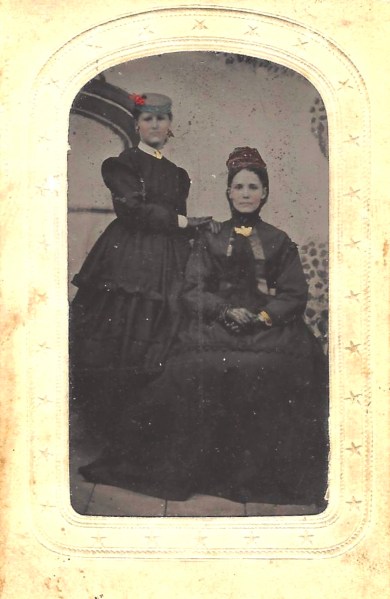
Aglae seated and her youngest sister Anais

Aglae was born on her parent’s farm in St. Constant, Quebec. The family was Catholic as recorded in the 1851 census but converted to Protestantism soon after. Aglae married Pierre Charles Paumier (1828 – 1914) in the First Baptist Church in Montreal in 1860. He was born in France and immigrated to the United States in 1856. He had a farm in Mooers Forks, New York close to the Quebec border. It is possible that they met at religious services held at the Felleur Institute in Grande Ligne, Quebec as French Protestants often moved back and forth across the border for religious events.
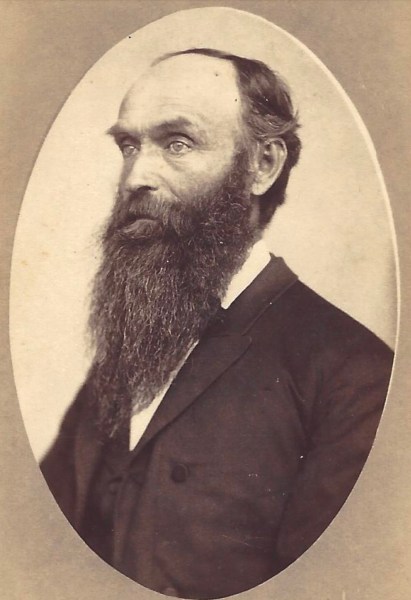
Pierre Charles Paumier

On many of the US census, Pierre Paumier is listed as a farmer but was he originally a Baptist minister from France? My great uncle, Sydney Bruneau, wrote in his recollections “One of my aunts had married a Baptist minister from France, a man who made no secret of loving his pipe and his homemade brew of well-fermented cider, to the no small scandal of his congregation. When he was informed of complaints which had reached the higher authorities, he lost no time in preaching his farewell sermon, flaying his listeners without mercy for their narrowness of mind and their intolerance of the harmless pleasures of life, and retired to a farm where he grew his own tobacco and lived to a ripe old age.” 

Like many of Aglae’s siblings, they only had one child Sophie F. Paumier. The family continued to live on their farm which Pierre owned outright and Aglae “kept house” until she died in 1906.

It appears that after Aglae died Sophie and her father sold the farm, packed up and moved to California, as they were living in Los Angeles according to the 1910 census. Two of Aglae’s sisters had also moved west to California. Pierre owned the house and neither he nor his daughter had an occupation listed so he continued to be a man of some means. In some directories, he is listed as Rev. Peter Pomier. Sophie died in LA only five years after her father.

The name Aglae has not been used again in our family. Aglae herself called her daughter Sophie after her mother rather than naming her after another Greek goddess.

Notes:

Census of 1851 (Canada East, Canada West, New Brunswick and Nova Scotia) for Image No.: e002302444 Archives Canada.

“United States Census, 1870”, , FamilySearch(https://www.familysearch.org/ark:/61903/1:1:M8FF-5DS : Tue Mar 05 04:26:42 UTC 2024), Entry for Peter Pa?mier and Aglae Pa?mier 1870.

“United States Census, 1900”, , FamilySearch(https://www.familysearch.org/ark:/61903/1:1:MS65-NLR : Thu Apr 11 19:59:05 UTC 2024), Entry for Charles Paumier and Aglaia Paumier, 1900.

1910 Census: “United States Census, 1910”, , FamilySearch(https://www.familysearch.org/ark:/61903/1:1:MV2R-4HP : Sun Mar 10 05:36:01 UTC 2024), Entry for P C Paumier and S F Paumier, 1910.

Bruneau A. Sydney. Walking With God in Dequen. Page 6. A memoir of his early childhood through the summer of 1910. Written by A. Sydney Bruneau in the late 1960s and transscribed by his granddaughter Virginia Greene, in January 2017. The author has a copy.

Tobacco was grown in Upstate New York and in Quebec and Ontario in the mid to late 1800’s. This shade tobacco was used commercially as cigar wrappers.
Napoleon Bruneau – A Tragic End

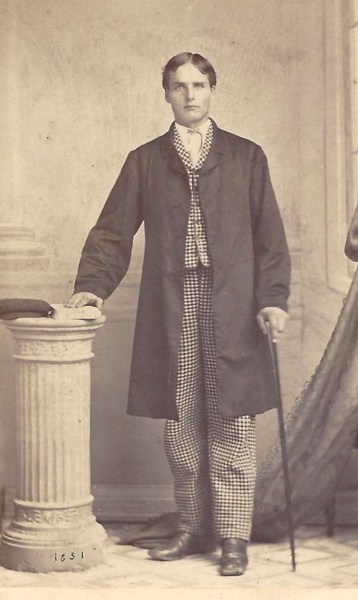
Napoleon Bruneau

Napoleon Bruneau died tragically on a Sunday night in 1916. The La Presse newspaper reported the train accident at Delson Junction on the CPR line but no details were given. This was not far from his home in St-Constant, Quebec. Was he coming home or going to Montreal? What happened? Did he fall on the tracks? He was almost 72 years old so he should have known better than to get in front of a train!

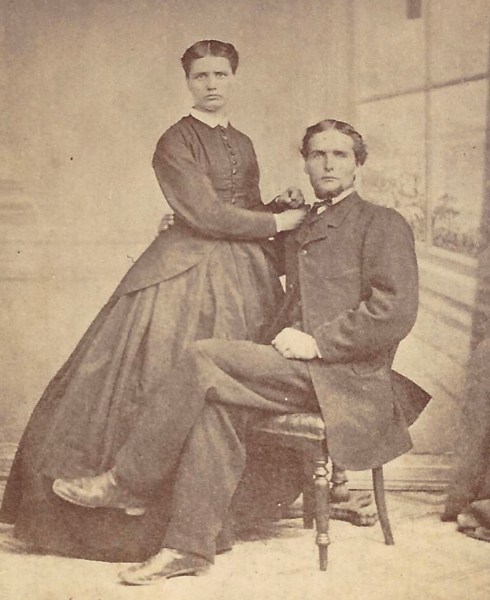
He and his twin sister Mathilde were the 5th and 6th children of Barnabe Bruneau and Sophie Marie Prudhomme. He lived his whole life in St-Constant, south of Montreal. It seems he inherited the family farm after his parent’s deaths. 

Napoleon and his sister Sophie Bruneau

Descriptions of Napoleon included being a farmer, a Free Will Baptist, a veterinarian and a justice of the peace. He was appointed a justice of the peace in 1902 for the district of Montreal which included St-Constant. It is possible he studied to be a veterinarian and didn’t just learn as an apprentice. A school for veterinarians was established in Quebec in 1866 with one of his cousins, Orphyr Bruneau as one of the lecturers. In 1876 courses were also offered in French when the school was under the McGill University Department of Agriculture. The Veterinary school, later associated with The University of Montreal, moved to Oka in 1928 and to its present location in Saint-Hyacinthe in 1947.

One would think that a tall handsome man with many interests and a farm would easily find a wife, so I found it strange that he didn’t marry until he was 66. His brother, Reverand Ismael Bruneau performed the ceremony at his Protestant Church, L’Eglise St Jean Baptiste de Montreal. Napoleon’s wife Emilie Beauchamp was 42 at the time, so it isn’t surprising that they didn’t have children. Emilie was born in Grenville, Quebec, on the Ottawa River. She probably met Napoleon in Montreal where she lived with her parents and sister Lily. Emilie had an uncle who was a French Protestant minister so it is quite possible that they met through the church.

My great-grandfather, Ismael Bruneau was upset with Emilie after Napoleon died as he wrote in a letter to his son Sydney.

You know your Uncle Napoleon made me the heir of all his estate except for $500, which I must give after the death of his widow as follows; $300 to my sister Helene, $100 to my sister Virginie and $100 to my sister Elmire. But his widow has everything during her lifetime. As she is a great deal younger than I, it is almost probable that I shall never enjoy this myself. They say she is already neglecting the house which is going to ruin and according to the law she must maintain it in good condition as it was at the time of the death of her late husband.”

Unfortunately, Ismael didn’t enjoy any of his inheritance as he died two years after Napoleon. Emilie only died in 1951. I don’t know what happened to the property as she married Emilien Frechette in 1929 and he had his own house and farm. Emilien had been married to two other Bruneau women, Emilina Bruneau, Ismael’s sister and and Ida Girod Bruneau Ismael’s wife.

Napoleon was buried in Mount Royal Cemetery with his sister Helene, her husband Celestin Lachance and their daughter Antoinette and not with his twin Mathilde in the Baptist cemetery in Grand Ligne. Emilie isn’t buried with Napoleon or even with Emilien Frechette and his first two wives, rather her final resting place is with her parents in the Beauchamp Cemetery in Marelan in the Laurentians near Grenville.

I haven’t yet found answers to questions about his tragic end.

Notes:

Napoleon Bruneau Obituary: LaPresse January 16, 1916.

Napoleon Bruneau’s death determined to be accidental. The Montreal Gazette, Tuesday, January 25, 1916. Page 7.

when searching for information on the train accident I found another Napoleon Bruneau who was also killed by a train. This accident happened in Huntington, Pennsylvania in 1908. He was decapitated and horribly mangled.

Appointed Justice of the Peace: Montreal Star Monday, June 23, 1902. page 10. Accessed Newspapers.com March 20, 2023.

Letter from Ismael Bruneau to his son Sydney Bruneau. Quebec, February 21, 1917. A copy in the hands of the author.

Emilie Beauchamp burial https://www.findagrave.com/memorial/167478027/emily-esther-beauchamp

accessed November 25, 2023.

Orphyr Bruneau one of Napoleon’s first cousins the son of his father Barnabe’s brother Medard.

There are notarial documents, Quittances which are receipts where Napoleon gave most of his siblings 300 piastres each, beginning two years after his mother died. These dispersals occurred from 1894 to 1904. Some received less and I haven’t found the documents for his sisters Aglae and Sophie. His brother Selene had already died and had no heirs. I am unsure if these were money paid to his siblings because he received the farm.

Three hundred piastres were 300 dollars. This would be the equivalent of over $10,000 today. Quebec used the word piastres on official documents into the 20th century. Even later it was used as a slang equivalent to the English word buck.

La Fermière Louise Mauger

Louise_Mauger_sculpture

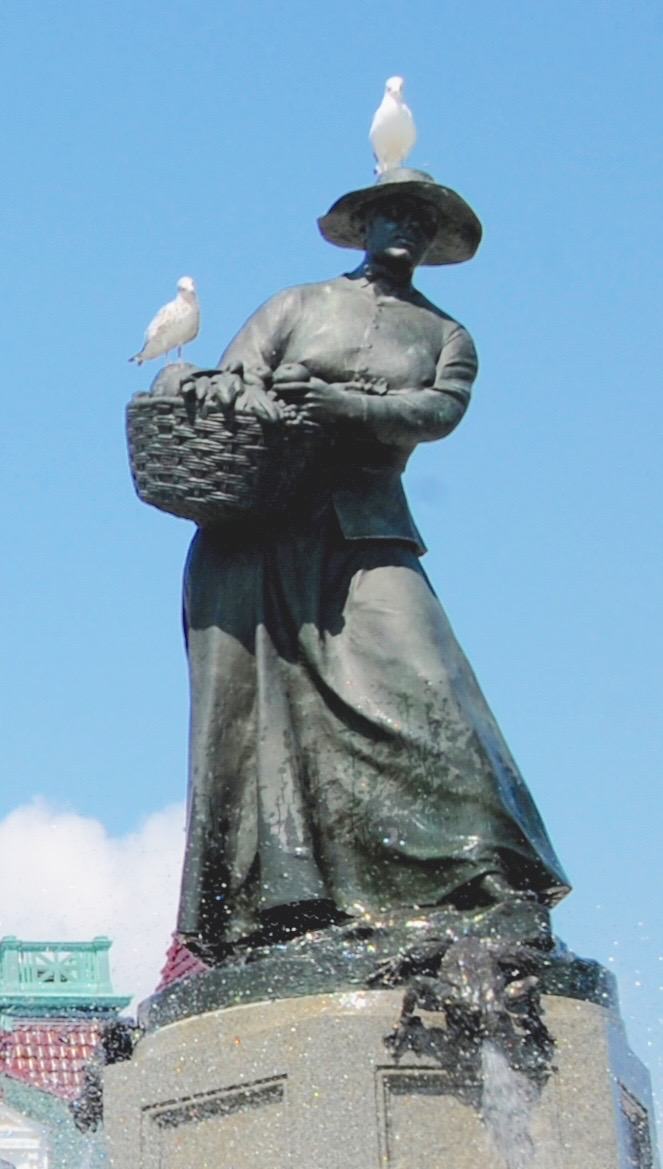
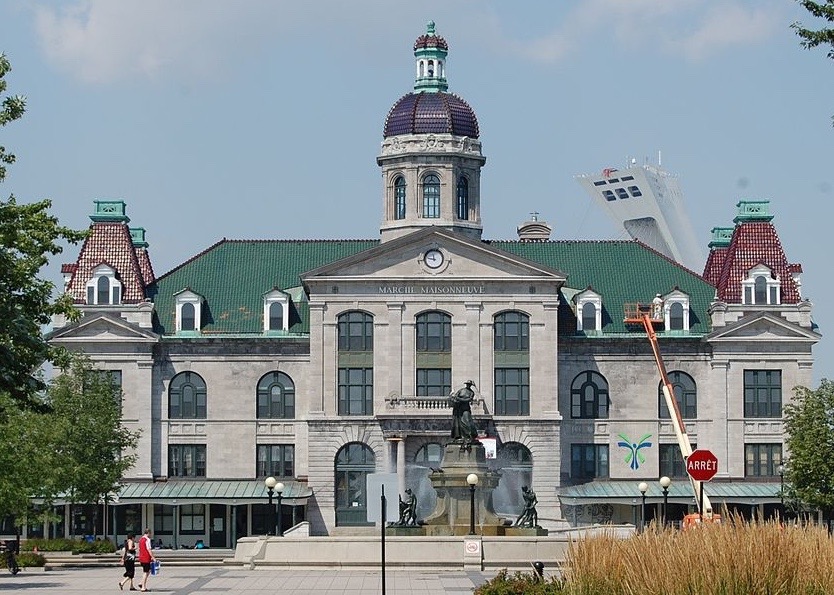
Women are rarely commemorated with a statue. There is one, La Fermière, in front of Marche Maisonneuve in Montreal’s East End. It depicts a woman holding a basket of produce. It was sculpted by Alfred Laliberté and he dedicated it to Louise Mauger, as a glorification of traditional rural values. She was one of the early settlers of Montreal and not the only person celebrated with a monument. Louise was my eight times great grandmother.

1024px-Marché_Maisonneuve_3
La Fermiere statue in front of Marche Maisonneuve

Both Louise (1598) and her husband Pierre Gadoys (1594) were born in Saint Martin d’-Inge in Perche, France. They came to New France about 1636 as part of a settlement initiative by Robert Giffard de Moncel, the first Seigneur of colonial New France. Records have them living and farming on the Beauport Seigneurie in 1636 and Pierre employed by the Société Notre-Dame de Montréal pour la Conversion des Sauvages, at Sainte-Foy or Sillery from 1643 to 1645.

Tracing families back is quite easy in Quebec as the church records of births, marriages and deaths, kept from the beginning of the colonies have been well preserved. My maternal grandmother was a Bruneau and her direct male line goes back to Francois Bruneau, my seven-time great grandfather, who arrived in New France in 1659.

The Bruneau family tree is just part of my story. There are all the women back through the tree who were only a name, their families not mentioned. A seventh times great grandfather is one of 256 grandfathers which means there are also 256 grandmothers who have their own stories.

I started with Sophie Marie Prud’homme who married Barnabé Bruneau, my two times great grandparents. Tracing back the Prud’homme line I arrived at Louis Prud’homme who arrived in New France in the 1640s, where he met and married Roberte Gadoys. Roberte came from France in the 1630s with her father Pierre Gadoys, her mother Louise Mauger and her brother Pierre.

Pierre Gadoys (Gadois, Gadoua) my 8th time’s great grandfather moved his family to Montreal shortly after this because of the many attacks by the Huron and Algonquin on settlers around Quebec City. Montreal was fortified. In 1648, he was the first person to be granted land in Montreal (Ville-Marie) by the governor, Paul de Chomedey de Maisonneuve. He was known as the “Premier Habitant or first farmer”1. The 40 arpents grant was from the current St Paul Street north to the Petite Riviere between St. Pierre and Bleury. In 1666 he was granted another 60 arpents for helping Charles LeMoyne fight the Iroquois.

Just as important as the first farmer is the first farmer’s wife. Louise had a lot of work to do. The couple had six children, possibly seven. Roberte, Pierre and Etienne (is the question mark) were born in France, while Francois, Jeanne and Joseph on the Seigneurie of Beauport and Jean-Baptiste was born in Sainte-Foy when Louise was 43. Jeanne died at birth, Joseph died in his first month and there is no other information about Francois. According to the 1667 census they had 40 acres under cultivation, six cows and a hired servant.

While Pierre Gadoys died in 1667, Louise lived another 23 years and died in Montreal at the age of 92.

Pierre also has a monument but it is a small trapezoid stone marker in Place d’Youville installed in 1992 as part of Montreal’s 350th celebration. It looks more like a concrete form used to block off a road than a commemoration. It is not a lovely bronze statue in the middle of a fountain.

Bibliography:

1. Dollier de Casson, Francois. Histoire du Montreal 1640-1672. pg 88

Jean-Jacques Lefebvre, “GADOYS, PIERRE,” in Dictionary of Canadian Biography, vol. 1, University of Toronto/Université Laval, 2003–, accessed November 29, 2018, http://www.biographi.ca/en/bio/gadoys_pierre_1E.html.

Fournier, Marcel. 1642-1643 Les Origins de Montréal Diffusion au Canada, 2013.

Le Bulletin Recherches Historique Vol XXXIII Levis – Mars 1927 Nos 3 Les Colons de Montreal de 1642-1667 pgs. 180,181.

PRDH-RAB; Origine des Familles Canadiennes; Parchemin Ancestry accessed January 2019.

Sulte, Benjamin: Histoire des Canadiens Français [1608-1880]: origine, histoire, religion, guerres, découvertes, colonisation, coutumes, vie domestique, sociale et politique, développement, avenir January 1, 1882 Wilson et Cie

Senécal, Jean-Guy(senecal@fmed.ulaval.ca); Sep 27, 1998, compilation OCR de trois documents Word disponible en ligne, ses documents se référant principalement au Tome IV & V, Chapitre IV du livreHistoire des Canadiens-Française de Benjamin Sulte, édition 1977.

Notes:

The statue La Fermière was made by Alfred Laliberte in 1915. It was part of a continent-wide city beautification project.

Pierre Gadoys’ sister Françoise was married to Nicholas Godé. They were present at the founding of Montreal.

It is possible but not proven that Pierre and Louise were in Montreal in May of 1642 for the founding ceremony. Their son Pierre, then 11, was said to have attended with his Aunt and Uncle, Francoise and Nicholas Godé. It was thought that Louise was not at the ceremony as she was attending to Jean Baptiste who was only a year old. Pierre first settled in Sillery with his family but had gone to Montreal in the early 1642 and then returned to Sillery as he was there in 1645.

After his death, Saint-Pierre street was named in his honour.

1666 Census – Pierre Gadois the eldest, 72, inhabitant; Louise Moger, 68, his wife; Jean-Baptiste, 25, gunsmith; Pierre Villeneuve, 25, hired servant. 

1667 Census – Pierre Gadoys, 65; Louise Mauger, his wife, 65; Pierre Villeneuve, domestic, 24; 6 cattle, 40 acres under cultivation.  She was buried March 18, 1690 in Montreal. 

Pierre Gadoys: 1594 – Oct 20 1667 Married 1627 de Igé, Saint-Martin, Orne, France.

Louise Mauger: 1598 – Mar 18 1690

Roberte Gadoys: Baptised Sept 15 1628 France – Sept 14, 1716 Montreal

Pierre Gadois: Nov 17, 1631 or 1632 France– May 18, 1714 Montreal

Etienne Gadois: Baptised Nov 17 1631 France – ? Are Pierre and Etienne the same person??

Francois Gadois: Dec 2 1632 Quebec – ?

Jeanne Gadois: June 26 1638 – June 26, 1638 Quebec

Joseph Godois: Sept 28 1639 – Oct 1639 Quebec

Jean-Baptiste Gadois: Mar 1, 1641 Quebec – April 15 1728 Montreal.

The inscriptions on Pierre Gadois Monument In Place d’Youville, Montreal reads, C’est d’ici que Le 4 Janvier 1648 Maisonneuve determina les bornes de la premiere concession accordee a Pierre Gadoys il fixait ainsi l’orientation des rues de la future Ville” and on another side, Stele erigee grace a L’Ordre des Arpenteurs- Geometres du Quebec, a L’Association des Detaillants de Monuments du Quebec, aux Archives Nationales du Quebec, aux Productions D’Amerique Francaise et Au Groupe de Recherche de Raymond Dumais Archivist.”