
Tag Archives: Henry Boggie

Mary’s Tragedy

“Of late she was somewhat weak in the mind.”

This sad sentence concludes the obituary of Mary Boggie who died by drowning on September 6, 1884 when she was just thirty-four years old.1 Her death was a suicide and this one sentence tries to explain why. Of course, no one will ever know why she jumped off a cliff into the cold and inhospitable waters of the North Sea. What we do know is that it was a desperate and definitive act.
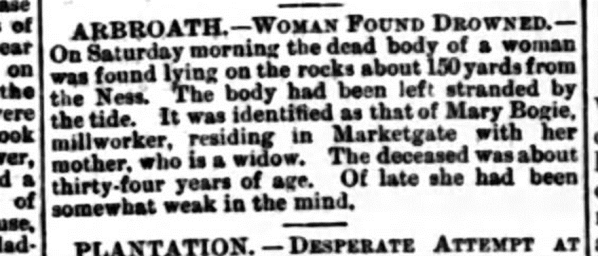
Mary Boggie was Henry Boggie’s sister. Henry, my great-grandfather, was taken to court by my great-grandmother, Annie Orrock, in a paternity suit. He never lived with Annie and, as far as I know, did not participate in bringing up my grandmother, Elspeth Orrock. Mary and Henry were the only children of George Boggie and Elspeth Milne. The Boggie family lived all their lives in Arbroath, Scotland. Arbroath is a coastal town located on the North Sea, about 26 km northeast of Dundee and 72 km southwest of Aberdeen.2 In the 19th century, Arbroath experienced a rapid growth in population with an influx of workers needed for the expansion of the jute and sailcloth industry.3 George was a member of the merchant navy and would have been absent from home most of the time. Both Mary and Henry lived at home, with their mother, all of their adult lives.

The registration of Mary’s death indicates that Henry was one of the “finders” of her body. The cause of death was “mental disturbance.”4 Who knows how long he and others were searching for her? She was found at the bottom of Whiting Ness, a cliff in Marketgate, Arbroath.
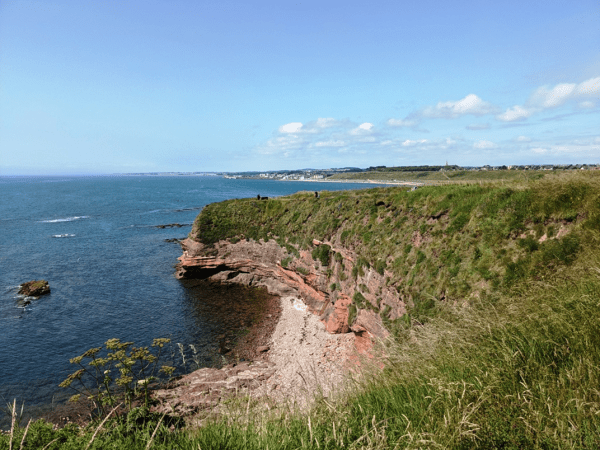
Part of the cliff face on Whiting Ness walk, James Herring, James Herring c10 Day Blog, Whiting Ness walk: The Needle’s E’e, The Deil’s Heid and Castle Gate, September 7, 2021

In 1884, sudden deaths in Scotland were referred to the Procurator Fiscal, known in other jurisdictions as the public prosecutor. The inquiry found that that the cause of Mary’s death was drowning and that she had committed suicide. The corrected entry notes that Mary had not been certified, meaning that she had never been certified as being mentally ill.5 The newspaper article implies that she was suffering from some mental affliction. And this is in accordance with the thinking at the time; that suicides were thought to be temporarily insane, thus being innocent of “self-murder.”6 Committing suicide was not considered a crime in Victorian and Edwardian Scotland. Citizens were free to take their own life, but it was assumed they would be answerable to God. This was not the case in England and Wales, where suicide was decriminalised only in 1961 with the passing of the Suicide Act. Prior to this, anyone who attempted suicide could be imprisoned and if they were successful and died, their families could be prosecuted. 7

No matter what the attitudes towards suicide at the time, Mary’s death was a tragedy. She could have been suffering from any number of mental or physical afflictions that would cause her to take her life. We can only imagine the anxiety and agony that Henry and Elspeth were feeling as people were desperately trying to find her. The trauma of finding her must have been almost more than Henry could bear. It would then be up to him to tell his mother. The suddenness and the violence of Mary’s death would have been a shock and difficult to understand. Henry and Elspeth were faced with an investigation and they would have had to deal with the press. Sadly, they may have had to deal with shame and the stigma of mental illness in the family.

  1. Obituary for Mary Boggie, Glasgow Daily Mail, 8 September 1884, newspapers.com, accessed 23 May 2024.
  2. Wikipedia, Arbroath, https://en.wikipedia.org/wiki/Arbroath, accessed 29 May 2024.
  3. Ibid.
  4. Scotland’s People, Registration of Deaths 1884, Mary Boggie, accessed 3 April 2024.
  5. Scotland’s People, Page 105, Register of Corrected Entries, Mary Boggie, signed by the Procurator Fiscal’s Office, 24 September 1884, accessed 3 April 2024.
  6. Shiels, Robert, The Investigation of Suicide in Victorian and Edwardian Scotland, Dundee Student Law Review, Vol. 5(1+2), No.4, https://sites.dundee.ac.uk/dundeestudentlawreview/wp-content/uploads/sites/102/2019/09/R-Shiels-No-4.pdf, accessed 27 May 2024.
  7. Wikipedia, Suicide Act 1961, https://en.wikipedia.org/wiki/Suicide_Act_1961, accessed 28 May 2024.
Who is Henry Boggie?

Henry Boggie is my great-grandfather, but he was never really part of the family.

My grandmother, Elspeth Mill Boggie Orrock was born in 1875 in Arbroath in County Angus, Scotland. Her mother, Annie Linn Orrock, registered the birth and gave Elspeth her surname Orrock but she also gave Elspeth the name Boggie. The registration notes that Elspeth was illegitimate as her parents were not married.1

In 1881, when Elspeth was 6 years old, Annie Linn, still residing at 32 East Mill Wynd where she had given birth to Elspeth, instituted a civil paternity suit against Henry Boggie in the Sheriff Court.  On 11 September 1882, a decree was issued by the Sheriff Court, stating that the birth registration be corrected to include Henry Boggie as Elspeth’s father.2

Paternity cases were usually attempts to make the father pay child support and we can assume that this is probably why Annie Linn sued Henry for paternity.3 There is no evidence that Henry and Annie every lived together.

The censuses show that Henry lived with his mother until at least 1891. He worked as a mason and remained in Arbroath his entire life. He died fairly young, at 53. The registration of his birth says that he was single.4 It is unlikely that he fathered any other children.

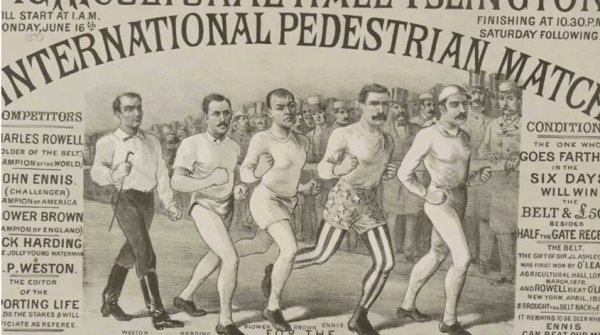
The records indicate that Henry led a quiet life, living in the same city all his life. However, Henry did practice an unusual sport, pedestrianism. In the 19th century, he would have been called a ped. At the time, pedestrianism was popular in Scotland and elsewhere. The six-day, 450-mile race usually began on a Sunday at 1:00 a.m. It started after midnight on Sunday because public amusements were prohibited on Sundays. The athletes walked for six days in a row, in a circle and had to complete the 450 miles. They could run, walk, or crawl. They ate, drank, and napped in little tents at the side. 5

Bloomberg, When Walking was a Spectator Sport, 7 August 2015

The walking matches were a spectator sport, with music and refreshments. It was like a fair. Gambling was also part of the attraction. There were lots of possibilities to place bets, such as the first pedestrian to drop out or the first to achieve a set number of miles. At the time, champagne was considered a stimulant. Some of the trainers (yes, they had trainers) would encourage the participants to drink copious amounts of it.6

Henry seems to have participated in several pedestrian tournaments. He was described as one of the “crack” walkers who participated in the Dundee tournament when he joined the Aberdeen Walking Match in December 1879. It took place in Cooke’s Circus, an equestrian establishment so we can assume that the participants walked around the equestrian arena. Prize money totalled £40 (about £6,000 today) and the winner won the champion belt of Scotland.7

On March 8, 1880, Henry competed in the Perth Grand Pedestrian Tournament. The thirty-three participants hailed from England and Scotland. The format of this tournament was that the men would walk or run between eleven o’clock in the morning and stop at eleven o’clock in the evening. First prize was £25 (about £3,800 today). Jostling, hindering another participant, or using bad language would result in disqualification.  Reserved seats were two shillings, second seats were one shilling, and third seats were a sixpence. A musical band was in attendance. Gambling was prohibited.8

The newspaper articles that list Henry’s participation in the Dundee, Perth, and Aberdeen tournaments are just a glimpse into this interesting sport. Not only did the participants travel to compete in these tournaments, the six-day races would have been quite exciting and exhilarating. There is no indication whether or not Henry ever won prize money, but still, he was a “crack” competitor.

  1. Scotland’s People, National Records of Scotland, Statutory Registers of Birth, 1875, District of Arbroath, County of Forfar, Elspeth Mill Boggie Orrock, retrieved 12 January 2018.
  2. Register of Corrected Entries for the District of Arbroath in the County of Forfar, dated 11 September 1882, directing that the defendant, Henry Boggie, Mason, should appear on the registration of birth of Elspeth Mill Boggie Orrock, in possession of author.
  3. Traces. Uncovering the Past, Tracing the Fathers of Illegitimate Children in Scottish Court Records, 3 December 2020, https://tracesmagazine.com.au/2020/12/tracing-the-fathers-of-illegitimate-children-in-scottish-court-records/, accessed 22 January 2024.
  4. Scotland’s People, National Records of Scotland, Statutory Registers of Death, 1905, District of Arbroath, County of Forfar, Henry Boggie, retrieved 22 January 2024.
  5. BBC, The Strange 19th century sport that was cooler than football, Zaria Gorvett, 28 July 2021, https://www.bbc.com/future/article/20210723-the-strange-19th-century-sport-that-was-cooler-than-football, accessed 22 January 2024.
  6. NPR,  In The 1870s And ’80s, Being A Pedestrian Was Anything But, 3 April 2014, accessed 23 January 2024.
  7. Aberdeen Press and Journal, 29 December 1879, page 4, accessed through British Newspapers on Findmypast, 23 January 2024.
  8. Dundee Courrier and Angus, 8 March 1880, page 1, accessed through British Newspapers on Findmypast, 23 January 2024.