
Tag Archives: Illegitimacy

Who is Henry Boggie?

Henry Boggie is my great-grandfather, but he was never really part of the family.

My grandmother, Elspeth Mill Boggie Orrock was born in 1875 in Arbroath in County Angus, Scotland. Her mother, Annie Linn Orrock, registered the birth and gave Elspeth her surname Orrock but she also gave Elspeth the name Boggie. The registration notes that Elspeth was illegitimate as her parents were not married.1

In 1881, when Elspeth was 6 years old, Annie Linn, still residing at 32 East Mill Wynd where she had given birth to Elspeth, instituted a civil paternity suit against Henry Boggie in the Sheriff Court.  On 11 September 1882, a decree was issued by the Sheriff Court, stating that the birth registration be corrected to include Henry Boggie as Elspeth’s father.2

Paternity cases were usually attempts to make the father pay child support and we can assume that this is probably why Annie Linn sued Henry for paternity.3 There is no evidence that Henry and Annie every lived together.

The censuses show that Henry lived with his mother until at least 1891. He worked as a mason and remained in Arbroath his entire life. He died fairly young, at 53. The registration of his birth says that he was single.4 It is unlikely that he fathered any other children.

The records indicate that Henry led a quiet life, living in the same city all his life. However, Henry did practice an unusual sport, pedestrianism. In the 19th century, he would have been called a ped. At the time, pedestrianism was popular in Scotland and elsewhere. The six-day, 450-mile race usually began on a Sunday at 1:00 a.m. It started after midnight on Sunday because public amusements were prohibited on Sundays. The athletes walked for six days in a row, in a circle and had to complete the 450 miles. They could run, walk, or crawl. They ate, drank, and napped in little tents at the side. 5
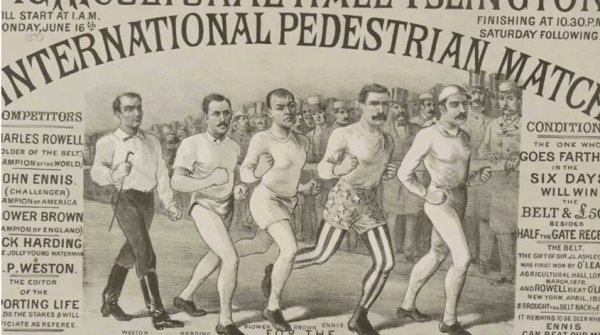
Bloomberg, When Walking was a Spectator Sport, 7 August 2015

The walking matches were a spectator sport, with music and refreshments. It was like a fair. Gambling was also part of the attraction. There were lots of possibilities to place bets, such as the first pedestrian to drop out or the first to achieve a set number of miles. At the time, champagne was considered a stimulant. Some of the trainers (yes, they had trainers) would encourage the participants to drink copious amounts of it.6

Henry seems to have participated in several pedestrian tournaments. He was described as one of the “crack” walkers who participated in the Dundee tournament when he joined the Aberdeen Walking Match in December 1879. It took place in Cooke’s Circus, an equestrian establishment so we can assume that the participants walked around the equestrian arena. Prize money totalled £40 (about £6,000 today) and the winner won the champion belt of Scotland.7

On March 8, 1880, Henry competed in the Perth Grand Pedestrian Tournament. The thirty-three participants hailed from England and Scotland. The format of this tournament was that the men would walk or run between eleven o’clock in the morning and stop at eleven o’clock in the evening. First prize was £25 (about £3,800 today). Jostling, hindering another participant, or using bad language would result in disqualification.  Reserved seats were two shillings, second seats were one shilling, and third seats were a sixpence. A musical band was in attendance. Gambling was prohibited.8

The newspaper articles that list Henry’s participation in the Dundee, Perth, and Aberdeen tournaments are just a glimpse into this interesting sport. Not only did the participants travel to compete in these tournaments, the six-day races would have been quite exciting and exhilarating. There is no indication whether or not Henry ever won prize money, but still, he was a “crack” competitor.

  1. Scotland’s People, National Records of Scotland, Statutory Registers of Birth, 1875, District of Arbroath, County of Forfar, Elspeth Mill Boggie Orrock, retrieved 12 January 2018.
  2. Register of Corrected Entries for the District of Arbroath in the County of Forfar, dated 11 September 1882, directing that the defendant, Henry Boggie, Mason, should appear on the registration of birth of Elspeth Mill Boggie Orrock, in possession of author.
  3. Traces. Uncovering the Past, Tracing the Fathers of Illegitimate Children in Scottish Court Records, 3 December 2020, https://tracesmagazine.com.au/2020/12/tracing-the-fathers-of-illegitimate-children-in-scottish-court-records/, accessed 22 January 2024.
  4. Scotland’s People, National Records of Scotland, Statutory Registers of Death, 1905, District of Arbroath, County of Forfar, Henry Boggie, retrieved 22 January 2024.
  5. BBC, The Strange 19th century sport that was cooler than football, Zaria Gorvett, 28 July 2021, https://www.bbc.com/future/article/20210723-the-strange-19th-century-sport-that-was-cooler-than-football, accessed 22 January 2024.
  6. NPR,  In The 1870s And ’80s, Being A Pedestrian Was Anything But, 3 April 2014, accessed 23 January 2024.
  7. Aberdeen Press and Journal, 29 December 1879, page 4, accessed through British Newspapers on Findmypast, 23 January 2024.
  8. Dundee Courrier and Angus, 8 March 1880, page 1, accessed through British Newspapers on Findmypast, 23 January 2024.
The Paternity Suit

Illegitimate. This word describes my grandmother. Elspeth Mill Bowie Orrock was born on January 3, 1875. My great-grandmother, Ann Linn Orrock was unmarried and she registered the birth of her daughter and signed the register with her mark.

When my father passed away, I found an extract of the Register of Corrected Entries for the District of Arbroath in the County of Forfar, Scotland among his documents. 1 This was the 1990s and I was astounded that my father never mentioned that his grandmother was unmarried at the time of his mother’s birth and that she remained unmarried.

I remember discussing it at the supper table and my two school-age children shrugged their shoulders and said, “Who cares if they weren’t married.” Exactly. Who cares? One hundred and fifty years later, no one in the family cares whether Elspeth’s parents were married or not. But in 1875, it would have been a serious offense.

The Presbyterian Church of Scotland (Kirk) formed parish councils that held Kirk Sessions, addressing matters of everyday life, such as “church non-attendance, sexual matters, bastardy and illegitimacy.”2 The Church elders dealt with the moral behaviour of their parishioners and “adulterers, fornicators, drunkards, slanderers and Sabbath breakers were all brought before the Kirk Session to answer for their behaviour and to do penance for their crimes. In the case of an illegitimate birth, the father’s name might be recorded along with the penance committed by both parents.”3

In the case of my grandmother, her mother registered the birth and gave her the father’s name as a middle name. Even though the name is recorded as Bowie, I assume that it is a mistake given that her mother could not read or write and did not know that the registrar had written Bowie instead of Boggie.4

The register of birth was corrected six years later when my great-grandmother decided to sue the father of her child in a paternity suit. On February 17, 1881, the Sheriff Court of Forfarshire found that Elspeth Orrock was the “illegitimate child of the said Ann Orrock and Henry Boggie.”5

The year of the court case, 1881, was also a census year. Ann was still living at the same address that she lived at when she gave birth to Elspeth six years earlier. She was also still living with her mother and her three siblings. Also present were both of Ann’s daughters, Elspeth and her sister, Jemima, eight months old.6  Jemima’s birth registration states that she was also illegitimate.7

The paternity suit that Ann instituted against Henry Boggie would have been a civil court action heard by the Sheriff Court under “Actions of Affiliation and Aliment.”8 I will probably never know why Ann took Henry to court but it is safe to assume that she was looking for an alimentary pension for her child. Was Henry a deadbeat father for six years? Maybe. Then again, maybe he stopped paying once Jemima was born. Or Ann simply needed more money, now that she had two children to care for by herself. It is impossible to know.

About fifteen years ago, I wrote to the Sheriff Court and asked them if they had a transcript of the court proceedings. Unfortunately, they had destroyed all transcripts after 1860 if there were nothing remarkable in the proceedings.


  1. Extract from the register of Corrected Entries for the District of Arbroath in the County of Forfar, dated July 29, 1947, in the writer’s possession.
  2. GenGuide web site, “Kirk/Church Sessions Scotland,” https://www.genguide.co.uk/source/kirkchurch-sessions-scotland/116/, accessed March 25, 2018.
  3. Scotland’s People web site, “Register of Corrected Entries,” https://www.scotlandspeople.gov.uk/guides/registering-illegitimate-births, accessed March 25, 2018.
  4. This is a deduction because on other official documentation, my grandmother’s name is Elspeth Mill Boggie Orrock and Boggie was her father’s name.
  5. Extract from the register of Corrected Entries for the District of Arbroath in the County of Forfar, dated July 29, 1947, in the writer’s possession.
  6. National Records of Scotland, “1881 Census,” Scotland’s People web site, Civil Parish of St. Vigeans, District of Arbroath, entry for Elspeth Orrock, accessed January 12, 2018.
  7. National Records of Scotland, “Statutory Registers Births,” Scotland’s People web site, entry for Jemima Kinnear Orrock, born July 25, 1880, District of Arbroath, County of Forfar, accessed January 12, 2018.
  8. Scottish Indexes web site, “Finding Paternity Cases in Sheriff Court Records,” http://www.scottishindexes.co.uk/learningcourt.aspx, accessed March 25, 2018.

The Family Secret

By Marian Bulford

My Gran told me that her mother Lilian, did not like her very much and was not very nice to her, and consequentially for some peculiar reason Lilian did not like my mother or me, either.

I remember Lilian as a very stern presence so I steered clear of her. She did live with my Gran for a time, but by the time I was a teen, she had moved to another daughter’s house to live, so I never had much contact with her.

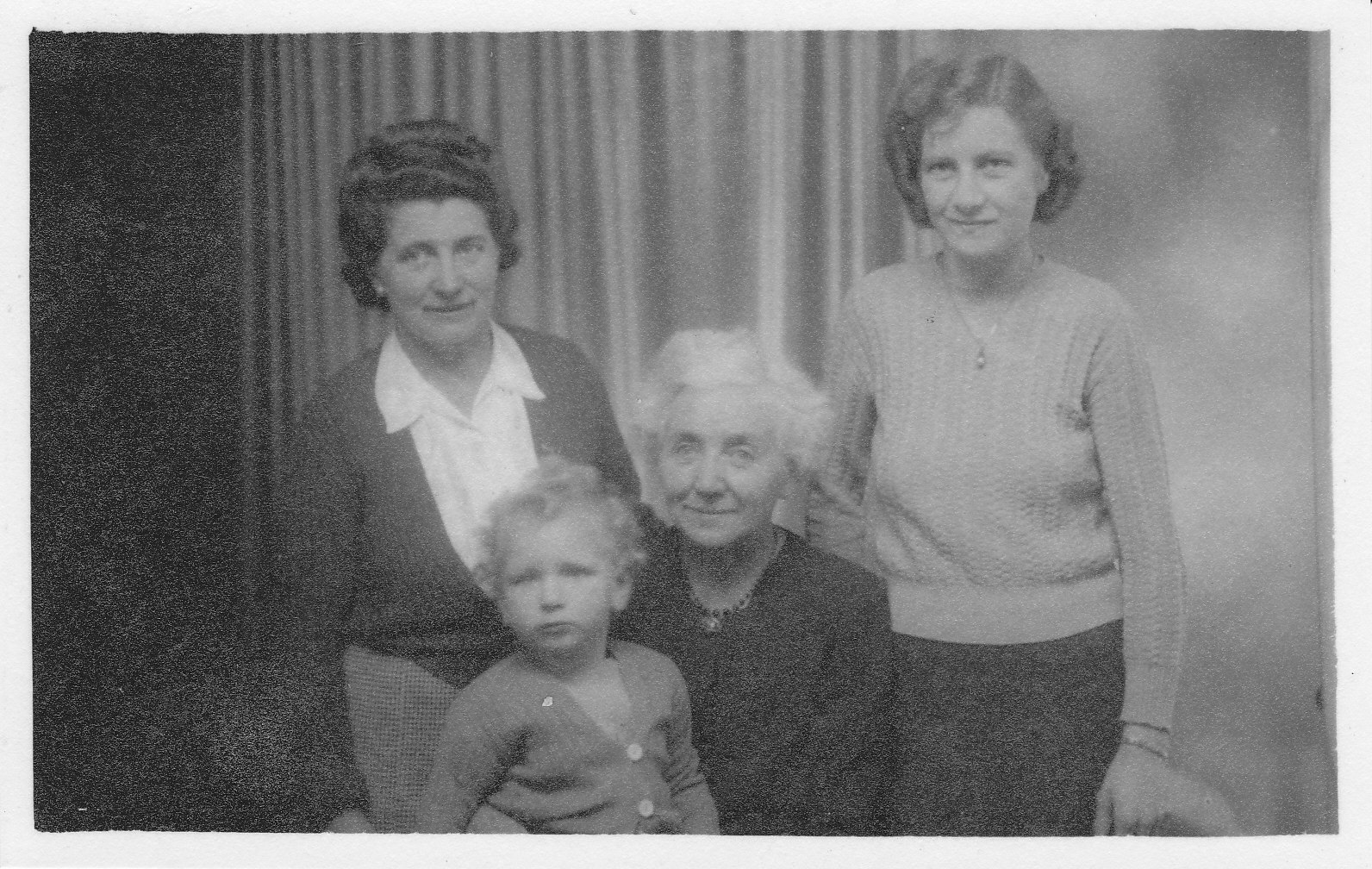
A photo below shows the four generations myself, Gran Mum and Lilian and I do not look very happy to be in this photo!

When my mother found out she was pregnant with me, 2 years after being married, she told me that Lilian said “Well, you made your bed now you have to sleep in it” Not a very nice thing to say about becoming a Great Grandmother! I never did understand why she did not like us and what she meant by that remark but years later, I was to find out.

For a while, I lived with my Grandparents from 11 years to 14 years. They were very strict but loving and Gran and I went everywhere together, to church the church fétes and shopping trips. Gran taught me to cook and bake.

One day, Gran wanted to go and see her mother who was living in Okehampton, Devon, a train ride away from us in Plymouth.

A train ride, what a treat! I was about 14 and we lived a very quiet life. Off we went, sandwiches and tea packed for the two-hour train journey to visit great-grandmother Lilian.

After my  Gran’s meeting with her mother lunch with the cousins and visiting, it was time to go. We had the train carriage to ourselves.

‘That was a lovely day, wasn’t it Gran?’ In answer, Gran burst into tears I was astounded, my Gran crying? She never cried.

I put my arm around her and asked her ‘Gran! What is the matter are you sick?” she cried some more, blew her nose and then said “I am a bastard”

Well! You could have knocked me down with a feather. Gran NEVER swore let alone say THAT word.

Eventually, she calmed down and I asked her what she was talking about. She must have been very very upset to divulge her mother’s secret to her young grand-daughter.

Apparently, Gran wanted to be baptized in the Church of England, and needed her birth certificate and to eventually claim her Old Age Pension, she also needed this document. That was the purpose of our visit.

When Lilian heard that Gran wanted her Birth Certificate SHE burst into tears and said that she hoped she would be dead by the time her secret came out.

Then, she had to reveal the reasons why she was so upset. Lilian was by then in her late 80’s and told Gran that she had given birth to her in the Leicestershire work house, because she was an unmarried mother. When she received Gran’s birth certificate it had stamped across it, in very large letters the word ‘ILLEGITIMATE’  Lilian had ripped it up and threw it away.

Lilian had, like many before and since, become pregnant at 17. The father Thomas was a Royal Navy Cooper a master carpenter. They met and she became pregnant. My Gran told me years later, that Lilian told her that she ‘fell off the style (or kissing gate) and never got up’ When Thomas did eventually come home from sea, they married. Gran was then three years old so yes, she WAS illegitimate for a while, but the parents had married, just a little late!

This seemed to be the reason Lilian did not like my Gran very much and Lilian did show a great deal of resentment towards Gran, my mother and me.


The four generations

IMG_0002
Standing, left Gran. Standing right my mother Front: Marian and Great Grandmother Lilian, 1948

This article is a continuation of a previous story, called “Illegitimate”

https://genealogyensemble.com/2015/07/13/illegitimate-2/