Tag Archives: Laurier Palace Fire

My grandfather’s brilliant city hall career in four scandals – part 3

The Coderre Police Corruption Inquiry/Laurier Palace Fire Scandal

The Crepeaus in Atlantic City probably 1927. Working vacation?

If you are a Quebecker of a certain age, it is possible that as a child you never went to the movies. Everyone under sixteen years of age in this Canadian province was banned from attending the motion pictures even in the company of an adult from 1927 until 1962 *1

This is because of the tragic Laurier Palace movie house fire in January 1927 where seventy eight children perished in a crush at the downstairs doors, doors that only opened inwardly.

These 78 children were among a larger group of working class kids crowded into the upper balcony of the ramshackle Laurier Palace watching a Western on a Sunday afternoon.

A slew of high-profile inquests and hearings followed the tragedy. My grandfather, Jules Crepeau, Director of City Services, was the first to testify at both the initial coroner’s inquest and subsequent hearings. It is unclear what exactly happened in the balcony as only children came forward to testify. All seven or so adults seated there seemed to disappear into the ether. There was talk of two men purposely closing the doors on the desperate kids. At least one older boy had time to go up and down the stairs a few times before the smoke got dangerous. The origin of the fire was never discovered. *2

Most parents, afraid of legal reprisals, testified that they thought their children were at church that afternoon. But parents of the era could hardly be blamed for allowing their children to attend the movies by themselves– against the by-laws. Many of their male children were already out in the workforce earning their own discretionary income and many of their young daughters were already ‘little mothers’ in charge of even younger siblings. With the traffic chaos on the streets in 1927, the movie house probably seemed like a relatively safe place for their children.*3
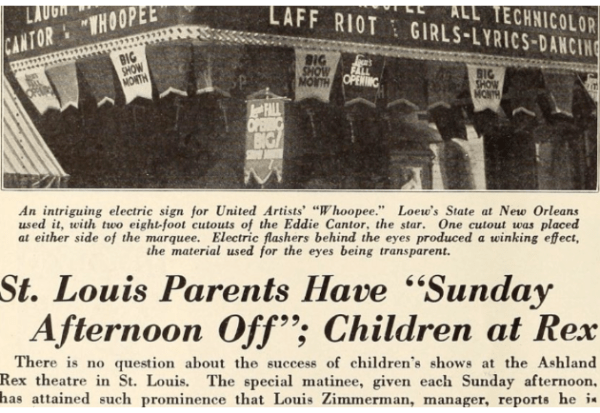
Just as special ‘kiddie matinees’ were taking off in the US (late 20’s early 30’s) Quebec banned all children from going to the cinema – for 4 decades. Crazy!

On January 10, 1927, the day after the Laurier Palace Fire, the front page of Le Devoir newspaper ran two related stories side-by-side. One was a dry report where my grandfather Jules Crepeau, Director of City Services, admitted that the Laurier Palace Theatre had been operating without a license.

“This will all be explained at the Coroner’s Inquest,” he said.

The second story was a shocking side-bar rehashing testimony from a two year old inquiry into police corruption, testimony that also mentioned my grandfather.

“Our readers will no doubt be interested in re-reading these extracts from testimony at the 1924 Coderre Inquiry into Police Malfeasance and Corruption, 4 that bear on motion picture theatre attendance.”

The side-bar included bits and pieces of testimony given in December, 1924 at this hearing by a certain Constable C.T. in the ‘special services’ division of the Montreal Police Department. The cop railed against City Hall. He was angry because members of the Executive Committee, he said, as well as my grandfather, repeatedly forced the police to cancel citations against motion picture houses that allowed children into the shows, unattended.

Constable CT gave specifics, naming each of the movies houses (the Ouimetoscope!) and the dates when citations were cancelled. He said, “One of these moments there’s going to be a catastrophe that will wake up the authorities.” Le Devoir put that quote in all caps.*5

Despite this sensational after-the-fact finger-pointing at a sensitive time by an otherwise respectable publication, no one took the bait. My grandfather Jules was once again called to testify at the Coroner’s Inquest as well as the other inquiries into the fatal fire but was never asked about Constable CT’s earlier accusations.

Indeed, a while later, when the Taschereau Government was deliberating whether to ban all Sunday showings in Quebec, my grandfather testified once again. He even brought in Ernest Cousins, Vice President of United Amusements, Montreal’s largest movie chain, to talk about the importance of Sunday showings to the movie distribution industry.*6

Isadore Crepeau, my grandfather’s brother, who just happened to be another Vice-President of United Amusements, was also called in to testify at this time, although I’m not sure anyone knew of the family connection.*7

So, why wasn’t my grandfather pilloried back in 1927, when passions over the tragedy were at a high boil, for these two year old allegations of interference with the policemen who patrolled motion picture houses (and who, btw, regularly accepted free tickets for their kids.)

Well, the truth is, Constable CT’s testimony was hardly gold-standard. Under cross-examination a day later, the cop admitted rather glibly to having lent the Chief of Police large sums of money at different times, for reasons he refused to elaborate on. He also admitted to depositing more than five thousand dollars into his five bank accounts over a short period of time. “Rents and winnings on horses” he said.

Constable CT was just another corrupt cop, put on the stand specifically to threaten my grandfather by bringing up, out-of-the-blue, the fairly benign subject of children and the motion pictures, when the Coderre Inquiry was mounted to deal with much more dire and dark issues: police involvement in prostitution of women and girls, drug rings and organized crime and illegal booze smuggling in the era of American prohibition.

Taken in that light, Constable CT’s statement “One day there’s going to be a catastrophe” uttered in December 1924, a full two years before the Laurier Palace fire, could be construed as a threat.

My grandfather, at the time, certainly felt threatened. He had Constable CT fired the very next day.

“Who is this Jules Crepeau who can tell the Chief of Police what to do?” asked Juge Coderre in his summary report in March 1925. As if he didn’t know.8

Three years later, in September, 1930, as explained in Part Two of this series, Mayor Camillien Houde was speechifying at the City Hall meeting where the aldermen debated whether or not to accept my grandfather’s coerced letter of resignation.

“The people want revenge,” Houde said. “They want revenge for the Montreal Water and Power Purchase (the purported reason for wanting my grandfather out) and for the Laurier Palace Fire.”

This was a sneak attack of some sort because never before had the Laurier Palace Fire been brought up as a reason to oust my grandfather from his lofty post at City Hall, at least not in any news clipping I have read.

With all the Houdist’s voting against him, my grandfather was, indeed, forced to resign his post of Director of City Services in September, 1930.

At the time, Grandpapa Jules negotiated a huge life pension that would make him the second highest paid employee at City Hall, without working. Seven years later, during the Great Depression, his huge pension would be rescinded by the City.

Two weeks after that, Jules was hit by a car near his home in Notre Dame de Grace, a car driven by an off-duty police officer. I guess my grandpapa threatened someone with a long reach.

He would die a year later of complications.

As it happens, Le Devoir was the only Montreal newspaper to give Jules a lengthy front page obituary. They even called out the other Montreal papers on this point.

The other day a noted public servant was put in the ground. The newspapers only published laconic biographical notes about him that don’t give a just idea of the role he played in municipal politics.”

The obituary didn’t mention the suspicious nature of my grandfather’s death, but it did allude, rather kindly, to the many scandals in his career:

He was too passionate not to occasionally take sides between two rivals, often creating his own enemies. Indeed, he received some knocks, some devastating knocks, but we must say upon his memory, that none of these accusations stuck.

Read the entire obit here.

I have added this on February, 14, 2022. The Montreal Star came online and I was able to read their point of view. They liked him, that’s for sure. Upon his forced retirement they wrote:

“His rise to the position he just vacated was accomplished by merit. A thorough knowledge of the whole involved process of civic administration, of civic problems and the various services, combined with a ready tact, a suave manner, and a keen intellect, which enabled him to penetrate to the root of any problem without delay and which made it very difficult for anyone to mislead him.”

Also, I reread the testimony of Constable CT during the Coderre hearing. Of course, different newspapers covered these political stories differently. I was surprised to see that in his testimony Constable CT claimed that Jules cancelled citations against movie houses owned by United Amusements. It was stated at the hearing that ‘no civic employee had any connection to the company.” LOL. My grandfather’s brother was VP.

Notes:

  1. The city by-laws forbade children to attend movies unless in the company of an adult, not because of a fear of fire-traps but for a fear of the morality of pre-code Hollywood. Indeed, exceptions could be made for films vetted by the Censor. A year later, a similar fire happened in a motion picture house in Scotland – also caused by a crush at doors that opened inwards. The only change that came of that was a law forbidding such doors in motion picture houses. But, in Quebec, everything becomes political. A parade of Montreal citizenry testified in the sad affair: the theatre owners (who were eventually exonerated) and employees and the firemen and the victims’ parents; then followed moguls in the theatre business, small independent theatre owners, union activists, more parents and more firemen, also educators and church officials and representatives of various community groups – anyone with a stake and an opinion – showed up to testify . Fire safety became a mere side issue: it was all about the morality of the motion pictures. The government ended up banning children from all showings, in return for allowing the controversial Sundays showings for adults. (Children could not vote, but their parents could.) I personally think the new “Talkies” coming in right then in 1927 had something to do with the decision. They were English talkies after all. Despite all this, Quebec children over the decades often evaded the rules by dressing up and acting like adults. There were also special children’s showings at various theatres over the years.

2. “It must have been a cigarette.” Most movie house fires of the time started in the projection booth. This wasn’t the case here, so they took a wild guess. A fire station was across the street, but firefighters could do nothing upon arrival to save the children.
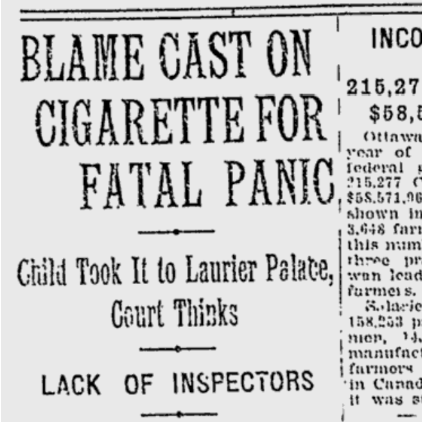
3. 1927 was a pivotal year in traffic safety in North America. The horse and wagon era was literally colliding with the era of the automobile – and their were no road rules yet. The same edition of the Montreal Gazette that covers the Laurier Palace Fire has a story of a toddler being run over in front of her house. This was a daily occurrence in North American cities at the time.

4. The Coderre Inquiry into Police Corruption and Malfeasance was launched after a record-breaking Brinks robbery in the Hochelaga district where it discovered that policemen were involved, but it had long roots back to WWI and prostitution around the Montreal Barracks. A Committee of Sixteen mostly Protestant groups organized an all-court press on Montreal City Hall in 1921, to protect the sad girls working in prostitution in the city after a prominent doctor gave a speech to the elite members of Canadian Club. They focused on the Baghdad Cafe, a sleazy dive serving US tourists located across the street from the ritzy Mount Royal Hotel, Tony Frank, Montreal’s leading mobster and top drug dealer was also implicated in the Brinks robbery. He thought he had the perfect alibi, but he and his henchmen were quickly hanged on circumstantial evidence. Judge Coderre, a religious conservative, used the Inquiry as his bully-pulpit. “Vice spreads its tentacles into every aspect of Montreal life, ” he wrote in his final report. He made many recommendations, all of which were ignored.
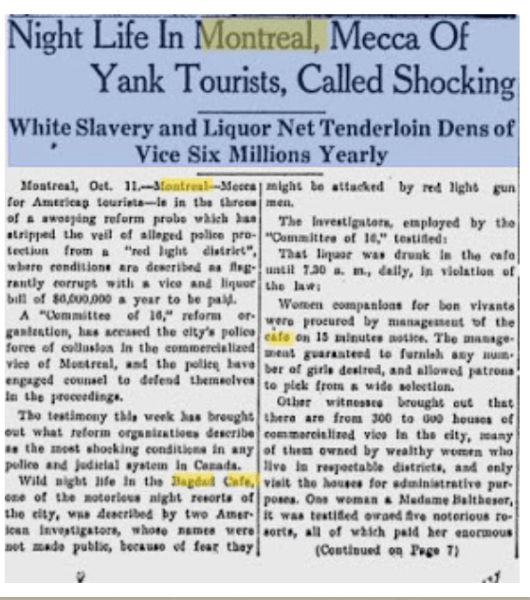
New York Times article: “300 to 600 houses of vice in Montreal, many owned by respectable women who live in good districts and seldom visit the brothels except to do administration.”

5. The Montreal Gazette’s quote at the time was “One day there’s going to be a catastrophe and if a fire breaks out one of these days no one will be able to get out.” These may or may not be the same quote. Unfortunately, the newspapers used creative license when transcribing the testimony and no full 10,000 page transcript of the Coderre Inquiry still exists, although Montreal City Hall has some original documents. https://www.archivesquebec.com/montrealp045.html . I visited there a few years ago and was shown a transcript on pdf that had been prepared for JAA Brodeur and the Executive Committee. It was edited down and did not include Constable CT’s ‘prescient’ quote. From what I read, it appears that Constable CT brought up the incriminating evidence against my grandfather without even being asked. He changed the subject himself in mid interview. This transcript did contain a vivid account of a visit to a house of prostitution made by an undercover American. All he had to do was to ask the cabby and he was guided to this brothel (that was said to be under the protection of the police) where a dozen of drug-addled girls wearing ‘handkerchiefs’ were displayed before him.

6. The UA chain did not have children as customers, said Cousins, but Sunday was the company’s biggest day at the box office for adults. If Sunday showings were cancelled, United Amusements would have to close down their entire operation…. United Amusements was a movie distribution chain founded by Greek immigrant George Ganetakos during the WWI years.. He started out small, showing ‘flickers’ on the wall o f his uncle’s ice cream shop, then took on Ernest Cousins (an ice cream man) and my great uncle Isadore Crepeau when he expanded. Eventually his company became part of Famous Players. United Amusements built many of the gorgeous Montreal movie palaces of the day. Greeks were big in the movie biz as they were entrepreneurial by nature and this new movie revolution presented a big opportunity for them. In his testimony, as reported in the Montreal Gazette, Constable CT accused Greeks of corralling children into the movies. The Laurier Palace was owned by Canadians of Syrian origin, a group often back then conflated with Greeks. On the morning after the fire, as reported in Le Devoir, George Ganetakos, using the name George Nicholas, set up an emergency fund for the victims.

7. My Mom’s Uncle Isadore was a glass manufacturer/insurance agent whose elegant stained-glass window graced the Rialto Theatre on Park Avenue for many years. It’s still there – in what is now an entertainment venue. In 1933, Isadore ‘fell’ out of his office window, seven floors up, and met his death. The police deemed it an accident relating a ridiculous story and citing unnamed witnesses. Isadore was very likely hired by Ganetakos because of his connection to my grandfather. A survey of movie industry magazines, like Box Office, reveals that my grandfather’s name came up much more often than Isadore’s.

8. Juge Coderre and his wife often attended City Hall events like the soiree for the Royal Princes held in August 1927.

In November 2022 I found a bit in an online archive from 1940. A man described the Director of City Services as the Manager of the City. Period. BUT he said when the post was created they didn’t allow for enough autonomy for the Director who was subject to blackmail and political interference. By 1940 only two men, my grandfather and Honore Parent had held the post.

Brush with a (Messy) Icon

Marion1FIXED

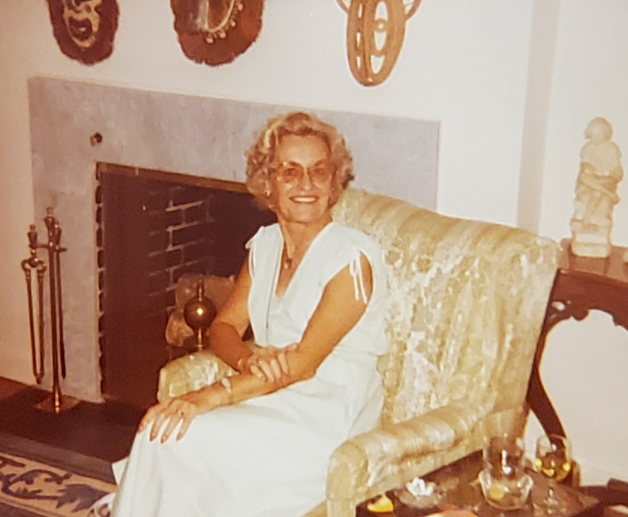
Marion Blair, my mother-in-law, 1990s

There were no teenagers back in the old days, my mother-in-law, Marion Blair, used to say. You were a girl one day and a woman the next – at least when it came to the way you dressed and the way you arranged your hair.

Somewhere, I have a black and white studio photo of Marion looking rather glamorous wearing what appears to be bright red lipstick, (it’s hard to tell for certain) taken in 1929.

I find the photo a bit freaky, because Marion was born in 1917! At a mere 12 years of age she certainly had achieved that polished ‘movie-star’ look and she maintained that impeccably groomed image right up until her death in 2002.

So it was no surprise to me when my husband came into the room a while back as I was watching an old Bette Davis movie on TCM and said, “That woman looks just like my mother.”

“Your mom didn’t look at all like Bette Davis,” I replied. “But, I can see your point. The movies, back then as now, instructed girls – and boys – on how to be grown up.”

Now, this was doubly ironic as here in Quebec in the 1930’s children under 16 were banned from the cinema because of the 1927 Laurier Palace Theatre Fire where 72 children had died in a crush to the exit.

So what did these deprived Depression Era English Quebec children do to bend the rules and partake of some healthy Hollywood escapism? According to my mother-in-law, they sneaked into the movie theatres and comported themselves like adults. That meant no shouting and no jostling. Girls often applied make-up to enhance the illusion.

Marion Blair was the middle of three sisters, so it is no surprise, really, that her appearance meant a lot to her, especially since her sisters were, let’s face it, much better looking. Think Rita Hayworth and Merle Oberon.

She was the skinny sister with the slightly wonky left eye and a wild boy-crazy “biker chick” personality that had to be tamed with two years at Trafalgar all-girls school. (Hmm. Maybe, there were ‘teenagers’ in the 1930’s after all.)

The 1930’s Hollywood Dream Factory inspired more than Marion’s hair and makeup. She was a wannabe thespian. At McGill in the late 30’s she got to play comedic parts in the famed Red and White Revue.

Somewhere, I have some clippings from the early WWII McGill Daily. In one of them Marion is flying in the air attached to cables with a giant wand in her hand and an enormous toothy grin on her face.

Marion Blair was a natural for the theatre, but in 1941, with war raging, she chose a domestic existence and married Thomas Wells, a Westmount boy who had played semi-pro  hockey with her brother and who had recently enlisted in the RCAF.

mariaondancefixe

Marion, ballerina, 1942, Dunville, Ontario RCAF training base.

As a young mother in the 1950’s, Marion continued to act in local amateur theatre out in the suburbs with the Hudson Players Club. (I guess the stage was the only place she felt safe ‘letting her hair down.’)

Her own mother, Marion Nicholson Blair, had been widowed in 1927, when Marion Jr. was just 10 years old. Mother Marion had been cut out of her husband’s family lumber fortune, but instead of remarrying one of her many suitors she went back to work as a teacher at the Montreal Board and also got involved with the Protestant Teachers Union, rising to President during WWII.

The Nicholson/Blair female-run family had little money to spare but being a natural wheeler-dealer, mother Marion found patrons to send her children to university which is why daughter Marion could swing from the rafters at McGill’s Morris Hall.

Which brings me to another related story – about another photograph, one I actually have on hand to show you.

My mother-in-law’s patron was a friend of her mother’s, a Mr. Dean from the local Westmount Church. One summer in 1936 he took them to Saranac Lake, New York on a vacation.

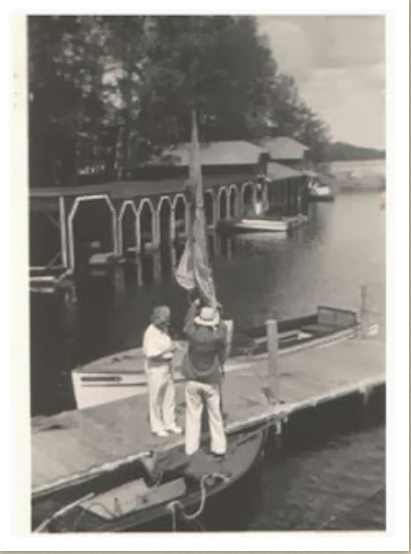
One morning,  as they walked on the waterfront, at the marina, Marion spotted a portly older man with very disheveled hair on the pier beside a small sailboat. “What messy hair that man has,” said Marion to her companions. “Disgraceful.”

Mr. Dean would have no part of it. “That, my dear,” he told her, in a hushed and reverent tone, “is Professor Einstein.”

So my mother in law snapped a photograph – and here it is.

Saranac Lake

This picture is more than mere family memorabilia.

With a little online research I soon figured out that my mother in law caught the Man of the Century setting up for a famous AP photo shoot. (Or perhaps shutting down from it.)

Here’s that photo “Einstein at Play” taken a few minutes before or after my mother-in- law snapped the photo of the physicist icon with the famously messy head of white hair.

EinsteinatPLAY


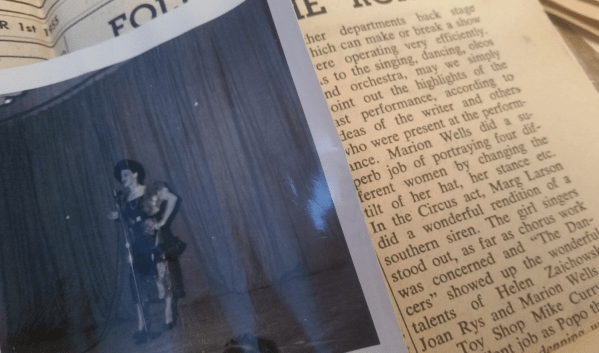
A pic of Marion on on stage and a clip from the December 1955 Lake of Two Mountains Gazette.

Montreal Movie Mysteries

rialto

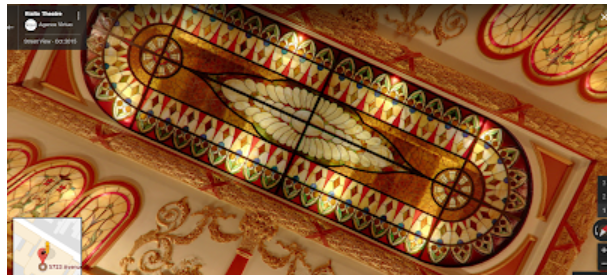
The Rialto ceiling today from Google Earth.

When I was a little girl in the 1960’s, whenever my family crossed the Cartierville Bridge in Montreal’s Ahunsic area to go to Laval, my mother would claim, “That is Uncle Louis’s bridge.”

Her much older brother, Louis, who died of a heart attack in 1965, had been a civil engineer and it is likely he worked for Dominion Bridge, the company that made that structure in the 1930’s.

The Cartierville Bridge wasn’t much to look at, so I wasn’t at all impressed.

I recently learned that back in the day my mother had a much lovelier family creation to brag about. Her Uncle Isadore’s glass company, Ceramo, had manufactured the beautiful stained-glass panels on the ceiling of the Rialto Theatre, the opulent 1924 movie theatre on Park Avenue decorated to look like the Paris Opera House.1

According to reporter Dane Lanken, who wrote the definitive book on Montreal’s old cinemas, this ceiling is rare, if not unique, among the grand movie houses of the day.*2

My mother’s Mon Oncle Isadore, an Outremont-based insurance broker, was also the VP of the United Amusements Corporation, a company that distributed films for Famous Players and that built the Rialto and dozens of other lavish Montreal movie houses, so it was all very convenient.3

Mummy rarely spoke about her Uncle Isadore during her life-time and she never talked about his many interlocked businesses.

She clearly didn’t know anything about the Rialto Cinema ceiling.  She never mentioned how Isadore had welcomed the audience at the opening of the magnificent Monkland Theatre in 1930, not in-person but from up on the screen in a talkie film.*4

(How cool that must have seemed just a few years after sound technology was introduced.)

In 1930, my mother would have been only nine years old and not entitled to enter movie houses.  Children under 16 had been banned from cinemas in Quebec 2 years before, in 1927, after the infamous fatal Laurier Palace fire.5

And my mom was only 11, in December 31, 1932, when her Uncle Isadore fell to his death from his 7th floor office window at 414 Saint James Street West.

She never ever mentioned that shocking event, either: I suspect no one told her about how her Uncle Isadore died.

Isadore414StJacques

From La Patrie, online.


Lanken mentions Mon Oncle Isadore more than a few times in his beautiful book. He doesn’t discuss the manner of Isadore’s death.

However, Louis Pelletier, a Concordia scholar, does mention Isadore’s demise in his PhD thesis about the movie distribution industry in Montreal – with a sly aside.  Was it a suicide? Who knows. *6

Pelletier also says that Isodore was likely brought on as VP of United Amusements in 1921 as a ‘token’ francophone.

The 2012 thesis is brilliant, but here Pelletier (like Lanken) fails to make one key connection. Isadore’s brother was Jules Crepeau, my grandfather, Director of City Services in the 1920’s. Isadore’s appointment wasn’t token: It was tactical.

If you conduct a search of the Digital Media Database which contains many era Hollywood Trade Magazines, Jules’ name comes up more than Isadore’s.*7

Jules also died relatively young, in 1938, about a year after he had been hit by a car driven by a plain clothes policeman on Royal Avenue in NDG.*8

He had retired from his lofty post at City Hall in 1930.*9

Back in 2008, when I asked my mother if the 1937 car ‘accident’ had been a ‘hit’ *10 she replied an emphatic “No.” The policeman in question had been very upset about it, she told me. She died in 2009.

Ten years later, knowing what I now know about Isadore Crepeau and my Grandpapa Crepeau’s controversial and scandal-ridden career at Montreal City Hall,*11 I imagine that my mom’s recollection of this very contrite cop was a second-hand memory planted there, perhaps, by her older brother Louis.

Uncle Louis. Now, he’s the one I should have been able to talk to.  Had he lived, what twisting tales he might have told me.

  1.  Lanken, Dane. Montreal Movie Palaces. Great Theatres of the Golden Era 1884 – 1938.  Penumbra Press. 1993. This feature is likely why the Rialto has been deemed a National Historic Monument, and why it still stands today. Most other Montreal movie houses were destroyed or left to languish.
  2. Ibid. These United Amusement theatres included the Belmont on St.Laurent, and the Monkland on Monkland Avenue and the fabulous Art Deco Snowdon Theatre where I saw The Sound of Music in 1965 – at 11 years old. We lived on the adjacent street.
  3. Ibid.
  4. Ibid
  5. It’s a ban that stayed in place until 1962. Over 70 children were crushed to death escaping from the balcony of a Sunday showing after a small fire.
  6. Pelletier, Louis. The Fellows Who Dress the Pictures: Montreal Film Exhibitors in the Days of Vertical Integration (1912-1952). Concordia PhD Thesis, Communications Department. 2012. The Montreal Gazette, December 31, 1932. The official story is Isadore fell trying to build a device to hang a flag to signal his chauffeur. This happened after his secretary had left his office. After dark. In the depth of winter. Supposedly, Isadore’s unfinished cigar was found on the sill. The police cited unnamed sources for this report, not the secretary, not the chauffeur, not the wife.
  7. www.digitalmediahistory.org. In 1921, Jules was interviewed by Variety about the controversy over Sunday showings. In 1924, he was interviewed about risqué movie posters. In 1926, during the Coderre Commission into Police Impropriety and Malfeasance, his name is brought up in connection with the police. It is said he forced police on the beat to look the other way when movie houses broke the bylaws by letting children in unattended. The New York Times rehashed this bit in 1926 in a two-page story covering testimony during American Senate hearings into Prohibition. In 1927, Jules is mentioned in relation to the Laurier Palace Fire. Jules was the first to testify at both the initial inquest and the later Royal Commission.
  8. Family lore says his death was due to bone cancer from the X-Rays he received from a broken leg from the accident. Upon his death the Montreal Gazette reported that Jules spent 2 months in hospital for this broken leg. Seems a long time, especially for a man with a comfy home and wife and 3 grown daughters to look after him.
  9. Jules had been forced to retire by new Mayor Camillien Houde. Jules negotiated a huge pension of 8,000 dollars a year that was rescinded in 1937 with an emergency measure due to the Depression, just two weeks before he was knocked down by that policeman on Royal Avenue, a block from the United Amusement Offices on Monkland.
  10. In 2008, I asked my mother to tell me all she remembered about her childhood and my grandfather. She didn’t know much about the political intrigue but she did know that her father and brother received numerous death threats and that on occasion big shots like the Mayor or the Chief of Police visited their home on Sherbrooke Street West in secret meetings.
  11. According his obit in Le Devoir, he had a mind like a bank vault and each drawer was filled by a City Hall by-law or other fact. A Gazette article about Mayor Mederic Martin in 1937 claimed “Jules Crepeau’s hair went gray teaching aldermen their jobs.”
  12. Jules and Isadore were the sons, two of four, of Joseph Crepeau and Vitaline Forget-Depatie who, according to Jules’ marriage certificate on Drouin (1901 – Maria Roy) were from St.Louis de France, which would be Trois Rivieres. Montreal City Hall records (his file) claim Jules was born in Laval and that Joseph was a house-painter. Joseph’s paternal line can be traced back to Maurice Crespeau (curly-haired ones) of Poitou-Charentes, born 1637. Vitaline’s Forget line goes back to Abraham Martin, owner of the Plaines of Abraham, known as “L’Ecossais.” https://www.geni.com/people/Abraham-Martin-dit-l-Écossais/6000000000397138666  Jules and my mother did have very curly hair and this is perhaps due to deep Sephardic Jew and Algerian roots. My mother has some Sephardic DNA, to the tune of 4 percent. Crespeau (Crespin) is understood to be one of the Sephardic French Canadian names. https://www.jewishgen.org/Sephardic/nameorig.HTM  Jules’ wife’s Maria Roy’s MT DNA has traces of Sephardic as well and can be traced back to a Lily Rodrigue in Normandy. Rodrigue (Rodriguez).


The Dowry

72 sherbrooke.JPG

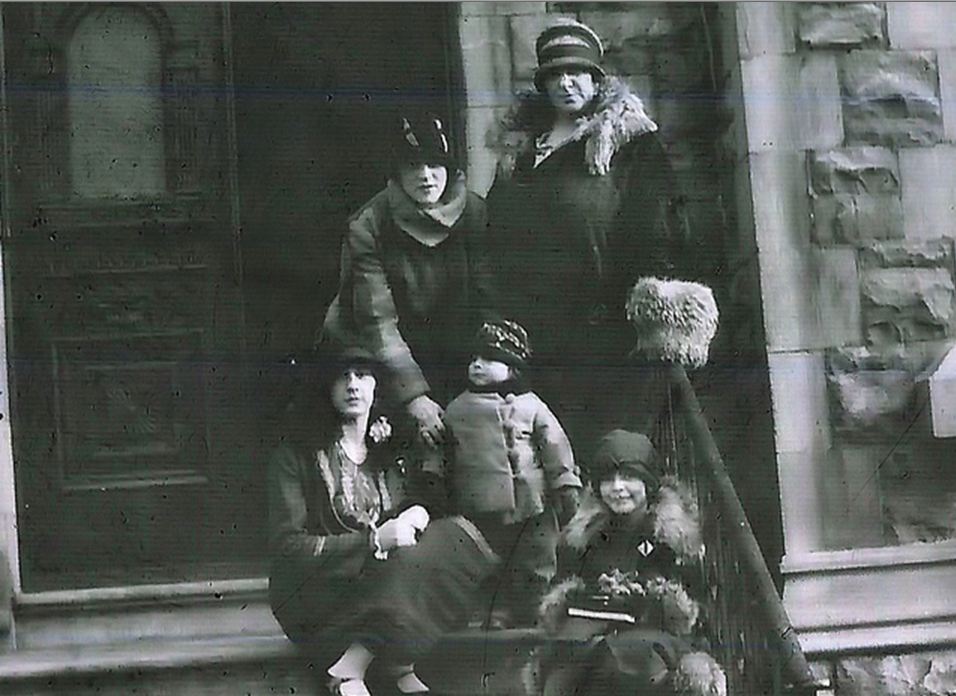
Maria Roy Crepeau and three daughters and a granddaughter in front of 72 Sherbrooke West in 1926 or so.

In the Edwardian Age, an ambitious young man, however resourceful, usually needed a solid financial foundation to kick-start his career.  If he didn’t have family money, he had to marry well. Take my grandfather, Jules Crépeau, (1873-1938). The son of a mere house painter, he rose up in 30 years from Messenger Boy in the Health Department to Director of City Services, the top civil servant at Montreal City Hall.

Jules didn’t have the advantage of a superior education; indeed, he completed his regular studies at night. He did have a workaholic nature, an affable disposition, a memory like a steel trap,*1 as well as a connection to the powerful French Canadian industrialists, the Forgets.

New information I found on the Internet reveals that the make-or-break-point for young Jules was in 1901, the year of his marriage. Back then, Jules was making only $600 a year, not a terrible salary for a single man, but certainly not enough to get married on.*2 So, Jules, like so many others, had to choose his wife very carefully.

My grandmother, Maria Roy, the daughter of a master butcher, brought a huge $40,000 dowry to their 1901 marriage, so I’m told. The next year, Jules had a house built for them on Amherst, near Ontario Street, and by a noted architect, at that.*3 Maria’s money!

Lovell’s Directory shows that in 1905 the Crépeau family moved to a tony stretch of St. Hubert Street.  Jules is listed as Head Clerk.  City Hall.   In 1918, they moved to St. Denis Street, just a few doors down from J. A. Brodeur, “Montreal’s Napoleon,” and Head of the Executive Committee. My grandfather was, by then, Second Assistant City Clerk, with a salary of $2,500 -$3,500.


julesfamily1.PNG

Crépeaus around 1918. My mother wasn’t born yet. Doesn’t Jules, center, look stressed?

In 1921, Jules was promoted to the newly-minted post of Director of City Services*4, almost tripling his salary to $8,000, and soon thereafter, to $10,000. In 1922, his family moved to a three storey greystone at 72 Sherbrooke West.

It’s during this period, the Roarin’ Twenties, that my grandmother, Maria, finally started earning dividends on her dowry, taking  shopping trips to New York City to stock up on bourgeois bric-a-brac like marble urns, porcelain statuary, and art nouveau lamps; a complement to the whole roomful of ‘gifts’ the family received from various community groups, especially at Christmas. Jules and Maria needed a good supply of breakables. Family legend has it that the crockery flew over the stairs throughout their tumultuous 37 year marriage.

mtflo.PNG

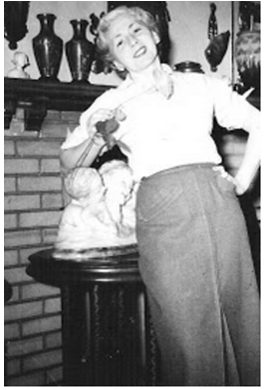
Aunt Flo posing in front of some Crépeau bric-a-brac on Harvard in the late 1940’s. The marble bust of three children actually ended up in my mother’s possession, gracing our upper duplex apartment in the 1960’s, but rather out of place among the melamine furnishings and artwork from Woolworth’s. Today, I own the orange art nouveau-deco Le Verre Francais “Amourettes” vase at top right.

In 1931, Jules Crépeau was forced to resign by the new populist Mayor Camillien Houde, but not before negotiating a huge life pension of $8,000 a year. But, soon,  my grandfather, who had no hands-on business experience, lost all of his savings with bad investments.*5  In 1937, Jules also lost his pension when Montreal City Hall passed an emergency bill to abolish it as a cost-saving measure. *6

Just two weeks later, Grandpapa was hit by a car driven by a plain clothes city policeman. He died the next year from complications. Jules probably threatened someone with a long reach.

Living out her life in the final family home on Harvard in Notre Dame de Grace, Jules’ wife, Maria Roy Crépeau (1879-1951) never complained about her situation as an impoverished widow, and this despite the fact her fat dowry financed the first years of the choppy Crépeau-Roy merger. Still, I suspect her story wasn’t at all unique, especially in the Depression Era.

Jules Crepeaurue.PNG

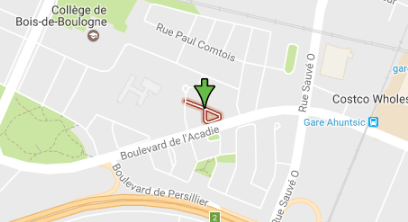
Rue Jules Crépeau, Ahunsic, Montreal. Designated in the 1980’s. Funny story. In the late 80’s, when my husband and I were buying our first computer, the ONLY place in Montreal we knew that sold them was in  Ahunsic, where we seldom ventured. We got lost and stumbled upon this road and park. I had to find a phone booth to phone my mother to tell her that a street had been named after her father. Serendipity or what? Jules’ nemesis, Camillien Houde, has the huge road winding through the mountain named after him.

park.PNG

  1. Le Devoir was the only Montreal newspaper to publish a long obit of my grandfather, in 1938, saying that Jules was the go-to guy for any information about how City Hall ran. Affable is their term.
  2. The 1911 census shows that a $600 a year salary was average/above average for a family. Many era workers were ‘day workers’ with unsteady employment, but, even that $600 salary was not enough for the big families of the era to live on. Terry Copp, the sociologist who wrote An Anatomy of Poverty,claims that $1500. was the minimum salary for a family to live in dignity in Montreal in 1910.  In the Edwardian Era, in England and elsewhere, a working class couple might start out in good shape, with a decent salary for a small family, but as more and more kids came, the family fell into poverty.  Such might have been Jules’ fate, save for this huge dowry.
  3. Louis Zephirin Gauthier specialized in churches. His partner was a Monsieur Roy, so maybe he was a relation. Back then few Montrealers owned their own home, in the 20 percent range. Since 1899, male renters could vote in the municipal elections; women had to be single and own their home to vote. Montreal has long been known as a city of renters, but, just lately, this appears to be changing.
  4. The post of Director of City Services was created in 1921 after much deliberation and input from citizens to ensure an equitable distribution of money among the city districts. The post was a liaison between the seven city departments and the Executive Committee. Newspaper accounts of the time reveal that my Grandfather’s office did everything from organizing events for the visiting Royal Princes to being on the City Clean-Up Committee, to testifying in Quebec with respect to Private Bills. When someone had a beef at City Hall, they wrote to his office. My grandfather was the first to testify at the inquiry in to the fatal Laurier Palace Fire, in January 1927, which was ironic, as I suspect  the fire may have been started by organized crime to get at him. (Just my theory, though.)
  5. Jules’ brother, Isadore, Insurance broker and VP Of United Theatre Amusements, the company that erected many of the famous 1920 era movie houses in Montreal, ‘fell’ out of his 7th floor office while waving for his chauffeur in 1933.
  6. Kristian Gravenor, journalist at Coolopolis.blogspot.ca http://coolopolis.blogspot.ca/2017/01/ndg-coincidence-undercover-cop-slams.html wrote a bit about Jules and dug out the info about the cancellation of his pension.