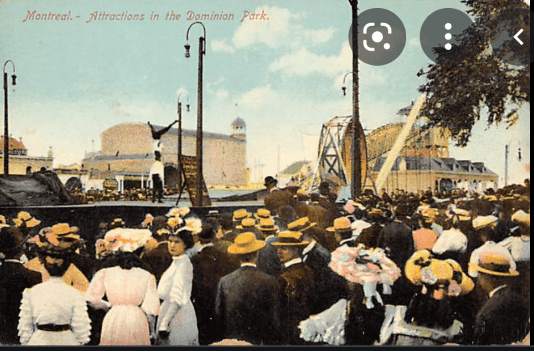
Everyone has heard of Coney Island, the legendary thrill park in New York, but have you ever heard of Dominion Park, Montreal’s Coney Island?
Not likely. The Montreal Amusement Park ran from 1906 to 1938 and is all but forgotten.

However, colourized photos like the one at top are widely available on the Internet thanks to Valentine and Sons.
Judging from the newspaper record, the ‘official’ opening of Dominion Park was in 1908, but I have hard evidence of a 1906 opening. In 1906, Herbert Nicholson, 21, my husband’s great uncle, working in Montreal, wrote a letter to his younger sister, Flora, 17, a student in Richmond, Quebec.
June 3, 1906
Dear Flora,
I suppose you have to be careful how you speak now that you are living with a model school teacher. I have not much news to give. I was down at Dominion Park last night. This is the new one that you may have heard so much about, or at least read so much about. Well, there is everything that you have ever heard of in your life. They take you way up on a slide and then slide you down in a boat into a little lake made just for the purpose. And then they have a railroad that goes down and up hill and around curves and through all kinds of places so fast that you loose your breath. Then there are other places where the stairs move and the wind blows and the floor jumps and I couldn’t tell you what all things do happen. There is a place where you lose yourself and then places where the looking glasses show you every way but the way they should. There are lots of other things, too, that I saw and many more I did not see.
I will tell you more about it when I see you,
Love, Herb.
Herb appears to have been thrilled with his visit.
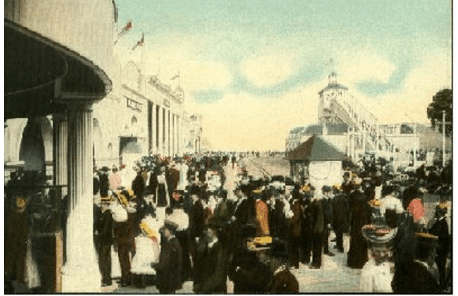
The newspaper record notes the attractions featured at Dominion Park. Some of them, like the roller-coaster, water slide and Fun House or “House of Nonsense” are familiar to Boomers.
There was also the Bump the Bumps, (bumper cars?) the trained wild animal show, the ‘Frisco Earthquake (just one year after the real thing happened) as well as a merry-go-round.
Some exhibits were frankly bizarre: the booth where young men could break crockery for a price (and get back at their mothers and wives, I imagine) as well as the Infant Incubator Exhibit where preemies were cared for by competent nurses in full view of the festive crowd.(Shades of the Dionne Quintuplets fiasco to come.)
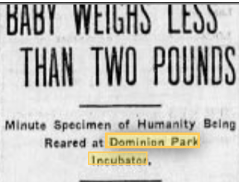
There were travelling side shows, of course, many of which were colourfully ‘ethnic’ that would be considered in poor taste -even racist – today.
There were also vaudeville acts and circus acrobats as well as fancy sit-down concerts, stealing the mojo of another, more refined, Montreal entertainment venue, Sohmer Park.
Dominion Park, like Coney Island, was a place where all entertainment options came together.
Judging from those Valentine and Sons postcards, Dominion Park was a place young men brought their ladies, whether courting or married, all of these men wearing their epoque signature straw boater hats (the kind we see in Renoir paintings) the women, in the 1910 era, in their puffy white dresses.
Herbert, a ladies man, discretely does not mention with whom he went. I doubt his sisters, young unmarried Edith, Marion and Flo, could go without an escort of some kind.
But in 1912, Marion Nicholson had someone to escort her to Dominion Park: her new beau Hugh Blair.
Her sister Edith writes her mother who is visiting Marion in Mile End: “Don’t let the villains, Marion and “Romeo” (Hugh) take you to Dominion Park.”
It’s true that Edith enjoyed ‘high-brow’ activities more than her younger sister Marion, but she liked to have fun as much as anyone, so I assume she is joking.
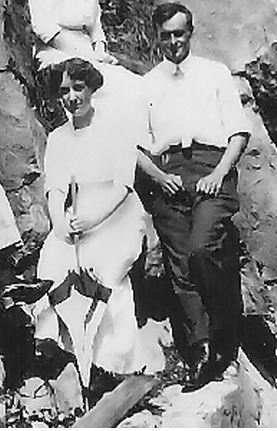
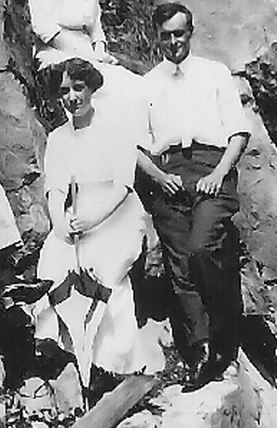
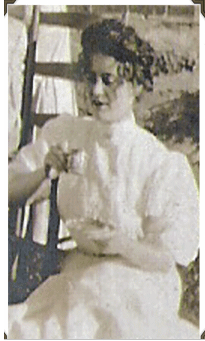
When I first saw the picture at top, I thought the woman looking into the camera might be Marion. She is wearing exactly the same white dress she wears in many pictures.
Here’s a blow up of Marion taking tea on the lawn of her home in Richmond, Quebec 1912.
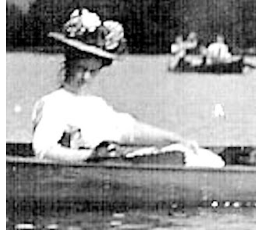
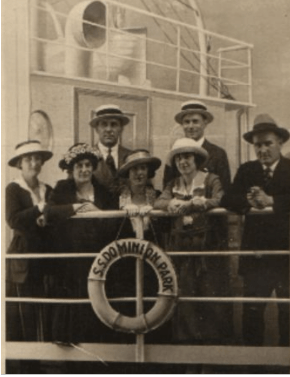
I have positive proof that Marion Nicholson visited Dominion Park around 1920 with Hugh Blair, now her husband, and both her sisters, Edith and Flora, as well as her brother Herb who was making a rare visit home from out West. It comes in the form of a novelty postcard.
From news reports I can glean that Dominion Park struggled through the Depression and closed without fanfare after the season in 1938.
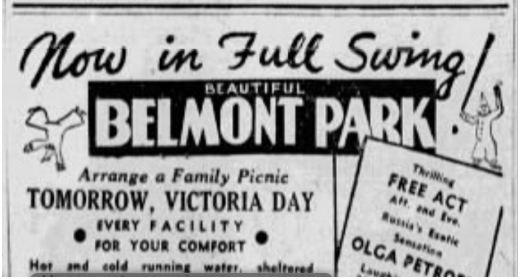
Here’s likely the reason why: 1938 was the first year of BELMONT PARK located in Cartierville. Belmont Park was a rickety place when I went there as a kid in the early 1960’s and was, in its turn, usurped by La Ronde at Expo 67, a bigger, brighter and more expensive amusement park.
1.In 1906, entertainment in the big cities ranged from vaudeville and circuses to high-end theatre with 100’s of small venues, especially along Ste Catherine East, showing “flickers” on the wall during the day, and featuring live acts at night. In Montreal, there was only one large venue devoted entirely to motion pictures, the 500 seat Ouimetoscope. By 1910 there were scores of small entertainment venues lining Ste Catherine, most places offering a mixed bag of live shows and flickers and sometimes ice cream. A May 26, 1906 Gazette newspaper reveals entertainment options: A Kipling play with a well known actor at his Majesty’s Theatre; the Georgia Minstrels at the Academy of Music; The Holy City, a religious drama at Le Francais; The London Gaeity Girls at the Royal; ‘improved’ music and lotsa vaudeville at Sohmer Park: Miller’s elephants and other midway attractions at Riverside Park (a small amusement park also on Notre Dame Steet that would close in 1906.) Also Dominion Park opening June 2 with the Duss Band. Something for everyone – especially for the young people from rural areas flocking to the city to find work.Most of these wonderful entertainment options (excluding theatre plays) were considered out-of-bounds for respectable middle class women, especially if unattended.
Herbert’s sister, Marion, was also living in the city, having just graduated from McGill Normal (teaching) School and taken a job at Royal Arthur Elementary School in Little Burgundy. The year previous, she had boarded at the YWCA on Dorchester, a cold, leaky place with “too many rules.” Her words.
The city elite, including the Refords, the Birks’, and Julia Parker Drummonds, were planning a woman’s hotel where ‘respectable’ women from out of town would stay – and where bible readings would be their main nighttime recreation.
Still, Marion went to many a theatre play with her sisters and to Vaudeville shows with her beaus. After 1914, movies became more respectable for the middle class because that is where you could get your war news.
One movie house, the Royal, advertised itself as a safe venue for women.
2. There were two fires at Dominion, 1913 and a fatal one in 1919. Journalist Edgar Andrew Collard, known for his Montreal history column in the Gazette newspaper, was saved from the conflagration by his father, according to a very personal story he wrote in 1977.
When the fire broke out, They were riding the Mystic Rill, a ‘water-maze’ boat ride through a tunnel lined with flammable material designed to look like rock. His father saw a high window and managed to push his son through it.
”Only magnificent strength could have accomplished what he did: he not only had to keep a grip on the window but he had with his legs and feet to keep the boat from being carried away by the current.”.
Even way back in 1977, the Park was all but forgotten: “Only a few older people remember Dominion Park,” wrote Collard in this same article.
https://www.youtube.com/watch?v=JAFkxSVlSCk Coney Island 1918 Americans at Play