Tag Archives: Richmond Quebec

From Daguerreotype to Digital in Four Generations

Sarah Maclean Macleod : Daguerrotype or Tintype

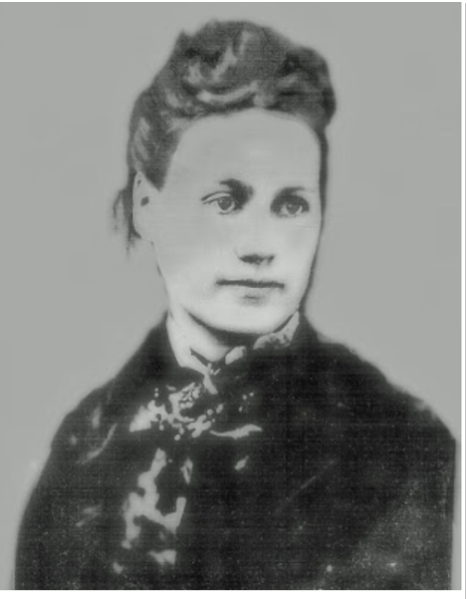
The above picture is a digital reproduction of a tintype or daguerreotype portrait of Sarah Marion McLean, my husband’s great great grandmother, taken (most probably) around the time of her marriage in 1849 in Flodden, Quebec. I scanned the metal photograph to computer over 10 years ago.

The pic above is composite montage of Sarah’s 4 times great granddaughter, Nora, my granddaughter born 2018, stored on my cellphone. The collage consists of photos snapped from the moment of her birth until her 1st birthday. These pics are but a fraction of the pictures existing of Mademoiselle Nora, now 4 years old, on various cellphones belonging to family.

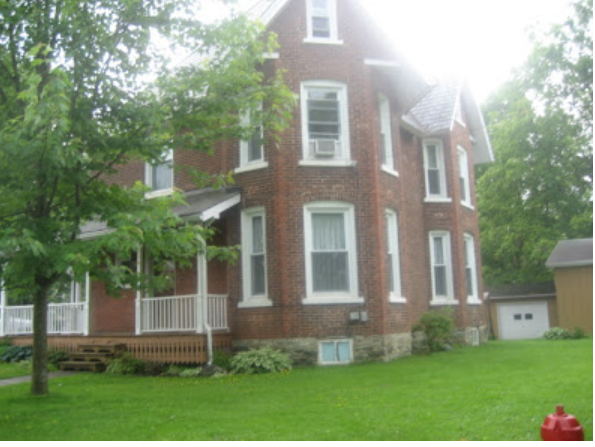
I have in my possession only two other photos of Nora’s 4x great granny, Sarah, one where she stands beside her seated husband (Isle of Lewisman John Mcleod ) looking very pregnant. Another cardboard studio photo of her is from her final year. At the back of the photograph someone wrote in her name and dates. Sarah Marion McLean McLeod 1825-1912. She may actually be dead in the photo.

Unfortunately, I have misplaced the metallic originals, so I can’t test whether they are daguerreotypes or tintypes. (Tintypes are slightly magnetic.) They must be in a box somewhere in the garage with the other ‘important’ family photos I am missing. I mean, it has to be, right? I would never have thrown out such precious mementos.

The Macleods emigrated to Quebec in 1838, before so many others in their clan were pushed out in the infamous ‘clearances.’ Sarah Maclean from Coll arrived in Quebec a little later, after her parents and two brothers died back home. She had a sister in the province. Sarah, who was born at the height of the Industrial Revolution, led a long life in southern Quebec before passing away just as the motor car was making life in the Eastern Townships much more exciting. Too bad. Apparently, she loved to travel about.

Sarah is oft mentioned in family letters I have on hand from the 1908-1913 period. The family is feuding over her care in old age. Apparently, she speaks only ‘the Gaelic.’

A few years ago, I digitally enhanced her portrait. There was a white ‘hole’ in her forehead. I scanned the dag/tintype into the computer (afraid that any residue from harsh chemicals on the photo might be harmful to me) and filled in the hole using Photoshop.
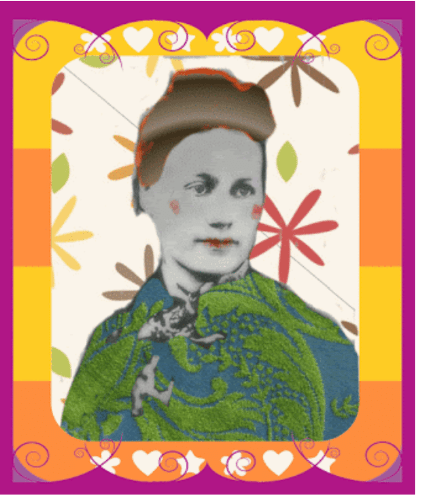
Later on I embellished the photo of this Scottish ancestor whose face has passed down through the generations.

So, in the almost 200 years between the births of Sarah and Nora, the photographic world has gone from solid metal daguerreotype to a multiverse of ephemeral digital media – with the act of taking photographs becoming progressively easier.

Photographers in the Victorian Age were well-heeled trailblazers and techno-enthusiasts in possession of a great deal of very expensive -and very cumbersome – equipment. Today taking pictures is, no, exaggeration, mere child’s play. Nora is already pretty adept with a cellphone. I imagine in a very few years she’ll be taking candid photos of me as I crawl out of bed and creating instant animations with my dishevelled image and posting them online. Well, she already is.

Nora is already taking candid photos of her grandmother.

Sarah Marion McLean McLeod saw great advances in photography within her very own lifetime.

Although I have only three photographs of Sarah, I have many more of her daughter, Margaret McLeod Nicholson, my husband’s great grandmother 1853-1942 , perhaps 15 in total, and even more, around 75, of her granddaughter Marion Nicholson Blair, my husband’s grandmother, 1887-1947.
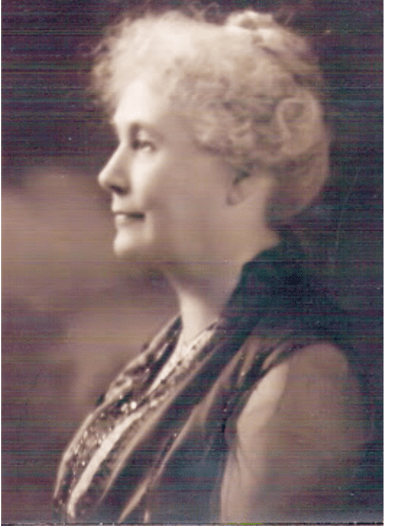
Margaret Macleod Nicholson, Sarah’s daughter. 1912. “I have the new pictures. I do not think they make me very good-looking.” (Letter)
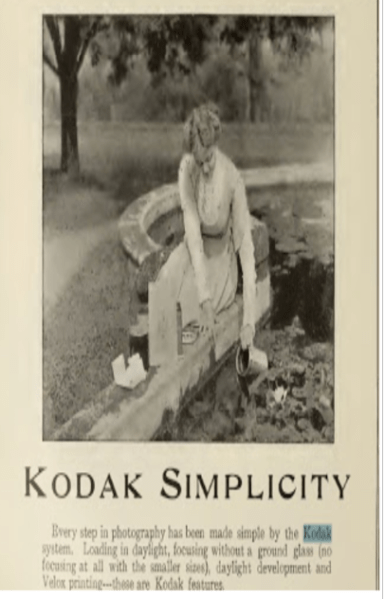
Advert for Kodak, aimed at women, without the technical jargon in camera ads aimed at men.
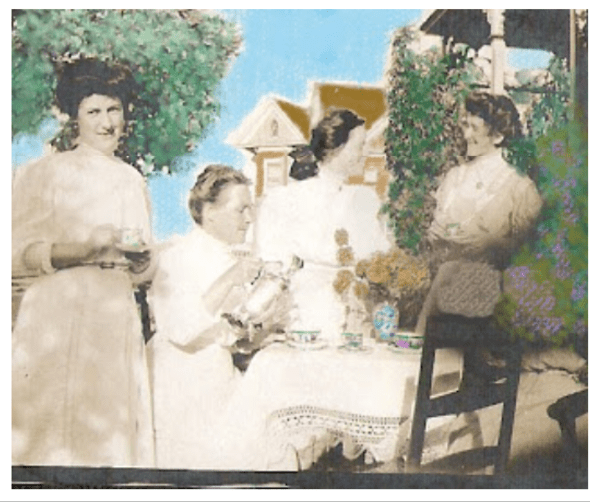
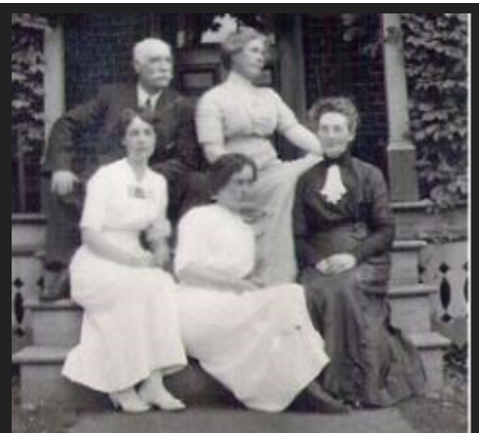
Photo of Margaret, her daughters Edith and Flo and a neighbour taking tea on the lawn circa 1912. Colourized by me. Taken by Marion as she is in another pic from the same day.

According to her 1906 diary, Marion Nicholson (my husband’s grandmother) who was a teacher liked ‘to fool around taking Kodaks’ during her summer vacations. The Nicholson likely purchased their camera at Sutherland’s drug store in their home town of Richmond.
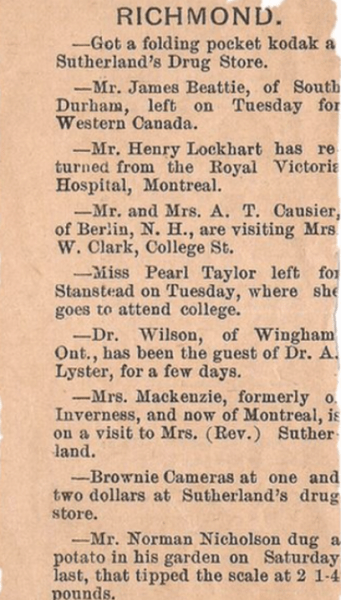
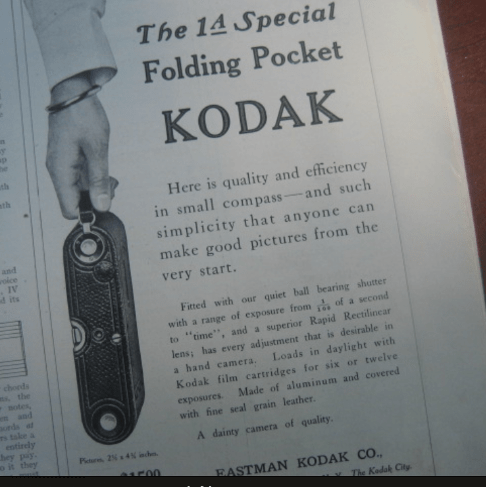
This was clipped because of the final potato entry, I imagine.
1910 Ad from the Delineator Women’s Magazine.
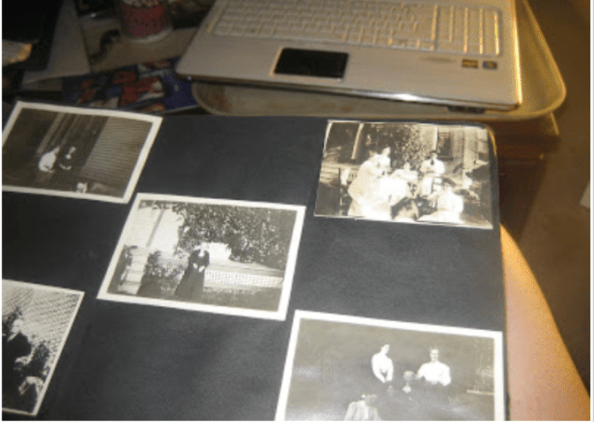
The Nicholson family photo album with the ‘tea on the lawn’ in upper right corner with Marion on the ground in her white dress. The album is full of pics of unnamed people,too. Alas!
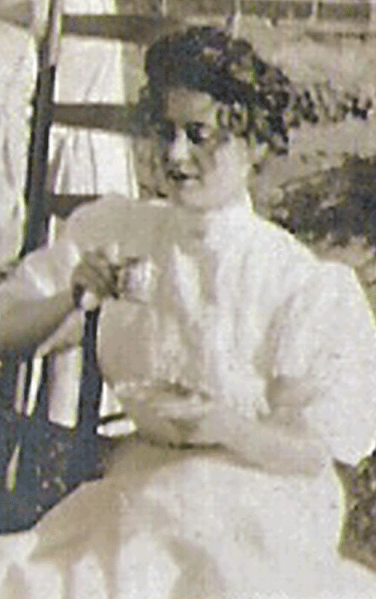
Marion, detail from pic above.
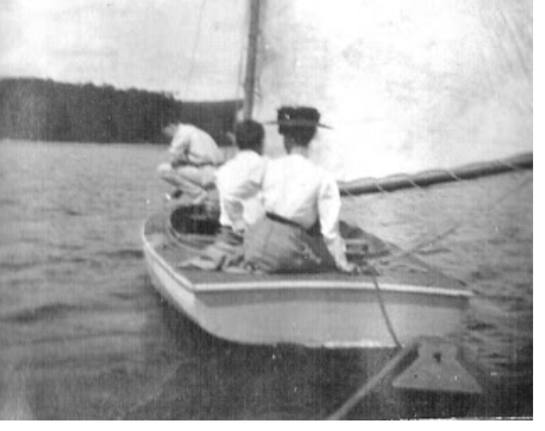
My fave photo from album: Sailing in Hudson, Quebec.
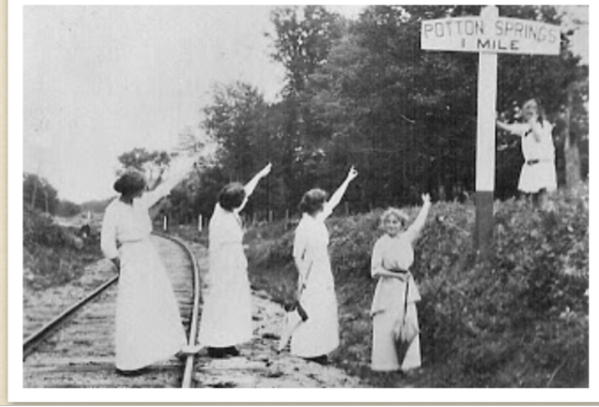
Trip to Potton Springs. I love this pic. It looks like a still from an old movie. Where’s Lillian Gish?
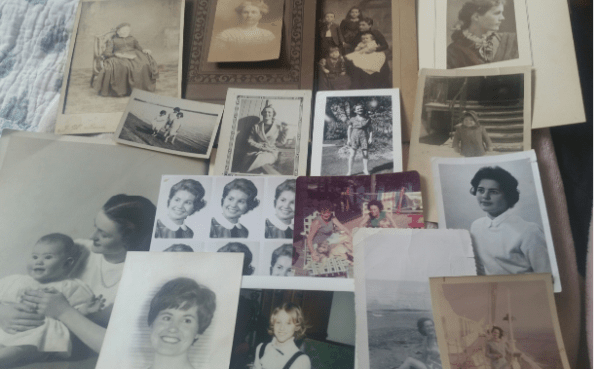
Collage of Sarah’s female descendants up until the 1970s. That’s the ‘death’ photo of Sarah top left.

And the family photographs just keep on coming throughout the 20th century. There was that first decade, the era of shirtwaists and silly-looking BIG hats; then the roaring twenties with Sarah’s descendants in home-made flapper dresses sporting crude bobs; then the 30s with the Nicholson women wearing tonnes of movie star makeup to emulate their favourite big screen thespians; then the 40’s with the women in suits with big shoulders or, yes, even military garb; the 50’s ladies in A-line floral sun dresses sporting wing-tipped sunglasses; the 60’s gals reclining in frilly one piece bathing suits at the cottage, all puffing on cigarettes.

Nora will likely have thousands and thousands of photos taken of her in her lifetime. Still, I wonder, will any of these photographs be accessible to HER four times great granddaughter? Or will they have vanished over the years into the Cloud? I have already lost many many valued pics and videos when my ‘ancient” Note 2 suddenly expired.

Should I, as the family genealogist, be printing out all of the best photos on glossy paper with a colour printer with permanent ink, putting them into a giant album – a real album – for these future generations? (Always making sure to put names and birth dates to the pictures.)

(This would be an extremely costly proposition considering the price of colour ink.)

Or, do I merely create an enormous virtual album and put it on a key and into the safety deposit box and hope against hope that it won’t be casually tossed out one day – and that the info on the key will remain accessible?

Maybe all that will be left of the bazillions of photos of Nora, my granddaughter, will be on novelty items like coffee cups and calendars given to me each Christmas.

Or perhaps her image will exist only on this blog post, ready to be extracted from the ether in 2300 by some self-styled cyber-archaeologist.

I’m no fortune teller but I can hazard a good guess…but, first, I have to find that box of precious old photos down in the garage.
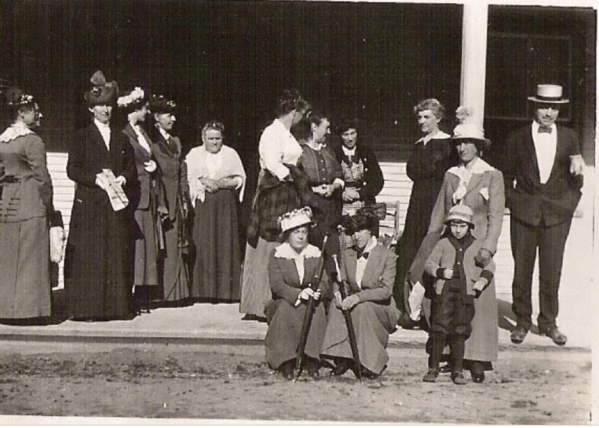
Possibly my favorite pic from the Nicholson collection. Waiting for the bus in Richmond, circa 1908. Edith Nicholson standing at front with young cousin Stanley Hill in front of her. Flora seated at left. Could be a scene from the Music Man. What is that decoration on Edith’s hat?

Years ago I wrote an essay for the Globe and Mail on the same topic. It was very well received and often reprinted. Gone with the WIndows.
An Ordinary Man

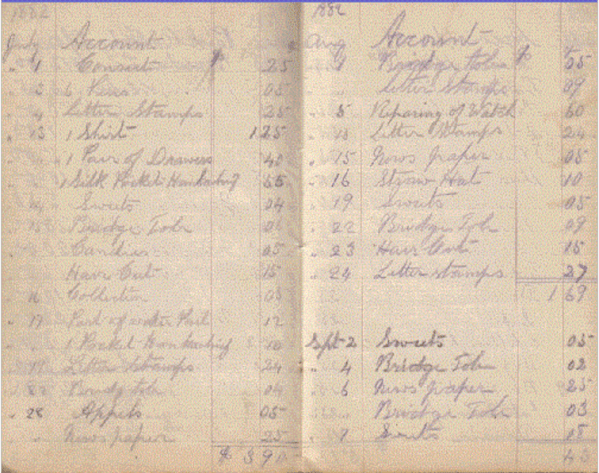
1882 store book page as a single man.

“When the courting at midnight has ended

And he stands with his hat in his fist

And she lovingly lingers beside him,

To wish him ta-ta and be kissed,

How busy his thoughts of the future,

You betchya his thoughts he don’t speak,

He is wondering how they can manage,

To live on six dollars a week.”

(little poem etched in pencil in one of Norman’s early ‘store books’)

Norman Nicholson, my husband’s great grandfather liked to keep track of things: Indeed, that was his one extraordinary trait. He kept track of his every expense, business or household, over five decades (right down to 5 cents tossed to a tramp). He kept balances, inventories, invoices and lists from 1881 when he left home to live on his own to 1921 at this death at home in Richmond, Quebec.

He kept all this information in dozens of ledgers, diaries and notebooks and he kept these booklets neatly arranged in a trunk under the window in his daughter’s room. ( I know because it said so in one of the many letters he kept, which the daughter in her turn kept, and which eventually fell into my hands as the wife of his great grandson.)

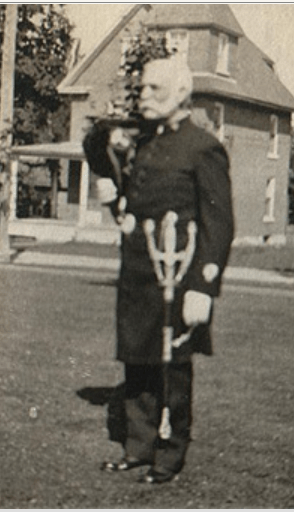
Norman in Masonic Regalia circa 1905

That’s how history-challenged I came to have a real appreciation for the life of a 1st generation Canadian living in the Eastern Townships of Quebec at the turn of the 20th century, that is Norman Nicholson, son of Malcolm Nicolson, he who came to this country in 1841 at age 26 with his parents and 8 siblings after being cleared from the family farm on the nearly treeless Isle of Lewis, Hebrides; who walked from Port St Francis to Flodden and settled on crown land, earning money by burning wood for potash and clearing trails through the forest.

That’s how I’ve come to understand that my husband’s great grandfather, Canadian-born, Canadian schooled Norman Nicholson, successful hemlock bark dealer, turkey salesman, bill collector for a local doctor, Town Public Works Clerk, Inspector for the Transcontinental Railway and The Quebec Streams Commission (I have all the documentation) was a work-a-day sort, devoted husband to the spirited feminist-minded Margaret McLeod, (also a Lewis descendant) doting father to three feisty and ambitious daughters Edith, Marion, Flora and one lost soul of a son, Herb.

He was the kind of ordinary man who lives a full life, with all its joys and sorrows and broken dreams, and dies, the memory of him quickly fading to black until, one day, (with any luck at all) a glimmer, as a great great grandson, flipping through the brittle pages of a photo album, points to one particular picture and asks. “Who’s this ‘sick-looking’ dude with the white moustache and beard?” And the boy’s middle aged father answers: “Oh, that’s Norman Nicholson, your great great grandfather, or at least, I think it is.”

“Was he a general or something, too?” the boy asks referring to the man’s mason uniform – because the boy is related to General Douglas MacArthur on another branch of his family tree.

“No, Norman Nicholson was just an ordinary man.”

Cost of setting up house 1883. 45 dollars for furniture

Now, after scanning the ledgers and reading all his diaries, that I can confirm: ordinary, in every possible way. Not a hero like Alexander Mackenzie, the Lewis born explorer, for whom a great Canadian river is named, although Norman did have a thing for bodies of water. From his 1912 diary: List of Rivers East of Cochrane, Abitibi River, Sucker Creek, Mistango River, Low Bush Creek

Not a villain like Lewis descendant Donald Morrison, the Megantic Outlaw, subject of Canada’s largest ever manhunt and at least two books and one documentary, although Norman did have a part in the man’s post capture defense.

From an 1889 press clipping: Let it be hereby resolved that Norman Nicholson be appointed by the Richmond Royal Caledonia Society to press the authorities for an interview with Donald Morrison.

Neither famous, nor infamous, neither scoundrel nor saint; ergo NOT the kind of man whose exploits are chronicled for future generations in plodding high school history texts or low budget straight to cable documentaries; just a loyal husband, protective father, dutiful citizen. An ordinary man, the kind of man who reaches a point in life where he feels the need to lay down the law to his kids: November 14, 1902 Future Regulations: All must be up and downstairs by 7:30 o’ clock in the morning, Sunday included, breakfast at 7:30. The kind of man who, lonely on the job in middle age, writes love letters to his wife: “I don’t want a concrete hall or a little birch canoe; just want a place with you by the fireside.”

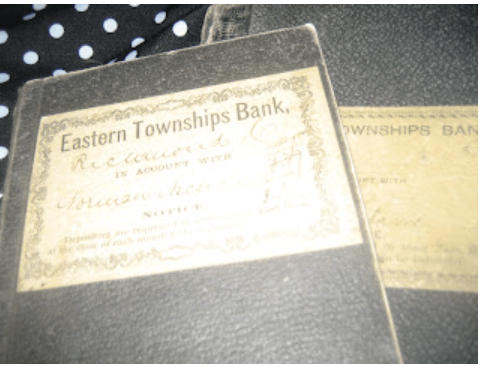
Very very ordinary. No, not the stuff of history books or even good caricature, although it would be easy to characterize Norman as the quintessential penny pinching Scot (someone who believes his bank book to be the best kind of reading) but that characterization would be totally unfair.

Norman Nicholson may have been a practical man:

Price of ash for 1899: 8 cents for 12 inch;10 cents for 13 inch; 12 cents for 14 inch.

1913 Trip to Boston to see Grand Lodge: ticket to Montreal, 2.55, street car 05, ticket to Newport, 3.25. Dinner on train .60

with a petty side:

number of times Dr. Kellock was away from his congregation in year 1897: 24 January in Boston; 21 March in Spencerville; 24 October in Toronto;

October 18, 1899. Date McMorine had his water cut off in his store by M. McDonald tinsmith.

But he also was a romantic:

Nothing to do Margaret, Dar..ling, nothing to do. Let’s take a trip on memory’s ship back to the by gone days. Let’s sail to the old village, anchor outside the school door. Look in and see, that’s you and me, a couple of kids once more.

See? An ordinary man of conflicting passions, just like you and me, the kind of man who has but one chance to have something flattering written about him and that’s at the end of his life:

From the Richmond Guardian June, 1922:

The death occurred suddenly last Friday morning in Montreal of Mr. Norman Nicholson, one of the most respected citizens of this place…

And then that’s it, finito, no more, except, perhaps, for an epitaph on a tombstone in a far-flung country cemetery no one ever visits.

RIP Norman Nicholson, my husband’s great grandfather. An oh-so ordinary man, except for this one extraordinary trait, this compulsion to keep track of things, to leave a paper trail for posterity – if mostly in list form.

END

LIST Cost of LIving 1900 Richmond Quebec.

1900 accounts, family of six, children in teens. Wife Margaret got a hefty allowance with her purchases going unnoted, but I see no mention of material or sewing notions in the list and Margaret sewed her daughter’s clothes for the most part. In 1900 the Nicholsons were comfortably middle class with a fine house, but their fortunes would soon fail with the end of the hemlock bark industry.

January

1/3 of a beef, 106 pounds 6.35

Skating rink 10

6 lbs pork 25

2 beef tongues 20

Marion for Rink 10

Postage 12

79 lbs pork from Bromfield 4.35

Sunday School 04

Church plate 05

Scribbler for Flora 05

1 lb sulphur 05

Hairdressing 15

Membership Board of Trade 1.00

Treat of cigars 25

Fare to Sherbrooke and return 1.35

Copy book Flora 08

Scribbler Edith 05

Marion skating rink 10

½ lb Black tea 18

Sunday school 04

1 Ladies Jacket 8.50

1 pair gent’s overshoes 2.00

¼ lb candies 05

1 lb frosting sugar 08

1 lb baking soda 04

¼ lb peppermint 05

Sunday School 04

Church concert 60

Postage 20

1 paper of pins 05

I pocket handkerchief 08

Herbert 05

Postage 25

1 jar molasses 14

Mending Marion’s boots 25

February

Sunday School 04

Bridge toll 02

¼ pound candies 05

Times for one year 1.00

Maggie 25

½ pound Black tea 18

Marion for rink 10

Sunday School 03

¼ lbs cream of tartar 09

1 lbs currants 10

1 bottle Powell’s medicine 25

Maggie 50

W. Daigle for hauling bark 15

1 writing pad 15

1 pair rubbers Edith 45

1 pair rubbers Marion 45

1 loaf break 05

1 lb crackers 08

1 pint oysters 20

Cough candies 02

Scribbler for Marion 05

Postage 02

Maggie 50

1 loaf bread 05

1 bag fine salt 10

Sunday school 02

Church Collection 10

100 lbs salt 05

1 whisk 15

1 loaf bread 06

¾ pounds walnuts 10

Maggie for Church 2.10

1 lamp chimney 07

1 bottle M. Liniment 25

Maggie 06

½ black tea

1 pair laces 04

4 gallons coal oil 75

10 lbs corn meal 15

10 lbs Graham flour 25

5 gallons Coal Oil 95

1 hockey stick 30

Herbert for Dictionary 15

Maggie 10

½ loaf bread 06

1 lbs ginger snaps 10

¼ pound Ceylon Pepper 10

Postage 06

Flora and Marion 05

1 package Corn Starch 09

¼ lbs cream of tarter

Hair dressing 15

Marion for rink 10

March

1 jar molasses 12

1 doz eggs 20

Maggie 10

Chinaman for laundry 14

Sunday School 04

Patriotic Fund for Hockey 60

1 pair rubbers Herbert 60

Maggie 40

Marion and Flora 10

Sutherland for Miss Wilson 1.00

Postage 20

Mending tins 05

Missionary meeting 05

Skating rink 05

Maggie 25

¼ pounds cream of tartar 10

Sunday School 03

Maggie for concert 10

1 cake shaving soap 07

1 lbs soda 04

½ lbs Black tea

¼ lbs cream of tartar 09

1 bottle vanilla 10

5 pounds sugar 25

Maggie 25

5 lbs butter McKee 1.00

Marion 05

Herbert for Sharpening skates 05

Maggie 1.00

5 lbs G Flour 10

6 ½ lbs butter 1.45

Mending Herbert’s boots 25

1 loaf bread 10

Cough candies 05

1 quart milk 05

Skating rink 20

Maggie 22

9 ½ lbs butter 2.00

Flora 05

1 bags fine salt 10

Maggie 50

1 bag flour 2.25

49 pounds oats 49

5 lbs sugar 25

Sunday School 04

½ lbs Black tea

Postage 10

Postal notes 05

Subscription to Herald `1.50

Subscription to Westminster

Pady Jim 25

12 ¾ cords wood 35.25

I scrubbing brush 10

April

5 lbs sugar 25

Maggie 10

1 pair of rubbers Flora 35

Sunday School 04

½ gal Coal oil 10

1 bottle ammonia 05

1 lamp burner 10

1 doz herrings 25

20 lbs Graham Flour 50

1 bag rolled oats 25

5 Gal Coal Oil 95

20 pounds corn meal 30

Flora 05

Small writing pad 05

1 box crackers 25

½ pound candies 10

Scrubbing floor 25

Herbert for sugar 10

Maggie 20

Hair dressing 15

1 jar molasses 15

½ lbs Black tea 18

2 lbs tapioca 10

Postage 27

Sunday School 07

Herbert for Birthday 25

Maggie 10

1 Gallon syrup 65

3 lbs sugar maple 24

3 pairs shoe laces 08

2 pair stockings 60

5 lbs sugar 25

Sugar scale 40

Maggie 2.60

1 pair rubbers 60

Maggie 35

To Sunday School 03

2 dozen eggs 30

1 package popcorn 05

F Lyster for milk 95

Fir dressing Herbert 15

5 lbs sugar 25

Maggie 1.00

Hauling manure 20

Postage 10

Sunday School 03

Bill of goods bought by Dan 32

1 box crackers 25

1 spool thread 10

1 can corn beef? 25

3 ¾ lbs steak 47

Sunday school 04

Candies 04

May

5 lbs sugar 25

½ lbs Black tea 18

¼ pounds ginger 09

1 bag potatoes 45

¼ ream bill paper 05

Daigle for manuring 40

Edith 50

Herbert suit of clothes 4.00

Spading garden 1.00

Mending M and F. Shoes 70

Garden seeds 40

2 pairs shoes Edith and Marion 3.00

1 necktie for funeral 25

Maggie 25

Seeds got by Dr. Cleveland 50

1 package envelopes 07

Post office box 1.00

Sunday School 03

2 scribblers 10

1 bag oatmeal 1.90

1 lb flour 4.50

Mending boots 1.25

Pass Book 10

Postage 09

10 lbs graham flour 30

¼ lbs cream of tartar 25

2 lbs steak 25

3 ½ pounds S. Ham 25

Military dinner 75

3 gallons Maple Syrup 1.95

Keeping Up with the Montgomerys

autoshow

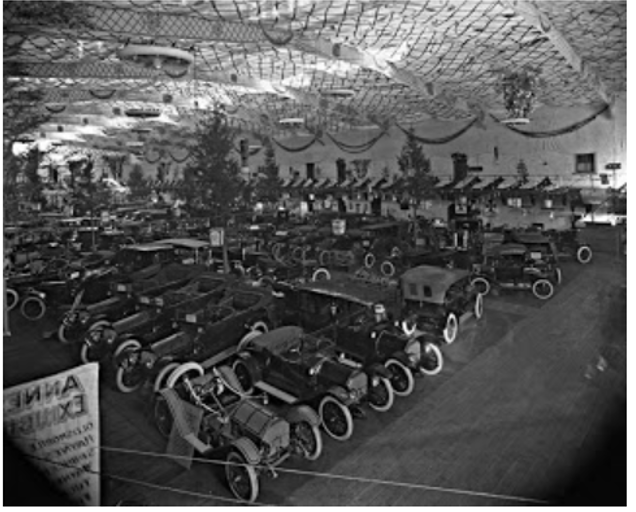
Montreal Auto Show. 1914. McCord Museum photograph

Roads trips. They have been a staple of life in North America for over one hundred years and it all began around 1910 in American and Canadian towns.

In big cities like New York or Montreal there was little need for an automobile, what with the streetcars and subways. As silent film footage from the era shows, the city roads were preposterously chaotic.

But, in the  towns during the warmer months, anyway, an auto was both useful to get around and quite the status symbol for the well-off professional man.

Case in point: Dufferin Street in Richmond, Quebec, a leafy stretch lined with red-brick homes in the Queen Anne Revival style.(1)

In 1910, the Skinners, the Nicholsons and the Montgomerys are neighbours on the north side of Dufferin.

Floyd  Skinner, a dentist, buys his first auto in 1909. So does Nathan Montgomery, a man in his forties who is already retired. (2)

Margaret Nicholson, my husband’s great grandmother, living in the pretty house called “Tighsolas” between them, doesn’t think much of these extravagant testosterone-fueled impulse purchases. She writes this in a letter to her husband, Norman, who is away in Northern Ontario working on the railroad:

“Mr. Montgomery is going to buy an automobile. He is getting rid of his horse. Don’t you think he’s foolish?  I would not want one. They are too dangerous.” (3)

TheNicholsos

Norman and Margaret Nicholson, daughters Edith and Marion and Aunt Christine Watters.

 The Nicholsons, you see, never, ever, get to own an automobile. In 1910, they are house-rich but cash poor. They cannot begin to afford a ‘motor’ because in 1910  autos can cost as much as a fine house, in the 2,000 to 4,000 dollar range. (4)

If Margaret Nicholson is very wary of the newfangled horseless carriage, her daughter, Marion, my husband’s grandmother, is not. In fact, she accompanies the Montgomerys on their 1909  auto-buying excursion in Montreal.  Marion, a teacher in the city, tells her mother about it in a letter but wrapped in a little white  lie. “I bumped into the Montgomerys on the street. He is buying an auto and she is in for a shirtwaist suit.”

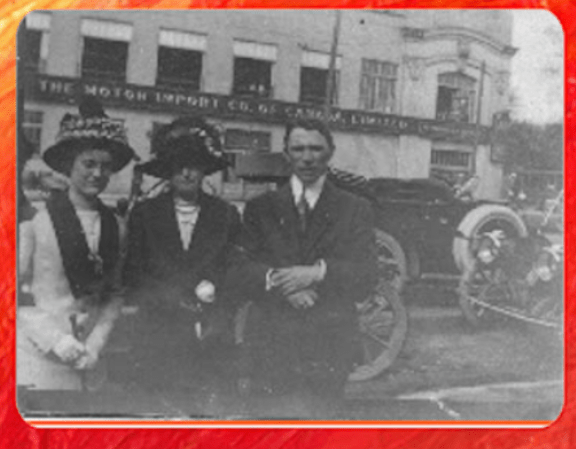
I suspect this is a lie because in the Nicholson family album there is a photograph of Marion and Mr. and Mrs. Montgomery posing in front of the Motor Import Company of Canada on Atwater and St. Catherine. Marion likely had planned to meet the Montgomerys all along.

MarionMON.PNG

Marion, left, caught in the act of accompanying her neighbours on an auto-buying excursion.

If Margaret felt autos were dangerous, her eldest daughter, Edith, also a teacher, clearly did not.  In the summer of 1911, Edith traveled all the way to Montreal by motor with the Skinners.  Here’s how Edith described her trip in a letter to her dad:

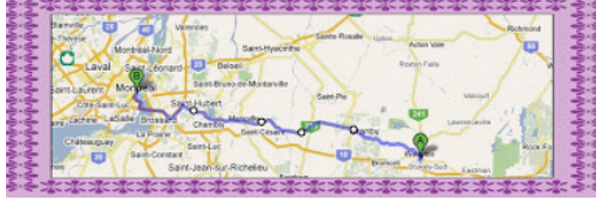
“As you will see by the address, I am in Montreal. I came in with Dr. and Mrs. Skinner in the motor Friday. Left home at 10 am and got to Waterloo at 12.30 had dinner. Saw all we could of the town and left at 2 for Montreal, got here at quarter past six. Without one break down. It was a beautiful day and we enjoyed every minute of it.

I will name the places we passed through so you will know the country we passed through. Melbourne, Flodden, Racine, Sawyerville, Warden, Waterloo, Granby, Abbotsford, St Caesar, Rougemont, Marieville, Chambly, Longueil, St. Lambert, Pointe St Charles.

Don’t you think I was a very fortunate girl to have such a trip?


Itineray

1911 itinerary.  6 ½ hours for 93 miles.  The speed limit in the city was 8 miles an hour and 15 miles an hour in the country.

 The Eastern Townships is a very hilly place so this pleasure trip must have been quite the  roller-coaster ride for Edith and possibly a bit hard on the, ahem, lower body, especially if Edith was wearing a tight corset under her ‘duster coat.’ (5)

In 1910, autos were considered toys. Motoring was considered a fad, a pastime. The preface to the special insert promoting the 1910 Westmount Horse Show in the Montreal Gazette claims, “The automobile will never replace the horse in Man’s affection.” (6)

So wrong.

Although it was wealthy males who kick-started the automobile revolution, it was women and teenagers who had the most to gain from it.  They were free at last to travel far and wide on their own.

freeatlast.PNG

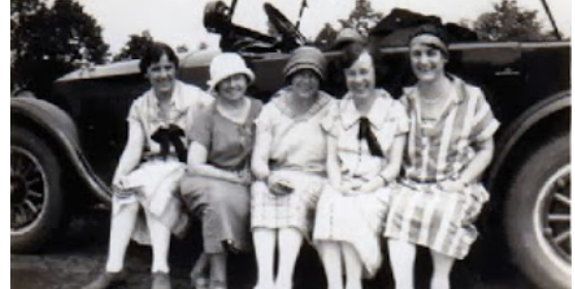
Free at Last! Margaret’s youngest daughter Flora and friends on an automobile ride in the country circa 1920.

So, here we have three houses on Dufferin Street in Richmond, Quebec – and already two automobiles.

Still, if you pay attention to her actions and not her words, it  is clear that Margaret Nicholson doesn’t really hate autos. Margaret often allows Mr. Skinner or Mr. Montgomery to take her to the mail to post letters to her husband.

 What she says to Norman in her letters is to soothe his prickly pride, that’s all.

To make things worse, just around the corner on posh College Street live Isabella and Clayton Hill, Margaret’s sister and brother-in-law. Clayton is a prosperous stone-mason and, much to Margaret’s chagrin, he owns an especially fine automobile.

Clayton'sauto

Magical Mystery Tour Car. Clayton’s Auto. A Pierce Arrow, perhaps. Very expensive at about 5,000 dollars.

Margaret is always feuding with Clayton and her sister mostly over the care of her elderly mother.

She remains bitter about her relations’ good fortune. In another letter to her husband she writes: “Clayton’s auto has broken down again. Isabel says the repairs are costing a fortune. Aren’t we lucky not to have one.”

Then, again, she accepts rides from her brother-in-law on occasion.

In 1910, there was no resisting the lure of the motorcar. The swanky male ‘toy’  was already proving to be indispensable even to its most vocal female critics.

Nichsolsonhomeafewdaysago

Tighsolas as it looks today.

  1. Richmond was a railway town, on the decline, between Portland, Maine and Montreal, Quebec. Queen Anne Revival style homes had irregular roofs, turrets, and lots of gingerbread moulding.
  2. On the 1911 Canada Census
  3. Nicholson Family Letters. Author’s collection.
  4. This was all changing with the Model-T Ford, and mass assembly. In 1910 Ford claimed his factory was putting out 1,000 autos a day. And he paid his people good salaries so they too could buy an auto. Soon, average middle class families could own a motorcar at around 400 to 600 dollars.
  5. Duster coats were long affairs meant to keep women’s clothes clean. Cars with an internal combustion engine were notoriously dirty.  Steam driven cars were dangerous and noisy. Electric cars, clean but slower-moving, were aimed at women in advertising, and, maybe, just for that reason, they did not catch on, at least until 100 years later.
  6. Magazine articles of the era were already pointing out that ‘the Billion Dollar Toy’ was creating significant waves in the economy, a sign that the auto wasn’t merely a toy but here to stay. By mid-century automobiles and automobile parts were the driver of the US economy.


The Mysterious Charlie G: An Edwardian Era Love Tragedy

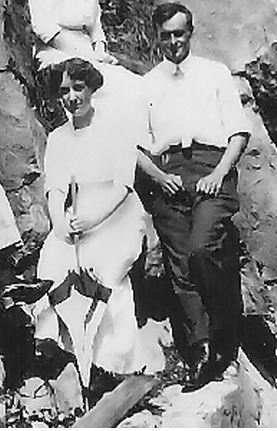
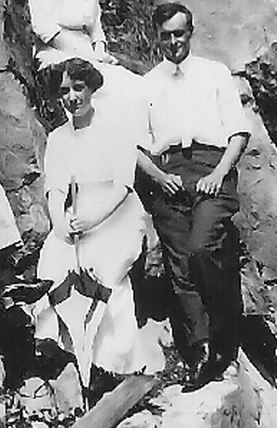
Edith and her beau circa 1909 somewhere near Potton Springs in the Eastern Townships of Quebec

Edith Nicholson (1884-1977), my husband’s Great Aunt Dede, never married. She told her nieces and nephews and great nieces and great nephews that she lost her Great Love in a hotel fire. The couple wasn’t ‘officially engaged’ but there was ‘an understanding’.

Some believed DeDe, some didn’t.

In 2004, I found 300 Nicholson family letters from the 1908-1913 period in an old trunk – and in a letter dated May 3, 1910, Edith writes of this loss to her mother, Margaret:

Your letter received this am. It was so good to hear your voice over the phone. It was quite natural. Oh, how I wish I could talk over everything with you. It seems terribly hard to think it all for the best, when there are so many that are of no use living on and others that are held in esteem cut off in a moment. One thing, I am very thankful for that he wrote me. No doubt one of the last things that he did. I can’t express my feelings. I never felt so badly in my life. But I suppose there are few who have had so pleasant a one as I have, and trouble comes to all.

So the story was true, after all!

Edith mentions many young men in her letters sent from Montreal where she was working as a teacher back to Richmond where her Mom lived. Edith often uses only initials when talking of her romantic life. Apparently, back then, courting was something to be coy about.

It took me long while to figure out but her Great Love was one Charlie Gagne, bank clerk, from Levis, Quebec. A French Canadian man, most likely. Now, that was a surprise.

It seems Edith and this Charlie had an on-again off-again relationship through 1908-1909.

Gagne is a French Canadian name but from the letters it is clear Charlie spent time around Edith’s group of Richmond Protestants. Perhaps he was a convert from Catholicism. In Montreal, Edith worked as a teacher at French Methodist Institute in Westmount, a school where Catholics, mostly French Canadians, were converted to “the Way.”

The Nicholson’s also left behind a photo album from the 1910 era. I have photographs of Edith on a country outing with a handsome young man. If this is Charlie of the May 3, 1910 letter, he is a slim, with a charming smile and a cocky attitude and he is a great dresser. Edith Nicholson would have accepted no less.

There are a few other mysterious mentions of Charlie, or Charlie G or CG in the 1909-10 letters.

In August 1909, Edith writes her Mom saying she managed to ‘show’ Charlie to her father at a train station, (it sounds like a set up) but her father was cool to her young man.

In September 1909, Edith’s mother Margaret writes her father Norman and says “Charlie has gone to Mexico. So that flirtation is over.”

In October 1909, Edith writes her Mom saying she hasn’t heard from Charlie G and that she has no intention of trying to contact him. “He could still be in Mexico, for all I know.”

In February, 1910, Edith writes that she is taking medicine, for ‘her heart has had a jolt’.

Then there’s NOTHING but that May 3 letter about Charlie’s death. Edith writes that she is looking at his picture in the Montreal Star and that “it does not do him justice.”

So I had bits and pieces of a sad love story, but I had to fill in the blanks. I couldn’t even be sure it was Charlie G. who died in the hotel fire.

One sentence in the May 3 missive was especially enigmatic. “It seems if it had only been an accident, it would be easier to understand.”

So, about 5 years ago, I skipped over to the McGill Library to check out the May 1910 Star.

Amidst the pages and pages of stories of Edward VII’s death, I found a story about a Cornwall fire, the Rossmore House Fire, where a Charlie Gagne, bank clerk from Levis, perished.   Proof at last.

Charlie had recently been transferred to the Cornwall branch from the Danville, Quebec branch, which is near Richmond, Edith’s home-base. (The February jolt!)

Only half of Charlie’s body was found at the scene and that was burned beyond recognition. There was only a tie pin to identify him.

The fire had started in a stairwell and, as a boarder who knew the hotel well, Charlie tried to use the stairway to escape the fire, as did a few other boarders, including an entire family.

Most hotel clients had been rescued by fireman at their hotel window, or had frantically jumped to safety.

There was no photograph with this Montreal Gazette newspaper article, though – so I was confused.

Then Google News archives came online and I saw that the Rossmore Fire happened on April 29!

I headed down to Concordia’s Webster Library to check out the January-April reel of the 1910 Montreal Star.

Sure enough, the Cornwall fire was front page news on April 29 as the Star was an afternoon paper.

The next day’s issue had a back of the newspaper follow up article on the fire with a photograph of Charlie Gagne, Levis-born bank teller at the Bank of Montreal.

The photo was of a sober-faced Charlie, but it was without a doubt the man of the family album.

At long last, mystery over.

Then, much later, on Ancestry.ca, I found Charlie’s name on the 1901 Census and his 1910 death certificate that claims he died accidentally in a fire. Charlie, the snappy dresser, was the son of a modiste, a widow, and he had a younger sister. And he was buried as a Roman Catholic!