Tag Archives: Montreal

Where did your ancestors live in Montreal?

I am often curious to find out where my ancestors lived at different times of their lives. For most of my 19th and 20th-century Montreal ancestors, this has been relatively easy using online maps and city directories, and I have used the same techniques to find ancestors in Philadelphia, Winnipeg, and other cities. And once I locate them, it is fun to look at the same addresses today using Google Street View.

In Montreal, the main directory has been published by Lovells since 1842, and these resources are searchable online on the Bibliothèque et Archives nationales du Québec (BAnQ) website. While the directories themselves are in English, this post should help you navigate that French-language provincial archives site.

Go to http://bibnum2.banq.qc.ca/bna/lovell/index.html and, on the left, click on explore. Then click on Montreal et sa banlieue (Montreal and its suburbs), then on serie principale (1842-1977) and choose the year you want to explore. You can search for either the name of the household head or for the street address. This directory often includes the occupation and/or employer of the household head.

Once you find your ancestor’s home address you can try to find it on a map of the city during the same time period. The page http://services.banq.qc.ca/sdx/cep/accueil.xsp will take you to the BAnQ’s collection of digitized cartes et plans, or maps and diagrams. You can search by lieu (place), by region of Quebec or Canada, or by title of the map, date, author or subject.

If you are looking for the easiest maps of Montreal to understand, go to the left hand side of that opening page and click on the bottom choice of Collections, Pour en savoir plus, “Sur les cartes de Montreal utiles à la recherché” (to learn more about easy-to-use maps of Montreal). This will take you to a list of useful maps of the city, such as Goad’s maps, which were created for insurance purposes and identify property owners.

Searching for property ownership documents is a whole other complicated story I’m not going to talk about here, except to say that these documents can be found — with a lot of effort. Go to https://www.mern.gouv.qc.ca/english/land/register/index.jsp, a site of the provincial department of Énergie et Ressources naturelles Québec, and follow the links to the Land Register of Quebec site.

First, though, you need to know the ward of the city your ancestors lived in, and the cadastral number of the property they owned, which is not the same thing as the street address. You may have to compare different maps of the same area over different time periods to nail this down, remembering that street names and numbers sometimes changed. Once you have a firm idea of your ancestor’s geographic location, the 1874 map titled Cadastral plans, City of Montreal (http://services.banq.qc.ca/sdx/cep/document.xsp?id=0000337579) can help you to identify the cadastral number.

Once you see the image of the map you want, you can click above it on the left to download it (télécharger l’image) or on the right for a full-screen view (image plein écran). Move the red rectangle in the small map at the upper right to navigate your way around the screen.

Good luck and have fun!


The German Presence in the Montreal Region

The first German-speaking families probably came to Montreal around 1700. While this community has never been large, it has been well-organized: the German Society of Montreal was set up in 1835 and St. John’s Lutheran Church was established in 1853. Many families of German origin attended Protestant and Catholic churches along with their English, Scottish and French Canadian neighbours. This compilation lists many of the city’s churches and the repositories where their birth, marriage and burial records are kept.

German Presence in Montreal Feb 1

The Mysterious Charlie G: An Edwardian Era Love Tragedy

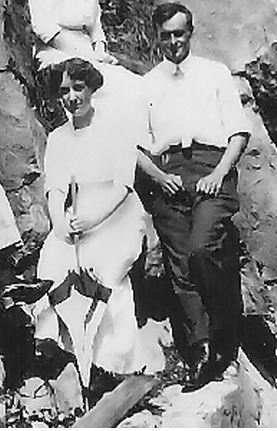
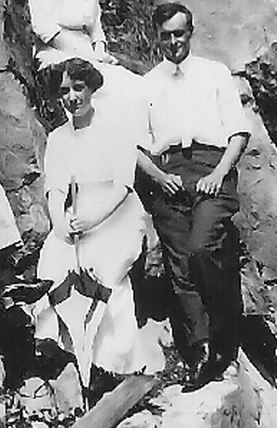
Edith and her beau circa 1909 somewhere near Potton Springs in the Eastern Townships of Quebec

Edith Nicholson (1884-1977), my husband’s Great Aunt Dede, never married. She told her nieces and nephews and great nieces and great nephews that she lost her Great Love in a hotel fire. The couple wasn’t ‘officially engaged’ but there was ‘an understanding’.

Some believed DeDe, some didn’t.

In 2004, I found 300 Nicholson family letters from the 1908-1913 period in an old trunk – and in a letter dated May 3, 1910, Edith writes of this loss to her mother, Margaret:

Your letter received this am. It was so good to hear your voice over the phone. It was quite natural. Oh, how I wish I could talk over everything with you. It seems terribly hard to think it all for the best, when there are so many that are of no use living on and others that are held in esteem cut off in a moment. One thing, I am very thankful for that he wrote me. No doubt one of the last things that he did. I can’t express my feelings. I never felt so badly in my life. But I suppose there are few who have had so pleasant a one as I have, and trouble comes to all.

So the story was true, after all!

Edith mentions many young men in her letters sent from Montreal where she was working as a teacher back to Richmond where her Mom lived. Edith often uses only initials when talking of her romantic life. Apparently, back then, courting was something to be coy about.

It took me long while to figure out but her Great Love was one Charlie Gagne, bank clerk, from Levis, Quebec. A French Canadian man, most likely. Now, that was a surprise.

It seems Edith and this Charlie had an on-again off-again relationship through 1908-1909.

Gagne is a French Canadian name but from the letters it is clear Charlie spent time around Edith’s group of Richmond Protestants. Perhaps he was a convert from Catholicism. In Montreal, Edith worked as a teacher at French Methodist Institute in Westmount, a school where Catholics, mostly French Canadians, were converted to “the Way.”

The Nicholson’s also left behind a photo album from the 1910 era. I have photographs of Edith on a country outing with a handsome young man. If this is Charlie of the May 3, 1910 letter, he is a slim, with a charming smile and a cocky attitude and he is a great dresser. Edith Nicholson would have accepted no less.

There are a few other mysterious mentions of Charlie, or Charlie G or CG in the 1909-10 letters.

In August 1909, Edith writes her Mom saying she managed to ‘show’ Charlie to her father at a train station, (it sounds like a set up) but her father was cool to her young man.

In September 1909, Edith’s mother Margaret writes her father Norman and says “Charlie has gone to Mexico. So that flirtation is over.”

In October 1909, Edith writes her Mom saying she hasn’t heard from Charlie G and that she has no intention of trying to contact him. “He could still be in Mexico, for all I know.”

In February, 1910, Edith writes that she is taking medicine, for ‘her heart has had a jolt’.

Then there’s NOTHING but that May 3 letter about Charlie’s death. Edith writes that she is looking at his picture in the Montreal Star and that “it does not do him justice.”

So I had bits and pieces of a sad love story, but I had to fill in the blanks. I couldn’t even be sure it was Charlie G. who died in the hotel fire.

One sentence in the May 3 missive was especially enigmatic. “It seems if it had only been an accident, it would be easier to understand.”

So, about 5 years ago, I skipped over to the McGill Library to check out the May 1910 Star.

Amidst the pages and pages of stories of Edward VII’s death, I found a story about a Cornwall fire, the Rossmore House Fire, where a Charlie Gagne, bank clerk from Levis, perished.   Proof at last.

Charlie had recently been transferred to the Cornwall branch from the Danville, Quebec branch, which is near Richmond, Edith’s home-base. (The February jolt!)

Only half of Charlie’s body was found at the scene and that was burned beyond recognition. There was only a tie pin to identify him.

The fire had started in a stairwell and, as a boarder who knew the hotel well, Charlie tried to use the stairway to escape the fire, as did a few other boarders, including an entire family.

Most hotel clients had been rescued by fireman at their hotel window, or had frantically jumped to safety.

There was no photograph with this Montreal Gazette newspaper article, though – so I was confused.

Then Google News archives came online and I saw that the Rossmore Fire happened on April 29!

I headed down to Concordia’s Webster Library to check out the January-April reel of the 1910 Montreal Star.

Sure enough, the Cornwall fire was front page news on April 29 as the Star was an afternoon paper.

The next day’s issue had a back of the newspaper follow up article on the fire with a photograph of Charlie Gagne, Levis-born bank teller at the Bank of Montreal.

The photo was of a sober-faced Charlie, but it was without a doubt the man of the family album.

At long last, mystery over.

Then, much later, on Ancestry.ca, I found Charlie’s name on the 1901 Census and his 1910 death certificate that claims he died accidentally in a fire. Charlie, the snappy dresser, was the son of a modiste, a widow, and he had a younger sister. And he was buried as a Roman Catholic!

Portrait of a Scandal: a Book Review

Portrait of a Scandal: the Abortion Trial of Robert Notman, by Elaine Kalman Naves, is many things: a non-fiction courtroom page-turner, a story about illicit love, a tale of Scottish immigrant families in mid-19th century Montreal, and an exploration of some of the social customs and beliefs of the times. The fact that the book describes abortion practices and life in Kingston Penitentiary makes it all the grittier, while the high-profile identity of the main individual — the younger brother of society photographer William Notman — makes the details all the juicier.

I wanted to learn more about life in 19th century Montreal, home to several of my ancestors. But this real-life story hooked me within a few pages, with the mysterious death of a young physician, Dr. Patton. I won’t be spoiling the book by revealing that Patton committed suicide because he mistakenly believed his patient, a student named Margaret Galbraith, had died as a result of the abortion he performed on her. Her lover, Robert Notman, was charged with procuring the abortion.

The book is full of strong individuals, from the young woman whose hopes of becoming a teacher were doomed the minute she fell for Robert, to the lawyers who argued the case with dramatic flourishes. Their story is in excellent hands. Author Elaine Kalman Naves is an award-winning author, having already written a memoir about her own family, a book about Montreal writers and numerous articles for The Gazette.

Many family historians would relate to Naves’ research process, from her frustration with the red tape she encountered at the McGill University archives to her pleasure following Margaret’s footsteps back to the shores of Loch Lomond in Scotland. Much of the material has been culled from sources familiar to genealogists, including newspaper articles, family papers and city directories. Naves has brought these 150-year-old sources together in a way that makes sense to modern readers. And despite only having fragments of information about Robert’s and Margaret’s lives, she has succeeded in bringing these people back to life.

The bibliographic essay at the end of the book is also worth a look. Two of Naves’ favourite sources, Call Back Yesterdays by Edgar Andrew Collard, and Montreal: Island City of the St. Lawrence by Kathleen Jenkins, are probably on many Montrealers’ bookshelves, while the Dictionary of Canadian Biography Online is only a Google search away.

Elaine Kalman Naves. Portrait of a Scandal: the Abortion Trial of Robert Notman. Montreal: Vehicule Press, 2013.


Montreal’s Black Market Babies

In the late 1940s and early 1950s, 1,000 babies were sold to adoptive parents through a black market baby ring that operated in Quebec. Most of the babies were born to unwed French Canadian mothers, most of the adoptive families were Jewish. Some of the children went to homes in Quebec and Ontario, and many grew up in the United States.

In 1984, my husband found out he had been adopted and that his parents had paid about $2,000 for him. About 15 years later, he found out about the black market baby ring that had arranged his adoption. Ever since then, he has been sharing his story with friends, with community groups and through the media. Several years ago, Global television told the story of Harold’s search for his birth mother on the program Past Lives.

This week, the Montreal CTV station aired a news feature about the black market baby ring. It puts Harold’s story in context, explaining how most of the mothers who gave birth out of wedlock had no choice but to give up their babies. Harold counts himself lucky that he ended up in a good home and not in an orphanage.

The ring was broken up 60 years ago this year. Some of the birth mothers have no doubt died, and many of their children are probably still trying to find them. The story is still fascinating.

Here is a link to that six-minute CTV feature: https://www.youtube.com/watch?v=DNKTqkZmIGE

Karen Balcom of McMaster University has written a book that addresses this topic: The Traffic in Babies: Cross-Border Adoption and Baby-Selling between the United States and Canada, 1930-1972 Studies in Gender and History, University of Toronto Press, 2011.

You can learn more about Montreal’s black market baby ring on the Parent Finders Montreal website, http://www.pfmtl.org/BMB/index.html. At the bottom of the page, there is a list of dates, pages and titles of old newspaper articles about the case. Paste in the url for one of these stories from The Gazette, http://news.google.com/newspapers?nid=Fr8DH2VBP9sC&dat=19540215&printsec=frontpage&hl=en, and from there you can easily browse the newspaper to find the other articles.

There is a Montreal Black Market Baby Facebook page.

Feb. 23 2016, this post has been updated. The link to the CTV feature now works.